

Party Wall Award: The Complete Guide to Understanding This Essential Legal Document
When planning building work that affects a shared wall with your neighbour, one seemingly simple construction project can quickly become complicated without the proper legal framework. A party wall award is the critical document that transforms potential disputes into structured agreements, protecting both property owners throughout the construction process. In 2026, understanding this legally binding instrument has become more important than ever as urban development intensifies and property owners undertake increasingly ambitious renovation projects.
Key Takeaways
- ✅ A party wall award is a legally binding document created under the Party Wall Act 1996 that sets out the terms and conditions for building work affecting shared walls
- ⏱️ The award process typically takes 4-8 weeks from notice issuance to completion, with works needing to commence within 12 months or the award becomes void
- 📋 Awards include essential provisions like a schedule of condition, permitted work hours, access arrangements, and damage resolution procedures
- 💰 Costs for party wall awards range from £1,000-£1,500 when using an agreed surveyor, with the building owner typically responsible for all reasonable fees
- 🏗️ Without a valid party wall award, building owners risk legal injunctions, work stoppages, and potential liability for any damage to neighbouring properties
What Is a Party Wall Award?
A party wall award is a legally binding document that outlines the terms and conditions under which building work on or near a shared wall can proceed[2]. This formal agreement is governed by the Party Wall Act 1996 and provides a structured mechanism to resolve situations when neighbours dissent to proposed works or fail to respond to party wall notices[1][2].
The award serves as both a protective measure and a roadmap for construction activities. It establishes clear boundaries, responsibilities, and procedures that both the building owner (the person undertaking the work) and the adjoining owner (the neighbour) must follow.
When Do You Need a Party Wall Award?
A party wall award becomes necessary when:
- Your neighbour dissents to your party wall notice within the 14-day response period
- Your neighbour fails to respond to the notice within 14 days (deemed dissent)
- Both parties agree to appoint surveyors to formalize the arrangement even with consent
- Complex works require detailed documentation to protect both parties
Understanding what types of party wall works trigger the need for notices and potentially awards is essential before beginning any construction project.
Essential Components of a Party Wall Award
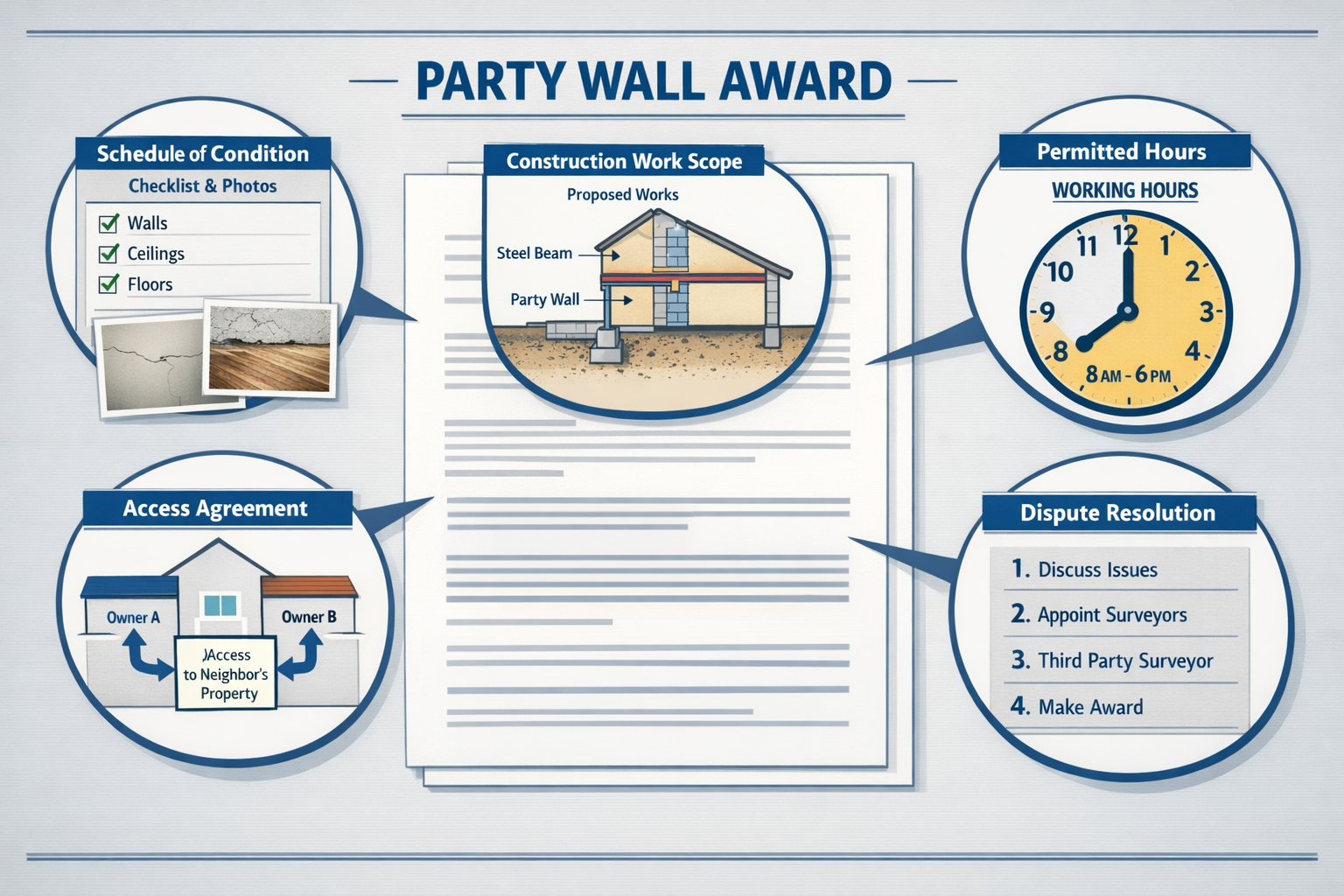
Every comprehensive party wall award must contain specific elements to be legally valid and practically useful. These components work together to create a complete framework for the proposed construction work.
1. Clear Statement of Work Scope 📝
The award must include a detailed description of the proposed works, specifying exactly what construction activities will take place[5]. This section leaves no room for ambiguity and typically includes:
- Specific structural alterations planned
- Materials to be used
- Construction methods and techniques
- Depth and extent of excavations (if applicable)
- Timeline for different phases of work
2. Schedule of Condition 📸
One of the most critical elements is the schedule of condition, which documents the current state of the neighbouring property before work begins[2][5]. This photographic and written record serves as baseline evidence to:
- Protect the adjoining owner from uncompensated damage
- Shield the building owner from false damage claims
- Provide objective evidence if disputes arise later
- Establish pre-existing conditions clearly
A thorough schedule of condition typically includes detailed photographs, written descriptions of existing cracks or defects, and measurements of any pre-existing issues.
3. Permitted Construction Hours ⏰
The award specifies when construction work can take place, balancing the building owner’s need to progress efficiently with the adjoining owner’s right to peaceful enjoyment of their property[5]. Standard permitted hours often include:
| Day Type | Typical Permitted Hours |
|---|---|
| Monday-Friday | 8:00 AM – 6:00 PM |
| Saturday | 8:00 AM – 1:00 PM |
| Sunday & Bank Holidays | No noisy works |
These hours may be adjusted based on local authority requirements or specific circumstances.
4. Access Arrangements 🚪
The award outlines how and when the building owner can access the adjoining owner’s property if necessary for the works[5]. This section typically covers:
- Notice period required before accessing neighbouring property
- Specific areas that may be accessed
- Duration of access required
- Compensation for any inconvenience or damage caused by access
5. Damage Procedures and Dispute Resolution 🔧
Clear procedures for handling damage are essential components[2][5]. The award should specify:
- How damage will be identified and assessed
- Timeframes for reporting and repairing damage
- Who bears responsibility for different types of damage
- Dispute resolution mechanisms if disagreements arise
For guidance on managing potential issues, review our resource on how to keep party wall costs down.
6. Construction Techniques to Minimize Risk 🏗️
The award may specify particular construction methods designed to minimize the risk of damage to the adjoining property[5]. This might include:
- Underpinning techniques for excavation work
- Vibration monitoring requirements
- Dust and noise control measures
- Structural support methods
The Party Wall Award Process: Timeline and Steps
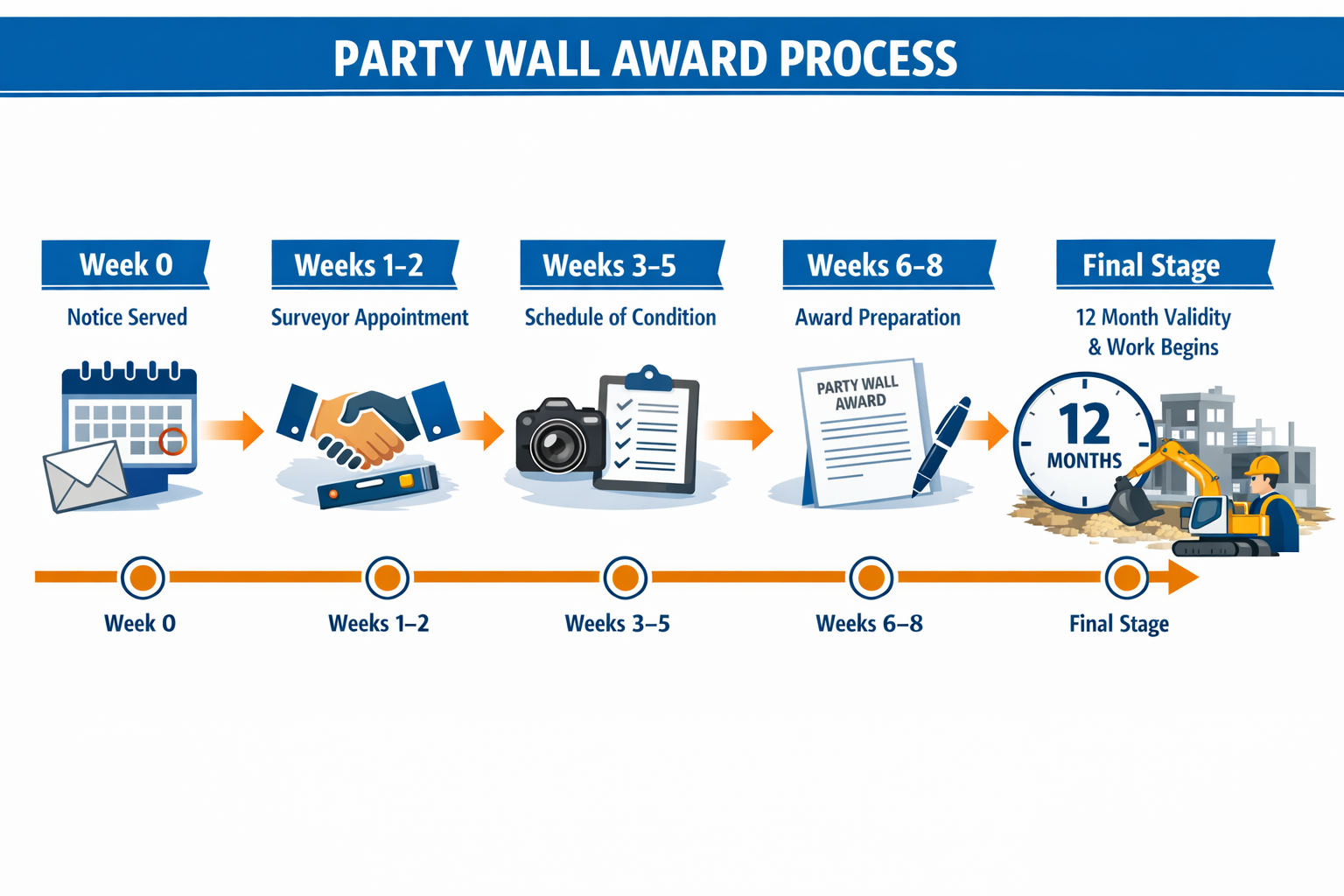
Understanding the timeline for obtaining a party wall award helps property owners plan their construction projects effectively. The process involves several distinct stages, each with its own timeframe.
Step 1: Serving Party Wall Notices (Day 0)
The process begins when the building owner serves appropriate party wall notices to affected neighbours. The type of notice depends on the proposed work:
- Party Structure Notice for work directly to a shared wall
- Line of Junction Notice for new walls at the boundary
- Notice of Adjacent Excavation for digging within specified distances
Step 2: Neighbour Response Period (Days 1-14)
Adjoining owners have 14 days to respond to the notice. They can:
- ✅ Consent to the works (no award needed unless both parties want one)
- ❌ Dissent to the works (triggers award process)
- 🔇 Fail to respond (deemed dissent, triggers award process)
Step 3: Surveyor Appointment (Weeks 2-3)
Once dissent occurs or is deemed to have occurred, surveyors must be appointed. There are two options:
Option A: Agreed Surveyor
- Both parties jointly appoint one surveyor
- Typically costs £1,000-£1,500[1]
- Faster process, taking 4-6 weeks[1]
- More cost-effective approach
Option B: Two Surveyors
- Each party appoints their own surveyor
- The two surveyors may appoint a third surveyor
- Higher costs but potentially more protective
- May take longer to complete
Step 4: Schedule of Condition (Weeks 3-5)
The appointed surveyor(s) conduct a detailed inspection of the adjoining property to create the schedule of condition[2][5]. This crucial step typically takes 1-2 weeks to complete thoroughly.
Step 5: Award Preparation (Weeks 6-8)
After completing the schedule of condition, the surveyor(s) draft the party wall award. This preparation typically takes 1-3 weeks[3], depending on the complexity of the proposed works and any negotiations between parties.
Step 6: Award Service (Week 8)
Once finalized, the award is served on both parties. From this point, the building owner has 12 months to commence the works, or the award becomes null and void[4].
Important Note: The entire process from notice issuance to award service typically takes 4-8 weeks on average, though complex cases can take considerably longer[3].
Costs Associated with Party Wall Awards
Understanding the financial implications of party wall awards is essential for budgeting construction projects effectively. The costs can vary significantly based on several factors.
Who Pays for the Party Wall Award? 💷
Under the Party Wall Act 1996, the building owner (the person undertaking the work) is responsible for paying all reasonable costs associated with the party wall process. This includes:
- Fees for the agreed surveyor or both appointed surveyors
- Third surveyor fees (if appointed)
- Costs of preparing the schedule of condition
- Reasonable legal or technical advice fees for the adjoining owner
For a detailed breakdown, consult our guide on costs of party wall procedures.
Typical Cost Ranges in 2026
| Award Type | Typical Cost Range | Timeline |
|---|---|---|
| Agreed Surveyor (simple works) | £1,000 – £1,500 | 4-6 weeks |
| Agreed Surveyor (complex works) | £1,500 – £3,000 | 6-8 weeks |
| Two Surveyors (simple works) | £2,000 – £4,000 | 6-10 weeks |
| Two Surveyors (complex works) | £3,000 – £6,000+ | 8-12 weeks |
These costs represent professional fees and do not include any compensation for damage or inconvenience.
Factors Affecting Party Wall Award Costs
Several variables influence the final cost of obtaining a party wall award:
- Complexity of proposed works – More intricate projects require more detailed awards
- Number of adjoining properties – Multiple neighbours mean multiple awards
- Property type and condition – Older or more delicate structures require more careful assessment
- Geographic location – Surveyor fees vary by region, with London typically commanding premium rates
- Cooperation level – Disputes and disagreements extend timelines and increase costs
Rights and Responsibilities Under a Party Wall Award
Once a party wall award is in place, it creates specific rights and obligations for both the building owner and the adjoining owner.
Building Owner Rights 🔨
Under a valid party wall award, building owners have the right to:
- Proceed with the specified works as described in the award
- Access the adjoining property as outlined in the access provisions
- Complete the works within the permitted timeframes
- Expect reasonable cooperation from the adjoining owner
Building Owner Responsibilities 📋
Building owners must:
- Adhere strictly to the terms outlined in the award
- Work only during permitted hours specified in the document
- Minimize disruption to the adjoining property
- Repair any damage caused by the works promptly
- Provide notice before accessing neighbouring property
- Cover all reasonable costs associated with the party wall process
For those carrying out works, our guide for building owners provides comprehensive information on navigating these responsibilities.
Adjoining Owner Rights 🏠
Adjoining owners are entitled to:
- A detailed schedule of condition protecting their property
- Compensation for any damage caused by the works
- Access to the party wall award document
- Appointment of their own surveyor (at the building owner’s expense)
- Enforcement of award terms if the building owner breaches them
Adjoining Owner Responsibilities ✅
Adjoining owners must:
- Allow reasonable access as specified in the award
- Not obstruct the building owner from carrying out permitted works
- Report damage promptly according to procedures in the award
- Act reasonably in all interactions regarding the works
Resources for adjoining owners can help neighbours understand their position throughout the process.
What Happens If You Don’t Get a Party Wall Award?
Proceeding with notifiable works without serving proper notices or obtaining a required party wall award can have serious consequences.
Legal Consequences ⚖️
Without a valid party wall award when one is required:
- Injunctions – Neighbours can obtain court orders stopping your work immediately
- Damages claims – You may be liable for any damage without the protection of an award
- Increased costs – Retroactive compliance is typically more expensive than following proper procedures
- Project delays – Work stoppages can extend timelines significantly
Practical Implications 🚧
Beyond legal issues, lacking a proper party wall award creates practical problems:
- Mortgage complications – Lenders may refuse to finance properties with party wall disputes
- Sale difficulties – Future buyers will discover non-compliance during conveyancing[4]
- Insurance issues – Coverage may be void for unauthorized works
- Neighbour relations – Damaged relationships can affect quality of life long-term
When buying a property with a party wall award already in place, understanding its terms and validity period is crucial[4].
Party Wall Awards vs. Party Wall Agreements
Many property owners confuse party wall awards with party wall agreements. While related, these are distinct documents with different purposes.
Key Differences
| Aspect | Party Wall Award | Party Wall Agreement |
|---|---|---|
| Creation | Prepared by appointed surveyor(s) | Negotiated directly between neighbours |
| Legal status | Formal legal document under Party Wall Act | Informal or formal agreement |
| When used | After dissent or deemed dissent | When neighbours consent to works |
| Cost | Higher (surveyor fees) | Lower (potentially no professional fees) |
| Protection | Comprehensive legal protection | Variable protection depending on terms |
Can You Have an Agreement Without a Surveyor?
Yes, neighbours who consent to proposed works can create their own agreement without involving surveyors. However, this approach has both advantages and risks. Our guide on having a party wall agreement without a surveyor explores this option in detail.
For those seeking templates, we offer a free downloadable party wall agreement template that can serve as a starting point.
Common Issues and Disputes Related to Party Wall Awards
Even with a properly prepared party wall award, disputes can arise during construction. Understanding common issues helps both parties address them effectively.
Frequent Dispute Triggers 🔥
- Work scope creep – Building owner undertakes work beyond what the award specifies
- Hour violations – Construction noise outside permitted times
- Access disputes – Disagreements about when and how access should occur
- Damage identification – Disputes over whether damage is new or pre-existing
- Delay compensation – Disagreements about compensation for extended disruption
Resolving Disputes Under the Award
Most party wall awards include dispute resolution mechanisms:
- Third surveyor determination – The appointed third surveyor can resolve disagreements between the two party-appointed surveyors
- Award amendment – Surveyors can issue supplemental awards to address unforeseen issues
- Mediation – Informal discussion facilitated by surveyors
- Court proceedings – As a last resort, parties can appeal to the County Court
Pro Tip: Most disputes can be resolved through open communication and reference to the award’s specific provisions before escalating to formal proceedings.
Regional Considerations: Party Wall Awards in London
London presents unique challenges for party wall procedures due to dense housing, complex property arrangements, and high property values. In 2026, London continues to see significant construction activity, making party wall awards particularly important.
London-Specific Factors
- Terraced housing prevalence – Most properties share walls with neighbours
- Higher surveyor fees – London-based professionals typically charge premium rates
- Complex ownership structures – Leasehold arrangements add layers of complexity
- Conservation areas – Additional planning considerations may affect works
Finding Local Expertise 📍
For London-based projects, working with local specialists who understand regional nuances is valuable:
- Party wall surveyors in North London
- Party wall surveyors in South London
- Party wall surveyors in East London
- Party wall surveyors in West London
- Party wall surveyors in Central London
The Future of Party Wall Awards: Trends in 2026
The party wall landscape continues to evolve as construction practices, technology, and legal interpretations develop. Several trends are shaping party wall awards in 2026.
Technological Integration 💻
Modern party wall processes increasingly incorporate:
- Digital schedules of condition with high-resolution photography and 3D scanning
- Online award platforms for faster document sharing and signing
- Vibration monitoring technology providing real-time data on construction impact
- Virtual inspections supplementing physical site visits
Increased Awareness and Compliance
Property owners in 2026 demonstrate greater awareness of party wall requirements than in previous years, driven by:
- Better information availability online
- Stricter enforcement by local authorities
- Mortgage lender requirements
- Professional advice from architects and builders
Industry experts predict continued evolution in party wall procedures, with predictions for party wall practices in 2026 suggesting increased standardization and efficiency[7].
Environmental Considerations 🌱
Modern party wall awards increasingly address environmental concerns:
- Sustainable construction methods
- Waste management during works
- Energy efficiency improvements
- Noise and air quality monitoring
Practical Tips for Navigating the Party Wall Award Process
Whether you’re a building owner planning works or an adjoining owner receiving a notice, these practical tips can help you navigate the party wall award process successfully.
For Building Owners 🔨
Before Starting:
- ✅ Identify all affected neighbours early in the planning process
- ✅ Serve notices with adequate lead time (at least 2 months before planned start)
- ✅ Budget for party wall costs in your overall project budget
- ✅ Choose experienced, qualified surveyors with good reputations
During the Process:
- ✅ Communicate openly with neighbours about your plans
- ✅ Respond promptly to surveyor requests for information
- ✅ Review the draft award carefully before it’s finalized
- ✅ Ensure your contractor understands the award’s requirements
During Construction:
- ✅ Adhere strictly to permitted hours
- ✅ Minimize disruption wherever possible
- ✅ Document your work with photographs
- ✅ Address any damage or concerns immediately
For Adjoining Owners 🏠
When You Receive a Notice:
- ✅ Read the notice carefully and seek clarification if needed
- ✅ Respond within the 14-day period (even if just acknowledging receipt)
- ✅ Consider appointing your own surveyor for complex or concerning works
- ✅ Don’t consent to works you don’t fully understand
During the Award Process:
- ✅ Participate in the schedule of condition inspection
- ✅ Point out any existing defects or concerns
- ✅ Review the award terms before it’s finalized
- ✅ Understand your rights and the building owner’s obligations
During Construction:
- ✅ Monitor the works for compliance with the award
- ✅ Document any issues with photographs and dates
- ✅ Report concerns promptly according to award procedures
- ✅ Maintain reasonable communication with your neighbour
Frequently Asked Questions About Party Wall Awards
How long does a party wall award remain valid?
A party wall award remains valid for 12 months from the date it is served[4]. If the building owner does not commence the specified works within this period, the award becomes void and a new notice and award process must begin.
Can I appeal a party wall award?
Yes, either party can appeal a party wall award to the County Court within 14 days of the award being served. However, appeals are only successful if there are clear procedural errors or the surveyor(s) acted unreasonably.
What if my neighbour refuses to allow access as specified in the award?
If an adjoining owner refuses reasonable access as outlined in the award, the building owner can seek enforcement through the courts. The award is a legally binding document, and obstruction can result in court orders compelling compliance.
Do I need a party wall award for internal works?
Generally, internal works that don’t affect the structural integrity of a party wall don’t require notices or awards. However, if your internal work involves cutting into, removing parts of, or adding load to a party wall, proper procedures must be followed.
Can a party wall award be amended after it’s issued?
Yes, surveyors can issue supplemental awards to address unforeseen circumstances or changes to the proposed works. However, significant changes may require a new notice and award process.
Conclusion: Protecting Your Interests with a Proper Party Wall Award
A party wall award is far more than bureaucratic paperwork—it’s a crucial legal instrument that protects both building owners and their neighbours throughout construction projects affecting shared structures. In 2026, with urban development continuing to intensify and property values remaining high, the importance of properly executed party wall procedures cannot be overstated.
The investment of time and money in obtaining a comprehensive party wall award pays dividends through:
- Legal protection for both parties
- Clear expectations about work scope and conduct
- Documented evidence of pre-existing conditions
- Dispute resolution mechanisms if issues arise
- Peace of mind throughout the construction process
Next Steps: Take Action Today 🚀
If you’re planning building work that may affect a party wall:
- Assess your project to determine if party wall procedures apply
- Identify all affected neighbours who will need to receive notices
- Engage a qualified party wall surveyor with relevant experience
- Serve appropriate notices at least 2 months before your planned start date
- Budget adequately for party wall costs in your overall project budget
- Communicate proactively with your neighbours throughout the process
If you’ve received a party wall notice from a neighbour:
- Read the notice carefully and understand what work is proposed
- Seek professional advice if you have concerns about the works
- Respond within 14 days to avoid deemed dissent
- Consider appointing your own surveyor for significant or complex works
- Participate fully in the schedule of condition process
- Know your rights under the Party Wall Act 1996
For comprehensive guidance tailored to your specific situation, explore our detailed resources on party wall awards and related topics. Whether you’re undertaking construction or responding to a neighbour’s plans, understanding the party wall award process empowers you to protect your property and maintain positive neighbour relations throughout the building process.
Don’t let party wall procedures become an afterthought—proper planning and compliance from the outset will save time, money, and stress in the long run. The party wall award is your roadmap to successful construction that respects both your ambitions and your neighbour’s rights.
References
[1] Party Wall Agreement Loft Conversion – https://www.houseup.co.uk/news/party-wall-agreement-loft-conversion
[2] Step By Step Guide To The Party Wall Act – https://toynbeeassociates.com/step-by-step-guide-to-the-party-wall-act/
[3] Party Wall Act Procedure Long Take – https://www.murrins.co.uk/party-wall-act-procedure-long-take/
[4] Buying Property Party Wall Award – https://osborneslaw.com/blog/buying-property-party-wall-award/
[5] Advantages Of A Party Wall Award – https://www.adamjoseph.co.uk/advantages-of-a-party-wall-award/
[6] Party Wall Agreement – https://hoa.org.uk/advice/guides-for-homeowners/i-am-improving/party-wall-agreement/
[7] Simple Surveys Party Wall Predictions For 2026 – https://www.simplesurvey.co.uk/article/simple-surveys-party-wall-predictions-for-2026/