

Three-fifths of construction firms are reporting postponed or canceled projects due to funding issues in 2026. This sobering statistic reflects a perfect storm of financial challenges: approximately $875 billion in commercial and multifamily mortgage debt is maturing this year, interest rates remain elevated, and construction costs continue to climb.[4] For property owners planning extensions, loft conversions, or basement excavations that trigger party wall obligations, understanding how Party Wall Awards and Project Financing: Navigating 2026's Funding Uncertainty intersect has never been more critical.
The relationship between party wall procedures and project financing is often overlooked until it's too late. When funding becomes scarce or prohibitively expensive, projects stall mid-process—sometimes after party wall notices have been served and awards issued. Strategic party wall surveyors are now incorporating financial contingencies and flexible award structures to protect both building and adjoining owners from the cascading consequences of funding failures.
Key Takeaways
- Funding uncertainty is widespread: With $875 billion in CRE debt maturing in 2026 and construction costs escalating 4-10%, project financing has become increasingly challenging[2][4]
- Party wall awards can protect against delays: Strategic award structures with phased work schedules and financial contingencies safeguard all parties when funding becomes unavailable
- Cost escalation demands flexibility: Material costs, particularly aluminum (up 340% due to tariffs), require party wall awards to include realistic cost provisions and revision mechanisms[2]
- Alternative financing changes timelines: Private credit and specialty lenders now fill gaps left by traditional banks, but with different terms that affect construction schedules
- Proactive communication is essential: Early engagement between surveyors, owners, and lenders prevents costly disputes when financial circumstances change mid-project
Understanding the 2026 Funding Landscape and Its Impact on Construction
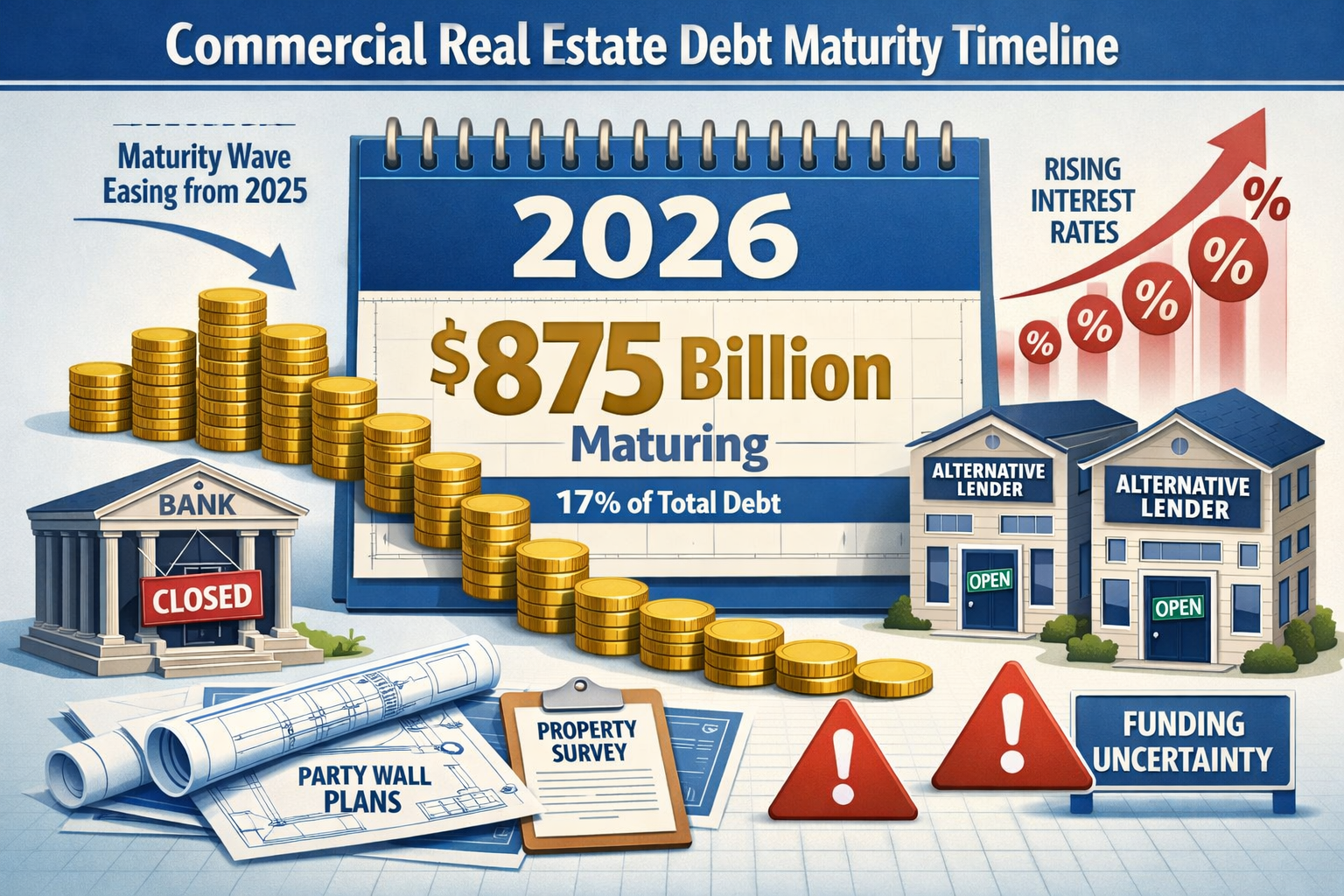
The construction financing environment in 2026 presents unprecedented challenges that directly affect party wall projects across London and the UK. The maturity of $875 billion in commercial and multifamily mortgage debt represents approximately 17% of the total $5 trillion outstanding, creating what industry experts call a "debt maturity wall."[4]
The Perfect Storm: Interest Rates, Lending Standards, and Cost Escalation
Property owners seeking to finance extensions, conversions, or major renovations face multiple headwinds simultaneously:
Higher Borrowing Costs 💰
Loans originated in the 2010s and early 2020s with favorable rates are now refinancing at significantly higher costs. The spread between old and new financing can add tens of thousands of pounds to project budgets, forcing owners to reconsider scope or delay work.
Constrained Underwriting Standards
Traditional lenders have tightened lending criteria, requiring higher equity contributions, stronger debt service coverage ratios, and more conservative property valuations. This means projects that would have easily secured funding three years ago now struggle to obtain financing.
Construction Cost Inflation
Early 2026 projections place project cost escalation at 4-6% under normal conditions, with tariff-driven scenarios potentially reaching 7-10%.[2] Aluminum tariffs alone have driven prices from roughly $500 per tonne in January 2025 to $2,200 per tonne, significantly impacting projects involving curtain walls, window frames, and structural elements.[2]
Material Supply Constraints
Limited material availability, combined with local sustainability mandates, creates additional cost pressure on mechanical and electrical systems—components frequently affected by party wall works involving service runs through shared structures.
How Funding Uncertainty Affects Party Wall Procedures
When project financing becomes uncertain or unavailable, the implications for party wall awards are significant:
| Funding Issue | Party Wall Impact | Risk to Owners |
|---|---|---|
| Delayed loan approval | Work cannot commence despite award being issued | Adjoining owner schedules disrupted; building owner incurs surveyor fees without progress |
| Reduced loan amount | Scope reduction may require revised notices and awards | Additional surveyor costs; potential disputes over changed work scope |
| Loan rejection | Project abandonment after notices served | Wasted professional fees; damaged neighbour relations |
| Mid-project funding withdrawal | Work stoppage with incomplete party wall works | Structural exposure; security concerns; potential damage claims |
Understanding these dynamics is essential for party wall surveyors crafting awards that protect all parties during Party Wall Awards and Project Financing: Navigating 2026's Funding Uncertainty.
Strategic Party Wall Award Structures for Financial Protection
Experienced party wall surveyors are adapting their approach to party wall awards to account for the heightened financial uncertainty of 2026. These strategic structures provide protection mechanisms that traditional awards often lack.
Incorporating Financial Contingencies into Awards
Phased Work Schedules with Funding Milestones 📋
Rather than authorizing all works simultaneously, sophisticated awards now break projects into distinct phases with defined funding checkpoints. For example:
- Phase 1: Foundation and below-ground works affecting party walls
- Phase 2: Structural alterations to party walls (contingent on Phase 1 completion and funding confirmation)
- Phase 3: Finishing works and reinstatement (contingent on Phase 2 completion)
This structure allows the building owner to demonstrate funding availability before each phase commences, protecting the adjoining owner from the disruption of abandoned partial works.
Conditional Commencement Clauses
Awards can include provisions requiring the building owner to provide evidence of secured financing before works commence. This might include:
- Mortgage offer letter or loan approval documentation
- Proof of funds for cash-financed projects
- Contractor payment guarantees or performance bonds
While the Party Wall etc. Act 1996 doesn't explicitly require financial proof, surveyors can incorporate such provisions by agreement to protect all parties' interests.
Extended Validity Periods with Review Mechanisms
Traditional party wall awards often assume work will commence within 12 months. In 2026's uncertain environment, awards might include:
- Extended validity periods (18-24 months) to accommodate financing delays
- Review mechanisms allowing cost updates if work doesn't commence within specified timeframes
- Provisions for revised schedules of condition if significant time passes before work begins
Cost Provision Strategies in an Inflationary Environment
The dramatic cost escalation seen in 2026—particularly the 340% increase in aluminum pricing[2]—requires party wall awards to address financial realities comprehensively.
Realistic Cost Estimates and Contingencies
Awards should reference current market conditions and include appropriate contingencies for:
- Material cost fluctuations (10-15% contingency for tariff-sensitive materials)
- Labor cost increases (5-8% annual escalation)
- Extended timeline scenarios (additional costs if work spans multiple years)
Cost Revision Mechanisms
For projects with uncertain timelines, awards can include formulae for updating costs based on:
- Published construction cost indices
- Documented material price changes
- Actual contractor quotations obtained closer to commencement
Detailed Specifications to Prevent Scope Creep
When funding is tight, building owners may be tempted to reduce quality or change specifications mid-project. Detailed awards prevent disputes by clearly defining:
- Material grades and standards
- Workmanship quality requirements
- Reinstatement and making-good obligations
This protects adjoining owners from receiving substandard work when budget pressures mount.
Alternative Dispute Resolution Provisions
Financial stress increases the likelihood of disputes. Modern party wall awards increasingly include:
- Mediation clauses requiring good-faith negotiation before formal dispute resolution
- Expert determination provisions for cost-related disagreements
- Communication protocols requiring regular updates on funding status and project progress
These provisions are particularly valuable when navigating Party Wall Awards and Project Financing: Navigating 2026's Funding Uncertainty, as they provide structured pathways for resolving funding-related conflicts without expensive litigation.
Practical Guidance for Property Owners and Surveyors

Successfully navigating the intersection of party wall procedures and project financing in 2026 requires proactive strategies from all parties involved.
For Building Owners: Securing Financing Before Serving Notices
Sequence Your Planning Strategically 🎯
Rather than serving party wall notices immediately after obtaining planning permission, consider this sequence:
- Obtain detailed cost estimates from contractors reflecting 2026 market conditions
- Secure financing approval (at minimum, agreement in principle)
- Engage party wall surveyor to understand likely award costs
- Serve party wall notices only when confident funding will be available
- Finalize financing during the notice period (typically 14 days for line of junction works, one month for other works)
This approach prevents the costly scenario of paying for party wall awards for projects that ultimately cannot proceed due to funding issues.
Build Comprehensive Budgets
Many building owners underestimate the total cost of party wall compliance. A realistic budget should include:
- Building owner's surveyor fees: £1,500-£5,000 depending on project complexity
- Adjoining owner's surveyor fees: Similar range, paid by building owner
- Third surveyor fees (if disputes arise): £2,000-£10,000+
- Schedule of condition costs: £500-£2,000 per property
- Contingency for making good damage: 10-15% of party wall work costs
Understanding the costs of party wall procedures upfront prevents financing shortfalls mid-project.
Explore Alternative Financing Options
With traditional lenders tightening standards, alternative lenders—including private credit and specialty finance providers—have shown continued interest in construction opportunities.[4] These options often feature:
- More flexible underwriting criteria
- Faster approval processes
- Higher interest rates but greater certainty
- Shorter loan terms requiring clear exit strategies
For party wall projects, the certainty of funding may justify the higher cost of alternative financing.
For Adjoining Owners: Protecting Your Interests
Engage Your Own Surveyor Early 👷
The adjoining owner's surveyor serves as your advocate throughout the process. Early engagement allows your surveyor to:
- Assess the building owner's project viability and funding likelihood
- Request appropriate financial protections in the award
- Ensure comprehensive schedules of condition document pre-work property condition
- Negotiate phased work schedules that minimize disruption if funding issues arise
Request Financial Assurances
Your surveyor can reasonably request evidence that the building owner has capacity to complete the works and make good any damage. While you cannot prevent works from proceeding, you can ensure the award includes:
- Detailed making-good provisions with cost estimates
- Security deposits or bonds for high-risk works
- Clear timelines with consequences for abandoned works
Understand Your Rights if Works Are Abandoned
If a building owner serves notices, awards are issued, but works never commence due to funding failure, you may have recourse for:
- Costs incurred preparing for works (moving furniture, arranging access, etc.)
- Surveyor fees if the building owner's actions were unreasonable
- Damage to your property if preliminary works began before abandonment
Documentation throughout the process is essential for protecting these rights.
For Party Wall Surveyors: Best Practices in 2026
Conduct Financial Viability Assessments 📊
While surveyors are not financial advisors, understanding basic project viability helps craft realistic awards. Consider:
- Whether the proposed works align with typical financing parameters
- Red flags suggesting funding uncertainty (vague timelines, changing scope, reluctance to commit to schedules)
- Market conditions affecting the specific property type and location
Draft Awards with Flexibility and Protection
Balance the building owner's right to proceed with the adjoining owner's need for protection:
- Include realistic timelines with provisions for reasonable extensions
- Specify clear communication requirements regarding funding status
- Build in review mechanisms if significant delays occur
- Address potential scope reductions due to budget constraints
Facilitate Communication Between Parties
In 2026's uncertain environment, transparent communication prevents disputes. Surveyors should:
- Encourage building owners to share realistic project timelines
- Help adjoining owners understand normal construction financing processes
- Mediate concerns about funding uncertainty before they escalate to formal disputes
- Provide regular updates to all parties on award progress and any identified risks
Stay Informed on Market Conditions
Understanding broader trends—like the $875 billion debt maturity wave[4], infrastructure investment patterns[2], and material cost escalation[2]—allows surveyors to provide informed guidance on realistic project timelines and costs.
Regional Considerations Across London
Funding availability and project viability vary significantly across London's diverse property markets:
Central London 🏙️
Party wall surveyors in Central London report that high-value properties often have better access to private financing, but projects face higher costs and more complex regulatory requirements.
South London
South London party wall projects frequently involve terraced properties where funding challenges affect multiple adjoining owners simultaneously, requiring coordinated approaches.
East London
East London developments often involve emerging areas where property valuations may not support traditional financing, making alternative lenders more common.
North and West London
North London and West London established residential areas typically see more straightforward financing but face significant cost pressures from sustainability requirements and conservation area restrictions.
Looking Ahead: Adapting to Continued Uncertainty
While the $875 billion debt maturity wave in 2026 represents a decline from 2025's approximately $957 billion[4], suggesting some easing of pressure, the refinancing environment remains challenging. Several trends will continue affecting Party Wall Awards and Project Financing: Navigating 2026's Funding Uncertainty:
Infrastructure and Technology Investment
Infrastructure investment is expected to strengthen through 2026, supported by Infrastructure Act funding, though consensus forecasts point to flat to low single-digit growth in total construction spending.[2] For party wall projects, this means:
- Increased activity in areas benefiting from infrastructure improvements
- Potential delays as skilled labor is drawn to larger infrastructure projects
- Material availability challenges as major projects consume supply
Data centers and large tech-related megaprojects continue as standout growth drivers, powered by ongoing demand for AI, cloud, and data infrastructure.[2] While these projects don't typically involve party wall issues, they affect the broader construction ecosystem through labor and material demand.
Regulatory and Sustainability Pressures
Local sustainability mandates are causing material cost escalation, especially for mechanical and electrical systems.[2] Party wall awards must increasingly address:
- Energy efficiency requirements affecting party wall insulation
- Sustainable material specifications
- Building regulation changes affecting party structure works
The Role of Professional Guidance
As financing complexity increases, the value of experienced professionals becomes more apparent. Property owners benefit from:
- Early consultation with party wall surveyors who understand financing realities
- Coordination between surveyors, architects, contractors, and lenders
- Proactive planning that sequences party wall procedures with financing milestones
For those carrying out works or responding to neighbour's works, understanding the financial context is now as important as understanding the legal requirements.
Conclusion

Party Wall Awards and Project Financing: Navigating 2026's Funding Uncertainty requires a fundamental shift in how property owners and surveyors approach party wall procedures. The convergence of maturing debt obligations, elevated interest rates, constrained lending, and significant cost escalation creates an environment where traditional approaches may leave parties exposed to financial risks.
Strategic party wall awards in 2026 must incorporate financial realities through phased work schedules, conditional commencement clauses, realistic cost provisions, and flexible timelines. Building owners must secure financing before serving notices, while adjoining owners should engage surveyors who can negotiate appropriate protections. Party wall surveyors themselves must evolve beyond purely technical roles to become strategic advisors who understand market conditions and craft awards that protect all parties when funding becomes uncertain.
Actionable Next Steps
✅ For Building Owners:
- Obtain detailed cost estimates reflecting 2026 market conditions before serving notices
- Secure financing approval (at minimum, agreement in principle) before engaging party wall procedures
- Budget comprehensively for all party wall costs, including surveyors, schedules of condition, and contingencies
- Consider alternative financing sources if traditional lenders prove restrictive
✅ For Adjoining Owners:
- Engage your own surveyor immediately upon receiving a party wall notice
- Request financial assurances and phased work schedules in the award
- Document all communications and property condition thoroughly
- Understand your rights if works are delayed or abandoned due to funding issues
✅ For Property Professionals:
- Stay informed on construction financing trends, material costs, and market conditions
- Draft awards with flexibility mechanisms and financial contingencies
- Facilitate transparent communication about funding status between parties
- Provide realistic guidance on project timelines given current market conditions
The intersection of party wall law and project financing will remain complex throughout 2026 and beyond. Those who adapt their approaches to this new reality—incorporating financial protections, maintaining flexibility, and prioritizing communication—will navigate these challenges successfully. Those who cling to traditional procedures designed for stable financing environments risk costly disputes, abandoned projects, and damaged relationships.
By understanding both the legal framework of party wall procedures and the financial realities of 2026's construction market, property owners and professionals can protect their interests while maintaining the collaborative spirit that successful party wall processes require.