

Over 60% of Victorian terraced properties in London still retain original chimney breasts, yet removal projects account for nearly 15% of all party wall disputes in 2026. The seemingly straightforward task of removing a disused chimney breast becomes exponentially complex when it shares structural integration with a party wall—a scenario that demands rigorous Party Wall Awards for Chimney Breast Removals: Structural Risks and Surveyor Protocols to prevent catastrophic failure and neighbour disputes.
Chimney breast removal ranks among the highest-risk party wall works due to the intimate structural relationship between the chimney masonry and the party wall itself. Unlike simple cosmetic alterations, cutting away brickwork that has been bonded and toothed into a shared wall for over a century creates vibration risks, load redistribution challenges, and potential collapse hazards that require specialist surveyor oversight and formal party wall awards.
This comprehensive guide provides property owners, contractors, and surveyors with the detailed protocols, structural assessments, and legal frameworks essential for safe chimney breast removal in 2026.
Key Takeaways
- Structural engineer assessments are mandatory before any chimney breast removal to calculate loads, design support systems, and prevent collapse of remaining chimney stacks
- Party Wall Notices under the 1996 Act must be served 2 months before work begins, with typical award processes taking 4-8 weeks depending on neighbour cooperation
- Victorian terrace chimney breasts present unique risks including fire-damaged brick degradation, inadequate historical support, and vibration vulnerability during removal
- Comprehensive condition schedules protect both parties by documenting pre-existing cracks, moisture levels, and structural defects before potentially damaging works commence
- Gallows brackets and steel RSJ beams are the primary support solutions for upper-floor chimney stacks when ground-floor breasts are removed
Understanding Structural Risks in Chimney Breast Removal
The Hidden Dangers of Victorian Chimney Construction
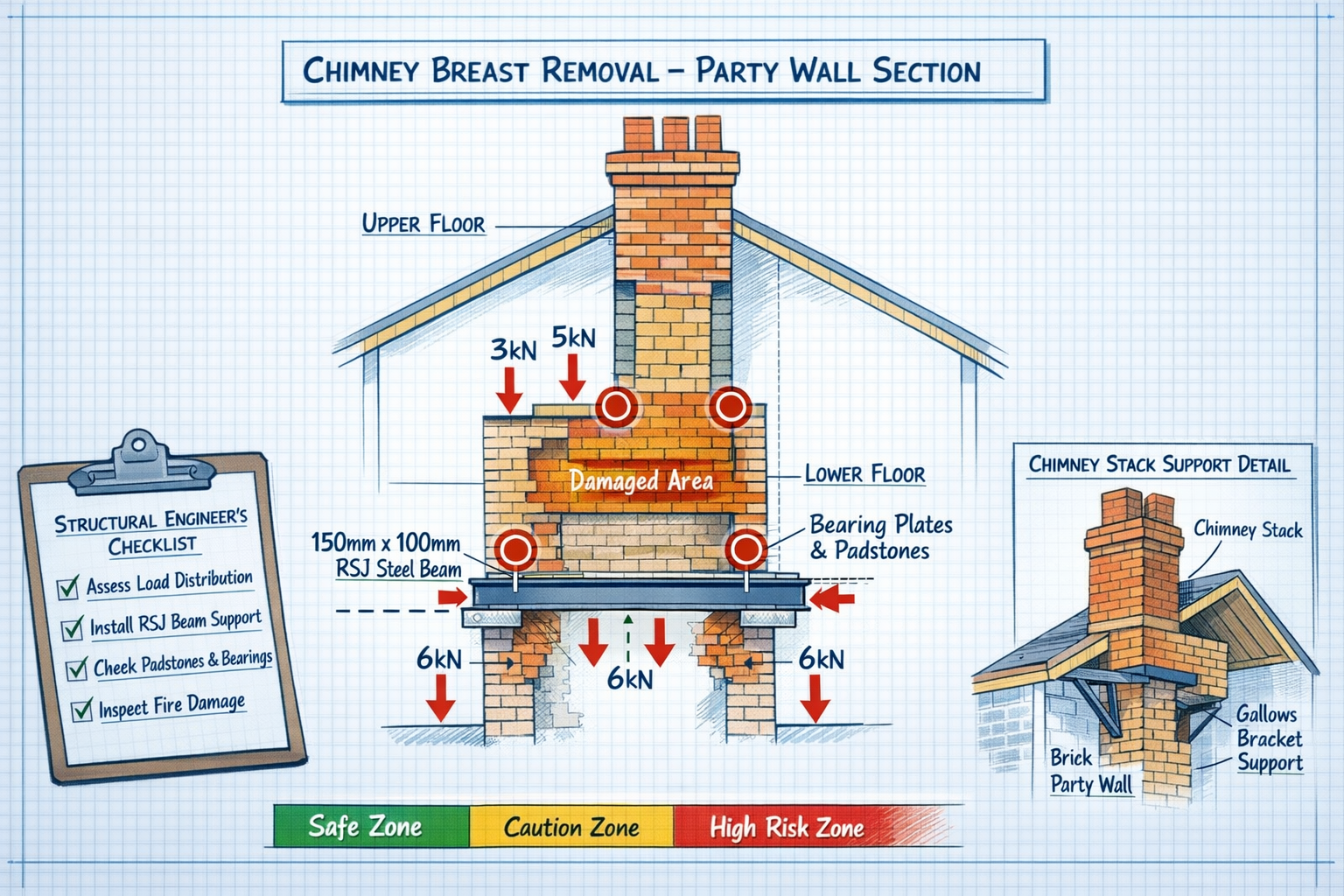
Chimney breasts in Victorian terraced properties were constructed as integral structural elements, not merely decorative features. The brickwork was toothed directly into the party wall, meaning alternate courses of brick physically interlock with the shared wall structure. This construction method creates a mechanical bond that distributes the chimney's weight across both the party wall and the building owner's structure.
When builders attempt removal without proper support, several critical risks emerge:
🔴 Collapse Hazards
Historical cases document unsupported chimney stacks collapsing through upper floors into rooms below, presenting genuine fatality risks[3]. The weight of a typical two-storey chimney stack can exceed 1,500 kg—a load that requires carefully engineered support when the lower breast is removed.
🧱 Material Degradation Issues
Chimney breast bricks exposed to decades of fire become dry, brittle, and structurally compromised. The party wall section behind the flue suffers similar degradation from heat exposure, undermining the structural integrity of the shared wall itself[3]. This fire damage isn't always visible during initial inspection but becomes apparent during removal when bricks crumble unexpectedly.
⚡ Vibration Vulnerability
Even chimney stacks that have remained stable for decades can be destabilized by vibrations from cutting, drilling, and demolition work. Major construction on adjacent properties can similarly loosen inadequately supported brickwork[3], creating delayed failure scenarios months or years after the initial removal.
Load Distribution and Support Requirements
A structural engineer must calculate the precise loads involved and design appropriate support structures. The two primary support methods are:
| Support Method | Application | Load Capacity | Typical Cost Range |
|---|---|---|---|
| Steel RSJ Beams | Ground floor removal with upper floors remaining | 2,000-5,000 kg | £800-£1,500 |
| Gallows Brackets | First floor removal with roof stack remaining | 1,000-2,500 kg | £400-£900 |
| Cantilever Support | Complex multi-floor scenarios | Variable | £1,200-£2,500 |
The structural engineer's report must include:
- ✅ Calculated dead loads and live loads for remaining chimney elements
- ✅ Specification of steel beam sizes (e.g., 152x89mm RSJ)
- ✅ Foundation impact assessment for new load paths
- ✅ Party wall penetration details for beam embedment
- ✅ Temporary works requirements during removal phases
This report is essential for both Building Control approval and serving proper Party Wall Notices[4].
Party Wall Awards for Chimney Breast Removals: Legal Requirements
When Party Wall Notices Are Required
The Party Wall etc. Act 1996 mandates serving notice before chimney breast removal because the work affects the structural integrity of shared walls. Specifically, chimney breast removal typically falls under Section 2 of the Act (works to existing party walls) when:
- The chimney breast is built into or bonded with the party wall
- Cutting operations will cause vibration affecting the party wall
- Support beams must be embedded into the party wall structure
- The removal alters load distribution on the party wall
Building owners must serve a Party Structure Notice at least 2 months before the intended start date for the works[6]. This notice must include:
- 📋 Detailed description of the proposed works
- 📐 Structural engineer's drawings and calculations
- 📅 Proposed start date and estimated duration
- 🏗️ Method statements for vibration control
For properties in densely populated areas, consulting a party wall surveyor in Central London or other relevant locations ensures proper notice service and compliance.
The Award Process Timeline
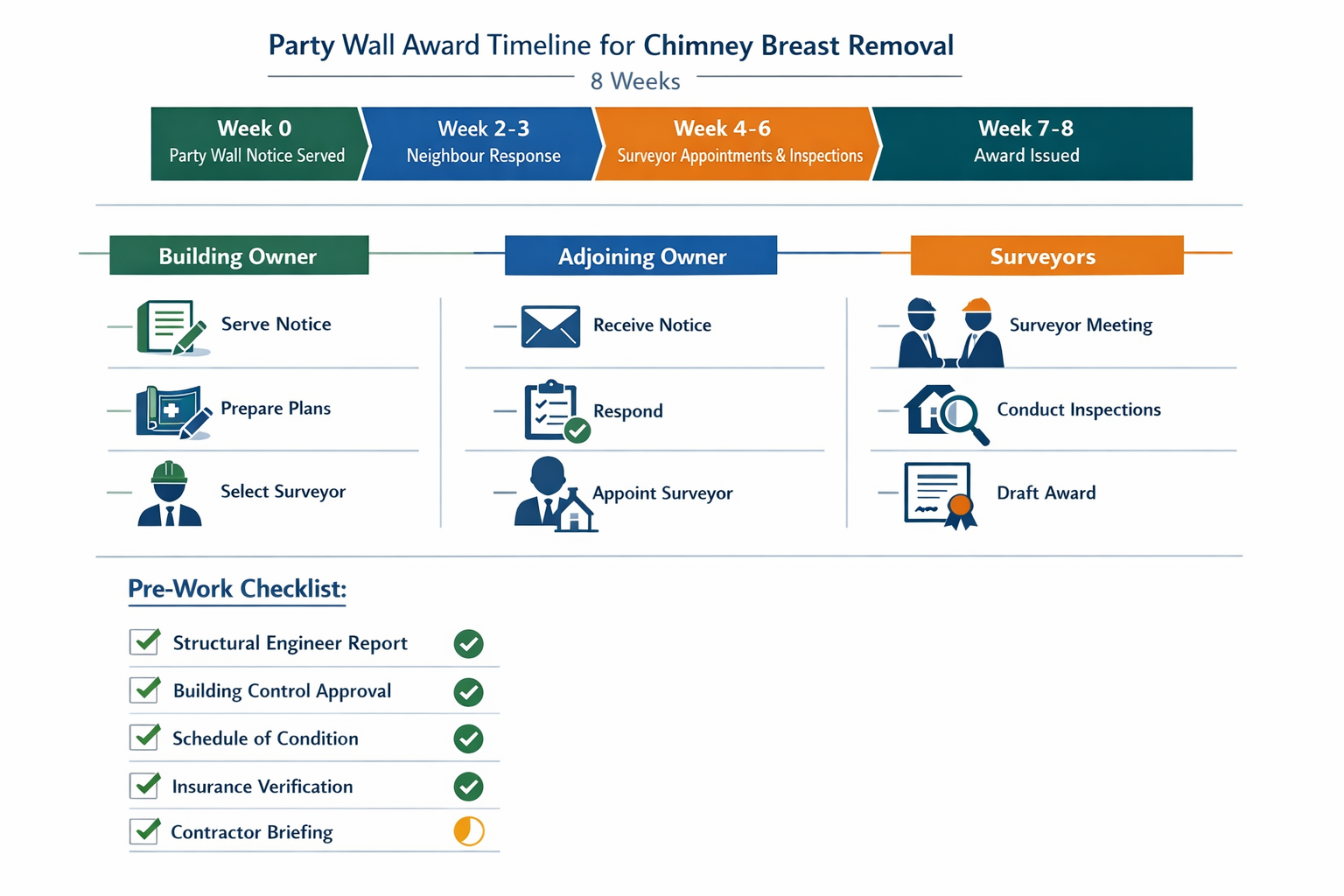
Party Wall Awards typically take between 4 and 8 weeks depending on neighbour response and whether surveyors are required[5]. The process follows this sequence:
Week 0-1: Notice Served
- Building owner serves Party Structure Notice
- Adjoining owner has 14 days to respond
Week 2-3: Neighbour Response
- Consent: Work can proceed with agreed conditions
- Dissent or no response: Party wall surveyors must be appointed
- Counter-notice: Adjoining owner may request additional protective works
Week 4-6: Surveyor Appointments
- Building owner appoints their surveyor
- Adjoining owner appoints their surveyor (or agrees to use the building owner's surveyor)
- Surveyors conduct inspections and prepare condition schedules
Week 7-8: Award Issued
- Surveyors agree on protective measures and working methods
- Formal Party Wall Award document is issued
- Both parties receive copies with right to appeal within 14 days
Understanding how to keep party wall costs down can help building owners budget appropriately for this process.
Surveyor Protocols for Safe Chimney Breast Removals
Pre-Work Condition Schedules: Essential Documentation
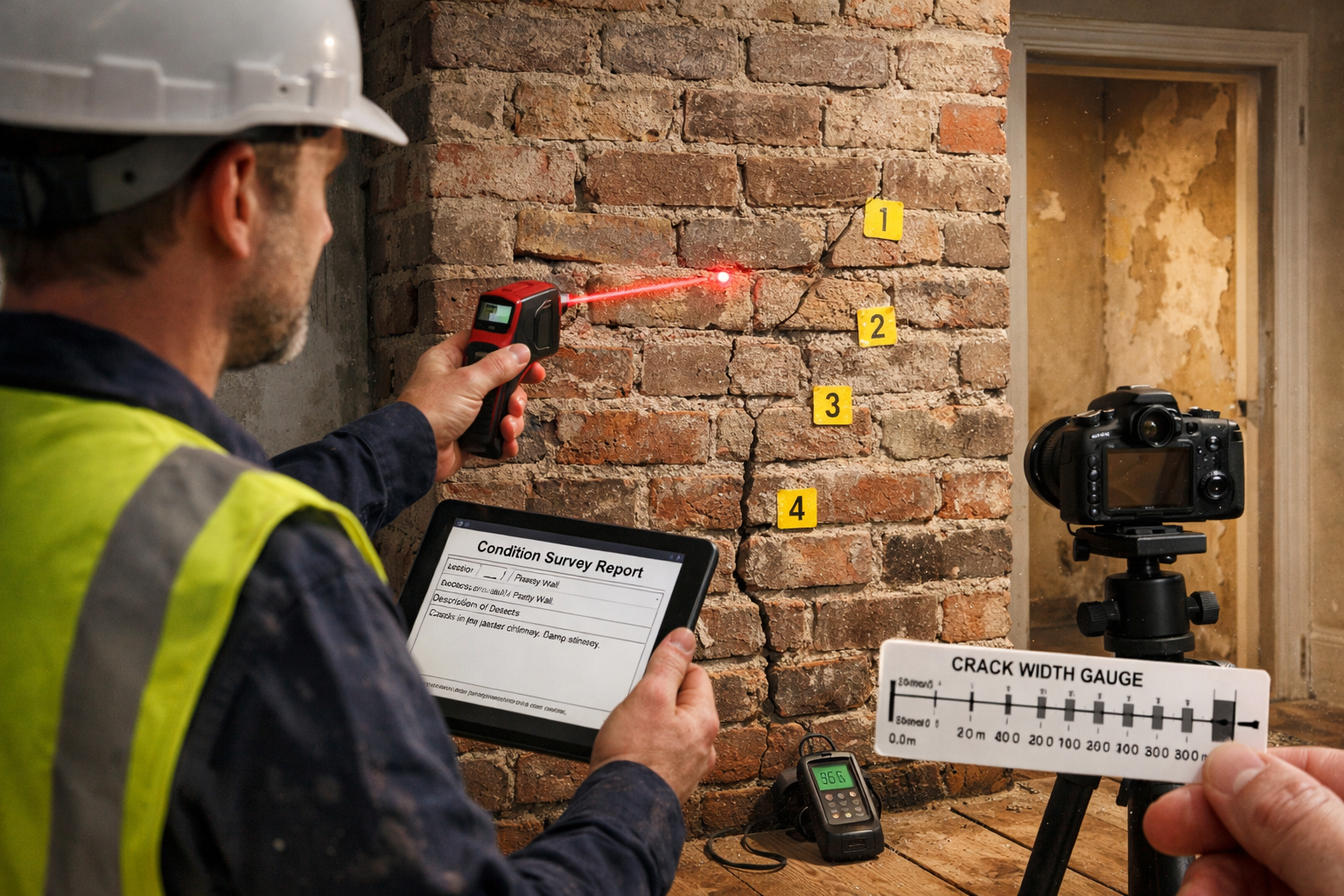
The condition schedule represents the most critical protective measure for both building and adjoining owners. This comprehensive photographic and written record documents the pre-existing state of both properties before potentially damaging works commence.
📸 Victorian Terrace-Specific Condition Schedule Checklist:
External Party Wall Assessment:
- ✅ Crack mapping with width measurements (use crack width gauge: <1mm, 1-5mm, >5mm)
- ✅ Mortar joint condition and repointing requirements
- ✅ Dampness readings at 5 heights using calibrated moisture meter
- ✅ Bulging or leaning measurements (use plumb line and laser level)
- ✅ Chimney stack condition including pots, flaunching, and brickwork
- ✅ Roof junction details where party wall meets roof structure
Internal Assessment (Both Properties):
- ✅ Ceiling and wall crack mapping in rooms adjacent to chimney breast
- ✅ Floor level measurements (Victorian properties often have settlement)
- ✅ Plaster condition and previous repair evidence
- ✅ Door and window operation (binding indicates structural movement)
- ✅ Skirting board gaps and separation from walls
- ✅ Decorative condition to establish liability for making good
Photographic Requirements:
- Minimum 50-80 photographs per property
- Include ruler or scale in crack photographs
- Date-stamped images with property address visible
- Wide-angle room shots plus detailed close-ups
- Video walkthrough as supplementary evidence
The condition schedule should be completed by an experienced surveyor from either East London, North London, or the relevant area, ideally within 2 weeks of the Party Wall Award being issued.
Structural Engineer Assessment Protocol
Before any surveyor can issue an award, a structural engineer must provide a comprehensive assessment specifically addressing:
Load Calculation Requirements:
-
Dead Load Assessment
- Weight of remaining chimney stack (typical: 150-200 kg per metre of height)
- Chimney pot weight (15-30 kg each)
- Flaunching and mortar (40-60 kg)
- Snow load on chimney cap (variable by exposure)
-
Support Beam Specification
- Steel grade (typically S275 or S355)
- Beam dimensions (e.g., 152x89mm Universal Beam)
- Bearing length into party wall (minimum 100mm each end)
- Lateral restraint requirements
- Connection details to existing structure
-
Foundation Impact Analysis
- New load paths created by beam installation
- Existing foundation capacity assessment
- Settlement risk evaluation
- Underpinning requirements (if necessary)
🔧 Victorian Terrace-Specific Considerations:
Victorian properties present unique structural challenges:
- Shallow foundations: Many Victorian terraces have foundations only 600-900mm deep, limiting their capacity to absorb redistributed loads
- Lime mortar construction: Original lime mortar is weaker than modern cement mortar, requiring gentler cutting techniques
- Hidden structural alterations: Previous undocumented works may have already compromised structural integrity
- Differential settlement: 100+ years of settlement creates stress patterns that chimney removal may exacerbate
The structural engineer's report must explicitly address these Victorian-specific factors and provide mitigation strategies.
Working Method Statements for Award Conditions
The Party Wall Award must specify detailed working methods to minimize damage risk. For chimney breast removal, essential conditions include:
Vibration Control Measures:
- ⚙️ Hand cutting of brickwork within 300mm of party wall (no power tools)
- ⚙️ Vibration monitoring equipment installed on adjoining owner's side
- ⚙️ Maximum vibration limits (typically 10mm/s peak particle velocity)
- ⚙️ Immediate work cessation if limits exceeded
Support Installation Sequence:
- 🔨 Install temporary props before any removal begins
- 🔨 Cut pockets for beam ends (one side at a time)
- 🔨 Insert and level steel beam with appropriate packing
- 🔨 Allow mortar to cure before removing temporary support
- 🔨 Only then proceed with breast removal below beam
Dust and Debris Control:
- 🧹 Plastic sheeting barriers to prevent soot contamination
- 🧹 HEPA vacuum systems for dust suppression
- 🧹 Daily cleaning protocols for adjoining owner's property
- 🧹 Professional cleaning provision if contamination occurs
Access and Hours:
- 🕐 Working hours restricted (typically 8am-6pm Monday-Friday)
- 🕐 Notice period for each phase of works (minimum 48 hours)
- 🕐 Access arrangements for surveyor inspections
- 🕐 Emergency contact procedures for out-of-hours issues
These conditions must be incorporated into the formal award document and become legally binding on all parties.
Step-by-Step Surveyor Checklist for 2026 Chimney Breast Removals
Phase 1: Initial Assessment and Notice (Weeks 1-2)
Building Owner's Surveyor Tasks:
- Verify structural engineer's report is comprehensive and addresses all party wall implications
- Confirm Building Control application has been submitted
- Review contractor's qualifications and insurance (minimum £5 million public liability)
- Draft Party Structure Notice with all required technical details
- Serve notice on adjoining owners via recorded delivery
- Provide explanatory letter clarifying the works in plain English
- Log service dates and maintain evidence of proper notice
Risk Assessment Checklist:
- Identify all properties affected (including diagonal neighbours if chimney is at junction)
- Assess age and construction type of affected properties
- Review planning history for previous structural alterations
- Check for existing structural defects that works might exacerbate
- Evaluate access requirements for condition survey
- Identify vulnerable occupants (elderly, disabled) requiring special consideration
Phase 2: Surveyor Appointment and Condition Survey (Weeks 3-5)
Adjoining Owner's Surveyor Tasks:
- Conduct thorough site inspection of both properties
- Complete comprehensive condition schedule (50+ photographs minimum)
- Take moisture readings at multiple heights on party wall
- Measure and record all existing cracks (width, length, orientation)
- Test structural movement indicators (door operation, floor levels)
- Interview occupants about previous issues or concerns
- Provide copy of condition schedule to building owner's surveyor within 7 days
Joint Surveyor Inspection:
- Meet on-site to discuss working methods and protective measures
- Agree on critical monitoring points for ongoing inspections
- Establish vibration monitoring locations and threshold limits
- Discuss contractor access arrangements and working hours
- Identify any special requirements (e.g., vulnerable occupants, business disruption)
- Agree inspection schedule during works (typically weekly for high-risk works)
Phase 3: Award Preparation (Weeks 6-7)
Collaborative Award Drafting:
The surveyors must jointly prepare an award document incorporating:
-
Scope of Works Section
- Detailed description of chimney breast removal extent
- Reference to structural engineer's drawings (append as schedules)
- Specification of support beam installation method
- Temporary works requirements
-
Protective Measures Section
- Vibration limits and monitoring protocols
- Dust suppression and contamination prevention
- Hours of working and notification requirements
- Access arrangements for inspections
-
Condition Schedule Section
- Append photographic condition schedule
- Reference baseline crack widths and moisture readings
- Establish liability thresholds for damage attribution
-
Making Good Section
- Specification for repairing any damage caused
- Timeline for completion of making good works
- Standard of finish required (match existing or better)
-
Costs and Fees Section
- Allocation of surveyor fees (building owner pays both surveyors)
- Responsibility for structural engineer costs
- Dispute resolution procedure costs
-
Special Conditions
- Insurance requirements and evidence provision
- Contractor competency requirements
- Emergency contact procedures
- Dispute escalation process
The award must be served on both building and adjoining owners with a 14-day appeal period before works can commence.
Phase 4: Works Monitoring (Weeks 8-12)
Active Supervision Protocol:
- Pre-commencement meeting: Surveyor meets contractor to review award conditions
- Weekly inspections: Document progress and check compliance with working methods
- Vibration monitoring: Review daily vibration logs and investigate any exceedances
- Photographic updates: Document each phase of work for comparison with condition schedule
- Adjoining owner liaison: Maintain regular communication about progress and any concerns
- Immediate response: Attend site within 4 hours if damage or dispute arises
- Variation management: Issue supplementary awards if unforeseen issues require method changes
Critical Inspection Points:
- Before removal begins: Verify temporary support is adequate
- After beam pocket cutting: Check party wall integrity around new openings
- During beam installation: Confirm correct sizing, positioning, and bearing
- After breast removal: Inspect party wall for new cracks or movement
- After making good: Verify repairs match specification in award
Phase 5: Completion and Final Inspection (Week 13+)
Post-Works Assessment:
- Conduct final joint inspection comparing current condition to baseline schedule
- Measure all previously recorded cracks to identify any widening
- Take new moisture readings to detect any water ingress from works
- Photograph all areas for comparison with pre-works images
- Test door and window operation to identify structural movement
- Document any damage attributable to the works
Making Good Supervision:
- Issue schedule of required repairs to building owner
- Agree timeline for completion (typically 30-60 days)
- Inspect completed making good works
- Obtain adjoining owner's acceptance of repairs
- Issue completion certificate releasing building owner from further liability
Final Documentation:
- Provide both parties with final photographic record
- Issue formal completion letter
- Archive all documentation for 15-year limitation period
- Update Building Control with confirmation of party wall compliance
Common Pitfalls and How to Avoid Them
Inadequate Structural Support Specifications
The Problem: Generic structural engineer reports that don't specifically address party wall implications or Victorian construction characteristics lead to inadequate support designs.
The Solution: Ensure the structural engineer explicitly addresses:
- Load transfer through party wall
- Bearing capacity of Victorian brickwork
- Differential settlement risks
- Connection details for beam embedment into party wall
Insufficient Condition Documentation
The Problem: Rushed or superficial condition schedules fail to capture pre-existing defects, leading to disputes about damage causation.
The Solution: Allocate minimum 2-3 hours per property for thorough condition survey. Use standardized checklists and take excessive photographs—it's impossible to have too much baseline documentation.
Poor Vibration Management
The Problem: Contractors using power tools too close to party walls cause cracking and structural damage that could have been prevented.
The Solution: Award must specify hand-cutting zones and include vibration monitoring with automatic alerts. Consider requiring trial cuts with monitoring before full-scale removal.
Delayed Surveyor Appointments
The Problem: Adjoining owners delay appointing surveyors, pushing back the entire timeline and creating pressure to rush the award process.
The Solution: Building owner's surveyor should proactively contact adjoining owners immediately after notice service, explaining the process and offering to recommend qualified surveyors. Understanding the types of party wall works helps set proper expectations.
Cost Implications and Budget Planning
Typical Cost Breakdown for Party Wall Chimney Breast Removal
| Cost Component | Typical Range | Notes |
|---|---|---|
| Structural Engineer Report | £400-£800 | Essential for Building Control and Party Wall Notice |
| Party Wall Surveyor Fees (Building Owner) | £600-£1,200 | Depends on complexity and number of inspections |
| Party Wall Surveyor Fees (Adjoining Owner) | £600-£1,200 | Building owner pays both surveyors |
| Contractor Removal Works | £1,500-£3,500 | Varies with number of floors and support requirements |
| Steel Beam Supply & Installation | £800-£1,800 | Depends on size and access difficulties |
| Making Good & Decoration | £500-£1,500 | Plastering, decoration to match existing |
| Building Control Fees | £300-£500 | Local authority charges |
| Total Project Cost | £4,700-£10,500 | Victorian terrace, two-storey removal |
Building owners should budget for the upper end of these ranges when dealing with Victorian terraces, as unforeseen complications frequently arise with older properties.
Who Pays What?
Under the Party Wall Act:
- 🏦 Building owner pays: Both surveyors' fees, structural engineer, all works costs, making good of damage caused
- 🏦 Adjoining owner pays: Nothing (unless they request additional protective works beyond reasonable requirements)
- 🏦 Shared costs: None typically, unless adjoining owner is taking advantage of works to upgrade their property simultaneously
For detailed cost guidance, review our comprehensive resource on costs of party wall processes.
Insurance and Liability Considerations
Essential Insurance Requirements
The Party Wall Award should mandate:
Contractor Insurance:
- ✅ Public liability insurance: Minimum £5 million
- ✅ Employer's liability insurance: Minimum £10 million
- ✅ Professional indemnity: £2 million (if contractor provides design input)
- ✅ Policy must specifically cover party wall works
Building Owner Insurance:
- ✅ Notify buildings insurer before works commence
- ✅ Confirm policy covers structural alterations
- ✅ Verify no exclusions for party wall disputes
- ✅ Consider additional project-specific insurance for high-value properties
Surveyor Insurance:
- ✅ Professional indemnity: Minimum £1 million per claim
- ✅ Current policy with no relevant exclusions
- ✅ Evidence provided to both parties before appointment
Liability for Damage
The building owner bears strict liability for damage caused by their works, regardless of contractor negligence. This means:
- Even if the contractor causes damage through poor workmanship, the building owner remains liable to the adjoining owner
- The building owner must repair damage promptly and to the required standard
- The building owner's only recourse is to pursue their contractor separately for compensation
This strict liability principle makes comprehensive condition schedules and careful contractor selection absolutely critical.
Conclusion: Ensuring Safe and Compliant Chimney Breast Removals
Party Wall Awards for Chimney Breast Removals: Structural Risks and Surveyor Protocols represent a complex intersection of structural engineering, legal compliance, and neighbour relations. The high-risk nature of cutting away Victorian brickwork bonded into party walls demands rigorous professional oversight that goes far beyond simple notification.
Key Success Factors
✅ Early structural engineer involvement to properly calculate loads and design appropriate support systems before serving party wall notices
✅ Comprehensive condition schedules that document every crack, moisture reading, and structural defect to protect both parties from unfounded damage claims
✅ Detailed Party Wall Awards specifying vibration limits, working methods, and protective measures tailored to Victorian construction vulnerabilities
✅ Active surveyor supervision throughout the works with regular inspections and immediate response to any concerns
✅ Proper budget allocation recognizing that party wall compliance costs represent 20-30% of total project costs but prevent disputes costing far more
Actionable Next Steps
For Building Owners Planning Chimney Breast Removal:
- Commission a structural engineer's report addressing party wall implications before serving notice
- Engage a qualified party wall surveyor early to review the structural report and draft comprehensive notices
- Budget £4,700-£10,500 for a compliant two-storey removal in a Victorian terrace
- Allow 8-12 weeks for the party wall process before works can commence
- Verify contractor insurance and experience with party wall works
For Adjoining Owners Who Have Received Notice:
- Respond within 14 days to avoid deemed dissent and automatic surveyor appointment
- Appoint an experienced surveyor (not the building owner's surveyor) to protect your interests
- Ensure a comprehensive condition schedule is completed before works begin
- Understand you pay nothing for reasonable protective measures
- Maintain communication with your surveyor throughout the works
For Surveyors Managing Chimney Breast Removals:
- Use the Victorian terrace-specific checklists provided in this guide
- Insist on structural engineer reports that explicitly address party wall load transfer
- Specify hand-cutting zones and vibration monitoring in every award
- Conduct weekly inspections during high-risk cutting and beam installation phases
- Document excessively and maintain detailed photographic records
The combination of structural vulnerability in Victorian construction, strict legal requirements under the Party Wall Act, and significant financial implications makes professional surveyor involvement non-negotiable for chimney breast removals. By following the protocols outlined in this guide, building owners can achieve their renovation goals while protecting their neighbours' properties and avoiding costly disputes.
For location-specific guidance and experienced surveyors familiar with Victorian terraces, consult specialists in South London or West London depending on your property location.
References
[1] Removing A Chimney Breast On A Party Wall Costs Process Legal Requirements – https://thepartywallguru.com/removing-a-chimney-breast-on-a-party-wall-costs-process-legal-requirements/
[2] Taking Out A Chimney Breast – https://stokemont.com/advice/taking-out-a-chimney-breast/
[3] Chimney Breast Removal – https://www.structuralengineersreports.org/chimney-breast-removal/
[4] Chimney%20breast%20removal – https://www.designingbuildings.co.uk/wiki/Chimney%20breast%20removal
[5] Party Wall Agreement For Wall Removal Chimney Breast Removal In Stockport Warrington 2026 Complete Guide – https://guardianstructuralltd.co.uk/party-wall-agreement-for-wall-removal-chimney-breast-removal-in-stockport-warrington-2026-complete-guide/
[6] Party Wall Agreement – https://hoa.org.uk/advice/guides-for-homeowners/i-am-improving/party-wall-agreement/
[7] Chimney Removal Cost Guide What Homeowners Should Know – https://www.fmb.org.uk/resource/chimney-removal-cost-guide-what-homeowners-should-know.html