
Over 70% of party wall disputes in 2026 stem from inadequate documentation before cutting work begins—a preventable failure that costs property owners thousands in legal fees and damage claims. When homeowners undertake structural alterations like chimney breast removals or beam insertions that involve cutting into shared walls, the margin for error shrinks dramatically. Understanding Party Wall Awards for Cutting into Shared Walls: 2026 Surveyor Checklists and Risk Mitigation protocols has become essential for anyone planning Section 2 works under the Party Wall etc. Act 1996.
This comprehensive guide walks through the step-by-step protocols surveyors follow when preparing awards for cutting work, with particular emphasis on schedules of condition that prevent costly damage claims. Whether you're a building owner planning renovations or an adjoining owner receiving notice of works, these 2026-updated checklists provide the framework for protecting your interests.
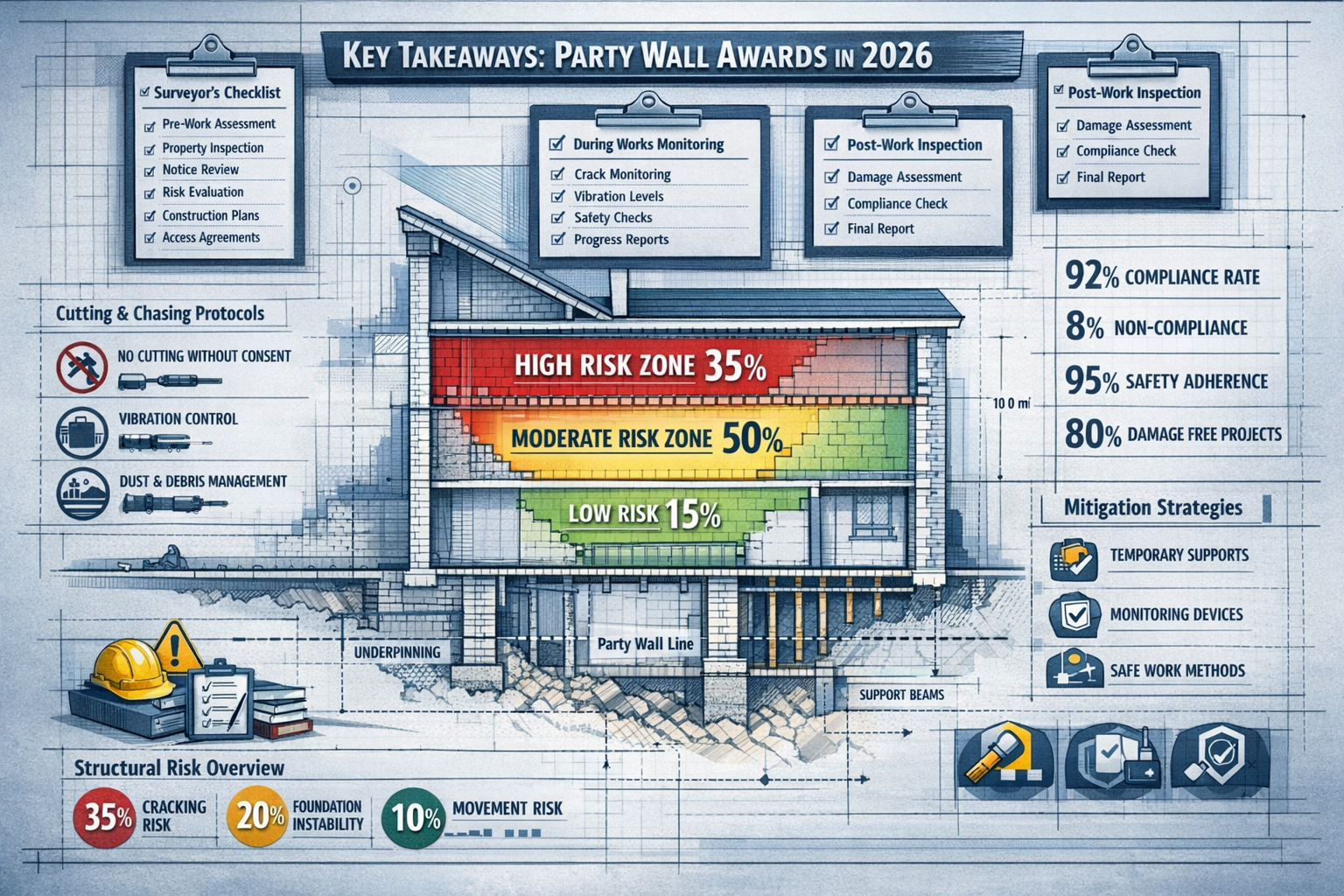
Key Takeaways
- Party wall awards are legally binding documents that establish the right to cut into shared walls and set protective conditions for neighboring properties[1]
- Schedules of condition with detailed photographs form the baseline evidence that prevents false damage claims after cutting work completes[3]
- Section 2 works like chimney removals require specific surveyor protocols including structural calculations, temporary support specifications, and making-good provisions
- 2026 regulatory updates emphasize enhanced digital documentation standards and risk-weighted assessment matrices for high-impact cutting operations
- Proper risk mitigation through comprehensive pre-work surveys can reduce dispute rates by over 80% and protect both building and adjoining owners
Understanding Party Wall Awards for Cutting Work
A party wall award serves as the legal foundation for any work involving cutting into shared walls between properties. This binding document determines not only the right to execute works but also establishes the precise terms under which a building owner can proceed with structural alterations[1]. For cutting operations specifically—whether removing chimney breasts, inserting steel beams, or creating new openings—the award must address unique structural and safety considerations.
What Constitutes Cutting Work Under Section 2
The Party Wall etc. Act 1996 categorizes cutting into shared walls under Section 2 works, which covers a range of structural interventions:
- Cutting into party walls to insert damp-proof courses or new structural members
- Removing chimney breasts that form part of the party wall structure
- Creating openings for doorways or service penetrations
- Underpinning or thickening party walls requiring cutting operations
- Demolishing and rebuilding sections of party walls
Each of these operations carries distinct risks that surveyors must evaluate and address through the award's protective conditions. Understanding what types of party wall works require formal notices helps building owners avoid costly procedural errors.
The Legal Framework in 2026
The Party Wall etc. Act 1996 remains the governing legislation, but 2026 has brought enhanced interpretation guidelines from professional bodies. The Royal Institution of Chartered Surveyors (RICS) now recommends digital documentation standards and structured risk assessment matrices for all cutting operations[4]. These updates reflect the increasing complexity of urban renovations and the need for more robust evidence trails.
Key components that every party wall award must contain include[1]:
✅ Description of works – Detailed specifications of cutting operations, depths, and structural implications
✅ Time and manner – Working hours, access requirements, and construction methodology
✅ Protective measures – Temporary support systems, vibration monitoring, and dust control
✅ Making good provisions – Repair standards and finishes for any damage caused
✅ Schedule of condition – Comprehensive photographic and written record of pre-work property state
The average cost for preparing a party wall award in 2026 hovers around £1,000, with surveyor rates typically ranging from £150-£200 per hour depending on the work's complexity[2]. For extensive cutting operations involving multiple floors or complex structural calculations, costs can increase substantially.
2026 Surveyor Checklists for Cutting into Shared Walls
Professional surveyors follow systematic protocols when preparing awards for cutting work. These checklists have evolved significantly in 2026 to incorporate enhanced risk assessment methodologies and digital documentation standards. The following sections detail the step-by-step approach that qualified surveyors employ when dealing with Party Wall Awards for Cutting into Shared Walls: 2026 Surveyor Checklists and Risk Mitigation.
Pre-Work Assessment Checklist
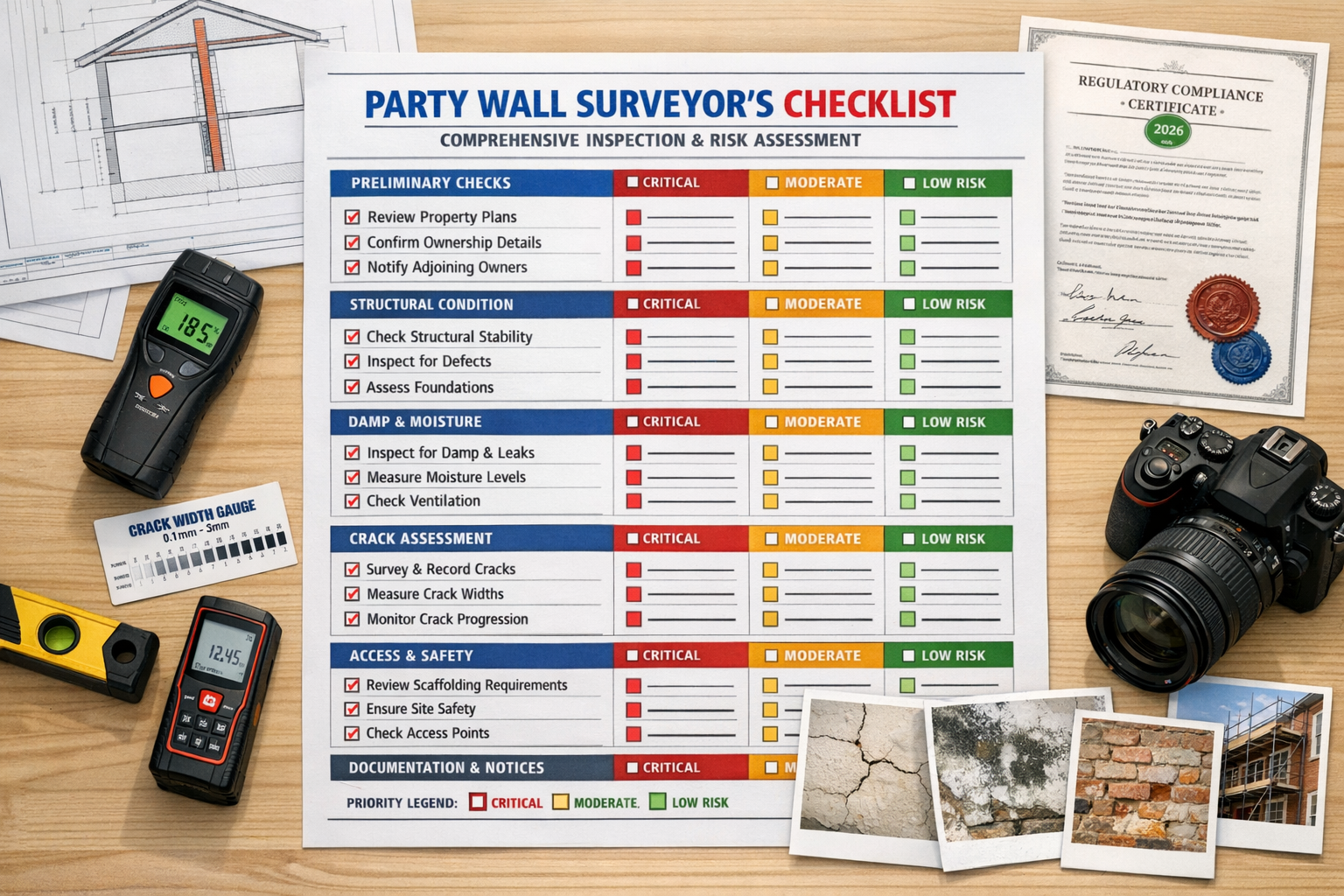
Before any cutting work receives approval through an award, surveyors must complete a thorough pre-work assessment. This initial phase establishes the baseline conditions and identifies potential risk factors.
Initial Documentation Review
| Checklist Item | Purpose | 2026 Standard |
|---|---|---|
| Review party wall notice | Verify correct notice type served | Digital timestamp verification |
| Examine structural drawings | Assess proposed cutting methodology | BIM-compatible format preferred |
| Check building control approvals | Confirm regulatory compliance | Cross-reference with local authority |
| Review insurance certificates | Verify adequate coverage | Minimum £5M public liability |
| Identify all affected parties | Ensure complete notification | Digital property boundary mapping |
Site Inspection Protocol
The physical site inspection represents the most critical phase of pre-work assessment. Surveyors must:
- Access both properties – Inspect from building owner's side and adjoining owner's side
- Document existing conditions – Photograph all surfaces, finishes, and structural elements
- Identify existing defects – Note pre-existing cracks, settlement, or damage
- Assess structural capacity – Evaluate wall thickness, material condition, and load-bearing capacity
- Test for hidden services – Use detection equipment to locate pipes, cables, and ducts
- Measure and record – Create detailed dimensional records of wall positions and room layouts
Professional surveyors typically spend 2-4 hours conducting thorough site inspections for standard cutting operations. Complex projects involving multiple party walls or historic buildings may require full-day assessments.
Schedule of Condition Requirements
The schedule of condition forms the cornerstone of dispute prevention for cutting work. This detailed record provides irrefutable evidence of the property's state before work commences, protecting both building and adjoining owners from unfounded damage claims[3].
Photographic Documentation Standards
2026 best practices require:
- High-resolution digital photographs (minimum 12MP) with embedded metadata showing date, time, and location
- Systematic coverage of all rooms adjoining the party wall, including ceilings, walls, floors, and decorative elements
- Close-up shots of any existing defects, cracks, or damage with measurement scales
- 360-degree panoramic images for each room to provide spatial context
- External elevations showing the relationship between properties
📸 Pro Tip: Professional surveyors take an average of 150-200 photographs for a standard terraced house schedule of condition. This comprehensive coverage eliminates ambiguity about pre-existing conditions.
Written Description Components
Photographs alone don't suffice—detailed written descriptions must accompany visual records:
- Room-by-room narratives describing finishes, condition, and notable features
- Crack mapping with width measurements (typically using crack width gauges accurate to 0.1mm)
- Moisture readings taken with calibrated meters at multiple points along party walls
- Structural observations noting any signs of movement, settlement, or previous repairs
- External conditions including boundary walls, garden structures, and drainage systems
The schedule of condition becomes an appendix to the party wall award, forming part of the legally binding documentation. Should disputes arise post-completion, this schedule provides the reference point for assessing whether damage occurred during the works.
Structural Assessment Checklist
Cutting into party walls demands rigorous structural evaluation. Surveyors must verify that proposed works won't compromise building stability or create dangerous conditions.
Load-Bearing Analysis
For chimney breast removals—one of the most common cutting operations—surveyors must:
- Calculate residual loads from upper floor chimney breasts if only ground floor removal planned
- Specify temporary support requirements during cutting operations
- Design permanent support systems (typically steel beams with adequate bearing)
- Verify foundation capacity to accept redistributed loads
- Consider lateral stability impacts on the party wall structure
🏗️ Critical Point: Removing a chimney breast that forms part of a party wall without adequate support specification represents a serious breach. The surveyor's award must detail exact beam sizes, bearing lengths, and installation sequences.
Material Condition Evaluation
The existing party wall's condition directly affects cutting work feasibility:
- Mortar strength testing – Weak lime mortar requires different approaches than strong cement mortar
- Brick condition assessment – Spalling or frost-damaged bricks may not provide adequate bearing
- Moisture content analysis – Damp walls require treatment before structural alterations
- Historic fabric considerations – Listed buildings need specialist conservation approaches
Many party wall surveyors in London now use non-destructive testing equipment including ultrasonic pulse velocity meters and rebound hammers to assess masonry strength without causing damage.
Risk Mitigation Strategies for Cutting Operations
Effective risk mitigation separates professional party wall practice from amateur approaches. The 2026 regulatory landscape emphasizes proactive risk management through structured assessment and comprehensive protective measures. Understanding Party Wall Awards for Cutting into Shared Walls: 2026 Surveyor Checklists and Risk Mitigation strategies helps prevent the disputes that plague poorly managed projects.
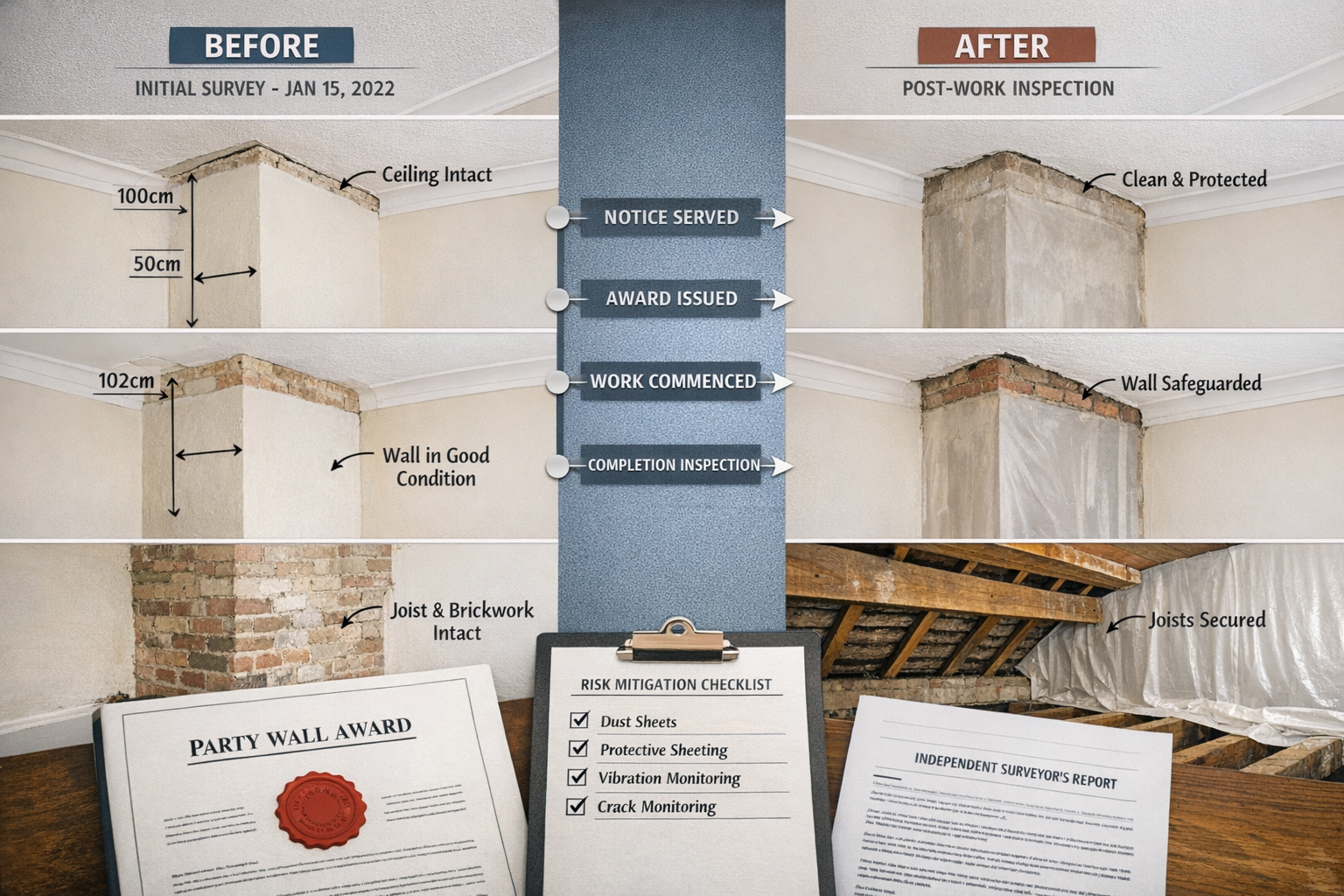
Risk Assessment Matrix for Cutting Work
Modern party wall practice employs risk-weighted assessment matrices that categorize cutting operations by potential impact severity and likelihood of complications.
High-Risk Cutting Operations
Certain types of cutting work carry elevated risk profiles requiring enhanced protective measures:
🔴 Critical Risk Level:
- Removing substantial portions of party walls (>25% of wall area)
- Cutting into party walls with known structural defects
- Works affecting historic or listed building fabric
- Operations in properties with previous settlement history
- Cutting near property boundaries with minimal clearance
For these high-risk scenarios, surveyors typically mandate:
- Continuous monitoring with vibration sensors and crack gauges
- Structural engineer involvement with stamped calculations
- Enhanced insurance coverage beyond standard requirements
- Staged work sequences with hold points for inspection
- Daily photographic records throughout the cutting operation
Medium-Risk Operations
🟡 Moderate Risk Level:
- Standard chimney breast removals with adequate support design
- Creating new openings with appropriate lintels
- Cutting for damp-proof course installation
- Inserting steel beams into sound masonry
Medium-risk works require standard protective measures including pre-work schedules of condition, appropriate temporary support, and defined making-good provisions.
Low-Risk Operations
🟢 Low Risk Level:
- Minor chasing for services in non-structural zones
- Small penetrations for ventilation or utilities
- Superficial repairs not affecting structural integrity
Even low-risk operations benefit from basic documentation and clear communication between parties. Serving proper party wall notices remains mandatory regardless of perceived risk level.
Protective Measures and Monitoring
The party wall award must specify concrete protective measures tailored to the cutting operation's specific risks. Generic provisions no longer satisfy 2026 professional standards[4].
Temporary Support Specifications
When cutting into load-bearing party walls, temporary support becomes critical:
- Acrow props or adjustable steel shores with adequate load capacity
- Needling beams threaded through the wall to transfer loads
- Calculation verification showing support adequacy with safety factors
- Installation sequence detailing the order of cutting and propping operations
- Inspection requirements before, during, and after cutting phases
💡 Best Practice: Awards should specify that temporary supports remain in place until permanent structural solutions achieve full strength—typically 28 days for concrete or immediate for properly installed steel beams.
Vibration and Movement Monitoring
For extensive cutting operations, particularly in terraced properties where vibrations can affect multiple adjoining owners, monitoring equipment provides objective evidence:
- Crack monitoring gauges installed across existing cracks to detect movement
- Vibration sensors with defined threshold limits triggering work stoppages
- Digital inclinometers measuring any tilting or settlement
- Regular readings documented in site diaries with date-stamped records
This monitoring data becomes invaluable if disputes arise, providing scientific evidence about whether works caused damage or movement.
Making Good and Completion Standards
The party wall award must define clear standards for making good any damage caused during cutting operations. Vague language like "restore to original condition" invites disputes—specific standards prevent arguments.
Defined Repair Standards
Professional awards in 2026 specify:
- Material matching requirements – Type, color, and texture of replacement materials
- Finish quality standards – Paint grades, plaster smoothness levels, joinery specifications
- Workmanship benchmarks – References to British Standards or trade association guidelines
- Inspection protocols – Who verifies completion and acceptance criteria
- Timeframes – Deadlines for completing making-good works
For example, rather than stating "repair any damage to plasterwork," a well-drafted award specifies: "Make good plasterwork damage using two-coat gypsum plaster to achieve smooth finish matching existing BS EN 13914-2:2016 Category 3 standard, decorated with two coats of emulsion paint color-matched to existing."
Dispute Resolution Mechanisms
Despite best efforts, disagreements sometimes arise. The award should establish clear dispute resolution pathways:
- Initial notification – Adjoining owner notifies building owner of concerns within defined timeframe
- Joint inspection – Both surveyors inspect disputed items together
- Third surveyor referral – Unresolved disputes escalate to the appointed third surveyor
- Determination timeline – Third surveyor issues binding decision within 10 working days
- Appeal rights – Limited grounds for appealing to County Court within 14 days
Having a party wall agreement without a surveyor might seem cost-effective initially, but the lack of professional dispute resolution mechanisms often proves expensive when problems emerge.
Cost Management and Fee Allocation
Understanding cost implications helps building owners budget appropriately for cutting operations involving party walls.
Typical Cost Breakdown
For standard chimney breast removal with party wall implications:
| Cost Component | Typical Range | Notes |
|---|---|---|
| Building owner's surveyor | £800-£1,200 | Depends on complexity |
| Adjoining owner's surveyor | £600-£1,000 | Building owner typically pays |
| Third surveyor appointment | £150-£300 | Only if disputes arise |
| Schedule of condition | Included | Part of surveyor's service |
| Structural engineer | £400-£800 | If required for calculations |
| Monitoring equipment | £200-£500 | For high-risk operations |
The building owner typically bears all reasonable surveyor costs under the Act, though disputes about "reasonableness" occasionally arise. Clear fee agreements before appointment prevent misunderstandings. For guidance on managing expenses, see our article on how to keep party wall costs down.
Fee Dispute Prevention
2026 best practices recommend:
- Written fee agreements before surveyor appointments commence
- Hourly rate transparency with estimates of time requirements
- Itemized invoicing showing specific tasks and time spent
- Scope limitation agreements defining what's included versus additional charges
- Payment milestone schedules rather than large upfront fees
Professional surveyors operating in areas like North London, West London, East London, and South London typically provide detailed fee proposals before accepting appointments.
Step-by-Step Protocol for Section 2 Chimney Removal
Chimney breast removal represents one of the most common cutting operations requiring party wall awards. This section provides the detailed protocol surveyors follow when preparing awards for this specific work type.
Initial Notice and Response Phase
The process begins when the building owner serves a Party Structure Notice under Section 3 of the Act, describing the proposed chimney removal works. For comprehensive guidance, review our article on what is a party structure notice and how to serve it.
Timeline requirements:
- Notice served at least 2 months before intended work commencement
- Adjoining owner has 14 days to consent or dissent
- If dissent or no response, dispute arises and surveyors get appointed
- Surveyors have 10 days to appoint third surveyor (if using separate surveyors)
- Award typically issued within 4-6 weeks of surveyor appointments
Technical Assessment for Chimney Removal
Surveyors must evaluate several technical factors specific to chimney cutting work:
Structural Implications
Upper floor considerations:
- Is chimney breast being removed on ground floor only, leaving upper floors cantilevered?
- What support system will carry upper floor chimney weight?
- Does the party wall have adequate strength to accept new beam bearings?
Typical support solutions:
- Gallows brackets – Steel frameworks supporting retained upper chimney
- RSJ beams – Rolled steel joists bearing into party wall and external wall
- Concrete padstones – Distributing beam loads across masonry
Party Wall Impact Assessment
The surveyor must determine:
- Does the chimney breast form part of the party wall structure?
- Will cutting affect the adjoining owner's side of the wall?
- Are there shared flues that require blocking and making good?
- Will structural vibrations from cutting affect adjoining property?
🔍 Key Consideration: If the chimney breast sits entirely on the building owner's side of the party wall center line, works may not require a party wall award. However, if cutting operations or beam insertions penetrate the party wall, Section 2 applies regardless of chimney position.
Award Preparation Checklist
The surveyor preparing the award must include these specific provisions for chimney removal:
✅ Work Description Section:
- Precise location of chimney breast to be removed (floor levels, room positions)
- Method of removal (hand demolition, mechanical cutting, etc.)
- Temporary support methodology during cutting phase
- Permanent support specification with structural calculations
- Making good provisions for both sides of party wall
- Flue blocking and ventilation requirements
✅ Protective Conditions:
- Working hours restrictions (typically 8am-6pm weekdays, 8am-1pm Saturdays)
- Dust suppression measures (sheeting, extraction, damping down)
- Vibration limits if mechanical cutting tools used
- Access requirements for adjoining owner's surveyor inspections
- Insurance evidence requirements
✅ Schedule of Condition:
- Comprehensive photographic record of adjoining owner's property
- Written descriptions of all rooms adjoining the party wall
- External elevations showing relationship between properties
- Existing defect documentation with measurements
- Date-stamped digital records with metadata
✅ Rights and Obligations:
- Building owner's right to execute works as specified
- Adjoining owner's right to inspect at reasonable times
- Making good obligations with defined standards
- Dispute resolution procedures
- Cost allocation provisions
Implementation and Monitoring
Once the award is issued and becomes binding (10 days after service unless appealed), work can commence. The surveyor's role continues through the construction phase:
During works:
- Attend site at key stages (commencement, cutting phase, beam installation, completion)
- Verify compliance with award specifications
- Document any variations or issues arising
- Mediate any concerns raised by adjoining owner
- Authorize payment for completed making good works
Post-completion:
- Final inspection of making good works
- Comparison with schedule of condition to assess any damage
- Issue of completion certificate or identification of outstanding items
- Resolution of any damage claims with reference to baseline schedule
- Fee accounting and final invoicing
For those interested in the broader framework, our guide to the Party Wall etc. Act 1996 provides comprehensive legislative context.
Common Pitfalls and How to Avoid Them
Even experienced building owners make mistakes when dealing with party wall cutting operations. Recognizing these common pitfalls helps avoid costly delays and disputes.
Starting Work Before Award Issued
The Problem: Some building owners assume that serving notice satisfies their legal obligations and commence cutting work before receiving the party wall award.
The Consequence: This constitutes trespass and breach of the Act. Adjoining owners can obtain injunctions halting work immediately, and building owners may face liability for any damage without the award's protective provisions.
The Solution: Never begin cutting into party walls until the award is issued and the 10-day appeal period expires. Plan project timelines to accommodate the 2-3 month notice and award preparation period.
Inadequate Schedule of Condition
The Problem: Rushed or incomplete schedules of condition fail to document pre-existing defects, leaving building owners vulnerable to false damage claims.
The Consequence: Without comprehensive baseline evidence, distinguishing between pre-existing damage and work-related damage becomes impossible. Building owners often pay for repairs to pre-existing problems.
The Solution: Insist on thorough schedules with hundreds of photographs, detailed written descriptions, and measurements of all existing defects. The modest additional surveyor time costs far less than disputed damage claims.
Ignoring Structural Calculations
The Problem: Building owners or contractors proceed with chimney removal using inadequate support systems without proper engineering calculations.
The Consequence: Structural failure, dangerous conditions, building control intervention, and potential liability for damage to adjoining properties.
The Solution: Ensure the party wall award includes or references structural engineer's calculations for all load-bearing alterations. Don't rely on "rule of thumb" or "we always do it this way" approaches.
Poor Communication
The Problem: Building owners fail to maintain communication with adjoining owners during works, leading to misunderstandings and complaints.
The Consequence: Minor issues escalate into formal disputes, requiring third surveyor determinations and damaging neighbor relationships.
The Solution: Provide regular updates to adjoining owners about work progress, anticipated noisy operations, and any variations from the award. Good communication prevents most disputes.
Conclusion
Party Wall Awards for Cutting into Shared Walls: 2026 Surveyor Checklists and Risk Mitigation protocols provide the essential framework for safely executing structural alterations while protecting all parties' interests. The systematic approach outlined in this guide—from initial notice through comprehensive schedules of condition to detailed protective specifications—represents current best practice in party wall surveying.
The key to successful cutting operations lies in thorough preparation. Investing time and resources in proper pre-work assessments, comprehensive documentation, and clear award specifications prevents the vast majority of disputes that plague poorly managed projects. The schedule of condition, in particular, serves as insurance against unfounded damage claims, providing irrefutable evidence of pre-existing conditions.
Actionable Next Steps
For Building Owners Planning Cutting Work:
- Serve proper notice at least 2 months before intended work commencement using the correct notice type
- Appoint a qualified surveyor experienced in cutting operations and structural alterations
- Budget appropriately for surveyor fees, structural engineer input, and potential monitoring equipment
- Ensure contractors understand award requirements and commit to compliance
- Maintain communication with adjoining owners throughout the process
For Adjoining Owners Receiving Notice:
- Respond within 14 days either consenting or dissenting to the proposed works
- Appoint your own surveyor or agree to the building owner's surveyor acting for both parties
- Insist on comprehensive schedules of condition before any work commences
- Understand your rights under the award including inspection access
- Document any concerns immediately and notify surveyors promptly
For Professional Surveyors:
- Adopt 2026 digital documentation standards including metadata-embedded photography and BIM-compatible formats
- Implement risk-weighted assessment matrices for all cutting operations
- Specify measurable protective standards rather than vague provisions
- Maintain continuing professional development on structural implications of cutting work
- Build relationships with structural engineers and specialist contractors
The Party Wall etc. Act 1996 provides a robust framework for managing shared wall alterations, but its effectiveness depends entirely on proper implementation. By following the comprehensive checklists and risk mitigation strategies outlined in this guide, building owners can execute necessary cutting operations while preserving neighbor relationships and avoiding costly disputes.
Whether you're planning a chimney breast removal, inserting structural beams, or undertaking other cutting operations, the investment in proper party wall procedures pays dividends through smooth project execution and protected legal positions. The schedule of condition alone—often viewed as an administrative burden—frequently proves its worth many times over when damage claims arise.
For professional assistance with party wall matters involving cutting operations, consult qualified surveyors who understand both the legal framework and the structural implications of shared wall alterations. The modest cost of expert guidance prevents expensive mistakes and provides peace of mind throughout your construction project.
References
[1] Reviewing A Party Wall Award Checklist – https://www.lexisnexis.co.uk/legal/guidance/reviewing-a-party-wall-award-checklist
[2] Party Wall Agreement – https://hoa.org.uk/advice/guides-for-homeowners/i-am-improving/party-wall-agreement/
[3] Party Wall Awards – https://jlewissurveyors.co.uk/party-wall-awards/
[4] Evergreen Guide To Party Wall Awards Drafting Enforceable Agreements Under 2026 Regulatory Updates – https://nottinghillsurveyors.com/blog/evergreen-guide-to-party-wall-awards-drafting-enforceable-agreements-under-2026-regulatory-updates