

The global race to build digital infrastructure has reached unprecedented heights. As artificial intelligence, cloud computing, and cryptocurrency drive insatiable demand for processing power, the construction industry faces a $3 trillion data center boom that's reshaping urban landscapes across the United Kingdom and beyond [1][2]. This explosive growth brings a critical challenge that many developers underestimate: party wall disputes that can derail multi-million-pound projects and create legal nightmares for unprepared stakeholders.
Party Wall Awards in the 2026 Data Center Boom: Surveyor Strategies for High-Stakes Tech Projects has become essential knowledge for construction professionals navigating this complex landscape. Unlike traditional residential or commercial developments, data center projects involve unique complications—24/7 construction schedules, massive excavations for cooling systems, continuous vibration from heavy machinery, and utility installations that can affect neighboring properties for months or even years. Party wall surveyors must now adapt their traditional approaches to accommodate these high-stakes technical requirements while protecting the rights of adjoining owners.
The convergence of rapid construction timelines, substantial financial investments, and complex technical specifications has elevated party wall awards from routine administrative documents to critical project management tools. Surveyors who understand these specialized requirements position themselves as invaluable partners in the data center development process.
Key Takeaways
- Data center construction is projected to dominate the UK construction sector in 2026, with billions invested in new facilities requiring sophisticated party wall management strategies [3][5]
- Traditional party wall award templates are insufficient for data center projects due to unique factors including continuous construction schedules, specialized cooling infrastructure, and extended timelines
- Surveyors must develop specialized checklists addressing noise restrictions, vibration monitoring, utility disruptions, and emergency access provisions specific to data center developments
- Proactive dispute resolution mechanisms built into awards can prevent costly construction delays that threaten tight project deadlines and substantial financial commitments
- Understanding data center technical requirements allows surveyors to draft more effective awards that balance developer needs with adjoining owner protections
Understanding the 2026 Data Center Construction Surge
The Scale of Investment
The data center construction boom represents one of the most significant infrastructure investments of the decade. Industry analysts predict that data center construction will account for a substantial portion of commercial building activity in 2026, driven by artificial intelligence workloads, edge computing requirements, and digital transformation initiatives across all economic sectors [1][7].
This growth translates into immediate challenges for party wall surveyors. Major urban centers—particularly London, Manchester, and Birmingham—are experiencing concentrated development in areas where available land is scarce and existing buildings share boundaries with proposed data center sites. The party wall awards process becomes exponentially more complex when dealing with projects valued at £50 million or more.
Why Data Centers Create Unique Party Wall Challenges
Data center construction differs fundamentally from traditional commercial development in several critical ways:
🏗️ Foundation and Excavation Requirements
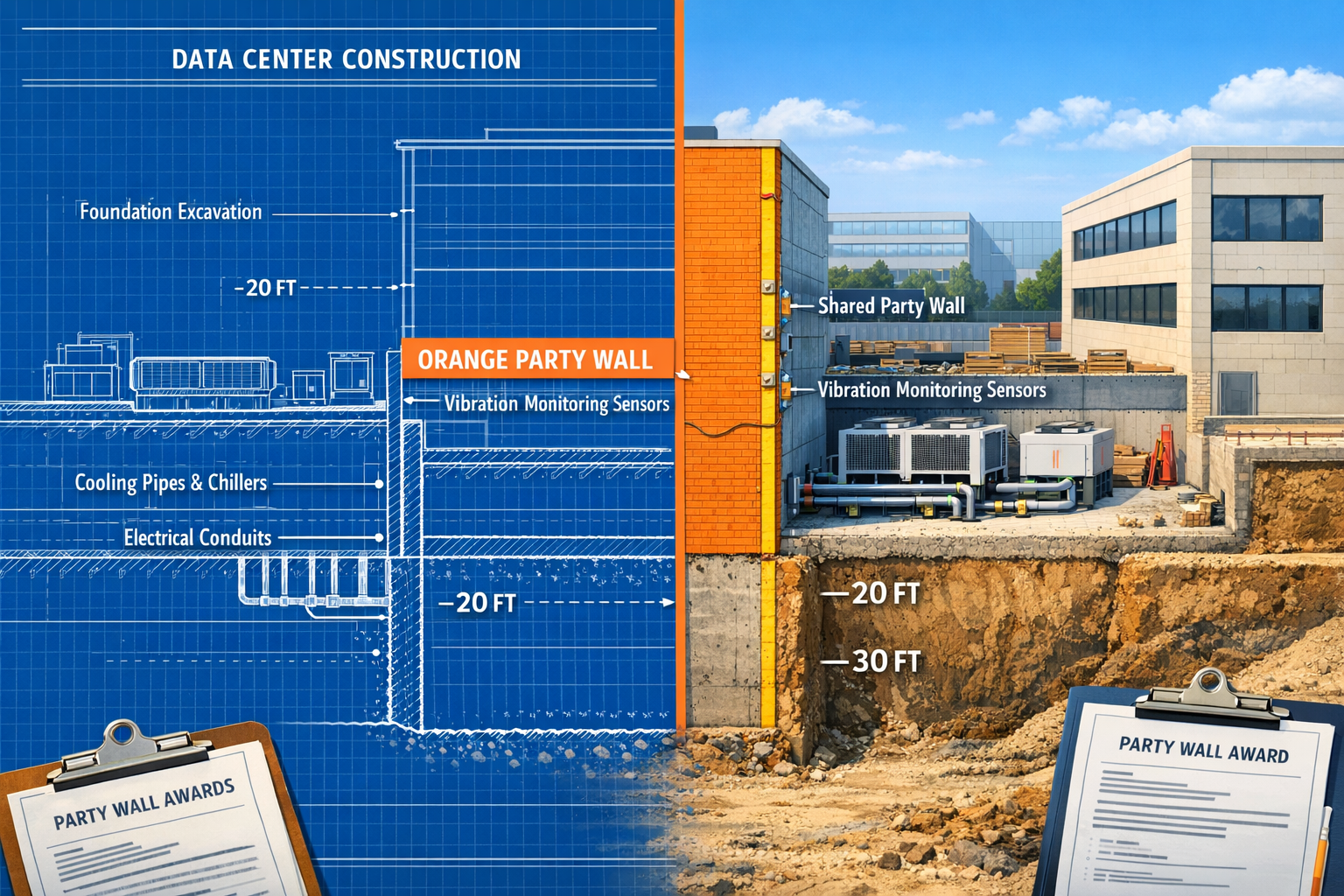
Data centers require substantial excavations to accommodate cooling systems, backup power infrastructure, and cable management systems. These excavations often extend 3-5 meters below ground level—significantly deeper than standard commercial buildings. Such work triggers multiple sections of the Party Wall etc. Act 1996, particularly concerning excavation near neighboring foundations.
⚡ Continuous Construction Schedules
Unlike conventional projects that observe standard working hours, data center developers often pursue 24/7 construction schedules to meet aggressive deployment timelines [3]. This creates tension with standard party wall award provisions that typically restrict noisy work to daytime hours on weekdays.
🔊 Vibration and Noise Intensity
The installation of massive cooling systems, backup generators, and server infrastructure generates sustained vibration and noise levels that exceed those of typical construction projects. Adjoining owners face prolonged disruption, requiring carefully crafted compensation and mitigation provisions within party wall awards.
🔌 Utility Infrastructure Complexity
Data centers consume enormous amounts of electricity—often equivalent to small towns. The installation of dedicated power lines, cooling water systems, and fiber optic connections frequently requires work that affects party walls, boundary structures, and shared utility corridors.
Party Wall Awards in the 2026 Data Center Boom: Essential Surveyor Adaptations
Tailoring Award Documents for Technical Complexity
Standard party wall award templates require significant modification when applied to data center projects. Surveyors must incorporate specialized provisions that address the unique characteristics of these developments while maintaining legal compliance with the Party Wall etc. Act 1996.
Key modifications include:
| Award Section | Standard Provision | Data Center Adaptation |
|---|---|---|
| Working Hours | Monday-Friday, 8am-6pm | Phased schedule with noise-restricted periods and emergency provisions |
| Duration | 6-12 months typical | 18-36 months with milestone-based reviews |
| Vibration Monitoring | Basic threshold monitoring | Continuous real-time monitoring with automated alerts |
| Access Rights | Standard inspection access | Emergency access provisions for critical infrastructure |
| Compensation | Property value diminution | Extended disruption payments plus utility service guarantees |
Developing Comprehensive Pre-Construction Surveys
The schedule of condition becomes critically important in data center projects due to the extended construction period and intensity of work. Surveyors must document existing conditions with exceptional thoroughness to protect both parties from future disputes.
Best practices for data center schedules of condition:
- Photographic documentation of every room in adjoining properties, with particular attention to areas likely affected by vibration (plaster finishes, tile work, decorative features)
- Structural surveys identifying pre-existing cracks, settlement patterns, and foundation conditions
- Utility baseline assessments documenting current service levels for water pressure, electrical supply, and telecommunications
- Noise baseline measurements establishing pre-construction ambient noise levels for comparison during construction
- Vibration sensitivity testing identifying vulnerable building elements that may require additional protection
Addressing Extended Construction Timelines
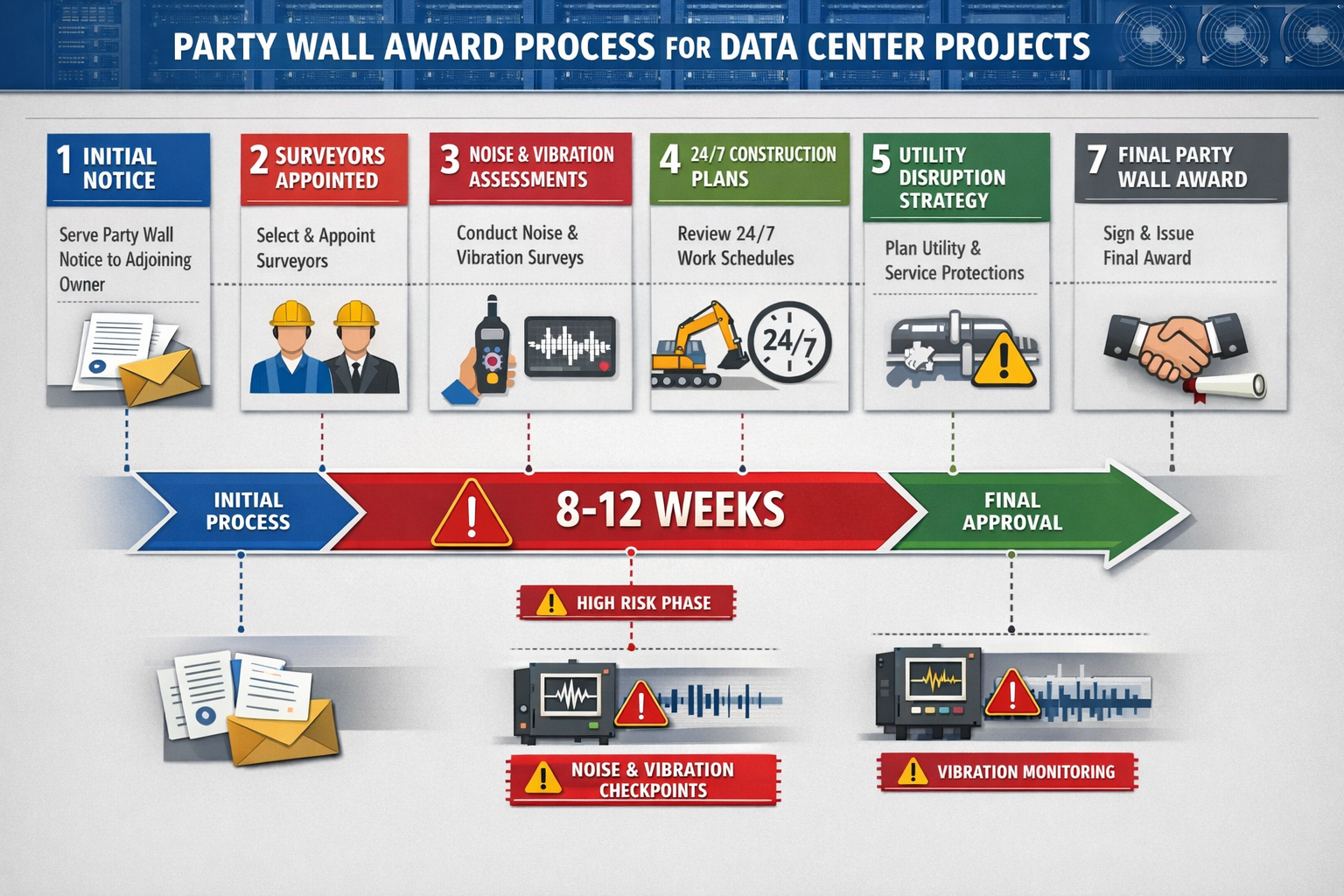
Data center projects frequently extend beyond initial projections due to supply chain challenges, technical complications, and scope changes [7]. Party wall awards must anticipate these extensions while protecting adjoining owners from indefinite disruption.
Effective strategies include:
📋 Milestone-Based Review Provisions
Rather than setting a fixed completion date, sophisticated awards establish review milestones at 6-month intervals. These reviews allow surveyors to reassess compensation, update protective measures, and address emerging concerns before they escalate into formal disputes.
💷 Escalating Compensation Structures
Awards can incorporate tiered compensation that increases if construction extends beyond agreed timelines. This approach incentivizes developers to maintain schedules while ensuring adjoining owners receive fair compensation for extended disruption.
🔄 Adaptive Working Hour Frameworks
Instead of rigid time restrictions, modern awards may establish noise budgets or cumulative disruption limits that allow developers flexibility while protecting adjoining owners. For example, an award might permit limited overnight work if daytime noise levels remain below specified thresholds.
Surveyor Strategies for High-Stakes Tech Projects: Practical Implementation
Pre-Notice Consultation and Strategic Planning
Successful party wall surveyors recognize that proactive engagement before formal notices are served significantly reduces conflict and streamlines the award process. This approach proves particularly valuable in data center projects where multiple adjoining owners may be affected.
Strategic pre-notice activities include:
- Stakeholder mapping – Identifying all potentially affected properties and prioritizing engagement based on proximity and impact severity
- Technical briefings – Arranging presentations where developers explain project scope, timeline, and mitigation measures to adjoining owners
- Preliminary condition surveys – Conducting informal assessments to identify sensitive properties requiring enhanced protection
- Communication protocols – Establishing clear channels for ongoing dialogue throughout the project lifecycle
These preparatory steps create goodwill and understanding that facilitate smoother formal processes once party wall notices are served.
Specialized Checklists for Data Center Party Wall Awards
Surveyors handling data center projects benefit from comprehensive checklists that ensure all critical issues receive appropriate attention. The following framework addresses the most common challenges:
Foundation and Excavation Checklist
✅ Excavation depth and proximity analysis – Document exact depths and distances from adjoining foundations
✅ Underpinning requirements assessment – Determine if neighboring structures require support during excavation
✅ Groundwater management plan – Address dewatering impacts on adjacent properties
✅ Vibration monitoring protocol – Specify equipment, threshold levels, and response procedures
✅ Emergency shoring provisions – Establish procedures if unexpected ground conditions arise
✅ Progressive inspection schedule – Define inspection frequency as excavation progresses
Noise and Disruption Management Checklist
✅ Baseline noise survey – Document existing ambient noise levels at property boundaries
✅ Noise limit specifications – Set maximum decibel levels for different times and activities
✅ Monitoring equipment installation – Position continuous noise monitors with data sharing to adjoining owners
✅ Mitigation measure requirements – Specify acoustic barriers, equipment selection, and operational restrictions
✅ Complaint response protocol – Establish 24-hour contact system and response timelines
✅ Compensation trigger thresholds – Define noise levels or duration that trigger additional payments
Utility Infrastructure Checklist
✅ Service continuity guarantees – Ensure uninterrupted water, electricity, and telecommunications
✅ Temporary service provisions – Plan backup systems if permanent services require disconnection
✅ Cable routing documentation – Map all new utility installations affecting party walls or boundaries
✅ Access maintenance provisions – Protect existing utility access rights for adjoining owners
✅ Future maintenance protocols – Establish procedures for accessing installed infrastructure after completion
✅ Emergency utility response – Define procedures for urgent utility failures during construction
Managing Multiple Adjoining Owners in Dense Urban Environments
Data center developments in areas like Central London or East London frequently affect numerous neighboring properties simultaneously. This complexity requires coordinated approaches that traditional bilateral party wall processes struggle to accommodate.
Effective multi-party strategies include:
🤝 Agreed Surveyor Appointments
When multiple adjoining owners are affected similarly, appointing a single agreed surveyor to represent their collective interests can streamline the process and reduce costs. This approach requires careful attention to potential conflicts of interest and clear communication about the surveyor's duties to all parties.
📊 Standardized Award Templates with Property-Specific Schedules
Developing a master award document that addresses common issues across all affected properties, supplemented by property-specific schedules addressing unique circumstances, ensures consistency while accommodating individual needs.
💬 Group Consultation Sessions
Organizing collective meetings where all adjoining owners receive simultaneous updates and can raise concerns creates transparency and reduces the risk of information asymmetries that fuel disputes.
⚖️ Coordinated Dispute Resolution
Establishing a unified dispute resolution mechanism that can address concerns from multiple adjoining owners prevents the project from facing simultaneous separate disputes that could compound delays.
Navigating Compressed Timelines and Developer Pressure
Balancing Speed with Thoroughness
The data center construction boom creates intense pressure on surveyors to expedite the party wall process. Developers facing competitive markets and substantial financial commitments often push for accelerated timelines that may conflict with the careful deliberation required for effective awards [2][5].
Professional surveyors must maintain ethical standards while acknowledging legitimate business pressures:
⏱️ Realistic Timeline Communication
Setting clear expectations from the outset about minimum timeframes required for proper surveys, consultations, and award preparation prevents misunderstandings and reduces pressure for inappropriate shortcuts.
📝 Efficient Process Design
Streamlining administrative procedures, using technology for documentation and communication, and preparing template provisions for common issues allows surveyors to work efficiently without compromising quality.
🛡️ Professional Independence
Maintaining independence from developer pressure ensures awards adequately protect adjoining owners while facilitating legitimate construction activities. Surveyors must remember their duties under the Party Wall etc. Act 1996 include protecting the interests of the party they represent.
Addressing Financial Stakes and Risk Management
Data center projects involve extraordinary financial commitments—often exceeding £100 million for major facilities. This scale creates unique risk profiles that party wall awards must address:
💰 Security for Costs and Damages
Standard security provisions may prove inadequate for projects of this magnitude. Awards should specify substantial financial guarantees or insurance policies ensuring funds are available to address any damage to adjoining properties.
📈 Escalation Provisions
Given the long timelines typical of data center construction, awards should include provisions for reviewing and adjusting compensation and security amounts if project scope or duration changes significantly.
⚖️ Professional Indemnity Considerations
Surveyors handling high-value data center projects should verify their professional indemnity insurance provides adequate coverage for the potential liabilities involved. The financial consequences of errors in awards for projects of this scale can be substantial.
Dispute Prevention and Resolution Mechanisms
Building Dispute Avoidance into Award Structure
The most effective party wall awards for data center projects incorporate proactive dispute prevention mechanisms rather than relying solely on reactive resolution procedures.
Key dispute prevention provisions include:
🔍 Regular Progress Meetings
Mandatory monthly meetings between surveyors, developers, and adjoining owner representatives create forums for addressing emerging concerns before they escalate into formal disputes.
📊 Transparent Monitoring Data Sharing
Real-time access to vibration, noise, and structural monitoring data allows adjoining owners to verify compliance with award provisions, building trust and reducing suspicion.
🎯 Clear Performance Standards
Specifying objective, measurable standards for noise levels, vibration limits, working hours, and other critical factors eliminates ambiguity that often fuels disputes.
💡 Adaptive Management Protocols
Establishing procedures for adjusting construction methods if monitoring reveals unexpected impacts allows problems to be addressed collaboratively rather than through adversarial processes.
Expedited Dispute Resolution for Time-Sensitive Projects
When disputes do arise in data center projects, traditional resolution mechanisms may prove too slow given the financial implications of construction delays. Modern awards increasingly incorporate alternative approaches:
⚡ Expert Determination Provisions
Rather than relying on the Third Surveyor appointment process specified in the Act, some awards incorporate expert determination clauses allowing rapid resolution of technical disputes by pre-agreed specialists.
🤝 Mediation Requirements
Mandatory mediation before formal dispute procedures can resolve many conflicts quickly and preserve working relationships essential for long-term project success.
⏰ Accelerated Third Surveyor Procedures
Awards can specify shortened timelines for Third Surveyor appointments and decisions when disputes threaten critical construction milestones, provided all parties agree to these modifications.
Regional Considerations Across London and the UK
Location-Specific Challenges
Data center development patterns vary significantly across different regions, creating location-specific party wall challenges that surveyors must understand:
North London Developments
Industrial conversions and brownfield redevelopments in areas like Tottenham and Edmonton often involve contaminated land remediation alongside party wall works, requiring specialized environmental provisions in awards.
South London Projects
Victorian and Edwardian terraced properties adjacent to data center sites in areas like Croydon require particular attention to structural sensitivity and heritage considerations.
West London Facilities
Proximity to Heathrow and excellent connectivity makes West London attractive for data centers, but high property values increase financial stakes in party wall disputes.
Understanding Local Authority Requirements
Data center developments face varying planning and building control requirements across different local authorities. Party wall surveyors should coordinate with these regulatory frameworks to ensure awards complement rather than conflict with other approval conditions.
Key coordination points include:
- Construction Management Plans – Aligning party wall award working hour provisions with planning condition requirements
- Section 61 Consents – Coordinating noise restrictions in awards with environmental health department approvals
- Highway Works – Addressing utility installations in public highways that may affect party boundaries
- Building Control Inspections – Scheduling party wall inspections to coincide with building control visits when appropriate
Cost Management and Fee Structures
Transparent Fee Arrangements for Complex Projects
The extended timelines and complexity of data center party wall awards require clear fee structures that fairly compensate surveyors for substantial work while remaining reasonable for the parties bearing costs.
Recommended approaches include:
📋 Phased Fee Structures
Breaking fees into distinct phases (initial consultation, award preparation, construction monitoring, completion inspection) provides transparency and allows parties to understand cost drivers.
⏱️ Time-Based Billing with Caps
Hourly rates with agreed maximum fees for specific activities balance flexibility with cost certainty, particularly important for building owners managing project budgets.
🎯 Value-Based Arrangements
For particularly complex projects, fees reflecting the value delivered through dispute avoidance and efficient project facilitation may prove more appropriate than simple time-based billing.
For guidance on managing overall party wall expenses, adjoining owners can review strategies for keeping party wall costs down while ensuring adequate protection.
Allocation of Costs in Multi-Party Scenarios
When data center projects affect numerous adjoining owners, cost allocation becomes complex. Awards should clearly specify:
- Surveyor fee responsibility – Whether the building owner bears all costs or if some expenses are shared
- Monitoring equipment costs – Allocation of expenses for vibration sensors, noise monitors, and structural monitoring
- Dispute resolution costs – How Third Surveyor fees or mediation expenses will be distributed
- Remediation cost responsibility – Clear provisions for who bears costs of addressing any damage discovered
Technology Integration in Modern Party Wall Practice
Digital Documentation and Communication
The 2026 data center boom coincides with rapid advancement in construction technology. Forward-thinking party wall surveyors leverage these tools to enhance service delivery:
📱 Digital Survey Tools
Tablet-based survey applications with integrated photography, annotation, and measurement capabilities streamline schedule of condition preparation and ensure consistent documentation quality.
☁️ Cloud-Based Document Management
Secure cloud platforms providing all parties with access to award documents, monitoring data, correspondence, and inspection reports enhance transparency and reduce administrative burden.
📊 Real-Time Monitoring Dashboards
Integration of vibration sensors, noise monitors, and structural movement tracking into accessible dashboards allows continuous compliance verification without constant site visits.
🤖 Automated Compliance Alerts
Systems that automatically notify relevant parties when monitoring data approaches or exceeds award thresholds enable rapid response to emerging issues.
Building Information Modeling (BIM) Integration
Advanced data center projects increasingly utilize BIM throughout design and construction. Party wall surveyors can leverage these models to:
- Visualize party wall interfaces and identify potential conflict points before construction begins
- Simulate construction sequences to assess impacts on adjoining properties at different project phases
- Coordinate monitoring locations by integrating sensor positions into the overall project model
- Document as-built conditions showing final relationships between new construction and party structures
Training and Professional Development for Data Center Specialists

Emerging Specialization Requirements
As data center construction becomes increasingly significant within the broader construction sector, party wall surveyors benefit from developing specialized expertise in this niche:
🎓 Technical Knowledge Development
Understanding data center design fundamentals—cooling systems, power distribution, structural loading, vibration isolation—enables surveyors to anticipate issues and communicate effectively with technical teams.
📚 Continuous Learning
Attending industry conferences, participating in data center construction forums, and maintaining awareness of technological developments ensures surveyors remain current with evolving best practices.
🤝 Professional Networking
Building relationships with data center developers, specialized contractors, and fellow surveyors experienced in these projects creates referral networks and knowledge-sharing opportunities.
✍️ Case Study Documentation
Systematically documenting lessons learned from each data center project builds institutional knowledge and improves future practice.
Future Trends: Looking Beyond 2026
Sustainability and Environmental Considerations
The data center industry faces increasing scrutiny regarding environmental impact, particularly energy consumption and carbon emissions [6]. This focus will influence future party wall practice:
🌱 Green Construction Methods
Awards may need to accommodate innovative sustainable construction techniques, including modular construction, recycled materials, and renewable energy integration affecting party walls.
💧 Water Management
As data centers seek alternatives to traditional water-intensive cooling, awards must address new technologies and their potential impacts on adjoining properties.
♻️ Circular Economy Approaches
Deconstruction and material reuse provisions may become standard in awards as the industry moves away from traditional demolition practices.
Regulatory Evolution
The party wall framework may evolve to address challenges revealed by the data center boom:
📜 Potential Legislative Updates
Industry stakeholders may advocate for amendments to the Party Wall etc. Act 1996 addressing extended construction timelines, continuous operations, and multi-party scenarios.
⚖️ Case Law Development
Disputes arising from data center projects will generate precedents clarifying how existing legislation applies to these unique circumstances.
🏛️ Professional Standards
Industry bodies may develop specific guidance for surveyors handling data center and other high-tech construction projects.
Conclusion: Excellence in High-Stakes Party Wall Practice
Party Wall Awards in the 2026 Data Center Boom: Surveyor Strategies for High-Stakes Tech Projects represents both a significant challenge and an exceptional opportunity for construction professionals. The unprecedented scale of investment, technical complexity, and compressed timelines characteristic of data center development demand evolution in traditional party wall practice.
Surveyors who develop specialized expertise in this area position themselves as indispensable partners in projects that will define the digital infrastructure landscape for decades to come. Success requires balancing multiple competing interests: developer urgency against adjoining owner protection, technical requirements against practical constraints, innovation against proven practice.
The strategies outlined in this comprehensive guide—from specialized award provisions and comprehensive checklists to proactive dispute prevention and technology integration—provide a foundation for excellence in this demanding field. However, each project presents unique circumstances requiring professional judgment, ethical practice, and commitment to the fundamental principles underlying the Party Wall etc. Act 1996.
Actionable Next Steps
For surveyors seeking to capitalize on the data center construction boom:
- Audit your current capabilities – Assess technical knowledge gaps and identify areas requiring professional development
- Develop specialized templates – Create data center-specific award provisions, checklists, and monitoring protocols
- Build strategic relationships – Connect with data center developers, specialized contractors, and fellow surveyors active in this sector
- Invest in technology – Implement digital tools for documentation, monitoring, and communication that enhance service delivery
- Document and share knowledge – Contribute to professional discourse through case studies, articles, and presentations that advance collective understanding
For building owners and developers planning data center projects:
- Engage party wall surveyors early – Involve specialists during project planning rather than treating party wall compliance as an afterthought
- Budget appropriately – Recognize that thorough party wall management represents sound risk management, not unnecessary expense
- Prioritize communication – Invest in stakeholder engagement and transparent processes that prevent disputes
- Build flexibility into timelines – Acknowledge that proper party wall procedures require time and avoid unrealistic compression
- Maintain professional standards – Resist pressure to cut corners that may create legal liabilities or damage community relationships
For adjoining owners affected by data center construction:
- Understand your rights – Familiarize yourself with protections provided under the Party Wall etc. Act 1996
- Appoint qualified surveyors – Select adjoining owner surveyors with relevant experience in complex commercial projects
- Document everything – Maintain records of all communications, site conditions, and disruption impacts
- Engage constructively – Participate in consultation processes and raise concerns promptly rather than allowing issues to escalate
- Seek professional advice – Consult specialists when facing complex technical issues or significant property impacts
The $3 trillion data center construction surge transforms the built environment while creating unprecedented demands on party wall professionals. Those who rise to meet these challenges with expertise, integrity, and innovation will not only protect the interests of their clients but will also contribute to the sustainable development of critical digital infrastructure that underpins modern society.
The future of party wall practice in the data center era belongs to professionals who combine deep technical knowledge, sophisticated project management skills, and unwavering commitment to the balanced protection of all parties' legitimate interests. As 2026 unfolds and this construction boom accelerates, the strategies and approaches outlined in this guide will prove essential for navigating successfully through this complex and rewarding landscape.
References
[1] Data Center Construction Boom To Grow In 2026 – https://www.equipmentworld.com/market-pulse/article/15816534/data-center-construction-boom-to-grow-in-2026
[2] Data Center Boom Powers 2026 Construction – https://www.constructionowners.com/news/data-center-boom-powers-2026-construction
[3] constructiondive – https://www.constructiondive.com/news/data-centers-construction-2026-trends/810016/
[5] Construction In 2026 A Boon For Data Centers But Uncertainty Elsewhere – https://www.smartbrief.com/original/construction-in-2026-a-boon-for-data-centers-but-uncertainty-elsewhere
[6] Virginia Data Center Tax Exemption – https://insideclimatenews.org/news/18022026/virginia-data-center-tax-exemption/
[7] Data Center Construction Predictions For 2026 – https://www.databank.com/resources/blogs/data-center-construction-predictions-for-2026/