


The global surge in artificial intelligence and cloud computing has triggered an unprecedented data centre construction boom in 2026. As tech giants and investment firms pour billions into new facilities across the UK, surveyors face a critical challenge: adapting traditional party wall procedures to handle the unique demands of these high-stakes industrial projects. Party Wall Awards in the 2026 Data Centre Boom: Drafting Enforceable Clauses for High-Stakes Projects has become essential knowledge for professionals navigating this complex landscape, where a single poorly drafted clause can lead to costly delays or protracted disputes.
Unlike residential extensions or office developments, data centre construction involves intensive timelines, specialized technical requirements, and substantial financial exposure. The stakes have never been higher for getting party wall awards right the first time.
Key Takeaways
- 🏗️ Data centre projects require specialized party wall awards that address unique technical specifications, including heavy foundations, vibration control, and 24/7 construction schedules
- ⚖️ Enforceable clauses must include precise technical standards, measurable performance criteria, and clear dispute resolution mechanisms tailored to industrial-scale construction
- 📋 Comprehensive schedules of condition are critical for protecting both building and adjoining owners when construction involves substantial ground works and structural loads
- ⏱️ Time-sensitive provisions must balance aggressive construction timelines with adequate protection for neighbouring properties and existing infrastructure
- 💼 Professional indemnity and insurance clauses require careful drafting to cover the elevated risks associated with multi-million pound data centre developments
Understanding the 2026 Data Centre Construction Landscape
The data centre boom of 2026 represents a fundamental shift in UK commercial construction. Investment in hyperscale facilities has reached record levels, driven by surging demand for AI processing power, cloud services, and digital infrastructure. These projects frequently occupy industrial estates, business parks, and urban fringes where multiple property boundaries intersect.
Why Traditional Party Wall Awards Fall Short
Standard residential party wall agreement templates were designed for conventional building works: loft conversions, basement excavations, and single-storey extensions. Data centre construction presents entirely different challenges:
Scale and Complexity 📊
- Foundation depths exceeding 15 metres for server hall structures
- Concrete pours involving hundreds of cubic metres
- Installation of specialized cooling and power infrastructure
- Round-the-clock construction schedules spanning 18-24 months
Technical Specifications 🔧
- Vibration limits to protect sensitive equipment in adjacent facilities
- Electromagnetic interference considerations
- Thermal management systems affecting boundary structures
- High-capacity utility connections crossing property lines
Financial Exposure 💷
- Project values ranging from £50 million to £500 million
- Delay costs potentially exceeding £100,000 per day
- Complex insurance and indemnity arrangements
- Multiple stakeholder interests including investors, operators, and tenants
According to recent industry analysis, data centre projects in 2026 face unique party wall challenges due to their intensive construction requirements and compressed delivery schedules [1].
Party Wall Awards in the 2026 Data Centre Boom: Essential Drafting Principles
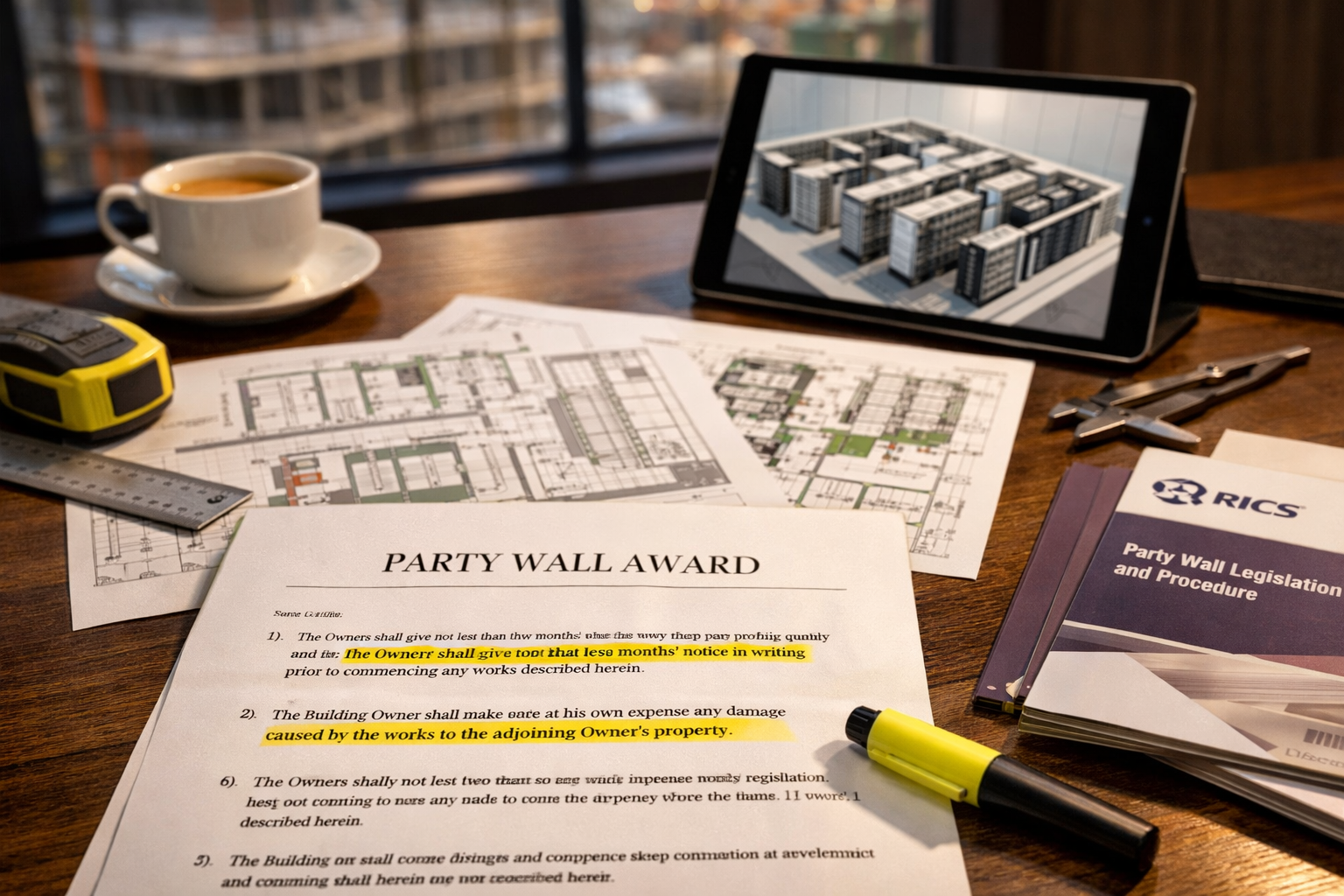
Creating robust awards for data centre projects requires surveyors to abandon generic templates and embrace project-specific drafting. The following principles form the foundation of enforceable clauses that withstand scrutiny.
Precision in Technical Specifications
Vague language invites disputes. Every technical requirement must include:
Measurable Performance Standards
- Vibration limits expressed in peak particle velocity (PPV) measurements
- Noise thresholds in decibels at specific boundary locations
- Dust control protocols with air quality monitoring requirements
- Temperature and humidity ranges for shared structures
Example Clause:
"The Building Owner shall ensure that vibration from piling operations does not exceed 5mm/s PPV measured at the foundation of the Adjoining Owner's property. Continuous monitoring equipment shall be installed and data made available within 24 hours of any request."
Time-Bound Obligations and Milestones
Data centre developers operate under strict delivery deadlines tied to tenant agreements and financing conditions. Awards must acknowledge these commercial realities while protecting adjoining owners.
Critical Timeline Provisions ⏰
- Notice periods aligned with construction programming
- Access arrangements specifying hours, duration, and advance notification
- Inspection rights with defined response times
- Remediation deadlines for identified defects or damage
The Party Wall etc. Act 1996 provides the statutory framework, but awards must add commercial precision to these baseline requirements.
Comprehensive Schedules of Condition
For high-value projects, schedules of condition serve as critical evidence baselines. Best practices for data centre awards include:
- Photographic surveys with minimum 200 images per adjoining property
- Structural surveys by qualified engineers for industrial buildings
- Services documentation mapping all utilities and infrastructure
- Digital formats with timestamped, tamper-proof storage
- Regular updates at defined construction milestones
Professional schedules of condition protect both parties by establishing clear before-and-after comparisons.
Insurance and Indemnity Frameworks
Standard professional indemnity insurance may prove inadequate for data centre projects. Awards should specify:
| Insurance Type | Minimum Coverage | Special Provisions |
|---|---|---|
| Public Liability | £50 million | Extended to cover specialized equipment |
| Contractors All Risks | Full reinstatement value | Include delay in start-up cover |
| Professional Indemnity | £10 million per claim | Joint names policy covering all surveyors |
| Environmental | £5 million | Contamination and pollution incidents |
Indemnity Clause Template:
"The Building Owner shall indemnify and hold harmless the Adjoining Owner against all losses, damages, costs, and expenses arising from the Works, including but not limited to structural damage, business interruption, and consequential losses, save where such losses result from the Adjoining Owner's negligence or breach of this Award."
Drafting Enforceable Clauses for High-Stakes Data Centre Projects
The enforceability of party wall awards depends on clear, unambiguous language that anticipates potential disputes and provides mechanisms for resolution. For data centre projects in 2026, several clause categories require particular attention.
Foundation and Excavation Provisions
Data centres require substantial foundations to support server equipment loads and mechanical systems. Awards must address:
Depth and Proximity Controls 🏗️
- Maximum excavation depths relative to adjoining foundations
- Minimum setback distances from boundary structures
- Underpinning requirements and methodologies
- Ground stabilization protocols
Monitoring Requirements
- Installation of settlement monitoring points
- Frequency of readings (typically daily during critical phases)
- Alert thresholds triggering immediate notification
- Reporting formats and distribution lists
Vibration and Noise Management
The intensive construction activity required for data centre development can severely impact neighbouring properties, particularly existing data facilities with sensitive equipment.
Vibration Control Clauses should specify:
- Pre-construction vibration surveys establishing baseline conditions
- Maximum PPV limits for different construction activities
- Alternative methodologies if limits are approached
- Real-time monitoring with automated alerts
- Compensation mechanisms for unavoidable exceedances
Noise Mitigation provisions must address:
- Permitted working hours (often extended for data centres)
- Maximum noise levels at boundary points
- Acoustic screening requirements
- Restrictions on particularly noisy operations
Research from 2026 projects demonstrates that comprehensive vibration and noise provisions significantly reduce disputes during construction phases [2].
Access and Working Space Arrangements
Data centre construction often requires temporary access to adjoining land for:
- Crane oversailing
- Material delivery and storage
- Installation of utilities
- Emergency egress routes
Effective Access Clauses Include:
- Precise location descriptions with scaled drawings
- Duration limits with extension procedures
- Condition requirements for reinstatement
- Compensation terms for loss of use
- Insurance obligations during access periods
Utility and Services Coordination
Modern data centres consume enormous amounts of power and require redundant utility connections. Awards must address:
Shared Infrastructure 🔌
- Location and capacity of existing services
- Protection measures during construction
- Notification requirements for shutdowns
- Emergency contact protocols
New Installations
- Routes for new utility connections
- Easement arrangements
- Maintenance access provisions
- Future modification rights
Dispute Resolution Mechanisms
Even well-drafted awards may face interpretation challenges. Include:
Tiered Dispute Resolution:
- Direct negotiation between surveyors (5 working days)
- Third surveyor determination (10 working days)
- Expert determination for technical matters (20 working days)
- Arbitration or litigation as final resort
Cost Allocation:
- Default position: each party bears own costs
- Exception: unreasonable conduct or bad faith
- Security for costs in high-value disputes
Case Studies: Lessons from 2026 Data Centre Projects
Real-world examples illustrate the importance of comprehensive drafting and proactive dispute management.
Case Study 1: The London Docklands Hyperscale Facility
A major cloud provider's 200MW data centre project adjacent to an operational logistics facility demonstrated the value of detailed vibration clauses. The award specified:
- PPV limits of 3mm/s during operational hours
- Alternative piling methodology if limits approached
- Continuous monitoring with 2-hour notification requirement
Outcome: When initial piling triggered alert thresholds, the contractor immediately switched to a lower-vibration system. Total delay: 48 hours. Dispute costs: zero.
Case Study 2: Manchester Business Park Boundary Dispute
A data centre development involving shared access roads and utility corridors faced challenges when the award failed to specify:
- Precise utility route corridors
- Reinstatement standards for access roads
- Compensation for extended access periods
Outcome: Three-month delay while surveyors negotiated supplementary agreement. Additional costs exceeded £250,000. The project highlighted the need for comprehensive utility provisions in initial awards.
Case Study 3: Edinburgh Co-location Facility Expansion
An expansion project benefited from incorporating lessons learned from earlier 2026 projects. The award included:
- Detailed technical specifications for all construction activities
- Weekly coordination meetings between surveyors
- Pre-agreed compensation rates for various scenarios
- Fast-track dispute resolution procedures
Outcome: Project completed on schedule with zero formal disputes. Both parties praised the clarity and comprehensiveness of the award.
Practical Templates and Checklists for Surveyors
Pre-Award Drafting Checklist ✅
Project Information Gathering:
- Obtain complete construction programme
- Review technical specifications and drawings
- Identify all potential party wall interfaces
- Assess neighbouring property uses and sensitivities
- Determine insurance requirements
- Establish key stakeholder contacts
Technical Assessment:
- Commission structural surveys of adjoining properties
- Conduct vibration and noise baseline studies
- Map all existing utilities and services
- Identify environmental considerations
- Assess access requirements and constraints
- Review planning conditions and restrictions
Legal and Commercial Review:
- Verify ownership and title information
- Check existing easements and covenants
- Assess lease terms for commercial properties
- Identify tenant rights and obligations
- Review insurance policies and limits
- Determine security and bonding requirements
Essential Award Clauses for Data Centre Projects
1. Definitions Section
Precisely define all technical terms, measurement standards, and key personnel roles to avoid ambiguity.
2. Scope of Works
Provide detailed descriptions referencing specific drawings and specifications, with version control.
3. Construction Methodology
Specify approved methods, alternative procedures, and approval processes for variations.
4. Protection Measures
Detail all protective works, monitoring requirements, and performance standards.
5. Access and Working Space
Define locations, times, durations, and conditions with scaled drawings.
6. Monitoring and Reporting
Establish frequency, formats, distribution, and alert thresholds for all monitoring activities.
7. Insurance and Indemnity
Specify coverage types, limits, policy terms, and claims procedures.
8. Dispute Resolution
Outline tiered procedures, timeframes, cost allocation, and final determination methods.
9. Completion and Reinstatement
Define completion criteria, inspection procedures, and reinstatement standards.
10. Costs and Fees
Clarify responsibility for surveyor fees, monitoring costs, and other expenses.
For additional guidance on structuring awards, consult our comprehensive guide to party wall awards.
Managing Stakeholder Expectations in High-Stakes Projects
Data centre developments involve multiple parties beyond the traditional building owner and adjoining owner:
Key Stakeholders 👥
- Investors and lenders concerned with project timelines and risk
- Operators and tenants requiring specific performance guarantees
- Contractors and subcontractors managing construction delivery
- Local authorities enforcing planning and building regulations
- Utility providers coordinating infrastructure connections
Communication Protocols
Effective awards establish clear communication channels:
- Primary contacts for each party with backup designees
- Notification methods (email, registered post, hand delivery)
- Response timeframes for different types of communications
- Escalation procedures for urgent matters
- Regular update schedules (weekly during active construction)
Transparency and Documentation
Maintain comprehensive project records:
- Meeting minutes from all coordination sessions
- Inspection reports with photographic evidence
- Monitoring data in accessible digital formats
- Correspondence logs tracking all communications
- Change orders documenting any award modifications
Common Pitfalls and How to Avoid Them
Pitfall 1: Generic Template Reliance
Problem: Using standard residential templates for complex industrial projects.
Solution: Develop project-specific awards addressing unique data centre requirements. Invest time in understanding the technical construction details.
Pitfall 2: Inadequate Technical Specifications
Problem: Vague performance standards leading to interpretation disputes.
Solution: Include measurable criteria with specific units, measurement methods, and acceptance thresholds.
Pitfall 3: Insufficient Insurance Coverage
Problem: Standard policy limits inadequate for high-value projects.
Solution: Specify minimum coverage levels appropriate to project scale and risk profile. Require evidence of coverage before works commence.
Pitfall 4: Unclear Dispute Resolution
Problem: No defined process for addressing disagreements, leading to costly litigation.
Solution: Establish tiered dispute resolution with clear timeframes and cost allocation principles.
Pitfall 5: Ignoring Commercial Realities
Problem: Awards that fail to acknowledge tight construction schedules and financial pressures.
Solution: Balance statutory protections with commercial practicality. Include fast-track procedures for time-sensitive decisions.
The Role of Technology in Modern Party Wall Practice
The 2026 data centre boom coincides with technological advances in surveying and construction management. Progressive surveyors are incorporating:
Digital Tools 💻
- 3D laser scanning for precise condition surveys
- BIM integration linking awards to construction models
- Cloud-based platforms for real-time monitoring data sharing
- Automated alerts triggering notifications when thresholds approached
- Digital signatures expediting award execution
Benefits of Technology Adoption:
- Enhanced accuracy and detail in surveys
- Improved communication and transparency
- Faster dispute resolution through objective data
- Reduced administrative burden
- Better risk management through early warning systems
Regulatory Compliance and Best Practice Standards
While the Party Wall etc. Act 1996 provides the legal framework, data centre projects must also comply with:
Building Regulations 🏛️
- Structural stability requirements
- Fire safety provisions
- Environmental performance standards
- Accessibility requirements
Planning Conditions
- Noise and vibration limits
- Working hours restrictions
- Traffic management requirements
- Environmental mitigation measures
Industry Standards
- RICS guidance on party wall procedures
- British Standards for construction practices
- Health and Safety Executive regulations
- Environmental protection requirements
Awards should explicitly reference applicable standards and demonstrate compliance mechanisms.
Future-Proofing Awards for Evolving Technologies
Data centre technology evolves rapidly. Awards drafted in 2026 should anticipate future modifications:
Flexibility Provisions 🔄
- Procedures for approving future alterations
- Reserved rights for technology upgrades
- Maintenance access arrangements
- Modification notification requirements
Sustainability Considerations
- Provisions for renewable energy installations
- Water efficiency measures
- Waste heat recovery systems
- Future decommissioning requirements
Working with Specialist Advisors
Complex data centre projects often require input beyond traditional party wall expertise:
Specialist Consultants:
- Structural engineers for foundation and loading assessments
- Acoustic consultants for noise and vibration analysis
- M&E engineers for services coordination
- Environmental consultants for contamination and ecology
- Legal advisors for complex commercial arrangements
Effective awards clearly define the roles and responsibilities of all professional advisors, ensuring coordinated delivery.
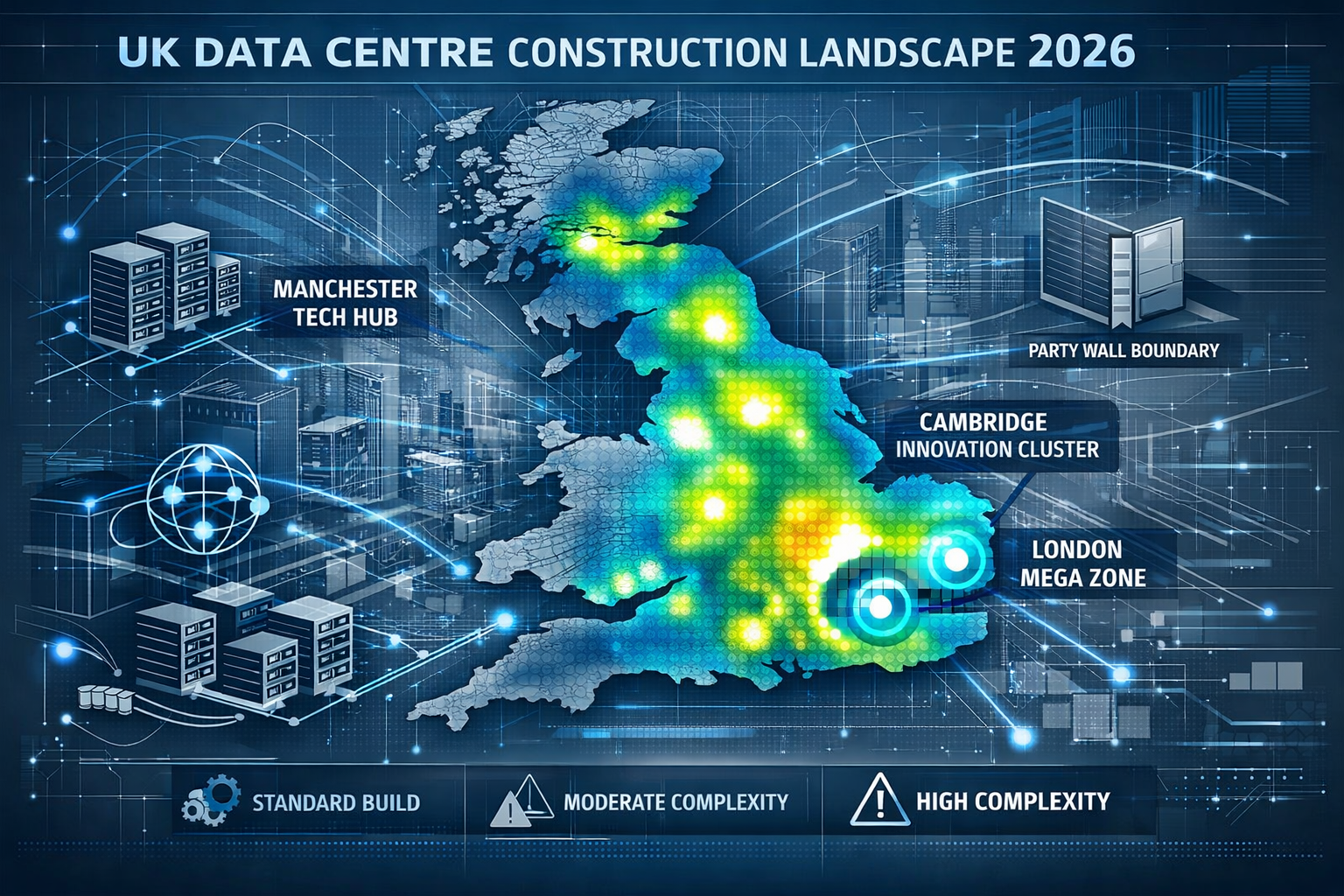
Regional Considerations Across the UK
Party wall procedures vary slightly across UK jurisdictions, and data centre development patterns differ regionally:
London and Southeast 🏙️
- Highest concentration of data centre development
- Complex urban sites with multiple boundaries
- Experienced surveyor pool
- Higher cost structures
- Access our central London and east London resources
Regional Hubs
- Manchester, Birmingham, Edinburgh emerging as data centre locations
- Often larger sites with fewer boundary issues
- May require educating less experienced adjoining owners
- Different cost expectations
Cost Management in Party Wall Procedures
Understanding and managing party wall costs is crucial for data centre projects:
Typical Cost Components:
- Surveyor fees (both building owner's and adjoining owner's)
- Monitoring and inspection costs
- Schedule of condition preparation
- Specialist consultant fees
- Insurance premiums
- Dispute resolution costs
Cost Control Strategies:
- Agree fee structures upfront
- Define scope limits clearly
- Establish approval processes for additional work
- Use technology to reduce inspection frequency
- Implement efficient communication protocols
For guidance on controlling expenses, review our article on how to keep party wall costs down.
Conclusion
Party Wall Awards in the 2026 Data Centre Boom: Drafting Enforceable Clauses for High-Stakes Projects represents a critical evolution in party wall practice. The unprecedented scale, technical complexity, and financial exposure of modern data centre developments demand a fundamental rethinking of traditional approaches.
Surveyors who succeed in this environment will:
- Embrace project-specific drafting rather than relying on generic templates
- Master technical specifications relevant to industrial construction
- Balance commercial realities with statutory protections
- Leverage technology for enhanced accuracy and efficiency
- Anticipate disputes through comprehensive, clear provisions
- Maintain professional standards while adapting to new challenges
Actionable Next Steps
For Building Owners and Developers: 🎯
- Engage experienced party wall surveyors early in project planning
- Allocate adequate budget and time for thorough party wall procedures
- Provide complete technical information to enable comprehensive awards
- Maintain open communication with neighbouring property owners
- Ensure insurance coverage appropriate to project scale
For Adjoining Owners:
- Appoint qualified surveyors with relevant industrial project experience
- Respond promptly to party wall notices
- Insist on comprehensive schedules of condition
- Understand your rights under the Party Wall Act
- Maintain detailed records of all communications and site conditions
For Surveyors:
- Invest in continuing professional development on data centre construction
- Build relationships with specialist technical consultants
- Develop project-specific award templates and checklists
- Adopt digital tools for enhanced service delivery
- Share lessons learned with the professional community
The data centre boom of 2026 presents both challenges and opportunities for party wall professionals. By applying the principles, templates, and strategies outlined in this guide, surveyors can draft enforceable awards that protect all parties' interests while enabling these vital infrastructure projects to proceed efficiently.
The future of party wall practice lies in combining deep understanding of statutory requirements with commercial pragmatism and technical expertise. Those who master this balance will find themselves in high demand as the digital economy continues its relentless expansion.
For expert guidance on your data centre party wall requirements, explore our comprehensive resources on party wall procedures and connect with experienced professionals who understand the unique demands of high-stakes industrial projects.
References
[1] Party Wall Surveys For Data Centre Expansions In The Uk Ai Boom Rics Guidance And Case Studies From 2026 Projects – https://nottinghillsurveyors.com/blog/party-wall-surveys-for-data-centre-expansions-in-the-uk-ai-boom-rics-guidance-and-case-studies-from-2026-projects
[2] Party Wall Surveys For Data Centre Expansions Navigating Agreements In The 2026 Investment Surge – https://nottinghillsurveyors.com/blog/party-wall-surveys-for-data-centre-expansions-navigating-agreements-in-the-2026-investment-surge
