

The Party Wall Etc Act: Your Complete Guide to Shared Wall Legislation in 2026

Imagine discovering that your neighbour’s planned loft conversion could legally affect your property—and you have just 14 days to respond. This scenario plays out thousands of times across England and Wales every year, yet many property owners remain unaware of the Party Wall Etc Act 1996 until construction disputes arise. Understanding this crucial piece of legislation can save homeowners from costly legal battles, construction delays, and damaged neighbourly relationships.
The party wall etc act provides a legal framework that balances property owners’ rights to improve their homes with neighbours’ rights to protect their properties from potential damage. Whether you’re planning a home extension, loft conversion, or basement excavation, this comprehensive guide will help you navigate the complexities of party wall legislation with confidence.
Key Takeaways
- 🏠 The Party Wall Etc Act 1996 applies exclusively to England and Wales, governing building works that affect shared walls, boundary structures, and nearby excavations
- ⏰ Building owners must serve formal notice 2 months before most party wall works or 1 month before excavation works, with adjoining owners having exactly 14 days to respond
- 💷 Surveyor fees for disputed party wall matters typically range from £1,500–£5,000, though costs can be managed through agreed surveyors and proper planning
- 📋 A schedule of condition documenting the adjoining property’s pre-work state is essential for protecting all parties against future damage disputes
- ⚖️ Neighbours cannot permanently block legitimate building works through the party wall process—the Act provides dispute resolution mechanisms to allow work to proceed with appropriate protections
What Is the Party Wall Etc Act 1996?
The Party Wall Etc Act 1996 is the governing legislation that regulates building works affecting shared walls, structures, and boundaries between neighbouring properties in England and Wales[1][3]. This Act replaced various local acts and created a unified framework for resolving disputes and protecting property owners’ interests during construction work.
Geographic Application and Scope
The party wall etc act applies exclusively to England and Wales[1][3]. Property owners in Scotland and Northern Ireland operate under different legal frameworks. This geographic limitation is crucial for anyone purchasing property or planning construction work across different UK jurisdictions.
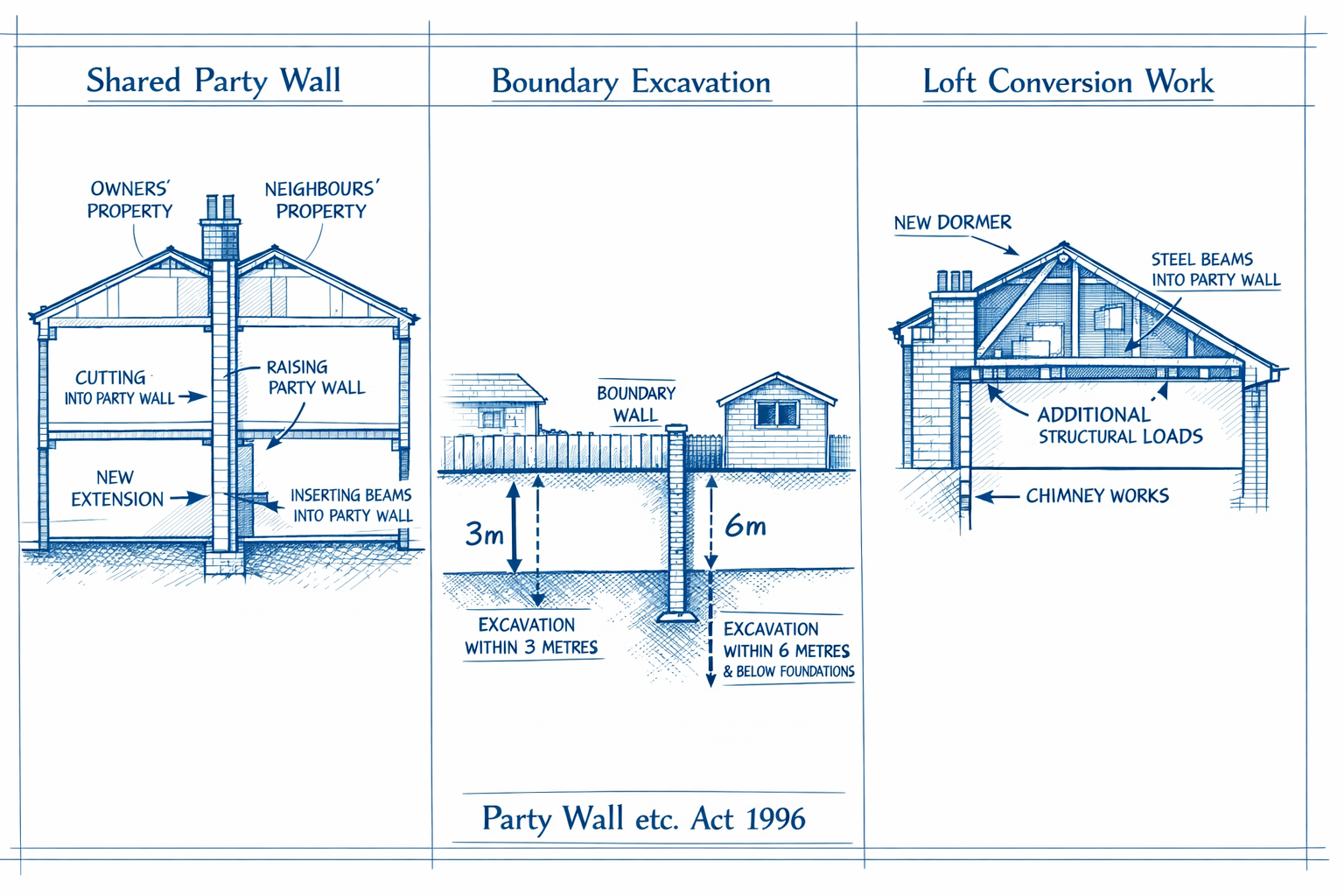
The legislation covers three primary categories of work:
Category 1: Work Directly to Party Walls
- Building a new wall on the boundary line
- Cutting into a party wall to insert beams
- Raising, underpinning, or demolishing party walls
- Removing chimney breasts from party walls
Category 2: Work to Party Structures
- Loft conversions affecting shared roof structures
- Inserting damp proof courses into party walls
- Structural alterations to floors or walls
Category 3: Excavation Near Neighbouring Properties
- Digging foundations within 3 meters of a neighbour’s structure (if deeper than their foundations)
- Excavating within 6 meters of a neighbour’s building (if the work extends below a 45-degree angle from their foundation base)[2]
What the Act Does NOT Cover
Understanding the limitations is equally important. The party wall etc act does not require formal notices for[3]:
- ✅ Plastering walls
- ✅ Electrical work installations
- ✅ Drilling into walls for kitchen units or shelving
- ✅ Minor decorative works
- ✅ Routine maintenance that doesn’t affect the structure
For clarity on what constitutes notifiable work, property owners should review the types of party wall works that trigger the Act’s requirements.
Understanding Party Wall Notices: Requirements and Timelines
Serving the correct party wall notice at the appropriate time is fundamental to legal compliance under the party wall etc act. The legislation establishes strict timelines that building owners must follow to avoid legal complications.
Notice Period Requirements
The Act mandates specific notice periods depending on the type of work[3]:
| Type of Work | Notice Period | Notice Type |
|---|---|---|
| Building on or near the boundary line | 1 month | Line of Junction Notice |
| Work directly to existing party walls/structures | 2 months | Party Structure Notice |
| Excavation within 3m or 6m of neighbour’s property | 1 month | Notice of Adjacent Excavation |
These notice periods are minimum requirements. Building owners cannot legally commence work before the notice period expires, even if the neighbour consents immediately[7].
What Must Be Included in a Party Wall Notice
A valid party wall notice must contain[4]:
- 📝 Building owner’s name and address
- 📝 Adjoining owner’s name and address
- 📝 Detailed description of the proposed works
- 📝 Date when works will commence (after notice period expires)
- 📝 Technical drawings or plans showing the work
- 📝 Clear statement of rights under the Act
Professional guidance on party wall notices can ensure all legal requirements are met from the outset.
The Critical 14-Day Response Window
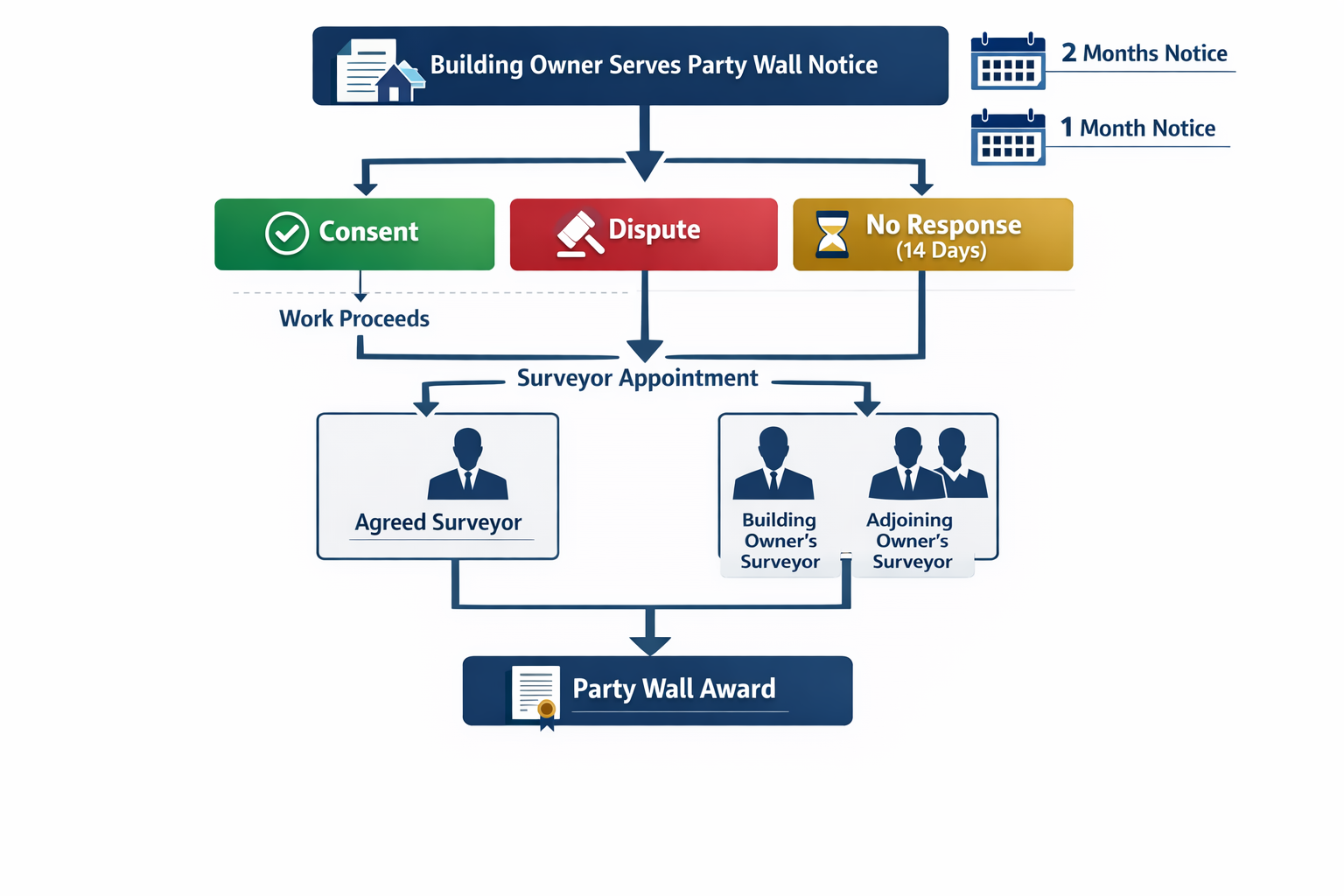
Once a party wall notice is served, adjoining owners have exactly 14 days to respond[2]. This timeframe is absolute and begins from the date of receipt. The adjoining owner has three options:
Option 1: Consent ✅
The adjoining owner agrees to the works in writing. No party wall award is required, and work can proceed after the notice period expires.
Option 2: Dissent ❌
The adjoining owner formally objects or raises concerns. This triggers the dispute resolution process requiring surveyor appointments.
Option 3: No Response ⏰
Silence or failure to respond within 14 days automatically constitutes a deemed dissent[2]. This creates a dispute by default, requiring surveyor involvement.
“Many property owners mistakenly believe that ignoring a party wall notice makes the problem disappear. In reality, non-response triggers the dispute resolution mechanism and may result in the building owner appointing a surveyor on the neighbour’s behalf.”[4]
Understanding how to respond to party wall notices properly can prevent unnecessary complications and costs.
The Party Wall Dispute Resolution Process
When consent is not obtained—either through formal dissent or deemed dissent—the party wall etc act provides a structured dispute resolution mechanism that ensures work can proceed while protecting all parties’ interests.
Appointing Party Wall Surveyors
The Act allows for two approaches to surveyor appointments[2]:
Agreed Surveyor Approach 💰 (More Cost-Effective)
Both parties jointly appoint a single “Agreed Surveyor” who acts impartially to prepare the party wall award. This approach typically costs £1,000–£2,500 and streamlines the process[2].
Separate Surveyors Approach 💷 (Traditional Method)
Each party appoints their own surveyor:
- Building owner appoints their surveyor
- Adjoining owner appoints their surveyor
- The two surveyors work together to prepare the award
- If they cannot agree, they appoint a third surveyor whose decision is binding[2]
This approach typically costs £1,500–£5,000 depending on complexity[2].
What If a Neighbour Refuses to Appoint a Surveyor?
The legislation prevents obstruction through refusal. If an adjoining owner fails to appoint a surveyor within 10 days of being requested, the building owner’s surveyor can appoint one on their behalf[9]. This ensures the process cannot be indefinitely delayed.
The Party Wall Award: Legal Protection for All Parties
The culmination of the surveyor process is the party wall award—a legally binding document that[8]:
- 📋 Describes the works to be undertaken in detail
- 📋 Specifies the time and manner of execution
- 📋 Records the pre-work condition of adjoining properties
- 📋 Establishes procedures for resolving future disputes
- 📋 Allocates costs and fees
The award must include a schedule of condition—comprehensive photographic and written evidence documenting the adjoining property’s condition before works commence[3]. This critical component protects both parties by establishing a baseline for assessing any damage claims.
For detailed information on awards, consult our guide to party wall awards.
Can a Neighbour Stop Your Loft Conversion?
A common misconception is that neighbours can permanently prevent legitimate building work through the party wall process. This is not true[2]. The party wall etc act provides a dispute resolution mechanism designed to allow work to proceed with appropriate safeguards, not to grant neighbours veto power over lawful development.
While neighbours cannot stop a loft conversion permanently, the Act ensures they receive:
- ✅ Proper notice of the works
- ✅ Protection against damage to their property
- ✅ Documentation of pre-existing conditions
- ✅ Right to have concerns addressed by impartial surveyors
- ✅ Compensation for any damage caused by the works
Common Building Works Requiring Party Wall Agreements
Understanding which projects trigger the party wall etc act helps property owners plan effectively and budget appropriately for compliance costs.
Loft Conversions and Roof Extensions
Loft conversions frequently require party wall agreements because they typically involve[2][3]:
- Cutting into or removing party walls for staircases
- Adding steel beams that rest on party walls
- Raising party walls to create additional headroom
- Altering shared roof structures in semi-detached or terraced properties
Even if the main work occurs entirely within your property, any structural interaction with shared elements triggers notice requirements. Property owners in Central London, North London, and other densely populated areas should be particularly aware of these requirements due to the prevalence of terraced and semi-detached housing.
Basement Excavations and Extensions
Basement projects are among the most complex party wall matters because they often involve both party structure work and excavation near neighbouring foundations[6]. Modern building practices increasingly require deeper foundations, which has significant party wall implications[6].
The Act applies to excavation work when[2]:
- Digging within 3 meters of a neighbour’s structure and going deeper than their foundations
- Excavating within 6 meters of a neighbour’s building where the work extends below a 45-degree line from the bottom of their foundations
These provisions protect neighbouring properties from subsidence and structural instability caused by nearby excavation.
Inserting Damp Proof Courses
Installing a damp proof course (DPC) into a party wall requires a party structure notice because it involves cutting into the shared structure[3]. This work is common in older properties where rising damp affects party walls.
Building New Walls on Boundary Lines
Constructing a new wall directly on the boundary line between properties—such as a party fence wall—requires a Line of Junction Notice with a 1-month notice period[3].
Understanding the difference between party fence walls and boundary walls is essential for determining notice requirements.
Managing Party Wall Costs in 2026
The financial aspects of party wall compliance concern many property owners. Understanding the cost structure and strategies for minimizing expenses can significantly impact project budgets.
Typical Cost Breakdown
Agreed Surveyor Scenario (Consent Obtained or Cooperative Dispute)
- Single surveyor fee: £1,000–£2,500
- Schedule of condition: Included in surveyor fee
- Total estimated cost: £1,000–£2,500[2]
Disputed Scenario (Separate Surveyors)
- Building owner’s surveyor: £1,500–£3,000
- Adjoining owner’s surveyor: £1,500–£3,000
- Third surveyor (if required): £1,000–£2,000
- Total estimated cost: £3,000–£8,000[2]
Who Pays?
Under the party wall etc act, the building owner (the person undertaking the works) typically bears all reasonable surveyor costs[7]. This includes fees for both their own surveyor and the adjoining owner’s surveyor.
Strategies to Keep Costs Down
Property owners can implement several practical strategies to minimize party wall expenses:
1. Early Neighbour Communication 🗣️
Discussing plans with neighbours before serving formal notices often leads to consent without dispute. This eliminates the need for surveyors entirely or allows for an agreed surveyor approach.
2. Propose an Agreed Surveyor 🤝
Suggesting a mutually acceptable agreed surveyor can reduce costs by 50% or more compared to separate surveyors[2].
3. Serve Notices Early ⏰
Rushing the process increases stress and potential for disputes. Serving notices well in advance demonstrates professionalism and allows time for discussions[7].
4. Provide Clear, Detailed Plans 📐
Comprehensive drawings and specifications reduce ambiguity and neighbour concerns, making consent more likely.
5. Choose Experienced Surveyors 👷
While it may seem counterintuitive, experienced party wall surveyors often resolve matters more efficiently, reducing overall costs despite potentially higher hourly rates.
For comprehensive guidance, review our article on how to keep party wall costs down and explore the costs of party wall processes.
Legal Consequences of Non-Compliance
Failing to comply with the party wall etc act creates significant legal and practical risks that can derail construction projects and result in substantial financial penalties.
Party Wall Injunctions
If a building owner commences work without serving the required notices, adjoining owners can apply for a party wall injunction[3]. This court order:
- ⛔ Immediately halts all construction work
- ⛔ Requires proper notices to be served
- ⛔ Restarts the entire notice period (1-2 months)
- ⛔ May result in legal costs being awarded against the building owner
The delays caused by injunctions can add months to project timelines and thousands of pounds in holding costs, contractor delays, and legal fees.
Difficulty Establishing Causation for Damage
Perhaps the most significant practical consequence of non-compliance is the inability to establish which damage was caused by the works versus pre-existing conditions[3]. Without a proper schedule of condition prepared before works commence, building owners face:
- Liability for damage they didn’t cause
- Inability to defend against exaggerated claims
- Costly disputes over repair responsibilities
- Potential insurance complications
“The schedule of condition is your insurance policy. It provides irrefutable evidence of the property’s state before your works began, protecting you from unfair damage claims and protecting your neighbour from uncompensated legitimate damage.”[5]
Professional Liability and Insurance Issues
Building contractors and professionals who proceed without ensuring party wall compliance may face:
- Professional negligence claims
- Insurance policy exclusions
- Regulatory sanctions from professional bodies
- Reputational damage
Practical Tips for Building Owners in 2026
Successfully navigating the party wall etc act requires strategic planning and professional guidance. These practical tips help building owners manage the process effectively.
Start the Process Early
Recommended Timeline:
- Begin party wall considerations 4-6 months before planned construction start date
- Serve notices 3-4 months before desired start date
- Allow time for potential disputes and surveyor appointments
- Factor party wall timelines into overall project planning[7]
Maintain Professional Communication
Best Practices:
- Keep all communications respectful and professional
- Document all conversations and agreements in writing
- Avoid confrontational language or ultimatums
- Consider face-to-face meetings before formal notices
- Be transparent about project scope and timeline
Consider Professional Representation
While the Act allows building owners to serve notices themselves, professional assistance often proves valuable:
When to Consider Professional Help:
- Complex projects involving multiple neighbours
- High-value properties where mistakes are costly
- Situations where neighbour relationships are already strained
- Technically complex works requiring detailed specifications
- Projects in areas with high property values (South London, West London, East London)
Document Everything
Essential Documentation:
- Copies of all notices served (with proof of delivery)
- Neighbour responses or evidence of non-response
- Photographs of existing conditions
- Correspondence with surveyors
- Final party wall award
- Completion photographs
This documentation protects against future disputes and provides evidence of compliance if questions arise during property sales.
Understand Your Rights and Obligations
Building owners should familiarize themselves with:
- Their right to undertake lawful development
- Obligations to protect neighbouring properties
- The dispute resolution process
- Cost allocation principles
- Rights of access for surveyors and inspections
Resources for building owners provide comprehensive guidance on navigating these responsibilities.
Practical Tips for Adjoining Owners
Receiving a party wall notice can be concerning, but understanding your rights under the party wall etc act helps ensure your property receives appropriate protection.
Don’t Ignore the Notice
The 14-day response deadline is absolute[2]. Failing to respond triggers a deemed dissent, which:
- Creates a dispute by default
- Requires surveyor appointments
- Increases costs (which the building owner pays, but may affect neighbourly relations)
- Removes your opportunity to consent with agreed conditions
Understand Your Response Options
If You’re Comfortable with the Works:
Provide written consent. You can consent with conditions, such as:
- Specific working hours
- Access arrangements
- Protection measures for your property
- Communication protocols
If You Have Concerns:
Dissent and appoint a surveyor who will:
- Inspect your property and document existing conditions
- Review the proposed works technically
- Negotiate protective measures
- Ensure a comprehensive schedule of condition
- Monitor works during construction
If You’re Unsure:
Seek professional advice immediately—the 14-day window doesn’t pause for deliberation.
You Cannot Permanently Stop Lawful Development
Understanding this fundamental principle prevents unrealistic expectations. The Act provides mechanisms to:
- ✅ Ensure proper notice
- ✅ Document existing conditions
- ✅ Protect against damage
- ✅ Obtain compensation for any damage
- ❌ Veto neighbour’s lawful building works
Resources for adjoining owners offer detailed guidance on protecting your interests throughout the process.
Consider the Costs and Benefits
While building owners pay surveyor fees, appointing your own surveyor provides:
- Independent professional advice
- Technical review of proposed works
- Negotiation of protective measures
- Peace of mind through proper documentation
- Protection of your property value
For straightforward works with trusted neighbours, an agreed surveyor may be appropriate. For complex projects or uncertain situations, separate representation offers valuable protection.
The Schedule of Condition: Your Essential Protection
The schedule of condition represents one of the most critical components of party wall compliance under the party wall etc act, yet it’s often underestimated by both building and adjoining owners.
What Is a Schedule of Condition?
A schedule of condition is a comprehensive record documenting the adjoining property’s condition before construction works commence[3]. It typically includes:
- 📸 Extensive photographs of all relevant areas
- 📸 Written descriptions of existing defects or damage
- 📸 Measurements and technical observations
- 📸 Video documentation for complex situations
- 📸 Date-stamped evidence
Why It Matters
Without a proper schedule of condition, disputes about damage become “he said, she said” arguments. The schedule provides:
For Building Owners:
- Protection against claims for pre-existing damage
- Clear baseline for assessing any damage caused by works
- Defense against exaggerated repair demands
- Evidence for insurance purposes
For Adjoining Owners:
- Documentation of property condition before works
- Basis for claiming compensation for legitimate damage
- Professional record prepared by qualified surveyor
- Protection of property value
What Should Be Documented?
A comprehensive schedule of condition covers:
- Internal walls and ceilings (particularly those adjacent to the party wall)
- External walls and facades
- Floors and floor finishes
- Decorative condition (paintwork, wallpaper, tiles)
- Existing cracks or structural issues
- Windows and doors (especially those near work areas)
- Drainage systems and external areas
- Any pre-existing damage or defects
The more thorough the documentation, the better the protection for all parties.
Regional Considerations Across London
The application of the party wall etc act remains consistent across England and Wales, but practical considerations vary by location, particularly in densely populated urban areas like London.
Central London Considerations
Central London presents unique challenges:
- High density of terraced and semi-detached properties
- Listed buildings with additional regulatory requirements
- Conservation area restrictions
- Premium property values increasing dispute stakes
- Limited access for construction equipment
Suburban London Areas
Areas in North, South, East, and West London often feature:
- Larger properties with more complex boundary issues
- Basement excavations triggering the 3m/6m rules
- Mixed property types requiring varied approaches
- Established neighbourhoods with long-term residents
Understanding local property characteristics helps anticipate party wall requirements and plan accordingly.
Frequently Asked Questions About the Party Wall Etc Act
Q: Can I proceed with minor repairs without a party wall notice?
Yes. Plastering, painting, electrical work, and drilling for fixtures do not require notices under the party wall etc act[3]. Only structural work affecting party walls or excavations near boundaries trigger notice requirements.
Q: What happens if my neighbour is unreasonable?
The Act’s dispute resolution mechanism ensures that unreasonable objections cannot permanently prevent lawful development. Surveyors are required to act impartially and make practical decisions that balance both parties’ interests[2].
Q: How long does the party wall process take?
Minimum timelines are 1-2 months for notice periods[3]. If disputes arise requiring surveyor appointments, add 4-8 weeks for award preparation. Total timeline: 3-4 months for straightforward matters, longer for complex disputes.
Q: Can I use a party wall agreement template?
While templates exist, party wall matters are highly specific to individual circumstances. Professional guidance ensures compliance and appropriate protection. However, sample party wall agreement templates can help understand the structure.
Q: What if I’m buying a property with ongoing party wall works?
Purchasers should request copies of all party wall notices, awards, and correspondence. Outstanding party wall matters can affect property value and use[1]. Ensure your solicitor reviews all party wall documentation during conveyancing.
Q: Do I need a party wall agreement for a garden wall?
It depends on the wall’s location and function. A boundary wall entirely on your property doesn’t require agreement, but a wall on the boundary line does[3].
Conclusion: Navigating the Party Wall Etc Act Successfully
The Party Wall Etc Act 1996 provides essential protections for property owners undertaking building works while safeguarding neighbours’ interests. Understanding this legislation transforms what might seem like bureaucratic obstacles into valuable protections for all parties involved.
Key Success Factors
✅ Plan Early – Begin party wall considerations 4-6 months before construction
✅ Communicate Professionally – Maintain respectful dialogue with neighbours
✅ Serve Proper Notices – Ensure compliance with notice requirements and timelines
✅ Document Thoroughly – Obtain comprehensive schedules of condition
✅ Seek Professional Guidance – Engage experienced surveyors for complex matters
✅ Understand Your Rights – Know what the Act requires and what it protects
Next Steps for Building Owners
If you’re planning construction work that may trigger the party wall etc act:
- Review your project plans against the three categories of notifiable work
- Identify all potentially affected neighbours (including those within 6m of excavations)
- Consult with a party wall surveyor to understand your obligations
- Prepare comprehensive drawings and specifications for your notices
- Initiate neighbour discussions before serving formal notices
- Serve notices with appropriate lead time (minimum 1-2 months before work)
- Respond promptly to any concerns or disputes that arise
Next Steps for Adjoining Owners
If you’ve received a party wall notice:
- Read the notice carefully and understand what work is proposed
- Respond within 14 days to avoid deemed dissent
- Consider whether to consent or appoint a surveyor based on work complexity
- Seek professional advice if you have concerns about the proposed works
- Ensure a thorough schedule of condition is prepared before works commence
- Maintain communication with the building owner and surveyors throughout
The party wall etc act exists to facilitate necessary building works while protecting property interests. With proper understanding, professional guidance, and good faith cooperation, the process protects everyone involved and enables property improvements to proceed smoothly.
For personalized guidance on your specific situation, consider consulting with experienced professionals who understand both the legal requirements and practical realities of party wall matters in 2026.
References
[1] Buying Property Party Wall Award – https://osborneslaw.com/blog/buying-property-party-wall-award/
[2] Party Wall Agreement Loft Conversion – https://www.houseup.co.uk/news/party-wall-agreement-loft-conversion
[3] Party Wall Agreement – https://hoa.org.uk/advice/guides-for-homeowners/i-am-improving/party-wall-agreement/
[4] Options For Responding To Party Wall Notices A Complete Guide For Homeowners – https://www.adamjoseph.co.uk/options-for-responding-to-party-wall-notices-a-complete-guide-for-homeowners
[5] Understanding Party Wall Matters Why Early Advice Protects You Your Property And Your Neighbours – https://thebusinessgroup.co.uk/understanding-party-wall-matters-why-early-advice-protects-you-your-property-and-your-neighbours/
[6] Are Foundations Getting Deeper A Look At Modern Building Practice And Party Wall Implications – https://www.peterbarry.co.uk/blog/are-foundations-getting-deeper-a-look-at-modern-building-practice-and-party-wall-implications/
[7] 2026 Building Owner Party Wall Tips – https://www.simplesurvey.co.uk/uncategorised/2026-building-owner-party-wall-tips/
[8] Party Walls – https://carterjonas.co.uk/services/party-walls
[9] Party Walls Frequently Asked Questions – https://www.lexisnexis.co.uk/legal/guidance/party-walls-frequently-asked-questions