
A staggering 90% of building owners serve invalid Party Wall Notices due to statutory defects that could have been easily prevented. These seemingly minor drafting errors—missing dates, incorrect owner identification, vague work descriptions—can halt construction projects, trigger costly legal disputes, and expose property owners to injunctions before a single brick is laid. Understanding Party Wall Notice drafting errors that invalidate compliance: avoiding legal challenges before work begins is not merely advisable; it’s essential for anyone planning construction work near shared boundaries in 2026.
The Party Wall etc. Act 1996 establishes strict requirements for notifying adjoining owners about planned works. Yet despite clear statutory guidance, the majority of DIY notices fail to meet basic legal standards. This comprehensive guide examines the critical mistakes that render notices invalid, provides actionable checklists to ensure compliance, and equips building owners with the knowledge to navigate party wall procedures confidently.

Key Takeaways
- Three mandatory elements must be present in every valid notice: clear identification of the building owner, accurate description of proposed works, and correct service within statutory timeframes
- Wrong notice type selection is a primary cause of invalidity—Section 1, Section 3, and Section 6 notices each serve different purposes and require specific information
- Incorrect owner identification renders notices void—notices must be served to all legal owners including freeholders, long leaseholders, and joint owners, not just occupants
- Notice periods matter critically: two months for party wall works, one month for excavation works, with a 12-month validity window from service date
- 2026 legislative changes have expanded tenant rights considerations, particularly affecting institutional buy-to-let properties with new compliance obligations
Understanding the Three Core Elements of Valid Party Wall Notices
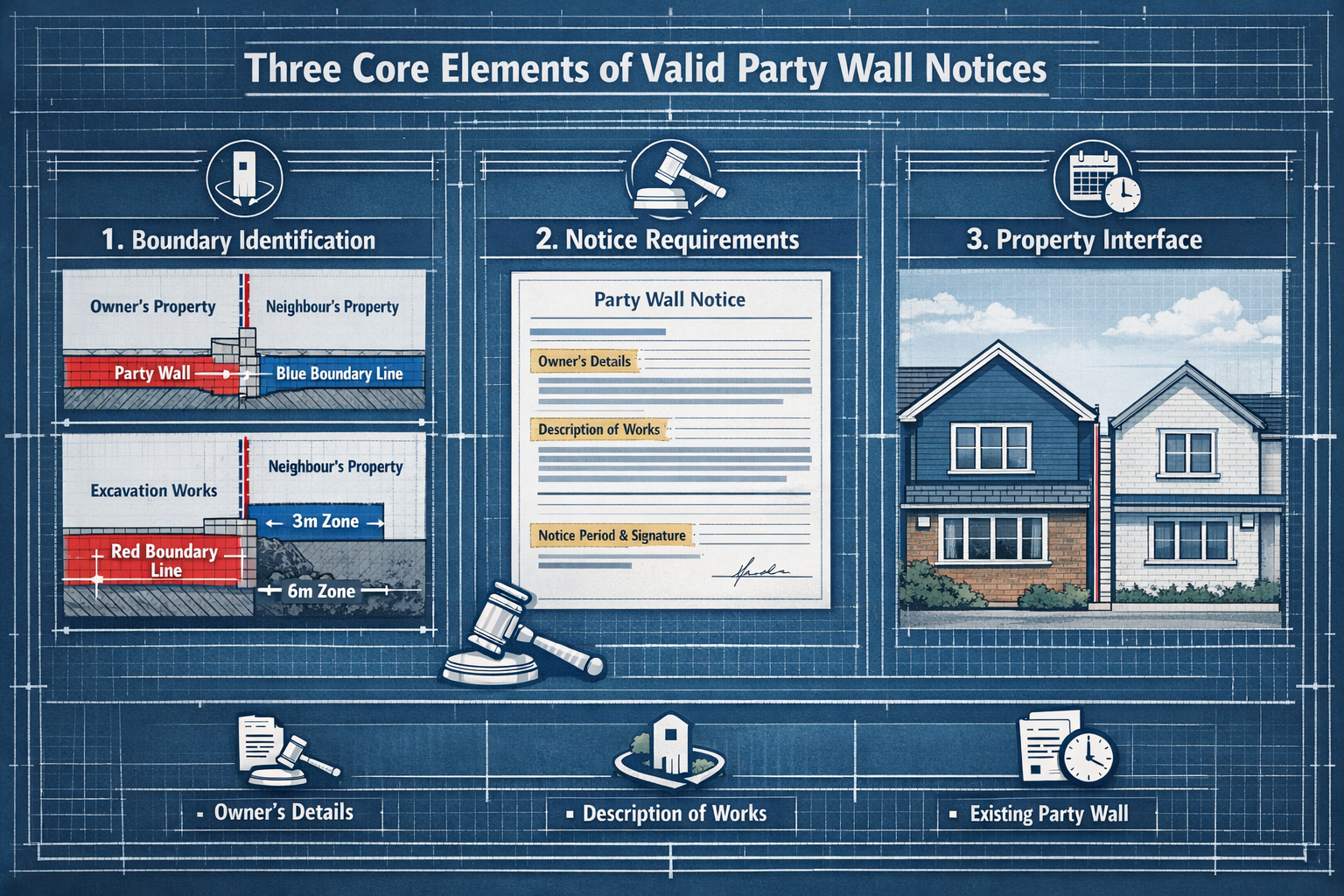
Every legally compliant party wall notice must contain three fundamental components that work together to satisfy statutory requirements. Missing even one element can invalidate the entire notice and leave building owners vulnerable to legal challenges.
Element 1: Clear Building Owner Identification
The building owner’s identification must be precise and legally accurate. This means:
- Full legal name exactly as it appears on Land Registry records
- Complete address of the property where works will occur
- Contact information for correspondence
A common mistake occurs when notices list a trading name, abbreviated name, or informal version that doesn’t match official property ownership records. For example, serving a notice as “J. Smith” when Land Registry shows “Jonathan Michael Smith” creates a discrepancy that can invalidate the notice.
In 2026, with increasingly complex property ownership structures including trusts, companies, and multiple joint owners, this requirement demands careful verification. Building owners should obtain current Land Registry documents before drafting notices to ensure accuracy.
Element 2: Accurate Work Description
Vagueness is the primary reason DIY notices fail legal scrutiny. The work description must be sufficiently detailed that an adjoining owner can reasonably understand what is being proposed without ambiguity.
A valid description includes:
✅ Specific work type: “Construction of single-storey rear extension” not “building work”
✅ Dimensions and measurements: “3.5m wide x 4m deep x 3m high”
✅ Materials to be used: “Brick cavity wall construction with concrete foundations”
✅ Relationship to party wall: “Works will involve cutting into existing party wall to insert steel beam”
✅ Foundation details: Depth, width, and proximity to boundary for excavation works
Generic phrases like “home improvements,” “renovation works,” or “extension” provide insufficient detail. Adjoining owners must be able to assess potential impact on their property, which requires concrete specifications.
For guidance on different work categories, review the comprehensive information on types of party wall works that require formal notification.
Element 3: Correct Service and Timing
The notice must be served correctly and within the appropriate timeframe:
| Work Type | Required Notice Period | Statutory Reference |
|---|---|---|
| Party wall or structure works | 2 months | Section 3 |
| New wall on boundary line | 1 month | Section 1 |
| Excavation within 3m (deeper than neighbour’s foundation) | 1 month | Section 6 |
| Excavation within 6m (within 45° plane) | 1 month | Section 6 |
Critical timing considerations:
⏰ Proposed start date must be clearly stated and at least the minimum notice period away
⏰ 12-month validity window: Works must commence within 12 months of service or the notice expires
⏰ No premature commencement: Starting work before the notice period expires invalidates the entire process
Service must be in writing (paper or electronic) and delivered by legally recognized methods: hand delivery, recorded post, or another method that provides evidence of receipt. Verbal notifications have no legal standing under the Act.
Understanding party wall notices and their proper service requirements is fundamental to compliance.
Common Drafting Errors That Invalidate Party Wall Notices
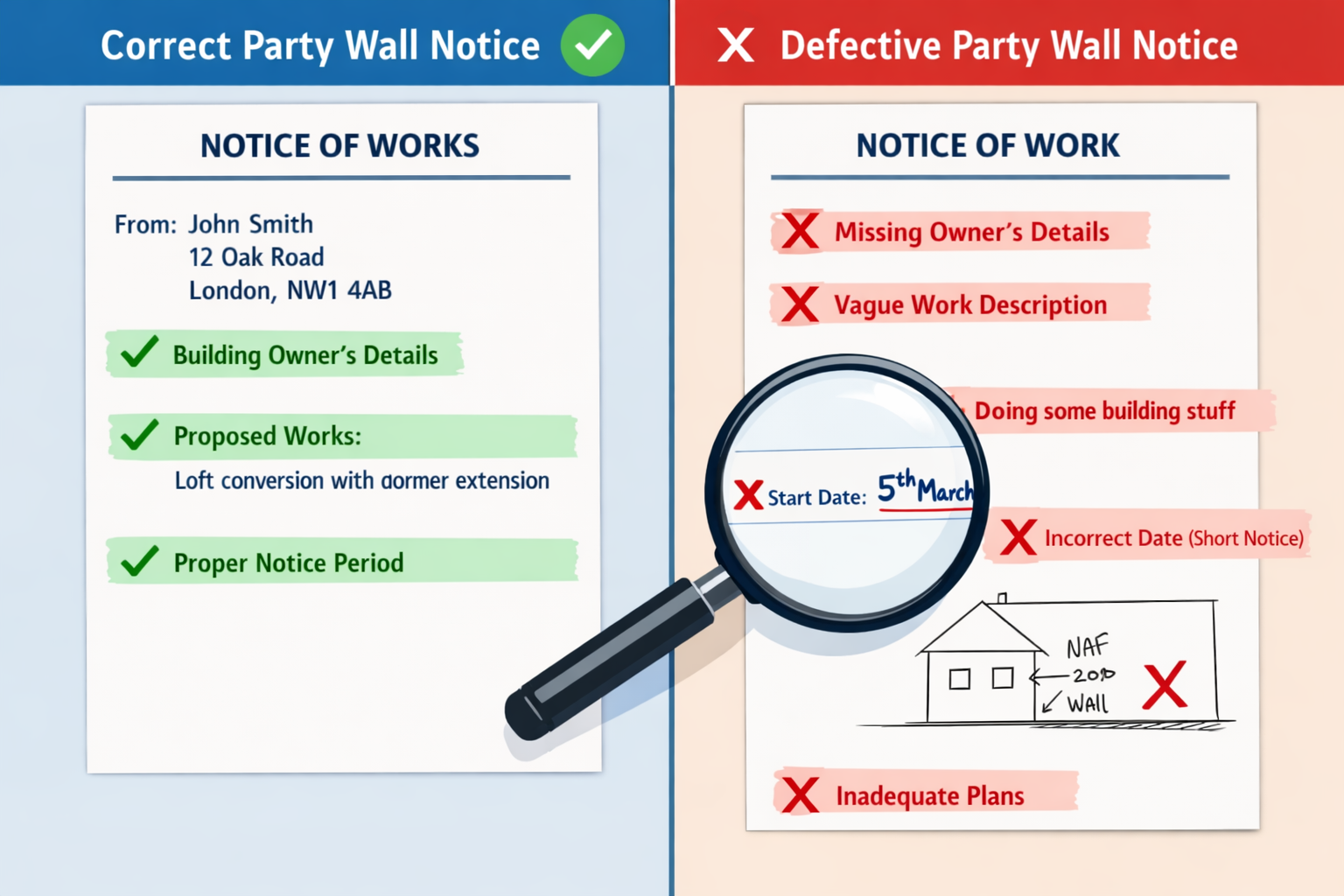
Error 1: Wrong Notice Type Selection
The Party Wall etc. Act 1996 establishes three distinct notice types, each designed for specific work categories. Using the wrong notice type—or attempting to use a generic template for all situations—is a fundamental error that invalidates compliance.
Section 1 Notice (Line of Junction Notice) 📋
Required for: Building a new wall directly on the boundary line between properties
Section 3 Notice (Party Structure Notice) 🏗️
Required for: Works to existing party walls, party structures, or boundary walls (repairs, alterations, underpinning, cutting into walls, inserting beams)
Section 6 Notice (Excavation Notice) ⛏️
Required for: Excavation or construction of foundations within specified distances of neighbouring buildings
Many DIY notices fail because building owners use a Section 3 template for excavation works or attempt to combine multiple notice types into a single document. Each notice type requires different technical information and documentation.
For detailed guidance on party structure works, consult resources on what is a party structure notice and how to serve it.
Error 2: Incorrect or Incomplete Adjoining Owner Identification
One of the most frequent invalidating errors involves serving notices to the wrong party or failing to identify all legal owners. In 2026, property ownership structures have become increasingly complex, making this error more common.
Who must receive notice:
✔️ Freeholders (always)
✔️ Long leaseholders (leases with more than one year remaining)
✔️ All joint owners (each must receive individual notice)
✔️ Mortgagees in certain circumstances
Common mistakes:
❌ Serving notice only to the occupant when they’re tenants, not owners
❌ Serving to “The Owner” or “The Occupier” rather than named individuals
❌ Missing joint owners (e.g., serving only one spouse when both are on the title)
❌ Serving to outdated owners after property has changed hands
❌ Assuming the person you speak to is the legal owner
2026 Legislative Update: Recent changes have repositioned tenant rights as central to party wall procedures, particularly for institutional buy-to-let properties. While tenants aren’t typically served with notices (as they’re not legal owners), landlords must now consider additional compliance obligations when initiating works that may affect tenanted properties.
To verify current ownership, building owners should:
- Obtain up-to-date Land Registry title documents (£3 online)
- Check for multiple registered proprietors
- Verify lease lengths for leasehold properties
- Confirm current addresses for service
Error 3: Insufficient or Missing Technical Drawings
Visual documentation is not merely helpful—it’s often statutorily required for notices to be valid. The level of detail required varies by notice type, but insufficient drawings are a common deficiency that can invalidate notices.
Minimum drawing requirements:
📐 Location plan: Showing the property, adjoining properties, and boundary lines
📐 Proposed work drawings: Elevations, sections, and floor plans showing the work in relation to the party wall
📐 Foundation details: For excavation works, showing depth, distance from boundary, and relationship to neighbouring foundations
📐 Structural details: For works involving cutting into walls or inserting beams
Common drawing deficiencies:
- Hand-sketched diagrams without measurements
- Plans that don’t clearly show the party wall location
- Missing cross-sections for excavation works
- No indication of existing neighbouring structures
- Drawings that contradict the written description
Professional architectural drawings aren’t always necessary, but drawings must be clear, scaled (or dimensioned), and sufficiently detailed for the adjoining owner and their surveyor to understand the proposal’s impact.
Error 4: Missing or Incorrect Statutory Information
Party wall notices must include specific statutory information beyond basic work descriptions. Omitting required details creates grounds for challenge.
Required statutory elements:
📄 Building owner’s name and address (exact legal name)
📄 Property address where works will occur
📄 Adjoining owner’s name and address (verified legal owners)
📄 Proposed start date (meeting minimum notice periods)
📄 Description of works (detailed and specific)
📄 Section of Act under which notice is served (Section 1, 3, or 6)
📄 Statement of adjoining owner’s rights (14-day response period, right to appoint surveyor)
Many template notices downloaded from the internet omit the statutory statement about adjoining owners’ rights or fail to reference the specific section of the Act being invoked. These omissions can render notices invalid.
For those preparing notices themselves, reviewing a sample party wall agreement template can provide insight into required elements, though professional advice is recommended.
Error 5: Timing and Validity Period Mistakes
Timing errors represent a critical category of invalidating mistakes that can expose building owners to legal challenges and work stoppages.
Critical timing rules:
⏱️ Two-month minimum for Section 3 (party structure) notices
⏱️ One-month minimum for Section 1 and Section 6 notices
⏱️ 12-month validity from date of service—works must commence within this window
⏱️ No retrospective notices—notices cannot be served after works have begun
Common timing errors:
- Insufficient notice period: Serving a notice 6 weeks before proposed start date for party wall works (requires 8 weeks minimum)
- Missing proposed start date: Notices must state when works will begin
- Premature commencement: Starting work before the notice period expires
- Expired notices: Attempting to rely on notices served more than 12 months ago when works haven’t commenced
- Vague timing: Using phrases like “early 2026” or “spring” instead of specific dates
The 12-month validity window is particularly important. If circumstances delay the project beyond this period, new notices must be served. Simply resuming work under an expired notice is non-compliant and exposes building owners to injunctions.
Understanding costs of party wall procedures helps building owners budget appropriately when timing delays require re-serving notices.
Error 6: Unverifiable Service Methods
Even a perfectly drafted notice becomes invalid if it cannot be proven to have been properly served. Service method and documentation are critical.
Acceptable service methods:
✉️ Hand delivery: Personal delivery to the adjoining owner (obtain signed receipt)
✉️ Recorded delivery post: Provides proof of delivery date
✉️ Registered post: Traditional method with signature confirmation
✉️ Email: Acceptable if you can prove receipt (read receipt or acknowledgment)
Unacceptable or risky methods:
❌ Verbal notification: Has no legal standing whatsoever
❌ Standard post: No proof of delivery if disputed
❌ Leaving notice with occupant: Unless they’re the legal owner
❌ Posting through letterbox: Without additional proof
Best practice documentation:
- Photograph the sealed envelope with visible address before posting
- Retain postal receipts and tracking information
- Keep copies of signed delivery confirmations
- For hand delivery, obtain dated signature on a duplicate copy
- For email, retain delivery and read receipts
If service is later disputed, the burden falls on the building owner to prove proper service occurred. Without documentation, even valid notices can be challenged successfully.
Checklist for Ensuring Party Wall Notice Compliance
Pre-Drafting Verification Checklist
Before drafting any party wall notice, complete these verification steps:
Ownership Verification 🔍
- Obtain current Land Registry title for your property
- Obtain current Land Registry title for adjoining property
- Verify all registered proprietors (including joint owners)
- Check lease lengths for leasehold properties
- Confirm current addresses for all owners
- Identify any mortgagees requiring notice
Work Classification 📋
- Determine which section of the Act applies (1, 3, or 6)
- Identify if multiple notice types are required
- Confirm work involves party wall, boundary, or excavation
- Assess if work falls within statutory distances
Timing Calculation 📅
- Determine realistic project start date
- Calculate minimum notice period required
- Add buffer time for potential disputes
- Confirm work can commence within 12-month validity window
Notice Drafting Checklist
When drafting the notice, ensure inclusion of:
Essential Information ✍️
- Building owner’s full legal name (matching Land Registry)
- Building owner’s complete address
- Building owner’s contact details
- Adjoining owner’s full legal name (all joint owners)
- Adjoining owner’s complete address
- Property address where works will occur
- Specific section of Act being invoked
Work Description 🏗️
- Detailed description of proposed works
- Specific dimensions and measurements
- Materials to be used
- Relationship to party wall/boundary
- Foundation depths (for excavation works)
- Structural interventions (beams, cutting, etc.)
Timing Information ⏰
- Specific proposed start date
- Date notice is being served
- Confirmation of appropriate notice period
Statutory Statements 📄
- Statement of adjoining owner’s rights
- 14-day response period notification
- Right to appoint surveyor
- Consequences of non-response
Supporting Documentation 📎
- Location plan attached
- Proposed work drawings attached
- Cross-sections (where applicable)
- Foundation details (for excavation)
- All drawings clearly labeled and scaled
Service and Documentation Checklist
After drafting, ensure proper service:
Service Preparation 📬
- Print notice on quality paper
- Include all required attachments
- Prepare duplicate for your records
- Choose appropriate service method
Service Execution ✅
- Serve to correct address for each owner
- Use trackable delivery method
- Obtain proof of service (signature/receipt)
- Photograph envelope before posting (if postal)
- Retain all postal receipts and tracking numbers
Post-Service Documentation 📝
- File copy of served notice
- File proof of service documentation
- Create service date record
- Calculate response deadline (14 days)
- Calculate earliest work commencement date
- Set reminder for 12-month validity expiry
For building owners managing the process themselves, understanding how to keep party wall costs down while maintaining compliance is valuable.
Regional Considerations for Party Wall Notices in 2026
While the Party Wall etc. Act 1996 applies uniformly across England and Wales, practical considerations vary by region, particularly in urban areas with high-density housing.
London-Specific Considerations 🏙️
London’s dense housing stock and complex ownership structures create unique challenges:
- Higher proportion of leasehold properties requiring multiple notices
- More frequent basement excavations triggering Section 6 notices
- Greater likelihood of terraced housing with multiple adjoining owners
- Professional surveyor involvement more common due to property values
Regional resources are available for party wall surveyors in Central London, East London, South London, North London, and West London.
Buy-to-Let and Rental Properties 🏢
The 2026 legislative changes have significantly impacted party wall procedures for rental properties. Building owners with tenanted properties must now consider:
- Enhanced tenant notification requirements
- Additional compliance obligations for institutional landlords
- Coordination with Section 8 possession proceedings if works require vacant possession
- Tenant rights considerations in party wall award negotiations
These changes represent a fundamental shift in how party wall procedures intersect with tenancy law, particularly affecting professional landlords and property investment companies.
Consequences of Invalid Notices and Legal Remedies
Serving an invalid party wall notice creates significant risks and potential legal consequences that extend far beyond simple delays.
Immediate Consequences ⚠️
Work Stoppage: Adjoining owners can obtain injunctions to halt works commenced under invalid notices
Trespass Claims: Works affecting party structures without valid notice may constitute trespass, exposing building owners to damages claims
Nullified Agreements: Any agreements or awards based on invalid notices may be void
Financial Exposure: Building owners may be liable for adjoining owners’ legal costs in challenging invalid notices
Legal Remedies for Building Owners
If a notice is discovered to be invalid:
- Immediate cessation: Stop all works immediately
- Re-serve correct notice: Draft and serve compliant notice following proper procedures
- Reset timeline: Restart the statutory notice period
- Engage professional help: Consider appointing a party wall surveyor to manage the process
- Document everything: Maintain comprehensive records of corrective actions
Dispute Resolution Process
When notice validity is disputed, the Party Wall etc. Act 1996 provides a statutory dispute resolution mechanism:
- Either party can appoint a party wall surveyor
- Surveyors prepare a party wall award resolving the dispute
- Awards are binding and enforceable
- Appeals are limited to specific grounds
Understanding the party wall awards process helps building owners navigate disputes effectively.
For adjoining owners receiving notices, resources on responding to party wall notices clarify rights and options.
When to Engage Professional Party Wall Surveyors
While the Act permits building owners to serve notices themselves, professional involvement significantly reduces the risk of invalidating errors.
Situations Requiring Professional Assistance
Consider engaging a party wall surveyor when:
🏗️ Complex structural works: Basement excavations, major extensions, structural alterations
🏗️ Multiple adjoining owners: Terraced properties or developments affecting several neighbors
🏗️ High-value properties: Where potential damages or disputes could be costly
🏗️ Commercial properties: Greater complexity and higher stakes
🏗️ Previous disputes: Difficult relationships with adjoining owners
🏗️ Tight timelines: When delays would be particularly costly
Professional Services Available
Building Owner’s Surveyor 👷
- Prepares and serves compliant notices
- Manages the statutory process
- Prepares schedules of condition
- Negotiates party wall awards
- Protects building owner’s interests
Adjoining Owner’s Surveyor 🏡
- Reviews notices for validity and completeness
- Protects adjoining owner’s interests
- Ensures adequate protection measures
- Negotiates fair compensation terms
Agreed Surveyor 🤝
- Acts impartially for both parties
- More cost-effective when parties cooperate
- Prepares single party wall award
Resources for building owners and adjoining owners provide guidance on working with surveyors.
Cost Considerations
Professional party wall surveyor fees typically range from £700-£2,000+ depending on:
- Complexity of works
- Number of adjoining owners
- Property location
- Whether disputes arise
Important: Under the Act, building owners typically bear the reasonable costs of both their own surveyor and the adjoining owner’s surveyor, making initial compliance even more critical to avoid unnecessary expenses.
Best Practices for Party Wall Notice Compliance in 2026
Start Early 📆
Begin the party wall process at least 3-4 months before intended work commencement to allow for:
- Proper notice periods
- Potential disputes or negotiations
- Schedule of condition surveys
- Unexpected delays
Maintain Comprehensive Records 📋
Document every aspect of the party wall process:
- Copies of all notices served
- Proof of service documentation
- Correspondence with adjoining owners
- Photographs of properties before work begins
- Surveyor appointments and awards
- Dates of all key events
Communicate Proactively 🗣️
While formal written notice is mandatory, informal communication can prevent disputes:
- Discuss plans with neighbors before serving formal notice
- Explain the work and expected timeline
- Address concerns proactively
- Maintain respectful, professional communication throughout
Use Professional Templates Cautiously ⚠️
If using templates:
- Ensure they’re current with 2026 requirements
- Customize completely for your specific situation
- Never use generic descriptions
- Verify all statutory elements are included
- Consider having a surveyor review before serving
Understand Your Specific Situation 🔍
Party wall requirements vary based on:
- Type of work planned
- Property type and construction
- Ownership structure
- Local factors
Generic advice may not apply to your circumstances. When in doubt, seek professional guidance.
For those managing works themselves, reviewing information about carrying out works provides valuable context.
Conclusion
Party wall notice drafting errors that invalidate compliance represent a preventable risk that can derail construction projects, trigger costly legal disputes, and damage neighbor relationships. The statistics are sobering: 90% of DIY notices contain statutory defects that could render them invalid. Yet with proper understanding and attention to detail, building owners can navigate the party wall process successfully.
The three mandatory elements—correct building owner identification, accurate work description, and proper service within statutory timeframes—form the foundation of compliance. Beyond these basics, selecting the correct notice type, identifying all legal owners, providing adequate technical drawings, and documenting service properly are essential to avoiding invalidating errors.
In 2026, with enhanced tenant rights considerations and increasingly complex ownership structures, the margin for error has narrowed. Building owners must approach party wall procedures with diligence, precision, and—when circumstances warrant—professional assistance.
Actionable Next Steps
Before serving any party wall notice:
- Verify ownership: Obtain current Land Registry documents for all affected properties
- Classify your work: Determine which section of the Act applies and which notice type is required
- Calculate timing: Ensure adequate notice periods and confirm work can commence within 12 months
- Draft comprehensively: Include all statutory elements with specific, detailed work descriptions
- Prepare documentation: Create clear, scaled drawings showing proposed works
- Serve properly: Use trackable methods and retain proof of service
- Consider professional help: For complex works or multiple adjoining owners, engage a party wall surveyor
If you’re an adjoining owner who has received a notice:
- Review it carefully against the requirements outlined in this guide
- Respond within 14 days to preserve your rights
- Consider appointing your own surveyor if works are significant
- Review resources on what to do when your neighbor is carrying out works
The Party Wall etc. Act 1996 provides a clear framework for managing construction works near shared boundaries. By understanding common drafting errors and following compliance checklists, building owners can protect their projects, maintain good neighbor relations, and avoid the legal challenges that invalid notices inevitably trigger.
For comprehensive guidance on the statutory framework, review information about the Party Wall etc. Act 1996 and consider consulting with qualified professionals for your specific circumstances.
References
[1] 2026 Diy Party Wall Notice Validity Tips – simplesurvey.co.uk
[2] How To Serve A Party Wall Notice – onlinearchitecturalservices.com
[3] Party Wall Agreement – hoa.org.uk
[4] Party Wall Surveys For Renters Rights Act Compliance Managing Notices When Landlord Initiated Works Face New Section 8 Ground Requirements – https://nottinghillsurveyors.com/blog/party-wall-surveys-for-renters-rights-act-compliance-managing-notices-when-landlord-initiated-works-face-new-section-8-ground-requirements
Speak to a RICS chartered party wall surveyor
Free initial consultation. Notices, awards and schedules of condition across London and nationwide.