

Misunderstanding party wall notice timelines can derail even the most carefully planned construction projects. A homeowner in London recently discovered this the hard way when their basement extension was delayed by four months—not due to construction issues, but because they served their party wall notice just three weeks before their planned start date. The result? Costly contractor rescheduling fees, extended rental accommodation, and significant financial stress that could have been easily avoided.
Understanding Party Wall Notice Timelines: The Two-Month Service Period and One-Year Completion Window Explained is essential for any property owner planning construction work in 2026. The Party Wall etc. Act 1996 establishes specific timeframes that must be followed, and failing to comply can result in legal disputes, project delays, and unnecessary expenses. This comprehensive guide clarifies when notices must be served, how long neighbours have to respond, and the critical one-year window for commencing work.
Key Takeaways
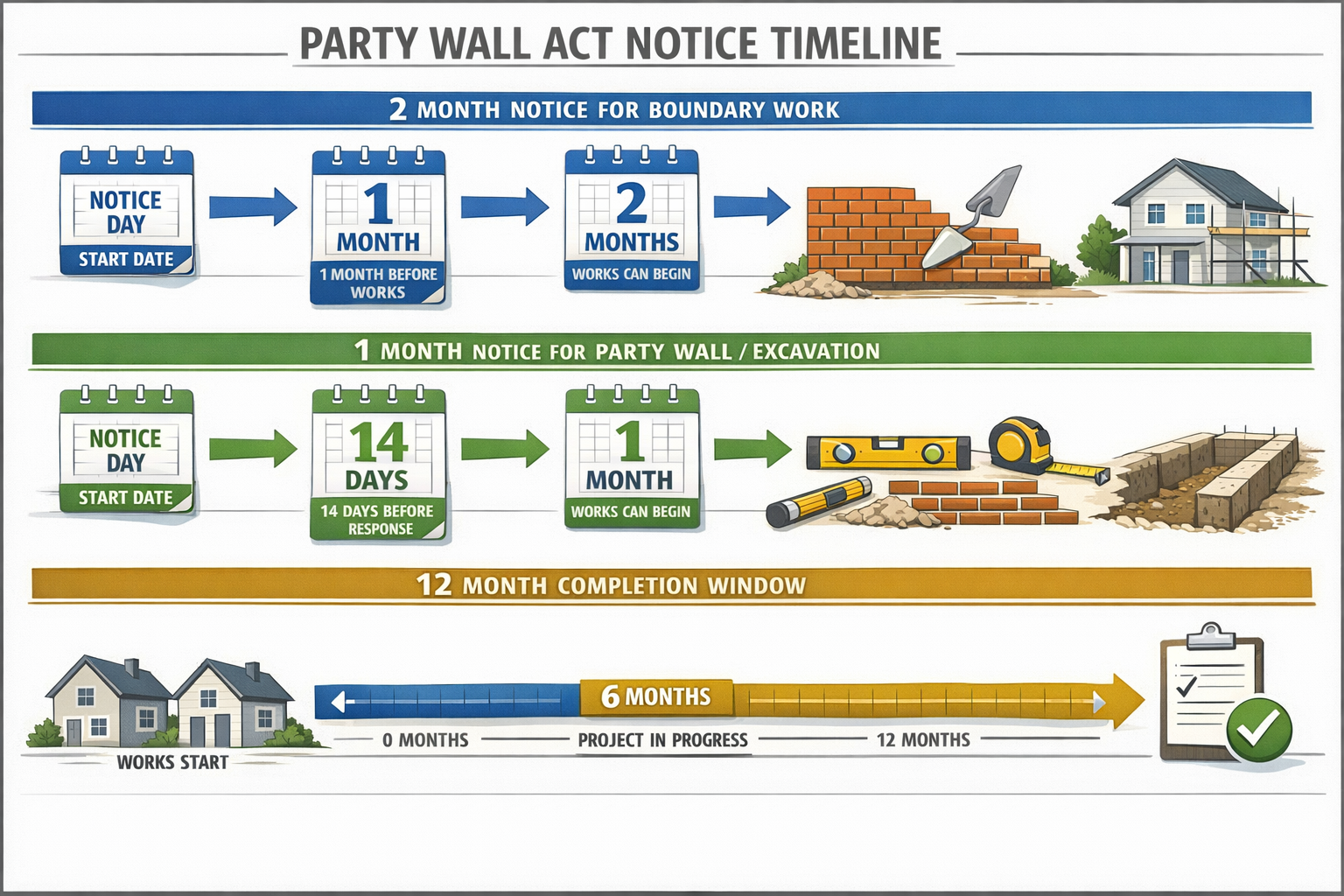
✅ Two-month notice required for boundary work: Building on or at the boundary line requires serving notice at least two months before work begins[1][2]
✅ One-month notice for party walls and excavations: Work to existing party structures or excavation near a neighbour's foundation needs only one month's advance notice[1][2]
✅ Twelve-month completion window: Once served, party wall notices remain valid for up to one year, giving building owners flexibility in scheduling[2]
✅ Fourteen-day neighbour response period: Adjoining owners have exactly 14 days to consent or dissent after receiving formal notice[1][4]
✅ Total timeline ranges from 2-9 months: Depending on neighbour cooperation and complexity, the complete party wall process typically takes between two and nine months from initial surveyor appointment to work commencement[4]
Understanding the Statutory Notice Periods Under the Party Wall Act
The Party Wall etc. Act 1996 establishes two distinct statutory notice periods that depend entirely on the type of work being undertaken. These aren't arbitrary timeframes—they're legally mandated minimum periods designed to give adjoining owners adequate time to understand proposed works, seek professional advice, and protect their property interests.
The Two-Month Notice Period for Boundary Work 📅
When planning to build a new wall on or at the boundary line between properties, the Act requires serving a Party Structure Notice or Line of Junction Notice at least two months before commencing work[1][2][3]. This extended period recognizes that boundary construction represents significant work that could substantially affect a neighbour's property rights and enjoyment.
Types of work requiring two-month notice include:
- Building a new wall directly on the boundary line
- Constructing foundations that straddle the property boundary
- Erecting a new party fence wall between properties
- Any structure positioned astride the line of junction
The two-month period begins from the date the notice is actually received by the adjoining owner—not the date it was posted or sent[2]. This distinction is crucial for timeline planning, as proof of delivery becomes essential documentation.
The One-Month Notice Period for Party Wall and Excavation Work ⏰
For work to existing party structures or excavation within specified distances of a neighbour's foundation, the Act requires only one month's advance notice[1][2]. This shorter period applies because the work involves structures or ground already subject to shared rights and obligations.
Work requiring one-month notice includes:
- Cutting into an existing party wall for beam insertion
- Raising, thickening, or underpinning a party wall
- Demolishing and rebuilding a party structure
- Excavating within three metres of a neighbour's structure (going deeper than their foundation)
- Excavating within six metres of a neighbour's structure (going deeper than a line drawn at 45 degrees from their foundation bottom)
Understanding which notice period applies to your specific types of party wall works is the first critical step in timeline planning. Many projects involve multiple types of work, requiring careful coordination of different notice periods.
Why These Specific Timeframes Matter
The statutory notice periods serve several important purposes beyond simple notification. They provide adjoining owners time to:
- Consult with professionals about the proposed work's implications
- Arrange property inspections to establish pre-work conditions
- Appoint their own surveyor if they choose to dissent
- Negotiate protective measures through the Party Wall Award process
- Prepare for potential disruption to their property use
For building owners, respecting these timelines demonstrates good faith and often leads to smoother neighbour relations. Rushing or attempting to circumvent these periods almost invariably creates conflict and delays that far exceed the original notice requirement.
The One-Year Completion Window: Flexibility and Limitations
One of the most misunderstood aspects of Party Wall Notice Timelines: The Two-Month Service Period and One-Year Completion Window Explained involves what happens after serving notice. The Act provides building owners with considerable scheduling flexibility through a twelve-month validity period[2].
How the Twelve-Month Window Works
Once a party wall notice is formally served and the statutory notice period expires, the building owner has up to one year to actually commence the notified works[2]. This provision recognizes the practical realities of construction projects, including:
- Planning permission delays that extend beyond initial estimates
- Building control approval processes taking longer than anticipated
- Contractor availability requiring schedule adjustments
- Financing arrangements needing additional time to finalize
- Seasonal considerations making certain work periods more practical
This flexibility proves invaluable for complex projects where multiple approvals and arrangements must align. A homeowner can serve their party wall notice while still finalizing other permissions, confident that the notice remains valid for twelve months.
What Happens When the One-Year Period Expires ⚠️
If construction work does not commence within twelve months of serving the notice, the notice becomes invalid. At this point, the building owner must:
- Serve fresh notices to all affected adjoining owners
- Restart the statutory notice period (one or two months depending on work type)
- Potentially prepare new documentation if project details have changed
- Incur additional surveyor fees for re-serving notices and updating assessments
This restart can be particularly problematic if the original party wall award was contentious or if neighbour relations have deteriorated during the delay. The fresh notice may receive a less cooperative response than the original.
Strategic Timing Considerations
Smart building owners use the twelve-month window strategically:
| Scenario | Strategic Approach |
|---|---|
| Uncertain start date | Serve notice once planning permission is granted but before finalizing contractor schedules |
| Seasonal work | Serve notice in autumn for spring commencement, avoiding winter weather delays |
| Phased projects | Coordinate notice timing with critical path activities requiring party wall access |
| Multiple properties | Stagger notice service if work will proceed sequentially rather than simultaneously |
The one-year window provides breathing room, but it shouldn't encourage complacency. Projects that drag on without clear timelines often encounter additional complications, including changing regulations, cost increases, and neighbour frustration.
Extending Beyond Twelve Months
There is no formal mechanism for extending a party wall notice beyond the twelve-month validity period. However, practical solutions exist:
- Serve a fresh notice before the original expires if delays are anticipated
- Commence work minimally (even preparatory activities) to satisfy the "commencement" requirement, then pause if necessary
- Communicate proactively with neighbours about delays—goodwill often prevents disputes even if technical compliance lapses
Understanding how to keep party wall costs down includes avoiding the expense of re-serving notices due to poor timeline management.
Complete Timeline Breakdown: From Surveyor Appointment to Work Commencement
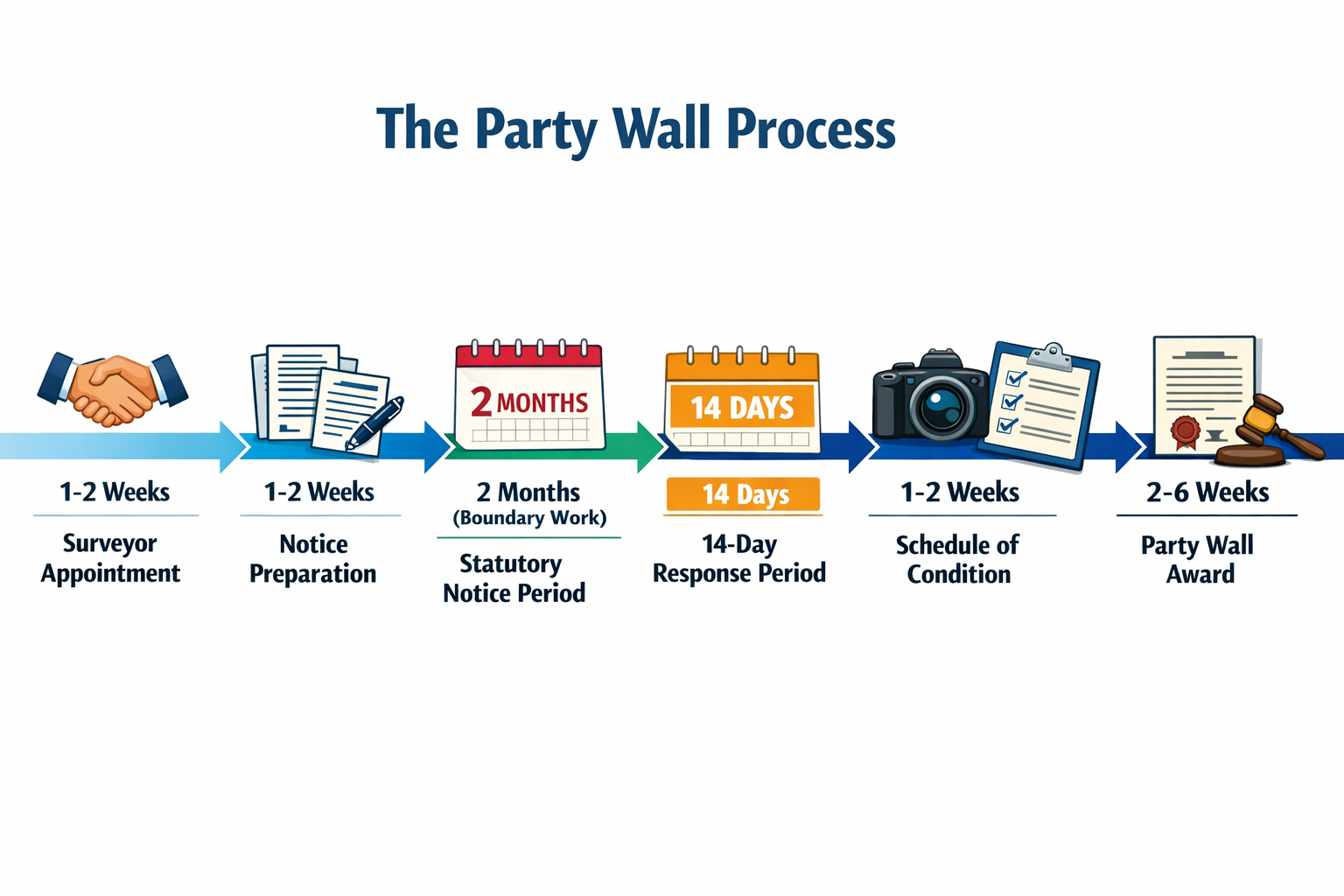
Understanding Party Wall Notice Timelines: The Two-Month Service Period and One-Year Completion Window Explained requires looking beyond just the statutory notice periods. The complete party wall process involves multiple phases, each with its own typical duration.
Phase 1: Pre-Notice Preparation (2-4 Weeks Total)
Before any formal notice can be served, several preparatory steps must occur:
Surveyor Appointment (1-2 weeks): Identifying and engaging a qualified party wall surveyor typically requires 1-2 weeks[4]. This includes:
- Researching and contacting potential surveyors
- Obtaining quotes and comparing services
- Reviewing terms of appointment
- Signing engagement letters
Notice Preparation (1-2 weeks): Once appointed, the surveyor needs 1-2 weeks to prepare proper notices for straightforward projects[1][4]. This involves:
- Reviewing architectural drawings and specifications
- Identifying all affected adjoining owners
- Determining which notice types apply
- Drafting legally compliant notice documents
- Arranging proper service methods
For complex projects involving multiple properties or unusual work types, this preparation phase can extend to 3-4 weeks. Having complete, accurate architectural drawings and project specifications ready when appointing your surveyor significantly accelerates this phase.
Phase 2: Statutory Notice Period (1-2 Months)
This is the legally mandated waiting period discussed earlier:
- Two months for boundary work (new walls on the line of junction)[1][2][3]
- One month for party wall work and excavations[1][2]
During this period, the building owner cannot commence work, regardless of neighbour consent. The clock starts when the notice is received by the adjoining owner, making proof of service critical.
Phase 3: Neighbour Response Window (14 Days)
After receiving the notice, adjoining owners have exactly 14 days to respond[1][4]. They can:
✅ Consent to the works (allowing the process to proceed quickly)
❌ Dissent from the works (triggering the Party Wall Award process)
⏸️ Fail to respond (treated as deemed dissent after 14 days)[1]
This 14-day period runs concurrently with the statutory notice period—not in addition to it. For example, with a two-month boundary notice, the neighbour's 14-day response window falls within those two months.
Phase 4: Schedule of Condition (1-2 Weeks)
Whether neighbours consent or dissent, preparing a Schedule of Condition is essential. This baseline assessment typically requires 1-2 weeks[1][4] and involves:
- Arranging access to adjoining properties
- Conducting thorough photographic surveys
- Documenting existing conditions, defects, and finishes
- Preparing detailed written descriptions
- Obtaining adjoining owner signatures
Neighbour cooperation significantly affects this timeline. Difficult access arrangements or uncooperative adjoining owners can extend this phase to 3-4 weeks or longer.
Phase 5: Party Wall Award Preparation (2-6 Weeks When Required)
If a neighbour dissents (or fails to respond), the appointed surveyors must prepare a Party Wall Award—a legally binding document setting out work details, protective measures, and dispute resolution mechanisms. This process typically takes 2-6 weeks[4], depending on:
- Project complexity and number of protective conditions required
- Surveyor cooperation and communication efficiency
- Disagreements requiring Third Surveyor involvement
- Documentation quality provided by the building owner
In complex or contentious cases, Award preparation can extend to 8-12 weeks, particularly if a Third Surveyor must be appointed to resolve disputes between the building owner's and adjoining owner's surveyors.
Realistic Timeline Scenarios 📊
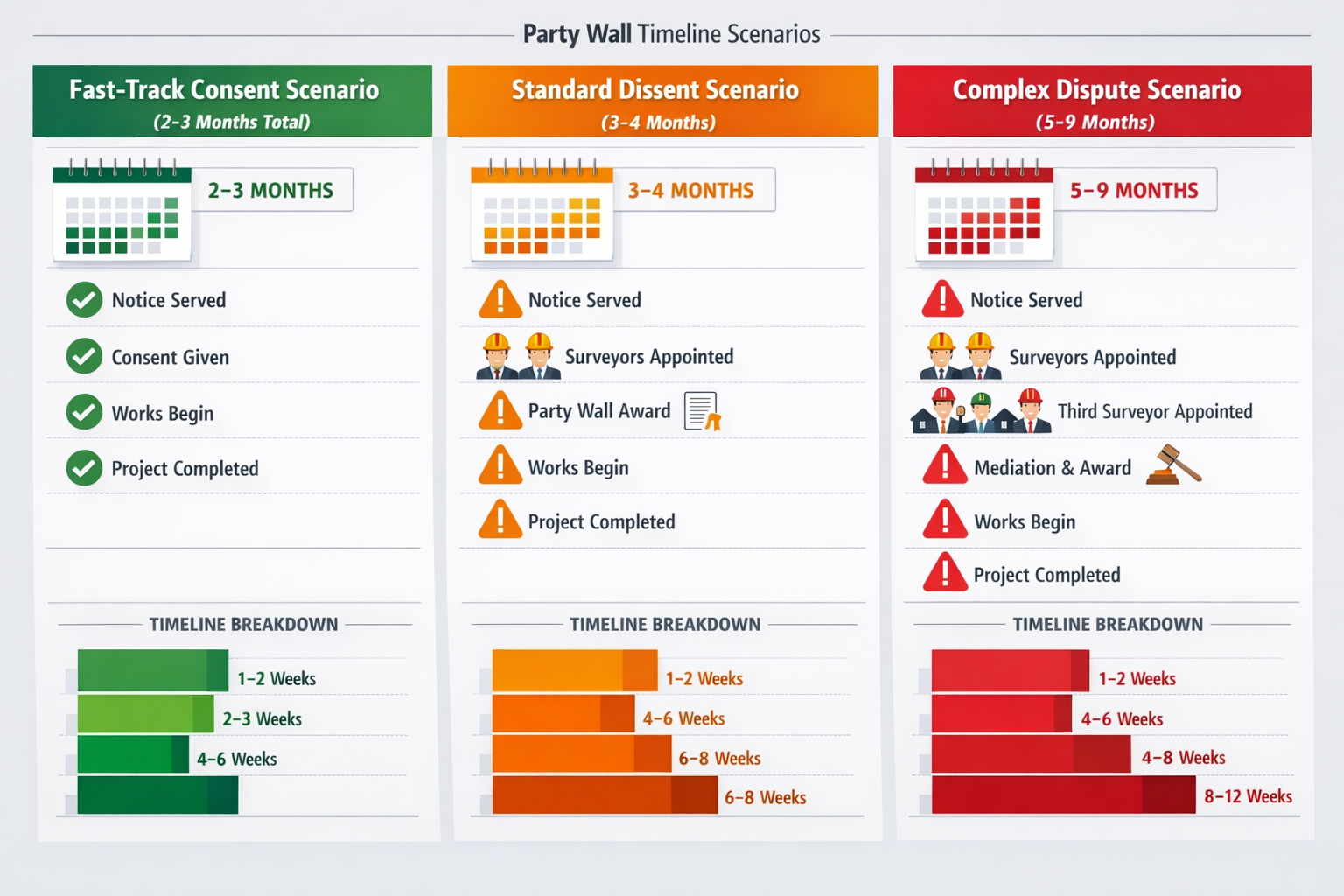
Best-Case Scenario (Prompt Consent): 2-3 Months Total
- Surveyor appointment: 1 week
- Notice preparation: 1 week
- Statutory notice period: 2 months (boundary work)
- Schedule of Condition: 1 week
- Total: ~10-12 weeks[4]
Standard Scenario (Dissent): 3-4 Months Total
- Surveyor appointment: 1-2 weeks
- Notice preparation: 1-2 weeks
- Statutory notice period: 2 months
- Schedule of Condition: 1-2 weeks
- Party Wall Award: 3-4 weeks
- Total: ~14-18 weeks[4]
Complex Scenario (Disputes/Delays): 5-9 Months Total
- Surveyor appointment: 2 weeks
- Notice preparation: 2-3 weeks
- Statutory notice period: 2 months
- Access difficulties for Schedule: 3-4 weeks
- Party Wall Award with Third Surveyor: 8-12 weeks
- Additional negotiations: 2-4 weeks
- Total: ~20-36 weeks[4]
Understanding these realistic timelines helps building owners plan appropriately and avoid the costly mistakes that result from underestimating the party wall process duration.
Common Timeline Challenges and How to Avoid Them
Even with careful planning, several common challenges can disrupt Party Wall Notice Timelines: The Two-Month Service Period and One-Year Completion Window Explained. Recognizing these potential pitfalls allows building owners to implement preventive strategies.
Challenge 1: Incorrect Notice Service 📮
The Problem: Notices served incorrectly or to wrong parties don't satisfy statutory requirements, forcing the building owner to re-serve and restart the clock.
Common mistakes include:
- Serving notice to tenants rather than freeholders
- Using incorrect notice types for the work proposed
- Insufficient detail about proposed works
- Missing or incorrect property descriptions
- Inadequate proof of service
Prevention strategies:
- Engage an experienced party wall surveyor early
- Conduct thorough land registry searches to identify all owners
- Use recorded delivery or hand-delivery with signed receipts
- Include comprehensive drawings and specifications
- Verify notice content before service
When working with a professional party wall surveyor in London, these errors become far less likely, as experienced practitioners understand the technical requirements intimately.
Challenge 2: Unresponsive or Difficult Neighbours 🚧
The Problem: Adjoining owners who ignore communications, refuse access, or create unnecessary obstacles can significantly extend timelines.
Impact on timelines:
- Delayed Schedule of Condition access (adding 2-6 weeks)
- Extended Award negotiations (adding 4-8 weeks)
- Potential Third Surveyor involvement (adding 6-12 weeks)
- Legal proceedings in extreme cases (adding 3-6 months)
Mitigation strategies:
- Communicate early and informally before serving formal notices
- Explain benefits and protections the process provides
- Offer flexible scheduling for property access
- Consider whether having a party wall agreement without a surveyor might work for simple, consensual situations
- Document all communication attempts thoroughly
Building positive neighbour relationships before construction begins pays enormous dividends when formal party wall procedures commence.
Challenge 3: Project Scope Changes Mid-Process ⚙️
The Problem: Significant changes to proposed works after serving notices may require fresh notices and restarting the process.
Triggering changes include:
- Extending excavation depth beyond originally notified levels
- Adding additional party wall penetrations not in original notice
- Changing construction methods that affect party structures differently
- Expanding work area to affect additional adjoining properties
Prevention strategies:
- Finalize designs thoroughly before serving notices
- Include reasonable contingencies in original notice descriptions
- Consult your surveyor before implementing any scope changes
- Serve supplementary notices promptly if changes become necessary
Understanding what is a party structure notice and how to serve it helps ensure the original notice covers all anticipated work comprehensively.
Challenge 4: Underestimating Total Process Duration ⏳
The Problem: Building owners frequently focus only on the statutory notice period, forgetting the additional time required for preparation, surveys, and awards.
Reality check:
- Statutory notice period: 1-2 months
- Actual total process: 2-9 months depending on circumstances[4]
Planning recommendations:
- Add 4-6 weeks minimum to statutory notice periods for realistic planning
- Assume dissent rather than consent when creating critical path schedules
- Build 2-3 month contingency into overall project timelines
- Engage surveyors 3-4 months before desired work commencement
- Communicate realistic timelines to contractors and other professionals
For building owners managing complex projects, conservative timeline estimates prevent the cascade of problems that result from premature contractor scheduling.
Challenge 5: Missing the Twelve-Month Commencement Window 🗓️
The Problem: Projects delayed beyond twelve months from notice service require completely restarting the party wall process.
Cost implications:
- Re-serving all notices (surveyor fees: £500-1,500+)
- New Schedule of Condition (surveyor fees: £300-800 per property)
- Fresh Party Wall Award if dissent occurs (surveyor fees: £1,500-3,000+)
- Potential neighbour goodwill loss leading to disputes
- Additional project delays of 2-4 months minimum
Avoidance strategies:
- Monitor notice expiry dates actively
- Commence work (even minimally) before twelve-month deadline if delays occur
- Communicate proactively with neighbours about timing changes
- Serve fresh notices 2-3 months before original expiry if significant delays are certain
- Consider whether project viability has changed if year-long delays are occurring
The costs of the party wall process multiply significantly when notices must be re-served, making timeline management a financial imperative.
Strategies for Expediting the Party Wall Process
While statutory minimums cannot be shortened, building owners can implement several strategies to ensure the party wall process proceeds as efficiently as possible within Party Wall Notice Timelines: The Two-Month Service Period and One-Year Completion Window Explained.
Early Engagement and Preparation 🎯
Start the process early: Engage your party wall surveyor 3-4 months before your desired work commencement date, not 2 months. This buffer accommodates unexpected delays without derailing your project schedule.
Prepare comprehensive documentation upfront:
- Complete architectural drawings showing all party wall implications
- Detailed specifications of construction methods
- Structural calculations if relevant
- Clear project timeline and phasing plans
Conduct preliminary neighbour outreach: Before formal notice service, informally discuss your plans with neighbours. This courtesy often results in:
- Faster consent when formal notices arrive
- Smoother Schedule of Condition access
- Reduced likelihood of disputes
- Better working relationships during construction
Choosing the Right Professionals 👷
Select experienced party wall surveyors: Not all surveyors have equal expertise. Look for:
- Specialists in party wall matters (not general practice surveyors)
- Members of the Faculty of Party Wall Surveyors
- Strong local knowledge of your area
- Proven track record of efficient, dispute-free processes
- Clear fee structures and communication practices
Whether you need a party wall surveyor in North London, South London, East London, or West London, selecting a local specialist familiar with area-specific challenges accelerates the process.
Consider appointing the same surveyor for both parties: When neighbours agree, appointing an "Agreed Surveyor" to act for both building and adjoining owners can:
- Reduce overall costs by 30-50%
- Eliminate surveyor-to-surveyor communication delays
- Streamline Award preparation
- Minimize potential for inter-surveyor disputes
This approach works best when relationships are good and work is relatively straightforward.
Proactive Communication and Cooperation 💬
Maintain open communication channels:
- Respond promptly to surveyor requests for information
- Facilitate neighbour access for surveys without delay
- Address concerns raised by adjoining owners constructively
- Keep all parties informed of timeline changes
Be flexible on protective measures: Adjoining owners often dissent because they fear damage or disruption. Demonstrating willingness to implement reasonable protective measures—even beyond minimum requirements—frequently converts dissent to consent.
Offer Schedule of Condition at your expense: While not legally required unless dissent occurs, proactively offering to document adjoining properties' conditions demonstrates good faith and provides neighbours reassurance.
Leveraging Technology and Modern Practices 📱
Digital documentation: Use digital platforms for:
- Sharing drawings and specifications instantly
- Obtaining electronic signatures on consents
- Conducting virtual preliminary meetings
- Maintaining transparent communication logs
Professional project management: Treat the party wall process as a critical path activity with:
- Dedicated timeline tracking
- Regular status reviews
- Proactive risk identification
- Contingency planning
For adjoining owners who receive party wall notices, understanding the process and responding promptly helps everyone achieve timely project completion.
Conclusion: Mastering Party Wall Timelines for Project Success
Understanding Party Wall Notice Timelines: The Two-Month Service Period and One-Year Completion Window Explained transforms what seems like a bureaucratic obstacle into a manageable project component. The key insights to remember:
Critical statutory requirements:
- Two months minimum for boundary work before commencement[1][2][3]
- One month minimum for party wall and excavation work[1][2]
- Fourteen days for neighbour response after notice receipt[1][4]
- Twelve months maximum validity period for commencing notified works[2]
Realistic total timelines:
- Best case (consent): 2-3 months from surveyor appointment to work start[4]
- Standard case (dissent): 3-4 months with Party Wall Award required[4]
- Complex case (disputes): 5-9 months with Third Surveyor involvement[4]
Success strategies:
- Engage qualified party wall surveyors 3-4 months before desired work commencement
- Prepare comprehensive documentation before serving notices
- Build positive neighbour relationships through early, informal communication
- Plan conservatively with timeline contingencies
- Monitor the twelve-month validity window carefully
- Respond promptly to all surveyor and neighbour communications
Your Next Steps 🚀
If you're planning construction work affecting party walls:
- Assess your project timeline using the realistic scenarios outlined above
- Engage a qualified party wall surveyor at least 3-4 months before your desired start date
- Review your project documentation to ensure completeness before notice service
- Initiate informal neighbour discussions to build goodwill before formal processes begin
- Create a comprehensive project timeline incorporating party wall process milestones
If you've received a party wall notice:
- Respond within 14 days to avoid deemed dissent[1][4]
- Consult with a party wall surveyor to understand your rights and protections
- Request a Schedule of Condition to document your property's current state
- Engage constructively with your neighbour's reasonable proposals
- Know that the process protects you through proper documentation and oversight
The party wall process, when properly understood and managed, protects both building and adjoining owners while enabling necessary construction work. The timelines may seem lengthy, but they serve essential purposes: allowing proper preparation, protecting property rights, and preventing disputes that would cause far greater delays.
By mastering these timelines and implementing the strategies outlined in this guide, building owners can navigate the party wall process efficiently, maintain positive neighbour relationships, and keep their construction projects on schedule. The two-month service period and one-year completion window aren't obstacles—they're the framework for successful, dispute-free construction in shared property situations.
For expert guidance tailored to your specific project, consult with qualified party wall professionals who can navigate these timelines while protecting your interests and maintaining productive neighbour relationships throughout the construction process.
References
[1] Party Wall Act Procedure Long Take – https://www.murrins.co.uk/party-wall-act-procedure-long-take/
[2] Party Wall Agreement – https://hoa.org.uk/advice/guides-for-homeowners/i-am-improving/party-wall-agreement/
[3] Knowledge Article Partywall Notice – https://www.aylingassociates.com/knowledge-article-partywall-notice.html
[4] Party Wall Agreement London 2026 – https://www.mayfairstudio.co.uk/blog/party-wall-agreement-london-2026