


The artificial intelligence revolution is reshaping Britain's skyline in ways few anticipated. As tech giants pour $320 billion into data centre infrastructure in 2026 alone[2], a quiet but critical challenge emerges: how do you build massive, power-hungry facilities next to existing properties without triggering legal disputes, structural damage, or community backlash? The answer lies in understanding Party Wall Notices and Awards for Data Centre Developments: Managing High-Stakes Infrastructure Projects in 2026—a specialized intersection of construction law, surveying expertise, and diplomatic negotiation that's becoming increasingly vital as the UK government designates data centres as critical national infrastructure[2].
This comprehensive guide explores how surveyors, developers, and property owners navigate the complex party wall compliance landscape when large-scale technology infrastructure meets traditional property boundaries.

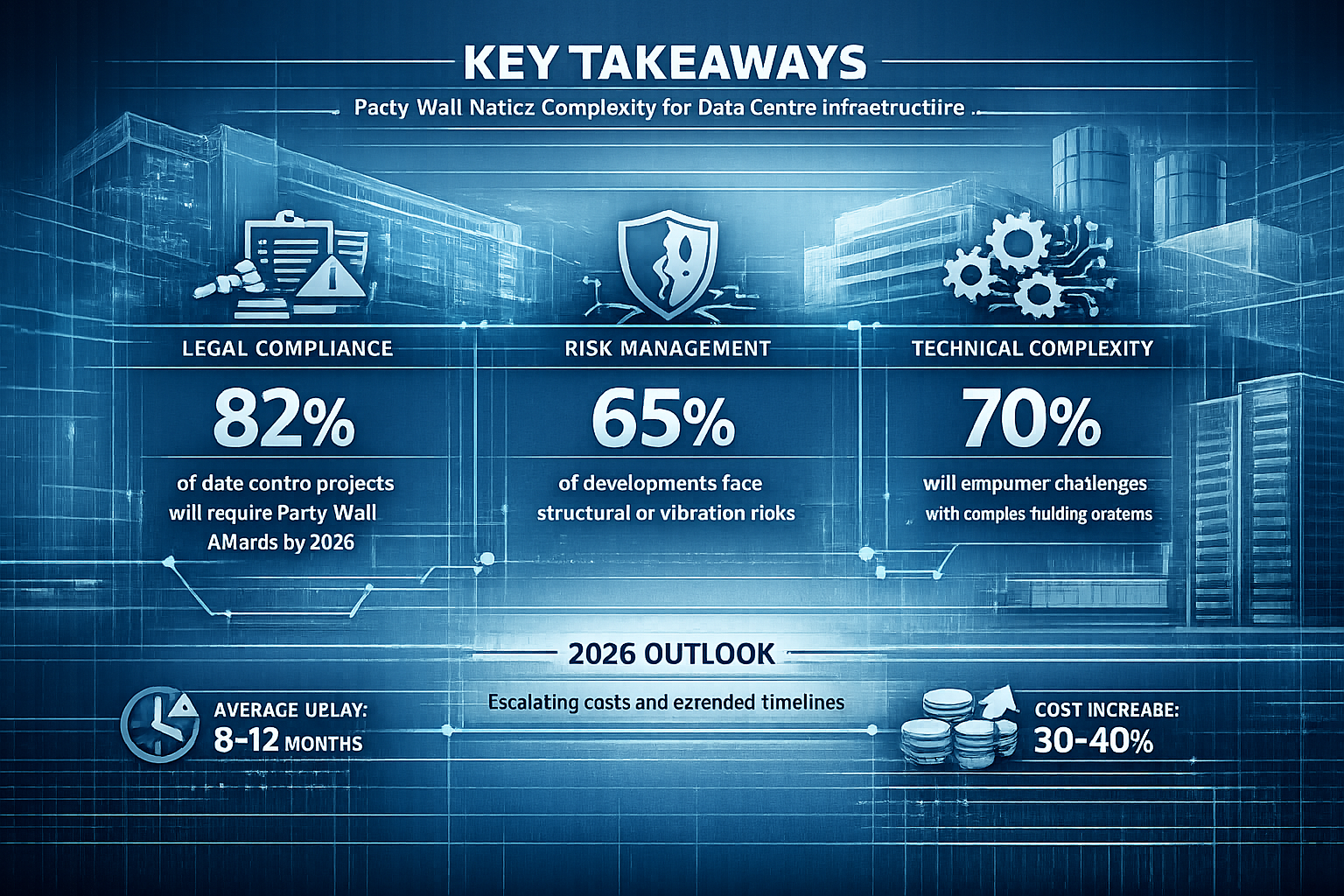
Key Takeaways
- Critical infrastructure status: Data centres now hold the same legal importance as utilities, making proper party wall compliance essential for project approval and community acceptance
- High-stakes complexity: Deep foundations, vibration from cooling systems, and 24/7 construction schedules create unique party wall challenges requiring specialized surveying expertise
- Proactive engagement: Early party wall notices and comprehensive awards prevent costly delays in time-sensitive infrastructure projects
- Risk mitigation: Detailed schedules of condition and continuous monitoring protect both developers and adjoining owners from disputes over structural damage
- Collaborative approach: Successful data centre developments balance technical requirements with community concerns through transparent party wall processes
Understanding Party Wall Requirements for Data Centre Infrastructure
What Makes Data Centres Different from Standard Developments?
Data centres aren't ordinary buildings. These facilities demand extraordinary structural specifications that trigger virtually every section of the Party Wall etc. Act 1996:
Foundation Requirements 🏗️
- Depths of 15-25 meters to support heavy server equipment and cooling systems
- Excavations frequently extend below neighboring properties' foundation levels
- Continuous concrete rafts that may affect adjacent ground stability
Operational Characteristics
- Vibration from thousands of cooling fans and backup generators
- 24/7 construction schedules to meet aggressive deployment timelines
- Significant electrical infrastructure requiring deep trenching along property boundaries
Scale and Proximity
- Multi-story facilities often built on constrained urban sites
- Shared walls with existing commercial or residential properties
- Limited setbacks due to land scarcity in areas with grid access
According to industry analysis, grid access and power availability have become primary factors determining development feasibility[2], often forcing developers to build on sites with challenging party wall situations rather than ideal greenfield locations.
Which Party Wall Notices Apply to Data Centre Projects?
Data centre developments typically require multiple notice types under the Party Wall etc. Act 1996:
| Notice Type | Common Data Centre Applications | Minimum Notice Period |
|---|---|---|
| Section 1 Notice | Building new walls on boundary lines for perimeter security or utility enclosures | 1 month |
| Section 3 Notice | Deep excavations for foundations and underground cooling systems | 1 month |
| Section 6 Notice | Work to existing party walls when converting adjacent buildings | 2 months |
Most large-scale data centre projects require Section 3 notices for excavation work. This applies when digging within three meters of a neighboring building if going deeper than its foundations, or within six meters if excavating below a 45-degree plane from the neighbor's foundation base.
"The complexity of party wall compliance for data centres cannot be underestimated. We're dealing with critical infrastructure that must be operational by specific deadlines, yet we cannot compromise on protecting adjoining owners' rights and properties." — Senior Party Wall Surveyor, London Infrastructure Projects
The Party Wall Award Process for High-Stakes Infrastructure
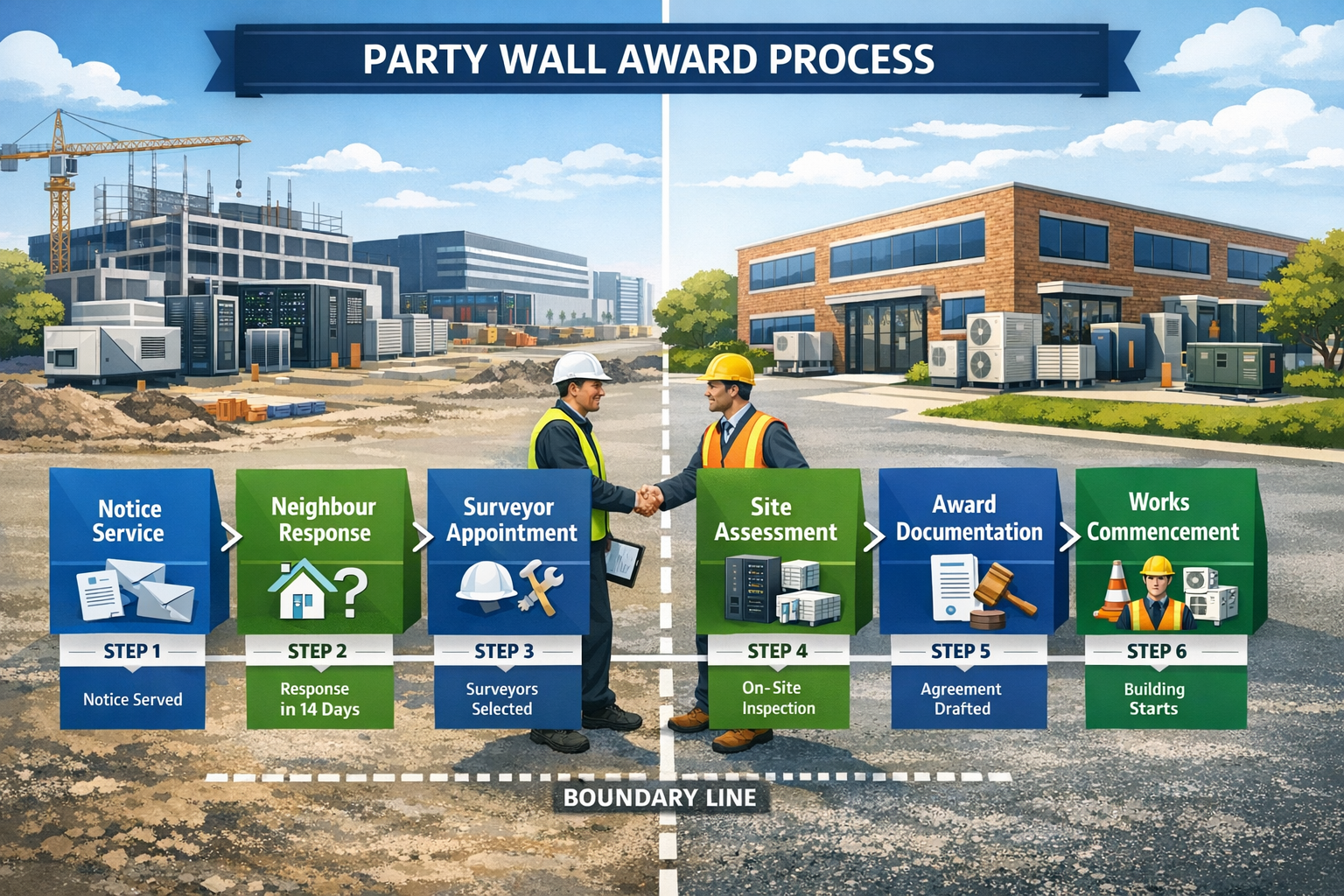
Initial Notice Service and Neighbour Engagement
Party Wall Notices and Awards for Data Centre Developments: Managing High-Stakes Infrastructure Projects in 2026 begins with proper notice service—but for infrastructure projects, this process requires additional strategic considerations.
Best Practices for Notice Service:
-
Early engagement (6-9 months before construction)
- Informal meetings with adjoining owners before formal notices
- Explanation of project benefits and community value
- Addressing concerns about noise, vibration, and construction impact
-
Comprehensive documentation
- Detailed construction methodology statements
- Vibration and noise impact assessments
- Traffic management plans for construction vehicles
-
Professional presentation
- Clear, jargon-free explanations of party wall act notices
- Visual aids showing construction phases
- Contact information for project liaisons
The importance of community engagement and securing "social licence" for data centre growth cannot be overstated[1]. Neighbors who understand the project's significance and feel respected are more likely to consent to party wall works or engage constructively in the surveyor appointment process.
Appointing Surveyors for Complex Infrastructure Projects
When adjoining owners don't consent within 14 days, surveyors must be appointed to create a party wall award. For data centre developments, surveyor selection is critical:
Essential Qualifications:
- ✅ Experience with large-scale commercial or infrastructure projects
- ✅ Understanding of deep foundation engineering
- ✅ Knowledge of vibration monitoring and structural assessment
- ✅ Familiarity with data centre construction methodologies
- ✅ Strong negotiation and dispute resolution skills
Three Surveyor Scenarios:
Agreed Surveyor Approach (most efficient for data centres)
- Single surveyor acts impartially for both parties
- Faster award preparation
- Lower costs
- Requires high trust and straightforward projects
Two Surveyors Plus Third Surveyor
- Building owner appoints their surveyor
- Adjoining owner appoints separate surveyor
- Third surveyor appointed to resolve disagreements
- Standard for complex, high-value developments
- Provides maximum protection for all parties
For guidance on managing expenses, see our article on how to keep party wall costs down.
Drafting Comprehensive Party Wall Awards
A party wall award is the legal document that authorizes work to proceed while protecting all parties' interests. For data centre developments, awards must address unique considerations:
Critical Award Components:
📋 Scope of Works
- Detailed descriptions of excavation depths and methods
- Foundation types and load-bearing specifications
- Temporary works including shoring and dewatering
- Cooling system installations affecting party structures
📋 Schedule of Condition
- Comprehensive photographic and written records of adjoining properties
- Structural surveys documenting pre-existing cracks, settlement, or defects
- Baseline vibration and noise measurements
- Underground utility mapping
📋 Protective Measures
- Vibration limits during piling and excavation
- Monitoring protocols with defined trigger levels
- Underpinning requirements if necessary
- Hours of work restrictions for noise-sensitive operations
📋 Access Rights
- Surveyor access for inspections during construction
- Emergency access provisions
- Notice periods for inspections
📋 Financial Provisions
- Security for costs (typically required for large projects)
- Compensation mechanisms for damage or inconvenience
- Cost allocation between parties
For detailed templates and examples, review our party wall contract template guide.
Managing Construction Risks and Monitoring Requirements
Implementing Robust Monitoring Systems
Party Wall Notices and Awards for Data Centre Developments: Managing High-Stakes Infrastructure Projects in 2026 demands continuous vigilance during construction. The scale and intensity of data centre building work creates elevated risks that require sophisticated monitoring.
Essential Monitoring Technologies:
Vibration Monitoring 📊
- Triaxial geophones installed on party walls and adjoining structures
- Real-time data transmission to project managers and surveyors
- Automated alerts when vibration exceeds award thresholds
- Typical limits: 15-20mm/s peak particle velocity for residential, 50mm/s for commercial
Structural Movement Monitoring
- Crack width gauges (tell-tales) on existing cracks
- Precise leveling surveys to detect settlement
- Tilt sensors for walls showing potential movement
- Photographic documentation at regular intervals
Environmental Monitoring
- Noise level meters for compliance with award conditions
- Dust monitoring in sensitive areas
- Groundwater level monitoring during dewatering
Responding to Issues During Construction
Despite careful planning, issues can arise during data centre construction:
Common Challenges and Solutions:
| Issue | Response Protocol | Party Wall Implications |
|---|---|---|
| Unexpected ground conditions | Immediate surveyor notification; revised methodology | May require award variation |
| Vibration exceeding limits | Stop work; implement additional mitigation | Potential compensation claim |
| New cracks appearing | Document immediately; structural assessment | Damage claim under award |
| Access disputes | Refer to award access provisions | Surveyor mediation |
Crisis Management Protocol:
- Immediate cessation of works causing damage
- Notification to all surveyors within 24 hours
- Emergency assessment of structural integrity
- Temporary stabilization if required
- Revised methodology before resuming works
- Documentation for potential claims
The schedule of condition prepared before works becomes crucial evidence when determining whether damage is attributable to the data centre construction or pre-existed.
Completion and Final Inspections
As data centre construction concludes, the party wall process requires formal closure:
Final Steps:
✅ Completion inspections by appointed surveyors
✅ Comparison against schedule of condition
✅ Documentation of any damage requiring remediation
✅ Negotiation of compensation if applicable
✅ Final account settlement for surveyor fees
✅ Release of any security held
For projects where minor damage occurred, surveyors negotiate appropriate remediation or financial compensation. The award provides the framework for these discussions, helping avoid litigation.
Special Considerations for Data Centre Developments in 2026
AI-Driven Demand and Accelerated Timelines
The explosive growth in artificial intelligence applications has created unprecedented demand for data centre capacity. This creates unique pressures on the party wall process:
Timeline Compression Challenges:
- Developers face contractual penalties for delayed commissioning
- Pressure to compress notice periods (which cannot be legally shortened)
- Temptation to begin work before awards are finalized (illegal and risky)
- Need for parallel processing of planning, party wall, and construction activities
Strategic Solutions:
- Begin party wall process during planning application phase
- Engage specialist surveyors familiar with infrastructure timelines
- Consider agreed surveyor approach when appropriate
- Build realistic party wall timeframes into project schedules
- Maintain open communication with adjoining owners throughout
Power Infrastructure and Grid Connections
Grid access and power availability are now primary factors determining development feasibility[2]. This creates party wall implications:
Electrical Infrastructure Challenges:
- High-voltage connections requiring deep trenching near boundaries
- Transformer installations potentially affecting party walls
- Backup generator foundations triggering Section 3 notices
- Emergency power testing creating vibration concerns
Developers, utilities, planners, and government must collaborate on grid reinforcement and smart energy systems[1]—and party wall compliance is an essential component of this coordination.
Community Relations and Social License
The UK government's designation of data centres as critical infrastructure[2] doesn't eliminate the need for community acceptance. In fact, it makes proper party wall compliance more important:
Building Trust Through Compliance:
- Demonstrates respect for property rights
- Shows commitment to protecting neighbors
- Provides formal dispute resolution mechanisms
- Creates accountability through surveyor oversight
Beyond Legal Compliance:
- Community liaison officers for ongoing communication
- Regular updates on construction progress
- Addressing concerns promptly and professionally
- Offering community benefits where appropriate
As noted in industry analysis, community engagement and securing "social licence" are critical priorities for data centre growth[1]. Proper party wall procedures are foundational to this social license.
Regional Considerations Across London and the UK
London-Specific Challenges
Data centre development in London faces unique party wall complexities:
Central London 🏛️
- Historic buildings requiring specialist assessment
- High property values increasing financial stakes
- Complex ownership structures (leasehold, freeholds, multiple parties)
- See party wall surveyor Central London for local expertise
East London 🏗️
- Rapid redevelopment creating construction-dense environments
- Former industrial sites with contamination concerns
- Mixed-use developments adjacent to data centres
- Learn more about party wall surveyor East London services
Outer London Boroughs
- More greenfield opportunities but still party wall requirements
- Industrial estate conversions
- Proximity to residential areas requiring careful management
UK-Wide Data Centre Expansion
Data centre development isn't limited to London. The Party Wall etc. Act 1996 applies across England and Wales, making proper compliance essential nationwide for infrastructure projects.
Regional Hotspots:
- Manchester and surrounding areas (connectivity hub)
- Birmingham and West Midlands (central location)
- Edinburgh and Scottish central belt (different legal framework)
- South Wales (power availability and land costs)
Cost Management for Data Centre Party Wall Compliance
Typical Cost Structures
Party wall costs for data centre developments vary significantly based on project complexity:
Surveyor Fees:
- Building owner's surveyor: £5,000-£25,000+ for large projects
- Adjoining owner's surveyor: £3,000-£15,000 per property
- Third surveyor (if required): £2,000-£10,000
Additional Costs:
- Schedule of condition preparation: £500-£2,000 per property
- Structural monitoring equipment: £3,000-£15,000
- Expert consultations (structural engineers): £2,000-£10,000
- Remediation of damage: Variable, potentially significant
For comprehensive cost guidance, visit our costs of party wall process page.
Who Pays for Party Wall Procedures?
Under the Party Wall etc. Act 1996, the building owner (data centre developer) typically bears the costs of:
- Their own surveyor's fees
- The adjoining owner's surveyor's fees
- Award preparation and administration
- Monitoring and inspections
- Remediation of damage caused by the works
This represents a significant but necessary investment in legal compliance and risk management for high-stakes infrastructure projects.
Avoiding Common Pitfalls in Data Centre Party Wall Compliance
Critical Mistakes to Avoid
❌ Starting work before awards are finalized
- Legal liability for all damage
- Injunction risk halting entire project
- Relationship damage with neighbors
❌ Inadequate schedule of condition
- Disputes over pre-existing damage
- Difficulty proving causation
- Increased compensation claims
❌ Ignoring vibration limits
- Structural damage to adjoining properties
- Breach of award conditions
- Potential project suspension
❌ Poor communication with adjoining owners
- Unnecessary disputes and delays
- Loss of social license
- Increased costs from adversarial relationships
❌ Cutting corners on surveyor selection
- Inadequate awards missing critical provisions
- Disputes requiring third surveyor intervention
- Professional negligence exposure
Best Practices for Success
✅ Early engagement with all stakeholders
✅ Experienced surveyor selection with infrastructure expertise
✅ Comprehensive documentation at every stage
✅ Robust monitoring systems with real-time alerts
✅ Proactive communication throughout construction
✅ Contingency planning for unexpected issues
✅ Professional project management coordinating all parties
Conclusion
Party Wall Notices and Awards for Data Centre Developments: Managing High-Stakes Infrastructure Projects in 2026 represents a critical intersection of legal compliance, technical expertise, and diplomatic skill. As artificial intelligence drives unprecedented demand for data centre capacity—with tech giants investing $320 billion in infrastructure this year alone[2]—proper party wall procedures become essential for project success.
The UK government's designation of data centres as critical infrastructure[2] elevates the importance of these facilities while simultaneously raising expectations for responsible development. Developers who approach party wall compliance proactively, engage experienced surveyors, and maintain transparent communication with adjoining owners position their projects for success.
Key Success Factors
🎯 Start early: Begin party wall procedures 6-9 months before construction
🎯 Choose expertise: Select surveyors with infrastructure project experience
🎯 Document thoroughly: Comprehensive schedules of condition protect all parties
🎯 Monitor continuously: Real-time tracking prevents damage and disputes
🎯 Communicate openly: Build trust through transparency and responsiveness
🎯 Plan for contingencies: Budget time and resources for unexpected challenges
Next Steps for Your Data Centre Project
Whether you're a developer planning a major data centre facility, an adjoining owner receiving a party wall notice, or a professional advisor supporting infrastructure projects, taking action now prevents costly problems later:
- For developers: Engage qualified party wall surveyors during project planning phases
- For adjoining owners: Seek independent advice when receiving notices about adjacent data centre developments
- For project managers: Integrate party wall compliance into critical path schedules
- For all stakeholders: Understand that proper party wall procedures protect everyone's interests
The intersection of critical infrastructure development and traditional property rights requires specialized expertise. For professional guidance on party wall notices and party wall awards for your data centre project, consult experienced surveyors who understand both the technical demands of infrastructure development and the legal requirements of party wall compliance.
As the UK's data centre landscape continues its dramatic transformation in 2026, those who master the complexities of party wall compliance will be best positioned to deliver the critical infrastructure our digital economy demands—while protecting the rights and properties of all stakeholders involved.
References
[1] How 2026 Will Redefine The Uks Data Centre Landscape – https://www.msp-channel.com/videos/5092/how-2026-will-redefine-the-uks-data-centre-landscape
[2] Watch – https://www.youtube.com/watch?v=oORz6MsyGE8
[3] Party Wall Agreements In Data Centre Developments 2026 Compliance Amid Ai Driven Uk Demand – https://nottinghillsurveyors.com/blog/party-wall-agreements-in-data-centre-developments-2026-compliance-amid-ai-driven-uk-demand