


The construction industry stands at a pivotal moment in 2026. Offsite construction methods—including panelized systems, modular housing, and Structural Insulated Panels (SIPs)—are rapidly transforming how buildings rise from the ground. With chronic labor shortages pushing developers toward factory-built solutions, the speed and efficiency of prefabricated construction have become game-changers. Yet this acceleration creates a critical challenge: ensuring proper Party Wall Notices in Offsite Construction Booms: Ensuring Compliance for 2026 Panelized and Modular Projects while maintaining the legal protections that safeguard neighboring properties. 🏗️
As modular builds compress traditional construction timelines from months to weeks, surveyors and developers must navigate complex party wall legislation designed for conventional brick-and-mortar projects. The stakes are high—failure to serve proper party wall notices can halt fast-tracked developments, trigger costly disputes, and expose building owners to significant legal liability.
Key Takeaways
- Offsite construction methods require the same party wall notice procedures as traditional builds, despite accelerated timelines
- Factory-built panels and modular units must undergo party wall compliance before installation at shared boundaries
- RICS-compliant strategies help surveyors adapt traditional notice frameworks to fast-tracked prefabricated projects [1]
- Early engagement with adjoining owners becomes critical when construction schedules compress from months to weeks
- Proper documentation of prefabricated components and installation methods prevents disputes over shared structures
Understanding the Offsite Construction Revolution
What Makes Offsite Construction Different?
Offsite construction represents a fundamental shift in building methodology. Rather than constructing walls, floors, and roofs piece-by-piece on-site, panelized and modular systems are manufactured in controlled factory environments and transported to building locations for rapid assembly.
Key offsite construction methods include:
- Panelized construction: Wall panels built in factories with pre-installed windows, doors, and insulation
- Modular housing: Complete room units (including plumbing and electrical) assembled off-site
- SIPs (Structural Insulated Panels): High-performance building panels combining structural support and insulation
- Volumetric construction: Three-dimensional units that arrive 70-90% complete
- Hybrid systems: Combinations of traditional and prefabricated elements
The 2026 Offsite Construction Boom
Several converging factors have accelerated offsite construction adoption in 2026:
| Driver | Impact on Construction |
|---|---|
| Labor Shortages | Factory production requires 40-50% fewer on-site workers |
| Housing Demand | Faster delivery addresses critical housing shortages |
| Quality Control | Factory conditions ensure consistent build standards |
| Sustainability Goals | Reduced waste and improved energy efficiency |
| Cost Pressures | Compressed timelines lower financing and overhead costs |
The construction industry has reached a tipping point where prefabricated methods are no longer alternative solutions but mainstream practice. This transformation demands that party wall procedures evolve to accommodate accelerated timelines while maintaining robust neighbor protections.
Party Wall Notices in Offsite Construction Booms: Compliance Fundamentals for 2026
Do Offsite Construction Projects Require Party Wall Notices?
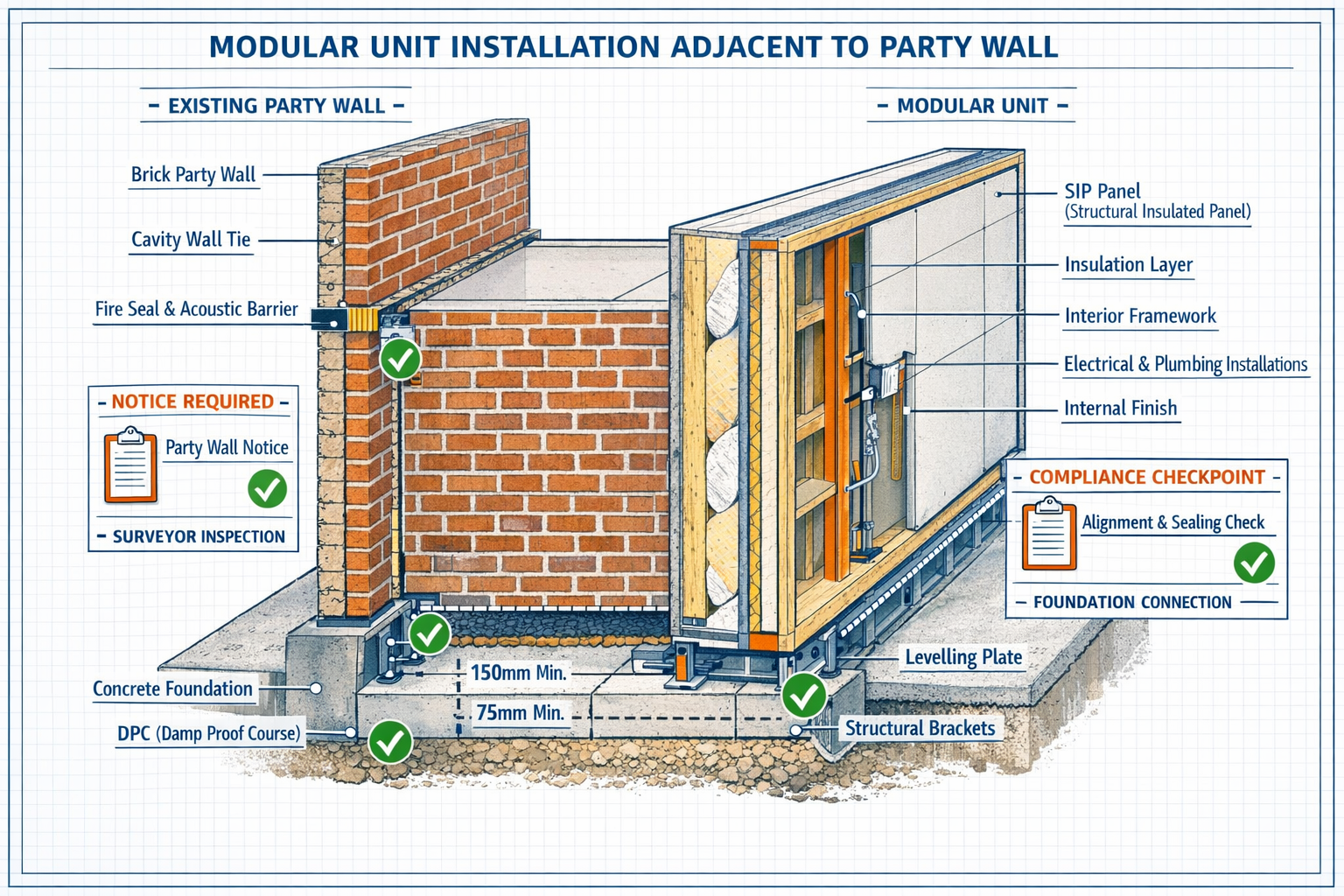
The answer is unequivocally yes. The Party Wall etc. Act 1996 applies equally to all construction methods that affect shared boundaries, regardless of whether components are built on-site or in factories. The legislation focuses on the impact on party structures, not the construction methodology.
Offsite construction triggers party wall requirements when:
- Installing foundations within three meters of a neighboring property
- Building new walls at or astride boundaries between properties
- Excavating near adjoining structures
- Cutting into or affecting existing party walls during installation
- Adding loads to shared structures through modular unit placement
The critical distinction lies in timing and planning. Traditional construction allows notices to be served as work progresses. Offsite methods demand that party wall act notices be resolved before factory-built components arrive on-site for installation.
Types of Party Wall Works in Panelized Projects
Understanding which types of party wall works apply to offsite construction helps developers plan compliance strategies:
Section 1 Notices apply when:
- Building new walls at boundaries using panelized systems
- Installing prefabricated fence walls along property lines
- Erecting modular units that create new party structures
Section 2 Notices are required for:
- Cutting into existing party walls to attach modular units
- Raising party walls to accommodate taller prefabricated structures
- Underpinning shared foundations before modular installation
- Inserting damp-proof courses in existing party walls
Section 6 Notices cover:
- Excavating for modular unit foundations near neighbors
- Installing deep foundation systems for multi-story prefab buildings
- Creating basements using offsite construction methods
The Notice Timeline Challenge
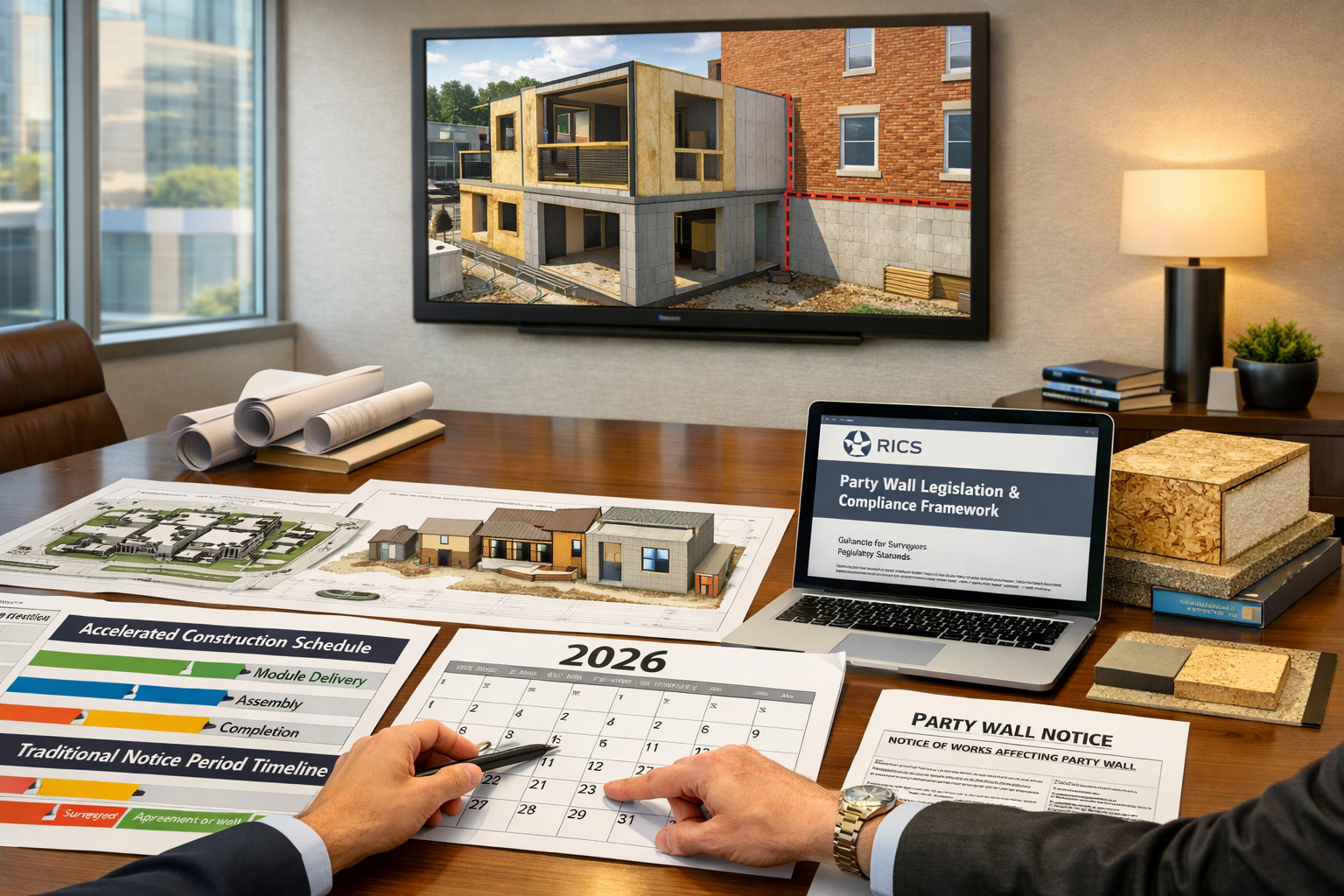
Traditional construction allows for two-month notice periods that often run concurrently with early groundwork. Offsite construction compresses this timeline dramatically:
Traditional Build Timeline:
- Serve notices (Month 1-2)
- Begin foundations (Month 2-3)
- Construct walls (Month 3-6)
- Complete structure (Month 6-12)
Offsite Construction Timeline:
- Serve notices (Week 1-8)
- Manufacture panels (Week 1-6, concurrent)
- Install foundations (Week 9-10)
- Assemble modules (Week 11-12)
- Complete structure (Week 12-16)
The compressed schedule means delays in party wall agreement can idle factory production, strand prefabricated components, and multiply project costs exponentially. According to recent industry analysis, construction upticks in 2026 have intensified pressure on surveyors to streamline compliance processes [1].
RICS-Compliant Strategies for Fast-Tracked Modular Builds
Adapting Traditional Processes to Prefabricated Systems
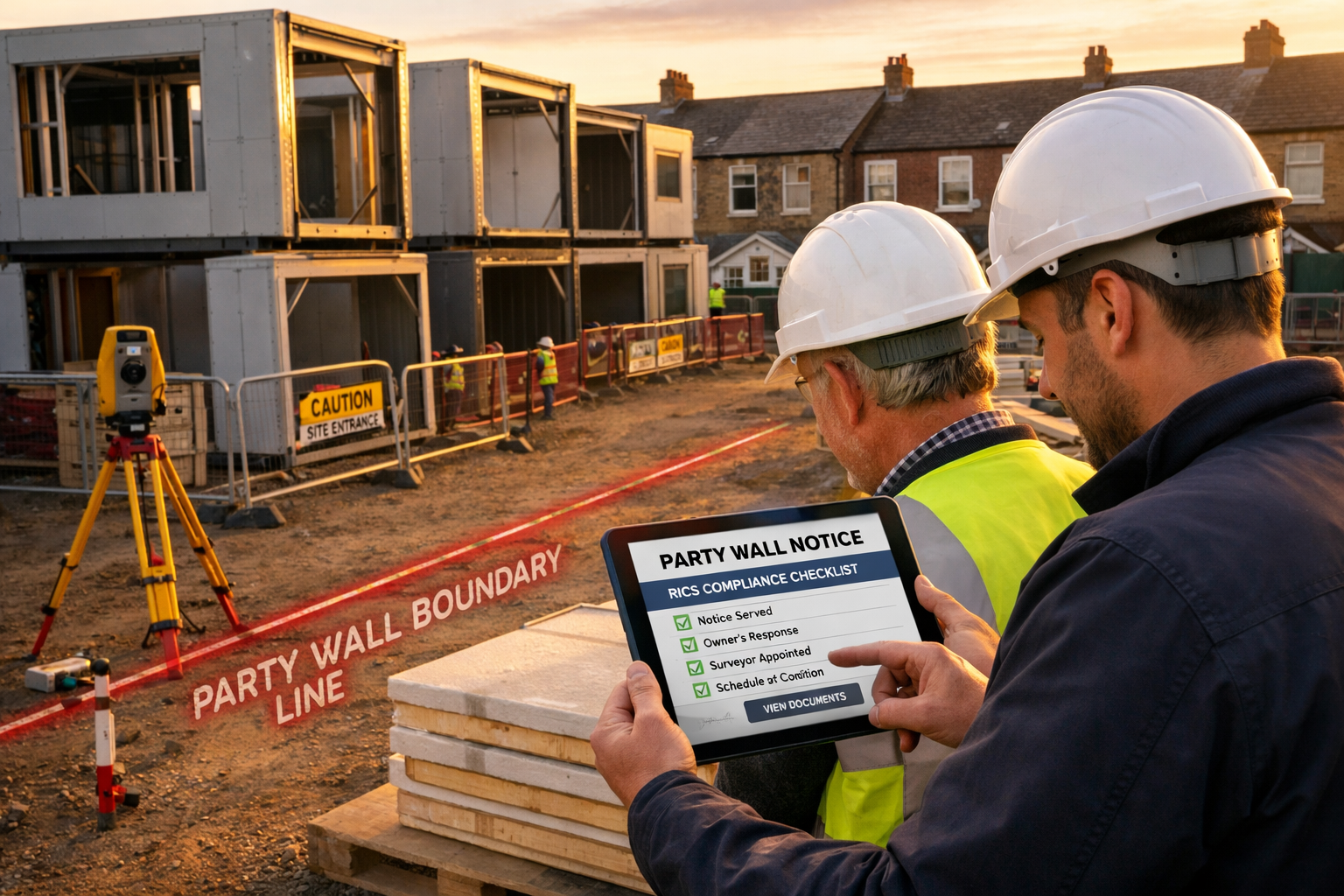
The Royal Institution of Chartered Surveyors (RICS) provides the professional framework that ensures party wall procedures maintain integrity while accommodating modern construction methods. RICS-compliant strategies for offsite construction focus on early engagement, comprehensive documentation, and proactive dispute prevention [1].
Key RICS principles for modular projects:
✅ Front-load the process: Begin party wall procedures during design phase, before manufacturing contracts
✅ Enhanced documentation: Provide detailed specifications of prefabricated components and installation methods
✅ Proactive schedules of condition: Complete neighbor property surveys before materials arrive on-site
✅ Clear communication: Explain accelerated timelines and factory production constraints to adjoining owners
✅ Flexible surveyor appointments: Engage professionals experienced in both party wall law and modern construction
Serving Notices for Panelized Construction
Effective notice service for offsite construction requires strategic planning and clear communication:
Step 1: Early Identification (Design Phase)
- Identify all potential party wall impacts during architectural design
- Map boundary relationships and existing party structures
- Determine which notice types apply to the planned prefabricated system
Step 2: Comprehensive Notice Preparation
- Include detailed drawings showing prefabricated component specifications
- Specify foundation types and load distributions for modular units
- Provide manufacturing and installation timelines
- Explain quality control measures in factory production
Step 3: Strategic Timing
- Serve notices before placing factory orders for custom panels
- Allow full statutory periods even when manufacturing proceeds concurrently
- Build contingency time into project schedules for potential disputes
Step 4: Supporting Documentation
- Provide structural calculations for prefabricated systems
- Include thermal and acoustic performance specifications
- Demonstrate compliance with building regulations
- Offer factory inspection opportunities when appropriate
Understanding what is a party structure notice and how to serve it becomes especially important when dealing with innovative construction methods that neighbors may not fully understand.
Preventing Disputes Over Shared Structures
The speed of offsite construction can create neighbor anxiety about unfamiliar building methods. Proactive dispute prevention strategies include:
Transparency Initiatives:
- Host pre-construction meetings explaining modular methods
- Provide visual materials showing panel installation processes
- Offer factory tours or videos demonstrating quality control
- Share case studies of successful nearby modular projects
Enhanced Schedules of Condition:
- Complete thorough schedule of condition surveys well before installation
- Use photographic and video documentation extensively
- Document existing party wall conditions in exceptional detail
- Establish baseline measurements for vibration and movement monitoring
Rapid Response Protocols:
- Establish direct communication channels between surveyors and installation teams
- Create fast-track procedures for addressing neighbor concerns
- Implement real-time monitoring during critical installation phases
- Maintain detailed installation logs for accountability
Professional Surveyor Selection:
- Engage surveyors with offsite construction experience
- Ensure understanding of both party wall law and modern building methods
- Select professionals capable of explaining technical concepts clearly
- Choose surveyors committed to collaborative problem-solving
The 2026 construction uptick has highlighted the importance of RICS compliance frameworks in managing increased neighbor disputes during rapid development periods [1].
SIPs and Prefab-Specific Considerations
Structural Insulated Panels (SIPs) and other advanced prefabricated systems present unique party wall considerations:
Foundation Connections:
- SIPs panels require precise foundation preparation before arrival
- Party wall agreements must address foundation work timing
- Load distributions differ from traditional masonry construction
- Connection details need clear specification in notices
Party Wall Interfaces:
- Prefabricated panels may require cutting existing party walls for connections
- Fire separation at party wall junctions needs careful detailing
- Acoustic performance must meet or exceed traditional construction
- Weatherproofing at boundaries requires specialized approaches
Installation Impacts:
- Crane operations may require temporary access over neighbor properties
- Panel delivery and staging areas need advance planning
- Installation speed reduces disruption duration but increases intensity
- Vibration from panel connections may affect adjoining structures
Quality Assurance Documentation:
- Factory quality control records supplement traditional inspection
- Third-party certification of prefabricated components
- Installation supervision by qualified professionals
- Post-installation verification of party wall integrity
Managing Costs and Timelines in 2026 Projects
Balancing Speed with Compliance
The primary advantage of offsite construction—speed—can become a liability when party wall procedures aren't properly integrated into project planning. Successful developers recognize that compliance costs represent a small fraction of potential delay expenses.
Cost considerations include:
💰 Surveyor fees: Professional fees for party wall surveyors typically range from £700-£1,500 per property for straightforward cases
💰 Schedule of condition costs: Comprehensive property surveys add £300-£800 per neighboring property
💰 Award preparation: Party wall awards for complex modular projects may cost £2,000-£5,000
💰 Dispute resolution: Contested cases requiring third surveyors can add £3,000-£10,000
💰 Delay costs: Each week of delay in modular installation can cost £5,000-£20,000 in financing and overhead
For practical guidance on how to keep party wall costs down, early engagement and clear communication remain the most effective strategies.
Timeline Integration Strategies
Successful timeline integration requires:
Parallel Processing:
- Run party wall notice periods concurrent with factory manufacturing
- Complete foundation work during panel production
- Finalize awards before delivery schedules lock in
- Maintain flexibility in installation dates until agreements are secured
Contingency Planning:
- Build 2-4 week buffers into installation schedules
- Identify alternative staging areas if disputes delay site access
- Develop backup plans for temporary storage of delivered components
- Maintain relationships with factory partners for schedule adjustments
Communication Protocols:
- Establish weekly updates between surveyors, developers, and manufacturers
- Create clear escalation procedures for emerging issues
- Maintain transparent timelines shared with all parties
- Document all communications for accountability
Regional Considerations in London
London's dense urban environment creates unique challenges for offsite construction and party wall compliance. Different areas present distinct considerations:
- Central London: Limited site access requires careful crane operation planning and neighbor coordination
- East London: Rapid regeneration areas see multiple concurrent modular projects
- West London: Higher property values increase scrutiny of new construction methods
- North London: Varied property types require flexible approach to party wall interfaces
- South London: Growing modular development creates experienced surveyor demand
Practical Implementation Guide for 2026
For Building Owners and Developers
Pre-Project Phase:
-
Engage party wall surveyors during design development
- Select professionals with offsite construction experience
- Discuss project timelines and manufacturing constraints
- Identify all potential party wall triggers early
-
Conduct boundary surveys and title research
- Verify exact property boundaries before finalizing designs
- Identify all adjoining owners requiring notices
- Research any existing party wall agreements or easements
-
Integrate compliance into project schedules
- Add party wall notice periods to critical path
- Build contingency time for potential disputes
- Coordinate surveyor availability with key milestones
Notice Service Phase:
-
Prepare comprehensive notice packages
- Include detailed drawings of prefabricated systems
- Provide specifications for factory-built components
- Explain installation methods and timelines clearly
- Offer to arrange factory visits or demonstrations
-
Serve notices with adequate lead time
- Allow full statutory periods even when manufacturing proceeds
- Provide contact information for immediate questions
- Follow up proactively after service
-
Facilitate neighbor understanding
- Host information sessions about modular construction
- Provide visual materials showing similar projects
- Address concerns about unfamiliar building methods
Installation Phase:
-
Complete schedules of condition before delivery
- Document neighboring properties thoroughly
- Establish baseline conditions for comparison
- Secure agreements before panels arrive on-site
-
Maintain communication during installation
- Provide advance notice of crane operations
- Keep neighbors informed of daily activities
- Address concerns promptly and professionally
-
Document compliance throughout
- Maintain detailed records of all party wall procedures
- Photograph installation at party wall interfaces
- Preserve correspondence and agreements
For Adjoining Owners
When you receive a party wall notice for an offsite construction project:
✓ Understand your rights: The Party Wall Act protects you equally regardless of construction method
✓ Review documentation carefully: Examine drawings and specifications of prefabricated components
✓ Ask questions: Request clarification about unfamiliar modular construction methods
✓ Consider appointing a surveyor: Professional representation ensures your interests are protected
✓ Don't delay responses: Compressed timelines make prompt engagement important
✓ Request schedules of condition: Ensure thorough documentation of your property before work begins
✓ Maintain communication: Work collaboratively with building owners and surveyors
Resources like having a party wall agreement without a surveyor can help you understand when professional representation is advisable.
For Party Wall Surveyors
Professional practice considerations for offsite construction:
Technical Knowledge:
- Develop understanding of prefabricated construction systems
- Learn about SIPs, modular units, and panelized methods
- Understand load distributions and connection details
- Stay current with building regulation compliance for offsite methods
Process Adaptation:
- Adjust traditional procedures for compressed timelines
- Develop enhanced documentation practices for factory-built components
- Create clear communication protocols for fast-tracked projects
- Build relationships with manufacturers and installation specialists
Risk Management:
- Identify unique risks in prefabricated construction
- Ensure adequate professional indemnity coverage
- Document decisions and recommendations thoroughly
- Maintain independence while facilitating project progress
Continuing Professional Development:
- Attend training on modern construction methods
- Participate in RICS guidance development for offsite construction
- Share knowledge with professional community
- Contribute to evolving best practices
Sustainability and Future Considerations
Eco-Compliance in Offsite Construction
The intersection of offsite construction and sustainability creates additional compliance considerations for 2026 projects. Sustainable home extensions increasingly incorporate eco-compliance clauses that affect party wall procedures [2].
Environmental factors affecting party wall notices:
🌱 Energy efficiency requirements: High-performance prefabricated panels may affect party wall thermal performance
🌱 Acoustic standards: Enhanced sound insulation in modular construction impacts party wall specifications
🌱 Material sustainability: Recycled and low-carbon materials require clear documentation in notices
🌱 Renewable energy integration: Solar panels and heat pumps on party walls need agreement
🌱 Water management: Sustainable drainage systems may affect shared structures
Emerging Technologies and Party Wall Law
As construction technology continues evolving, party wall procedures must adapt to:
Digital Documentation:
- Building Information Modeling (BIM) integration with party wall processes
- Digital service of notices and electronic agreements
- Virtual reality property inspections and schedules of condition
- Blockchain-based record keeping for party wall awards
Advanced Manufacturing:
- 3D-printed building components and party wall interfaces
- Robotically assembled structures at shared boundaries
- Smart building systems integrated into party walls
- Adaptive structures that respond to environmental conditions
Regulatory Evolution:
- Potential updates to Party Wall etc. Act 1996 for modern methods
- Enhanced guidance from RICS and professional bodies
- Local authority planning integration with party wall procedures
- Building safety reforms affecting shared structures
Conclusion
Party Wall Notices in Offsite Construction Booms: Ensuring Compliance for 2026 Panelized and Modular Projects represents a critical intersection of traditional property law and modern building innovation. As offsite construction methods become mainstream solutions to housing shortages and labor constraints, the fundamental principles of party wall legislation remain unchanged: protecting the rights of building owners while safeguarding neighboring properties from damage or disruption.
The key to successful compliance lies in early engagement, comprehensive planning, and proactive communication. Developers must integrate party wall procedures into project timelines from the design phase, recognizing that statutory notice periods cannot be compressed to match accelerated construction schedules. Surveyors must adapt traditional practices to accommodate prefabricated systems while maintaining RICS-compliant standards. Adjoining owners deserve clear explanations of unfamiliar construction methods and robust protections for their properties.
Actionable Next Steps
For immediate implementation:
- Review current projects for party wall compliance gaps in offsite construction planning
- Engage qualified surveyors with experience in both party wall law and modern construction methods
- Develop enhanced documentation standards for prefabricated building components
- Create communication protocols that explain modular construction to neighbors effectively
- Build contingency time into project schedules for party wall procedures
- Invest in professional development to understand evolving construction technologies
- Establish relationships with experienced professionals in your region
The offsite construction boom of 2026 offers tremendous opportunities for faster, more sustainable building delivery. Success requires recognizing that speed and compliance are not competing priorities but complementary objectives. Proper party wall procedures protect all parties, prevent costly disputes, and enable the construction innovation that our housing market desperately needs.
For expert guidance on navigating party wall notices for your offsite construction project, consult with qualified professionals who understand both the legal requirements and the technical demands of modern building methods. The investment in proper compliance pays dividends in project success, neighbor relationships, and long-term property value.
References
[1] Party Wall Surveys And Neighbour Disputes During 2026s Construction Uptick Rics Compliance Framework – https://nottinghillsurveyors.com/blog/party-wall-surveys-and-neighbour-disputes-during-2026s-construction-uptick-rics-compliance-framework
[2] Party Wall Notices For Sustainable Home Extensions In 2026 Eco Compliance Clauses – https://nottinghillsurveyors.com/blog/party-wall-notices-for-sustainable-home-extensions-in-2026-eco-compliance-clauses