
{"cover":"Professional landscape format (1536x1024) hero image featuring bold text overlay 'Party Wall Notices Under the 2026 Building Safety Act Amendments: Compliance Checklist for Surveyors' in extra large 72pt white sans-serif font with dark shadow and semi-transparent overlay box, positioned in upper third. Background shows modern surveyor reviewing architectural plans on tablet against backdrop of London terraced houses with shared walls, construction safety equipment visible, split-screen composition showing traditional party wall and modern safety compliance documentation. Color scheme: deep navy blue, safety orange accents, professional white. High contrast, magazine cover quality, editorial style with rule of thirds composition.","content":["Detailed landscape format (1536x1024) image showing close-up of surveyor's hands holding official party wall notice document with 2026 Building Safety Act compliance stamps and checkmarks, alongside digital tablet displaying building registration portal interface with 11-18 metre building classification highlighted, safety levy calculator visible on screen, professional desk setting with architectural drawings partially visible, warm office lighting, focus on documentation details and regulatory symbols, photorealistic professional photography style","Wide-angle landscape format (1536x1024) image depicting comprehensive compliance checklist infographic with three distinct vertical columns labeled Gateway One, Gateway Two, Gateway Three, each column showing party wall notice requirements with timeline arrows, safety inspection checkpoints marked with orange safety icons, building height measurements illustrated with simple building silhouettes ranging from 11m to 18m+ heights, professional blue and orange color scheme, clean modern infographic design with clear typography and visual hierarchy","Landscape format (1536x1024) image showing professional surveyor in high-visibility vest conducting on-site inspection of shared party wall between two residential properties, using laser measurement device and digital documentation tablet, building safety compliance signage visible on construction hoarding, detailed schedule of condition photography equipment on tripod nearby, natural daylight, urban London setting with scaffolding and safety barriers, emphasis on practical fieldwork and professional compliance procedures"]}
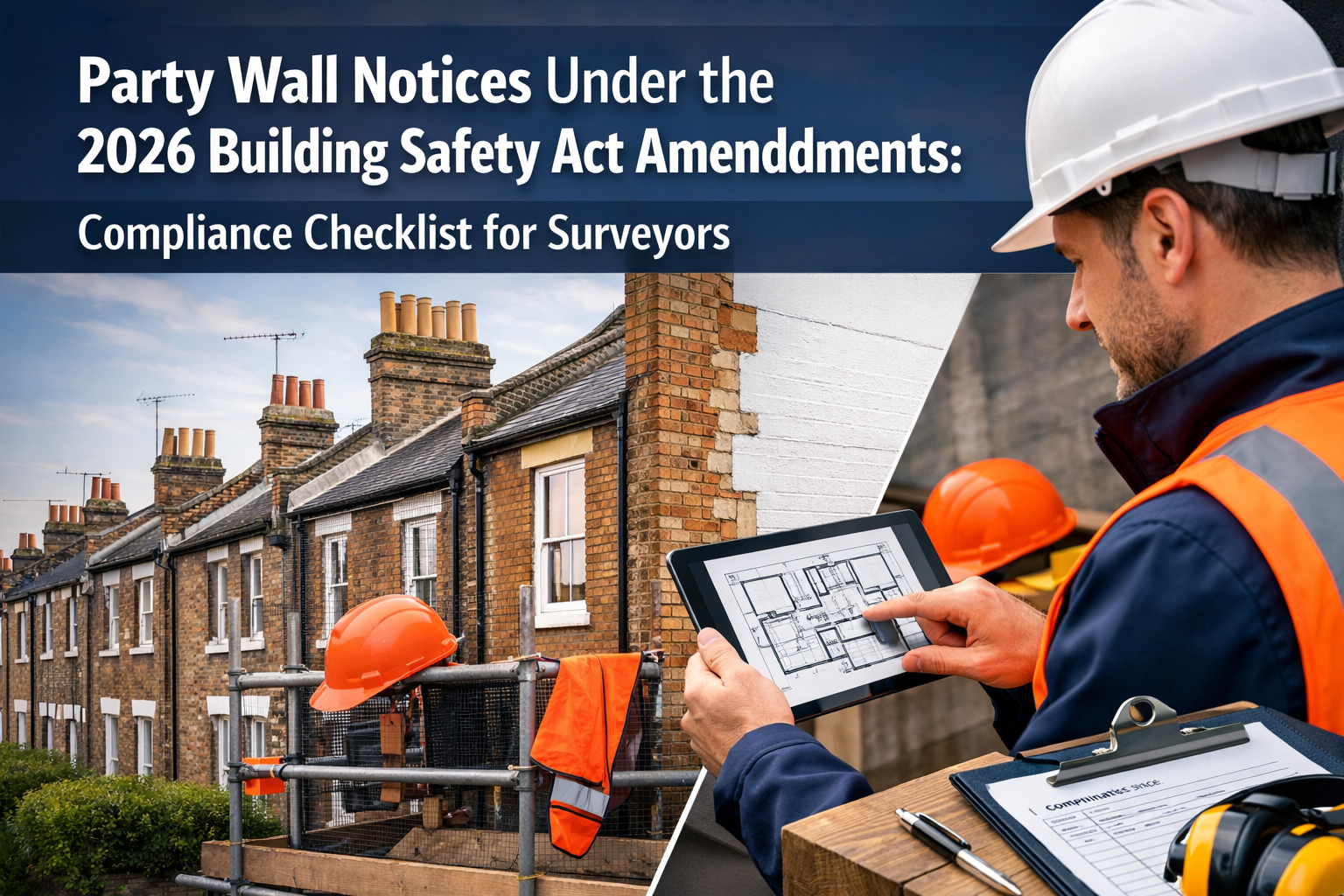
The construction landscape in 2026 has become significantly more complex for surveyors. With the recent Building Safety Act amendments taking effect this year, party wall notices now intersect with heightened safety regulations in ways that fundamentally change how surveyors approach notifiable works. Understanding Party Wall Notices Under the 2026 Building Safety Act Amendments: Compliance Checklist for Surveyors has become essential for professionals navigating this new regulatory environment.
The changes aren't merely administrative—they represent a fundamental shift in how building safety and neighbour rights converge. For surveyors working on buildings between 11-18 metres or conducting works affecting shared structures, the compliance requirements have expanded dramatically. Missing a step could result in costly delays, legal disputes, or regulatory penalties.
Key Takeaways
✅ 2026 amendments expand registration requirements to buildings 11-18 metres, directly impacting party wall procedures for mid-rise developments
✅ Building Safety Levy implementation from October 1, 2026, adds financial compliance layer to party wall works on applicable buildings
✅ Gateway processes now intersect with party wall timelines, requiring coordinated notice serving and safety approvals
✅ Enhanced documentation standards mandate detailed safety assessments alongside traditional party wall schedules of condition
✅ Surveyor responsibilities have expanded to include building safety compliance verification within party wall awards
Understanding the 2026 Building Safety Act Amendments
What Changed in 2026?
The Building Safety Act amendments introduced in 2026 represent the most significant regulatory overhaul since the Party Wall etc. Act 1996 was established. Three major changes directly affect how surveyors handle party wall matters:
🏢 Expanded Building Registration
Buildings between 11-18 metres now fall under mandatory registration requirements. Previously, only buildings over 18 metres (typically seven storeys or more) required registration with the Building Safety Regulator. This expansion means thousands of additional properties across London and the UK now trigger enhanced compliance obligations.
💰 Building Safety Levy
Launching October 1, 2026, the Building Safety Levy applies to most new residential building projects in England. For surveyors dealing with party wall notices, this creates an additional financial consideration that must be factored into project planning and cost assessments.
🔄 Independent Building Safety Regulator
As of January 27, 2026, the Building Safety Regulator transitioned from the Health and Safety Executive (HSE) to operate as an independent body. This institutional change brings stricter enforcement mechanisms and clearer accountability for building safety compliance.
How These Amendments Affect Party Wall Procedures
The intersection of building safety regulations with traditional party wall procedures creates several new compliance touchpoints:
| Traditional Party Wall Process | 2026 Enhanced Requirements |
|---|---|
| Serve notice 2 months before work | Verify building registration status first |
| Appoint agreed surveyor | Ensure surveyor has building safety competency |
| Prepare schedule of condition | Include fire safety and structural integrity assessments |
| Issue party wall award | Incorporate gateway compliance checkpoints |
| Monitor works | Report safety concerns to Building Safety Regulator |
For surveyors working across different London areas—whether as a party wall surveyor in South London, North London, or elsewhere—understanding these regional building stock characteristics becomes crucial for compliance.
Party Wall Notices Under the 2026 Building Safety Act Amendments: Core Compliance Requirements
Building Classification and Registration Verification
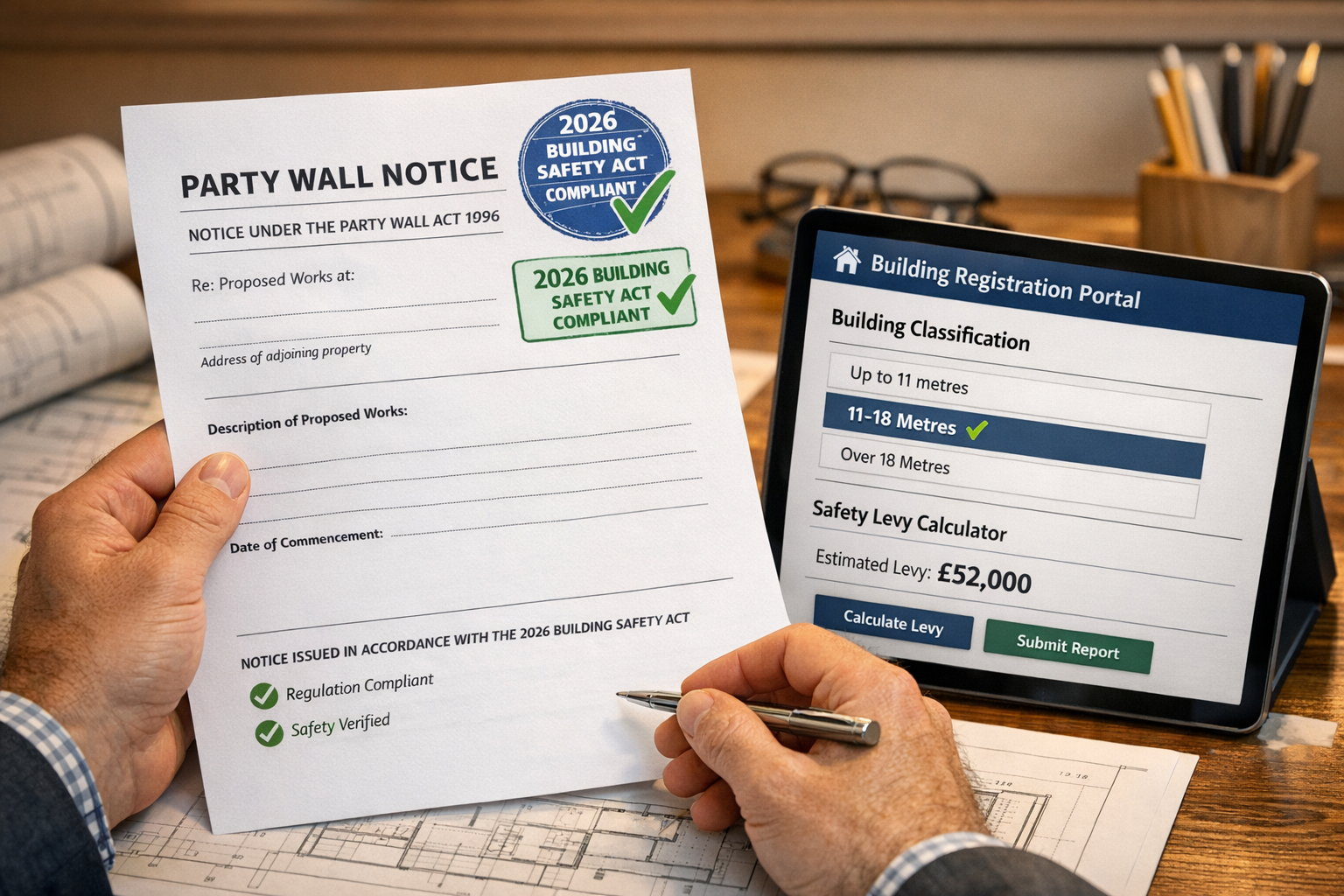
Before serving any party wall notice in 2026, surveyors must first determine whether the building falls under the new registration requirements:
Step 1: Measure Building Height
Determine if the building is:
- Under 11 metres (standard party wall procedures apply)
- 11-18 metres (new registration requirements apply)
- Over 18 metres (full higher-risk building regime applies)
Step 2: Check Registration Status
Access the Building Safety Regulator's portal to verify:
- Current registration status
- Accountable Person designation
- Outstanding compliance notices
- Safety case documentation (for 18m+ buildings)
Step 3: Identify Notifiable Works
Determine if your proposed types of party wall works trigger gateway processes:
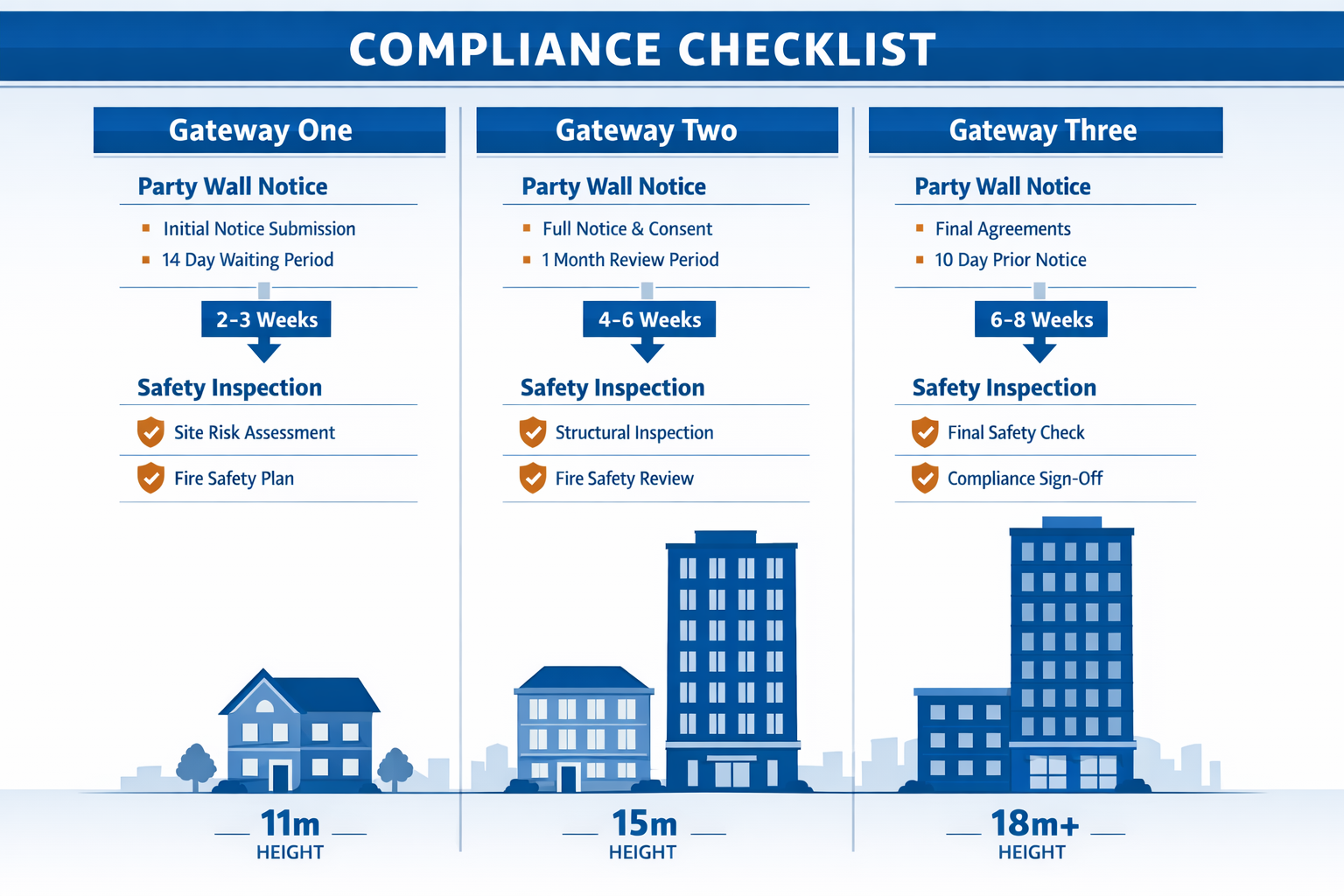
- Gateway One: Planning stage (design review)
- Gateway Two: Pre-construction (before work begins)
- Gateway Three: Completion and handover
Enhanced Notice Requirements
The 2026 amendments don't replace the Party Wall etc. Act 1996—they supplement it. Surveyors must now serve notices that address both traditional party wall matters and new safety considerations:
📋 Party Structure Notice Enhancements
When serving a party structure notice, include:
- Building Safety Statement: Brief description of how works comply with current fire safety and structural standards
- Gateway Compliance Reference: If applicable, reference to gateway approval status
- Competent Person Declaration: Confirmation that designers and contractors hold appropriate building safety competencies
- Safety Levy Acknowledgment: For applicable projects, acknowledgment of Building Safety Levy obligations
📋 Line of Junction Notice Additions
For works on or astride the boundary line, additional documentation now includes:
- Fire resistance specifications for new walls
- Compartmentation details
- Acoustic performance data (where relevant to safety)
📋 Adjacent Excavation Notice Updates
When serving notices for excavation within 3 or 6 metres of neighbouring structures:
- Foundation stability assessments
- Groundwater management plans
- Temporary works safety protocols
- Vibration monitoring commitments
Documentation Standards for 2026
The schedule of condition—a cornerstone of party wall practice—now requires expanded scope:
Traditional Elements:
- Photographic record of existing conditions
- Crack mapping and structural observations
- Services identification
- Access arrangements
2026 Safety Additions:
- Fire door condition and certification
- Escape route integrity
- Compartmentation breach identification
- Safety-critical element assessment
- Cladding system documentation (where relevant)
This enhanced documentation protects both building owners and adjoining owners while creating a comprehensive baseline for regulatory compliance.
Comprehensive Compliance Checklist for Party Wall Surveyors
Pre-Notice Phase Checklist
✅ Building Assessment
- Measure building height accurately (ground to topmost floor)
- Check Building Safety Regulator portal for registration status
- Identify Accountable Person for buildings 11m+
- Review any existing safety case documentation
- Determine if Building Safety Levy applies to project
✅ Project Scoping
- Classify proposed works under Party Wall Act categories
- Identify which gateway processes apply
- Assess fire safety implications of proposed works
- Review structural engineer's safety competency certification
- Confirm contractor holds appropriate building safety credentials
✅ Stakeholder Identification
- Identify all adjoining owners affected by works
- Determine if any adjoining properties are registered buildings
- Establish contact with Accountable Persons where relevant
- Notify building owner's surveyor of enhanced requirements
Notice Serving Phase Checklist
✅ Notice Preparation
- Draft notice using 2026-compliant templates
- Include all traditional Party Wall Act required information
- Add Building Safety Statement section
- Reference gateway approval status (if obtained)
- Attach competent person declarations
- Include safety levy acknowledgment (where applicable)
✅ Service Requirements
- Serve notices within statutory timeframes (minimum 2 months for party structure works)
- Provide copies to Accountable Person for registered buildings
- Maintain proof of service documentation
- Follow up with adjoining owners within 14 days
- Document all responses and consents
✅ Response Management
- Track 14-day response deadline for each adjoining owner
- Identify disputes requiring surveyor appointment
- Verify adjoining owner's surveyor credentials and building safety competency
- Establish agreed surveyor arrangements where appropriate
- Initiate dispute resolution procedures if needed
Award Preparation Phase Checklist
✅ Site Investigation
- Conduct comprehensive schedule of condition survey
- Photograph all safety-critical elements
- Document fire doors, escape routes, compartmentation
- Assess structural condition with safety lens
- Identify any pre-existing safety defects
- Record cladding systems and materials
✅ Award Drafting
- Include all traditional award clauses
- Add building safety compliance conditions
- Specify monitoring requirements for safety-critical works
- Define notification triggers for safety concerns
- Establish reporting protocols to Building Safety Regulator
- Include dispute resolution mechanisms
- Reference relevant gateway approvals
✅ Technical Specifications
- Detail fire resistance requirements for new/altered structures
- Specify compartmentation maintenance measures
- Include acoustic performance standards (where relevant)
- Define structural integrity monitoring protocols
- Establish quality assurance checkpoints
Works Monitoring Phase Checklist
✅ Ongoing Compliance
- Conduct regular site inspections per award schedule
- Monitor compliance with safety specifications
- Document any deviations from approved plans
- Verify competent person oversight of works
- Maintain photographic progress records
- Test fire resistance of completed elements (where specified)
✅ Issue Management
- Establish clear reporting channels for safety concerns
- Document all variations from original scope
- Assess building safety implications of any changes
- Notify Building Safety Regulator of material safety issues
- Update party wall awards as needed
✅ Completion Verification
- Conduct final inspection against schedule of condition
- Verify all safety-critical works completed as specified
- Obtain completion certificates for fire-rated elements
- Document any damage requiring remediation
- Prepare completion report with safety compliance confirmation
Post-Completion Phase Checklist
✅ Final Documentation
- Issue completion certificates to all parties
- Provide safety compliance summary to Accountable Person
- Archive all project documentation (minimum 15-year retention recommended)
- Update building information models with as-built details
- Confirm gateway three completion (where applicable)
✅ Defects Management
- Establish defects notification period
- Monitor for latent defects affecting safety
- Coordinate remediation of identified issues
- Maintain communication channels for 12 months minimum
Special Considerations for Different Building Types
Mid-Rise Buildings (11-18 Metres)
This newly regulated category presents unique challenges for party wall surveyors:
Key Compliance Points:
- Mandatory building registration before commencing notifiable works
- Accountable Person must be identified and engaged
- Fire safety considerations take precedence in design decisions
- Staircase and escape route protection during works is critical
Common Scenarios:
- Loft conversions adding height to existing buildings
- Rear extensions on Victorian terraces
- Basement excavations affecting neighbouring mid-rise blocks
When working on projects in areas with high concentrations of mid-rise buildings—such as those handled by a party wall surveyor in East London or West London—understanding local building stock characteristics becomes essential.
Higher-Risk Buildings (18+ Metres)
For buildings exceeding 18 metres, the full higher-risk building regime applies:
Additional Requirements:
- Full safety case documentation review
- Gateway process coordination with party wall timelines
- Principal Designer and Principal Contractor engagement
- Golden thread information management
- Residents' engagement strategy alignment
Timeline Coordination:
Party wall notice periods must align with gateway approval timelines. A typical sequence might be:
- Months 1-2: Gateway One submission and party wall notice preparation
- Month 3: Serve party wall notices while awaiting Gateway One approval
- Months 4-5: Surveyor appointments and award preparation
- Month 6: Gateway Two submission with party wall award in place
- Month 7+: Works commence after both Gateway Two approval and party wall compliance
Heritage and Conservation Areas
Buildings in conservation areas or with listed status add another layer of complexity:
Integrated Compliance Approach:
- Conservation officer consultation alongside party wall procedures
- Heritage impact assessments within schedule of condition
- Reversibility considerations for party wall works
- Traditional materials and methods documentation
Common Pitfalls and How to Avoid Them
❌ Pitfall 1: Assuming Standard Procedures Still Apply
The Problem: Many surveyors continue using pre-2026 templates and processes without adapting to new requirements.
The Solution: Update all templates, checklists, and standard operating procedures to incorporate Building Safety Act requirements. Attend continuing professional development courses focused on the 2026 amendments.
❌ Pitfall 2: Inadequate Building Height Verification
The Problem: Relying on planning documents or estimates rather than accurate measurements can result in missing registration requirements.
The Solution: Always verify building height through:
- Architectural drawings with certified dimensions
- Physical measurement where possible
- Building control records
- Building Safety Regulator database
❌ Pitfall 3: Overlooking Building Safety Levy Implications
The Problem: Failing to account for the Building Safety Levy in project budgets and timelines.
The Solution: For all projects starting after October 1, 2026, verify levy applicability early in the planning phase. Include levy costs in party wall costs estimates provided to building owners.
❌ Pitfall 4: Insufficient Safety Competency Verification
The Problem: Appointing surveyors or contractors without confirming their building safety competencies.
The Solution: Establish a verification process for all project team members:
- Request competency certificates
- Verify professional indemnity insurance covers building safety work
- Confirm continuing professional development in building safety
- Check for any regulatory sanctions or restrictions
❌ Pitfall 5: Poor Gateway-Party Wall Timeline Coordination
The Problem: Serving party wall notices without considering gateway approval timelines, leading to delays and frustrated stakeholders.
The Solution: Create integrated project timelines that map:
- Gateway submission deadlines
- Party wall notice periods
- Surveyor appointment windows
- Award preparation timeframes
- Works commencement dates
Technology and Tools for 2026 Compliance
Digital Documentation Platforms
Modern party wall practice increasingly relies on digital tools:
Benefits:
- Centralized document storage with version control
- Automated compliance checklists
- Integration with Building Safety Regulator portals
- Real-time collaboration between surveyors
- Audit trails for regulatory purposes
Recommended Features:
- Mobile app for on-site schedule of condition recording
- Photo annotation and markup capabilities
- Automated notice generation with 2026 compliance
- Stakeholder communication tracking
- Gateway submission integration
Building Information Modeling (BIM)
For larger projects, BIM integration provides:
- 3D visualization of party wall works
- Clash detection with existing structures
- Fire safety modeling
- Golden thread information management
- As-built documentation accuracy
Compliance Management Software
Specialized platforms help track:
- Multiple project timelines simultaneously
- Regulatory deadline alerts
- Document expiry notifications (certificates, approvals)
- Competency verification status
- Cost tracking including Building Safety Levy
Professional Development and Training
Essential Knowledge Areas for 2026
Party wall surveyors must now demonstrate competency in:
-
Building Safety Regulations
- Gateway processes and requirements
- Fire safety principles and Approved Document B
- Structural integrity assessment
- Competent person schemes
-
Enhanced Risk Assessment
- Safety-critical element identification
- Fire spread risk evaluation
- Structural stability during works
- Resident safety during construction
-
Regulatory Engagement
- Building Safety Regulator communication protocols
- Mandatory occurrence reporting
- Safety case understanding
- Accountable Person liaison
-
Technical Standards
- Fire resistance testing and certification
- Compartmentation principles
- Acoustic performance requirements
- Cladding safety considerations
Continuing Professional Development Resources
Professional Bodies:
- Royal Institution of Chartered Surveyors (RICS) building safety modules
- Pyramus & Thisbe Club updated guidance notes
- Faculty of Party Wall Surveyors training programs
- Chartered Institute of Building safety courses
Regulatory Resources:
- Building Safety Regulator guidance publications
- Ministry of Housing, Communities & Local Government updates
- Health and Safety Executive technical guidance
- Local authority building control bulletins
Cost Implications and Fee Structures
How 2026 Amendments Affect Party Wall Costs
The enhanced compliance requirements inevitably impact project costs:
Additional Time Requirements:
- Building registration verification: 1-2 hours per project
- Enhanced schedule of condition: 20-30% more time
- Safety compliance documentation: 3-5 additional hours
- Gateway coordination: 2-4 hours per gateway stage
New Cost Elements:
- Building Safety Levy (for applicable projects)
- Enhanced professional indemnity insurance premiums
- Specialist safety assessments
- Additional site monitoring visits
- Extended document retention and management
Transparent Fee Communication
When discussing how to keep party wall costs down, surveyors should clearly explain:
What's Included in 2026 Fees:
- Traditional party wall services
- Building safety compliance verification
- Gateway coordination support
- Enhanced documentation
- Regulatory liaison
What May Incur Additional Charges:
- Specialist fire safety assessments
- Structural engineer consultations
- Building Safety Regulator submissions
- Extended monitoring for complex projects
- Dispute resolution proceedings
💡 Pro Tip: Provide itemized fee proposals that separate traditional party wall services from 2026 enhancement requirements. This transparency helps building owners understand the value of comprehensive compliance.
Regional Considerations Across London
Central London Challenges
Working as a party wall surveyor in Central London presents unique challenges:
- High concentration of registered buildings
- Complex ownership structures (freehold, leasehold, commonhold)
- Heritage and conservation constraints
- Tight site conditions affecting works methodology
- Resident density requiring enhanced safety protocols
Outer London Considerations
Different challenges emerge in outer boroughs:
- More mid-rise buildings newly brought into registration
- Mixed-use developments with varied safety requirements
- Larger sites with multiple party wall interfaces
- Varied building ages and construction methods
- Different local authority building control approaches
Future-Proofing Your Practice
Anticipated Further Amendments
The building safety regulatory landscape continues to evolve. Surveyors should monitor:
Upcoming Consultations:
- Expanded competency requirements for party wall surveyors
- Standardized reporting templates for safety-critical works
- Enhanced enforcement mechanisms
- Resident engagement protocols during party wall works
Emerging Best Practices:
- Digital-first documentation standards
- Integrated building safety and party wall awards
- Proactive safety defect identification
- Collaborative working protocols between surveyors and Accountable Persons
Building a Resilient Practice
Strategic Investments:
- Technology Infrastructure: Invest in platforms that can adapt to regulatory changes
- Professional Development: Allocate budget for ongoing training (minimum 20 hours annually recommended)
- Network Building: Engage with professional bodies and peer groups
- Quality Systems: Implement ISO-aligned quality management for consistency
- Insurance Review: Ensure coverage adequately addresses building safety work
Client Education:
Help building owners and adjoining owners understand:
- Why compliance requirements have expanded
- How enhanced procedures protect their interests
- The value of professional surveyor services in 2026
- Realistic timelines and cost expectations
Conclusion
Party Wall Notices Under the 2026 Building Safety Act Amendments: Compliance Checklist for Surveyors represents more than a procedural update—it signals a fundamental evolution in how building safety and neighbour rights intersect. The amendments don't replace the foundational principles of the Party Wall etc. Act 1996; rather, they enhance them with critical safety considerations that protect both building occupants and adjoining owners.
Key Actions for Surveyors in 2026
Immediate Steps:
- ✅ Update all notice templates and award precedents to incorporate building safety requirements
- ✅ Verify building heights and registration status for all current and upcoming projects
- ✅ Complete building safety competency training through recognized professional bodies
- ✅ Review and enhance professional indemnity insurance coverage
- ✅ Establish relationships with Building Safety Regulator representatives
Medium-Term Development:
- 📈 Implement digital documentation systems for enhanced compliance tracking
- 📈 Develop integrated timeline planning tools that coordinate gateway and party wall processes
- 📈 Build referral networks with fire safety specialists and structural engineers
- 📈 Create client education materials explaining 2026 requirements
- 📈 Participate in professional body working groups shaping future guidance
Long-Term Strategic Planning:
- 🎯 Position your practice as a building safety-competent party wall specialist
- 🎯 Invest in emerging technologies like BIM and digital twins
- 🎯 Contribute to industry knowledge through case studies and publications
- 🎯 Mentor junior surveyors in integrated compliance approaches
- 🎯 Anticipate and prepare for further regulatory evolution
The Path Forward
The intersection of party wall procedures with building safety regulations may initially seem daunting, but it ultimately serves the profession's core purpose: protecting property rights while ensuring safe, compliant construction. Surveyors who embrace these changes, invest in appropriate training and systems, and communicate transparently with clients will find themselves well-positioned for success in this enhanced regulatory environment.
Whether you're serving party wall notices for a modest residential extension or coordinating complex multi-party awards for major developments, the principles remain consistent: thorough assessment, clear communication, comprehensive documentation, and unwavering commitment to both neighbour rights and building safety.
The 2026 amendments don't diminish the party wall surveyor's role—they elevate it, recognizing that these professionals serve as crucial guardians of both property interests and public safety. By following the compliance checklist outlined in this guide and maintaining commitment to professional excellence, surveyors can navigate this new landscape with confidence and competence.
Ready to ensure your party wall practice meets 2026 compliance standards? Download our comprehensive checklist, stay informed about regulatory updates, and invest in the professional development that positions you as a trusted expert in this evolving field.