

As the UK experiences a significant construction boom in 2026, understanding Party Wall Notices Under the Party Wall Act: Best Practices for 2026's UK Construction Uptick and Neighbor Disputes has never been more critical for homeowners, developers, and construction professionals. With housing demand surging and renovation projects multiplying across England and Wales, knowing how to properly serve notices, navigate timelines, and respond to neighbor concerns can mean the difference between smooth construction progress and costly legal disputes. This comprehensive guide breaks down everything property owners need to know about party wall procedures in today's high-demand housing market.
Key Takeaways
- ⏰ Two-month notice required for works affecting existing party walls (loft conversions, structural modifications), while excavation and new boundary structures require one-month notice
- 📋 Neighbors cannot permanently block your project – the Party Wall Act provides dispute resolution mechanisms that allow work to proceed with protective measures
- 💷 Early compliance saves money – proper notice procedures and cooperative agreements can reduce surveyor costs from £5,000+ to £1,000-£2,500
- 📸 Documentation protects all parties – schedule of condition surveys with photographs safeguard both building and adjoining owners during construction
- 🏴 England and Wales only – the Party Wall Act 1996 doesn't apply in Scotland or Northern Ireland, which have different legal frameworks
Understanding the Party Wall Act 1996 Framework
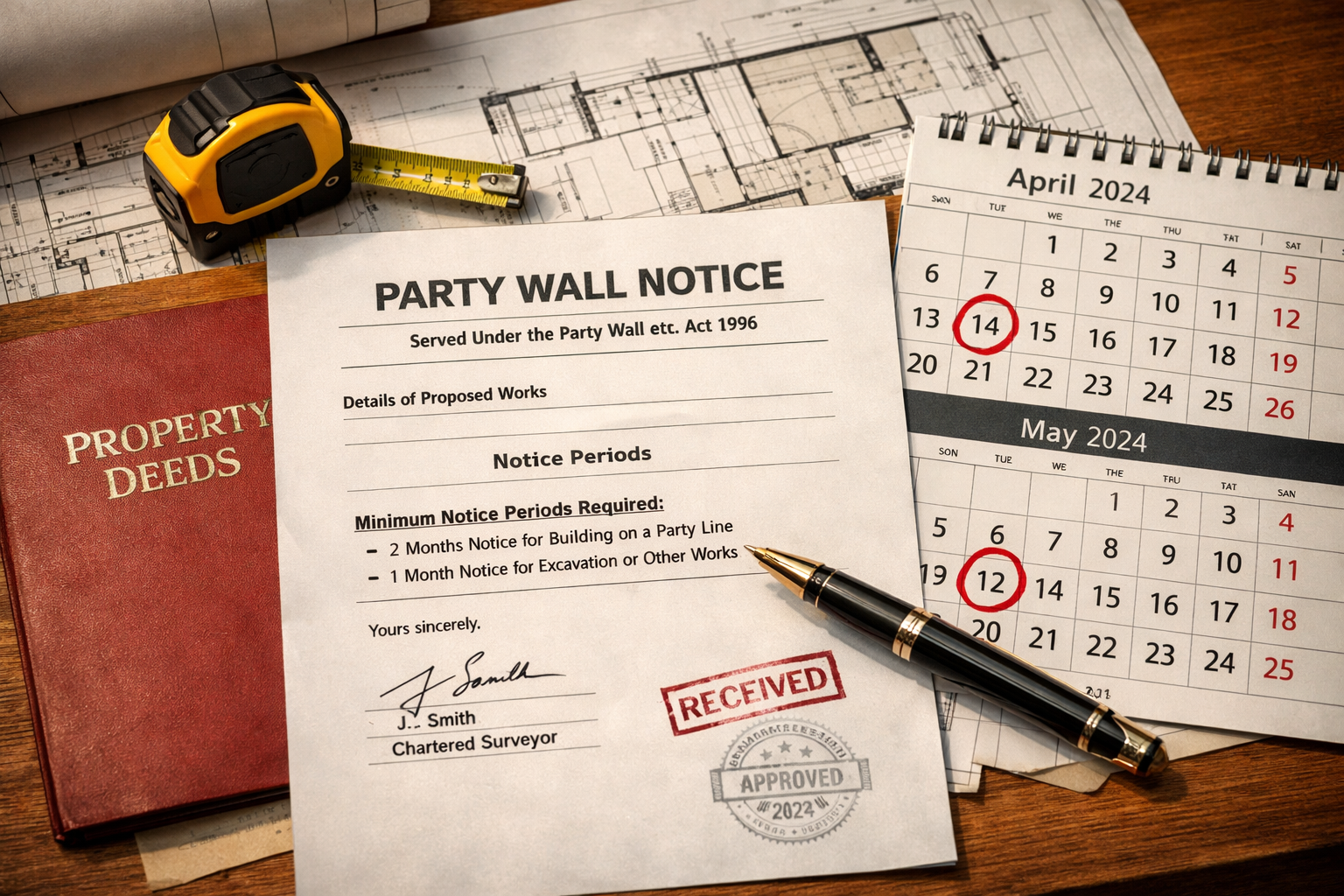
The Party Wall etc. Act 1996 provides the legal foundation for managing construction works that affect shared walls, boundaries, and structures between neighboring properties in England and Wales. This legislation creates a balanced framework that protects the rights of both building owners who want to carry out works and adjoining owners whose properties may be affected.[2]
What Qualifies as a Party Wall?
A party wall is any wall or structure that stands on the boundary between two properties and is used by both owners. This includes:
- 🏠 Walls separating semi-detached or terraced houses
- 🧱 Shared garden walls between properties
- 🏢 Walls dividing different units in converted buildings
- 🔧 Floor and ceiling structures separating flats in different ownership
Understanding what constitutes a party fence wall versus other boundary structures is essential for determining whether the Act applies to your planned works.[3]
Geographic Limitations and Jurisdiction
Important: The Party Wall Act 1996 applies exclusively to England and Wales. Property owners in Scotland and Northern Ireland operate under completely different legal frameworks for boundary and shared wall matters.[2] This geographic limitation becomes particularly relevant in 2026 as construction activity increases across all UK regions, requiring property owners to verify which regulations govern their specific location.
Types of Party Wall Notices: When and How to Serve
Navigating Party Wall Notices Under the Party Wall Act: Best Practices for 2026's UK Construction Uptick and Neighbor Disputes requires understanding which type of notice applies to your specific construction project. The Act establishes three distinct notice categories, each with unique timelines and requirements.
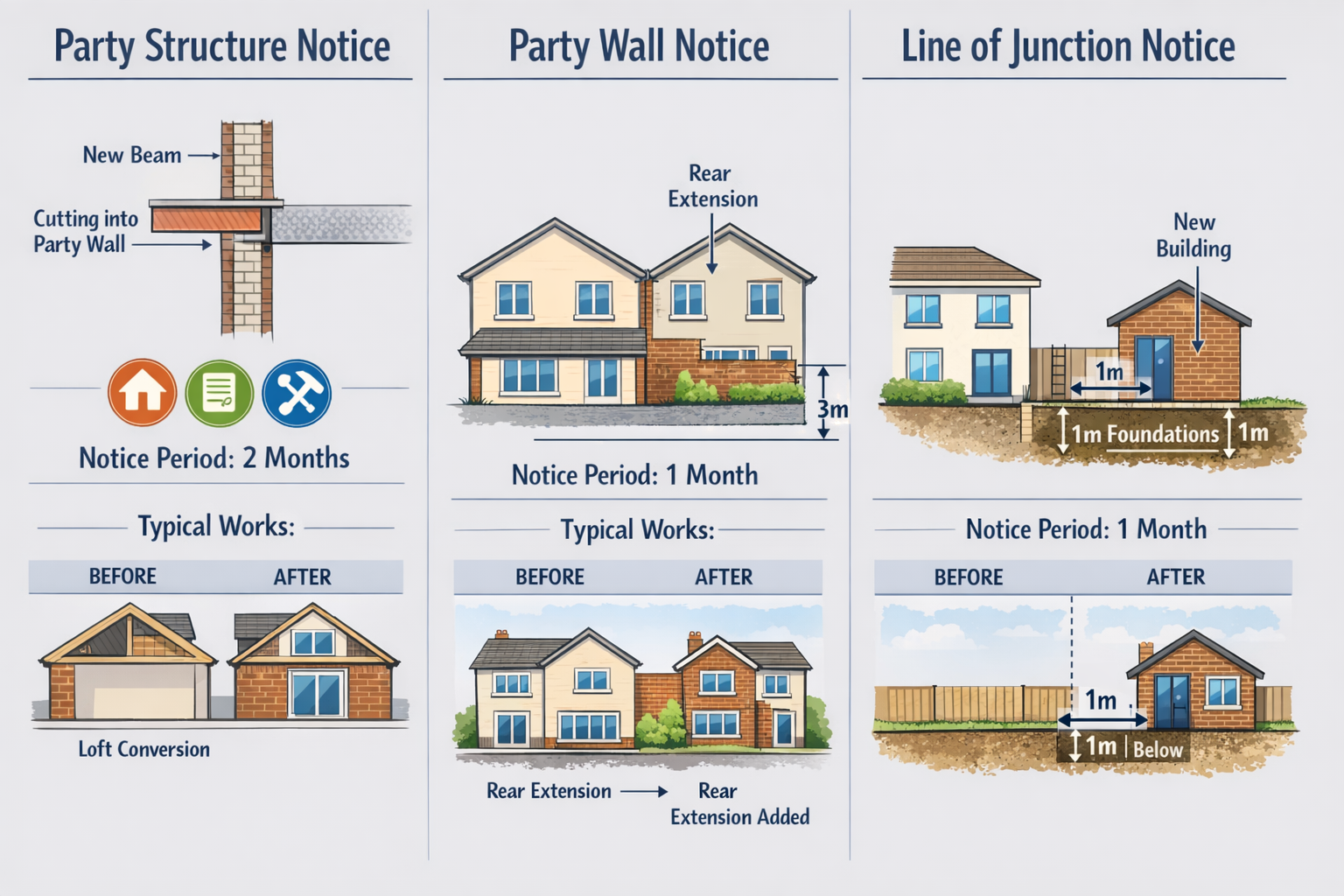
Party Structure Notice (Section 3)
This notice applies when you plan to carry out works directly to an existing party wall or structure. Common scenarios requiring a Party Structure Notice include:[3][5]
| Work Type | Description | Notice Period |
|---|---|---|
| Wall Thickening | Adding thickness to a party wall for insulation or structural reasons | 2 months |
| Wall Height Increase | Raising the height of a party wall or building | 2 months |
| Damp Proof Course | Inserting or replacing damp proof course in party walls | 2 months |
| Cutting Projections | Removing chimney breasts or other projections from party walls | 2 months |
| Demolition/Rebuilding | Taking down and rebuilding sections of party walls | 2 months |
The two-month notice period for Party Structure Notices is mandatory and begins from the date your neighbor receives the notice, not when you send it.[2][5] This extended timeline allows adjoining owners adequate time to review plans, seek professional advice, and respond appropriately.
Party Wall Notice (Section 2)
This notice type covers works to walls that sit astride the boundary line between properties, including:[4]
- Building a new wall directly on the property boundary
- Repairing or modifying an existing boundary wall
- Constructing extensions that involve boundary walls
For these works, property owners must serve notice one month before construction begins.[2] This shorter timeline reflects the typically less invasive nature of boundary-line construction compared to works affecting existing shared structures.
Line of Junction Notice (Section 6)
The third notice category addresses excavation and foundation work near neighboring properties. You must serve a Line of Junction Notice if you plan to:[2][4]
- Excavate within 3 meters of a neighbor's structure and deeper than their foundations
- Excavate within 6 meters of a neighbor's structure at depths that create a 45-degree angle below their foundation level
This notice requires one month's advance warning and includes detailed information about excavation depth, proximity to neighboring foundations, and protective measures.[4]
Statutory Timelines and Response Protocols
Understanding the precise timelines governing Party Wall Notices Under the Party Wall Act: Best Practices for 2026's UK Construction Uptick and Neighbor Disputes is crucial for project planning in 2026's fast-paced construction environment.
The 14-Day Response Window
Once you serve a party wall notice, your neighbor has 14 days to respond in one of three ways:[2][9]
- ✅ Consent – Written agreement allowing works to proceed as planned
- ❌ Dissent – Formal disagreement triggering the surveyor appointment process
- 🔇 No Response – Silence after 14 days automatically constitutes dissent
"The 14-day response period is strict and non-negotiable. Building owners should never assume silence means consent – legally, it triggers the dispute resolution process."[9]
Calculating Notice Periods Correctly
Many homeowners make critical errors when calculating notice periods. Here's the correct approach:
- Day Zero = The day your neighbor receives the notice (not the day you send it)
- Proof of Service = Always use recorded delivery or hand-delivery with signed receipt
- Count Forward = Two months means exactly two calendar months from receipt date
- Work Start Date = Cannot begin until the notice period expires AND consent is received (or Party Wall Award is in place)
For example, if your neighbor receives a Party Structure Notice on January 15, 2026, the earliest you can legally commence work is March 15, 2026 – and only if they've consented or a Party Wall Award has been issued.[5]
Common Timing Mistakes to Avoid
🚫 Starting work before notice period expires – This constitutes a breach of the Act and can result in injunctions and legal costs
🚫 Assuming email service is sufficient – While increasingly accepted, formal notice should be served via recorded post or hand delivery
🚫 Failing to account for surveyor appointment time – If neighbors dissent, add 2-4 weeks for surveyor selection and initial assessments
🚫 Not coordinating with planning permission timelines – Party wall procedures run independently of planning applications
Works Requiring Party Wall Agreements vs. Exemptions
Not all construction work triggers Party Wall Act requirements. Understanding which projects need formal notices helps property owners avoid unnecessary delays and costs while ensuring compliance where legally required.
Major Works Requiring Notices
Loft Conversions represent one of the most common scenarios requiring party wall agreements in 2026's housing market. When converting a loft in a semi-detached or terraced property, notices are typically necessary if the work involves:[1][5]
- Installing steel beams that rest on or connect to party walls
- Removing chimney breasts that form part of the party structure
- Adding dormers that require modifications to shared roof structures
- Underpinning or strengthening foundations near the boundary
Basement Excavations and extensions almost always trigger Line of Junction Notice requirements, particularly in urban areas where properties sit close together.[4] The 2026 construction boom has seen increased basement conversion demand, making proper notice procedures essential.
Structural Modifications including:
- Removing or inserting load-bearing walls
- Creating new openings in party walls
- Strengthening existing party structures
- Installing damp proof courses or cavity wall insulation[3][5]
Minor Works Exempted from the Act
The following common household improvements do not require party wall notices:[2][3]
- 🎨 Plastering or decorating party walls
- 🔌 Installing electrical wiring or sockets
- 🪛 Drilling for shelves, kitchen units, or picture frames
- 🚿 Plumbing work that doesn't affect wall structure
- 🪟 Replacing windows in existing openings
- 🚪 Installing new doors in existing doorways
These exemptions apply only when work remains genuinely non-structural. If you're uncertain whether your project requires notice, consulting with professionals who understand types of party wall works can prevent costly mistakes.
Best Practices for Serving Party Wall Notices in 2026
With construction activity intensifying across England and Wales, implementing Party Wall Notices Under the Party Wall Act: Best Practices for 2026's UK Construction Uptick and Neighbor Disputes ensures smooth project progression and maintains positive neighbor relationships.
Pre-Notice Communication Strategy
Before formal notice service, consider these relationship-preserving steps:
- 🗣️ Informal Discussion – Talk to neighbors about your plans before serving formal notices
- 📐 Share Preliminary Plans – Show drawings and explain how you'll protect their property
- ⏰ Discuss Timing – Ask about any concerns regarding construction schedules
- 🤝 Address Concerns Early – Identify potential objections and find solutions proactively
This approach, while not legally required, significantly reduces the likelihood of disputes. In 2026's competitive construction environment where surveyor availability may be limited, avoiding formal dispute procedures saves both time and money.[6]
Notice Content Requirements
A valid party wall notice must include:[2][5]
- Building owner's name and address
- Adjoining owner's name and address
- Detailed description of proposed works
- Drawings or plans showing the work
- Proposed start date (respecting statutory notice periods)
- Statement of rights explaining the adjoining owner's options
Many property owners find using a party wall agreement template helpful for ensuring all required information is included.
Service Methods and Proof
Recommended service methods in order of reliability:
- ✉️ Hand Delivery with Receipt – Personally deliver and obtain signed acknowledgment
- 📬 Recorded Delivery Post – Provides tracking and delivery confirmation
- 📧 Email (with confirmation) – Increasingly accepted but should be followed by hard copy
- 🚪 Affixing to Property – Last resort if neighbor cannot be located
Always retain proof of service including:
- Signed receipts
- Postal tracking numbers
- Email delivery confirmations
- Photographs of affixed notices (if applicable)
This documentation becomes critical if disputes arise or if you need to demonstrate compliance with statutory timelines.[8]
Responding to Party Wall Notices: Options for Adjoining Owners
When you receive a party wall notice as an adjoining owner, understanding your options for responding to party wall notices protects your property interests while maintaining reasonable relationships with neighbors.
Response Option 1: Consent
Giving consent means you agree to the proposed works proceeding as described in the notice. This option works best when:[9]
- The proposed works are minor and unlikely to affect your property
- You trust your neighbor to carry out work responsibly
- The building owner has addressed your concerns satisfactorily
- You want to avoid surveyor costs
Important: Even when consenting, you can request:
- A schedule of condition documenting your property's current state
- Specific working hours or access arrangements
- Regular progress updates
- Contact information for the contractor
Consent should always be in writing and clearly reference the notice you're responding to.[9]
Response Option 2: Conditional Consent
This middle-ground approach allows you to consent with specific conditions, such as:[5][9]
- Requiring additional protective measures
- Specifying acceptable working hours
- Requesting particular construction methods
- Demanding regular inspections or updates
Conditional consent can reduce surveyor costs to £1,000-£2,500 compared to full dispute procedures while still protecting your interests.[5] However, both parties must agree to the conditions, or the matter proceeds to formal surveyor appointment.
Response Option 3: Dissent
Formal dissent doesn't mean you're blocking the work – you're simply requiring the statutory dispute resolution process. Dissent is appropriate when:[2][5]
- The proposed works are extensive or potentially damaging
- You have significant concerns about construction methods
- The building owner hasn't adequately addressed your questions
- You want professional protection throughout the process
"Dissenting to a party wall notice is not obstructive – it's a legitimate right that triggers professional oversight to protect all parties during construction."[8]
The "Deemed Dissent" Rule
If you don't respond within 14 days, the law automatically treats this as dissent, triggering the surveyor appointment process.[2] This rule protects adjoining owners who may be away, unwell, or simply overwhelmed by the legal complexity.
The Party Wall Award Process: Dispute Resolution
When neighbors dissent to a notice, the Party Wall Act's dispute resolution mechanism creates a Party Wall Award – a legally binding document that allows construction to proceed with appropriate safeguards.
Surveyor Appointment Options
The Act provides three surveyor appointment structures:[5][6]
Option 1: Agreed Surveyor
- Both parties jointly appoint a single impartial surveyor
- Most cost-effective approach (£1,500-£3,000 typically)
- Requires mutual trust and cooperation
- Surveyor must act impartially for both parties
Option 2: Two Surveyors
- Each party appoints their own surveyor
- The two surveyors work together to create the award
- More expensive (£3,000-£5,000+) but provides dedicated representation
- Most common approach in 2026's construction boom[6]
Option 3: Third Surveyor
- Appointed by the two party-appointed surveyors
- Acts as arbitrator if the two surveyors cannot agree
- Additional cost but ensures resolution
- Rarely needed in straightforward cases
What the Party Wall Award Contains
A comprehensive Party Wall Award includes:[5]
- Detailed work description – Exactly what construction is permitted
- Protective measures – How the building owner will safeguard the adjoining property
- Schedule of condition – Photographic and written record of the adjoining property's current state
- Access rights – When and how contractors can access neighboring property (if necessary)
- Working hours – Permitted times for construction activity
- Cost allocation – Who pays for what aspects of the process
- Dispute resolution – Procedures if problems arise during construction
Schedule of Condition: Essential Protection
The schedule of condition represents one of the most valuable components of the Party Wall Award process. This detailed survey:[5]
- 📸 Documents the adjoining property's condition before work begins
- 🔍 Identifies existing cracks, damage, or defects
- 📝 Creates baseline for assessing any construction-related damage
- 🛡️ Protects both parties from false claims
In 2026's busy construction market, thorough schedules of condition have become increasingly important as multiple simultaneous projects in dense urban areas increase the risk of construction-related damage.[6]
Timeline for Award Preparation
From dissent to completed award typically takes:[5][6]
- Week 1-2: Surveyor appointments and initial property inspections
- Week 3-4: Schedule of condition preparation and photography
- Week 5-6: Draft award preparation and review
- Week 7-8: Final award issued to both parties
Building owners should factor this 6-8 week timeline into project planning, particularly in 2026 when surveyor availability may be constrained by high demand.[6]
Cost Implications and Financial Responsibilities
Understanding the financial aspects of Party Wall Notices Under the Party Wall Act: Best Practices for 2026's UK Construction Uptick and Neighbor Disputes helps property owners budget accurately and make informed decisions about construction projects.
Who Pays for Party Wall Procedures?
The building owner (the person carrying out the work) typically bears all costs associated with party wall procedures, including:[5]
- Their own surveyor's fees
- The adjoining owner's surveyor's fees
- Third surveyor fees (if required)
- Schedule of condition preparation
- Award documentation and administration
This cost allocation reflects the principle that those benefiting from construction should bear the associated expenses.[2]
Typical Cost Ranges in 2026
Agreed Surveyor Approach:
- Simple projects: £1,500-£2,500
- Complex projects: £2,500-£4,000
Two Surveyor Approach:
- Simple projects: £3,000-£4,000
- Complex projects: £4,000-£6,000
- Highly complex or disputed cases: £6,000-£10,000+[5][6]
Factors affecting costs:
- 📊 Project complexity and scope
- 🏘️ Number of adjoining properties affected
- 📸 Extent of schedule of condition required
- ⚖️ Level of disagreement between parties
- 📍 Geographic location (London typically higher)
For property owners across different London areas, costs may vary – those working with a party wall surveyor in West London may encounter different fee structures than those using surveyors in other regions.
Strategies to Minimize Party Wall Costs
💡 Early neighbor engagement – Addressing concerns before formal dissent reduces surveyor involvement
💡 Agreed surveyor where possible – Mutual appointment of a single surveyor cuts costs significantly
💡 Clear, detailed notices – Comprehensive initial notices reduce back-and-forth and surveyor time
💡 Realistic timelines – Rushing the process often increases costs through expedited fees
💡 Professional notice preparation – Well-prepared notices reduce the likelihood of disputes
For more cost-saving approaches, review guidance on how to keep party wall costs down.
Regional Considerations Across England and Wales
The 2026 construction boom affects different regions with varying intensity, creating location-specific considerations for party wall procedures.
London and Major Urban Centers
High-density housing in London creates unique party wall challenges:[6]
- Multiple adjoining owners – Terraced properties may require notices to neighbors on both sides
- Vertical neighbors – Flat conversions require notices to properties above and below
- Limited surveyor availability – High demand in 2026 may extend surveyor appointment timelines
- Higher costs – Urban surveyor fees typically exceed rural equivalents
Property owners should consider location-specific expertise, whether working with a party wall surveyor in North London, East London, South London, or Central London.
Suburban and Rural Areas
Lower-density areas present different considerations:
- Fewer party wall scenarios (more detached properties)
- Longer distances between surveyors and properties
- Potentially limited local surveyor availability
- Generally lower costs but possibly longer travel times
Wales-Specific Considerations
While the Party Wall Act 1996 applies throughout Wales, property owners should note:[2]
- Language requirements may apply in certain areas
- Local building traditions may affect construction approaches
- Rural Wales may have limited surveyor availability
- Cross-border properties (Wales-England) follow English law if the property is in England
Case Studies: Lessons from 2026's Construction Boom
Real-world examples illustrate best practices and common pitfalls in managing Party Wall Notices Under the Party Wall Act: Best Practices for 2026's UK Construction Uptick and Neighbor Disputes.
Case Study 1: Successful Loft Conversion Through Early Engagement
Scenario: Homeowner in terraced property plans loft conversion requiring steel beam installation on party wall.
Approach:
- Informal discussion with neighbors 3 months before planned work
- Shared architect's drawings and explained protective measures
- Served formal Party Structure Notice 10 weeks before desired start date
- Neighbors consented after requesting specific working hours
Outcome:
- ✅ Work commenced on schedule
- ✅ No surveyor costs incurred
- ✅ Positive neighbor relationships maintained
- ✅ Project completed without disputes
Key Lesson: Early, transparent communication often eliminates the need for formal dispute procedures.[8]
Case Study 2: Basement Excavation Requiring Full Award Process
Scenario: Property owner plans basement excavation within 3 meters of neighbor's Victorian terrace foundation.
Approach:
- Served Line of Junction Notice with detailed excavation plans
- Neighbor dissented due to concerns about foundation stability
- Both parties appointed surveyors (two-surveyor approach)
- Comprehensive schedule of condition documented neighbor's existing cracks
- Award specified underpinning requirements and monitoring protocols
Outcome:
- ✅ Work proceeded with enhanced protective measures
- ✅ Regular monitoring confirmed no new damage
- ✅ Total surveyor costs: £4,200
- ✅ Schedule of condition protected building owner from pre-existing damage claims
Key Lesson: For complex, high-risk works, the Party Wall Award process provides essential protection for all parties.[5][6]
Case Study 3: Avoiding Delays Through Proper Timeline Planning
Scenario: Developer plans rear extension on semi-detached property with tight completion deadline.
Mistake:
- Served Party Wall Notice only 6 weeks before desired start date
- Neighbor dissented, triggering surveyor appointment
- Surveyor appointment and award process took 7 weeks
- Project delayed by 3 weeks beyond planned start
Corrective Action:
- Future projects now factor 12-week buffer for party wall procedures
- Pre-notice neighbor engagement initiated earlier
- Surveyor identified during planning phase for faster appointment
Key Lesson: Inadequate timeline planning remains the most common cause of construction delays in party wall scenarios.[6]
Appeals and Dispute Escalation
While Party Wall Awards resolve most disputes, the Act provides mechanisms for addressing persistent disagreements.
County Court Appeals
Either party may appeal a Party Wall Award to the County Court within 14 days of the award being served.[6] Grounds for appeal include:
- Surveyor bias or improper conduct
- Award contains factual errors
- Procedural irregularities in award preparation
- Unreasonable conditions or requirements
Important: Appeals must be filed within the strict 14-day window – late appeals are typically rejected regardless of merit.[6]
Alternative Dispute Resolution
Before pursuing formal appeals, consider:
- Mediation – Neutral third party facilitates agreement
- Surveyor clarification – Request surveyor explain or clarify award terms
- Negotiated modifications – Discuss concerns with the other party directly
- Third surveyor determination – If two surveyors disagree, third surveyor resolves
These approaches often resolve issues faster and more cost-effectively than County Court proceedings.[9]
Having a Party Wall Agreement Without a Surveyor
In some circumstances, parties can create party wall agreements without formal surveyor involvement, though this approach carries both benefits and risks.
When DIY Agreements Work
Surveyor-free agreements may be appropriate for:[7]
- Very minor works with minimal risk
- Neighbors with excellent existing relationships
- Simple, straightforward construction projects
- Situations where both parties fully understand the Act
Essential Elements of Self-Prepared Agreements
If proceeding without surveyors, the agreement must still include:
- Detailed work description
- Protective measures
- Access arrangements (if needed)
- Working hours and duration
- Photographic record of adjoining property
- Dispute resolution procedures
- Signatures from both parties
Risks of Avoiding Professional Involvement
⚠️ Legal validity concerns – Improperly drafted agreements may not satisfy statutory requirements
⚠️ Inadequate protection – Missing critical protective measures or documentation
⚠️ Future disputes – Ambiguous terms can lead to conflicts during construction
⚠️ Insurance implications – Some insurers require professional party wall procedures
For most projects in 2026's active construction environment, professional surveyor involvement provides valuable risk mitigation.[6]
Practical Tips for Building Owners in 2026
Property owners planning construction in 2026's busy market should follow these best practices:
Pre-Construction Planning
📅 Start early – Begin party wall procedures 3-4 months before desired construction start
📋 Assess all affected neighbors – Identify every property that may require notice
🔍 Research local surveyors – Identify qualified professionals before disputes arise
💰 Budget for full costs – Assume dissent and budget for two-surveyor approach
📐 Prepare detailed plans – Comprehensive drawings reduce questions and concerns
During the Notice Period
✉️ Document everything – Keep copies of all notices, responses, and communications
🤝 Stay accessible – Respond promptly to neighbor questions or surveyor requests
⏰ Respect timelines – Never commence work before notice periods expire
📸 Take photographs – Document your own property's condition before work begins
During Construction
🚧 Follow award terms exactly – Deviation can result in injunctions or legal action
👷 Maintain communication – Update neighbors on progress and any issues
🔊 Minimize disruption – Respect agreed working hours and access arrangements
🛠️ Address concerns immediately – Respond quickly to neighbor complaints or surveyor observations
For those carrying out works, understanding these practical considerations ensures smoother project execution.
Practical Tips for Adjoining Owners in 2026
Receiving a party wall notice can be stressful, but informed adjoining owners can protect their interests effectively.
Upon Receiving Notice
📖 Read carefully – Review all details of proposed works
❓ Ask questions – Request clarification on anything unclear
⏱️ Note the deadline – You have 14 days to respond
🔍 Inspect your property – Document current condition with photographs
💼 Consider professional advice – Consult a surveyor if works seem significant
For guidance, review resources for neighbors carrying out works.
Evaluating Your Response
Consider these factors when deciding how to respond:[9]
Consent if:
- Works are minor and low-risk
- You trust your neighbor's approach
- The building owner has addressed your concerns
- You want to avoid surveyor costs
Dissent if:
- Works are extensive or potentially damaging
- You have significant concerns about methods
- Your property is particularly vulnerable
- You want professional protection and documentation
Conditional consent if:
- You generally agree but have specific requirements
- You want some professional oversight without full dispute procedures
- The building owner is willing to negotiate terms
Protecting Your Rights
🛡️ Insist on schedule of condition – Even if consenting, request photographic documentation
📝 Get everything in writing – Verbal agreements are difficult to enforce
⚖️ Know your rights – The building owner cannot start work without proper procedures
🚫 Don't be pressured – You have 14 days to respond and shouldn't be rushed
Understanding Boundary Walls vs. Party Walls

Confusion between boundary walls and party walls can lead to incorrect notice procedures. Understanding the difference between party fence walls and boundary walls is essential.
Key Distinctions
Party Wall:
- Stands on the boundary line
- Shared ownership between neighbors
- Both parties have rights to the structure
- Party Wall Act applies
Boundary Wall:
- Stands entirely on one property
- Single ownership
- Other party has no structural rights
- Party Wall Act generally doesn't apply (except for excavation near foundations)
Determining Wall Status
To identify whether a wall is a party wall:[3]
- Check property deeds and title documents
- Review historical surveys
- Examine wall construction (straddling boundary suggests party wall)
- Consult a surveyor if uncertain
Misidentifying wall status can lead to serving incorrect notices or failing to serve required notices.[3]
Height Restrictions and Planning Considerations
Party wall procedures operate independently from planning permission, but both may apply to the same project. Understanding how high you can build a wall between neighbours requires considering multiple regulatory frameworks.
Party Wall Act vs. Planning Permission
Party Wall Act:
- Addresses structural and procedural issues
- Protects neighboring property rights
- Required regardless of planning status
- Focuses on construction methods and protection
Planning Permission:
- Addresses land use and development control
- Considers broader community impact
- May be required in addition to party wall procedures
- Focuses on appropriateness of development
Critical Point: You need both party wall compliance and planning permission (if required) – one doesn't substitute for the other.[7]
Building Regulations Compliance
Beyond party wall and planning requirements, all construction must comply with Building Regulations covering:
- Structural safety
- Fire safety
- Energy efficiency
- Accessibility
- Drainage and waste
Party Wall Awards don't override Building Regulations requirements – full compliance with all applicable regulations is mandatory.[7]
The Future of Party Wall Procedures: 2026 and Beyond
As the UK construction sector continues its 2026 boom, several trends are shaping party wall practice:
Technology Integration
Digital notice service – Electronic notice service is becoming more widely accepted, though physical copies remain recommended
Virtual surveys – Some surveyors now offer remote schedule of condition services using video technology
Online dispute resolution – Digital platforms are emerging for surveyor communication and award preparation
Drone photography – Aerial documentation is increasingly used for complex or hard-to-access properties
Regulatory Developments
While the Party Wall Act 1996 remains the foundational legislation, emerging trends include:[6]
- Greater emphasis on environmental protection during construction
- Enhanced requirements for noise and vibration monitoring
- Stricter enforcement of working hours in residential areas
- Increased focus on heritage property protection
Market Pressures
The 2026 construction boom creates specific pressures:[6]
- Surveyor shortage – High demand may extend appointment timelines
- Cost inflation – Surveyor fees are rising with general construction costs
- Quality concerns – Rushed procedures may compromise thoroughness
- Neighbor fatigue – Multiple simultaneous projects in dense areas increase tensions
Property owners should anticipate these challenges and plan accordingly, building extra time and budget into project schedules.
Common Myths and Misconceptions
Clearing up misunderstandings about Party Wall Notices Under the Party Wall Act: Best Practices for 2026's UK Construction Uptick and Neighbor Disputes helps property owners make informed decisions.
Myth 1: "My neighbor can block my project"
Reality: Neighbors cannot permanently prevent lawful construction. The Party Wall Act provides dispute resolution mechanisms that allow work to proceed with appropriate safeguards.[5]
Myth 2: "I don't need party wall procedures if I have planning permission"
Reality: Planning permission and party wall procedures are completely separate. Both may be required for the same project.[7]
Myth 3: "Party wall procedures only apply in London"
Reality: The Party Wall Act 1996 applies throughout England and Wales, not just London.[2]
Myth 4: "I can start work as soon as I serve the notice"
Reality: You must wait for the full notice period to expire (1-2 months depending on work type) AND receive consent or have a Party Wall Award in place.[2][5]
Myth 5: "If my neighbor doesn't respond, I can proceed"
Reality: No response after 14 days constitutes dissent, triggering the surveyor appointment process – you cannot simply proceed.[2]
Myth 6: "Party wall surveyors are too expensive"
Reality: While surveyors cost money, they often save more by preventing disputes, documenting conditions, and ensuring proper construction methods that avoid damage claims.[5][6]
Conclusion: Navigating Party Wall Procedures Successfully in 2026
As the UK experiences unprecedented construction activity in 2026, mastering Party Wall Notices Under the Party Wall Act: Best Practices for 2026's UK Construction Uptick and Neighbor Disputes has become essential for property owners, developers, and construction professionals. The Party Wall Act 1996 provides a balanced framework that protects both those undertaking construction and their neighbors, but success requires understanding statutory timelines, proper notice procedures, and dispute resolution mechanisms.
Key Success Factors
✅ Early planning – Start party wall procedures 3-4 months before desired construction dates
✅ Transparent communication – Engage neighbors informally before serving formal notices
✅ Accurate notice service – Include all required information and use reliable delivery methods
✅ Realistic budgeting – Prepare for potential surveyor costs of £3,000-£6,000
✅ Professional involvement – Engage qualified surveyors for complex or high-risk projects
✅ Complete documentation – Maintain comprehensive records of all notices, responses, and agreements
✅ Regulatory compliance – Ensure party wall procedures complement (not replace) planning and building regulations
Actionable Next Steps
For Building Owners Planning Construction:
- 📋 Identify all potentially affected neighbors
- 📅 Create a timeline incorporating 2-month notice periods
- 💷 Budget for potential surveyor costs
- 🗣️ Initiate informal neighbor discussions
- 📐 Prepare detailed plans and drawings
- ✉️ Serve formal notices with proof of delivery
- 🔍 Research qualified local surveyors in case of dissent
For Adjoining Owners Who Receive Notices:
- 📖 Read the notice carefully and completely
- 📸 Document your property's current condition
- ❓ Ask questions about anything unclear
- 💼 Consider consulting a surveyor for significant works
- ⏰ Respond within 14 days (consent, dissent, or conditional consent)
- 📝 Ensure all agreements are documented in writing
- 🛡️ Request a schedule of condition regardless of response type
The Bottom Line
The 2026 construction boom presents both opportunities and challenges for UK property owners. Those who understand and properly implement party wall procedures will find their projects proceed smoothly, costs remain controlled, and neighbor relationships stay positive. Those who ignore or mishandle these requirements face delays, legal disputes, and potentially significant financial penalties.
The Party Wall Act 1996 isn't an obstacle to construction – it's a framework for ensuring development proceeds responsibly and fairly. By following best practices, serving notices correctly, respecting statutory timelines, and engaging professional surveyors when needed, property owners can navigate even complex party wall scenarios successfully.
Whether you're planning a simple loft conversion or a major basement excavation, investing time and resources in proper party wall procedures at the outset saves money, stress, and neighbor relationships in the long run. In 2026's competitive construction environment, this investment represents not just legal compliance but sound business practice.
References
[1] Buying Property Party Wall Award – https://osborneslaw.com/blog/buying-property-party-wall-award/
[2] Party Wall Agreement – https://hoa.org.uk/advice/guides-for-homeowners/i-am-improving/party-wall-agreement/
[3] An Introductory Guide To The Party Wall Etc Act 1996 – https://www.parklaneplowden.co.uk/an-introductory-guide-to-the-party-wall-etc-act-1996/
[4] Rear Extensions And The Party Wall Act – https://www.peterbarry.co.uk/blog/rear-extensions-and-the-party-wall-act/
[5] Party Wall Agreement Loft Conversion – https://www.houseup.co.uk/news/party-wall-agreement-loft-conversion
[6] Party Wall Surveys Amid 2026 Construction Boom Handling Disputes In High Demand Uk Housing Markets – https://nottinghillsurveyors.com/blog/party-wall-surveys-amid-2026-construction-boom-handling-disputes-in-high-demand-uk-housing-markets
[7] The Benefits Of Party Wall Agreements In Kent For – https://fpws-kent.co.uk/the-benefits-of-party-wall-agreements-in-kent-for/
[8] Understanding Party Wall Matters Why Early Advice Protects You Your Property And Your Neighbours – https://thebusinessgroup.co.uk/understanding-party-wall-matters-why-early-advice-protects-you-your-property-and-your-neighbours
[9] Options For Responding To Party Wall Notices A Complete Guide For Homeowners – https://www.adamjoseph.co.uk/options-for-responding-to-party-wall-notices-a-complete-guide-for-homeowners