

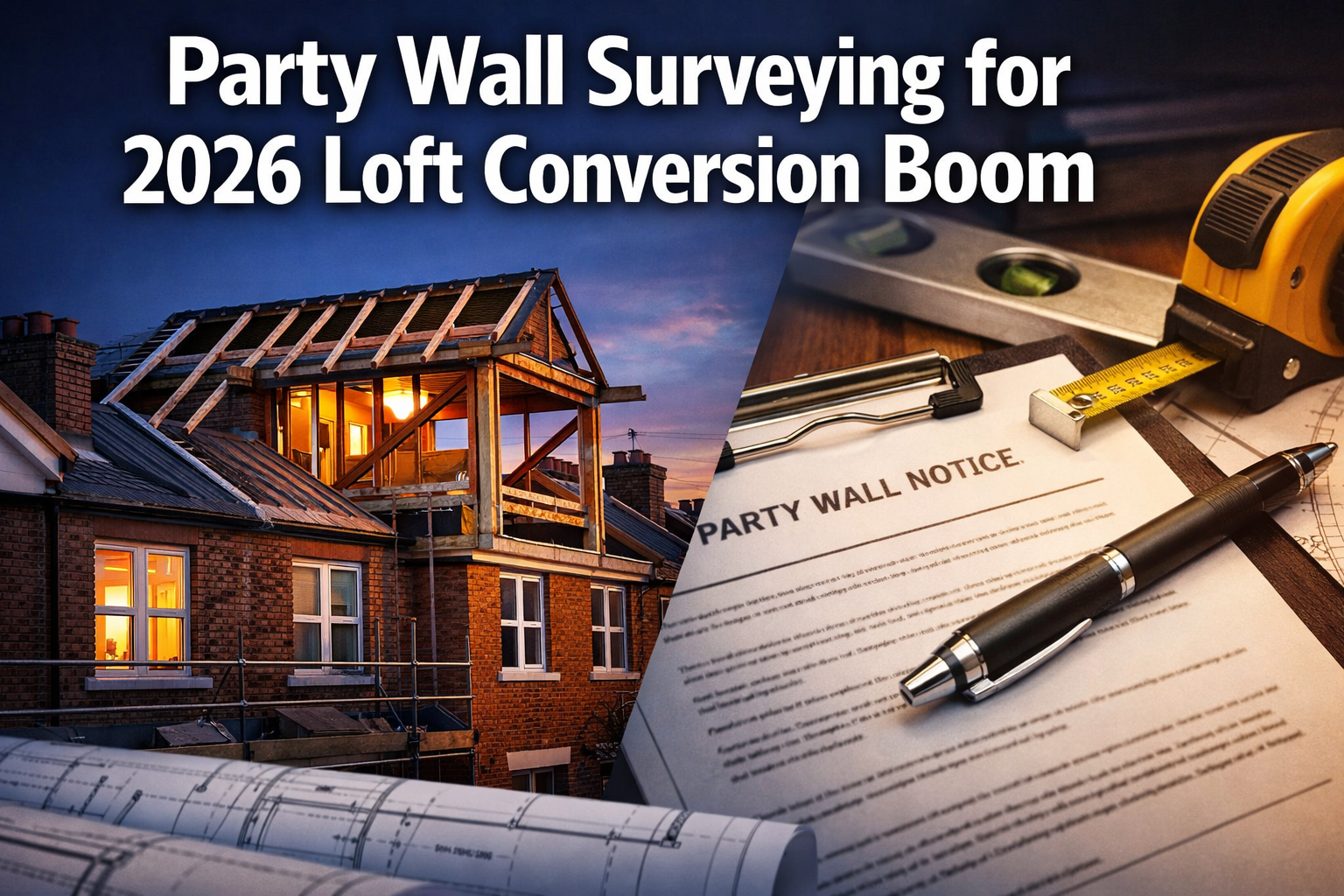
The housing market in 2026 is witnessing an unprecedented surge in loft conversions as homeowners seek creative solutions to the ongoing housing shortage. With property prices continuing to climb and limited availability of new builds, converting underutilized attic spaces has become the go-to strategy for adding value and living space. However, this boom brings with it a critical legal requirement that many homeowners overlook until it's too late: Party Wall Surveying for 2026 Loft Conversion Boom: Essential Notices and Award Protocols Amid Housing Uptick. Understanding these mandatory procedures can mean the difference between a smooth project launch and costly delays that derail your entire timeline.
The Party Wall Act 1996 governs all work affecting shared walls, boundaries, and nearby foundations in England and Wales. As loft conversion demand intensifies in 2026, proper compliance with notice requirements and award protocols has never been more crucial. This comprehensive guide breaks down everything property owners need to know about navigating party wall procedures in today's high-demand construction environment.
Key Takeaways
- Two-month minimum notice is legally required before starting any loft conversion work that affects shared walls or foundations within 3-6 metres of neighbouring properties
- Party wall awards cost between £700-£2,000 per affected neighbour and become mandatory when neighbours dissent or fail to respond to notices
- Building Regulations approval is universally required for all loft conversions, covering structural integrity, fire safety, and thermal performance
- Professional surveyor appointment protects both parties through documented pre-work conditions and dispute resolution mechanisms
- Proper documentation prevents project delays and potential legal disputes that can cost thousands in additional fees
Understanding Party Wall Surveying for 2026 Loft Conversion Boom
The surge in loft conversions throughout 2026 has placed party wall surveying at the forefront of residential construction planning. Unlike detached properties where homeowners have complete autonomy, terraced and semi-detached homes require careful navigation of legal obligations to neighbouring property owners.
What Triggers Party Wall Requirements?
Loft conversions typically trigger party wall procedures in several scenarios:
🏗️ Structural alterations to shared walls – Installing steel beams, cutting into party walls, or adding load-bearing supports
📏 Foundation work within proximity – Excavations within 3-6 metres of neighbouring foundations (depending on depth)
🔨 Raising party walls – Extending shared walls upward to accommodate increased ceiling height
🏠 Installing dormer windows – Work that affects the structural integrity of shared walls
The Party Wall etc. Act 1996 establishes clear guidelines for these scenarios, but many homeowners underestimate the complexity of compliance in 2026's competitive construction market.
The Critical Timeline Factor
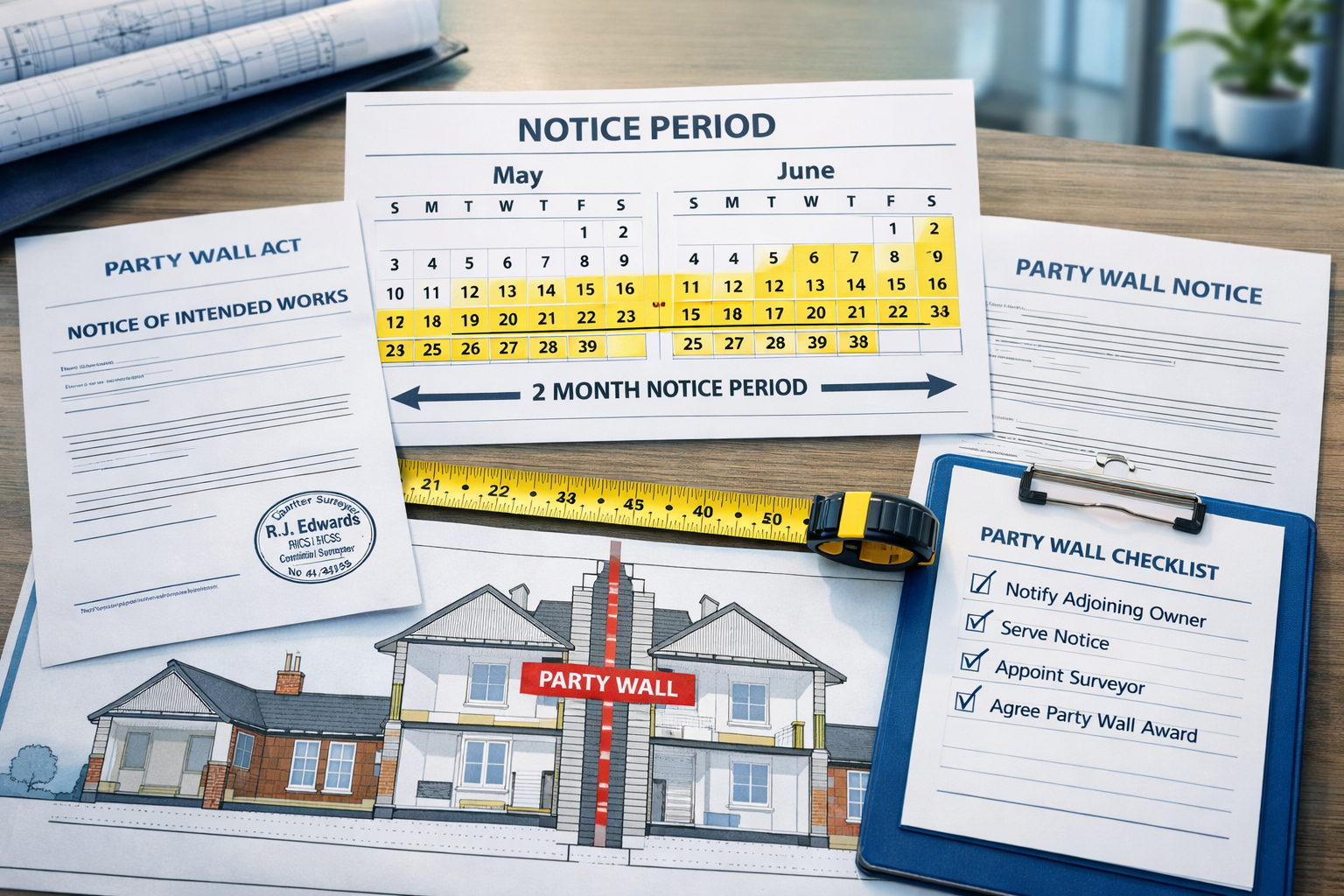
In 2026's booming loft conversion market, timing is everything. The Act mandates specific notice periods that cannot be shortened:
| Work Type | Minimum Notice Period |
|---|---|
| Party wall work (structural changes) | 2 months |
| Excavation within 3 metres | 1 month |
| Excavation within 6 metres (deeper than neighbour's foundation) | 1 month |
Missing these deadlines can push your project start date back by months, potentially losing your contractor's availability during peak season. With construction demand at an all-time high in 2026, scheduling delays often cascade into significantly higher costs.
Essential Notice Protocols for Party Wall Surveying in 2026
Serving proper notice represents the first critical step in Party Wall Surveying for 2026 Loft Conversion Boom: Essential Notices and Award Protocols Amid Housing Uptick. The process may seem straightforward, but errors in documentation or delivery can invalidate your notice entirely.
Types of Party Wall Notices
The Party Wall Act recognizes three distinct notice types, each serving specific purposes:
1. Party Structure Notice 📋
Used when work directly affects the shared wall structure itself. This includes cutting into the wall, inserting beams, or removing chimney breasts. Our guide on what is a party structure notice provides detailed serving instructions.
2. Line of Junction Notice 📐
Required when building a new wall exactly on the boundary line between properties, though less common in loft conversions.
3. Notice of Adjacent Excavation ⛏️
Necessary when foundation work or excavation occurs within the specified proximity to neighbouring foundations.
Crafting Compliant Notices
A valid party wall notice must contain specific information to meet legal requirements:
- Detailed description of proposed works – Vague descriptions invite disputes
- Precise commencement date – Must be at least two months from notice service
- Technical drawings and specifications – Showing exactly how the party wall will be affected
- Building owner's details – Full names and contact information
- Property addresses – Both the building owner's and adjoining owner's properties
Many homeowners in 2026 are turning to professional party wall notices services to ensure compliance, particularly given the high stakes of project delays in today's market.
Delivery Methods That Hold Up Legally
Simply posting a notice through your neighbour's letterbox may not constitute valid service. The Act recognizes several delivery methods:
✅ Hand delivery with signed acknowledgment
✅ Registered post with proof of delivery
✅ Recorded delivery maintaining postal records
✅ Email (if previously agreed in writing)
Pro tip: Always retain proof of service. In 2026's litigious environment, documentation protects against claims that notice was never received.
Neighbour Response Scenarios
Once you've served notice, three outcomes are possible:
Scenario 1: Written Consent ✍️
If your neighbour provides written consent within 14 days, you can proceed without appointing surveyors. However, it's still advisable to conduct a schedule of condition to document pre-work property status.
Scenario 2: Dissent or Counter-Notice ⚠️
Your neighbour formally objects or proposes modifications. This triggers the surveyor appointment process and award protocol.
Scenario 3: No Response 🤐
If 14 days pass without response, the law treats this as a deemed dissent, requiring surveyor appointment just as if they had formally objected.
Understanding these protocols is essential for anyone navigating party wall Act notices and how to respond in 2026's active construction environment.
Award Protocols and Surveyor Appointment in the 2026 Market
When neighbours dissent or fail to respond, the party wall award process begins. This formal procedure has become increasingly important in 2026 as loft conversion disputes rise alongside project volumes.
The Surveyor Appointment Process
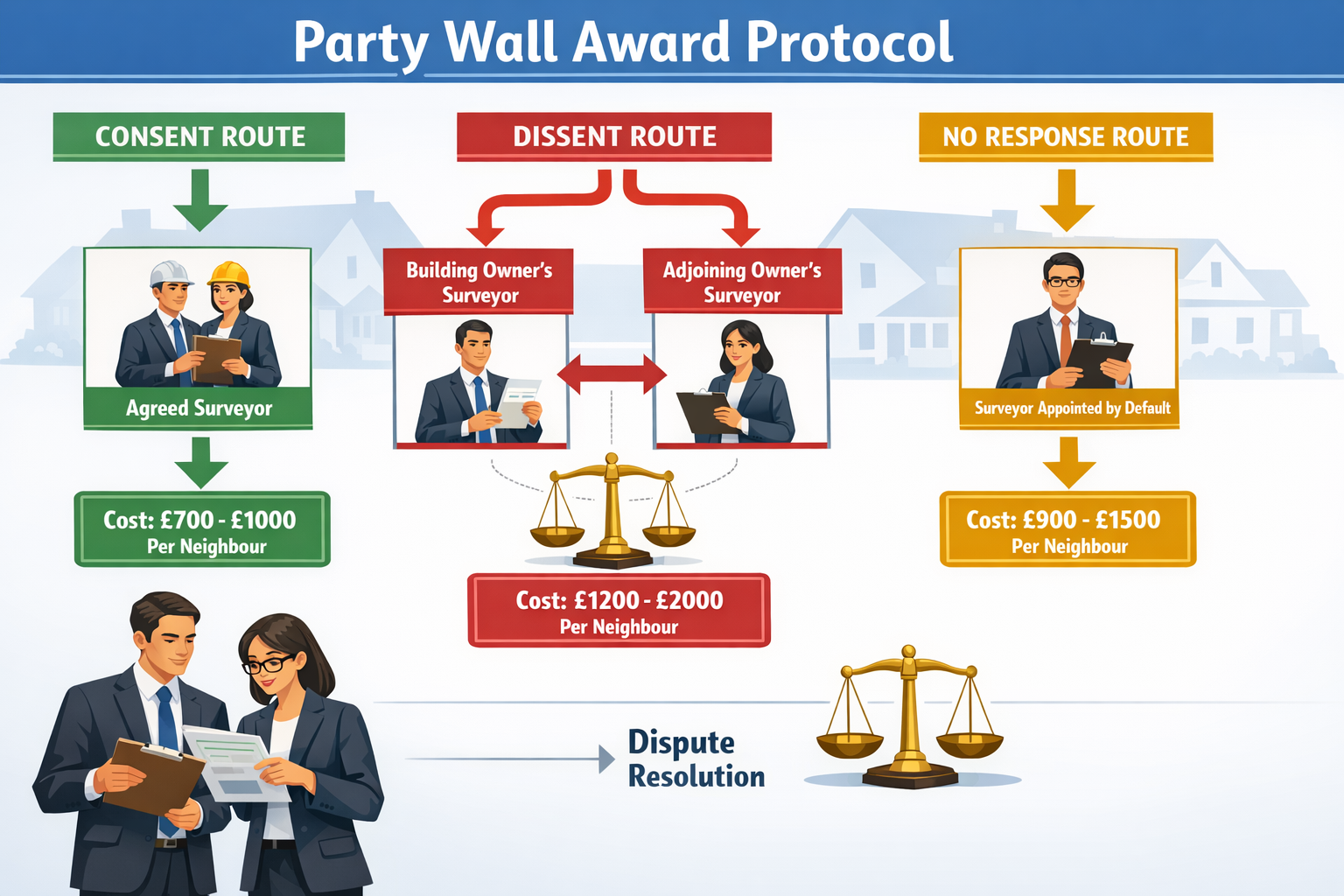
The Party Wall Act provides three surveyor appointment options:
Option 1: Agreed Surveyor 🤝
Both parties jointly appoint a single surveyor to act impartially. This is typically the most cost-effective approach, with fees ranging from £700-£1,200 for straightforward loft conversions.
Option 2: Two Surveyors Plus Third Surveyor 👥
Each party appoints their own surveyor, who then jointly select a third surveyor to resolve any disagreements. This option costs significantly more, typically £1,500-£2,000 per neighbour, but provides maximum protection for both sides.
Option 3: Building Owner Appoints Both 💼
If the adjoining owner refuses to appoint a surveyor within 10 days, the building owner can appoint one on their behalf. The building owner bears all surveyor costs regardless of appointment structure.
What the Party Wall Award Contains
A comprehensive party wall award documents every aspect of the proposed work and establishes protection mechanisms:
📄 Detailed work description – Specifications matching your notice
📸 Schedule of condition – Photographic evidence of pre-work property status
⏰ Working hours and access rights – When work can occur and entry permissions
🛡️ Protection measures – Required safeguards during construction
💰 Cost allocation – Who pays for what aspects of the process
⚖️ Dispute resolution procedures – Steps for addressing disagreements
The award becomes a legally binding document once served on both parties. Understanding party wall contract templates and awards helps homeowners recognize what to expect.
Cost Considerations in 2026
Party wall costs have increased in 2026 alongside general construction inflation. Here's the typical breakdown:
| Cost Component | Price Range (2026) |
|---|---|
| Agreed surveyor (single) | £700-£1,200 |
| Building owner's surveyor | £800-£1,500 |
| Adjoining owner's surveyor | £800-£1,500 |
| Third surveyor (if needed) | £500-£1,000 |
| Schedule of condition | £200-£400 |
Important: The building owner pays all reasonable surveyor fees, even for the adjoining owner's surveyor. This represents a significant consideration when budgeting for loft conversions in 2026.
For strategies to minimize expenses, review our tips on how to keep party wall costs down.
Regional Variations in 2026 Demand
The loft conversion boom isn't uniform across all areas. Certain London regions are experiencing particularly intense activity:
- Central London – Highest demand due to space constraints and property values
- East London – Rapid gentrification driving conversion projects
- North London – Family homes seeking additional bedrooms
- West London – Premium conversions with luxury specifications
- South London – Growing market for Victorian terrace conversions
Each area presents unique challenges in terms of surveyor availability and typical award timelines.
Navigating Building Regulations Alongside Party Wall Requirements
While party wall procedures dominate the legal conversation around loft conversions, Building Regulations approval represents an equally critical requirement that cannot be overlooked in 2026.
Universal Building Regulations Requirements
Every loft conversion in England and Wales requires Building Regulations approval, covering:
🏗️ Structural integrity – Ensuring new floors can safely support loads
🔥 Fire safety – Escape routes, fire-resistant materials, and smoke alarms
🌡️ Thermal performance – Insulation meeting current energy efficiency standards
💨 Ventilation – Adequate air circulation and moisture control
⚡ Electrical safety – Compliant wiring and lighting installations
🪜 Staircase specifications – Safe access with proper headroom and dimensions
These requirements exist independently of planning permission status. Even permitted development loft conversions must satisfy Building Regulations.
Coordination With Party Wall Timelines
Smart project planning in 2026 requires coordinating multiple approval streams:
Week 1-2: Serve party wall notices while preparing Building Regulations application
Week 3-8: Party wall notice period running concurrent with Building Regulations review
Week 9-10: Receive Building Regulations approval and party wall award
Week 11+: Commence construction with all legal requirements satisfied
This parallel processing prevents the common mistake of waiting for party wall resolution before pursuing Building Regulations, which can add months to your overall timeline.
Common Pitfalls in 2026's Rushed Market
The pressure to capitalize on 2026's housing market has led to several recurring mistakes:
❌ Starting work before awards are finalized – Exposes homeowners to injunctions and legal action
❌ Inadequate schedule of condition documentation – Makes it impossible to prove pre-existing damage
❌ Ignoring types of party wall works – Assuming minor changes don't require notices
❌ DIY notice serving without professional review – Technical errors invalidate notices
❌ Underestimating costs – Failing to budget for surveyor fees and potential delays
❌ Poor neighbour communication – Creating antagonistic relationships that complicate resolution
Dispute Resolution and Protecting Your Investment
Despite best intentions, disputes arise in approximately 15-20% of party wall cases in 2026. Understanding resolution mechanisms protects your project and investment.
When Neighbours Object
Neighbour objections typically fall into several categories:
Concern about property damage 🏚️
Solution: Comprehensive schedule of condition and insurance provisions in the award
Noise and disruption worries 🔊
Solution: Clearly defined working hours and advance notice of particularly disruptive phases
Structural safety fears 🏗️
Solution: Detailed engineering specifications and professional surveyor oversight
Property value impact 💷
Solution: Evidence that quality loft conversions typically increase neighbourhood values
The appointed surveyor(s) mediate these concerns and incorporate appropriate protections into the award.
The Third Surveyor's Role
When two appointed surveyors cannot reach agreement, the third surveyor provides binding resolution. This professional:
- Reviews both surveyors' positions and supporting evidence
- Considers technical feasibility and legal requirements
- Issues determinations that both parties must accept
- Resolves cost allocation disputes
Third surveyor involvement adds time and expense, but provides definitive resolution without court proceedings.
Legal Recourse Options
If disputes escalate beyond surveyor resolution, several legal pathways exist:
County Court Appeals ⚖️
Either party can appeal an award within 14 days of service, though courts generally defer to surveyor expertise.
Injunctions 🚫
Adjoining owners can seek injunctions to stop work that violates the award or proceeds without proper notices.
Damage Claims 💰
Post-construction disputes about damage require evidence from the schedule of condition to establish causation.
Understanding your rights as either a building owner or adjoining owner helps navigate these complex situations.
Insurance Considerations
Standard home insurance policies typically don't cover party wall disputes or damage. Consider:
- Professional indemnity insurance for your surveyor
- Contractor liability insurance covering party wall damage
- Legal expenses insurance for dispute resolution costs
- Structural warranty for long-term defect protection
These protections become increasingly valuable in 2026's litigious environment.
Best Practices for Smooth Party Wall Procedures in 2026
Successfully navigating Party Wall Surveying for 2026 Loft Conversion Boom: Essential Notices and Award Protocols Amid Housing Uptick requires proactive planning and professional guidance.
Early Neighbour Engagement
Start conversations before serving formal notices. Informal discussions help:
- Gauge likely response and concerns
- Explain project benefits and precautions
- Build goodwill that facilitates smoother processes
- Identify potential issues before they become formal objections
Many successful 2026 loft conversions attribute smooth party wall processes to early, respectful neighbour communication.
Professional Team Assembly
Assemble your professional team early:
🏗️ Structural engineer – Designs safe, compliant structural solutions
📐 Architect or designer – Creates detailed plans for notices and applications
🔍 Party wall surveyor – Manages legal compliance and award preparation
👷 Experienced contractor – Understands party wall requirements and protocols
Experienced professionals familiar with party wall surveying processes prevent costly mistakes and delays.
Documentation Excellence
Maintain meticulous records throughout:
- All correspondence with neighbours (emails, letters, conversations)
- Proof of notice service with dates and delivery confirmation
- Photographs and videos for schedule of condition
- Surveyor appointments and communications
- Award documents and any subsequent amendments
- Construction progress aligned with award specifications
This documentation proves invaluable if disputes arise months or years after completion.
Budget Realistically
Factor all party wall costs into your project budget:
| Budget Item | Typical Allocation |
|---|---|
| Surveyor fees | £700-£2,000 per neighbour |
| Schedule of condition | £200-£400 |
| Contingency for disputes | 10-15% of surveyor costs |
| Additional insurance | £200-£500 |
Underbudgeting for these requirements causes financial stress when bills arrive.
Timeline Management
Build realistic timelines accounting for:
- 2-month minimum notice period
- 14-day neighbour response window
- 2-4 weeks for award preparation
- Potential delays if third surveyor needed
- Building Regulations approval (4-8 weeks)
In 2026's competitive contractor market, securing your builder's schedule requires accurate timeline projections.
Alternative Approaches
Some homeowners explore having a party wall agreement without a surveyor when neighbours consent. While this saves money, it sacrifices the protection and documentation that professional surveyors provide.
Conclusion: Positioning Your Loft Conversion for Success in 2026
The 2026 loft conversion boom presents tremendous opportunities for homeowners seeking to add value and space amid housing shortages. However, success requires navigating the complex landscape of Party Wall Surveying for 2026 Loft Conversion Boom: Essential Notices and Award Protocols Amid Housing Uptick with precision and professionalism.
The key principles to remember:
✅ Start early – Serve notices at least two months before your planned construction date
✅ Communicate proactively – Build positive neighbour relationships before formal procedures
✅ Budget comprehensively – Include all surveyor fees and potential dispute costs
✅ Document thoroughly – Maintain detailed records of every step and communication
✅ Engage professionals – Expert surveyors prevent costly mistakes and delays
✅ Coordinate approvals – Run party wall and Building Regulations processes in parallel
✅ Respect the process – Never commence work before receiving your party wall award
Next Steps for Your Loft Conversion Project
Ready to move forward with your 2026 loft conversion? Take these immediate actions:
- Consult with a qualified party wall surveyor to assess your specific situation and requirements
- Review your project plans with a structural engineer to identify all party wall triggers
- Prepare comprehensive notice documents including detailed specifications and drawings
- Initiate neighbour conversations to build goodwill before formal notice service
- Establish your project budget incorporating all party wall costs and contingencies
- Coordinate with your contractor to align timelines with notice periods and award preparation
The costs of party wall processes represent a small fraction of your total loft conversion investment, but proper handling prevents delays and disputes that can multiply costs exponentially.
For homeowners carrying out works or neighbours whose neighbour is carrying out works, understanding these protocols protects everyone's interests and property values.
The 2026 housing market rewards those who plan thoroughly and execute professionally. By mastering party wall surveying requirements, you position your loft conversion project for smooth execution, legal compliance, and maximum value creation in today's competitive environment.