
When construction work begins next door, the delicate balance between property rights and neighborly protection becomes critical. Party Wall Surveyor Duties Under Current Case Law: Balancing Building Owner and Adjoining Owner Interests has evolved significantly through recent legal precedents, fundamentally reshaping how professionals navigate their responsibilities in 2026. These developments have created new standards for impartiality, liability exposure, and dispute resolution that every surveyor must understand.
The landscape of party wall surveying has transformed dramatically since landmark cases in 2018-2021 established clearer boundaries around professional conduct, compensation awards, and the limits of surveyor authority. With the construction boom continuing across UK housing markets, understanding these legal developments isn't just academic—it's essential for protecting both building owners and adjoining owners while maintaining professional standards.
Key Takeaways
- Surveyors must maintain strict impartiality regardless of which party appointed them, with courts now able to issue injunctions against "rogue awards" that favor one side unfairly
- Professional negligence claims are now viable against party wall surveyors, with no special protection status, though the bar remains higher than simple disagreement with decisions
- Disputes must actually arise before compensation can be awarded under Section 7(2), as established in the practice-changing Evans v Paterson (2021) case
- Adjoining owners have a duty to mitigate loss when dealing with damages, fundamentally affecting how surveyors approach Section 10 dispute resolution
- Written owner agreements can override surveyor authority, immediately terminating the dispute resolution process even after formal appointments
Understanding Party Wall Surveyor Duties Under Current Case Law
The Foundation of Surveyor Impartiality
Party wall surveyors operate under a unique professional obligation that distinguishes them from typical consultants. Surveyors must act as neutral professionals who ensure legal process compliance regardless of which party appointed them.[2] This fundamental principle has been reinforced through recent case law, establishing that the surveyor's role centers on fairness rather than advocacy.
The impartiality standard extends beyond mere intention. When parties choose to appoint an agreed surveyor (rather than each appointing their own), that professional should be independent and not the same surveyor the homeowner uses for their own works to maintain perceived neutrality.[7] This separation helps prevent conflicts of interest that could undermine the entire party wall process.
Key aspects of surveyor impartiality include:
- 🔍 Objective assessment of proposed works against statutory requirements
- ⚖️ Fair consideration of both building owner and adjoining owner concerns
- 📋 Transparent documentation of decisions and reasoning
- 🛡️ Protection of legal rights for all parties involved
The Building Owner's Surveyor and Adjoining Owner's Surveyor appointments create a system designed to balance interests, but the surveyor's duty remains to the statutory process itself, not to the appointing party's preferences.
The Two-Surveyor and Three-Surveyor Models
The Party Wall etc. Act 1996 provides flexibility in how parties structure their surveyor appointments. Parties may either appoint a single joint surveyor or each appoint their own surveyor; when separate surveyors are appointed, they select a third surveyor if needed to resolve disputes between them.[2]
This structural choice has significant implications:
Single Agreed Surveyor Model:
- ✅ Generally more cost-effective
- ✅ Faster decision-making process
- ⚠️ Requires high confidence in surveyor's impartiality
- ⚠️ No built-in check on surveyor decisions
Two-Surveyor Model:
- ✅ Each party has direct representation
- ✅ Built-in review of decisions
- ⚠️ Higher costs for both parties
- ⚠️ Potential for disagreement requiring third surveyor
The selection of a third surveyor becomes critical when the two appointed surveyors cannot reach agreement. This professional must be mutually acceptable and serves as the final arbiter on disputed matters within the Party Wall Award.
Mandatory Duties and Documentation Requirements
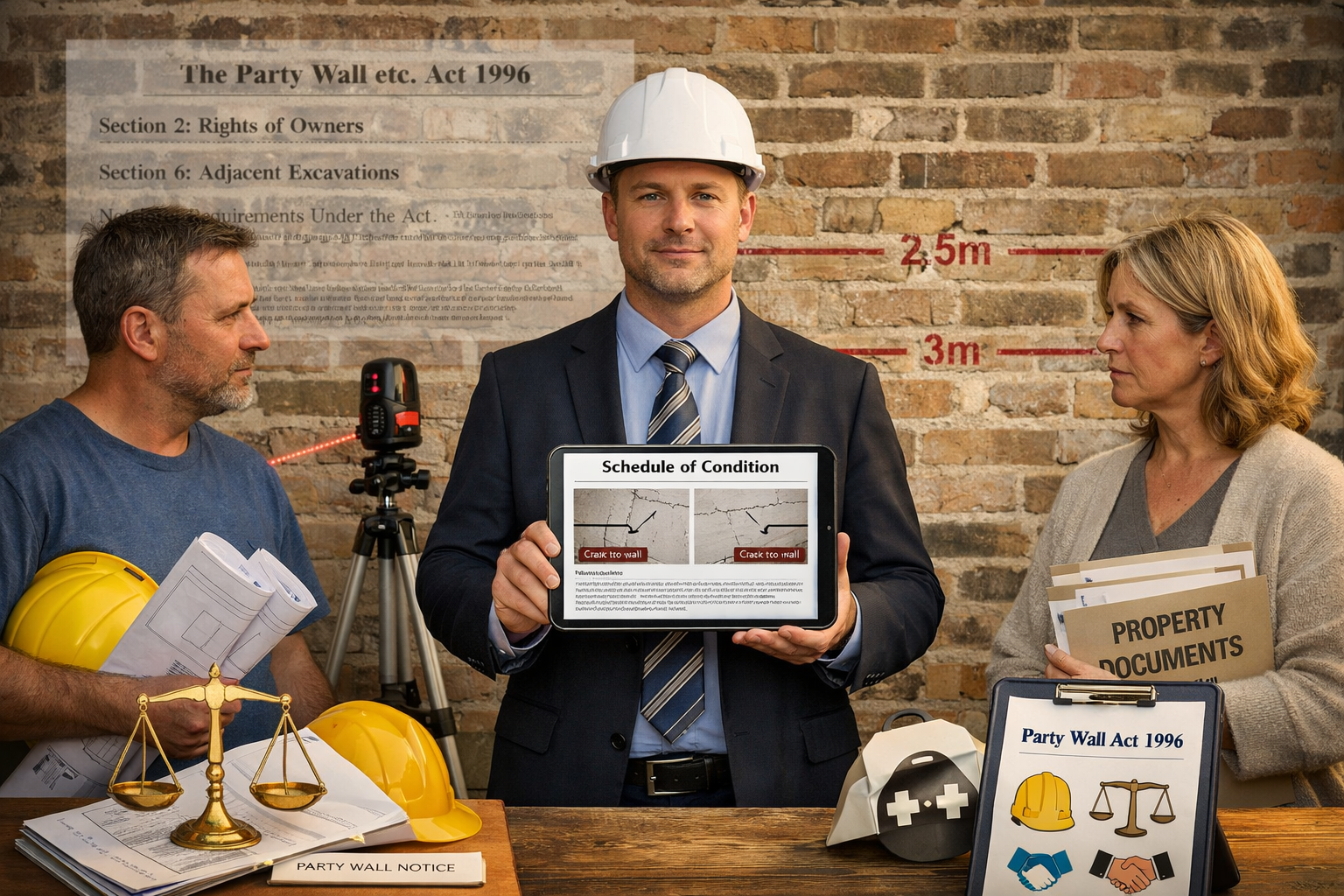
Surveyors carry specific statutory obligations that cannot be waived or modified by party agreement. The Schedule of Condition stands as perhaps the most critical protection mechanism. Before any work begins, surveyors must conduct and prepare comprehensive documentation of the adjoining property's existing structural condition, visible cracks or defects, and photographic evidence.[2]
This documentation serves multiple purposes:
- Baseline establishment for determining future damage claims
- Evidence preservation for potential disputes
- Protection for building owners against false damage allegations
- Protection for adjoining owners proving legitimate damage claims
The importance of thorough Schedule of Condition documentation cannot be overstated—it often becomes the determining factor in compensation disputes arising months or years after construction completion.
Recent Case Law Shaping Party Wall Surveyor Duties Under Current Practice
The Welter v McKeeve (2018-2019) Mitigation Principle
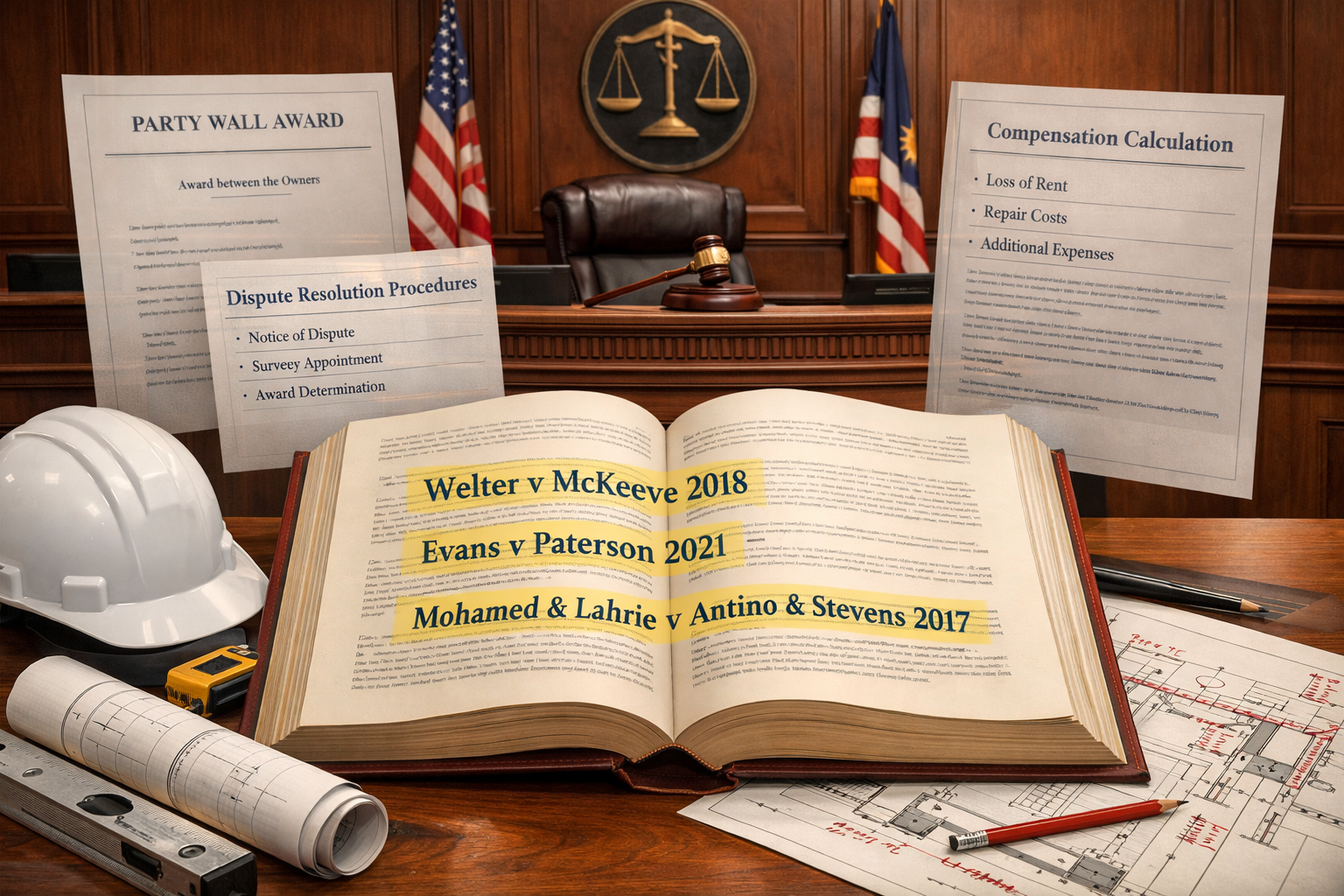
The case of Welter v McKeeve established a fundamental requirement that adjoining owners must mitigate their losses when dealing with damages under the Party Wall etc. Act 1996.[1] This precedent fundamentally reshaped how surveyors should approach dispute resolution under Section 10 of the Act.
Prior to this decision, some adjoining owners took the position that they could simply claim compensation without taking reasonable steps to minimize damage or losses. The court rejected this approach, importing the common law principle of mitigation into party wall disputes.
Practical implications for surveyors:
- 📊 Assess whether adjoining owners have taken reasonable mitigation steps
- 💰 Reduce compensation awards where mitigation duties were ignored
- 📝 Document mitigation opportunities in award reasoning
- ⚖️ Balance building owner interests against adjoining owner protections
This case demonstrates how Party Wall Surveyor Duties Under Current Case Law: Balancing Building Owner and Adjoining Owner Interests requires active consideration of both parties' responsibilities, not just their rights.
Evans v Paterson (2021): The Dispute Requirement
The Evans v Paterson decision in 2021 created what many practitioners consider practice-changing precedent for compensation awards.[4] The court clarified that a dispute must have actually arisen for surveyors to make an award for compensation under Section 7(2) of the Act.
This ruling established that surveyors cannot issue compensation determinations before the building owner has been made aware of alleged damage and given opportunity to respond. The key principle: no dispute exists until the building owner knows about the claim and either disputes it or fails to address it.
"The requirement that a dispute must arise before compensation can be awarded under Section 7(2) fundamentally changes how surveyors approach damage claims and protects building owners from premature compensation determinations."
The practical workflow now requires:
- Adjoining owner notifies building owner of alleged damage
- Building owner responds (or fails to respond within reasonable time)
- Dispute crystallizes if disagreement exists
- Surveyors then have authority to determine compensation
For Building Owners and Adjoining Owners, this case provides important procedural protections and clarity about when compensation mechanisms activate.
Mohamed & Lahrie v Antino & Stevens (2017): Injunctions Against Rogue Awards
The 2017 case Mohamed & Lahrie v Antino & Stevens established that courts can use injunctions to stop surveyors before publication of "rogue awards"—preventing threats of ongoing awards and escalating fee charges.[1] This remedy represents a significant check on surveyor authority and potential abuse.
The case recognized that some surveyors might issue awards that:
- ❌ Exceed statutory authority
- ❌ Favor one party without proper justification
- ❌ Include unreasonable fee provisions
- ❌ Misapply the Party Wall etc. Act 1996
Courts now have clear authority to intervene before such awards take effect, protecting parties from improper surveyor conduct. This development has increased accountability within the profession and provided parties with recourse when surveyors appear to be acting improperly.
The availability of injunctive relief reinforces that Party Wall Surveyor Duties Under Current Case Law: Balancing Building Owner and Adjoining Owner Interests includes judicial oversight as a backstop against professional misconduct.
Owner Agreements Overriding Surveyor Authority
Recent cases have established that written agreement between building owner and adjoining owner confirming no dispute exists immediately terminates the surveyors' authority to resolve a dispute, even if surveyors have been formally appointed.[1]
This principle recognizes party autonomy and prevents surveyors from creating or perpetuating disputes where none actually exist. The practical effect:
Scenario: Building owner serves notice, adjoining owner appoints surveyor, but parties then reach direct agreement on all matters.
Result: Surveyors' authority ends, and parties can proceed under their private agreement without formal award.
Surveyor obligations: Recognize when authority has been superseded and cease charging fees for dispute resolution services no longer needed.
This case law development provides an important escape valve for parties who can resolve matters amicably, preventing unnecessary costs and formality. However, surveyors should still document the agreement and their withdrawal to protect against future disputes about their role and fees.
Understanding these developments is crucial for anyone carrying out works or dealing with neighbor construction activities.
Professional Liability and Standards in Party Wall Surveyor Duties Under Current Case Law

The End of Special Protection Status
A significant development in recent legal thinking indicates that party wall surveyors have no special protection or status against professional negligence claims.[1] While the bar remains set higher than simply being on the wrong side of an appeal or a third surveyor's decision, legal opinion is becoming firmer in situations involving clear malpractice.
This evolution represents a major shift from earlier assumptions that surveyors operated with quasi-judicial immunity. The current position recognizes that surveyors are professionals who can be held accountable for:
- 🚫 Failure to follow statutory procedures properly
- 🚫 Gross misapplication of the Act or case law
- 🚫 Negligent preparation of schedules of condition
- 🚫 Unreasonable delay causing damage to parties
- 🚫 Breach of impartiality duties favoring one party
The professional negligence exposure has prompted increased attention to professional indemnity insurance requirements and heightened awareness of proper procedure among practitioners.
Surveyor Joinder and Cost Exposure
Courts have accepted the concept that surveyors can be joined in proceedings and exposed to the risk of cost awards against them.[1] This development has prompted wider professional discussion about liability exposure and the circumstances under which surveyors might face personal cost consequences.
Key considerations for cost exposure:
| Scenario | Risk Level | Protective Measures |
|---|---|---|
| Following proper procedure with reasonable judgment | Low | Document reasoning thoroughly |
| Procedural errors with minor impact | Medium | Correct promptly, acknowledge error |
| Rogue awards favoring appointing party | High | Maintain strict impartiality |
| Excessive fees without justification | High | Transparent fee agreements |
| Ignoring clear case law precedents | High | Stay current with legal developments |
The possibility of cost awards creates additional incentive for surveyors to maintain high professional standards and avoid conduct that could be characterized as unreasonable or improper.
The Dispute Notification and Response Framework
Under the Party Wall etc. Act 1996, if a neighbor refuses or does not reply within 14 days to a party wall notice, a dispute is formally considered to exist, triggering the mandatory surveyor appointment process.[2]
This automatic dispute mechanism serves important purposes:
✅ Prevents indefinite delay through non-response
✅ Protects building owner rights to proceed with lawful works
✅ Ensures adjoining owner representation through surveyor appointment
✅ Creates clear timeline for dispute resolution
However, surveyors must recognize that this "deemed dispute" may not reflect actual disagreement. The adjoining owner may simply have been away, missed the notice, or not understood the response requirement. Sensitive handling of these situations demonstrates proper balancing of building owner and adjoining owner interests in practice.
Surveyors should:
- Verify notice was properly served before treating non-response as dispute
- Attempt direct communication with adjoining owner to understand their position
- Explain the process to parties who may be unfamiliar with party wall procedures
- Seek genuine resolution rather than perpetuating unnecessary formality
Understanding how to respond to party wall notices helps both parties navigate this critical initial stage effectively.
Party Wall Award Requirements and Enforceability
The Party Wall Award must detail specific mandatory contents to be valid and enforceable.[2] These requirements ensure transparency and provide clear guidance for all parties:
Essential Award Components:
📋 Proposed works description – Detailed specification of what will be done
⏰ Working hours and access arrangements – When and how work will proceed
🛡️ Protective measures – How adjoining property will be safeguarded
💰 Responsibilities for repairs and compensation – Who pays for what
⚖️ Dispute resolution procedures – How future disagreements will be handled
Awards that omit these elements may be challenged as invalid or incomplete. Surveyors must ensure comprehensive coverage of all statutory requirements while maintaining clarity and accessibility for non-technical parties.
The award serves as a binding determination that both parties must follow. Understanding the costs of the party wall process helps parties budget appropriately and avoid disputes over fee allocation.
Legislative Stagnation and Modern Construction Challenges
The Party Wall etc. Act 1996 has only been amended by the Party Wall etc. Act 1996 (Electronic Communications) Order 2016 and has not been adapted in any other way despite developing construction techniques.[1] This legislative stagnation creates uncertainty about how modern construction methods fit within the existing framework.
Emerging challenges in 2026:
- 🏗️ Advanced foundation systems not contemplated in 1996
- 🔧 Modern excavation techniques with different risk profiles
- 🏢 High-density urban development creating complex multi-party scenarios
- 🌱 Sustainability requirements affecting traditional party wall approaches
- 💻 Digital documentation and remote surveying capabilities
Surveyors must interpret the 1996 Act's provisions in light of these modern realities, often relying on case law principles and professional guidance rather than explicit statutory direction. This requires judgment, experience, and careful consideration of how Party Wall Surveyor Duties Under Current Case Law: Balancing Building Owner and Adjoining Owner Interests applies to novel situations.
The lack of legislative updates places greater weight on case law development and professional standards as the primary sources for resolving ambiguities and addressing new scenarios.
Practical Application: Balancing Interests in Real-World Scenarios
Pre-Work Documentation and Risk Assessment
Effective surveyor practice begins well before construction commences. The preparation phase determines how successfully interests will be balanced throughout the project.
Critical pre-work steps:
- Comprehensive Schedule of Condition – Document every crack, defect, and structural characteristic
- Photographic evidence – Capture high-resolution images from multiple angles
- Risk assessment – Identify potential damage points and vulnerable areas
- Protective measure specification – Detail monitoring, shoring, or other safeguards
- Communication protocols – Establish how parties will report concerns
This thorough preparation protects both the building owner from false claims and the adjoining owner from undocumented damage. The investment in proper documentation typically prevents far more expensive disputes later.
Managing Disputes When They Arise
Despite best efforts, disputes sometimes develop during or after construction. Surveyor response to emerging conflicts demonstrates their commitment to balancing interests fairly.
Effective dispute management:
- 🔍 Investigate promptly – Examine damage claims quickly to prevent escalation
- 📞 Facilitate communication – Help parties understand each other's positions
- 📊 Gather evidence – Document current conditions and compare to baseline
- ⚖️ Apply case law principles – Consider mitigation duties, dispute requirements, and compensation standards
- 📝 Document reasoning – Explain decisions clearly to support transparency
The Evans v Paterson principle requires ensuring that building owners have proper notice and opportunity to respond before compensation determinations. The Welter v McKeeve mitigation duty requires assessing whether adjoining owners took reasonable steps to minimize losses.
Cost Management and Fee Transparency
One area where surveyor duties significantly impact both parties involves fee management and cost allocation. Recent case law has heightened scrutiny of surveyor fees, particularly when they appear excessive or unjustified.
Best practices for fee transparency:
✅ Provide written fee agreements before commencing work
✅ Explain cost allocation under the Act's provisions
✅ Bill incrementally with detailed descriptions of services
✅ Justify any variations from initial estimates
✅ Respond to fee concerns promptly and professionally
Understanding how to keep party wall costs down benefits all parties and reduces friction around financial aspects of the process.
Regional Considerations Across London
Party wall surveying practices can vary somewhat across different London regions, though the legal framework remains constant. Surveyors working in East London, West London, North London, South London, or Central London encounter different property types, construction densities, and local expectations.
Regional factors affecting practice:
- 🏘️ Property age and construction – Victorian terraces vs. modern developments
- 👥 Owner sophistication – Familiarity with party wall procedures
- 🏗️ Construction intensity – High-activity areas vs. stable neighborhoods
- 💷 Property values – Impact on cost-benefit analysis of disputes
Effective surveyors adapt their communication and approach to regional contexts while maintaining consistent application of legal principles and professional standards.
Conclusion
Party Wall Surveyor Duties Under Current Case Law: Balancing Building Owner and Adjoining Owner Interests has evolved significantly through landmark decisions between 2017 and 2021, creating a more defined framework for professional conduct while increasing accountability. The principles established in Welter v McKeeve, Evans v Paterson, and Mohamed & Lahrie v Antino & Stevens fundamentally reshaped how surveyors approach impartiality, compensation, and dispute resolution.
The key developments—mitigation duties for adjoining owners, dispute requirements before compensation awards, court power to enjoin rogue awards, and removal of special protection from negligence claims—all point toward a more balanced, accountable profession. Surveyors in 2026 operate with clearer guidance but also greater scrutiny of their decisions and conduct.
For building owners and adjoining owners, these legal developments provide better protection against both improper surveyor conduct and unreasonable party behavior. The framework now recognizes that both parties have rights and responsibilities, with surveyors serving as neutral professionals ensuring fair process rather than advocates for either side.
Actionable Next Steps
For Building Owners planning works:
- ✅ Engage a qualified surveyor early in the planning process
- ✅ Ensure proper party wall notices are served with adequate detail
- ✅ Budget for comprehensive Schedule of Condition documentation
- ✅ Maintain open communication with adjoining owners throughout the process
For Adjoining Owners receiving notices:
- ✅ Respond within 14 days to avoid deemed dispute
- ✅ Consider whether to appoint your own surveyor or agree to joint appointment
- ✅ Participate actively in Schedule of Condition preparation
- ✅ Document any concerns promptly and in writing
For Surveyors practicing in 2026:
- ✅ Stay current with case law developments and professional guidance
- ✅ Maintain strict impartiality regardless of appointing party
- ✅ Document reasoning thoroughly to support decisions if challenged
- ✅ Apply mitigation and dispute principles from recent cases
- ✅ Maintain appropriate professional indemnity insurance
The evolution of party wall law through case precedents demonstrates a maturing framework that increasingly balances competing interests while holding all parties—including surveyors—to appropriate standards of conduct. As construction activity continues across UK housing markets, these principles will guide fair resolution of the inevitable conflicts that arise when building works affect neighboring properties.
References
[1] Party Walls In Case Law – https://ww3.rics.org/uk/en/journals/property-journal/party-walls-in-case-law.html
[2] Neighbour Disputes And Party Walls Legal Insights From The Experts – https://www.adamjoseph.co.uk/neighbour-disputes-and-party-walls-legal-insights-from-the-experts
[4] Practice Changing Party Wall Case Law Evans V Paterson 2021 – https://www.peterbarry.co.uk/blog/practice-changing-party-wall-case-law-evans-v-paterson-2021/
[7] Party Wall Agreement – https://hoa.org.uk/advice/guides-for-homeowners/i-am-improving/party-wall-agreement/