


Building owners planning extensions, loft conversions, or basement excavations in 2026 face an uncomfortable reality: party wall surveyor fees now represent one of the most contentious and unpredictable costs in residential construction projects. With single surveyor appointments ranging from £900 to £2,700 and dual surveyor arrangements potentially exceeding £5,400, disputes over these professional fees have become increasingly common [3]. Understanding how to navigate Party Wall Surveyor Fee Disputes 2026: Negotiation Tactics and RICS Fee Scales can mean the difference between a straightforward project and a financial quagmire.
The current economic climate has intensified scrutiny over surveyor charges, with building owners questioning whether fees reflect genuine complexity or represent opportunistic billing practices. This comprehensive guide breaks down typical fee structures, identifies common dispute triggers, and provides proven strategies for fair cost recovery without resorting to litigation.

Key Takeaways
- Single surveyor appointments typically cost £900-£2,700, while dual surveyor arrangements can reach £1,800-£5,400 depending on project complexity
- Building owners pay all party wall costs except in cases where shared wall defects affect both neighbors equally
- Early neighbor communication before serving formal notices significantly reduces the likelihood of disputes and associated costs
- Fixed-fee agreements with surveyors provide cost certainty and are increasingly available in 2026
- Fee challenges are legitimate when surveyors appoint unnecessary consultants or charge excessive hourly rates without justification
Understanding Party Wall Surveyor Fee Structures in 2026
Single Surveyor vs. Dual Surveyor Appointments
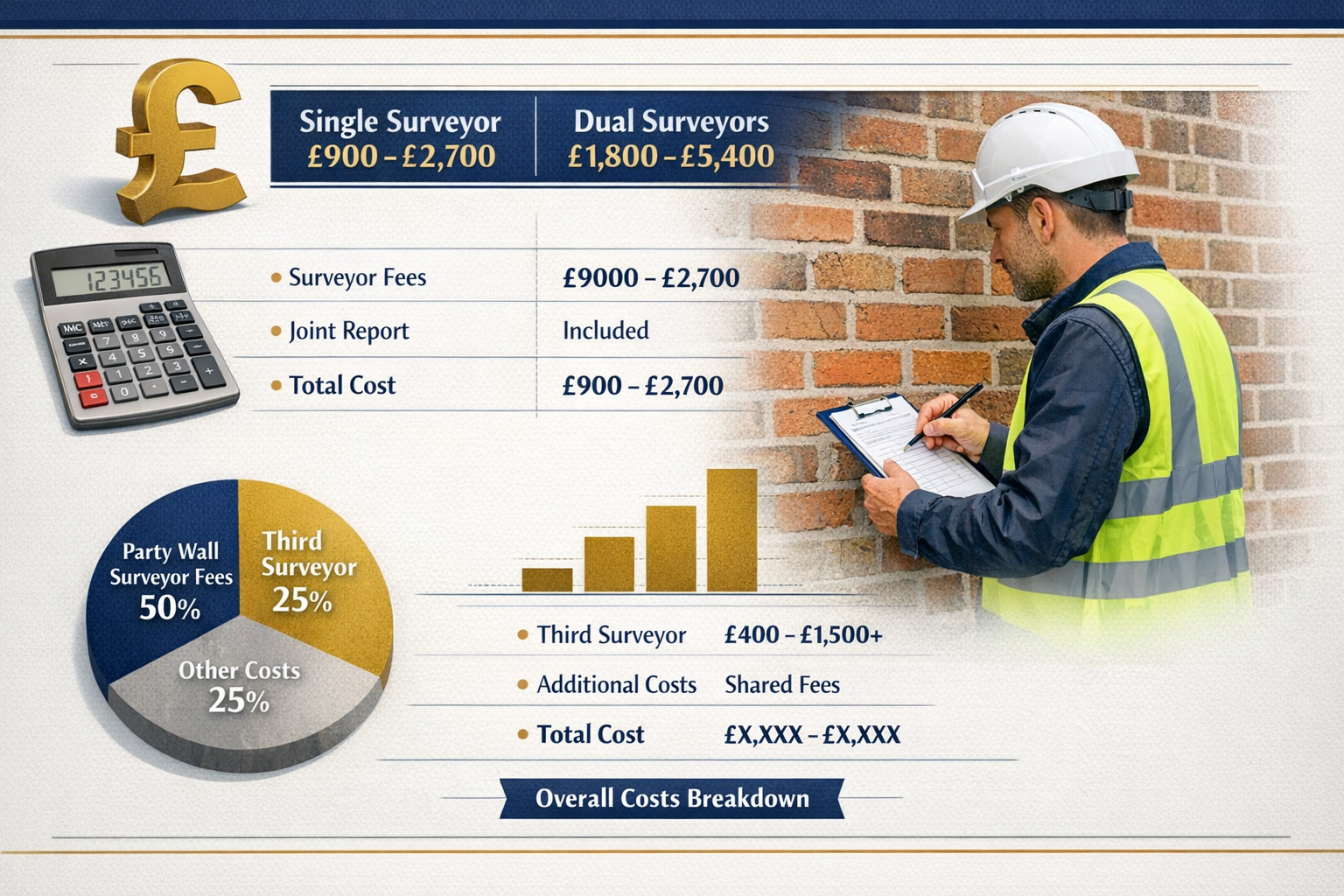
The most significant cost variable in party wall procedures stems from whether neighbors agree to share one impartial surveyor or appoint separate professionals. A single agreed surveyor acting for both parties represents the most economical approach, with fees typically ranging from £900 to £2,700 [3]. This arrangement works best when neighbors maintain cordial relationships and the proposed works are relatively straightforward.
When neighbors cannot agree on a single surveyor—or when trust has broken down—each party appoints their own representative. This dual surveyor arrangement essentially doubles the professional fees, with costs ranging from £1,800 to £5,400 [3]. Both surveyors must coordinate to produce the party wall award, and their combined fees fall entirely on the building owner in most circumstances.
In rare cases where the two appointed surveyors cannot reach agreement, they must appoint a third independent surveyor to resolve the impasse. This adds another layer of professional fees and can extend timelines significantly [3].
Who Pays Party Wall Surveyor Fees?
A fundamental principle governs party wall cost allocation: the building owner planning the work pays all surveyor fees—including those of their neighbor's appointed surveyor [3]. This arrangement exists because the building owner initiates the process and benefits from the proposed works.
However, important exceptions apply:
- Shared wall repairs: When a party wall requires repairs due to defects affecting both properties equally, costs may be split between neighbors [3]
- Mutual benefit scenarios: If both parties benefit from the proposed works, cost-sharing arrangements can be negotiated
- Pre-existing damage: When the adjoining owner's property has existing defects that the works will address, contribution to costs may be appropriate
Understanding these cost allocation principles helps building owners budget appropriately and identifies situations where negotiating cost-sharing arrangements might be appropriate.
Typical Fee Components and Billing Methods
Party wall surveyor fees typically comprise several distinct elements:
Hourly rate charges remain the most common billing method for adjoining owner surveyors, with rates varying based on:
- Surveyor experience and qualifications
- Geographic location (London fees typically exceed regional rates)
- Project complexity
- Market demand
Fixed-fee arrangements have become more readily available in 2026, particularly from building owner surveyors who can assess project scope before quoting [4]. These arrangements provide cost certainty and eliminate disputes over time spent.
Additional disbursements may include:
- Site inspection costs
- Schedule of condition preparation
- Specialist consultant fees (structural engineers, checking engineers)
- Travel expenses for distant properties
- Award preparation and documentation
Common Triggers for Party Wall Surveyor Fee Disputes 2026
Excessive Hourly Rates Without Justification
One of the most frequent dispute triggers involves surveyors charging premium hourly rates without demonstrating commensurate expertise or project complexity. While RICS-qualified surveyors command professional fees, building owners increasingly challenge rates that exceed market norms for straightforward projects.
Red flags for excessive billing include:
- Hourly rates significantly above regional averages
- Charging senior partner rates for routine administrative tasks
- Billing for excessive travel time to local properties
- Multiple site visits when one comprehensive inspection would suffice
Building owners have legitimate grounds to contest fees that appear disproportionate to the work performed [2]. The key lies in understanding what constitutes reasonable professional remuneration for the specific project scope.
Unnecessary Appointment of Specialist Consultants
A growing source of fee disputes involves surveyors appointing checking engineers or other specialist consultants for projects that don't warrant such expertise. While complex structural works may genuinely require specialist input, routine extensions or loft conversions typically do not [2].
Surveyors sometimes classify relatively standard works as "complex" to justify consultant appointments, significantly inflating costs. Building owners should question:
- Whether the proposed works genuinely require specialist structural assessment
- If the appointed surveyor possesses sufficient expertise to assess the works independently
- Whether consultant fees are proportionate to the project scale
Challenging these appointments early—before consultants begin work—prevents disputes over fees already incurred.
Lack of Cost Transparency and Estimates
Fee disputes often arise when surveyors fail to provide clear cost estimates before commencing work. Adjoining owner surveyors working on time-based charges may be reluctant to commit to fixed fees, but they should still provide estimated ranges based on anticipated work scope [4].
Best practices for cost transparency include:
- Written fee agreements before work commences
- Itemized billing showing time spent on specific tasks
- Regular cost updates for projects extending beyond initial estimates
- Clear explanation of any additional charges or disbursements
When surveyors refuse to discuss likely costs or provide only vague estimates, building owners should consider this a warning sign and document all communications carefully.
Duplicate Work and Administrative Inefficiencies
Some fee disputes stem from surveyors billing for work that should be streamlined or coordinated. Common examples include:
- Charging full rates when serving multiple party wall notices for the same property where documentation can be duplicated
- Separate site visits when a single comprehensive inspection would capture all necessary information
- Excessive time spent on routine award preparation using standard templates
- Failure to coordinate efficiently with the other appointed surveyor
Building owners can negotiate reduced fees for multiple appointments or properties by highlighting opportunities for efficiency [4].
Effective Negotiation Tactics for Party Wall Surveyor Fee Disputes 2026
Pre-Emptive Strategies: Preventing Disputes Before They Arise
The most effective approach to managing Party Wall Surveyor Fee Disputes 2026: Negotiation Tactics and RICS Fee Scales involves preventing disputes from arising initially. Early neighbor communication—before serving formal party wall notices—dramatically improves outcomes [4].
Proactive steps include:
✅ Informal discussions: Talk to neighbors about planned works before formal notices, explaining the project and addressing concerns
✅ Offer schedule of condition: Proposing to pay for a professional schedule of condition demonstrates good faith and addresses damage concerns [4]
✅ Request fixed-fee quotes: When appointing your building owner surveyor, specifically request fixed-fee arrangements rather than open-ended hourly billing [4]
✅ Suggest shared surveyor: Propose a single agreed surveyor to neighbors, emphasizing cost savings for you and convenience for them
✅ Forward planning: Engage surveyors well before construction deadlines to avoid rush fees and allow time for negotiation
These preventive measures often eliminate the need for formal party wall procedures entirely, particularly when neighbors consent to the proposed works after understanding project details.
Negotiating Fixed-Fee Arrangements
Fixed-fee agreements represent one of the most effective tools for controlling party wall costs in 2026. While adjoining owner surveyors traditionally resist fixed fees due to uncertainty about project scope, building owner surveyors increasingly offer them [4].
Negotiating fixed fees effectively:
For building owner surveyors:
- Request detailed fixed-fee proposals from multiple surveyors before appointing
- Ensure the fixed fee covers all anticipated work, including award preparation and reasonable site visits
- Clarify what circumstances would trigger additional charges
- Get the agreement in writing before work commences
For adjoining owner surveyors:
- While you cannot control your neighbor's surveyor choice, you can request they seek fixed-fee quotes
- Offer to pay a reasonable fixed fee directly to encourage the adjoining owner to select a surveyor willing to work on this basis
- Document any agreement with your neighbor about cost expectations
Scope definition is critical: Fixed fees only work when both parties clearly understand what works are proposed and what the surveyor's responsibilities entail.

Challenging Unreasonable Fees: The Formal Process
When surveyor fees appear excessive or unjustified, building owners have legitimate recourse to challenge them. The process requires careful documentation and understanding of what constitutes "reasonable" professional remuneration [2].
Steps for challenging unreasonable fees:
1. Request detailed breakdown: Ask the surveyor to provide itemized billing showing:
- Hours spent on each task
- Hourly rates applied
- All disbursements and consultant fees
- Justification for any specialist appointments
2. Compare against market rates: Research typical fees for similar projects in your area using:
- Quotes from other qualified surveyors
- Industry guidance on reasonable fee ranges
- Regional fee surveys from professional bodies
3. Identify specific concerns: Document precisely which charges appear excessive:
- Hourly rates above market norms
- Time spent disproportionate to tasks
- Unnecessary consultant appointments
- Duplicate work or inefficiencies
4. Formal challenge letter: Write to the surveyor explaining your concerns with specific reference to:
- Comparable market rates
- Industry standards for similar projects
- Any lack of prior cost disclosure
- Request for fee reduction or detailed justification
5. Third surveyor determination: If the dispute cannot be resolved directly, either party can request the appointed third surveyor (or request appointment of one) to determine reasonable fees [2]
The key to successful fee challenges lies in demonstrating that charges exceed what a reasonable professional would charge for equivalent work, not simply that the building owner finds the fees expensive.
Alternative Dispute Resolution and Mediation
Before escalating fee disputes to formal legal proceedings, alternative dispute resolution (ADR) methods offer cost-effective resolution paths. In 2026, mediation has become increasingly popular for party wall disputes, including fee disagreements [5].
ADR approaches for fee disputes:
Direct negotiation: Many disputes resolve through structured negotiation when both parties:
- Approach discussions professionally and without emotion
- Focus on objective fee benchmarks rather than subjective opinions
- Consider compromise positions that partially reduce fees while acknowledging legitimate work performed
Mediation services: Professional mediators specializing in construction disputes can:
- Facilitate productive discussions between building owners and surveyors
- Provide independent perspective on reasonable fee ranges
- Help parties reach compromise agreements without formal proceedings
- Typically resolve disputes in single sessions lasting 2-4 hours
Expert determination: Appointing an independent expert (often the third surveyor) to determine reasonable fees provides:
- Binding resolution without court proceedings
- Industry-specific expertise in fee assessment
- Faster resolution than litigation
- Lower costs than formal legal action
Benefits of ADR in 2026: The current construction boom has increased demand for party wall services, making ADR particularly attractive as it preserves professional relationships and avoids the time and expense of litigation [5].
RICS Fee Scales and Professional Standards
Understanding RICS Guidance on Party Wall Fees
The Royal Institution of Chartered Surveyors (RICS) provides professional guidance that influences—though does not strictly dictate—party wall surveyor fees. While RICS does not publish mandatory fee scales, their professional standards establish expectations for:
Transparency and disclosure: RICS members must provide clear information about their fees and billing methods before commencing work
Proportionality: Fees should be proportionate to the complexity and value of the works being assessed
Professional competence: Surveyors should only accept appointments where they possess adequate expertise, avoiding unnecessary consultant appointments
Conflicts of interest: Surveyors must disclose any relationships or circumstances that might affect their impartiality
Understanding these professional standards helps building owners assess whether their surveyor's fees and practices align with industry expectations.
Benchmarking Against Market Rates
Effective negotiation requires understanding current market rates for party wall surveyor services across different UK regions. In 2026, typical fee ranges include:
| Project Type | Single Surveyor | Dual Surveyors | Complexity Factors |
|---|---|---|---|
| Simple extension | £900-£1,500 | £1,800-£3,000 | Single storey, no excavation |
| Loft conversion | £1,200-£1,800 | £2,400-£3,600 | Roof alterations, party wall works |
| Basement excavation | £1,800-£2,700 | £3,600-£5,400 | Underpinning, structural complexity |
| Multiple properties | £2,000-£3,000 | £4,000-£6,000 | Terraced houses, multiple neighbors |
These ranges reflect typical fees in London and major urban areas. Regional variations apply, with fees in South London, North London, East London, West London, and Central London often at the higher end of these ranges.
Factors justifying higher fees:
- Exceptionally complex structural works
- Multiple party walls affected
- Listed buildings or conservation areas
- Difficult site access
- Extensive existing damage requiring detailed recording
Red flags for excessive fees:
- Charges significantly exceeding these ranges for standard projects
- Vague justifications for premium pricing
- Refusal to provide cost estimates or comparisons
When to Seek Second Opinions
Building owners uncertain whether proposed fees are reasonable should consider obtaining second opinions from other qualified surveyors. This approach works particularly well:
Before appointing your building owner surveyor: Get quotes from multiple surveyors to establish market rates and identify those offering fixed-fee arrangements
When challenging adjoining owner surveyor fees: Obtain expert opinions on whether the charges align with industry norms for comparable projects
For complex projects: When works involve unusual technical challenges, independent assessment helps determine whether specialist consultant fees are justified
Documentation strategy: Keep records of all fee quotes and opinions, as these provide evidence if formal fee challenges become necessary.
Practical Cost Control Strategies
Combining Multiple Appointments for Discounts
Building owners undertaking works affecting multiple neighbors can often negotiate fee reductions by appointing the same surveyor for all required party wall awards [4]. This approach leverages:
Documentation efficiency: Much of the project description, drawings, and technical information remains identical across multiple awards
Site visit consolidation: A single comprehensive site visit can assess all affected properties
Administrative streamlining: Award preparation uses templated sections applicable to all neighbors
Negotiation leverage: The prospect of multiple appointments gives building owners bargaining power to request discounted rates
Typical discounts range from 20-40% for second and subsequent appointments when the same surveyor acts for multiple adjoining owners.
Limiting Scope and Avoiding Scope Creep
Clear project scope definition prevents disputes over what work the surveyor's fees should cover. Scope creep—where surveyors expand their involvement beyond what's necessary—represents a common source of excessive fees.
Strategies for scope control:
📋 Written scope agreement: Document precisely what the surveyor will deliver:
- Number of site visits anticipated
- Award preparation and service
- Reasonable follow-up during construction
- Circumstances triggering additional charges
📋 Exclude unnecessary services: Clarify that fees don't include:
- Ongoing construction monitoring (unless specifically required)
- Dispute resolution between neighbors on unrelated matters
- Advice on planning permission or building regulations
- Design advice or project management services
📋 Construction phase boundaries: Establish that post-award involvement is limited to:
- Addressing genuine concerns about compliance with the award
- Investigating legitimate damage claims
- Resolving disputes specifically related to the party wall works
By clearly defining boundaries, building owners prevent surveyors from billing for services beyond the core party wall function.
Leveraging Technology and Digital Tools
The 2026 party wall landscape increasingly incorporates technology that can reduce costs:
Digital documentation: Electronic serving of notices and awards reduces printing and postage costs while accelerating timelines
Virtual site inspections: For straightforward projects, video walkthroughs can supplement or partially replace physical site visits, reducing surveyor time and travel costs
Online collaboration platforms: Digital document sharing and communication tools streamline coordination between surveyors, reducing administrative time
Template automation: Modern surveyors using efficient award preparation software can reduce drafting time, potentially passing savings to clients
When appointing surveyors, ask about their use of technology and whether digital approaches might reduce costs for your specific project.
Legal Rights and Escalation Options
Understanding Your Rights Under the Party Wall Act
The Party Wall etc. Act 1996 establishes the framework for party wall procedures but provides limited specific guidance on surveyor fees. However, building owners retain important rights:
Right to reasonable fees: While the Act requires building owners to pay surveyor costs, these must be "reasonable" in relation to the work performed
Right to fee justification: Building owners can request detailed breakdowns and justifications for charges
Right to challenge: Excessive or unjustified fees can be challenged through the third surveyor mechanism or, ultimately, through courts
Right to surveyor selection: Building owners choose their own surveyor and can select based on fee structures and cost transparency
Understanding these rights empowers building owners to negotiate effectively and challenge unreasonable demands.
When to Consider Legal Action
Most party wall fee disputes resolve through negotiation, mediation, or third surveyor determination. However, legal action becomes appropriate when:
Surveyors refuse reasonable compromise: If a surveyor insists on clearly excessive fees despite evidence of market norms and refuses ADR
Significant sums involved: When disputed fees exceed several thousand pounds, legal costs may be proportionate to potential savings
Principle matters: In cases involving egregious overcharging that sets concerning precedents for future projects
Breach of professional duties: When surveyors have clearly violated RICS professional standards or acted in bad faith
Before initiating legal proceedings, consider:
- Legal costs may exceed disputed fees for smaller amounts
- Court proceedings extend timelines and delay construction
- Litigation damages professional relationships
- Alternative dispute resolution remains available even after proceedings commence
Third Surveyor Determination Process
The third surveyor mechanism provides a structured approach to resolving fee disputes without full litigation [3]. This process involves:
1. Third surveyor appointment: If two appointed surveyors cannot agree (including on fee disputes), they must appoint a third surveyor. If they cannot agree on this appointment, either party can request a court appointment.
2. Determination request: Either the building owner or an appointed surveyor can request the third surveyor determine whether fees are reasonable.
3. Evidence submission: Both parties provide:
- Detailed fee breakdowns
- Justifications for charges
- Comparable market rate evidence
- Documentation of work performed
4. Third surveyor decision: The third surveyor reviews evidence and determines reasonable fees, with decisions binding on both parties.
5. Costs allocation: The third surveyor also determines who pays their fees, typically allocating costs based on who prevailed in the dispute.
This process typically resolves disputes within 4-8 weeks and costs significantly less than court proceedings.
Conclusion
Navigating Party Wall Surveyor Fee Disputes 2026: Negotiation Tactics and RICS Fee Scales requires understanding typical fee structures, recognizing dispute triggers, and employing effective negotiation strategies. With single surveyor costs ranging from £900 to £2,700 and dual surveyor arrangements potentially exceeding £5,400, building owners must approach party wall procedures strategically to control costs.
The most effective approach combines prevention through early neighbor communication, negotiation of fixed-fee arrangements, and willingness to challenge unreasonable charges with documented evidence. Alternative dispute resolution methods, particularly mediation and third surveyor determination, offer cost-effective paths to resolving disputes without litigation.
Actionable Next Steps
🔹 Before starting your project: Have informal conversations with neighbors about your plans before serving formal party wall notices
🔹 When appointing surveyors: Request fixed-fee quotes from multiple qualified professionals and compare their fee structures and transparency
🔹 During the process: Document all communications and costs, maintaining records that support potential fee challenges if necessary
🔹 If disputes arise: Pursue direct negotiation and mediation before escalating to formal proceedings, focusing on objective market rate comparisons
🔹 For cost control: Consider strategies to keep party wall costs down including combining multiple appointments and limiting scope creep
By understanding your rights, market rates, and negotiation tactics, you can navigate party wall procedures in 2026 while controlling costs and maintaining positive neighbor relationships. The key lies in proactive planning, clear communication, and informed decision-making throughout the process.
References
[1] Common Party Wall Disputes And How To Resolve Them Effectively – https://www.partywallslimited.com/blog/common-party-wall-disputes-and-how-to-resolve-them-effectively
[2] Contesting The Unreasonable Fees Of A Party Wall Surveyor – https://thirdsurveyor.co.uk/contesting-the-unreasonable-fees-of-a-party-wall-surveyor/
[3] Party Wall Surveyor Cost – https://hoa.org.uk/advice/guides-for-homeowners/i-am-improving/party-wall-surveyor-cost/
[4] 11 Ways To Keep The Cost Of Party Wall Procedures Down – https://www.peterbarry.co.uk/blog/11-ways-to-keep-the-cost-of-party-wall-procedures-down/
[5] Party Wall Surveys Amid 2026 Construction Boom Handling Disputes In High Demand Uk Housing Markets – https://nottinghillsurveyors.com/blog/party-wall-surveys-amid-2026-construction-boom-handling-disputes-in-high-demand-uk-housing-markets