
Recent case law has exposed a critical tension in party wall practice: surveyors challenged in Welter v McKeeve and Walsh v PSB Management for awards deemed invalid due to jurisdictional overreach and perceived bias. These cases have prompted the Royal Institution of Chartered Surveyors (RICS) to launch an unprecedented consultation in April 2026, specifically addressing how Party Wall Surveyor Impartiality in 2026: Balancing Client Duties with Adjoining Owner Protections must evolve to meet statutory requirements while serving appointing parties.
The fundamental question remains: how can a surveyor appointed and paid by one party remain genuinely impartial when resolving disputes?
Key Takeaways
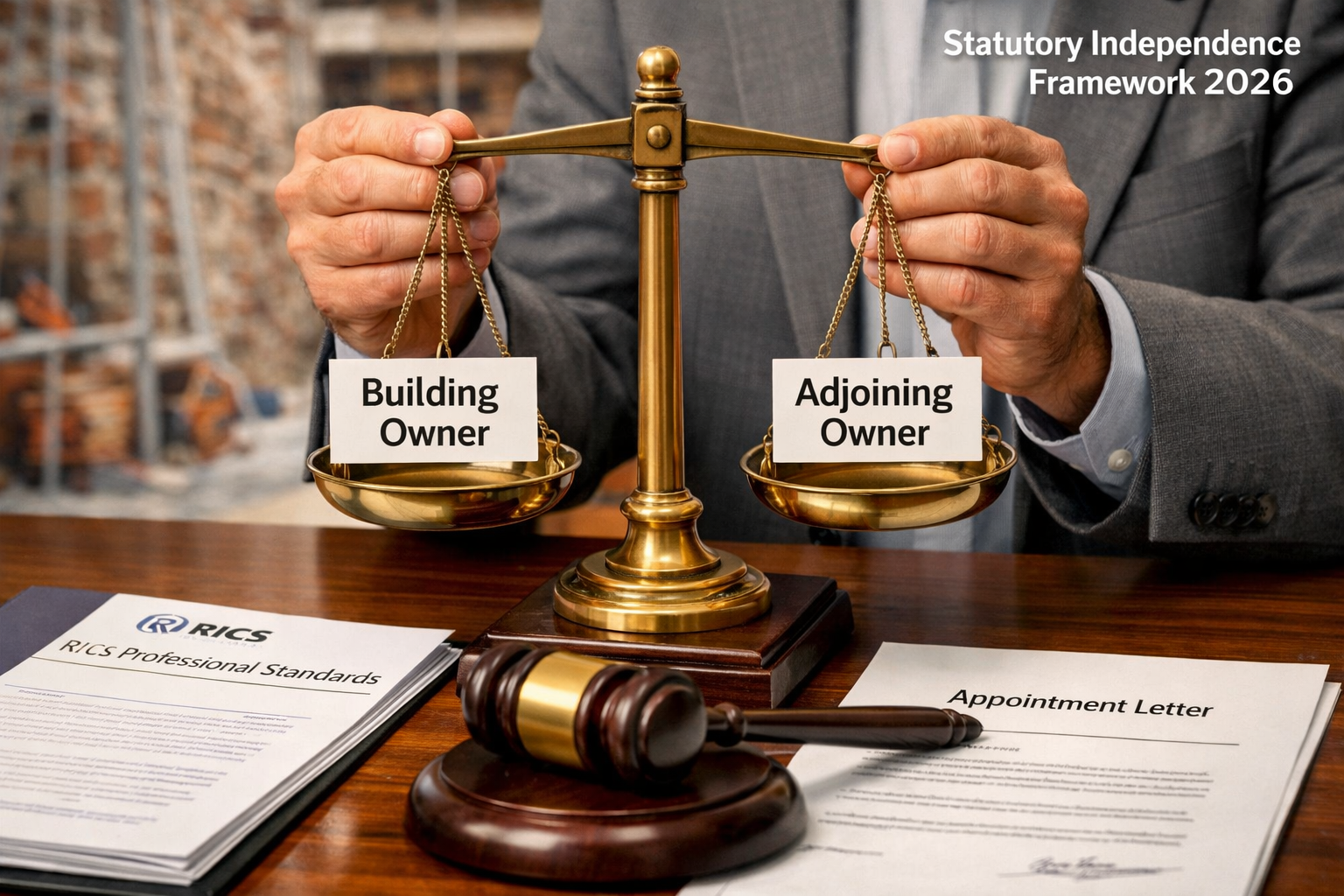
✅ Statutory Independence: Party wall surveyors’ appointments are personal and statutory, meaning professional duties supersede commercial relationships with appointing parties.
✅ 2026 Regulatory Overhaul: RICS draft 8th edition guidance addresses jurisdictional concerns where awards have been challenged due to surveyors acting without proper authority.
✅ Conflict Protections: Agreed surveyors cannot be the same professionals handling the building owner’s construction works, establishing critical independence requirements.
✅ Fee Responsibility Framework: Building owners typically pay both surveyors’ fees (£700–£1,800 per neighbour in 2026), but this payment structure must not compromise impartiality.
✅ Legal Accountability: Recent case law demonstrates that awards can be invalidated when surveyors fail to maintain genuine neutrality or act beyond their jurisdiction.
Understanding the Statutory Framework for Party Wall Surveyor Impartiality in 2026
The Party Wall etc. Act 1996 establishes a unique professional role where surveyors must serve dual masters: the appointing party who pays their fees and the statutory requirement to act impartially. This creates inherent tension that the 2026 RICS consultation seeks to address.
The Personal and Statutory Nature of Surveyor Appointments
RICS has explicitly clarified that “a party wall surveyor’s appointment is personal and statutory, independent of client instruction”[2]. This means that once appointed, surveyors operate under the Act’s authority rather than as conventional consultants following client directions.
Key distinctions include:
- 📋 Not mediators: Surveyors resolve disputes through awards, not negotiated settlements
- ⚖️ Judicial function: They make binding determinations on construction methods, timing, and safeguards
- 🔒 Independence requirement: Professional judgment cannot be influenced by who pays the fees
- 📜 Statutory powers: Authority derives from the Act, not contractual engagement
The building owner’s surveyor and adjoining owner’s surveyor both carry these obligations, though their initial appointments come from different parties.
The Three Surveyor Appointment Models
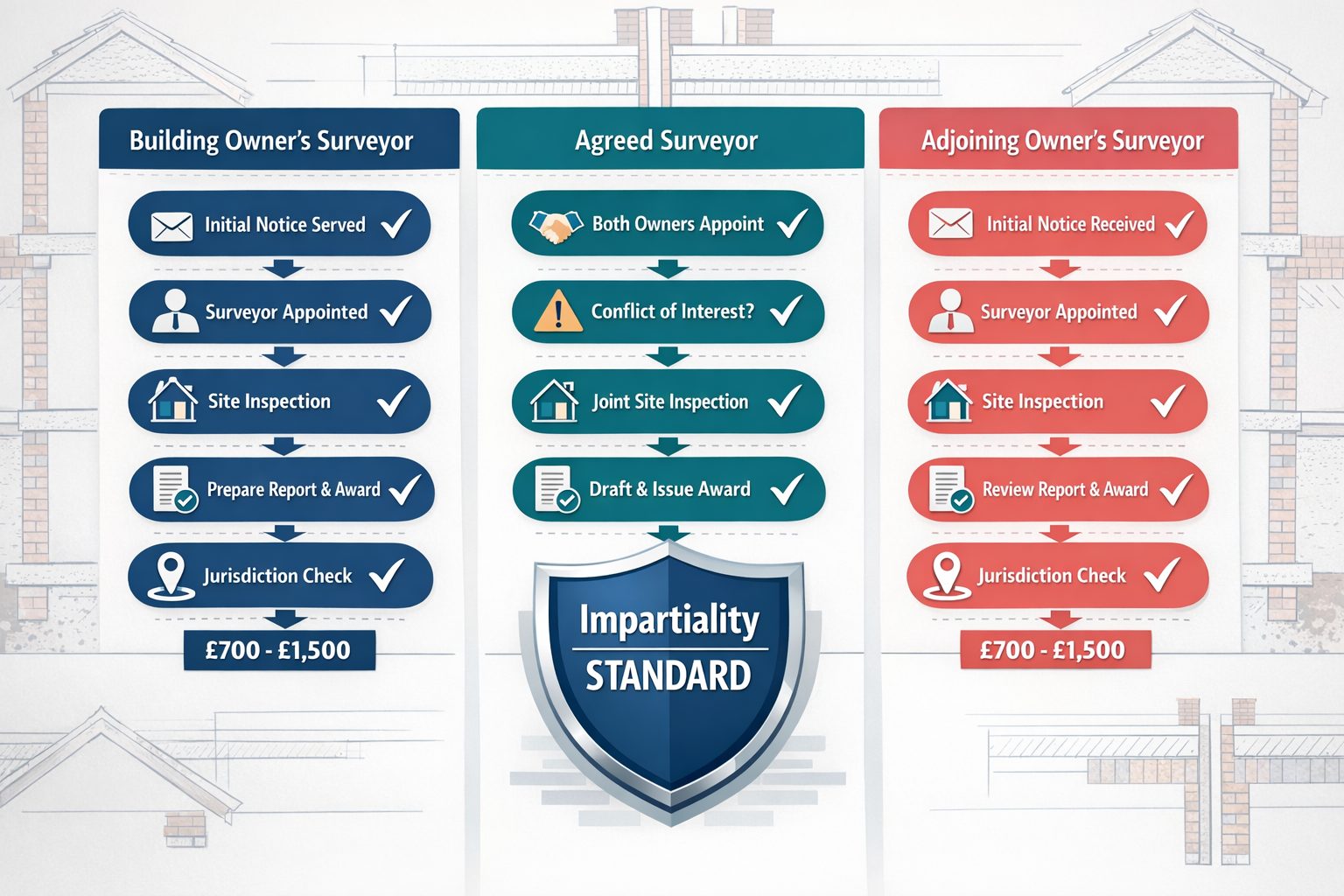
The Act provides three pathways for surveyor selection, each with distinct impartiality implications:
| Appointment Type | Selection Method | Impartiality Standard | 2026 Fee Range |
|---|---|---|---|
| Agreed Surveyor | Both parties consent to single surveyor | Must remain neutral regardless of who contacted them first | £700–£1,500 (£750–£1,800 London)[4][6] |
| Two Surveyors | Each party appoints their own | Must act impartially despite representing appointing owner | £700–£1,500 each |
| Third Surveyor | Selected by the two appointed surveyors | Resolves disagreements between first two surveyors | Additional fees as needed |
The agreed surveyor model faces the strictest scrutiny. As HomeOwners Alliance notes, an agreed surveyor “cannot be the same surveyor the homeowner might be using for their own works” because the neighbour must view them as neutral[1]. This conflict-of-interest protection has become central to Party Wall Surveyor Impartiality in 2026: Balancing Client Duties with Adjoining Owner Protections.
Jurisdictional Boundaries and the 2026 RICS Consultation
The April-May 2026 RICS consultation emerged directly from concerns “where awards have been challenged because surveyors acted without proper jurisdiction, including circumstances where no genuine dispute existed between the parties”[2].
This addresses cases where:
🚫 Surveyors issued awards when neighbours had already agreed informally
🚫 Professionals exceeded their statutory authority by imposing unnecessary conditions
🚫 Awards were prepared without proper party wall notices being served
🚫 Surveyors acted more as advocates than impartial adjudicators
The draft 8th edition includes “strengthened guidance on regulatory and conduct matters, including fee practices, use of the Third Surveyor, service of notices and public engagement”[2], representing the most comprehensive update to party wall practice standards in recent years.
Case Law Challenges to Party Wall Surveyor Impartiality in 2026
Recent legal challenges have tested the boundaries of surveyor impartiality, with courts increasingly scrutinizing whether professionals maintained genuine neutrality or acted as advocates for their appointing parties.
Welter v McKeeve: Jurisdictional Overreach
The Welter v McKeeve case highlighted how surveyors can exceed their statutory authority when they issue awards without proper jurisdictional foundation. The case questioned whether a genuine dispute existed that required formal award procedures, or whether the surveyors had manufactured a dispute to justify their engagement.
Key lessons from this case:
- ✔️ Surveyors must verify that a genuine dissent exists before proceeding to award
- ✔️ Simply receiving party wall notices doesn’t automatically create jurisdiction
- ✔️ Awards can be challenged if they address matters beyond the Act’s scope
- ✔️ Documentation must demonstrate impartial consideration of both parties’ interests
Walsh v PSB Management: Bias and Procedural Fairness
Walsh v PSB Management examined whether surveyors maintained procedural fairness when one party felt their concerns were dismissed or inadequately addressed in the award documentation.
The case reinforced that party wall awards must demonstrate:
- Balanced consideration of both parties’ submissions
- Reasoned explanations for decisions that favour one party over another
- Proper consultation with both building and adjoining owners
- Fair opportunity for both parties to present evidence and concerns
These cases directly influenced the 2026 RICS guidance, which now includes “revised letters of appointment and terms, and an updated draft award”[2] to establish clearer contractual frameworks preventing disputes over surveyor scope and independence.
Implications for Award Validity
Courts have demonstrated willingness to invalidate awards where impartiality standards were breached. This creates significant risks for building owners who may find their types of party wall works delayed or halted if awards are successfully challenged.
Award validity now depends on:
- 📝 Clear documentation of impartial consideration
- 🔍 Proper jurisdictional foundation
- ⚖️ Balanced treatment of both parties’ concerns
- 📊 Reasonable fee structures that don’t suggest bias
- 🛡️ Adherence to updated RICS professional standards
Building owners working with party wall surveyors in Central London or other areas should verify their surveyor’s commitment to these standards before appointment.
Practical Mechanisms for Maintaining Party Wall Surveyor Impartiality in 2026
The theoretical requirement for impartiality must translate into practical procedures that protect both parties while allowing construction to proceed efficiently. The 2026 regulatory framework provides specific mechanisms to achieve this balance.
Conflict of Interest Screening
Before accepting any appointment, surveyors must conduct thorough conflict checks:
Prohibited relationships include:
- 🚫 Acting as agreed surveyor while also serving as the building owner’s project architect or engineer
- 🚫 Having financial interests in the construction company performing the works
- 🚫 Previous representation of either party in unrelated disputes
- 🚫 Family or close personal relationships with either party
For adjoining owners, this protection ensures their surveyor isn’t compromised by external relationships. The screening process should be documented in the surveyor’s letter of appointment.
Fee Transparency and Reasonableness
One of the most contentious impartiality issues involves fees. Since building owners typically pay both surveyors’ fees, there’s potential for adjoining owners’ surveyors to inflate charges without accountability.
2026 market standards indicate:
- 💰 Straightforward compliance works: £700–£1,500 per surveyor[4]
- 💰 London-specific rates: £750–£1,800 per neighbour[6]
- 💰 Complex works with extensive conditions: £2,000–£3,500
- 💰 Third surveyor fees: Additional costs when disputes arise
The building owner pays these fees “because they are the party benefitting from the works”[3], but this doesn’t grant them control over the surveyor’s professional judgment. The updated RICS guidance emphasizes that fee practices must not compromise impartiality.
For those concerned about costs of party wall procedures, understanding this fee structure is essential to budgeting appropriately.
Schedule of Condition Protocols
One of the most important impartiality safeguards is the schedule of condition, which documents the adjoining property’s state before works commence.
Impartial surveyors ensure:
- 📸 Comprehensive photographic documentation
- 📝 Detailed written descriptions of existing defects
- 🎯 Joint inspection opportunities for both parties
- 🔄 Regular monitoring visits during construction
- ✅ Post-completion verification
This creates objective evidence that protects adjoining owners from being blamed for pre-existing damage while also protecting building owners from false claims.
Award Documentation Standards
The 2026 RICS guidance introduces “an updated draft award”[2] that establishes clearer documentation standards. Awards must now explicitly demonstrate impartial consideration through:
- Recital of both parties’ positions on disputed matters
- Reasoned determinations explaining why specific conditions were imposed
- Proportionate safeguards that don’t unnecessarily burden the building owner
- Clear dispute resolution procedures if disagreements arise during construction
- Defined monitoring protocols ensuring ongoing impartiality
These standards address concerns raised in recent case law where awards appeared to favour one party without adequate justification.
The Third Surveyor Safety Valve
When the two appointed surveyors cannot agree, the Third Surveyor provides an additional impartiality layer. The 2026 guidance includes enhanced provisions for Third Surveyor use, recognizing this role as critical to Party Wall Surveyor Impartiality in 2026: Balancing Client Duties with Adjoining Owner Protections.
Third Surveyor engagement occurs when:
- 🔄 The two surveyors disagree on award terms
- ⚖️ One surveyor believes the other has acted partially
- 📋 Disputes arise over fee reasonableness
- 🛠️ Disagreements emerge regarding construction methods or safeguards
This mechanism prevents deadlock while maintaining the impartiality framework, though it does add costs to the process.
Regional Considerations for Party Wall Surveyor Impartiality in 2026
Impartiality standards apply uniformly across England and Wales under the Party Wall etc. Act 1996, but practical implementation varies by region based on property density, construction activity, and local surveyor practices.
London-Specific Impartiality Challenges
London’s dense housing stock and high construction activity create unique pressures on surveyor impartiality:
Geographic variations include:
- 🏙️ North London: Victorian terraces with complex shared structures
- 🌆 East London: Rapid development creating volume-based surveyor practices
- 🏛️ South London: Mixed property types requiring varied approaches
- 💼 West London: High-value properties with sophisticated parties
In high-volume areas, some surveyors have developed “factory” approaches that may compromise individual attention to impartiality. The 2026 guidance specifically addresses concerns about surveyors handling excessive caseloads that prevent proper consideration of each party’s interests.
Tenant Rights Integration
The 2026 legislative landscape has “repositioned tenant rights as central to all party wall notices and procedures”[5], adding another dimension to surveyor impartiality. When neighbours are carrying out works, surveyors must now consider:
- 🏠 Tenant occupancy rights during construction
- 📅 Timing restrictions that minimize tenant disruption
- 🔊 Noise and access limitations protecting tenant quiet enjoyment
- 📋 Notice requirements to tenants as well as landlords
This expansion of protected parties requires surveyors to balance even more competing interests while maintaining impartiality.
The Future of Party Wall Surveyor Impartiality Beyond 2026
The ongoing RICS consultation represents just the beginning of evolving impartiality standards. Several trends will shape Party Wall Surveyor Impartiality in 2026: Balancing Client Duties with Adjoining Owner Protections in coming years.
Enhanced Regulatory Oversight
While the Act currently doesn’t require surveyors to belong to specific governing bodies[3], pressure is mounting for mandatory professional accreditation. Future developments may include:
- ✅ Compulsory RICS or similar body membership
- ✅ Specialist party wall surveyor certification
- ✅ Continuing professional development requirements
- ✅ Disciplinary procedures for impartiality breaches
Technology and Transparency
Digital tools are transforming how surveyors demonstrate impartiality:
- 📱 Cloud-based award platforms showing both parties’ submissions
- 🎥 Video documentation of condition surveys
- 📊 Standardized fee calculators preventing overcharging
- 🔔 Automated notification systems ensuring equal communication
These technologies make it harder for surveyors to favour one party without leaving digital evidence.
Alternative Dispute Resolution Integration
Some practitioners advocate for incorporating mediation techniques while maintaining statutory impartiality. The challenge is balancing facilitated negotiation with the surveyor’s duty to make binding determinations when parties cannot agree.

Practical Guidance for Building and Adjoining Owners
Understanding surveyor impartiality helps both parties navigate the party wall process more effectively.
For Building Owners
When carrying out works, building owners should:
- Select surveyors with strong impartiality records rather than those who promise to “get the award through quickly”
- Budget for reasonable fees for both surveyors, recognizing that artificially low fees may indicate quality concerns
- Provide complete information to surveyors, as withholding details can lead to awards being challenged
- Respect the surveyor’s independence rather than attempting to direct their professional judgment
- Consider agreed surveyor appointments when relationships with neighbours are cooperative
Building owners can review sample party wall agreement templates to understand standard terms, though these cannot replace proper surveyor involvement when disputes exist.
For Adjoining Owners
When neighbours are carrying out works, adjoining owners should:
- Appoint your own surveyor rather than accepting the building owner’s suggested agreed surveyor without independent advice
- Verify independence by confirming your surveyor has no conflicts with the building owner or their contractors
- Engage early rather than waiting until works commence, as late involvement limits protection
- Document concerns clearly in writing to your surveyor
- Understand fee responsibility – building owners pay, but you control your surveyor’s appointment
The option of having a party wall agreement without a surveyor exists for straightforward works where both parties agree, but this removes the impartiality safeguards that surveyors provide.
Red Flags Indicating Potential Impartiality Issues
Both parties should watch for warning signs:
🚩 Surveyor refuses to meet with or communicate with one party
🚩 Awards prepared without proper site inspections
🚩 Fees significantly above or below market rates
🚩 Surveyor dismisses legitimate concerns without explanation
🚩 Rush to finalize awards without adequate consultation
🚩 Surveyor has ongoing commercial relationship with one party
🚩 Refusal to provide clear reasoning for determinations
If these issues arise, parties should consider invoking the Third Surveyor mechanism or seeking professional advice about award validity.
Conclusion
Party Wall Surveyor Impartiality in 2026: Balancing Client Duties with Adjoining Owner Protections represents a critical evolution in party wall practice. The RICS consultation and recent case law have exposed tensions inherent in a system where surveyors are appointed and paid by one party yet must serve both impartially.
The 2026 regulatory framework addresses these challenges through enhanced guidance on jurisdictional boundaries, conflict-of-interest protections, fee transparency, and award documentation standards. Surveyors must now demonstrate impartiality through clear procedures rather than simply asserting professional independence.
For building owners, this means selecting surveyors based on their impartiality track record and respecting their statutory independence rather than viewing them as advocates. For adjoining owners, it means understanding the protections available and actively engaging with appointed surveyors to ensure concerns are properly addressed.
The cases of Welter v McKeeve and Walsh v PSB Management demonstrate that awards lacking genuine impartiality can be challenged and invalidated, creating delays and additional costs for all parties. As party wall practice continues evolving beyond 2026, the fundamental principle remains unchanged: surveyors serve the Act first, and their appointing parties second.
Next Steps
If you’re planning construction works:
- Serve proper party wall notices early in your planning process
- Budget £700–£1,800 per affected neighbour for surveyor fees
- Select surveyors with demonstrated impartiality credentials
- Review the party wall contract template guide to understand award components
If you’re an affected neighbour:
- Respond to notices promptly to preserve your rights
- Consider appointing your own surveyor rather than accepting an agreed surveyor
- Document existing property conditions before works commence
- Understand your protections under the updated 2026 guidance
For both parties:
- Consult the general FAQs for common questions
- Seek professional advice early rather than waiting for disputes to escalate
- Recognize that proper surveyor impartiality protects everyone’s interests
The party wall process works best when all participants – building owners, adjoining owners, and surveyors – understand and respect the impartiality framework that makes construction possible while protecting property rights.
References
[1] Party Wall Agreement – hoa.org.uk
[2] Rics Launches Consultation On Updated Party Wall Practice Guidance – rics.org
[3] Role Of Party Wall Surveyor – peterbarry.co.uk
[4] Party Wall Notice Requirements For Prs Database Compliance Works Surveyor Tactics Post Renters Rights Act Registration In 2026 – https://nottinghillsurveyors.com/blog/party-wall-notice-requirements-for-prs-database-compliance-works-surveyor-tactics-post-renters-rights-act-registration-in-2026
[5] Party Wall Surveys For Renters Rights Act Compliance Managing Notices When Landlord Initiated Works Face New Section 8 Ground Requirements – https://nottinghillsurveyors.com/blog/party-wall-surveys-for-renters-rights-act-compliance-managing-notices-when-landlord-initiated-works-face-new-section-8-ground-requirements
[6] Party Wall Agreement London 2026 – mayfairstudio.co.uk
Speak to a RICS chartered party wall surveyor
Free initial consultation. Notices, awards and schedules of condition across London and nationwide.