


Nearly 60% of homeowners planning renovations in 2026 mistakenly believe their architect handles all legal requirements for shared walls—a costly misconception that can derail projects and damage neighbour relations. Understanding the Party Wall Surveyor vs Architect: Clarifying Roles and When to Involve Both in 2026 Renovations is essential for anyone undertaking extensions, loft conversions, or basement excavations in terraced or semi-detached properties across the UK.
The confusion is understandable. Both professionals wear suits, carry clipboards, and speak authoritatively about your renovation. Yet their responsibilities couldn't be more different. Architects create the vision—transforming your cramped kitchen into an open-plan masterpiece or converting that dusty loft into a home office. Party wall surveyors, meanwhile, protect legal rights and prevent disputes when your dream renovation affects the shared structures between you and your neighbours.
This distinction matters more than ever in 2026, as construction activity surges and neighbour disputes over party wall matters increase alongside rising property values. Getting these roles wrong can mean project delays, unexpected costs, or even legal action from adjoining owners.
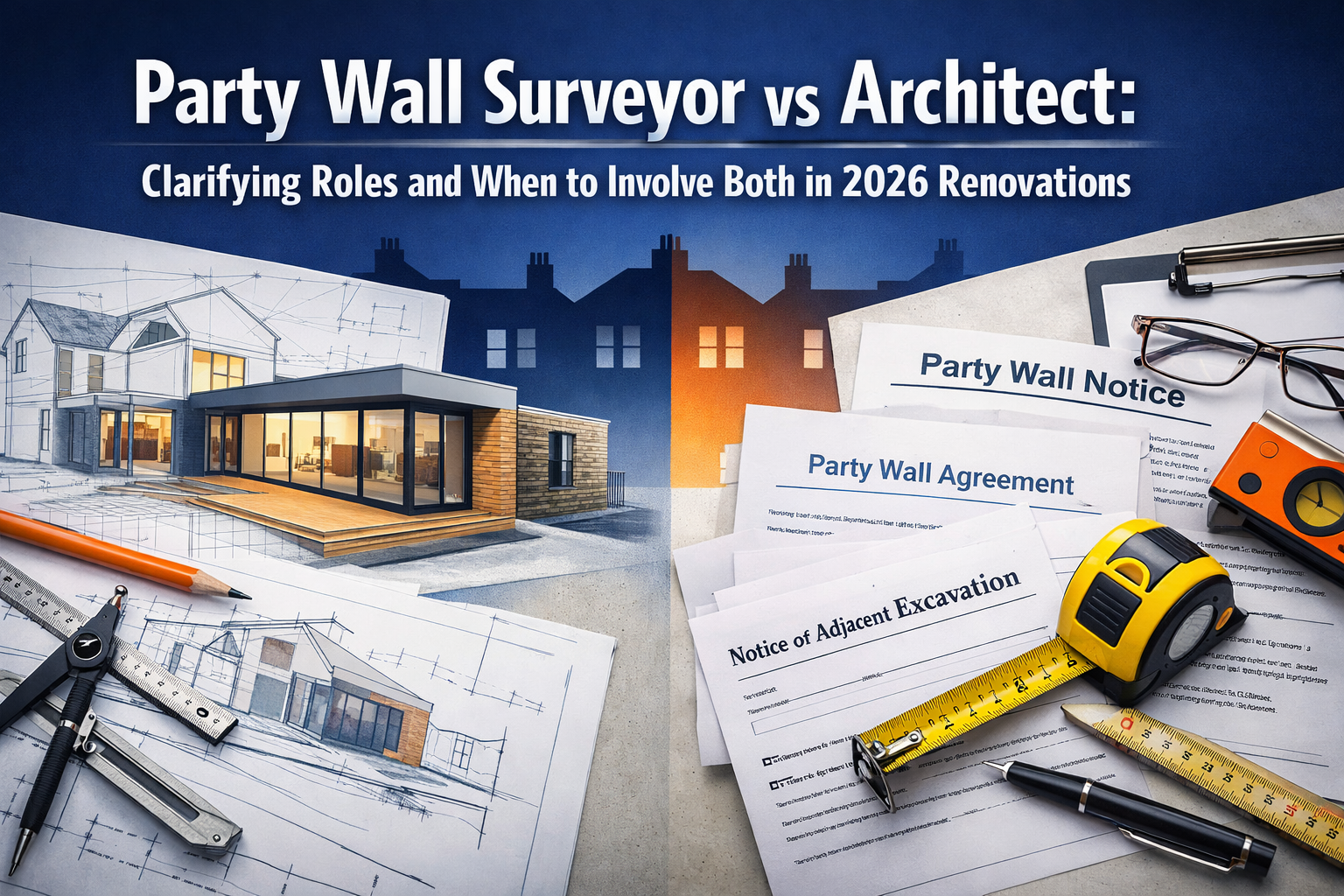
Key Takeaways
✅ Architects design; surveyors protect rights – Architects handle creative design, planning permission, and building regulations, while party wall surveyors manage legal compliance under the Party Wall etc. Act 1996
✅ No professional substitution allowed – Architects cannot serve as party wall surveyors unless specially trained and formally appointed, and vice versa
✅ Both professionals often needed together – Projects like loft conversions, extensions, and basement excavations typically require both an architect for design and a surveyor for party wall matters
✅ Timing matters for cost control – Involving the right professional at the correct project stage prevents expensive redesigns and neighbour disputes
✅ Legal triggers are specific – Party wall surveyors become mandatory when work involves shared walls, boundary construction, or excavation within 3-6 metres of a neighbour's foundation
Understanding the Fundamental Differences: Party Wall Surveyor vs Architect
What Does an Architect Actually Do?
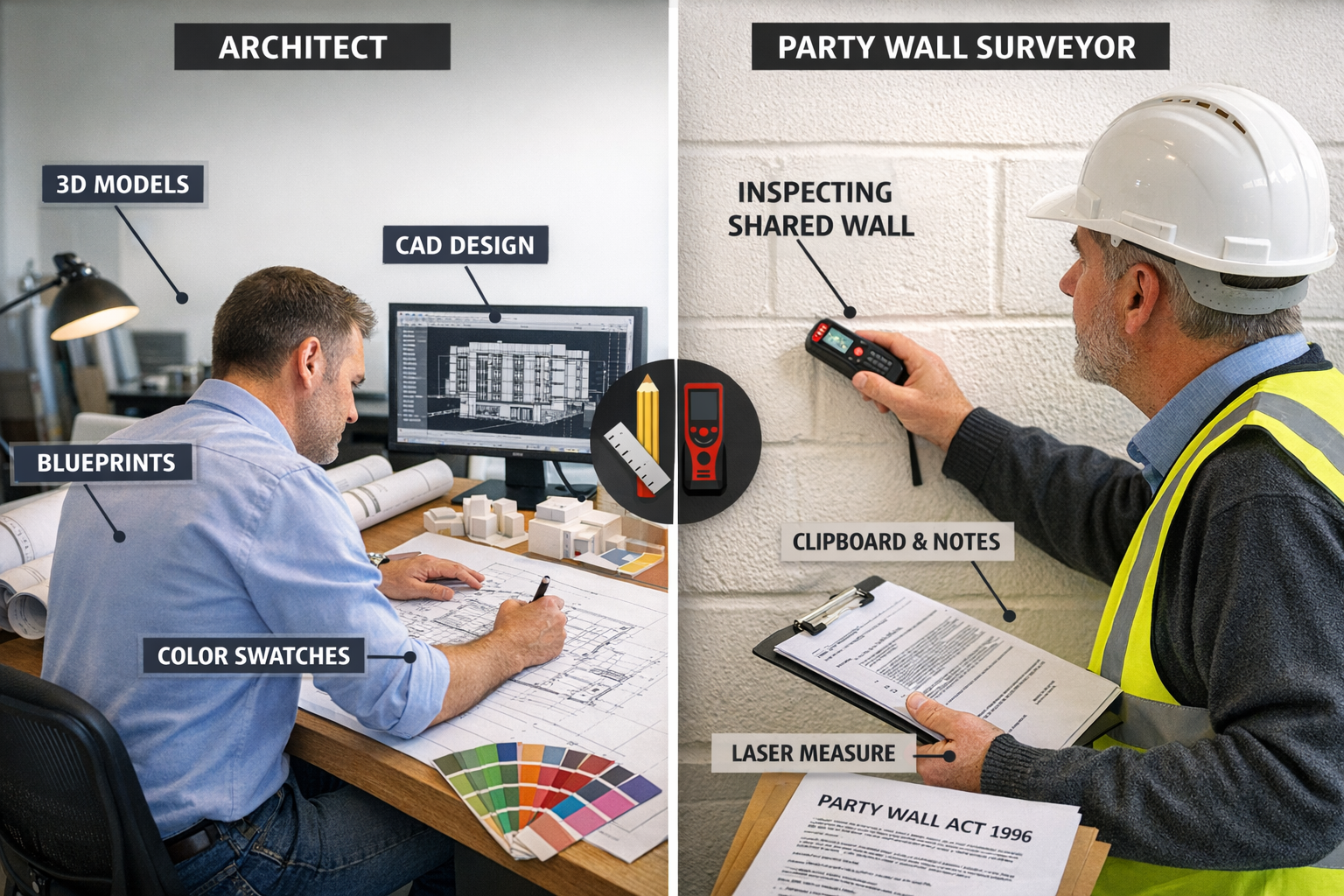
Architects are the creative visionaries of your renovation project. Their expertise centres on spatial design, aesthetic appeal, and functional transformation of living spaces. When you hire an architect, you're engaging someone to reimagine how your home works and looks [1].
Core architect responsibilities include:
- 🎨 Concept design and spatial planning – Creating layouts that maximize light, space, and usability
- 📐 Technical drawings and specifications – Producing detailed plans for builders to follow
- 🏛️ Planning permission applications – Navigating local authority requirements and permitted development rights
- 📋 Building regulations compliance – Ensuring structural safety, fire safety, accessibility, and energy efficiency standards
- 🔍 Site monitoring – Overseeing construction quality and adherence to approved plans
- 🌱 Sustainability integration – Incorporating eco-friendly materials and energy-efficient solutions
Architects typically remain involved throughout your entire project journey—from initial sketches through to final completion. They coordinate with structural engineers, builders, and other specialists to bring your vision to life while meeting all regulatory requirements [2].
What Does a Party Wall Surveyor Actually Do?
Party wall surveyors operate in a completely different domain: legal compliance and dispute prevention under the Party Wall etc. Act 1996. Their role is protective rather than creative, focused on safeguarding the rights of both building owners and their neighbours [3].
Core party wall surveyor responsibilities include:
- ⚖️ Legal compliance verification – Ensuring proper notice procedures under the Act
- 📸 Pre-construction condition surveys – Documenting existing conditions of neighbouring properties through detailed schedules of condition
- 📄 Party Wall Award preparation – Creating legally binding documents that specify work methods, timing, and dispute resolution procedures
- 🛡️ Rights protection – Acting impartially to protect both the building owner's right to build and the adjoining owner's property rights
- 🔧 Technical specifications – Detailing construction methods to minimize risk to shared structures
- 🤝 Dispute resolution – Mediating disagreements between neighbours about proposed works
Importantly, party wall surveyors have no formal qualification requirements under the Act—technically, anyone not party to the works can be appointed. However, most are qualified building surveyors, structural engineers, or architects with specialist party wall training [3].
The Critical Distinction: Design vs. Legal Protection
The fundamental difference boils down to this: architects create; surveyors protect [1].
An architect asks: "How can we transform this space beautifully and functionally while meeting building codes?"
A party wall surveyor asks: "How do we ensure this work complies with the Party Wall Act and protects all parties' legal rights?"
These are complementary but entirely separate functions. An architect might design a stunning rear extension, but they cannot issue the party wall notices required by law or prepare the Party Wall Award that protects you legally. Similarly, a party wall surveyor can assess whether your foundation excavation complies with the Act, but they cannot design the extension itself unless they also hold architectural qualifications—which is rare [1].
When Do You Need Each Professional? Trigger Points Explained
Scenarios Requiring an Architect
You'll need an architect when your renovation involves significant design complexity, structural changes, or planning permission requirements [2].
Definite architect scenarios:
| Project Type | Why Architect Needed |
|---|---|
| Extensions (single or double-storey) | Design, planning permission, building regulations, structural calculations coordination |
| Loft conversions | Spatial planning, dormer design, staircase integration, building regulations |
| Basement excavations | Complex structural design, waterproofing specifications, planning permission |
| Major internal reconfigurations | Load-bearing wall removal, open-plan layouts, structural engineer coordination |
| New builds | Complete design from foundation to roof, full regulatory compliance |
| Listed building alterations | Specialist conservation knowledge, listed building consent applications |
Even for projects that fall under permitted development rights (not requiring full planning permission), you'll likely need an architect to ensure your design meets the technical criteria and building regulations [2].
Scenarios Requiring a Party Wall Surveyor
You'll need a party wall surveyor when your work triggers the Party Wall etc. Act 1996—specifically when construction affects shared structures or occurs near neighbouring properties [1].
Definite party wall surveyor scenarios:
🏠 Work on existing party walls:
- Cutting into a party wall to insert a beam or damp-proof course
- Raising a party wall for an extension or loft conversion
- Demolishing and rebuilding a party wall
- Underpinning a party wall
🧱 Building new walls on boundaries:
- Constructing a new wall directly on the boundary line
- Building a wall astride the boundary (half on each property)
⛏️ Excavation near neighbours:
- Digging foundations within 3 metres of a neighbour's structure if going deeper than their foundations
- Excavating within 6 metres of a neighbour's structure if the work will cut a line drawn at 45 degrees from the bottom of their foundations
These triggers apply whether you're in North London, South London, East London, West London, or Central London—the Act applies across England and Wales.
Projects Requiring BOTH Professionals
Many common 2026 renovation projects need both an architect and a party wall surveyor working in tandem [1].
Typical dual-requirement projects:
✅ Loft conversions in terraced/semi-detached houses – Architect designs the conversion; surveyor handles party wall matters if raising the party wall or excavating for new foundations
✅ Rear or side extensions – Architect creates design and obtains planning permission; surveyor manages party wall procedures if building on or near boundaries
✅ Basement excavations – Architect designs the space and coordinates structural engineering; surveyor addresses excavation proximity to neighbours' foundations
✅ Major renovations with structural changes – Architect redesigns layout and manages building regulations; surveyor handles any party wall implications
The key insight: architectural work and party wall compliance are parallel processes, not sequential ones. Both should begin early in your project timeline [8].
The Party Wall Surveyor vs Architect Collaboration: How They Work Together in 2026 Renovations
Sequential vs. Parallel Involvement
Understanding when each professional enters your project prevents costly delays and redesigns.
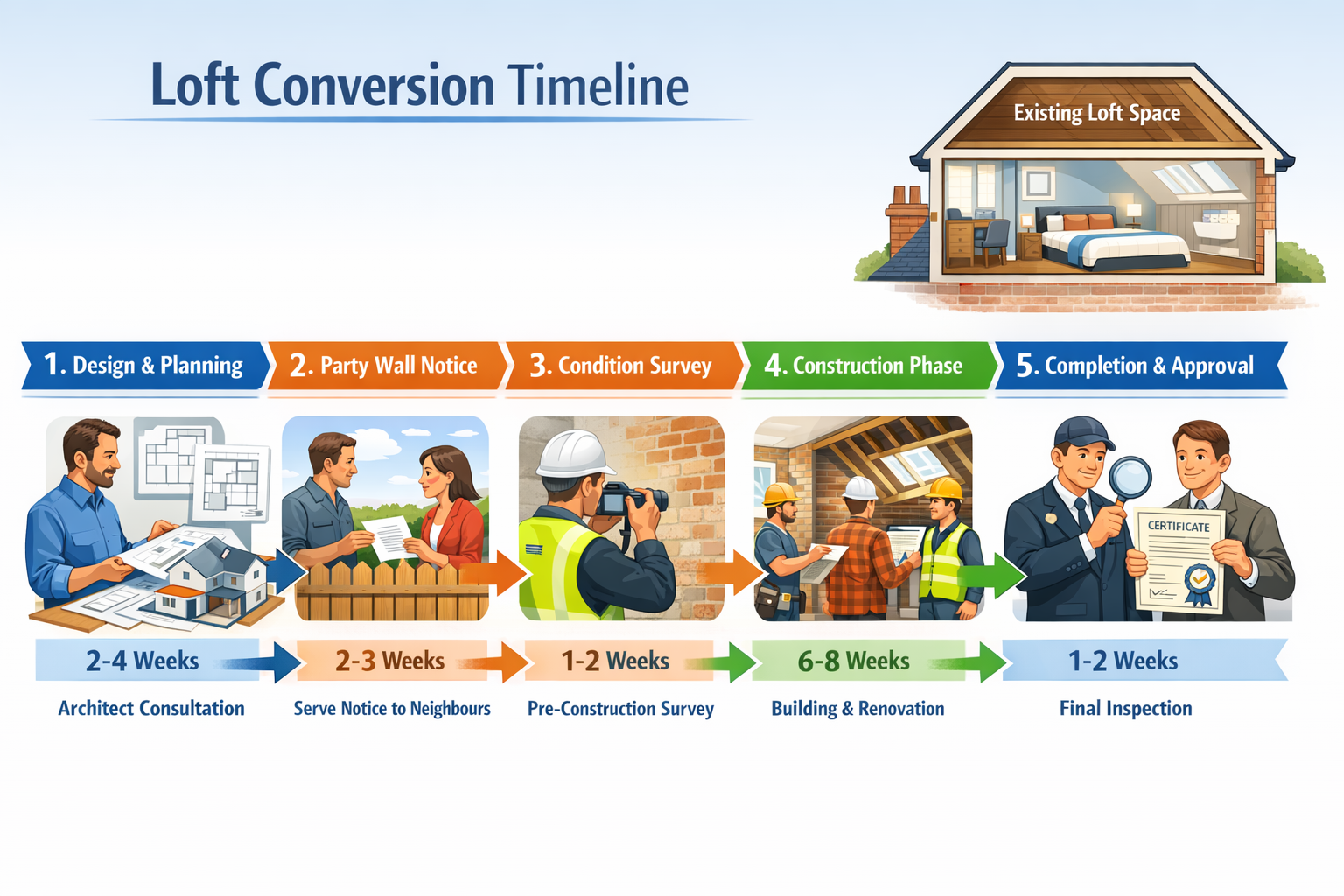
Typical project timeline:
Months 1-2: Initial Planning Phase
- Architect: Initial consultation, site survey, concept sketches
- Party Wall Surveyor: Not yet involved (unless early advice needed)
Months 2-4: Design Development
- Architect: Detailed designs, planning permission application, structural engineer coordination
- Party Wall Surveyor: Review designs to identify party wall triggers, advise on notice timing
Months 4-5: Pre-Construction Legal Compliance
- Architect: Finalizing technical drawings, building regulations submission
- Party Wall Surveyor: Serving party wall notices (minimum 2 months before work starts), conducting pre-construction condition surveys
Months 5-6: Award Preparation
- Architect: Responding to building control queries, contractor selection
- Party Wall Surveyor: Negotiating and preparing Party Wall Awards with adjoining owners' surveyors
Months 6-12: Construction Phase
- Architect: Site visits, design queries resolution, quality monitoring
- Party Wall Surveyor: Monitoring compliance with Award conditions, addressing any damage claims
Month 12+: Completion
- Architect: Final inspections, building control sign-off, snagging
- Party Wall Surveyor: Final condition survey comparison, dispute resolution if needed
Communication Between Professionals
Effective collaboration requires clear information sharing between your architect and party wall surveyor [1].
What architects provide to surveyors:
- Detailed construction drawings showing party wall interfaces
- Foundation depth and excavation specifications
- Construction methodology and sequencing
- Structural calculations affecting shared walls
What surveyors provide to architects:
- Party Wall Award conditions that may affect design
- Neighbour concerns requiring design modifications
- Access requirements for condition surveys
- Construction timing restrictions from Awards
Pro tip: Appoint both professionals early and ensure they communicate directly. A surveyor discovering a party wall issue late in the design process can force expensive redesigns [6].
Who's Responsible for Informing You About Party Wall Requirements?
This question causes considerable confusion. Legally, it's the building owner's responsibility to comply with the Party Wall Act—but good architects should flag potential party wall issues during initial consultations [6].
However, architects are not required by their professional body to provide party wall advice unless specifically engaged to do so. Many architects will recommend you consult a party wall surveyor but won't handle the process themselves [6][7].
Best practice in 2026: Ask your architect explicitly during initial meetings whether your proposed work triggers party wall requirements. If they're unsure, seek independent party wall advice early—ideally before finalizing designs [6].
Cost Considerations: Budgeting for Both Professionals in 2026
Typical Architect Fees
Architect fees vary significantly based on project complexity and the service level you choose.
2026 fee structures:
- Hourly rates: £80-£150 per hour for smaller practices; £150-£250+ for established firms
- Percentage of construction cost: Typically 8-15% of total build cost for full service
- Fixed fees: £2,000-£5,000 for basic extension designs; £10,000-£30,000+ for complex projects
Service levels:
- Full service (concept through completion): 10-15% of build cost
- Planning package (design and planning permission only): 5-8% of build cost
- Technical package (building regulations drawings): 3-5% of build cost
Typical Party Wall Surveyor Fees
Party wall surveyor costs are more standardized but vary by project complexity [4].
2026 fee structures:
- Hourly rates: £150-£200 per hour
- Fixed fee Party Wall Awards: £800-£1,500 for straightforward cases
- Average total cost: Approximately £1,000 for typical residential projects [4]
Cost factors:
- Number of adjoining owners (more neighbours = higher costs)
- Project complexity (basement excavations cost more than simple extensions)
- Whether neighbours appoint their own surveyors (increases costs)
- Geographic location (London typically higher than other regions)
Who pays? The building owner (you) pays for:
- Your own surveyor's fees
- The agreed surveyor's fees (if using one surveyor for both parties)
- The adjoining owner's surveyor's reasonable fees [4]
This can be a shock—you're legally responsible for your neighbour's surveyor costs even though you don't choose them. Budget £1,500-£3,000 total for party wall matters when multiple neighbours are involved.
Cost-Saving Strategies
For architect fees:
💰 Use architects for planning permission only, then work with a good builder for technical details
💰 Choose a smaller practice for simpler projects
💰 Get detailed quotes from 3-4 architects before committing
💰 Clearly define scope to avoid scope creep and additional fees
For party wall surveyor fees:
💰 Consider having a party wall agreement without a surveyor if your neighbour is cooperative
💰 Suggest an Agreed Surveyor (one surveyor for both parties) rather than separate surveyors [4]
💰 Provide complete information upfront to minimize surveyor time
💰 Read our guide on how to keep party wall costs down
Combined savings:
💰 Engage both professionals early to prevent expensive design changes
💰 Ensure your architect's drawings include all party wall details to minimize surveyor queries
💰 Address neighbour concerns proactively before formal disputes arise
Common Misconceptions About Party Wall Surveyor vs Architect Roles
Myth 1: "My Architect Handles Everything"
Reality: Architects focus on design and building regulations, not party wall legal compliance [1].
While some architects have party wall knowledge, they cannot act as your party wall surveyor unless formally appointed under the Act. Even architect-surveyors typically separate these roles to maintain professional boundaries and avoid conflicts of interest [1].
Myth 2: "I Don't Need a Surveyor If My Neighbour Agrees"
Partially true: If your neighbour provides written consent to your party wall notice, you can proceed without appointing surveyors [5].
However, you remain legally liable for any damage caused by your works. Without a pre-construction schedule of condition, proving what damage existed before your work becomes nearly impossible [5].
Best practice: Even with neighbour consent, commission a photographic condition survey for protection.
Myth 3: "Party Wall Surveyors Are Only Needed for Disputes"
Reality: Party wall surveyors prevent disputes through proper procedure and documentation [3].
The Party Wall Act is a preventative framework, not just a dispute resolution mechanism. Surveyors ensure compliance before problems arise, protecting both parties' interests [3].
Myth 4: "Architects Can Serve Party Wall Notices"
Partially true: Anyone can physically serve a party wall notice—it's a legal document, not a professional service [1].
However, drafting notices correctly requires specialist knowledge. Incorrect notices can invalidate the entire process, causing project delays. Most homeowners use their party wall surveyor to prepare and serve notices, though architects may assist with basic notice templates [6].
Myth 5: "I Can Use the Same Surveyor as My Builder"
Problematic: While legally possible, using your builder's recommended surveyor creates perceived conflicts of interest [4].
The surveyor must act impartially, protecting both your rights and your neighbour's. An independent surveyor with no connection to your construction team maintains credibility and reduces dispute risk [4].
Practical Steps: Engaging the Right Professionals for Your 2026 Renovation
Step 1: Assess Your Project Requirements
Before contacting any professionals, clarify what you're trying to achieve.
Ask yourself:
- What's the scope? (Extension, conversion, remodel)
- Does it require planning permission?
- Does it involve shared walls or boundary work?
- Are you within 3-6 metres of a neighbour's foundation?
- What's your budget and timeline?
Step 2: Engage an Architect First (Usually)
For most projects, start with an architect to develop your design vision [2].
Initial architect consultation should cover:
- Feasibility of your ideas
- Planning permission requirements
- Approximate costs and timeline
- Potential party wall implications
- Structural engineering needs
The architect can then advise whether party wall procedures will be necessary based on your design.
Step 3: Identify Party Wall Triggers Early
Once you have preliminary designs, assess party wall requirements.
Review your plans against these questions:
- Does work affect any shared walls?
- Are you building on or within 6 metres of a boundary?
- Are you excavating near a neighbour's property?
If yes to any, you'll need a party wall surveyor. Learn more about types of party wall works that trigger the Act.
Step 4: Appoint a Party Wall Surveyor
Choose a surveyor with relevant experience and local knowledge.
Selection criteria:
- Membership in Faculty of Party Wall Surveyors or Pyramus & Thisbe Club
- Experience with similar projects
- Clear fee structure
- Good communication skills
- Independence from your builder
Your surveyor will then prepare and serve the appropriate party wall notices to affected neighbours.
Step 5: Coordinate Timeline and Communication
Ensure both professionals understand the project timeline and communicate effectively.
Create a coordination plan:
- Share architect's drawings with surveyor immediately
- Schedule joint meetings if complex issues arise
- Establish clear communication channels
- Set milestone dates for notices, awards, and construction start
- Budget for both professional fees from the outset
Step 6: Manage Neighbour Relations Proactively
Good neighbour relations prevent disputes and reduce costs.
Best practices:
- Inform neighbours of your plans before formal notices
- Address concerns openly and honestly
- Provide contact details for both professionals
- Commit to minimizing disruption
- Consider suggesting an Agreed Surveyor to reduce costs for everyone
Real-World Scenarios: Party Wall Surveyor vs Architect in Action
Scenario 1: Terraced House Loft Conversion
Project: Converting unused attic space into a master bedroom with ensuite in a Victorian terraced house.
Architect's role:
- Design dormer window and internal layout
- Ensure adequate headroom and natural light
- Coordinate structural engineer for roof alterations
- Submit building regulations application
- Specify insulation, fire safety, and staircase requirements
Party Wall Surveyor's role:
- Assess whether party wall is being raised or altered
- Serve party wall notices to neighbours on both sides
- Conduct pre-construction condition surveys of adjoining properties
- Prepare Party Wall Award specifying work methods and access arrangements
- Monitor construction to ensure compliance with Award
Outcome: Both professionals essential; architect creates functional design while surveyor ensures legal compliance and protects all parties.
Scenario 2: Basement Excavation Under Existing House
Project: Excavating under a semi-detached house to create additional living space.
Architect's role:
- Design basement layout and access
- Coordinate structural engineer for underpinning calculations
- Specify waterproofing and drainage systems
- Obtain planning permission (if required)
- Ensure building regulations compliance for new habitable space
Party Wall Surveyor's role:
- Assess excavation depth relative to neighbour's foundations
- Serve excavation notices under Section 6 of the Act
- Commission specialist monitoring of neighbour's property during works
- Prepare detailed Party Wall Award with strict construction methodology
- Resolve any damage claims post-construction
Outcome: Highly complex project requiring close collaboration; surveyor's role particularly critical due to high risk to neighbouring property.
Scenario 3: Rear Extension on Boundary
Project: Single-storey rear extension on a detached house, with new wall built on the boundary line.
Architect's role:
- Design extension maximizing space and light
- Ensure compliance with permitted development rules or obtain planning permission
- Coordinate structural engineer for foundation design
- Produce technical drawings for building control
- Select materials and finishes
Party Wall Surveyor's role:
- Serve Line of Junction notice for new wall on boundary
- Negotiate Party Wall Award terms with neighbour's surveyor
- Specify foundation construction to avoid damage to neighbour's property
- Document pre-existing conditions
- Monitor construction and resolve any disputes
Outcome: Both professionals needed; architect focuses on design optimization while surveyor manages legal and neighbourly aspects.
Conclusion: Making Informed Decisions About Party Wall Surveyor vs Architect Roles in 2026
Understanding the Party Wall Surveyor vs Architect: Clarifying Roles and When to Involve Both in 2026 Renovations is fundamental to successful home improvement projects. These professionals serve complementary but distinctly different functions—architects bring creative vision and regulatory expertise, while party wall surveyors provide legal protection and dispute prevention under the Party Wall etc. Act 1996.
The key insights to remember:
🎯 Architects and party wall surveyors cannot substitute for each other—each brings specialized knowledge that the other typically lacks
🎯 Many common renovations require both professionals—extensions, loft conversions, and basement excavations frequently trigger both planning/building regulations and party wall procedures
🎯 Early engagement saves money—involving the right professional at the right time prevents expensive redesigns and legal complications
🎯 Clear communication between professionals is essential—ensure your architect and surveyor coordinate effectively throughout your project
🎯 Budget realistically for both—expect £5,000-£15,000+ for architectural services and £1,000-£3,000 for party wall matters on typical projects
Your Action Plan
Before starting any renovation:
- Consult an architect to develop your design vision and understand planning/building regulation requirements
- Identify party wall triggers early by reviewing your plans against the Act's criteria
- Appoint a qualified party wall surveyor if your work affects shared structures or occurs near boundaries
- Budget for both professionals from the outset to avoid financial surprises
- Facilitate communication between your architect and surveyor to ensure seamless coordination
- Maintain good neighbour relations throughout the process to minimize disputes and costs
The construction boom continuing through 2026 means party wall matters are more relevant than ever [8]. Properties in high-demand areas see particularly intense renovation activity, making professional guidance invaluable for navigating both creative design challenges and legal compliance requirements.
By understanding what each professional brings to your project and engaging them appropriately, you'll protect your investment, maintain positive neighbour relationships, and achieve your renovation goals efficiently and legally.
Ready to start your renovation journey? Ensure you have the right team in place—both the creative vision of a skilled architect and the legal protection of an experienced party wall surveyor working together to make your 2026 project a success.
References
[1] Party Wall Surveyor Vs Architect Understanding Their Roles In Renovation – https://www.adamjoseph.co.uk/party-wall-surveyor-vs-architect-understanding-their-roles-in-renovation
[2] Surveyor Vs Architect – https://www.draw-architecture.co.uk/post/surveyor-vs-architect
[3] Role%20of%20party%20wall%20surveyors – https://www.designingbuildings.co.uk/wiki/Role%20of%20Party%20Wall%20Surveyors
[4] Party Wall Agreement – https://hoa.org.uk/advice/guides-for-homeowners/i-am-improving/party-wall-agreement/
[5] Party Wall Agreements What You Need To Know – https://www.fmb.org.uk/find-a-builder/ultimate-guides-to-home-renovation/party-wall-agreements-what-you-need-to-know.html
[6] Is It The Architect S Job To Inform Client S Of The Need For Party Wall Agreement – https://www.mybuilder.com/questions/v/31876/is-it-the-architect-s-job-to-inform-client-s-of-the-need-for-party-wall-agreement
[7] Th6if Architect Party Wall Surveyor – https://www.justanswer.co.uk/law/th6if-architect-party-wall-surveyor.html
[8] Party Wall Surveys Amid 2026 Construction Boom Handling Disputes In High Demand Uk Housing Markets – https://nottinghillsurveyors.com/blog/party-wall-surveys-amid-2026-construction-boom-handling-disputes-in-high-demand-uk-housing-markets