

The UK construction sector is experiencing unprecedented growth in 2026, with housing recovery driving a surge in residential extensions, loft conversions, and basement excavations across London and beyond. However, this building boom has brought an unwelcome side effect: neighbour disputes over party walls have reached record levels. Property owners embarking on construction projects are increasingly finding themselves at odds with adjoining neighbours over structural concerns, access rights, and procedural compliance. Understanding Party Wall Surveys Amid 2026 Construction Uptick: RICS Framework for Managing Surging Neighbour Disputes has never been more critical for homeowners, developers, and construction professionals navigating these complex legal waters.
The Royal Institution of Chartered Surveyors (RICS) has established comprehensive professional standards to help surveyors manage these escalating conflicts while ensuring compliance with the Party Wall etc. Act 1996. As construction activity intensifies, RICS-accredited surveyors are playing an essential role in preventing disputes from escalating into costly legal battles and project delays.
Key Takeaways
- 🏗️ Construction boom drives disputes: The 2026 housing recovery has caused a significant increase in party wall-related neighbour conflicts across the UK
- 📋 RICS standards are mandatory: RICS members must comply with professional standards that extend beyond statutory Party Wall Act requirements
- ⚖️ Professional framework reduces costs: Following RICS guidance helps resolve disputes swiftly and cost-effectively, preventing expensive litigation
- 🤝 Early engagement is critical: Serving proper notices and appointing qualified surveyors early prevents most disputes from escalating
- 📊 Documentation protects all parties: Comprehensive schedules of condition and party wall awards provide legal protection for building and adjoining owners
Understanding the 2026 Construction Surge and Its Impact on Party Wall Disputes
The Housing Recovery Phenomenon
The UK property market has rebounded strongly in 2026 following several years of uncertainty. Government incentives, favorable mortgage rates, and pent-up demand have created a perfect storm for residential construction activity. Homeowners who delayed renovation projects are now proceeding with extensions, conversions, and structural modifications—many of which trigger requirements under the Party Wall etc. Act 1996.
This surge has particularly affected urban areas where properties share walls, boundaries, and structural elements. London boroughs have reported a 40% increase in party wall notices served compared to 2024 levels, placing unprecedented pressure on surveyors and dispute resolution mechanisms.
Why Disputes Are Escalating
Several factors contribute to the rising tide of neighbour conflicts in 2026:
- Lack of awareness: Many building owners remain unaware of their legal obligations under party wall legislation
- DIY culture: Online resources have encouraged some property owners to attempt the process without professional guidance
- Property values: High property prices make neighbours more protective of their investments and concerned about potential damage
- Construction complexity: Modern projects often involve deeper excavations and more invasive structural work
- Time pressures: Developers rushing to capitalize on favorable market conditions may cut corners on proper notification procedures
The combination of increased construction activity and insufficient understanding of legal requirements has created an environment where Party Wall Surveys Amid 2026 Construction Uptick: RICS Framework for Managing Surging Neighbour Disputes has become essential knowledge for anyone involved in property development.
The RICS Framework: Professional Standards for Party Wall Surveyors
RICS Party Wall Legislation and Procedure Standard
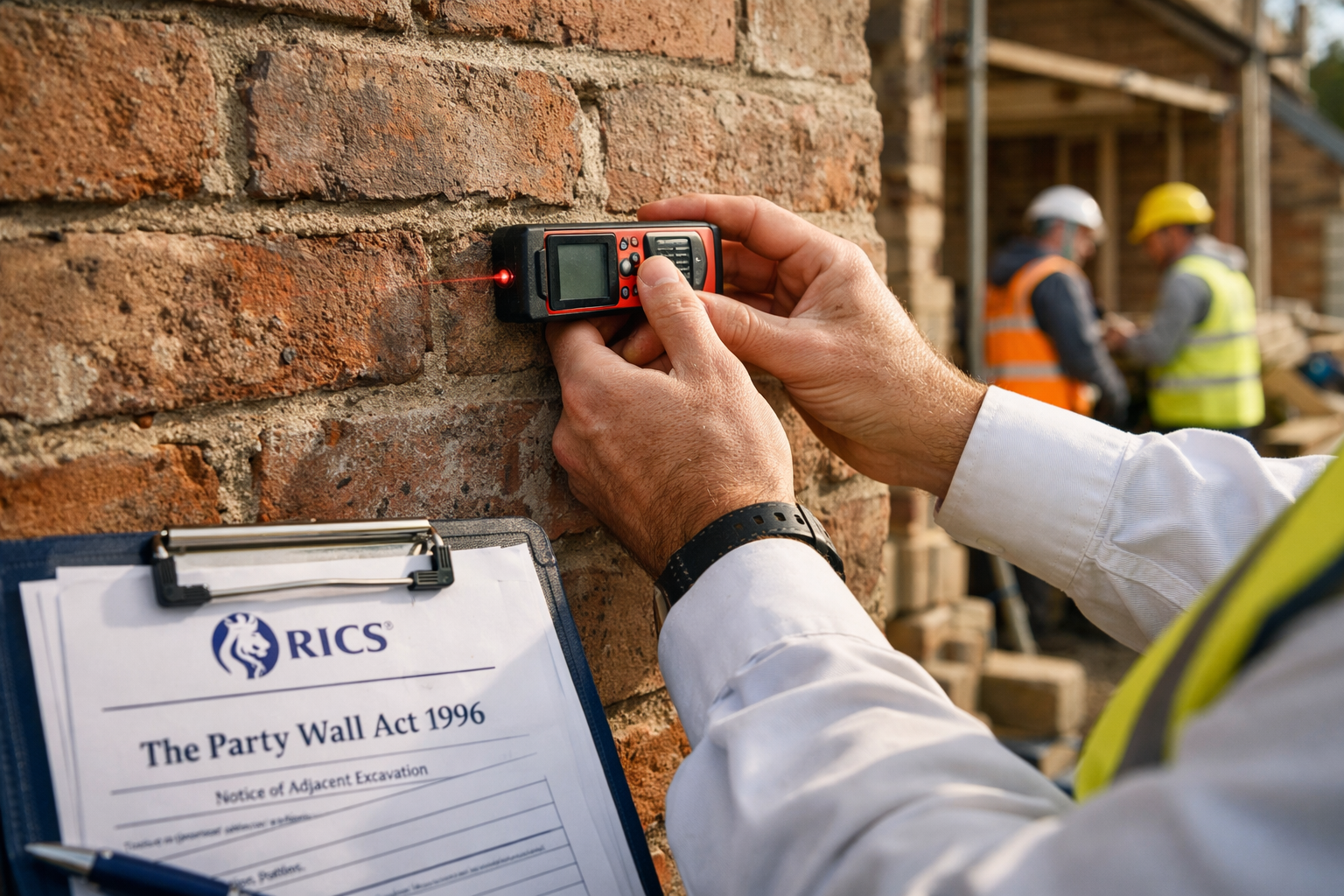
The Royal Institution of Chartered Surveyors maintains the Party Wall Legislation and Procedure standard, which was reissued as a professional standard in May 2023 (effective from December 2019 as the 7th edition).[1] This comprehensive framework establishes expectations that go significantly beyond the minimum statutory requirements of the Party Wall etc. Act 1996.
RICS members must demonstrate:
✅ Technical competence in structural assessment and building pathology
✅ Ethical behavior when acting for either building or adjoining owners
✅ Transparent communication with all parties throughout the process
✅ Impartial decision-making when appointed as agreed surveyors
✅ Proper documentation including detailed schedules of condition and awards
The standard emphasizes that RICS professionals have responsibilities to both their clients and the wider public interest, requiring them to balance competing interests fairly and professionally.[1]
Key Components of the RICS Framework
1. Pre-Construction Assessment
Before any types of party wall works commence, RICS-accredited surveyors conduct thorough assessments including:
- Structural surveys of the party wall and adjacent structures
- Risk analysis identifying potential impacts on neighbouring properties
- Photographic documentation establishing baseline conditions
- Consultation with building owners regarding notice requirements
2. Notice Procedures
Proper service of party wall notices is fundamental to avoiding disputes. The RICS framework requires:
| Notice Type | When Required | Minimum Notice Period |
|---|---|---|
| Party Structure Notice | Work directly to existing party wall | 2 months |
| Line of Junction Notice | Building new wall on boundary | 1 month |
| Adjacent Excavation Notice | Excavation within 3-6 meters | 1 month |
Understanding what party wall act notices are and how to respond helps both building and adjoining owners navigate the process correctly.
3. Surveyor Appointment and Conduct
The RICS framework establishes clear protocols for surveyor appointments:
- Building owner's surveyor: Acts in the best interests of the building owner while maintaining professional standards
- Adjoining owner's surveyor: Protects the adjoining owner's legitimate interests
- Agreed surveyor: Acts impartially when both parties consent to a single surveyor
- Third surveyor: Resolves disputes between the two appointed surveyors
All RICS members must maintain professional indemnity insurance and declare any conflicts of interest that might compromise their impartiality.
4. Party Wall Awards
The party wall award is the legally binding document that authorizes works to proceed. RICS standards require awards to include:
- Detailed description of proposed works
- Schedule of condition documenting pre-construction state
- Access arrangements for construction and inspection
- Working hours and noise restrictions
- Security for expenses (if appropriate)
- Dispute resolution procedures
Consumer Protection and Transparency
RICS provides a dedicated Consumer Guide: Party Walls to help homeowners and landlords understand their rights and responsibilities.[2] This guidance emphasizes transparency in fees, clear communication, and accessible complaint procedures.
The framework also requires RICS members to provide:
- Clear fee proposals before appointment
- Regular progress updates to all parties
- Plain language explanations of technical matters
- Written confirmation of all decisions and agreements
Managing Surging Neighbour Disputes: Practical Strategies for 2026
Early Intervention and Communication
The most effective strategy for managing Party Wall Surveys Amid 2026 Construction Uptick: RICS Framework for Managing Surging Neighbour Disputes is proactive communication before conflicts arise. RICS-accredited surveyors recommend:
Initial Neighbour Engagement
Before serving formal notices, building owners should:
- Inform neighbours personally about planned works and timelines
- Share preliminary drawings to demonstrate the scope of work
- Address concerns about noise, access, and potential disruption
- Explain the party wall process and their rights under the Act
- Provide contact information for the appointed surveyor
This informal approach often prevents misunderstandings from escalating into formal disputes. Many neighbours appreciate being consulted rather than simply receiving legal notices.
Professional Representation
While some property owners consider having a party wall agreement without a surveyor, professional representation typically results in better outcomes for all parties. RICS surveyors bring:
- Technical expertise to identify potential problems before they occur
- Negotiation skills to find mutually acceptable solutions
- Legal knowledge to ensure compliance with statutory requirements
- Impartiality when acting as agreed surveyors
- Documentation that protects both parties legally
Cost Management Strategies
One major source of neighbour disputes in 2026 involves the costs of party wall the process. Under the Party Wall etc. Act 1996, building owners are generally responsible for all reasonable costs, including the adjoining owner's surveyor fees.
Keeping Costs Under Control
To manage expenses effectively while maintaining RICS standards:
✅ Appoint surveyors early to avoid rushed decisions and premium fees
✅ Consider an agreed surveyor when relationships are amicable (reduces overall costs)
✅ Request detailed fee proposals before appointment
✅ Maintain clear communication to minimize unnecessary correspondence
✅ Complete works efficiently to reduce monitoring requirements
For additional guidance, review our tips on how to keep party wall costs down.
Dispute Resolution Mechanisms
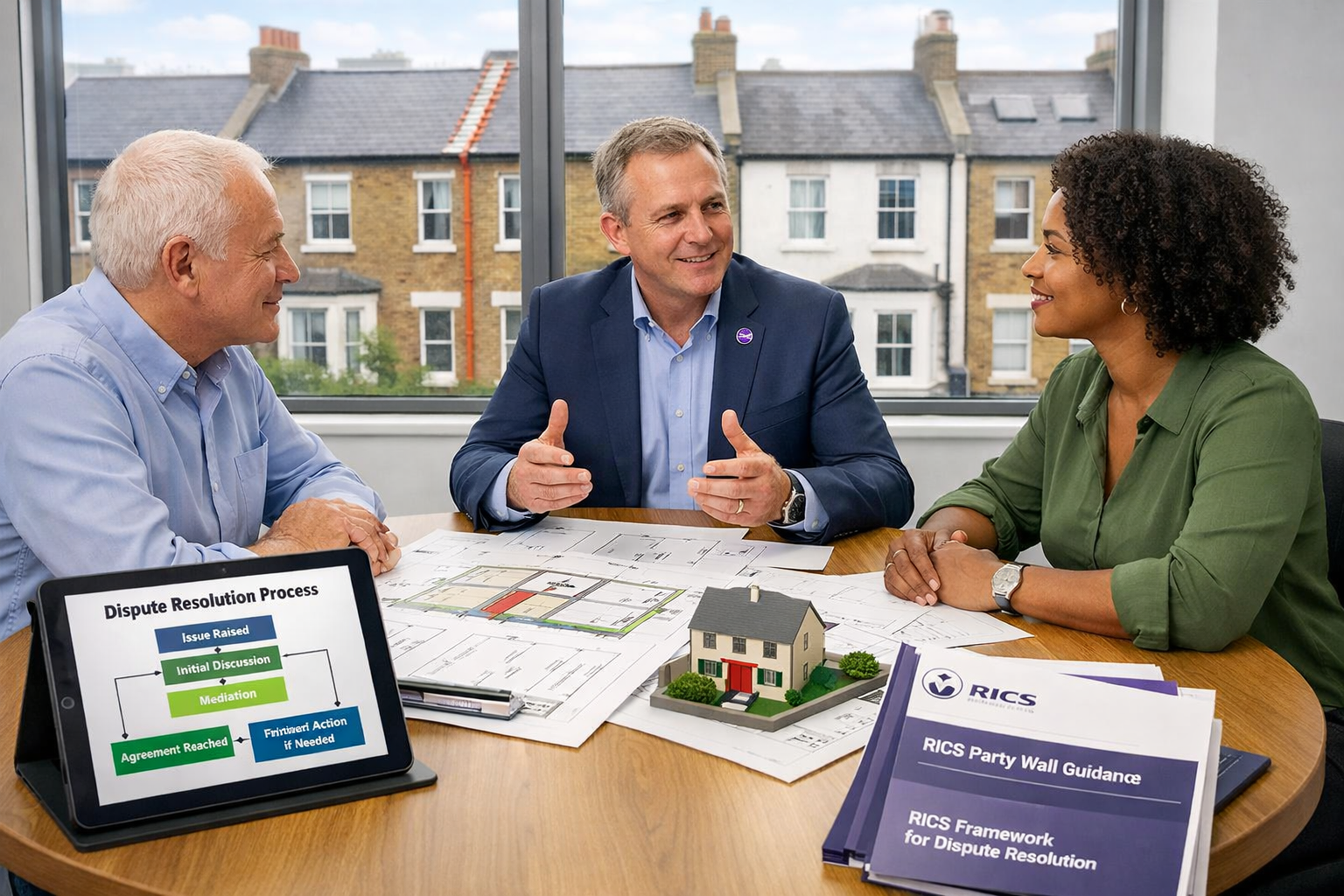
When conflicts do arise despite best efforts, the RICS framework provides structured resolution pathways:
Level 1: Direct Surveyor Negotiation
The two appointed surveyors work collaboratively to find solutions that protect both parties' interests. Most disagreements are resolved at this stage through:
- Technical assessments of proposed works
- Modifications to construction methods
- Additional protective measures
- Adjusted working hours or access arrangements
Level 2: Third Surveyor Determination
If the appointed surveyors cannot reach agreement, they select a third surveyor to make binding determinations. The third surveyor:
- Reviews submissions from both appointed surveyors
- May conduct additional inspections or request expert reports
- Issues a determination that is legally binding on all parties
- Allocates costs according to the circumstances
Level 3: Appeals to County Court
Either party may appeal a party wall award to the County Court within 14 days, but only on limited grounds:
- The surveyor exceeded their jurisdiction
- Procedural irregularities occurred
- The award is fundamentally unreasonable
RICS standards emphasize that proper adherence to professional protocols minimizes the likelihood of successful appeals.
Regional Considerations Across London in 2026
The 2026 construction uptick has affected different London areas uniquely, requiring surveyors to adapt their approaches:
North London
Party wall surveyors in North London report increased activity in Islington, Haringey, and Camden, where Victorian terraces are undergoing extensive renovations. The predominance of older properties requires particular attention to structural integrity and heritage considerations.
East London
East London party wall work has surged due to ongoing regeneration projects. Tower Hamlets and Hackney have seen substantial new development alongside renovation of existing housing stock, creating complex scenarios where multiple party wall issues intersect.
West London
In affluent areas served by West London party wall surveyors, basement excavations and luxury extensions have driven dispute rates higher. Property values exceeding £2 million make neighbours particularly vigilant about potential damage.
South London
South London boroughs like Wandsworth and Lambeth have experienced growth in loft conversions and rear extensions, with many first-time renovators requiring education about party wall obligations.
Central London
Central London surveyors handle particularly complex scenarios involving listed buildings, conservation areas, and high-value properties where stakes are elevated and scrutiny is intense.
Common Scenarios and RICS-Compliant Solutions
Scenario 1: Basement Excavation Disputes
Challenge: Building owner plans deep basement excavation within 3 meters of neighbour's foundation, raising concerns about subsidence and structural damage.
RICS Solution:
- Comprehensive structural engineering assessment
- Detailed schedule of condition including crack monitoring
- Underpinning proposals if necessary
- Regular monitoring throughout construction
- Security for expenses to cover potential remedial work
Scenario 2: Loft Conversion Party Wall Issues
Challenge: Loft conversion requires work to shared party wall, including inserting steel beams and modifying the roof structure.
RICS Solution:
- Serve proper party structure notice with detailed drawings
- Appoint qualified structural engineer to design connections
- Schedule work during reasonable hours to minimize disruption
- Provide temporary weather protection during construction
- Complete comprehensive post-construction inspection
Scenario 3: Boundary Wall Construction
Challenge: Building owner wants to construct new wall on boundary line, but neighbour disputes the exact boundary location.
RICS Solution:
- Commission professional boundary survey with historical title research
- Review boundary wall rules and differences between party fence walls and boundary walls
- Consider alternative foundation positions if boundary remains disputed
- Obtain agreement on how high walls can be built between neighbours
- Document agreed boundary in party wall award
Scenario 4: Adjoining Owner Concerns
Challenge: Neighbour receives notice of proposed works and is uncertain how to respond or protect their interests.
RICS Solution:
- Review guidance for adjoining owners on rights and options
- Appoint experienced adjoining owner's surveyor within 14 days
- Ensure comprehensive schedule of condition documents existing property state
- Request appropriate protective measures in the award
- Establish clear procedures for reporting concerns during construction
For building owners planning works, understanding what to do when carrying out works and for neighbours, knowing what to do when a neighbour is carrying out works provides essential guidance.
Training and Professional Development for 2026
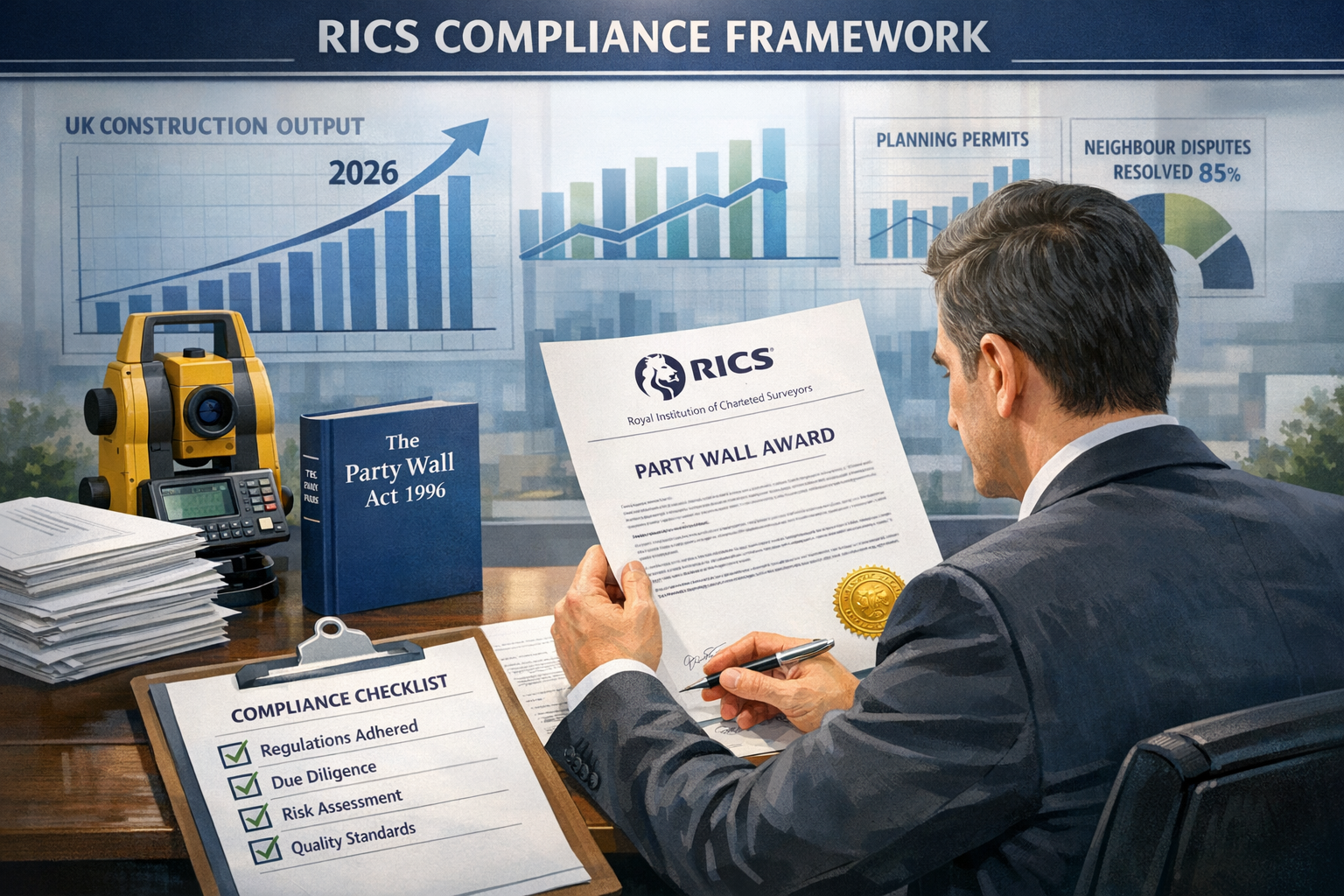
The surge in party wall disputes has highlighted the need for ongoing professional development. RICS offers comprehensive training resources including:
Party Walls: The Fundamentals
RICS provides Party Walls: The Fundamentals training covering party wall agreement preparation, statutory requirements, and best practices.[3] This on-demand course helps surveyors:
- Understand their duties under the Party Wall etc. Act 1996
- Prepare compliant notices and awards
- Conduct effective schedules of condition
- Navigate common dispute scenarios
- Apply RICS professional standards
Continuing Professional Development (CPD)
RICS members must complete mandatory CPD to maintain their professional status. In 2026, recommended CPD topics include:
- Structural engineering fundamentals for assessing party wall impacts
- Alternative dispute resolution techniques for complex negotiations
- Building pathology to identify pre-existing defects accurately
- Legal updates on recent case law affecting party wall practice
- Digital tools for documentation and communication
Specialization and Accreditation
As disputes become more complex, many surveyors are pursuing additional specializations:
- Registered Expert Witness status for court proceedings
- Structural engineering qualifications for technical assessments
- Mediation and arbitration certifications for dispute resolution
- Heritage building expertise for listed properties and conservation areas
Future Outlook: Party Wall Practice Beyond 2026
Emerging Trends
Several developments are likely to shape party wall practice in coming years:
🏡 Increased Regulation: Government may introduce additional requirements for party wall surveyors, including mandatory registration schemes and enhanced consumer protections.
💻 Digital Transformation: Technology is streamlining party wall processes through:
- Digital notice service and tracking systems
- 3D scanning for schedules of condition
- Real-time monitoring of vibration and movement
- Online dispute resolution platforms
🌍 Climate Adaptation: Retrofitting properties for energy efficiency and climate resilience will create new party wall scenarios involving:
- External wall insulation affecting shared structures
- Heat pump installations near boundaries
- Flood protection measures impacting adjoining properties
⚖️ Case Law Development: Recent court decisions continue to refine interpretation of the Party Wall etc. Act 1996, requiring surveyors to stay current with legal developments.
Preparing for Continued Construction Growth
As the UK addresses its housing shortage, construction activity is expected to remain elevated beyond 2026. Property professionals should:
- Invest in RICS-accredited training to maintain professional standards
- Build collaborative relationships with local surveyors for third surveyor appointments
- Develop expertise in emerging construction methods and technologies
- Maintain comprehensive professional indemnity insurance
- Engage with industry associations to influence policy development
Conclusion
Party Wall Surveys Amid 2026 Construction Uptick: RICS Framework for Managing Surging Neighbour Disputes represents a critical intersection of legal compliance, professional standards, and practical problem-solving. As the UK construction sector continues its robust growth, the volume and complexity of party wall matters will only increase.
The RICS framework provides a proven pathway for managing these disputes effectively:
✅ Professional standards that extend beyond statutory minimums protect all parties
✅ Early engagement and transparent communication prevent most conflicts from escalating
✅ Qualified surveyors bring technical expertise and impartiality to complex situations
✅ Structured processes ensure legal compliance while maintaining neighbourly relationships
✅ Comprehensive documentation protects property owners and provides clear evidence if disputes arise
Actionable Next Steps
For Building Owners Planning Works:
- Consult a RICS-accredited building owner's surveyor before finalizing construction plans
- Engage with neighbours informally before serving formal notices
- Budget appropriately for party wall costs as part of project planning
- Ensure contractors understand party wall award requirements
- Maintain open communication throughout the construction process
For Adjoining Owners Receiving Notices:
- Don't ignore party wall notices—respond within 14 days to protect your rights
- Appoint an experienced surveyor to represent your interests
- Request a comprehensive schedule of condition before works commence
- Understand your rights regarding access, working hours, and compensation
- Document any concerns promptly and communicate through proper channels
For Property Professionals:
- Maintain current knowledge of RICS standards and legal developments
- Invest in continuing professional development focused on dispute resolution
- Build networks with qualified third surveyors for complex cases
- Adopt digital tools to improve efficiency and documentation quality
- Prioritize ethical practice and transparent communication with all parties
The 2026 construction boom presents both opportunities and challenges for property owners and professionals alike. By embracing the RICS framework and maintaining professional standards, surveyors can transform potentially contentious situations into collaborative processes that protect property rights, preserve neighbourly relationships, and enable construction projects to proceed smoothly.
Understanding and applying Party Wall Surveys Amid 2026 Construction Uptick: RICS Framework for Managing Surging Neighbour Disputes is not merely about legal compliance—it's about building a more professional, efficient, and equitable construction sector that serves the interests of all property owners while supporting the UK's housing and development needs.
For personalized guidance on your specific party wall situation, contact experienced RICS-accredited surveyors who can provide expert advice tailored to your circumstances.
References
[1] Party Wall Legislation And Procedure – https://www.rics.org/profession-standards/rics-standards-and-guidance/sector-standards/building-surveying-standards/party-wall-legislation-and-procedure
[2] Rics Consumer Guide Party Walls – https://www.ricsfirms.com/residential/legal-issues/party-walls/rics-consumer-guide-party-walls/
[3] Party Walls The Fundamentals – https://www.rics.org/training-events/online-training/on-demand/party-walls-the-fundamentals