


The digital revolution is reshaping Britain's construction landscape in ways few could have predicted. As artificial intelligence, cloud computing, and digital transformation accelerate across every sector, data centres have emerged as the critical infrastructure of our time. In 2026, contractors report an unprecedented 57% net positive reading for data centre construction projects [2], signaling one of the most significant infrastructure booms in recent history. Yet beneath this surge lies a complex web of legal obligations, shared boundaries, and neighbour relations that demand expert navigation. Party Wall Surveys for Data Centre Construction Booms: Managing Notices and Awards in 2026's Infrastructure Surge represents not just a procedural challenge but a fundamental requirement for successful project delivery in today's fast-paced development environment.
The scale and complexity of modern data centre construction create unique challenges under the Party Wall etc. Act 1996. These facilities often occupy substantial footprints in urban and industrial areas where shared boundaries are common. Unlike residential developments, data centres require specialized foundation systems, extensive excavation for cooling infrastructure, and robust structural supports—all of which frequently trigger party wall obligations. The convergence of technical complexity, accelerated timelines, and high-value investments makes proper party wall management not merely advisable but essential.
Key Takeaways
- 📊 Data centre construction shows 57% net positive contractor sentiment in 2026, creating unprecedented demand for specialized party wall expertise in this sector [2]
- ⚖️ The Party Wall etc. Act 1996 applies fully to data centre projects, requiring proper notices and awards despite industrial scale and technical complexity
- ⏱️ Fast-tracked development schedules demand proactive party wall planning, with notice periods and survey timelines integrated into project critical paths
- 🏗️ Specialized foundation and excavation works common to data centres frequently trigger Section 6 excavation notices and Section 2 building works requirements
- 🤝 Multi-party scenarios are typical in data centre developments, requiring coordinated surveyor appointments and comprehensive award management across multiple adjoining owners
Understanding the 2026 Data Centre Construction Boom
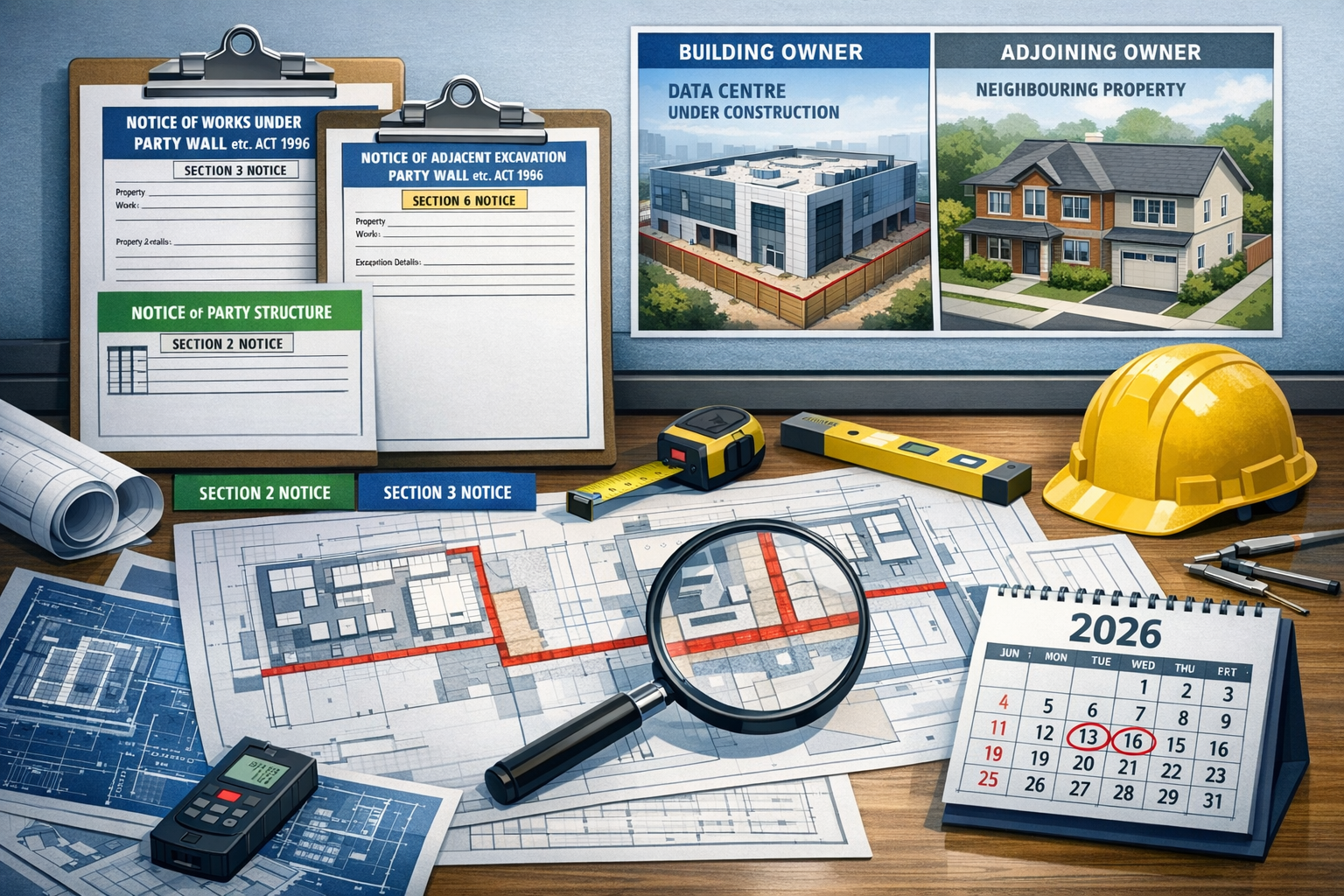
The infrastructure landscape of 2026 presents a striking contrast. While many construction sectors face uncertainty and economic headwinds, data centre development stands as a beacon of sustained growth and investment confidence [4]. This divergence reflects fundamental shifts in how modern economies function and where capital flows in an increasingly digital world.
The Scale of Current Growth
Industry forecasts for 2026 paint a picture of robust expansion. Construction spending on data centres continues to climb, driven by several converging factors:
Primary Growth Drivers:
- 🤖 Artificial intelligence computing requirements
- ☁️ Cloud service expansion and migration
- 🔒 Data sovereignty and localization mandates
- 📱 5G network infrastructure rollout
- 💼 Enterprise digital transformation initiatives
The 57% net positive reading among contractors represents the highest confidence level for any construction subsector in 2026 [2]. This enthusiasm translates into real projects across the United Kingdom, particularly in established technology corridors and emerging digital infrastructure zones.
Geographic Concentration and Urban Challenges
Data centre development concentrates in specific geographic areas where power infrastructure, connectivity, and land availability converge. Major development zones include:
| Region | Key Characteristics | Party Wall Implications |
|---|---|---|
| West London | Established data centre corridor, high-density industrial estates | Multiple shared boundaries, complex multi-party scenarios |
| East London | Emerging tech hub, regeneration areas | Mixed-use adjacencies, residential interfaces |
| North London | Industrial conversions, brownfield sites | Existing structures, potential subsidence concerns |
| South London | Strategic connectivity locations | Varied property types, diverse adjoining owner profiles |
These concentrated development patterns inevitably increase the frequency of party wall scenarios. Unlike greenfield sites, urban and industrial locations present existing structures, established property boundaries, and multiple stakeholders—all factors that elevate the importance of proper party wall notices and awards.
Technical Characteristics of Data Centre Construction
Modern data centres differ substantially from conventional commercial buildings in ways that directly impact party wall considerations:
Foundation and Structural Requirements:
- Heavy floor loading for server equipment (often 150-250 kg/m²)
- Specialized vibration isolation systems
- Deep excavations for underground cooling infrastructure
- Reinforced concrete slabs with complex reinforcement patterns
Below-Ground Infrastructure:
- Extensive basement levels for mechanical systems
- Deep foundation piles extending 15-25 meters
- Underground water storage and cooling reservoirs
- Cable trenches and utility corridors
Boundary-Adjacent Works:
- Perimeter security walls and fencing
- Backup generator installations near boundaries
- External cooling towers and heat rejection systems
- Service yard areas with heavy vehicle access
Each of these technical requirements can trigger obligations under the Party Wall etc. Act 1996, making specialized surveyor knowledge essential for project teams.
Party Wall Legislation Applied to Data Centre Projects
The Party Wall etc. Act 1996 establishes a clear framework for managing construction work that affects shared boundaries or structures. While the legislation predates the modern data centre boom by decades, its principles apply with full force to these contemporary infrastructure projects.
Relevant Sections of the Act
Section 1: New Building on the Line of Junction
This section addresses construction of new walls directly on the boundary line between properties. For data centre projects, this might include:
- Perimeter security walls shared with adjacent industrial units
- Fire separation walls between data centre zones and neighbouring facilities
- Boundary walls supporting shared infrastructure
Section 2: Adjacent Excavation and Construction
Section 2 covers works to existing party walls, party fence walls, and party structures. Data centre applications include:
- Modifications to existing shared walls for new connections
- Raising or underpinning shared boundary walls
- Cutting into party walls for service penetrations
- Installing damp-proof courses in existing party structures
Section 6: Excavation Near Neighbouring Buildings
Perhaps the most frequently triggered section for data centre construction, Section 6 addresses excavations within 3 or 6 meters of adjoining structures. Given the deep foundations and basement requirements typical of data centres, this section demands careful attention.
The Act requires excavation notices when digging:
- Within 3 meters of a neighbouring building where the excavation goes deeper than the neighbour's foundations
- Within 6 meters of a neighbouring building where the excavation cuts a line drawn downward at 45 degrees from the bottom of the neighbour's foundations
Determining Applicability to Your Data Centre Project
Assessment Framework:
- Boundary Analysis: Conduct comprehensive boundary surveys identifying all shared walls, fences, and structures
- Excavation Mapping: Plot all proposed excavation depths against neighbouring foundation levels
- Structural Impact Assessment: Evaluate which works physically affect or approach party structures
- Adjacency Review: Identify all properties within 6 meters of proposed excavation works
Most data centre projects trigger multiple sections of the Act simultaneously. A typical scenario might involve:
- Section 6 notices for deep foundation excavations
- Section 2 notices for modifications to existing boundary walls
- Section 1 notices for new perimeter security structures
Understanding these overlapping obligations is where specialized party wall surveyor expertise becomes invaluable.
Special Considerations for Industrial and Commercial Contexts
While the Party Wall Act applies equally to all property types, industrial and commercial contexts present distinct challenges:
Business Continuity Concerns:
Adjoining owners may operate data centres, warehouses, or manufacturing facilities where disruption carries significant financial consequences. Awards must address:
- Operational access maintenance
- Vibration limits during sensitive processes
- Noise restrictions during business hours
- Emergency contact protocols
Complex Ownership Structures:
Commercial properties often involve:
- Multiple leaseholders within single buildings
- Freeholder-leaseholder relationships requiring dual consent
- Corporate ownership with delegated authority questions
- Investment funds with remote decision-making processes
Enhanced Documentation Requirements:
Commercial adjoining owners typically demand:
- Detailed structural calculations and engineering reports
- Comprehensive insurance documentation
- Financial security arrangements
- Professional indemnity evidence from appointed surveyors
These factors don't change the legal framework but significantly affect the practical implementation of party wall procedures on data centre projects.
The Notice Process for Data Centre Construction in 2026
Serving proper party wall notices represents the critical first step in the statutory process. For data centre projects operating on compressed timelines with substantial capital at stake, getting the notice process right from the outset prevents costly delays and disputes.
Types of Notices Required
The specific notices required depend on the nature of works proposed. Most data centre projects involve multiple notice types:
Party Structure Notice (Section 2)
Required for works directly affecting existing party walls or structures. This notice must describe the proposed works in detail and typically includes:
- Precise description of works to the party structure
- Architectural drawings showing the affected areas
- Proposed start date (minimum 2 months from service)
- Details of any special foundation or structural works
Learn more about what is a party structure notice and how to serve it for detailed guidance on this critical document.
Notice of Adjacent Excavation (Section 6)
Essential for the deep foundations typical of data centre construction. This notice requires:
- Excavation depth specifications
- Distance from neighbouring buildings
- Foundation details for the new structure
- Proposed construction methodology
Line of Junction Notice (Section 1)
For new walls built directly on the boundary line, including:
- Exact position of the proposed wall
- Height, thickness, and materials
- Foundation details
- Whether the wall will be wholly on the building owner's land or astride the boundary
Timing and Service Requirements
The Party Wall Act establishes specific timeframes that cannot be shortened, even for fast-tracked data centre projects:
Statutory Notice Periods:
| Notice Type | Minimum Period | Calculation Start |
|---|---|---|
| Party Structure Notice | 2 months | Date of service to adjoining owner |
| Line of Junction Notice | 1 month | Date of service to adjoining owner |
| Adjacent Excavation Notice | 1 month | Date of service to adjoining owner |
Service Methods:
Valid service requires delivery by:
- Hand delivery to the property owner
- Registered or recorded delivery post
- Leaving the notice at the property
- Sending to the last known address
For corporate adjoining owners common in industrial areas, determining the correct service address requires careful investigation of:
- Companies House registered office details
- Actual business operating addresses
- Designated agent or property manager details
- Leaseholder versus freeholder status
Content Requirements and Documentation
A properly drafted party wall notice for a data centre project should include:
Essential Elements:
- ✅ Building owner's full legal name and address
- ✅ Adjoining owner's full legal name and address
- ✅ Property addresses for both building and adjoining properties
- ✅ Detailed description of proposed works
- ✅ Proposed start date
- ✅ Reference to specific sections of the Act being invoked
Supporting Documentation:
- Architectural drawings showing the works in context
- Cross-sections illustrating excavation depths
- Foundation details and structural calculations
- Site plan showing relationship to neighbouring properties
For complex data centre projects, consider including:
- Preliminary construction methodology statements
- Indicative schedules showing work phases
- Contact details for the project team
- Information about appointed surveyors (if already selected)
Understanding party wall act notices and how to respond helps ensure compliance with all statutory requirements.
Managing Multi-Party Scenarios
Data centre developments frequently affect multiple adjoining owners simultaneously. A single project might require notices to:
- Industrial units sharing boundary walls on both sides
- Residential properties backing onto the development site
- Commercial premises with foundations within the excavation zone
- Utility companies with infrastructure in proximity
- Highway authorities for works affecting public boundaries
Coordination Strategies:
- Simultaneous Service: Serve all notices on the same date to synchronize response periods
- Consistent Documentation: Use identical drawings and descriptions across all notices
- Centralized Tracking: Maintain a master schedule of all notice dates and response deadlines
- Proactive Communication: Brief all affected parties before formal notice service
- Surveyor Pre-Appointment: Consider appointing the building owner's surveyor before serving notices
The complexity of multi-party scenarios often justifies early engagement with experienced party wall surveyors in Central London or other relevant locations where expertise in industrial and commercial projects is essential.
Party Wall Awards for Data Centre Infrastructure Projects
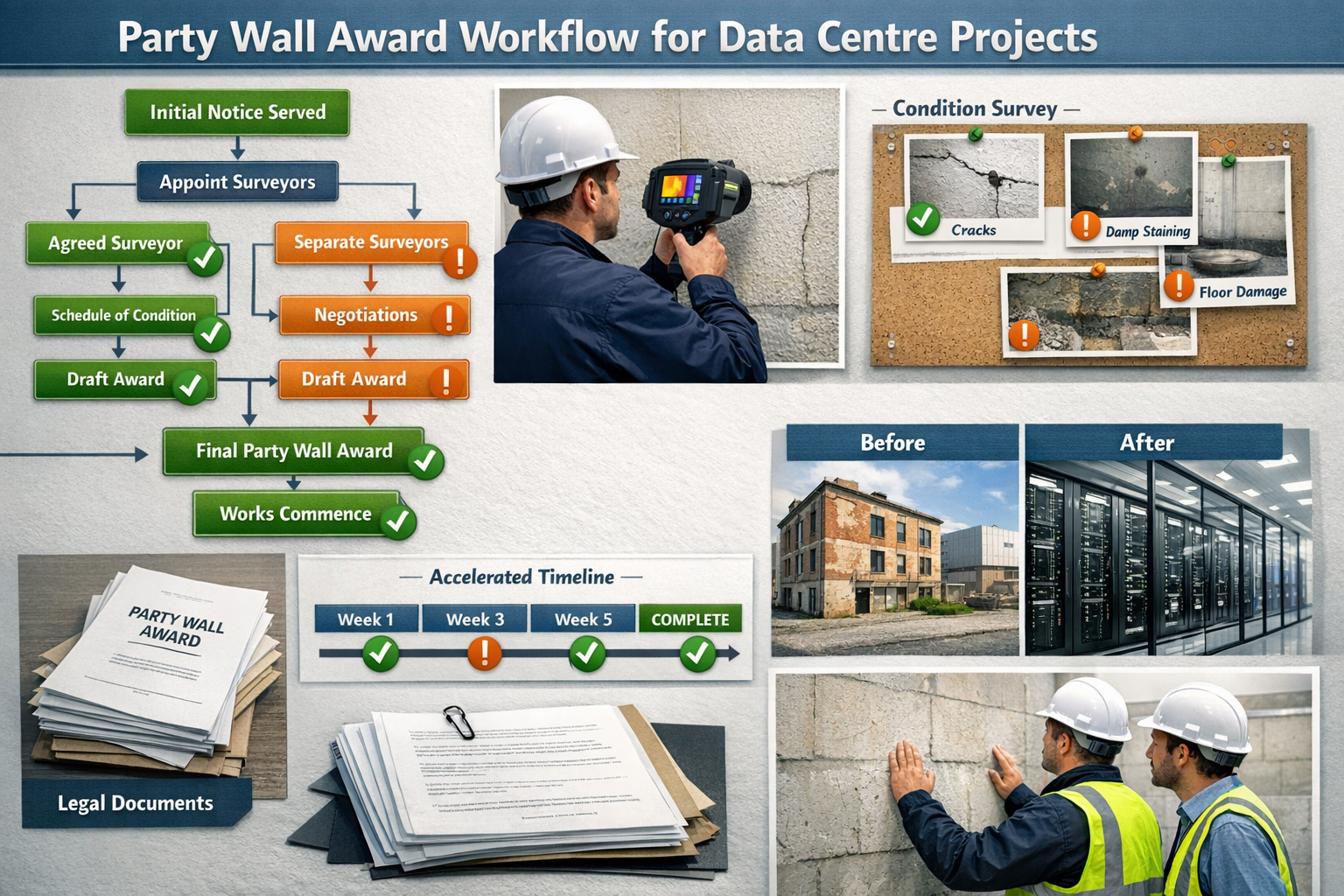
When adjoining owners dissent to party wall notices—or when the statutory 14-day response period expires without consent—the process moves to the award stage. Party wall awards represent legally binding documents that govern how construction proceeds, protect adjoining owners' interests, and establish the framework for dispute resolution.
The Award Process Timeline
Understanding the award timeline is critical for integrating party wall requirements into data centre project schedules:
Typical Award Process Flow:
-
Surveyor Appointment (Weeks 1-2)
- Building owner appoints their surveyor
- Adjoining owner appoints their surveyor or agrees to a single agreed surveyor
- If no response, building owner's surveyor can appoint on behalf of adjoining owner
-
Initial Inspections (Weeks 2-4)
- Surveyors conduct detailed condition surveys
- Photographic and written records of existing conditions
- Structural assessments where necessary
- Identification of pre-existing defects
-
Award Drafting (Weeks 4-8)
- Surveyors negotiate award terms
- Technical specifications developed
- Working methods agreed
- Dispute resolution procedures established
-
Award Finalization (Weeks 8-10)
- Final award document prepared
- Served on both parties
- 14-day appeal period begins
- Works can commence (subject to other consents)
For fast-tracked data centre projects, this 10-week timeline represents a minimum. Complex scenarios with multiple adjoining owners, technical disputes, or challenging site conditions can extend the process significantly.
Essential Components of Data Centre Awards
A comprehensive party wall award for data centre construction should address:
Technical Specifications:
- Permitted excavation methods and sequences
- Shoring and temporary support requirements
- Vibration limits and monitoring protocols
- Noise restrictions and working hours
- Foundation design and construction methodology
Protection Measures:
- Underpinning requirements for adjacent structures
- Temporary propping or support systems
- Protective hoarding and barriers
- Access arrangements during construction
Monitoring and Documentation:
- Vibration monitoring locations and trigger levels
- Crack monitoring protocols
- Settlement monitoring points and frequency
- Photographic documentation requirements
- Reporting schedules to adjoining owners
Rights and Obligations:
- Building owner's rights to execute the works
- Adjoining owner's rights of access for inspection
- Surveyor's rights of access for monitoring
- Emergency contact procedures
- Dispute escalation mechanisms
Financial Provisions:
- Security for expenses (if required)
- Cost allocation for remedial works
- Surveyor fee responsibility
- Insurance requirements
Negotiating Terms for High-Value Projects
Data centre construction involves substantial capital investment and tight delivery schedules. These factors create unique negotiation dynamics in the award process:
Building Owner Priorities:
- Certainty of construction methodology approval
- Clear timelines for permitted works
- Flexibility for design refinements
- Protection from excessive adjoining owner demands
- Defined cost exposure for party wall matters
Adjoining Owner Concerns:
- Protection of structural integrity
- Business continuity during construction
- Compensation for any damage or disruption
- Professional oversight of works
- Financial security for potential remediation
Balancing Competing Interests:
Experienced surveyors navigate these tensions by:
- Early Technical Engagement: Sharing detailed construction methodologies before award drafting
- Proportionate Protection: Tailoring monitoring and safeguards to actual risk levels
- Clear Communication: Establishing regular update protocols
- Contingency Planning: Addressing potential issues before they arise
- Professional Standards: Maintaining objectivity and applying industry best practices
The goal is an award that enables construction to proceed efficiently while genuinely protecting adjoining owners' legitimate interests.
Managing Awards Across Multiple Adjoining Properties
Data centre projects often require simultaneous awards with numerous adjoining owners. This complexity demands systematic management:
Award Coordination Matrix:
| Adjoining Owner | Notice Date | Surveyor Appointed | Inspection Complete | Award Served | Status |
|---|---|---|---|---|---|
| Industrial Unit A | 15/01/2026 | 29/01/2026 | 12/02/2026 | 05/03/2026 | Active |
| Warehouse B | 15/01/2026 | 22/01/2026 | 10/02/2026 | 28/02/2026 | Active |
| Residential Block C | 15/01/2026 | Agreed Surveyor | 15/02/2026 | 08/03/2026 | Active |
Best Practices for Multi-Party Awards:
- 📋 Maintain centralized tracking of all award timelines
- 🤝 Coordinate inspection schedules to minimize disruption
- 📝 Standardize award terms where properties face similar risks
- 💬 Establish single point of contact for all adjoining owners
- 🔄 Synchronize award service dates where possible
Understanding types of party wall works helps categorize which adjoining owners face similar impacts and can be managed with parallel processes.
Digital Documentation and Award Management
Modern party wall practice increasingly leverages technology for award management:
Digital Tools and Platforms:
- Cloud-based document repositories for award storage
- Digital signature platforms for award execution
- Photographic databases with metadata tagging
- Automated monitoring data collection and reporting
- Stakeholder portals for real-time status updates
These tools prove particularly valuable for data centre projects where:
- Multiple parties need simultaneous access to documentation
- Construction teams operate across shifts requiring 24/7 information availability
- International investors require remote access to project status
- Audit trails and compliance documentation are essential
However, surveyors must ensure digital processes comply with statutory service requirements and maintain legal validity of awards.
Specialized Surveyor Expertise for Data Centre Projects
The unique technical, commercial, and legal characteristics of data centre construction demand surveyors with specialized knowledge and experience. Not all party wall surveyors possess the industrial and commercial expertise necessary for these complex projects.
Required Technical Knowledge
Structural Engineering Competence:
Data centre party wall surveyors should understand:
- Heavy floor loading calculations and structural implications
- Deep foundation design and construction methodology
- Soil mechanics and geotechnical considerations
- Vibration analysis and sensitive equipment protection
- Seismic design requirements for critical infrastructure
Data Centre-Specific Systems:
Familiarity with specialized building systems helps surveyors assess risks:
- Raised floor systems and structural loading
- Cooling infrastructure and water management
- Backup power systems and generator installations
- Cable management and service distribution
- Fire suppression systems and compartmentation
Construction Methodology:
Understanding modern construction techniques enables realistic award conditions:
- Piling methods and vibration profiles
- Basement waterproofing systems
- Temporary works and excavation support
- Concrete placement for heavy structures
- Modular construction and off-site fabrication
Commercial and Industrial Experience
Beyond technical knowledge, data centre party wall surveyors need commercial acumen:
Stakeholder Management:
- Negotiating with corporate property owners
- Communicating with facilities management teams
- Addressing business continuity concerns
- Managing investor and lender requirements
- Coordinating with project management offices
Risk Assessment:
- Evaluating business interruption exposure
- Quantifying potential operational impacts
- Assessing financial security requirements
- Understanding insurance implications
- Balancing risk against project economics
Contract Integration:
- Aligning party wall obligations with construction contracts
- Coordinating with CDM (Construction Design and Management) requirements
- Integrating with planning conditions and Section 106 agreements
- Managing interface with building control approvals
- Synchronizing with utility diversions and highway works
Selecting the Right Surveyor for Your Project
Building Owner Selection Criteria:
When appointing a building owner's surveyor for a data centre project, consider:
- Relevant Experience: Track record on similar industrial or commercial projects
- Technical Qualifications: Structural engineering or building surveying credentials
- Professional Memberships: RICS (Royal Institution of Chartered Surveyors) membership
- Local Knowledge: Familiarity with the development area and local conditions
- Availability: Capacity to meet project timeline requirements
- Communication Skills: Ability to explain technical matters to non-specialists
- Commercial Awareness: Understanding of project economics and developer constraints
For projects in specific areas, consider specialists such as party wall surveyors in North London, West London, East London, or South London depending on your site location.
Adjoining Owner Considerations:
Adjoining owners should appoint surveyors who:
- Understand the technical aspects of data centre construction
- Can realistically assess risks to the adjoining property
- Will negotiate proportionate rather than excessive protections
- Communicate clearly about the process and timeline
- Maintain independence while protecting the client's interests
Learn more about the role of an adjoining owner's surveyor in protecting your property rights.
The Agreed Surveyor Option
In some circumstances, both parties may agree to appoint a single "agreed surveyor" rather than each appointing their own. This approach offers:
Advantages:
- ✅ Reduced overall costs (single surveyor fee instead of two)
- ✅ Simplified communication and coordination
- ✅ Faster award process without inter-surveyor negotiation
- ✅ Single point of contact for all parties
Disadvantages:
- ❌ Potential perception of bias toward one party
- ❌ Less robust challenge to technical proposals
- ❌ Single perspective on risk assessment
- ❌ Reduced checks and balances
For high-value data centre projects, the agreed surveyor route is less common. The complexity and stakes typically justify separate representation. However, for straightforward scenarios with cooperative parties, it remains a viable option.
Cost Management and Fee Structures
Party wall surveyor fees represent a small fraction of overall data centre construction costs, but understanding fee structures helps budget accurately:
Typical Fee Arrangements:
| Fee Structure | Description | Typical Application |
|---|---|---|
| Fixed Fee | Agreed price for defined scope | Simple projects, single adjoining owner |
| Hourly Rate | Time-based charging | Complex negotiations, uncertain scope |
| Percentage | Based on construction value | Rarely used for party wall work |
| Hybrid | Fixed fee plus hourly for variations | Most data centre projects |
Fee Responsibility:
Under the Act, the building owner typically bears:
- Their own surveyor's fees
- The adjoining owner's surveyor's fees (if dissent occurs)
- The agreed surveyor's fees (if appointed)
For strategies to minimize costs, review guidance on how to keep party wall costs down.
Common Challenges and Risk Mitigation Strategies
Data centre construction presents specific party wall challenges that require proactive management and strategic planning.
Challenge 1: Accelerated Project Timelines
The Problem:
Data centre developers face intense pressure to deliver facilities quickly. Tenant pre-leases, market windows, and capital deployment schedules create compressed timelines that conflict with statutory party wall periods.
Risk Mitigation Strategies:
- Early Party Wall Planning: Integrate party wall timelines into project planning from inception
- Pre-Notice Engagement: Informally brief adjoining owners before formal notice service
- Parallel Processing: Run party wall procedures concurrent with other consents
- Surveyor Pre-Appointment: Engage surveyors before notice service to accelerate award process
- Contingency Buffering: Build party wall duration into critical path with realistic contingency
Timeline Integration Example:
Month 1-2: Site acquisition and initial design
Month 2-3: Boundary surveys and adjoining owner identification
Month 3: Party wall notice service
Month 3-4: Planning application submission
Month 4-5: Surveyor appointments and inspections
Month 5-6: Award negotiation
Month 6: Award service and appeal period
Month 7: Construction commencement (subject to planning)
Challenge 2: Deep Excavations and Foundation Works
The Problem:
Data centres require substantial foundations to support heavy equipment loads. Deep excavations trigger Section 6 notices and create genuine risks to adjacent structures, particularly older industrial buildings with shallow foundations.
Risk Mitigation Strategies:
- Comprehensive Geotechnical Investigation: Understand soil conditions and adjacent foundation depths
- Conservative Design Approach: Design foundations with party wall constraints in mind
- Temporary Works Planning: Specify robust excavation support systems in advance
- Monitoring Protocols: Establish vibration and settlement monitoring before works commence
- Contingency Underpinning: Budget for potential underpinning requirements identified during surveys
Technical Safeguards:
- Vibration monitoring with real-time alerts at agreed trigger levels
- Daily visual inspections of adjacent structures during excavation
- Settlement monitoring points with weekly readings
- Photographic documentation of any changes
- Immediate stop-work protocols if thresholds exceeded
Challenge 3: Multi-Party Coordination Complexity
The Problem:
Data centres often occupy sites with multiple adjacent properties, each with different owners, uses, and concerns. Coordinating party wall procedures across numerous parties creates administrative complexity and multiplies potential delay points.
Risk Mitigation Strategies:
- Stakeholder Mapping: Identify all affected parties early and understand their profiles
- Centralized Management: Appoint a dedicated party wall coordinator for the project
- Standardized Communication: Develop template communications and information packs
- Phased Approach: Structure works to minimize simultaneous impacts where possible
- Relationship Building: Invest in adjoining owner relationships beyond statutory minimums
Coordination Tools:
- Master schedule tracking all notice and award deadlines
- Regular stakeholder briefings (monthly or quarterly)
- Dedicated project website or portal for information sharing
- Single point of contact for all party wall queries
- Escalation procedures for issues requiring senior attention
Challenge 4: Business Continuity for Operating Adjoining Facilities
The Problem:
Adjacent industrial or commercial operations may be highly sensitive to construction impacts. Vibration affecting precision manufacturing, noise disrupting office environments, or access restrictions impeding logistics can trigger significant claims.
Risk Mitigation Strategies:
- Pre-Construction Engagement: Understand adjoining owners' operations and sensitivities
- Tailored Working Methods: Adapt construction techniques to minimize specific impacts
- Advance Notice of Critical Activities: Provide detailed schedules for high-impact works
- Continuous Monitoring: Real-time tracking of vibration, noise, and other parameters
- Compensation Frameworks: Establish clear processes for addressing legitimate disruption claims
Award Provisions:
- Specific vibration limits based on adjoining use (e.g., lower for data centres than warehouses)
- Restricted working hours for noise-sensitive activities
- Advance notice requirements for particularly disruptive works
- Access maintenance guarantees
- Emergency contact protocols
Challenge 5: Complex Ownership Structures
The Problem:
Commercial and industrial properties often involve complex ownership arrangements: freeholders, leaseholders, management companies, and corporate structures. Determining who must receive notices and consent to awards can be unclear.
Risk Mitigation Strategies:
- Title Investigation: Conduct thorough Land Registry searches for all adjacent properties
- Legal Advice: Obtain specialist property law advice on complex ownership scenarios
- Comprehensive Service: Serve notices on all potentially interested parties
- Authority Verification: Confirm decision-making authority for corporate owners
- Documentation: Maintain detailed records of all service and consent processes
Investigation Checklist:
- ✅ Land Registry title documents for all adjacent properties
- ✅ Lease agreements identifying freeholder-leaseholder relationships
- ✅ Companies House searches for corporate owners
- ✅ Management company details for multi-unit buildings
- ✅ Mortgagee information where relevant
- ✅ Tenant occupation details
Integrating Party Wall Procedures with Project Delivery
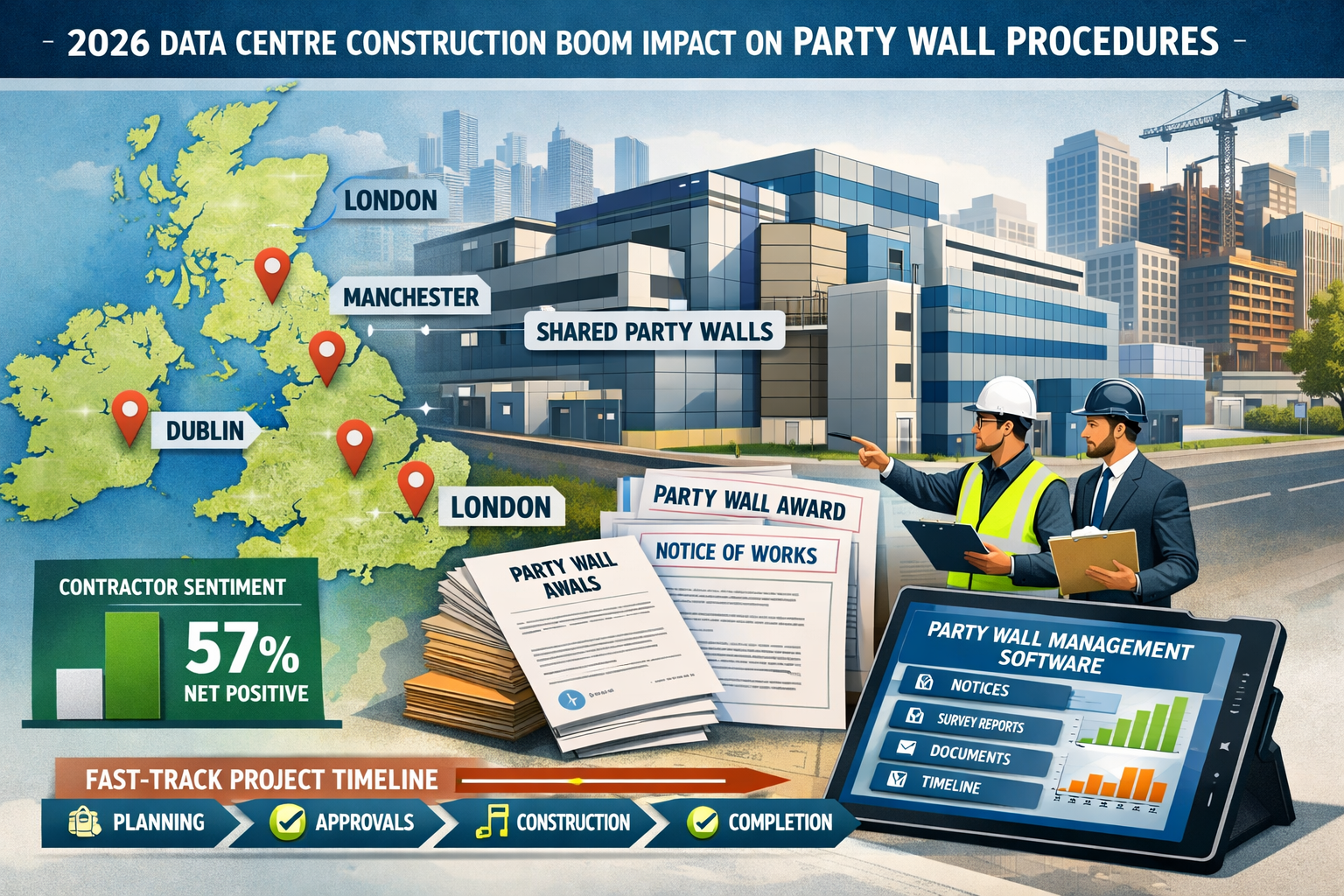
Successful data centre projects treat party wall obligations not as isolated legal requirements but as integrated elements of overall project delivery.
Critical Path Integration
Party Wall Milestones on the Project Schedule:
Effective project planning incorporates party wall activities as critical path items:
- Notice service dates (driven by desired construction start)
- Surveyor appointment deadlines
- Inspection completion targets
- Award negotiation periods
- Award service and appeal periods
- Condition survey updates
- Monitoring and reporting schedules
Dependencies and Interfaces:
Party wall procedures interact with other project workstreams:
- Planning Permission: Party wall and planning can run in parallel, but construction cannot commence until both are resolved
- Building Control: Foundation design may need party wall award approval before building control submission
- Construction Contracts: Main contract commencement depends on party wall awards being in place
- Enabling Works: Preliminary site works may proceed before awards if they don't trigger party wall obligations
- Tenant Fit-Out: Party wall monitoring may extend into tenant installation phases
Risk Register Integration
Party wall matters should feature in project risk registers with appropriate mitigation:
| Risk | Probability | Impact | Mitigation | Owner |
|---|---|---|---|---|
| Adjoining owner dissent delays award | Medium | High | Early engagement, surveyor pre-appointment | Development Manager |
| Deep excavation affects adjacent foundations | Medium | Very High | Geotechnical investigation, monitoring protocols | Technical Director |
| Multiple party coordination extends timeline | High | Medium | Dedicated party wall coordinator, parallel processing | Project Manager |
| Vibration damages adjacent facility | Low | Very High | Real-time monitoring, conservative working methods | Construction Manager |
Stakeholder Communication Plans
Internal Stakeholders:
- Project board: Monthly party wall status updates
- Construction team: Weekly coordination on upcoming activities
- Design team: Party wall constraints feedback into design development
- Commercial team: Cost tracking and fee management
External Stakeholders:
- Adjoining owners: Regular progress updates and advance notice of impacts
- Appointed surveyors: Continuous coordination and information sharing
- Planning authority: Coordination where party wall and planning conditions interact
- Funders/investors: Reporting on party wall risk status and mitigation
Documentation and Compliance Management
Maintaining comprehensive party wall documentation serves multiple purposes:
Legal Compliance:
- Evidence of proper notice service
- Award execution and service records
- Consent documentation
- Dispute resolution records
Risk Management:
- Condition survey baselines
- Monitoring data and trend analysis
- Incident reports and remediation records
- Photographic evidence libraries
Commercial Protection:
- Cost tracking and fee reconciliation
- Claim substantiation or defense
- Insurance documentation
- Audit trails for investors and lenders
Knowledge Management:
- Lessons learned for future projects
- Best practice development
- Surveyor performance evaluation
- Relationship history with adjoining owners
Modern document management systems enable:
- Centralized storage with role-based access
- Version control and audit trails
- Automated retention and disposal schedules
- Search and retrieval functionality
- Integration with other project systems
Future Outlook: Party Wall Practice in the Data Centre Era
As data centre construction continues its robust growth trajectory through 2026 and beyond, party wall practice will evolve to meet the sector's unique demands.
Emerging Trends and Developments
Increased Specialization:
The party wall surveying profession will likely see greater specialization in industrial and commercial projects, with surveyors developing specific expertise in data centre construction techniques, risks, and stakeholder management.
Technology Integration:
Digital tools will increasingly support party wall processes:
- Remote condition surveys using drone and 3D scanning technology
- Automated monitoring with IoT sensors and real-time alerts
- Digital award platforms with electronic signatures and service
- AI-assisted risk assessment and award drafting
- Blockchain-based immutable record-keeping
Standardization Efforts:
Industry bodies may develop specific guidance for data centre party wall procedures, establishing best practices for:
- Standard award conditions for typical data centre works
- Monitoring protocols tailored to data centre construction
- Template notices addressing common scenarios
- Fee scales appropriate to project complexity
Regulatory Evolution:
While the Party Wall etc. Act 1996 remains the statutory framework, regulatory guidance may evolve to address:
- Digital service of notices and awards
- Electronic consent mechanisms
- Alternative dispute resolution procedures
- Accelerated processes for critical infrastructure
Preparing for Continued Growth
For Building Owners and Developers:
Organizations planning data centre developments should:
- Build Internal Capability: Develop in-house understanding of party wall requirements
- Establish Surveyor Relationships: Cultivate relationships with qualified specialists
- Integrate Procedures: Embed party wall planning in standard project processes
- Budget Appropriately: Allocate realistic budgets for party wall costs and contingencies
- Learn from Experience: Capture lessons learned and continuously improve approaches
For Adjoining Owners:
Property owners near potential data centre sites should:
- Understand Rights: Familiarize themselves with party wall protections
- Maintain Records: Keep good documentation of property condition
- Engage Proactively: Respond promptly to notices and engage constructively
- Appoint Qualified Surveyors: Select experienced professionals when dissenting
- Balance Interests: Seek fair protection without unreasonable obstruction
For Party Wall Surveyors:
Professionals serving this market should:
- Develop Technical Knowledge: Build expertise in data centre construction
- Understand Commercial Context: Appreciate project economics and stakeholder pressures
- Invest in Technology: Adopt digital tools enhancing service delivery
- Maintain Professional Standards: Uphold independence and objectivity
- Contribute to Practice Development: Share knowledge and advance industry standards
The Broader Infrastructure Context
Data centres represent just one element of the broader infrastructure investment surge. The party wall expertise developed in this sector will transfer to other growth areas:
- 5G Network Infrastructure: Cell tower installations and equipment buildings
- Electric Vehicle Charging: Rapid charging hubs and battery storage facilities
- Renewable Energy: Solar farms and wind turbine foundations
- Advanced Manufacturing: Semiconductor fabs and precision engineering facilities
The skills, processes, and technologies refined through data centre party wall management will benefit the entire construction sector as infrastructure investment continues.
Conclusion
The convergence of unprecedented data centre construction growth and established party wall legal requirements creates both challenges and opportunities in 2026. Party Wall Surveys for Data Centre Construction Booms: Managing Notices and Awards in 2026's Infrastructure Surge represents not merely a compliance exercise but a critical success factor for project delivery.
The 57% net positive contractor sentiment for data centre construction [2] signals sustained investment and development activity. This boom brings party wall considerations to the forefront of project planning, requiring developers, adjoining owners, and surveyors to navigate complex technical, legal, and commercial landscapes.
Key Success Factors:
✅ Early Planning: Integrate party wall procedures into project timelines from inception
✅ Specialist Expertise: Engage surveyors with relevant industrial and commercial experience
✅ Proactive Communication: Build constructive relationships with adjoining owners beyond statutory minimums
✅ Technical Rigor: Implement robust monitoring and protection measures appropriate to risks
✅ Systematic Management: Coordinate multi-party scenarios with centralized tracking and documentation
The Party Wall etc. Act 1996 provides a proven framework for managing shared boundary issues. While the legislation predates modern data centres, its principles apply with full force. Proper application of party wall notices and awards protects all parties' interests while enabling essential infrastructure development.
Actionable Next Steps
For Data Centre Developers:
- Conduct Boundary Assessment: Commission comprehensive boundary surveys identifying all potential party wall scenarios
- Appoint Specialist Surveyors: Engage experienced building owner's surveyors early in project planning
- Integrate Timelines: Build realistic party wall durations into project critical paths with appropriate contingencies
- Budget Comprehensively: Allocate funds for surveyor fees, monitoring, and potential remediation
- Engage Stakeholders: Brief adjoining owners informally before formal notice service
For Adjoining Property Owners:
- Document Current Condition: Photograph and record your property's existing state
- Understand Your Rights: Review guidance on responding to party wall notices
- Seek Professional Advice: Appoint qualified adjoining owner's surveyors if dissenting
- Engage Constructively: Participate in the process while protecting your legitimate interests
- Maintain Records: Keep copies of all notices, awards, and correspondence
For All Parties:
- Prioritize Communication: Maintain open, professional dialogue throughout the process
- Focus on Substance: Address genuine risks and protections rather than procedural technicalities
- Leverage Expertise: Trust qualified surveyors to navigate technical and legal complexities
- Document Thoroughly: Maintain comprehensive records of all party wall activities
- Learn and Improve: Capture lessons learned for application to future projects
The data centre construction boom of 2026 demonstrates the critical role of digital infrastructure in modern economies. As this essential development continues, proper party wall management ensures that progress occurs with appropriate protection for all affected parties. By combining statutory compliance, technical expertise, and constructive stakeholder engagement, the industry can deliver the infrastructure society demands while respecting property rights and neighbor relations.
The future of party wall practice in the data centre era will be characterized by increased specialization, technological integration, and professional excellence. Those who invest in understanding and implementing best practices will be well-positioned to navigate the infrastructure surge successfully, delivering projects efficiently while maintaining the highest standards of professional practice.