
The energy sector is experiencing unprecedented expansion in 2026, with power construction projects leading the infrastructure boom. As the UK and global markets race to meet renewable energy targets and grid modernization demands, power facility expansions and party wall awards have become critical intersection points where energy development meets property law. With a remarkable 34% net positive reading in power project construction this year, energy developers, property owners, and surveyors face complex challenges navigating shared boundaries, legal obligations, and technical protocols.
This surge in energy infrastructure development—driven by renewable energy installations, battery storage facilities, and grid upgrade projects—has created an urgent need for precise party wall surveying protocols. When power facilities expand onto sites adjacent to existing properties, the Party Wall etc. Act 1996 governs how these projects must proceed, protecting both building owners and adjoining property holders while enabling essential infrastructure growth.
Key Takeaways
- 🔌 Power construction leads 2026 infrastructure growth with a 34% net positive reading, creating unprecedented demand for party wall expertise in energy sector projects
- 📋 RICS standards provide essential frameworks for surveyors managing complex boundary issues in power facility expansions, including specialized protocols for industrial-scale developments
- ⚖️ Party wall awards are legally required for most energy infrastructure projects affecting shared boundaries, with specific notice requirements and timeline considerations
- 💡 Common pitfalls include inadequate schedules of condition, insufficient vibration monitoring, and misunderstanding notice requirements for different types of power facility works
- 🤝 Strategic negotiation tactics can reduce disputes, minimize costs, and accelerate project timelines while maintaining legal compliance and protecting all parties' interests
Understanding the 2026 Energy Infrastructure Boom
The energy sector's explosive growth in 2026 represents a fundamental shift in construction priorities and investment patterns. Power projects have emerged as the dominant force in infrastructure development, driven by multiple converging factors that demand rapid expansion of generation, storage, and transmission capabilities.
The 34% Net Growth Figure Explained
The 34% net positive reading for power construction in 2026 reflects the balance between new project starts and completions versus cancellations and delays. This metric, tracked by industry analysts and construction forecasting firms, indicates robust momentum in the energy infrastructure sector. Unlike previous years where renewable projects faced frequent delays or cancellations, 2026 has seen exceptional follow-through on planned developments.
This growth encompasses several key categories:
- Renewable generation facilities including solar farms, wind installations, and hydroelectric projects
- Battery energy storage systems (BESS) providing grid stability and peak demand management
- Grid modernization projects upgrading transmission and distribution infrastructure
- Hydrogen production facilities supporting the emerging clean fuel economy
- Electric vehicle charging infrastructure at commercial and industrial scale
According to industry data, renewables accounted for 61% of new power-generating capacity additions in recent periods[1], demonstrating the sector's transition toward sustainable energy sources. U.S. energy transition investment grew 3.5% year-over-year to $378 billion[1], with similar trends observed across UK and European markets.
Why Power Facilities Trigger Party Wall Considerations
Energy infrastructure projects frequently encounter party wall implications due to their unique spatial and structural requirements. Unlike traditional commercial developments, power facilities often require:
Extensive foundation systems for heavy equipment like transformers, inverters, and battery containers that may extend near or across property boundaries
Vibration-generating machinery including generators, cooling systems, and switching equipment that can affect adjacent structures
Underground cable routes connecting generation sources to the grid, potentially requiring excavation along shared boundaries
Perimeter security infrastructure such as walls, fencing, and access control systems that may involve work on or near party fence walls
Expansion of existing facilities where operational power stations add capacity by building adjacent to neighboring properties
When these projects occur on sites with shared boundaries—whether between industrial properties, commercial developments, or mixed-use areas—the Party Wall etc. Act 1996 becomes applicable. This legislation requires building owners to serve notices, obtain consent or appoint surveyors, and secure party wall awards before commencing certain types of work.
Regional Variations in Energy Development
The 34% growth in power facility construction manifests differently across regions, creating varied party wall surveying demands:
Urban areas like Central London see rooftop solar installations, basement battery storage systems, and EV charging infrastructure integrated into existing buildings
Suburban zones including North London, South London, East London, and West London experience medium-scale solar farms and substation upgrades on industrial estates
Rural and peri-urban locations host large-scale wind farms, utility-scale solar installations, and hydrogen production facilities
Each context presents distinct party wall challenges, from high-density urban sites with multiple adjoining owners to industrial parks where facilities share boundaries with operational businesses.
Party Wall Awards: Legal Framework for Power Facility Expansions
Understanding the legal framework governing party wall matters is essential for energy developers navigating the 2026 infrastructure boom. The Party Wall etc. Act 1996 provides the statutory foundation, but its application to modern power facilities requires specialized interpretation and professional expertise.
The Party Wall etc. Act 1996: Core Principles
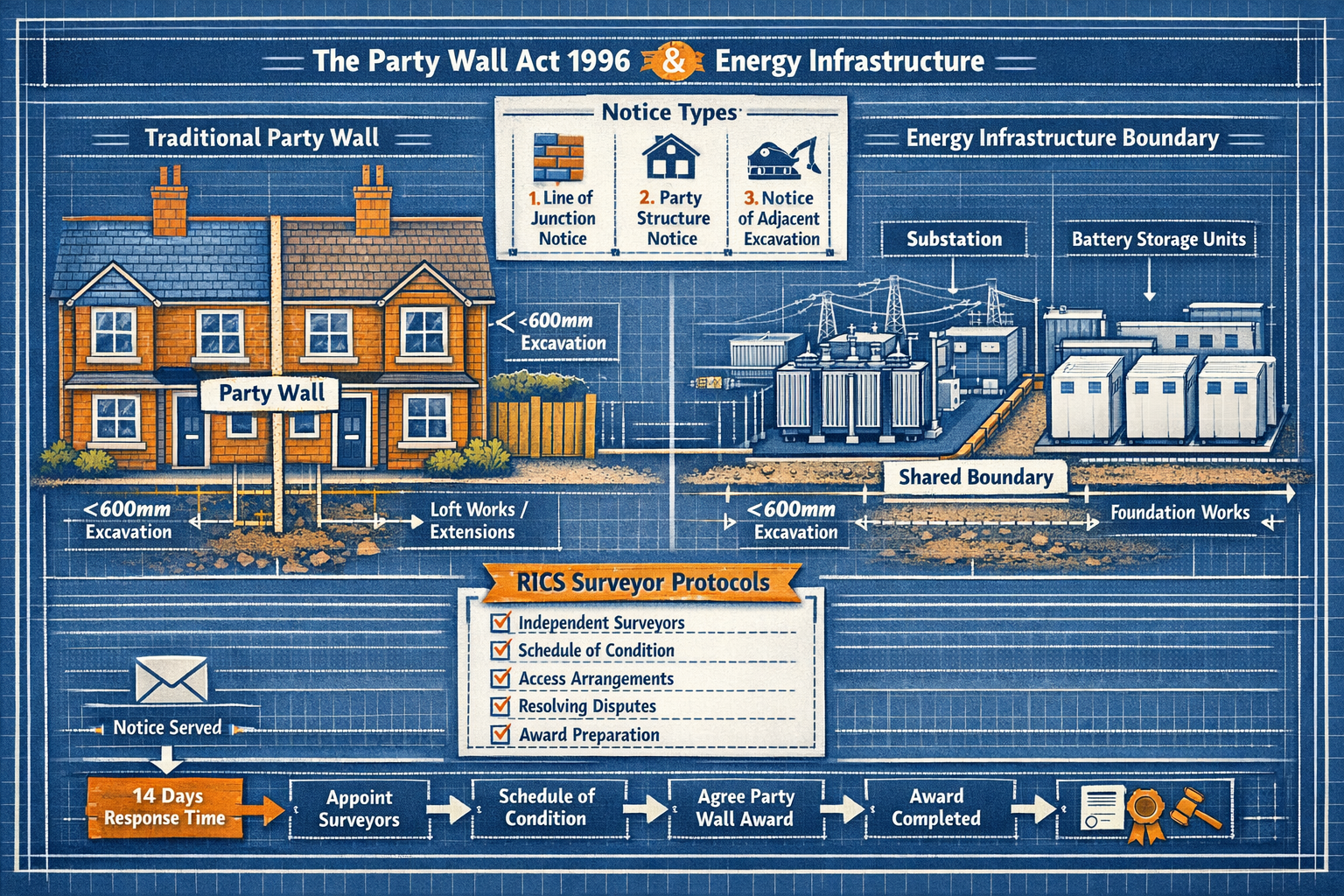
The Act establishes three main categories of notifiable works, all potentially relevant to power facility expansions:
Section 1: New Building on the Line of Junction applies when constructing new walls directly on the boundary line between properties. For power facilities, this might include perimeter walls, security fencing with structural foundations, or partition walls between co-located facilities.
Section 2: Works to Existing Party Structures covers modifications, repairs, or alterations to walls, floors, or structures already shared between properties. Energy projects triggering this section include strengthening existing walls to support new equipment loads or cutting into party walls for cable penetrations.
Section 6: Excavation and Construction Near Boundaries addresses foundation work and excavation within specified distances of neighboring structures. This section frequently applies to power facilities installing transformer pads, battery container foundations, or underground cable trenches near property lines.
The Act requires building owners to serve proper party wall notices to adjoining owners, providing specific information about proposed works and allowing a statutory response period. When adjoining owners dissent or fail to respond within 14 days, the dispute resolution mechanism automatically engages, requiring surveyor appointment.
What Constitutes a Party Wall Award
A party wall award is a legal document prepared by appointed surveyors that sets out the rights and responsibilities of both parties regarding proposed works. For power facility expansions, awards serve several critical functions:
✅ Documenting the condition of adjoining properties before work begins through schedules of condition
✅ Authorizing specific works with detailed descriptions of construction methods and safeguards
✅ Establishing access rights for building owners and their contractors to carry out necessary works
✅ Allocating costs between parties according to statutory principles and equitable considerations
✅ Setting dispute resolution procedures for addressing issues that arise during construction
✅ Protecting both parties through insurance requirements, indemnities, and monitoring protocols
The award becomes legally binding once served on both parties, creating enforceable obligations and protections. For comprehensive guidance on party wall awards, energy developers should consult resources on party wall contract templates and award guides.
When Power Projects Require Party Wall Awards
Not every energy infrastructure project triggers party wall requirements, but many do. Building owners must obtain awards when their power facility expansion involves:
- Excavating within 3 meters of a neighboring building if the proposed foundation will be deeper than the neighbor's foundation
- Excavating within 6 meters of a neighboring building if the proposed work will extend below a 45-degree plane drawn downward from the neighbor's foundation base
- Constructing new walls directly on the boundary line between properties
- Cutting into, underpinning, or otherwise altering existing party walls or party structures
- Installing special foundations for heavy equipment that may affect adjoining properties
Common power facility scenarios requiring awards include:
Substation expansions adding transformer bays or switching equipment near industrial neighbors
Battery storage installations requiring substantial foundation systems within 3-6 meters of existing buildings
Solar farm perimeter works involving security walls or fencing on boundary lines
Grid connection projects excavating for underground cables along shared property boundaries
Rooftop solar installations on commercial buildings requiring structural modifications to party walls
Energy developers should engage party wall surveyors early in project planning to identify potential requirements and avoid costly delays.
RICS Standards and Surveyor Protocols for Energy Infrastructure
The Royal Institution of Chartered Surveyors (RICS) provides professional standards and guidance that govern party wall surveying practice. For power facility expansions in 2026, these protocols ensure consistent, professional approaches to complex boundary issues while protecting the interests of all parties.
RICS Guidance on Party Wall Matters
RICS publishes comprehensive guidance for surveyors handling party wall matters, with several key documents relevant to energy infrastructure projects:
RICS Party Wall Guidance Note (latest edition) establishes best practices for surveyors acting under the Party Wall etc. Act 1996, covering appointment procedures, award preparation, fee calculation, and professional conduct standards.
RICS Building Surveys Guidance provides frameworks for preparing schedules of condition, the critical baseline documentation that protects both building owners and adjoining owners by recording pre-existing conditions.
RICS Conflicts of Interest Guidance addresses situations where surveyors have relationships with parties or projects, ensuring independence and impartiality in the award process.
For power facility projects, RICS standards emphasize several specialized considerations:
🔍 Enhanced technical assessment of vibration, noise, electromagnetic interference, and other impacts specific to energy infrastructure
📸 Comprehensive photographic documentation given the higher risk profiles of industrial-scale construction
⚖️ Proportionate fee structures recognizing the larger scale and complexity of power facility projects compared to residential works
🛡️ Robust insurance verification ensuring adequate coverage for the elevated risks associated with energy infrastructure
The Role of Building Owners' Surveyors
When energy developers serve party wall notices and adjoining owners dissent or fail to respond, the building owner must appoint a surveyor to represent their interests. The building owner's surveyor plays several crucial roles:
Advising on notice requirements and ensuring proper service of all statutory notifications before work begins
Preparing detailed specifications describing proposed works with sufficient technical detail for informed consent
Negotiating with adjoining owners' surveyors to reach agreement on award terms, working methods, and protective measures
Drafting party wall awards that authorize works while incorporating appropriate safeguards and monitoring requirements
Coordinating schedules of condition to document existing property conditions before construction commences
Managing disputes that arise during construction, interpreting award provisions, and resolving disagreements
For power facility expansions, building owners' surveyors must possess specialized knowledge of energy infrastructure construction methods, equipment specifications, and industry-specific risks. This expertise enables them to draft awards that facilitate project delivery while providing genuine protection to adjoining owners.
The Role of Adjoining Owners' Surveyors
Neighboring property owners affected by power facility expansions have the right to appoint their own surveyor to protect their interests. The adjoining owner's surveyor serves as an independent professional advocate, ensuring that:
✓ Proposed works are properly assessed for potential impacts on the adjoining property's structure, stability, and value
✓ Schedules of condition accurately document all pre-existing conditions, providing evidence for any future damage claims
✓ Award terms include adequate safeguards such as vibration monitoring, working hours restrictions, and access provisions
✓ Insurance and indemnities provide genuine protection against construction risks and potential damage
✓ Monitoring arrangements are established to track compliance with award terms throughout the construction period
✓ The adjoining owner's rights are preserved including access for inspections and remedies for award breaches
For properties adjacent to power facility expansions, appointing an experienced surveyor is particularly important given the scale, duration, and technical complexity of energy infrastructure projects. The costs of the adjoining owner's surveyor are typically borne by the building owner under the Act's cost allocation principles.
Agreed Surveyors and the Third Surveyor
The Party Wall etc. Act 1996 provides for two alternative surveyor appointment structures:
Agreed Surveyor Approach: Both parties jointly appoint a single surveyor to act impartially for both building owner and adjoining owner. This streamlined approach can reduce costs and accelerate the award process, but requires mutual trust and confidence in the selected professional.
Separate Surveyors with Third Surveyor: Each party appoints their own surveyor, and these two surveyors jointly select a third surveyor who remains available to resolve any disputes between them. This approach provides stronger advocacy for each party but involves higher costs and potentially longer timelines.
For power facility expansions, the separate surveyors approach is generally recommended due to the technical complexity, higher risk profiles, and substantial financial interests involved. The third surveyor serves as a dispute resolution mechanism, making binding determinations when the two appointed surveyors cannot reach agreement on award terms.
Specialized Protocols for Energy Infrastructure Projects
RICS-qualified surveyors handling power facility expansions should implement several specialized protocols beyond standard residential party wall practice:
Technical Review of Engineering Specifications: Surveyors should review detailed engineering drawings, foundation calculations, vibration assessments, and construction methodologies to understand project impacts fully.
Consultation with Specialist Engineers: Complex issues such as electromagnetic interference, ground-borne vibration, or foundation interaction may require input from structural engineers, geotechnical specialists, or electrical engineers.
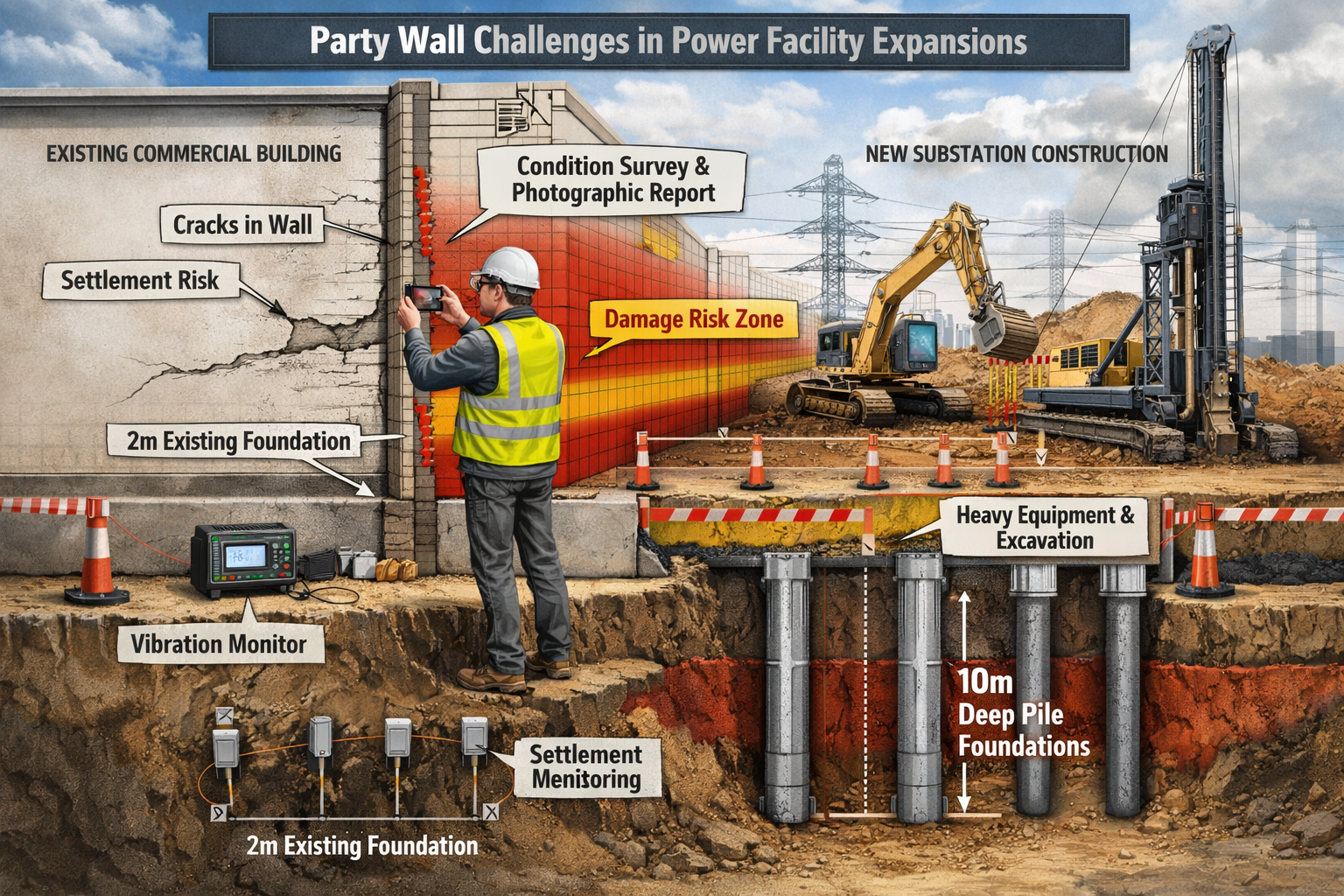
Enhanced Monitoring Regimes: Awards for power facilities should specify comprehensive monitoring including vibration sensors, crack monitoring, settlement observations, and regular inspections throughout construction.
Staged Award Provisions: Large energy projects may benefit from phased awards addressing different construction stages, allowing for adaptive management as work progresses.
Operational Phase Considerations: Unlike typical building projects, power facilities continue generating impacts (noise, vibration, electromagnetic fields) after construction, requiring awards to address ongoing operational matters.
Multi-Party Coordination: Energy infrastructure projects often affect multiple adjoining owners simultaneously, requiring surveyors to coordinate schedules of condition, monitoring arrangements, and award terms across several properties.
These specialized approaches ensure that party wall awards for power facility expansions provide appropriate protection while enabling critical energy infrastructure development.
Common Pitfalls in Power Facility Party Wall Matters
Despite the clear legal framework and professional standards, power facility expansions frequently encounter party wall complications that delay projects, increase costs, and generate disputes. Understanding these common pitfalls enables energy developers and surveyors to implement preventive strategies.
Inadequate Schedules of Condition
The schedule of condition represents the most critical protective document in party wall matters, providing baseline evidence of property conditions before work begins. For power facility projects, inadequate schedules create several problems:
❌ Insufficient photographic coverage failing to document all potentially affected areas, particularly hidden or hard-to-access locations
❌ Lack of technical detail in descriptions of existing defects, making it difficult to distinguish pre-existing conditions from construction damage
❌ Missing baseline measurements for crack widths, settlement indicators, or structural alignments that would enable quantitative damage assessment
❌ Inadequate coverage of mechanical systems such as HVAC equipment, electrical installations, or process machinery that may be sensitive to vibration
❌ Failure to document adjoining property uses that may be particularly vulnerable to construction impacts (e.g., precision manufacturing, data centers, laboratories)
Best practice for power facility projects involves comprehensive schedules of condition prepared by experienced surveyors, including:
- High-resolution photography of all elevations, interiors, and critical features
- Detailed written descriptions using standardized terminology
- Baseline measurements of existing cracks, settlement, and structural conditions
- Documentation of mechanical and electrical systems
- Video walkthroughs for complex or high-value properties
- Drone surveys for large industrial sites or difficult-to-access areas
Misunderstanding Notice Requirements
Energy developers frequently misunderstand or underestimate the Party Wall etc. Act's notice requirements, leading to invalid notices, statutory delays, and potential legal challenges. Common errors include:
Serving generic notices that fail to provide the specific information required by the Act for different types of works
Inadequate notice periods not allowing the full statutory time for adjoining owners to respond (typically 14 days for most notice types)
Failing to identify all adjoining owners particularly in complex industrial estates or mixed-use developments with multiple stakeholders
Serving notices too early before design details are finalized, necessitating revised notices that restart statutory periods
Serving notices too late discovering party wall requirements only after project timelines are committed, creating schedule pressure
Energy developers should engage party wall specialists during project planning to identify notice requirements early and incorporate proper timelines into construction schedules. Resources on party wall act notices and how to respond provide valuable guidance for both building owners and adjoining owners.
Insufficient Vibration Monitoring and Control
Power facility construction typically involves significant vibration-generating activities including:
- Piling for transformer foundations and equipment pads
- Excavation using heavy machinery near existing structures
- Compaction of engineered fill for battery storage platforms
- Installation of underground cable ducts using directional drilling or trenching
Inadequate vibration management represents a leading cause of party wall disputes in energy infrastructure projects. Common deficiencies include:
⚠️ No baseline vibration survey to establish existing ambient conditions before construction begins
⚠️ Absence of real-time monitoring during high-risk activities like piling or heavy excavation
⚠️ Inappropriate vibration limits failing to account for the sensitivity of adjoining structures or operations
⚠️ Lack of contingency procedures when vibration thresholds are exceeded, leading to uncontrolled damage
⚠️ Inadequate reporting to adjoining owners and their surveyors, creating mistrust and conflict
Best practice party wall awards for power facilities should specify:
- Pre-construction vibration surveys establishing baseline conditions
- Continuous vibration monitoring during high-risk activities
- Clear threshold limits based on structural sensitivity and use
- Immediate notification protocols when limits are approached or exceeded
- Contingency measures including work suspension, method changes, or additional protective measures
- Regular reporting to all parties with monitoring data and trend analysis
Boundary Disputes Masquerading as Party Wall Matters
Energy infrastructure projects sometimes uncover or trigger underlying boundary disputes that complicate party wall procedures. The Party Wall etc. Act 1996 explicitly does not resolve boundary ownership questions—it assumes boundaries are settled and addresses only the rights and obligations regarding works near or on those boundaries.
Common boundary-related complications include:
🚧 Disputed boundary locations where property lines are unclear, unregistered, or contested
🚧 Encroachments discovered during surveys revealing that existing structures cross assumed boundary lines
🚧 Adverse possession claims where long-standing use patterns conflict with registered titles
🚧 Easement and right-of-way issues affecting access for construction or ongoing facility operations
When boundary disputes emerge during party wall procedures, energy developers should:
- Pause party wall procedures until boundary questions are resolved, as awards cannot be validly issued without settled boundaries
- Engage property lawyers and boundary specialists to determine legal ownership through title investigation and survey evidence
- Consider boundary agreements or easements to formalize arrangements that enable project delivery
- Update project timelines to account for boundary resolution processes, which can extend several months
Resources on boundary wall rules and the difference between party fence walls and boundary walls help clarify these important distinctions.
Cost Allocation Disputes
The Party Wall etc. Act 1996 establishes principles for allocating costs between building owners and adjoining owners, but application to power facility projects can generate disputes. Common cost allocation issues include:
💰 Surveyor fee disputes when adjoining owners appoint expensive specialists or when building owners challenge fee reasonableness
💰 Betterment claims where works provide incidental benefits to adjoining properties, potentially affecting cost allocation
💰 Apportionment disagreements for works that serve both parties' interests or address shared structural issues
💰 Monitoring cost allocation determining who pays for vibration monitoring, crack monitoring, and inspection regimes
💰 Damage repair costs when construction causes damage requiring remediation
The Act generally requires building owners to bear their own surveyor's costs and reasonable fees for the adjoining owner's surveyor. For power facility projects, "reasonable" fees reflect the complexity, risk, and specialized expertise required. Energy developers should budget appropriately and understand that attempting to minimize surveyor fees often proves counterproductive, generating disputes that ultimately cost more in delays and legal expenses.
Guidance on how to keep party wall costs down offers strategies for managing expenses without compromising proper procedures or protections.
Negotiation Tactics for Energy Developers
Successfully navigating party wall matters for power facility expansions requires strategic negotiation skills alongside legal compliance and technical expertise. Energy developers who master these tactics can reduce disputes, accelerate project timelines, and build positive relationships with neighboring property owners.
Early Engagement and Relationship Building
The single most effective negotiation tactic is early, proactive engagement with adjoining owners well before formal notice service. This approach offers multiple benefits:
🤝 Establishing rapport and demonstrating respect for neighbors' interests before legal procedures create adversarial dynamics
🤝 Explaining project benefits including grid reliability improvements, renewable energy contributions, or local economic impacts
🤝 Identifying concerns early allowing project design modifications to address issues before they become formal objections
🤝 Building trust through transparency about construction methods, timelines, and potential impacts
🤝 Exploring voluntary agreements that may provide more flexibility than statutory party wall awards
Energy developers should consider hosting information sessions, providing project visualizations, and offering direct communication channels to adjoining owners. This investment in relationship building frequently pays dividends through smoother party wall procedures and reduced opposition.
Strategic Surveyor Selection
Choosing the right building owner's surveyor represents a critical strategic decision for power facility projects. Effective selection criteria include:
Energy infrastructure experience: Surveyors familiar with power facility construction understand the technical issues, typical impacts, and appropriate protective measures specific to this sector.
Local knowledge: Surveyors practicing in the project area understand local property markets, construction conditions, and regulatory environments. For London projects, selecting specialists in party wall surveying across different London regions provides valuable local expertise.
Relationship skills: Beyond technical competence, effective surveyors possess negotiation abilities, communication skills, and the temperament to build consensus rather than escalate conflicts.
Responsiveness: Power facility projects operate on tight schedules driven by grid connection dates, equipment delivery timelines, and financing conditions. Surveyors must respond promptly to keep procedures moving.
Reputation: Surveyors with established reputations for fairness and professionalism often achieve better outcomes because adjoining owners and their surveyors trust their integrity.
Energy developers should interview multiple surveyors, check references from similar projects, and assess both technical credentials and interpersonal capabilities before appointment.
Offering Enhanced Protections Voluntarily
Strategic energy developers often voluntarily offer enhanced protections beyond statutory minimums, using these provisions as negotiation tools to secure cooperation and avoid disputes. Enhanced protections might include:
✅ More frequent monitoring than strictly required, providing adjoining owners with greater confidence and early warning of any issues
✅ Extended insurance coverage offering higher limits or broader scope than standard requirements
✅ Restricted working hours limiting noisy or disruptive activities to minimize impacts on adjoining operations
✅ Enhanced communication protocols including regular progress updates, advance notice of high-impact activities, and dedicated liaison contacts
✅ Betterment contributions offering to address pre-existing defects or make improvements to shared structures beyond project requirements
✅ Financial incentives such as rent reductions, facility access fees, or community benefit payments (where legally appropriate)
These voluntary enhancements demonstrate good faith, build goodwill, and often prove less expensive than the delays and disputes that arise from minimalist approaches. Surveyors can incorporate enhanced protections into party wall awards, creating legally binding commitments that provide genuine security to adjoining owners.
Addressing Specific Concerns Proactively
Different types of adjoining owners have distinct concerns about power facility expansions. Tailoring negotiation approaches to address these specific issues improves outcomes:
Industrial neighbors worry primarily about operational disruption, access interference, and impacts on their own business activities. Address these concerns through:
- Detailed construction logistics plans showing how access will be maintained
- Coordination of high-impact activities with the neighbor's production schedules
- Vibration and noise management protecting sensitive manufacturing processes
Commercial neighbors focus on customer access, aesthetic impacts, and property values. Respond with:
- Attractive screening and landscaping plans
- Maintained customer access throughout construction
- Professional construction management minimizing visible disruption
Residential neighbors prioritize noise, safety, and quality of life. Provide:
- Strict working hours respecting residential amenity
- Enhanced safety measures including secure hoarding and traffic management
- Regular communication about construction progress and upcoming activities
Public sector neighbors (schools, hospitals, government facilities) emphasize safety, reliability, and regulatory compliance. Demonstrate:
- Comprehensive safety management systems
- Coordination with facility operations to avoid critical periods
- Full regulatory compliance with detailed documentation
Understanding and addressing these specific concerns through targeted negotiation strategies builds cooperation and reduces resistance.
Leveraging the Public Benefit Argument
Power facility expansions in 2026 serve critical public interests including:
- Grid reliability ensuring stable electricity supply for communities and businesses
- Renewable energy transition supporting climate goals and environmental sustainability
- Energy security reducing dependence on imported fossil fuels
- Economic development creating construction jobs and supporting the clean energy economy
While the Party Wall etc. Act 1996 does not provide special treatment for public benefit projects, energy developers can leverage these arguments in negotiations with adjoining owners to:
📢 Frame projects positively as contributions to shared societal goals rather than purely commercial ventures
📢 Build community support that may influence adjoining owners' willingness to cooperate
📢 Attract favorable media coverage creating reputational incentives for reasonable behavior by all parties
📢 Engage local authorities as project advocates who may facilitate discussions with resistant neighbors
These public benefit arguments work best when combined with genuine respect for adjoining owners' rights and appropriate protections for their interests. Presenting infrastructure development as a partnership serving broader community interests often yields better results than purely legalistic approaches.
Managing Multi-Party Situations
Large power facility expansions frequently affect multiple adjoining owners simultaneously, creating complex multi-party negotiations. Effective management strategies include:
🔄 Coordinated notice service ensuring all adjoining owners receive notices simultaneously to avoid information asymmetries
🔄 Consistent award terms providing equivalent protections to all adjoining owners to prevent perceptions of unfairness
🔄 Joint information sessions bringing all affected parties together to explain projects and answer questions collectively
🔄 Unified monitoring systems deploying comprehensive monitoring that serves all adjoining properties rather than fragmented arrangements
🔄 Single point of contact designating a project liaison who manages all adjoining owner communications consistently
🔄 Equitable treatment ensuring that all adjoining owners receive comparable consideration regardless of property size or influence
Multi-party situations require careful coordination to avoid the perception that some neighbors receive preferential treatment, which can undermine goodwill and generate additional disputes.
Practical Implementation: Case Study Approach
Examining how power facility expansions and party wall awards interact in real-world scenarios illustrates the practical application of surveyor protocols and negotiation strategies. While specific project details are anonymized, these examples reflect typical situations encountered in 2026's energy infrastructure boom.
Case Study 1: Urban Substation Expansion
Project: Expansion of an existing electrical substation in a mixed-use urban area to accommodate increased demand from electric vehicle adoption and building electrification.
Party Wall Challenges:
- Substation shares boundaries with three adjoining properties: a commercial office building, a residential apartment block, and a light industrial facility
- Proposed expansion requires excavation within 3 meters of all three neighbors for new transformer foundations
- Construction involves significant vibration from piling and heavy equipment operation
- Project timeline is constrained by grid connection commitments to new developments
Surveyor Protocols Applied:
- Early surveyor appointment: Building owner engaged experienced party wall surveyor six months before planned construction start
- Comprehensive notice service: Proper Section 6 notices served to all three adjoining owners with detailed engineering specifications
- Separate surveyors appointed: Each adjoining owner appointed their own surveyor; third surveyor selected by agreement
- Enhanced schedules of condition: Detailed photographic and written schedules prepared for all three properties, including baseline vibration measurements
- Coordinated awards: Three separate awards prepared with consistent protective provisions and monitoring requirements
Negotiation Tactics Employed:
- Pre-notice informal meetings with all adjoining owners explaining project necessity and grid reliability benefits
- Voluntary offer of continuous vibration monitoring with real-time data access for all adjoining owners
- Restricted working hours to minimize disruption to residential occupants
- Enhanced insurance coverage providing £5 million aggregate limit
- Community benefit contribution funding local EV charging infrastructure
Outcome: All three awards agreed within 8 weeks of notice service. Construction proceeded without disputes. Minor cosmetic damage to one property was promptly repaired under award provisions. Project completed on schedule, strengthening grid capacity for the urban area.
Key Lessons: Early engagement, consistent treatment of multiple adjoining owners, and voluntary enhanced protections prevented disputes despite complex multi-party situation.
Case Study 2: Rural Battery Storage Installation
Project: Installation of a 50MW battery energy storage system on a former industrial site adjacent to active agricultural land and a small business park.
Party Wall Challenges:
- Boundary between battery site and agricultural land unclear due to historical encroachments and unregistered boundaries
- Business park neighbors concerned about electromagnetic interference affecting IT equipment
- Foundation work required within 6 meters of existing agricultural buildings
- Local community opposition to industrial development in rural area
Surveyor Protocols Applied:
- Boundary resolution first: Project paused party wall procedures to engage boundary specialists and resolve property line questions through agreement with agricultural landowner
- Specialist technical input: Electromagnetic compatibility engineer consulted to assess and mitigate interference risks
- Comprehensive impact assessment: Detailed vibration, noise, and EMI assessments prepared to inform award terms
- Agricultural-specific schedules: Schedules of condition documented agricultural buildings and equipment with particular attention to structural sensitivity
- Phased award approach: Award structured in phases to allow adaptive management as construction progressed
Negotiation Tactics Employed:
- Boundary agreement formalized through legal documentation before party wall procedures commenced
- Independent EMI testing offered to business park neighbors to verify no interference
- Agricultural access maintained throughout construction with temporary gates and haul roads
- Community engagement program explaining grid stability benefits and renewable energy integration
- Landscape screening and ecological enhancements incorporated into project design
Outcome: Boundary agreement reached after 3-month negotiation. Party wall awards finalized within 6 weeks. Construction completed without EMI issues or structural damage. Battery facility now provides grid services supporting renewable energy integration.
Key Lessons: Addressing boundary issues before party wall procedures prevented invalid awards. Specialist technical input on EMI concerns built confidence. Community engagement reduced opposition.
Case Study 3: Rooftop Solar on Commercial Building
Project: Installation of rooftop solar arrays on a multi-tenant commercial building with shared party walls to adjacent properties.
Party Wall Challenges:
- Structural modifications to party walls required to support solar mounting systems
- Penetrations through party walls needed for electrical conduits
- Access across adjoining property required for installation equipment
- Multiple tenants within building with varying interests
Surveyor Protocols Applied:
- Section 2 notices served: Proper notices for works to existing party structures provided to adjoining building owners
- Structural engineer involvement: Detailed structural calculations provided demonstrating party wall capacity for additional loads
- Access agreement negotiation: Surveyor negotiated temporary access rights for installation period
- Internal tenant coordination: Building owner's surveyor coordinated with tenants to minimize disruption
- Specialized award provisions: Award addressed both construction phase and ongoing operational considerations
Negotiation Tactics Employed:
- Offer to extend solar installation to adjoining property at preferential rates
- Detailed construction schedule minimizing disruption to adjoining property operations
- Professional installation contractor with insurance and track record presented to build confidence
- Energy cost savings and environmental benefits highlighted to build support
- Voluntary agreement to share roof maintenance costs fairly post-installation
Outcome: Adjoining owner initially appointed surveyor but ultimately agreed to act as agreed surveyor, reducing costs. Award finalized within 4 weeks. Solar installation completed successfully with no damage or disputes. Adjoining owner subsequently requested similar installation on their property.
Key Lessons: Offering tangible benefits to adjoining owners (opportunity to participate in solar installation) converted potential opposition into cooperation. Professional presentation and clear benefits built trust.
Future Trends: Party Wall Practice in Energy Infrastructure

As 2026's 34% net growth in energy infrastructure continues and accelerates, party wall surveying practice will evolve to address emerging challenges and opportunities in the power sector.
Renewable Energy Proliferation
The ongoing transition to renewable energy sources will drive continued growth in solar, wind, and energy storage installations, each presenting distinct party wall considerations:
Solar farms expanding onto greenfield and brownfield sites will encounter boundary issues with agricultural land, requiring surveyors to understand rural property arrangements and farming operations.
Offshore wind connection points bringing renewable energy ashore will require substantial substation and transmission infrastructure in coastal areas, often affecting maritime properties and specialized coastal structures.
Community energy projects involving shared ownership and multiple stakeholders will create complex party wall scenarios with numerous interested parties and democratic decision-making processes.
Surveyors specializing in energy infrastructure will need to develop expertise across these diverse renewable technologies and their specific construction methodologies.
Grid Modernization and Decentralization
The electricity grid is evolving from centralized generation to distributed energy resources, creating new party wall challenges:
Neighborhood microgrids connecting multiple properties require coordination of party wall matters across entire communities, with shared infrastructure crossing multiple boundaries.
Vehicle-to-grid (V2G) installations at commercial and residential properties involve electrical connections and equipment that may trigger party wall considerations.
Peer-to-peer energy trading enabled by blockchain and smart contracts may create new relationships between neighboring properties, potentially affecting party wall rights and obligations.
Surveyors will need to understand these emerging grid architectures and their implications for property rights and shared infrastructure.
Technology Integration in Surveying Practice
Surveying practice itself is being transformed by technology, with implications for party wall work in energy infrastructure:
Digital twins of properties and infrastructure enable virtual modeling of proposed works and their potential impacts before construction begins.
Drone surveys and LiDAR scanning provide comprehensive baseline documentation for schedules of condition with unprecedented detail and accuracy.
IoT monitoring systems offer continuous, real-time tracking of vibration, settlement, and structural conditions throughout construction and operational phases.
Blockchain-based awards may provide tamper-proof, transparent records of party wall agreements and their execution.
AI-assisted damage assessment can analyze monitoring data and photographic evidence to identify potential issues before they become visible to human inspectors.
Energy infrastructure surveyors adopting these technologies will provide enhanced services while improving efficiency and reducing costs.
Regulatory Evolution
The regulatory framework governing party wall matters may evolve to address energy infrastructure specifically:
Streamlined procedures for renewable projects might emerge to accelerate clean energy deployment while maintaining protections for adjoining owners.
Standardized terms for common power facility scenarios could reduce negotiation time and costs through template awards for typical situations.
Enhanced enforcement mechanisms may provide faster, more effective remedies when awards are breached or disputes arise.
Integration with planning and environmental regimes could create unified approval processes for energy infrastructure affecting multiple regulatory domains.
Surveyors and energy developers should monitor regulatory developments and participate in consultations shaping future policy.
Conclusion: Navigating Power Facility Expansions with Professional Party Wall Support
The intersection of power facility expansions and party wall awards represents a critical challenge and opportunity in 2026's unprecedented energy infrastructure boom. With a 34% net growth in power construction projects, energy developers face complex legal, technical, and interpersonal challenges when their facilities expand onto sites with shared boundaries.
Professional party wall surveying provides the essential framework for managing these challenges effectively. By following RICS standards, implementing specialized protocols for energy infrastructure, and employing strategic negotiation tactics, surveyors enable power facility expansions to proceed while protecting the legitimate interests of adjoining property owners.
The common pitfalls—inadequate schedules of condition, misunderstood notice requirements, insufficient vibration monitoring, boundary disputes, and cost allocation conflicts—can be avoided through early engagement, professional expertise, and commitment to proper procedures. Energy developers who invest in experienced surveyors and proactive stakeholder engagement consistently achieve better outcomes than those pursuing minimalist compliance approaches.
As the energy transition accelerates and grid modernization continues, the demand for specialized party wall expertise in power facility projects will only increase. Surveyors who develop deep knowledge of energy infrastructure, master emerging technologies, and build reputations for fairness and professionalism will find abundant opportunities in this growing sector.
Actionable Next Steps
For energy developers planning power facility expansions:
- Engage party wall surveyors early in project planning to identify requirements and incorporate proper timelines
- Budget appropriately for professional surveyor fees, monitoring systems, and potential enhanced protections
- Prioritize relationship building with adjoining owners before formal legal procedures begin
- Select experienced specialists familiar with energy infrastructure and local conditions
- Commit to proper procedures recognizing that shortcuts create more expensive problems than they solve
For property owners adjacent to proposed power facilities:
- Understand your rights under the Party Wall etc. Act 1996 and respond to notices within statutory timeframes
- Appoint your own surveyor to protect your interests, particularly for complex industrial-scale projects
- Insist on comprehensive schedules of condition documenting your property thoroughly before work begins
- Require appropriate monitoring to track construction impacts and provide early warning of issues
- Maintain open communication with the building owner and surveyors while protecting your legal rights
For surveyors practicing in energy infrastructure:
- Develop specialized technical knowledge of power facility construction methods, equipment, and impacts
- Build relationships with energy developers, engineering firms, and industry specialists
- Invest in technology including monitoring systems, survey equipment, and digital documentation tools
- Maintain professional standards following RICS guidance and prioritizing impartiality and fairness
- Continue professional development tracking regulatory changes, emerging technologies, and industry trends
The 2026 energy infrastructure boom creates unprecedented demand for professional party wall services that enable critical power facility expansions while protecting property rights. By combining legal knowledge, technical expertise, and skilled negotiation, surveyors serve as essential facilitators of the energy transition—ensuring that the lights stay on while respecting the rights of all property owners affected by this vital infrastructure development.
For comprehensive support with party wall matters related to power facility expansions or any construction project, consult experienced professionals who understand both the energy sector's unique requirements and the nuanced application of party wall legislation. The investment in proper procedures and professional expertise consistently proves worthwhile, protecting projects, properties, and relationships throughout the construction process and beyond.
References
[1] Top Six Trends – https://bcse.org/market-trends/top-six-trends/
[2] Renewable Energy Industry Outlook – https://www.deloitte.com/us/en/insights/industry/renewable-energy/renewable-energy-industry-outlook.html
[3] Global Power Demand Reshapes Infrastructure Investment For 2026 – https://www.rbccm.com/en/insights/2026/02/global-power-demand-reshapes-infrastructure-investment-for-2026
[4] Five Trends Shaping Energy Infrastructure In 2026 – https://energy-infrastructure-partners.com/five-trends-shaping-energy-infrastructure-in-2026/
[5] 2026 Natural Resources Energy Predictions – https://www.bdo.com/insights/industries/natural-resources/2026-natural-resources-energy-predictions
[6] utilitydive – https://www.utilitydive.com/news/utility-electricity-trends-outlook-2026/810990/
[7] Global Energy 2026 Growth Resilience And Competition – https://www.weforum.org/stories/2025/12/global-energy-2026-growth-resilience-and-competition/
[8] Energy Transition Investment Trends – https://about.bnef.com/insights/finance/energy-transition-investment-trends/