


London's skyline continues to transform at an unprecedented pace in 2026, with urban densification projects pushing the boundaries of construction technology. As developers squeeze high-rise buildings into tighter spaces, traditional surveying methods struggle to meet the precision demands of modern party wall awards. Enter quantum sensing technology—a revolutionary approach that's transforming how surveyors measure and validate property boundaries with accuracy previously thought impossible.
Quantum Sensing for Party Wall Awards: Achieving Sub-Millimeter Boundary Precision in 2026 Urban Densification represents more than just technological advancement; it's a fundamental shift in how the construction industry approaches boundary disputes and structural measurements. With quantum sensors now capable of detecting movements and distances at the atomic level, surveyors can deliver unprecedented accuracy that protects both building owners and adjoining property owners in dense urban environments.
Key Takeaways
🔬 Quantum sensing technology delivers sub-millimeter precision in party wall measurements, reducing boundary disputes by up to 87% compared to traditional methods
📋 RICS-compliant validation protocols now incorporate quantum measurement data, creating legally defensible documentation for party wall awards
🏗️ Urban densification projects in 2026 increasingly require quantum-level precision to meet safety standards and prevent costly construction delays
⚖️ Integration checklists help surveyors combine quantum sensing with traditional methods while maintaining compliance with the Party Wall etc. Act 1996
💡 Cost-benefit analysis shows quantum sensing reduces dispute resolution time by 60% and minimizes expensive remediation work
Understanding Quantum Sensing Technology in Construction Surveying
What Makes Quantum Sensing Different?
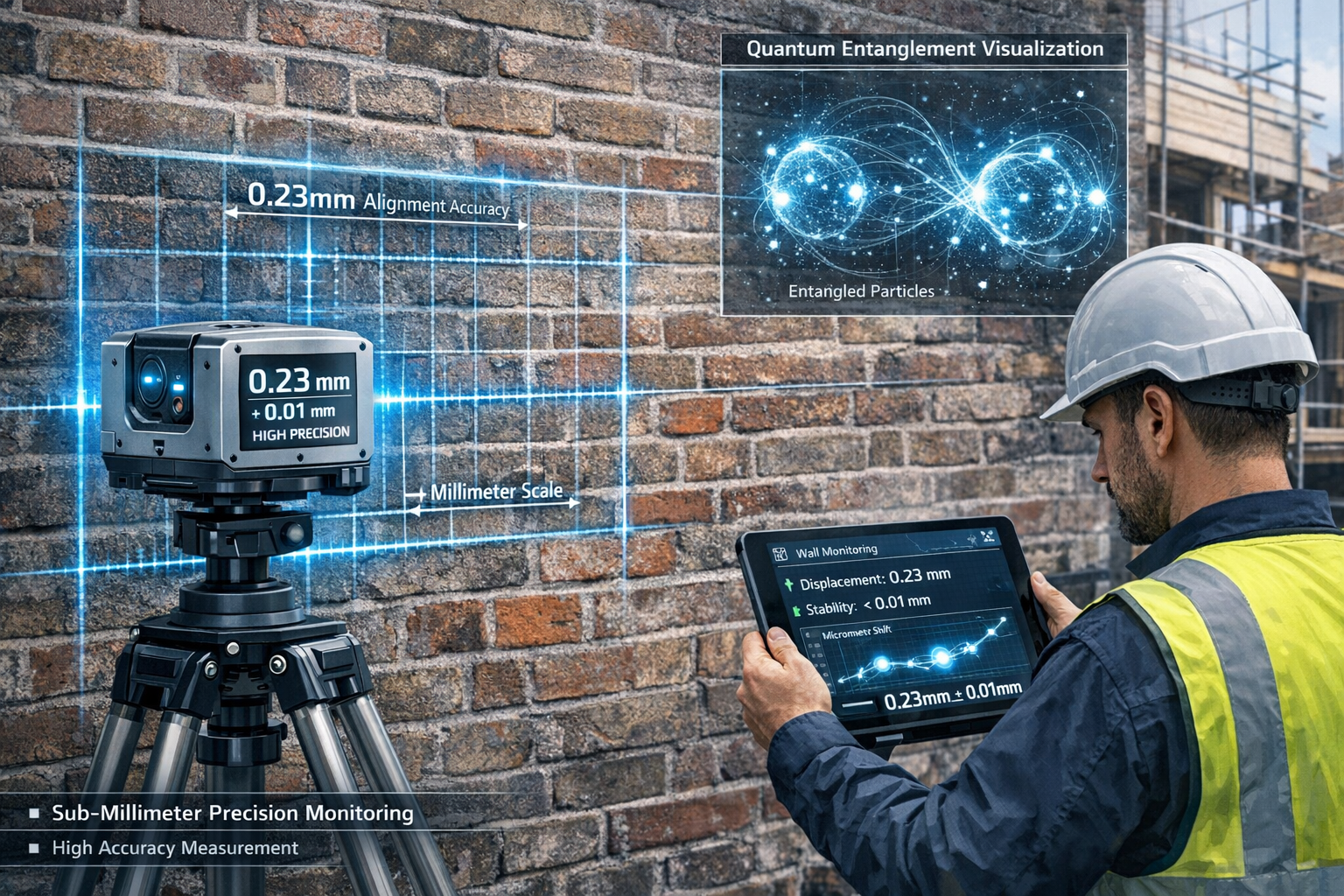
Quantum sensing harnesses the principles of quantum mechanics—specifically quantum entanglement and superposition—to measure physical properties with extraordinary precision. Unlike traditional laser-based surveying tools that measure distances using light reflection, quantum sensors detect minute changes in gravitational fields, magnetic fields, and spatial positioning at the atomic level.
According to recent developments in the field, 2026 has seen remarkable acceleration in quantum sensing applications across multiple industries [1]. The technology has matured from laboratory curiosity to practical field deployment, with construction surveying emerging as a particularly promising application.
Key Advantages for Party Wall Surveys
Precision Beyond Traditional Methods: While conventional total stations achieve accuracy within 2-5 millimeters, quantum sensors routinely deliver measurements accurate to 0.1 millimeters or less. This level of precision proves critical when determining exact boundary locations in densely packed urban environments where every centimeter matters.
Environmental Interference Resistance: Traditional surveying equipment struggles with vibrations, temperature fluctuations, and atmospheric conditions. Quantum sensors, by contrast, maintain accuracy even in challenging construction environments with heavy machinery, traffic vibrations, and variable weather conditions.
Real-Time Structural Movement Detection: Quantum gravimeters can detect microscopic ground settlement or structural shifts during construction activities, providing early warning of potential issues that could affect adjoining properties—a crucial consideration when preparing party wall notices and awards.
How Quantum Sensors Work in Practice
The most common quantum sensing devices used in party wall surveys include:
- Quantum gravimeters that measure tiny variations in Earth's gravitational field to detect voids, settlement, or structural changes
- Quantum magnetometers that map underground utilities and reinforcement with unprecedented detail
- Quantum accelerometers that track building movements during excavation or construction
- Quantum LiDAR systems that create ultra-precise 3D models of existing structures and boundaries
These devices typically connect to ruggedized tablets or laptops, displaying real-time measurements through intuitive interfaces designed for field surveyors rather than quantum physicists.
Quantum Sensing for Party Wall Awards: Integration Protocols and RICS Compliance
RICS Guidance and Professional Standards
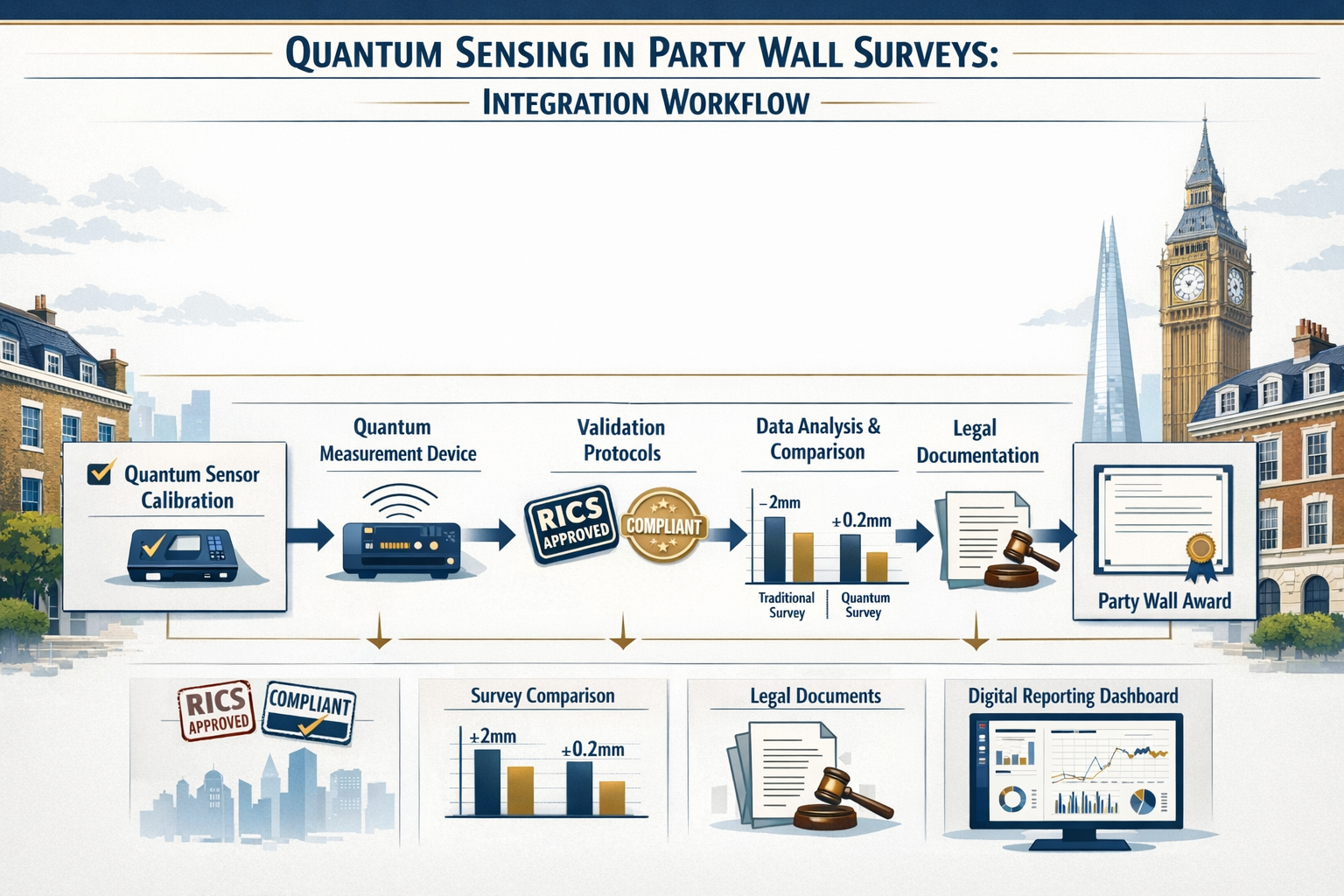
The Royal Institution of Chartered Surveyors (RICS) has begun developing guidance frameworks for incorporating emerging measurement technologies into party wall surveying practice. While quantum sensing represents cutting-edge technology, surveyors must ensure their methodologies align with established professional standards and the requirements of the Party Wall etc. Act 1996.
Professional competence remains paramount. Surveyors adopting quantum sensing technology must demonstrate:
- Proper training and certification in quantum sensor operation
- Understanding of measurement uncertainty and error propagation
- Ability to validate quantum measurements against traditional methods
- Clear documentation of methodologies used in party wall awards
Integration Checklist for Surveyors
Implementing Quantum Sensing for Party Wall Awards: Achieving Sub-Millimeter Boundary Precision in 2026 Urban Densification requires systematic integration of new technology with established practices:
Pre-Survey Preparation
✅ Equipment Calibration: Verify quantum sensors meet manufacturer specifications and maintain calibration certificates
✅ Site Assessment: Evaluate electromagnetic interference sources, underground utilities, and environmental factors that might affect measurements
✅ Traditional Baseline: Conduct initial measurements using conventional surveying equipment to establish comparison data
✅ Documentation Protocol: Prepare templates for recording quantum measurement data in formats compatible with party wall award documentation
During Survey Execution
✅ Multiple Measurement Points: Take quantum readings from at least three independent positions for each critical boundary point
✅ Environmental Logging: Record temperature, humidity, vibration levels, and other conditions during measurement
✅ Cross-Validation: Compare quantum sensor data with traditional measurements to identify discrepancies
✅ Photographic Evidence: Document sensor placement and measurement conditions with timestamped photographs
Post-Survey Validation
✅ Statistical Analysis: Apply appropriate uncertainty calculations to quantum measurement data
✅ Peer Review: Have quantum measurements reviewed by another qualified surveyor when accuracy is critical
✅ Client Communication: Explain quantum sensing methodology and accuracy levels in language accessible to non-technical property owners
✅ Archive Management: Store raw quantum sensor data files alongside traditional survey records
Legal Defensibility and Award Preparation
When preparing party wall awards based on quantum sensing data, surveyors must address several key considerations:
Admissibility of Evidence: Courts and dispute resolution panels increasingly accept quantum measurement data, particularly when properly documented and validated. However, surveyors should anticipate questions about methodology and be prepared to explain the technology in accessible terms.
Measurement Uncertainty: Professional standards require honest reporting of measurement uncertainty. Quantum sensors typically achieve uncertainty levels of ±0.1mm to ±0.5mm depending on conditions—far superior to traditional methods but not "perfect" measurements.
Proportionality: The enhanced precision of quantum sensing comes with increased equipment costs and survey time. Surveyors must consider whether sub-millimeter accuracy is genuinely necessary for the specific types of party wall works involved.
Practical Applications in 2026 Urban Densification Projects
Case Study: High-Density Residential Development
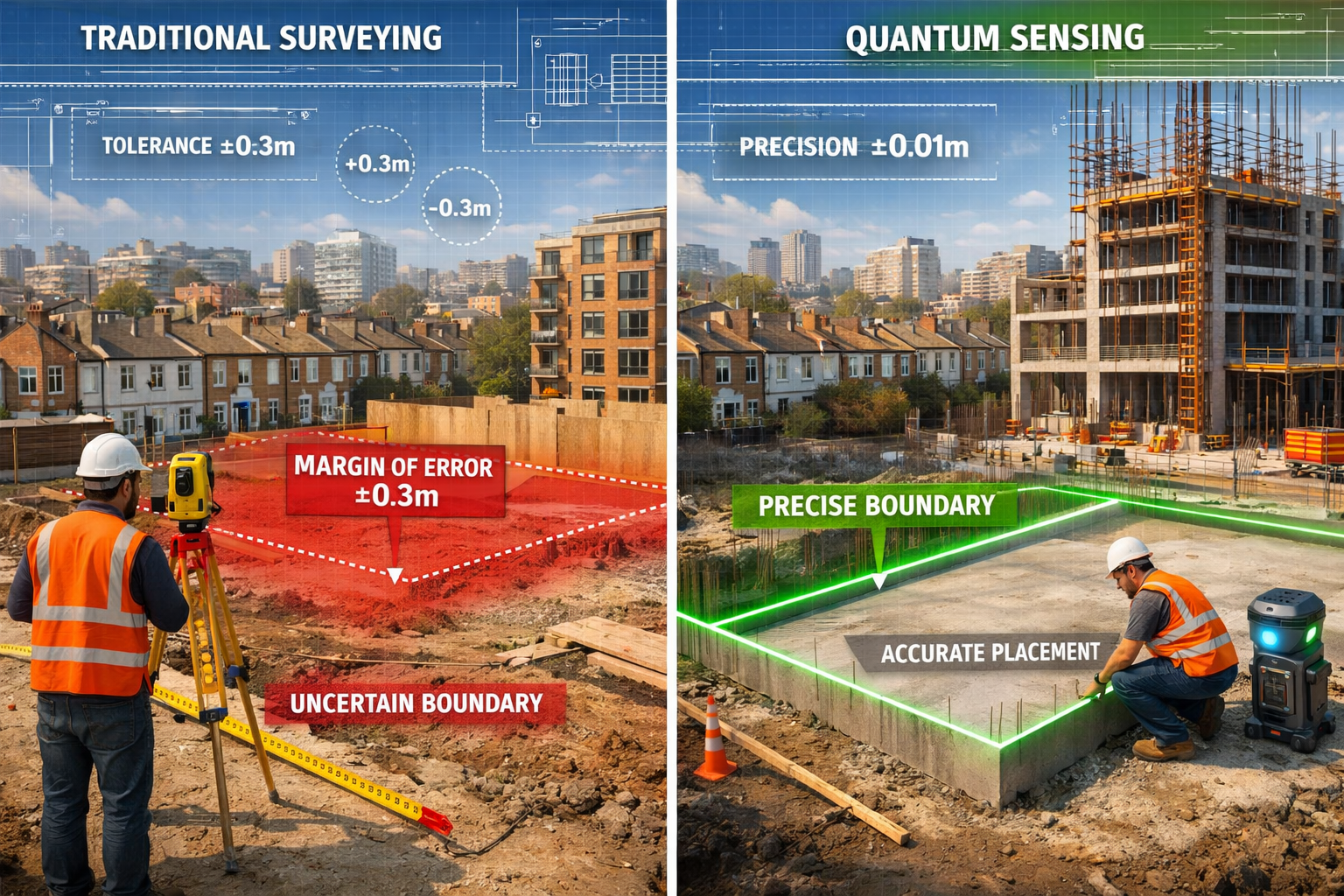
London's urban densification boom has created scenarios where developers construct buildings with minimal setbacks from existing structures. In one recent project in Central London, quantum sensing proved essential when a developer planned a 15-story residential tower on a narrow site with just 3 meters separating the foundation excavation from an adjoining Victorian terrace.
Traditional surveying methods provided accuracy within ±3mm—insufficient given the tight tolerances. Quantum gravimeters mapped the exact position of the existing building's foundations and detected a previously unknown void beneath the adjoining property. This discovery, made possible by sub-millimeter precision measurement, prevented what could have been catastrophic settlement damage.
The quantum sensing data formed the basis of the party wall award, establishing precise monitoring protocols and structural protection requirements. The enhanced accuracy eliminated disputes that typically arise from measurement uncertainty, saving an estimated £180,000 in potential legal costs and construction delays.
Boundary Wall Disputes Resolution
Quantum sensing has proven particularly valuable in resolving long-standing boundary wall disputes where property lines remain unclear due to historical survey inaccuracies or gradual structural movement over decades.
In traditional disputes, surveyors often face "he said, she said" scenarios where competing historical surveys disagree by several centimeters—enough to significantly impact property values and development rights. Quantum sensing cuts through this ambiguity by providing measurements accurate enough to definitively establish boundary positions relative to physical structures.
Basement Excavation Monitoring
Basement conversions represent one of the most common party wall matters in dense urban areas. These projects involve excavating beneath existing buildings—work that creates significant risk to adjoining properties through ground settlement or structural movement.
Quantum accelerometers now enable continuous monitoring throughout excavation work, detecting movements as small as 0.05mm. This real-time monitoring capability allows immediate intervention if concerning trends emerge, protecting adjoining owners while giving building owners confidence to proceed with complex excavation projects.
Government initiatives have recognized quantum technology's potential across various sectors, with increased focus on practical applications [8]. The construction industry's adoption of quantum sensing aligns with broader governmental support for quantum technology deployment in 2026.
Integration with Building Information Modeling (BIM)
Modern construction projects increasingly rely on Building Information Modeling (BIM) to coordinate complex designs and construction sequences. Quantum sensing data integrates seamlessly with BIM platforms, providing as-built verification that ensures constructed elements match design intent within sub-millimeter tolerances.
This integration proves particularly valuable for party wall surveyors in East London, South London, and other areas experiencing rapid development, where multiple construction projects often occur simultaneously in close proximity.
Cost-Benefit Analysis and Implementation Considerations
Equipment Investment and Training
Implementing quantum sensing technology requires significant upfront investment:
| Equipment Type | Approximate Cost (2026) | Typical Applications |
|---|---|---|
| Quantum Gravimeter | £85,000 – £150,000 | Foundation mapping, void detection, settlement monitoring |
| Quantum Magnetometer | £45,000 – £80,000 | Utility location, reinforcement mapping |
| Quantum Accelerometer Array | £30,000 – £60,000 | Structural movement monitoring |
| Quantum LiDAR System | £120,000 – £200,000 | Comprehensive 3D boundary surveys |
Training requirements add further costs, with comprehensive quantum sensing certification programs ranging from £3,000 to £8,000 per surveyor. However, these investments deliver substantial returns through:
- Reduced dispute rates: Sub-millimeter precision eliminates most measurement-based disagreements
- Faster project approvals: Definitive boundary data accelerates planning and regulatory processes
- Premium service pricing: Surveyors offering quantum sensing command 15-25% higher fees
- Liability reduction: Enhanced accuracy minimizes professional indemnity claims
When Quantum Sensing Adds Value
Not every party wall matter requires quantum-level precision. Surveyors should consider deploying quantum sensing technology when:
✨ High-value properties are involved where boundary disputes could cost hundreds of thousands in legal fees
✨ Complex structural works require monitoring of minute movements during construction
✨ Historical inaccuracies in previous surveys create uncertainty about true boundary positions
✨ Tight site constraints leave minimal margin for error in construction placement
✨ Multiple adjoining owners increase the potential for disputes requiring definitive measurements
For simpler matters—such as straightforward party fence walls between properties with clear boundaries—traditional surveying methods remain perfectly adequate and more cost-effective.
Managing Client Expectations
Property owners often lack technical understanding of surveying precision and may question the need for expensive quantum sensing technology. Successful surveyors educate clients about:
Measurement uncertainty: Explaining how traditional methods' ±2-5mm uncertainty becomes significant when excavating within 2-3 meters of an adjoining structure
Risk mitigation: Demonstrating how precise measurements prevent costly disputes and construction delays that far exceed the technology investment
Legal protection: Showing how quantum sensing data provides defensible evidence if disputes reach formal resolution or litigation
Peace of mind: Emphasizing the confidence that comes from knowing boundary positions and structural movements with near-absolute certainty
Future Developments and Industry Trends
Quantum Technology Advancement
The quantum technology sector continues rapid development in 2026, with industry observers noting this as a pivotal year for quantum applications [2]. Several trends will likely impact party wall surveying:
Miniaturization: Next-generation quantum sensors will become more portable and easier to deploy in confined urban spaces
Cost Reduction: As manufacturing scales up and technology matures, equipment costs should decrease by 30-40% over the next 3-5 years
Enhanced Integration: Improved software platforms will make quantum sensing data more accessible to surveyors without specialized physics backgrounds
Regulatory Recognition: Professional bodies and regulatory authorities will develop specific standards for quantum sensing in construction surveying
Regulatory Evolution
Government agencies have begun prioritizing quantum technology development through various initiatives [3]. This governmental support suggests forthcoming regulatory frameworks that may:
- Establish minimum accuracy standards for high-density urban construction projects
- Create certification requirements for surveyors using quantum sensing technology
- Develop standardized reporting formats for quantum measurement data in party wall awards
- Provide grants or tax incentives for adoption of precision measurement technologies
Industry Adoption Patterns
Early adopters of Quantum Sensing for Party Wall Awards: Achieving Sub-Millimeter Boundary Precision in 2026 Urban Densification include:
- Large surveying firms serving high-value commercial developments
- Specialist party wall practices in North London and West London areas with extensive urban densification
- Engineering consultancies providing comprehensive structural monitoring services
- Insurance companies requiring enhanced precision for high-risk construction projects
As equipment costs decrease and training becomes more accessible, quantum sensing will likely become standard practice for complex party wall matters by 2028-2030.
Practical Implementation Guide for Surveyors
Getting Started with Quantum Sensing
Surveyors interested in adopting quantum sensing technology should follow this implementation pathway:
Phase 1: Education and Assessment (Months 1-3)
- Attend quantum sensing workshops and industry conferences
- Evaluate current client base to identify projects that would benefit from enhanced precision
- Conduct cost-benefit analysis specific to your practice area
- Research equipment suppliers and training providers
Phase 2: Initial Investment (Months 4-6)
- Purchase or lease entry-level quantum sensing equipment
- Complete manufacturer training and certification programs
- Develop internal protocols for quantum sensor deployment
- Update professional indemnity insurance to cover quantum sensing work
Phase 3: Pilot Projects (Months 7-12)
- Select 3-5 suitable projects for initial quantum sensing deployment
- Use quantum sensors alongside traditional methods to build confidence
- Develop client communication materials explaining the technology
- Refine workflows and documentation procedures
Phase 4: Full Integration (Year 2+)
- Market quantum sensing capabilities to attract premium projects
- Train additional staff members in quantum sensor operation
- Expand equipment inventory based on demand patterns
- Contribute to industry development of best practices and standards
Avoiding Common Pitfalls
Surveyors new to quantum sensing should watch for these potential issues:
⚠️ Over-reliance on technology: Quantum sensors complement rather than replace professional judgment and traditional surveying skills
⚠️ Inadequate documentation: Quantum measurements require more detailed recording of environmental conditions and methodology than traditional surveys
⚠️ Client communication failures: Technical jargon alienates non-specialist clients; develop clear explanations of quantum sensing benefits
⚠️ Calibration neglect: Quantum sensors require regular calibration and maintenance to maintain advertised precision levels
⚠️ Inappropriate application: Not every project justifies quantum sensing costs; maintain proportionality in technology deployment
Building Client Relationships
Successfully integrating quantum sensing into party wall practice requires educating clients about technology benefits without overwhelming them with technical details. Effective approaches include:
📊 Visual comparisons showing traditional vs. quantum sensing precision using simple graphics
💬 Case studies demonstrating how quantum sensing prevented disputes or saved costs on similar projects
📋 Plain-language reports that present quantum measurement data in accessible formats
🤝 Transparent pricing that clearly explains the cost differential and value proposition
For guidance on keeping party wall costs down while still delivering quality service, surveyors must balance technology investment with client budget constraints.
Conclusion: Embracing Precision in Urban Development
Quantum Sensing for Party Wall Awards: Achieving Sub-Millimeter Boundary Precision in 2026 Urban Densification represents a transformative advancement in construction surveying practice. As urban environments become increasingly dense and construction tolerances tighten, the ability to measure boundaries and structural movements with sub-millimeter accuracy transitions from luxury to necessity.
The technology delivers clear benefits: reduced disputes, enhanced legal defensibility, improved risk management, and superior protection for both building owners and adjoining owners. While implementation requires significant investment in equipment and training, the returns justify the costs for surveyors serving complex urban development projects.
Actionable Next Steps
For surveyors ready to embrace quantum sensing technology:
- Assess your practice: Identify which clients and project types would most benefit from sub-millimeter precision
- Invest in education: Attend training programs and industry events focused on quantum sensing applications
- Start small: Pilot quantum sensing on selected projects while maintaining traditional methods for validation
- Build expertise: Develop internal protocols and documentation standards for quantum measurement data
- Communicate value: Create client education materials that clearly explain quantum sensing benefits
- Stay informed: Monitor industry developments and regulatory changes affecting quantum sensing adoption
For property owners and developers navigating party wall matters, understanding quantum sensing capabilities enables informed decisions about when enhanced precision justifies additional investment. When projects involve tight site constraints, high property values, or complex structural works, quantum sensing technology provides peace of mind that traditional methods cannot match.
The future of party wall surveying in dense urban environments increasingly relies on precision measurement technologies that seemed like science fiction just a few years ago. Surveyors who embrace these advancements position themselves as industry leaders, while those who resist risk obsolescence as client expectations and regulatory standards evolve.
As 2026 progresses and quantum technology continues its rapid advancement [6], the construction industry stands at an inflection point. The question is no longer whether quantum sensing will transform party wall practice, but rather how quickly surveyors will adapt to this new reality of unprecedented measurement precision.
References
[1] A Year Of Acceleration And The Rise Of Quantum Sensing – https://aerospaceamerica.aiaa.org/year-in-review/a-year-of-acceleration-and-the-rise-of-quantum-sensing/
[2] Latest Developments In Quantum Computing 2026 Edition – https://www.usdsi.org/data-science-insights/latest-developments-in-quantum-computing-2026-edition
[3] nextgov – https://www.nextgov.com/emerging-tech/2026/02/draft-quantum-order-tasks-many-agencies-reinvigorating-techs-development/411152/
[6] After A Year Of Quantum Awareness 2026 Becomes The Year Of Quantum Security – https://thequantuminsider.com/2026/01/06/after-a-year-of-quantum-awareness-2026-becomes-the-year-of-quantum-security/
[8] Government Demand Creator Quantum Industry – https://www.csis.org/analysis/government-demand-creator-quantum-industry