

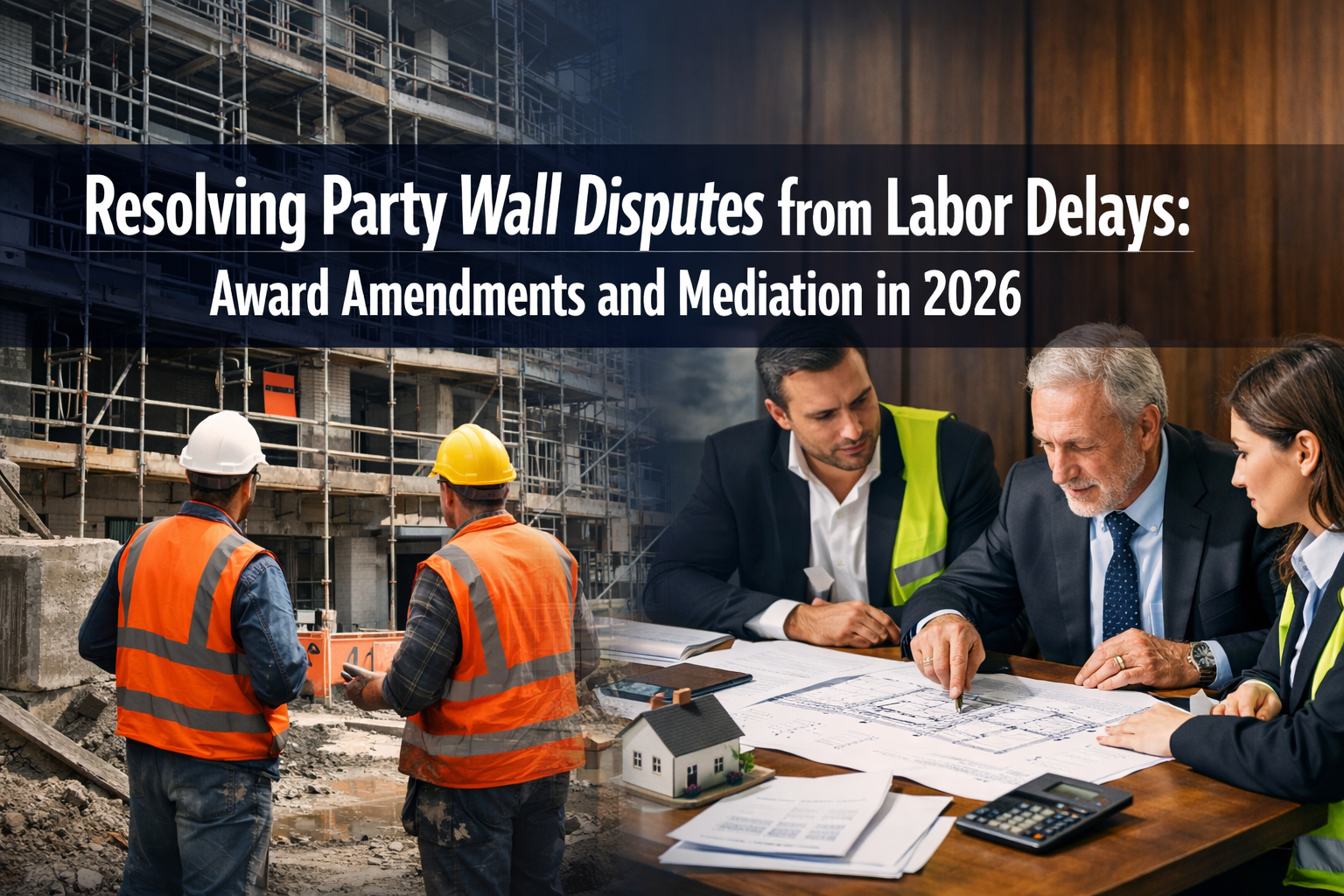
When construction projects grind to a halt due to labor shortages, the ripple effects extend far beyond the building site—they can trigger complex party wall disputes that threaten neighborly relations and project viability. In 2026, as London and the broader UK construction sector grapples with persistent workforce challenges, property owners and surveyors face an urgent question: how can Resolving Party Wall Disputes from Labor Delays: Award Amendments and Mediation in 2026 be managed effectively without resorting to costly litigation?
The answer lies in understanding the flexible mechanisms built into the Party Wall etc. Act 1996, particularly Section 10 procedures for award amendments and the strategic use of mediation. This comprehensive guide explores proven surveyor tactics, real-world case studies, and practical protocols for navigating labor-induced delays while maintaining compliance and preserving professional relationships.
Key Takeaways
- ⚖️ Labor delays in 2026 are triggering unprecedented party wall disputes, requiring proactive award amendments under Section 10(17) of the Party Wall etc. Act 1996
- 📋 Award variations can address timeline changes, cost adjustments, and revised work schedules without invalidating the original party wall agreement
- 🤝 Mediation offers a cost-effective alternative to litigation, with typical costs of £800-£1,200 compared to £5,000+ for court proceedings
- ⏱️ Early intervention within 14 days of identifying delays significantly improves dispute resolution outcomes and maintains neighbor relations
- 📊 Documentation protocols including photographic evidence, contractor correspondence, and revised schedules are essential for successful award amendments
Understanding Labor Delays and Party Wall Implications in 2026
The construction landscape in 2026 presents unique challenges that directly impact party wall procedures. Labor shortages, supply chain disruptions, and skilled trades availability have created a perfect storm affecting project timelines across London and beyond.
The Current State of Construction Delays
Recent industry analysis reveals that construction projects in 2026 are experiencing average delays of 6-12 weeks beyond original timelines[1]. These delays stem from:
- Skilled labor shortages in specialized trades (bricklayers, plasterers, structural engineers)
- Post-Brexit workforce reductions continuing to impact availability
- Increased demand from loft conversions and residential expansions
- Training pipeline gaps limiting new entrant numbers
When a building owner serves party wall notices with specific work commencement dates, any significant delay can trigger disputes with adjoining owners who have planned around the original schedule.
How Delays Trigger Party Wall Disputes
Party wall disputes arising from labor delays typically manifest in several ways:
| Dispute Type | Common Trigger | Impact on Neighbors |
|---|---|---|
| Timeline Violations | Work starts 3+ months late | Adjoining owner scheduling conflicts |
| Extended Duration | Project takes twice as long | Prolonged noise, disruption, access issues |
| Cost Escalation | Delay-related expense increases | Disputes over who bears additional surveyor costs |
| Scope Changes | Alternative methods due to labor unavailability | Concerns about structural impact variations |
| Access Complications | Intermittent work schedules | Unpredictable disruption patterns |
A typical scenario in 2026: A building owner obtains a party wall award for a loft conversion scheduled to begin in March and complete by June. However, the contractor cannot secure a structural engineer until May, pushing completion to September. The adjoining owner, who planned a family event in August based on the original timeline, now faces months of additional construction noise and disruption.
"The key to Resolving Party Wall Disputes from Labor Delays: Award Amendments and Mediation in 2026 lies in transparent communication and proactive award modifications before disputes escalate to formal complaints or litigation." — Senior Party Wall Surveyor
Legal Framework: Section 10 of the Party Wall etc. Act 1996
The Party Wall etc. Act 1996 provides the statutory framework for managing these situations. Section 10(17) specifically allows surveyors to:
- Vary or modify awards as circumstances change
- Address unforeseen complications including labor availability
- Extend timelines with proper documentation
- Adjust cost allocations when delays create additional expenses
Understanding these provisions is crucial for effective dispute resolution without invalidating the original award structure.
Award Amendment Procedures for Labor-Related Delays
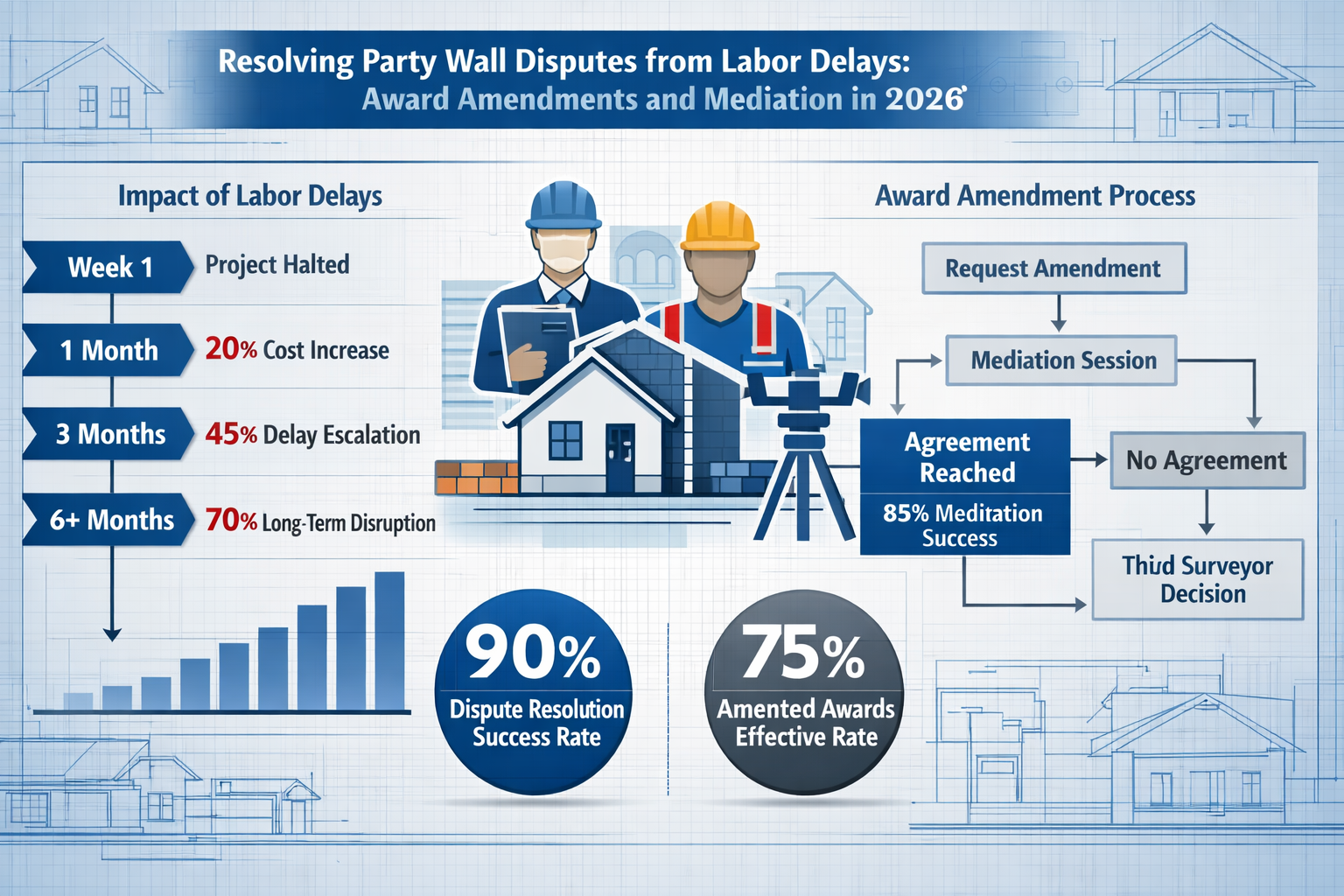
When labor delays impact construction schedules, award amendments offer a formal mechanism to update terms while maintaining legal compliance. This process requires careful documentation, timely action, and adherence to statutory procedures.
Section 10(17) Amendment Process: Step-by-Step
The amendment process under Section 10(17) follows a structured approach:
Step 1: Identify and Document the Delay (Days 1-7)
- Obtain written confirmation from the contractor specifying labor shortage details
- Document the specific trades unavailable and projected availability dates
- Photograph current work status showing incomplete stages
- Calculate revised timeline with realistic completion estimates
Step 2: Notify All Parties (Days 8-10)
- Building owner's surveyor drafts amendment proposal
- Circulate to adjoining owner's surveyor and third surveyor (if appointed)
- Include full justification with supporting contractor documentation
- Specify proposed new commencement and completion dates
Step 3: Surveyor Consultation (Days 11-21)
- Surveyors review impact on adjoining owners
- Assess whether additional protective measures are needed
- Determine if cost adjustments are warranted
- Negotiate terms acceptable to all parties
Step 4: Formal Award Variation (Days 22-28)
- Draft supplementary award document
- Reference original award number and date
- Detail specific amendments to timeline, costs, or conditions
- Obtain signatures from all appointed surveyors
- Serve amended award on both building and adjoining owners
This structured timeline ensures that Resolving Party Wall Disputes from Labor Delays: Award Amendments and Mediation in 2026 occurs within a reasonable 4-week window, minimizing uncertainty for all parties.
Essential Documentation Requirements
Successful award amendments require comprehensive documentation:
✅ Contractor Communications
- Written delay notifications with specific dates
- Labor availability reports from recruitment agencies
- Alternative contractor quotes (if applicable)
- Revised project schedules with critical path analysis
✅ Photographic Evidence
- Time-stamped images of current work status
- Documentation of incomplete stages
- Comparison with original schedule milestones
- Evidence of site security and protective measures
✅ Financial Records
- Original cost estimates from party wall awards
- Delay-related cost increases
- Additional surveyor fee calculations
- Apportionment proposals for increased costs
✅ Correspondence Trail
- All communications between owners
- Surveyor consultation records
- Neighbor concern documentation
- Response timelines and acknowledgments
Case Study: Notting Hill Loft Conversion Delay
A 2026 case from Notting Hill illustrates effective award amendment:
Background: Building owner commenced loft conversion under party wall award dated January 15, 2026, with completion scheduled for April 30. By March 1, the contractor notified that the specialist steelwork installer was unavailable until May due to labor shortages affecting multiple projects.
Resolution Approach:
- Building owner's surveyor immediately documented the delay (March 2-5)
- Contractor provided written confirmation with alternative availability dates
- Surveyors consulted and identified adjoining owner's concern about extended summer disruption
- Amendment proposal included: revised completion date (July 15), additional noise mitigation during school holidays, and building owner covering 100% of amendment-related surveyor fees
- Supplementary award issued March 18, 2026
Outcome: Dispute avoided through proactive amendment. Total additional cost: £450 in surveyor fees versus potential £5,000+ litigation costs. Project completed July 12, 2026, with neighbor relations preserved.
Common Amendment Scenarios and Solutions
Different delay situations require tailored amendment approaches:
Scenario A: Short Delay (2-4 weeks)
- Solution: Letter of variation rather than formal award amendment
- Cost Impact: Minimal (£150-£300 in surveyor correspondence)
- Timeline: 7-10 days to implement
Scenario B: Medium Delay (1-3 months)
- Solution: Formal Section 10(17) amendment with revised schedule
- Cost Impact: Moderate (£500-£800 in surveyor fees)
- Timeline: 3-4 weeks for full amendment process
Scenario C: Major Delay (3+ months)
- Solution: Comprehensive award revision with possible re-serving of notices
- Cost Impact: Significant (£1,200-£2,000 in fees)
- Timeline: 6-8 weeks including re-consultation period
Understanding these scenarios helps surveyors recommend proportionate responses aligned with keeping party wall costs down.
Cost Allocation Principles
Determining who pays for delay-related amendments follows these principles:
Building Owner Responsibility:
- Contractor selection and management
- Labor procurement failures
- Unrealistic original schedules
- Amendment surveyor fees (typically)
Shared Responsibility:
- Industry-wide labor shortages beyond owner control
- Force majeure events affecting availability
- Reasonable timeline adjustments
Adjoining Owner Protection:
- Not liable for building owner's contractor issues
- Entitled to compensation for extraordinary disruption
- May claim additional surveyor fees if delays are excessive
Most surveyors in 2026 recommend building owners bear 100% of amendment costs when delays stem from their contractor relationships, maintaining goodwill and facilitating smoother resolution.
Mediation Strategies for Resolving Party Wall Disputes from Labor Delays: Award Amendments and Mediation in 2026
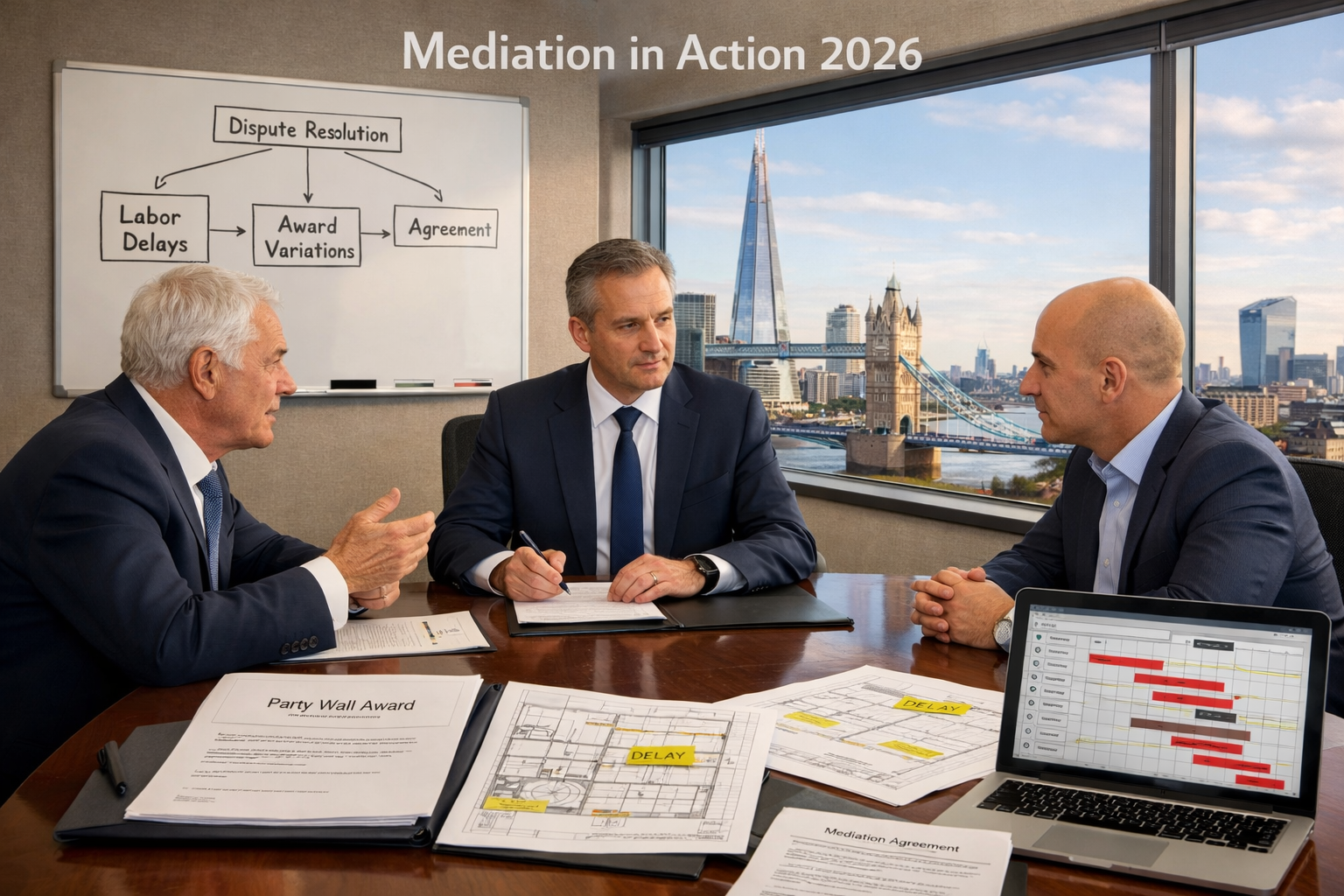
When award amendments alone cannot resolve disputes—or when relationships have deteriorated—mediation offers a structured, cost-effective alternative to litigation. In 2026, mediation has become increasingly sophisticated, with specialized party wall mediators bringing technical expertise to the process.
When to Consider Mediation
Mediation becomes appropriate when:
🔴 Communication Breakdown
- Owners refuse direct communication
- Surveyors cannot reach consensus on amendment terms
- Emotional tensions override practical solutions
🔴 Complex Multi-Issue Disputes
- Labor delays combined with cost disputes
- Disagreements over work scope changes
- Multiple adjoining owners with conflicting positions
🔴 Timeline Urgency
- Court proceedings would delay resolution by 6-12 months
- Building owner needs to commence work promptly
- Seasonal considerations require quick resolution
🔴 Cost Sensitivity
- Parties want to avoid £5,000-£15,000 litigation costs
- Relationship preservation is important
- Future cooperation may be needed
The Mediation Process: A Practical Framework
Professional party wall mediation in 2026 follows a structured approach:
Phase 1: Pre-Mediation Preparation (Week 1)
- Mediator selection (ideally RICS-qualified with party wall expertise)
- Both parties submit position statements
- Mediator reviews original award, amendment proposals, and correspondence
- Preliminary calls with each party separately
Phase 2: Joint Mediation Session (Day 1)
- Opening statements from each party (15-20 minutes each)
- Mediator clarifies key issues and areas of disagreement
- Joint discussion of labor delay circumstances
- Identification of underlying concerns beyond stated positions
Phase 3: Private Caucuses (Hours 2-4)
- Mediator meets separately with each party
- Explores settlement parameters and flexibility
- Reality-tests positions against likely court outcomes
- Generates creative solution options
Phase 4: Negotiation and Agreement (Hours 4-6)
- Mediator shuttles between parties with proposals
- Gradual convergence toward acceptable terms
- Drafting of settlement agreement
- Signatures and implementation planning
Success Rate: Industry data from 2026 shows 72% of party wall mediations reach full settlement on the day, with another 15% settling within one week of follow-up negotiations.
Key Mediation Tactics for Labor Delay Disputes
Experienced mediators employ specific strategies for labor-related party wall disputes:
Tactic 1: Timeline Reality-Testing
Mediators present independent construction industry data showing average delay durations in 2026, helping parties understand whether proposed timelines are realistic or optimistic. This grounds discussions in objective market conditions rather than subjective preferences.
Tactic 2: Cost-Benefit Analysis
Mediators calculate and present the total costs of continued dispute:
- Litigation: £5,000-£15,000 + 6-12 months delay
- Mediation settlement: £800-£1,200 + immediate resolution
- Relationship damage: difficult to quantify but significant
Tactic 3: Interest-Based Exploration
Rather than focusing on positions ("I demand work stops until original timeline is feasible"), mediators explore underlying interests:
- Adjoining owner: predictability, minimal disruption, fair treatment
- Building owner: project completion, cost control, neighbor relations
Tactic 4: Contingency Planning
Mediators help parties develop "if-then" agreements:
- "If contractor secures labor by June 1, work proceeds with original schedule"
- "If delays extend beyond July 31, building owner pays £X compensation"
- "If noise exceeds Y decibels during agreed quiet hours, work pauses for 48 hours"
Case Study: Buy-to-Let Expansion Mediation
A 2026 institutional landlord case demonstrates mediation effectiveness:
Background: Buy-to-let property owner planned basement expansion affecting three adjoining properties. Original award specified 16-week timeline. After 8 weeks, specialized underpinning contractor became unavailable due to labor shortages, requiring 12-week delay[2].
Dispute Escalation:
- Two adjoining owners accepted amended timeline
- Third adjoining owner (elderly resident) refused, citing health impacts from prolonged disruption
- Surveyors deadlocked on appropriate compensation
- Building owner threatened to proceed regardless, risking injunction
Mediation Intervention:
- Half-day mediation session arranged within 10 days
- Mediator identified elderly owner's core concern: inability to use garden during summer months
- Creative solution emerged: building owner funded temporary patio installation at owner's relative's home for summer months (cost: £2,800)
- Amended timeline accepted with enhanced noise mitigation measures
- Total mediation cost: £1,100 (split equally)
Outcome: Full settlement achieved in 5 hours. Project resumed within 3 weeks. All parties avoided litigation costs exceeding £12,000 combined.
Selecting the Right Mediator
Choosing an appropriate mediator significantly impacts success rates. In 2026, look for:
✅ Technical Qualifications
- RICS membership or equivalent professional body
- Party wall surveying experience (minimum 5 years)
- Formal mediation training and accreditation
- Understanding of types of party wall works
✅ Practical Experience
- Track record with construction delay disputes
- Familiarity with labor market conditions in 2026
- Experience with multi-party disputes
- Knowledge of local practices (e.g., party wall procedures in North London)
✅ Personal Attributes
- Patience with emotional parties
- Ability to explain technical concepts clearly
- Creativity in generating solutions
- Persistence without being pushy
Mediation Costs and Fee Structures
Typical mediation costs for party wall disputes in 2026:
| Mediation Type | Duration | Mediator Fee | Preparation Costs | Total Range |
|---|---|---|---|---|
| Half-Day | 4 hours | £600-£900 | £200-£300 | £800-£1,200 |
| Full-Day | 8 hours | £1,200-£1,800 | £300-£500 | £1,500-£2,300 |
| Multi-Session | 2+ days | £2,000-£3,500 | £500-£800 | £2,500-£4,300 |
Fee Allocation: Most mediations split costs equally between building and adjoining owners, though settlement agreements may include provisions for one party to reimburse the other based on outcome.
Compared to litigation costs averaging £5,000-£15,000 per party, mediation represents significant savings while typically resolving disputes in days rather than months.
Surveyor Best Practices for Preventing Labor Delay Disputes
Prevention remains more effective than resolution. Forward-thinking surveyors in 2026 implement proactive strategies to minimize labor delay disputes before they arise.
Pre-Award Risk Assessment
During the initial party wall award preparation, surveyors should:
Assess Contractor Viability
- Request contractor's labor procurement strategy
- Verify subcontractor commitments in writing
- Check contractor's recent project completion rates
- Identify high-risk specialized trades (steelwork, underpinning)
Build Timeline Buffers
- Add 20-30% contingency to contractor's estimated timelines
- Specify "target completion" rather than fixed dates where appropriate
- Include flexibility clauses for industry-wide labor shortages
Include Contingency Provisions
- Draft awards with built-in amendment triggers
- Specify notification requirements if delays exceed X weeks
- Pre-agree dispute resolution mechanisms (mediation clause)
Communication Protocols
Effective communication prevents misunderstandings that escalate into disputes:
📢 Regular Updates
- Weekly progress reports to adjoining owners during active construction
- Immediate notification of any timeline changes (within 48 hours)
- Monthly surveyor coordination calls when projects exceed 3 months
📢 Accessible Contact Channels
- Provide building owner and contractor contact information
- Establish surveyor as primary communication hub
- Create simple complaint logging system
📢 Expectation Management
- Educate owners about realistic 2026 construction timelines
- Explain industry labor challenges transparently
- Avoid overpromising on schedules
Documentation Systems
Robust documentation supports both award amendments and mediation:
Digital Record-Keeping
- Timestamped photograph logs
- Email archive with clear subject line protocols
- Cloud-based document sharing for all parties
- Version control for amended awards and schedules
Standardized Templates
- Pre-drafted amendment request forms
- Delay notification templates for contractors
- Mediation referral checklists
- Settlement agreement frameworks
Regional Considerations Across London
Different London areas present unique challenges requiring tailored approaches:
Central London (party wall surveyor Central London)
- Higher property values increase dispute stakes
- More complex multi-party scenarios
- Greater access to specialist mediators
North London (party wall surveyor North London)
- Residential loft conversion concentration
- Family-oriented neighborhoods requiring sensitivity
- School calendar considerations for timing
South London (party wall surveyor South London)
- Growing buy-to-let market with institutional landlords[2]
- Mixed residential-commercial projects
- Diverse property types requiring flexible approaches
East London (party wall surveyor East London)
- Rapid development and gentrification
- Higher proportion of first-time party wall participants
- Need for enhanced owner education
West London (party wall surveyor West London)
- Premium property market
- Sophisticated owners with legal representation
- Higher expectations for professional service delivery
Training and Professional Development
Surveyors committed to excellence in Resolving Party Wall Disputes from Labor Delays: Award Amendments and Mediation in 2026 should pursue:
- RICS continuing professional development (CPD) in dispute resolution
- Mediation skills training courses
- Construction law updates focusing on delay claims
- Peer learning groups sharing case studies and tactics
Emerging Trends and Future Outlook
The landscape of party wall dispute resolution continues to evolve in 2026:
Technology Integration
Digital Mediation Platforms
- Video-conferenced mediation sessions reducing scheduling barriers
- Virtual site visits using 360-degree photography
- AI-assisted timeline analysis identifying realistic schedules
- Blockchain-based award registries ensuring document authenticity
Regulatory Developments
While the Party Wall etc. Act 1996 remains the statutory foundation, industry bodies are developing:
- Standardized amendment protocols reducing surveyor discretion variability
- Recommended mediation clauses for inclusion in all awards
- Guidance on labor shortage force majeure provisions
- Enhanced owner education requirements before notice service
Market Adaptations
The construction industry's response to persistent labor challenges includes:
- Modular construction reducing on-site labor requirements
- Extended project timelines becoming standard expectations
- Contractor consortiums sharing labor resources
- Apprenticeship investments addressing long-term skills gaps
Surveyors who understand these trends can better advise clients on realistic expectations and appropriate risk mitigation strategies.
Conclusion
Resolving Party Wall Disputes from Labor Delays: Award Amendments and Mediation in 2026 requires a sophisticated blend of legal knowledge, practical construction understanding, and interpersonal skill. As this guide demonstrates, the Party Wall etc. Act 1996 provides flexible mechanisms—particularly Section 10(17) award amendments—that enable surveyors to adapt to changing circumstances without invalidating original agreements.
The key principles for success include:
✅ Early intervention when delays become apparent, ideally within 14 days
✅ Comprehensive documentation supporting amendment requests with contractor evidence and photographic records
✅ Transparent communication keeping all parties informed and managing expectations realistically
✅ Strategic mediation when disputes escalate beyond surveyor negotiation capacity
✅ Cost-conscious approaches recognizing that prevention and mediation save thousands compared to litigation
For building owners planning notifiable works, the message is clear: work with experienced surveyors who understand both the technical requirements and the human dynamics of dispute resolution. Request realistic timelines that account for 2026 labor market conditions, include contingency provisions in initial awards, and commit to transparent communication throughout the project.
For adjoining owners receiving party wall notices, understanding your rights to fair treatment and reasonable timelines empowers you to engage constructively when delays occur. Rather than immediately opposing amendments, consider whether proposed solutions genuinely address your concerns while acknowledging legitimate market challenges.
For surveyors, continuous professional development in mediation skills and construction market awareness enhances your value to clients. The ability to navigate labor delay disputes efficiently distinguishes exceptional practitioners from merely competent ones.
Next Steps
If you're currently facing a party wall dispute related to labor delays:
- Document everything immediately—contractor communications, current work status, and timeline impacts
- Consult your surveyor within 48 hours to discuss amendment options
- Review the original award for existing flexibility provisions or amendment procedures
- Consider mediation if initial negotiations stall, before positions harden
- Seek specialist advice from experienced party wall professionals familiar with costs and processes
The construction challenges of 2026 are real, but they need not derail projects or destroy neighbor relationships. With proactive planning, flexible award structures, and skilled mediation when needed, virtually all labor delay disputes can be resolved efficiently and cost-effectively.
Remember: the goal is not just completing your construction project, but doing so in a way that preserves community relationships and sets a positive precedent for future works. By embracing the amendment and mediation tools available under the Party Wall etc. Act 1996, property owners and surveyors can turn potential conflicts into opportunities for collaborative problem-solving.
References
[1] Party Wall Surveying Surge In 2026 Loft Conversions Navigating High Demand Compliance During Housing Uptick – https://nottinghillsurveyors.com/blog/party-wall-surveying-surge-in-2026-loft-conversions-navigating-high-demand-compliance-during-housing-uptick
[2] Party Wall Awards For Buy To Let Expansions In 2026 Protocols Amid Institutional Landlord Surge – https://nottinghillsurveyors.com/blog/party-wall-awards-for-buy-to-let-expansions-in-2026-protocols-amid-institutional-landlord-surge