


When construction work begins next door, the sound of hammering and drilling isn't the only thing that can disrupt your peace of mind. In 2026, property owners across the UK are facing a perfect storm: rising construction activity in urban areas colliding with severe labor shortages that are fundamentally changing how party wall disputes unfold. Resolving Party Wall Disputes in 2026: Strategies Amid Construction Labor Shortages has become more complex than ever, with project delays, cost overruns, and extended timelines creating friction between neighbours who share walls, boundaries, and structural elements.
The construction industry is experiencing unprecedented challenges. Labor shortages have driven costs up by 15-20% in many regions, while project timelines have stretched from months to years in some cases. These delays don't just affect building owners—they impact adjoining property owners who must endure prolonged disruption, structural uncertainty, and the stress of unresolved party wall matters. Understanding how to navigate these challenges while maintaining legal compliance and neighbourly relations has never been more critical.
Key Takeaways
- Labor shortages are extending party wall project timelines by 30-50%, requiring new negotiation tactics and flexible party wall award clauses that account for construction delays
- Proactive communication and early party wall notice service (at least two months in advance) are essential to prevent disputes from escalating amid unpredictable construction schedules
- Independent party wall surveyors play a crucial role in mediating between building owners and adjoining owners when labor cost hikes create financial tensions
- Written agreements with extension clauses protect both parties when workforce availability issues cause unavoidable project delays
- Mediation and arbitration offer faster, more cost-effective dispute resolution than court proceedings, especially important when construction timelines are already stretched
Understanding Party Wall Disputes in the Current Construction Climate 🏗️
Party wall disputes arise when construction work affects shared structures between neighbouring properties. The Party Wall etc. Act 1996 provides the legal framework for managing these situations, but the Act was written during a time of relative construction stability. In 2026, the landscape has shifted dramatically.
What Constitutes a Party Wall Dispute?
A party wall dispute typically involves disagreements over:
- Structural damage or perceived risk to adjoining properties during construction
- Access requirements for workers to complete party wall works
- Noise, dust, and disruption extending beyond reasonable timeframes
- Cost allocation for necessary remedial works or protective measures
- Delays in project completion that prolong inconvenience to neighbours
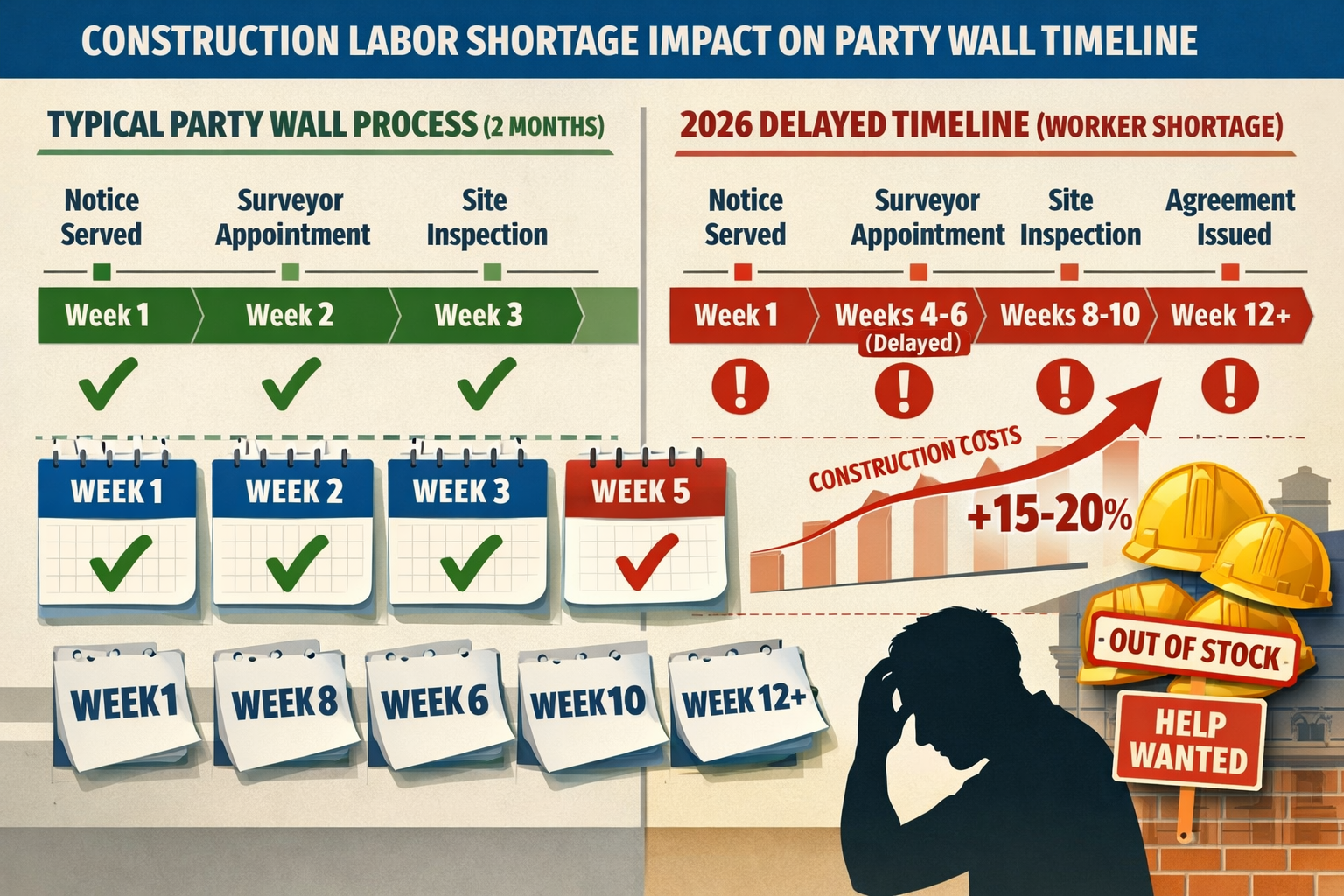
The construction labor shortage has amplified each of these issues. When skilled tradespeople are scarce, projects that should take three months can stretch to six or nine months. This extended timeline means adjoining owners face prolonged disruption, while building owners struggle with escalating costs and contractor availability[1].
The 2026 Construction Labor Crisis
The construction sector in 2026 faces a critical shortage of skilled workers across multiple trades. Brexit-related workforce reductions, an aging tradesperson demographic, and insufficient training programs have created a supply-demand imbalance. According to industry reports, construction firms are competing fiercely for qualified bricklayers, electricians, and structural engineers.
This shortage creates specific challenges for party wall matters:
Increased Costs: Labor rates have risen 15-20% in high-demand areas, forcing building owners to revise budgets mid-project. These unexpected costs can strain relationships when adjoining owners perceive that corners are being cut to save money[2].
Extended Timelines: Projects that historically took 8-12 weeks now regularly extend to 16-20 weeks or longer. Adjoining owners who consented to temporary disruption find themselves enduring months of noise and inconvenience.
Quality Concerns: Rushed work by overstretched contractors can lead to structural issues that directly impact party walls, creating legitimate concerns for adjoining property owners.
Communication Breakdowns: When contractors are juggling multiple projects due to workforce constraints, communication with affected neighbours often suffers, leading to preventable disputes.
Resolving Party Wall Disputes in 2026: Strategies Amid Construction Labor Shortages Through Proactive Planning
The most effective strategy for resolving party wall disputes in 2026: strategies amid construction labor shortages is preventing them from occurring in the first place. Proactive planning requires understanding both legal obligations and practical realities.
Serving Proper Party Wall Notices
Formal party wall notices remain the foundation of compliance. The law requires building owners to serve notice at least two months before starting work that affects party walls, boundaries, or excavations near neighbouring properties[6].
In 2026's challenging construction environment, best practices include:
Early Notice Service: Rather than waiting until the last moment, serve notices 3-4 months in advance. This provides buffer time for negotiations and allows adjoining owners to prepare for extended disruption.
Detailed Work Descriptions: Clearly outline the scope, expected duration, and potential impacts. Be honest about uncertainty regarding timelines due to labor availability.
Multiple Communication Channels: Don't rely solely on formal legal notices. Follow up with personal conversations, emails, and regular updates.
Realistic Timelines: Account for potential labor shortages when estimating project duration. It's better to over-estimate and finish early than to constantly revise completion dates.
Appointing Independent Party Wall Surveyors
When disputes arise or when adjoining owners dissent to proposed works, appointing independent party wall surveyors becomes essential. These professionals assess structural concerns, document existing conditions through schedules of condition, and prepare party wall awards that protect both parties' interests[1].
In the context of labor shortages, surveyors can:
- Negotiate realistic timelines that account for workforce availability
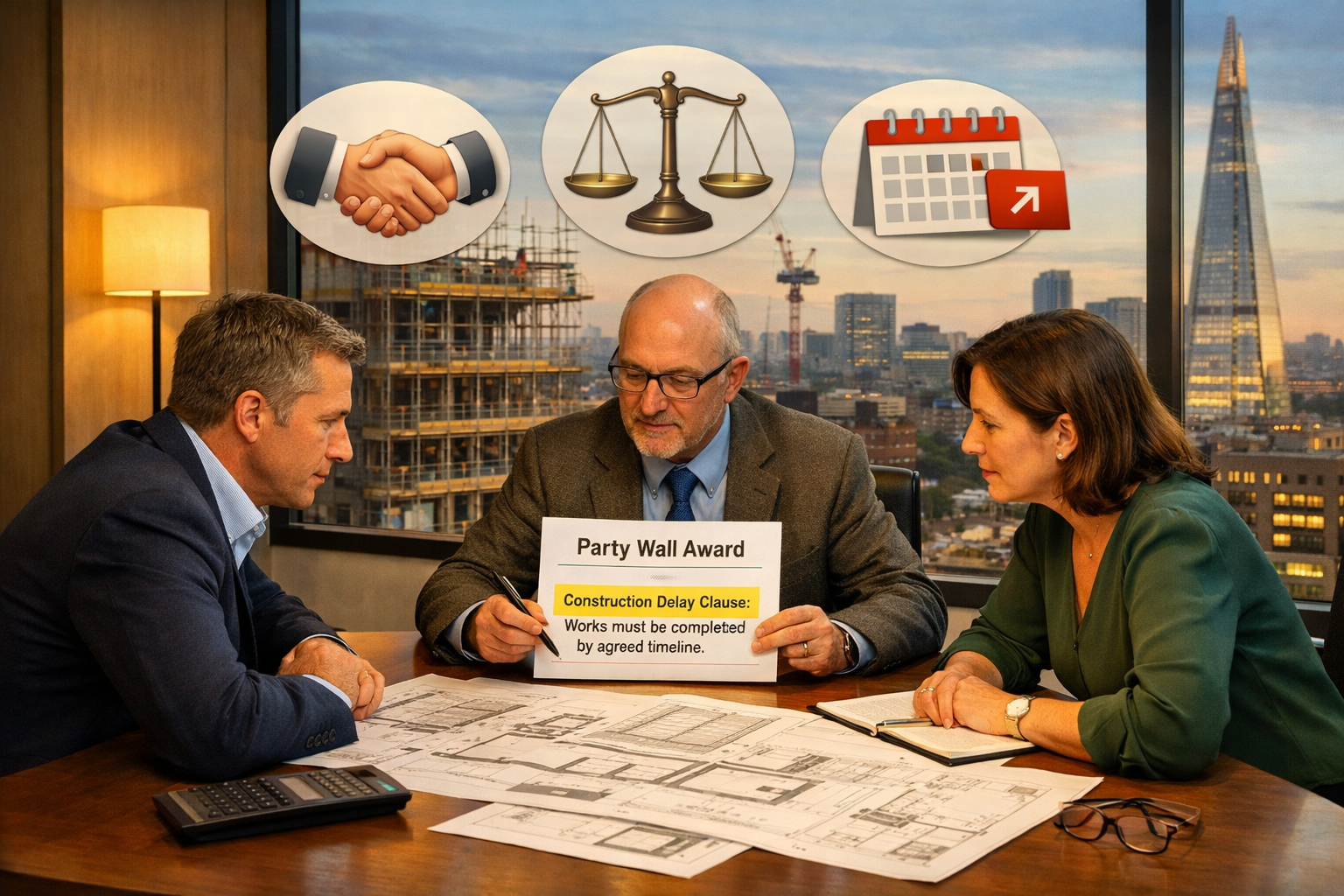
- Include extension clauses in party wall awards for documented labor delays
- Establish cost-sharing frameworks that are fair when material and labor prices fluctuate
- Monitor work quality to ensure labor shortages don't compromise structural integrity
- Mediate disputes before they escalate to costly legal proceedings
Finding experienced surveyors in high-demand areas like Central London, West London, or East London requires early engagement, as surveyors themselves face scheduling constraints.
Crafting Flexible Party Wall Awards
Party wall awards are legal documents that set out the rights and responsibilities of both building owners and adjoining owners. In 2026, these awards must address construction uncertainty more explicitly than ever before.
Key Clauses for Labor Shortage Scenarios:
| Clause Type | Purpose | Example Language |
|---|---|---|
| Timeline Extensions | Allow for documented delays due to labor unavailability | "Project timeline may be extended by up to 60 days upon written notice documenting contractor workforce constraints" |
| Cost Escalation Limits | Protect against unlimited cost increases | "Material and labor cost increases beyond 20% require renegotiation and adjoining owner consent" |
| Communication Requirements | Mandate regular updates during delays | "Building owner must provide written progress updates every 14 days if project extends beyond original timeline" |
| Quality Assurance | Ensure standards don't slip due to workforce pressures | "All party wall works must be completed by appropriately qualified tradespeople with documented credentials" |
| Remediation Rights | Address damage from rushed or substandard work | "Adjoining owner retains right to independent structural assessment if concerns arise about work quality" |
These provisions create flexibility while maintaining accountability—essential when construction schedules are inherently unpredictable[2].
Effective Dispute Resolution Tactics for 2026 Challenges
Even with proactive planning, disputes can arise. Resolving party wall disputes in 2026: strategies amid construction labor shortages requires understanding modern dispute resolution mechanisms that balance legal rights with practical constraints.
Mediation as a First Resort
Mediation involves a neutral third party facilitating discussions between building owners and adjoining owners to reach mutually acceptable solutions. In 2026's construction environment, mediation offers significant advantages over litigation[2][4].
Benefits of Mediation:
✅ Speed: Mediation sessions can be scheduled within weeks, compared to court proceedings that may take 6-12 months
✅ Cost-effectiveness: Mediation typically costs £1,500-£3,000, while litigation can exceed £20,000-£50,000
✅ Flexibility: Solutions can address unique circumstances like labor shortages that rigid legal frameworks may not accommodate
✅ Relationship preservation: Mediation focuses on collaborative problem-solving, helping neighbours maintain civil relations
✅ Confidentiality: Unlike court proceedings, mediation discussions remain private
When to Pursue Mediation:
- Disputes over reasonable project timeline extensions due to documented labor shortages
- Disagreements about cost allocation when material and labor prices have increased unexpectedly
- Conflicts regarding acceptable working hours when projects run longer than anticipated
- Concerns about work quality when contractors are stretched thin across multiple projects
Professional mediators with construction industry experience can help parties understand the realities of 2026's labor market while finding fair compromises. For guidance on keeping party wall costs down during mediation, consider consulting experienced professionals early in the process.
Arbitration for Cost Disputes
When mediation doesn't resolve financial disagreements, arbitration provides a binding resolution without full court proceedings. This is particularly valuable for disputes over labor cost increases and project budget overruns[1].
Arbitration Process:
- Selection of Arbitrator: Both parties agree on a construction industry expert to hear the dispute
- Evidence Submission: Each party presents documentation of costs, market rates, and contractor quotes
- Hearing: The arbitrator reviews evidence and may question both parties
- Binding Decision: The arbitrator issues a decision that both parties must accept
- Limited Appeals: Arbitration decisions can only be challenged on narrow legal grounds
Arbitration Best Practices for Labor Shortage Disputes:
- Document Everything: Maintain detailed records of contractor quotes, labor rate increases, and workforce availability issues
- Market Comparisons: Present evidence of prevailing labor rates in your area to demonstrate reasonableness
- Timeline Evidence: Show how labor shortages have affected similar projects in your region
- Good Faith Efforts: Demonstrate attempts to minimize costs despite market constraints
Arbitration typically concludes within 2-4 months and costs significantly less than litigation, making it an efficient option when financial disputes threaten project completion.
Negotiation Tactics for Extended Timelines
Direct negotiation between building owners and adjoining owners remains the most efficient dispute resolution method. In 2026's construction climate, successful negotiation requires acknowledging legitimate concerns while working within practical constraints.
Effective Negotiation Strategies:
1. Transparent Communication 💬
Building owners should proactively share:
- Detailed project schedules with realistic contingency periods
- Contractor availability updates as circumstances change
- Evidence of labor market constraints (contractor quotes, workforce reports)
- Plans for minimizing disruption during extended timelines
2. Compensation Frameworks
When projects extend beyond originally agreed timelines due to labor shortages, consider:
- Disruption payments: Modest financial compensation for extended inconvenience (£50-£200 per week)
- Accommodation assistance: Offering to cover temporary accommodation costs during particularly disruptive phases
- Property improvements: Funding minor improvements to adjoining property as goodwill gestures
- Reduced working hours: Limiting noisy work to minimize daily disruption when timelines extend
3. Milestone-Based Agreements
Rather than rigid completion dates, structure agreements around achievable milestones:
- Foundation work completion
- Party wall structural modifications completion
- Scaffolding and access equipment removal
- Final inspections and remediation
This approach acknowledges labor availability uncertainty while maintaining progress accountability[3].
4. Regular Review Meetings
Schedule monthly review meetings to:
- Assess progress against milestones
- Address emerging concerns before they escalate
- Adjust timelines based on actual contractor availability
- Maintain open communication channels
These meetings create accountability and demonstrate good faith efforts to minimize disruption despite challenging circumstances.
Case Studies: Resolving Party Wall Disputes in 2026 Amid Labor Shortages
Real-world examples illustrate how property owners are successfully navigating party wall challenges in 2026's construction environment.
Case Study 1: West London Loft Conversion Delay
Situation: A homeowner in West London planned a loft conversion requiring party wall works on a shared gable wall. The original timeline was 12 weeks, but the contractor's workforce was reduced by 40% due to labor shortages.
Challenges:
- Project timeline extended from 12 weeks to 20 weeks
- Adjoining owner had planned a family event during what should have been the completion period
- Labor costs increased by 18% mid-project
- Noise and disruption extended through summer months
Resolution Strategy:
The building owner engaged an independent party wall surveyor who:
- Documented the contractor's workforce constraints with employment records
- Negotiated a revised party wall award with a phased timeline
- Arranged for a two-week work pause during the adjoining owner's family event
- Established a £100/week disruption payment for the extended period
- Required weekly progress reports to maintain transparency
Outcome: The project completed in 21 weeks (one week beyond the revised timeline). The adjoining owner received £900 in disruption payments and appreciated the work pause for their event. Both parties maintained a positive relationship, and the building owner's total additional costs (£2,400 for surveyor fees, disruption payments, and extended insurance) were far less than potential litigation costs.
Key Lesson: Flexibility, transparency, and modest financial compensation can resolve disputes even when circumstances change dramatically.
Case Study 2: Central London Basement Excavation Conflict
Situation: A Central London property owner planned basement excavation requiring underpinning of the party wall. Specialized underpinning contractors were booked 6 months in advance due to high demand.
Challenges:
- Six-month delay before work could commence
- Adjoining owner concerned about extended uncertainty
- Property market concerns affecting both properties during prolonged construction
- Risk of contractor booking falling through if deposit terms weren't met
Resolution Strategy:
Rather than serving party wall notice immediately, the building owner:
- Secured contractor booking with deposit and penalty clauses
- Served notice only when contractor start date was confirmed
- Arranged for the schedule of condition to be completed just before work commenced (rather than months earlier)
- Offered to share the party wall surveyor's fees to demonstrate good faith
- Provided monthly updates during the waiting period
Outcome: By delaying formal notice until the contractor was secured, the building owner avoided creating months of unnecessary anxiety for the adjoining owner. The work proceeded smoothly once started, and the relationship between neighbours remained positive throughout.
Key Lesson: Timing party wall procedures to align with actual contractor availability can reduce stress and prevent disputes from arising during extended waiting periods.
Case Study 3: North London Multi-Property Development
Situation: A developer in North London was converting a commercial building into residential units, affecting party walls with three separate adjoining properties. Labor shortages meant the developer couldn't complete all party wall works simultaneously.
Challenges:
- Three different adjoining owners with varying concerns
- Phased construction timeline extending over 18 months
- Different contractors for different trades, each with availability constraints
- Risk of disputes if some neighbours received attention before others
Resolution Strategy:
The developer appointed a single independent party wall surveyor to work with all three adjoining owners:
- Created a master timeline showing when each property would be affected
- Established a communication protocol with monthly updates to all parties
- Offered identical disruption compensation packages to maintain fairness
- Scheduled party wall works in order of structural priority rather than convenience
- Created a shared dispute resolution process if issues arose
Outcome: By treating all adjoining owners equally and maintaining transparent communication, the developer completed the project with only minor disputes that were resolved through mediation. The consistent approach prevented any adjoining owner from feeling disadvantaged compared to others.
Key Lesson: Multi-party situations require extra coordination, but consistent treatment and transparent communication can prevent disputes even during complex, extended projects.
Legal Frameworks and Regulatory Considerations for 2026
Understanding the legal landscape is essential for resolving party wall disputes in 2026: strategies amid construction labor shortages. While the fundamental legal framework remains the Party Wall etc. Act 1996, its application in 2026's construction environment requires nuanced interpretation.
Party Wall etc. Act 1996 Fundamentals
The Party Wall etc. Act 1996 establishes three main categories of work requiring notice:
- New building on or at the boundary between properties
- Work to an existing party wall or party structure
- Excavation within 3 or 6 meters of a neighbouring building's foundation
For each category, specific notice periods and procedures apply. Building owners must serve appropriate party wall notices describing the proposed work and allowing adjoining owners to consent or dissent[6].
How Labor Shortages Affect Legal Compliance
The Act doesn't explicitly address construction delays or labor market conditions, creating interpretive challenges in 2026:
Notice Validity Periods: Party wall notices don't expire, but adjoining owners may question whether notices served months or years before work commences remain valid when circumstances have changed dramatically. Best practice involves serving updated notices if significant time has passed or project scope has changed.
Reasonable Timeframes: The Act requires building owners to complete work within reasonable timeframes. In 2026, "reasonable" must account for documented labor constraints. Party wall awards should explicitly define what constitutes reasonable progress given market conditions.
Cost Allocation: When labor shortages drive up costs, disputes may arise about which party bears increased expenses. The Act's cost allocation principles remain unchanged, but awards should address cost escalation scenarios proactively.
Access Rights: Building owners have statutory rights to access adjoining property for necessary work. However, extended timelines due to labor shortages may require renegotiating access arrangements that were originally agreed for shorter periods.
Emerging Legal Trends in 2026
Legal professionals are observing several trends in party wall disputes related to construction challenges:
Force Majeure Clauses: Some party wall awards now include force majeure provisions addressing extreme labor shortages, though courts have been reluctant to treat ordinary market conditions as force majeure events.
Liquidated Damages: Awards increasingly specify liquidated damages for delays beyond agreed extensions, creating financial incentives for building owners to maintain progress despite labor constraints.
Quality Standards: More awards explicitly require work to meet specific quality standards regardless of contractor availability, with independent inspection rights for adjoining owners.
Dispute Resolution Hierarchies: Modern awards often specify a progression from direct negotiation to mediation to arbitration, reducing the likelihood of costly court proceedings[7].
Working With Legal Professionals
Navigating party wall law in 2026's construction environment often requires professional guidance. When selecting legal advisors:
- Choose construction law specialists familiar with party wall matters
- Seek professionals with mediation experience to facilitate negotiations
- Prioritize advisors with current market knowledge who understand labor shortage impacts
- Consider fixed-fee arrangements to control legal costs during extended disputes
For those exploring having a party wall agreement without a surveyor, understand that while possible for simple projects, complex situations in 2026's challenging environment typically benefit from professional involvement.
Financial Strategies for Managing Dispute Costs
Resolving party wall disputes in 2026: strategies amid construction labor shortages requires careful financial planning. Disputes can quickly become expensive, and labor market challenges add financial uncertainty.
Budgeting for Party Wall Processes
Understanding the costs of party wall processes helps building owners plan appropriately:
Typical Cost Components:
| Cost Category | Typical Range | 2026 Considerations |
|---|---|---|
| Party Wall Surveyor Fees | £700-£1,500 per property | Higher in high-demand areas; expect 10-15% increases |
| Schedule of Condition | £300-£600 | May need updates if projects delay significantly |
| Party Wall Award Preparation | £500-£1,200 | More complex awards addressing labor shortages cost more |
| Mediation Services | £1,500-£3,000 | Cost-effective compared to litigation |
| Arbitration | £3,000-£8,000 | Depends on dispute complexity and arbitrator fees |
| Legal Representation | £200-£400/hour | Can escalate quickly; consider fixed-fee arrangements |
Budget Recommendations for 2026:
- Add 20-30% contingency to standard party wall budgets to account for potential delays and disputes
- Front-load surveyor engagement to prevent issues rather than resolving them later
- Consider dispute resolution insurance for large projects with multiple adjoining owners
- Negotiate fee caps with surveyors and legal advisors where possible
Cost-Sharing Negotiations
Party wall costs are typically borne by the building owner, but labor shortage scenarios create opportunities for creative cost-sharing arrangements:
Scenarios for Cost Sharing:
- Mutual Benefit Works: When party wall works benefit both properties (e.g., structural improvements, damp-proofing), costs may be shared proportionally
- Extended Protection Measures: If adjoining owners request monitoring or protection beyond standard requirements due to extended timelines, they may contribute to those specific costs
- Expedited Timelines: If adjoining owners want work completed faster than labor availability allows, they might contribute to premium labor rates
- Enhanced Remediation: When adjoining owners request improvements beyond restoring the status quo, cost-sharing may be appropriate
Negotiation Tips:
- Document all agreements in writing to prevent future disputes
- Use party wall awards to formalize cost-sharing arrangements
- Be transparent about actual costs with receipts and contractor quotes
- Consider tax implications of cost-sharing arrangements
Insurance Considerations
Construction insurance takes on added importance in 2026's challenging environment:
Essential Coverage Types:
🛡️ Contractor's All Risks Insurance: Covers damage during construction, essential when labor shortages may lead to rushed or substandard work
🛡️ Professional Indemnity Insurance: Protects against surveyor errors or omissions, important when complex awards address labor shortage scenarios
🛡️ Public Liability Insurance: Covers injury or property damage, crucial during extended construction periods with more exposure to risk
🛡️ Legal Expenses Insurance: May cover dispute resolution costs, though policies vary in party wall coverage
Insurance Best Practices:
- Verify contractor insurance before work commences, as some contractors may let coverage lapse during slow periods
- Notify insurers of timeline extensions to ensure coverage remains valid
- Document all pre-existing conditions thoroughly to support any future claims
- Review policy exclusions related to delays and labor shortages
Technology and Innovation in Party Wall Dispute Resolution
2026 brings technological innovations that can help prevent and resolve party wall disputes more efficiently, particularly valuable when construction timelines are uncertain.
Digital Communication Platforms
Specialized platforms now facilitate party wall communications:
- Shared project portals where building owners post updates, photos, and schedules
- Automated notification systems that alert adjoining owners to milestone completions
- Document repositories for party wall notices, awards, and schedules of condition
- Video conferencing for surveyor appointments and mediation sessions
These tools create transparency and maintain communication even during extended projects, reducing the likelihood of disputes arising from information gaps.
Structural Monitoring Technology
Advanced monitoring systems can reassure adjoining owners during prolonged construction:
- Vibration sensors that detect and record construction impacts on party walls
- Crack monitoring systems that track any structural movement in real-time
- Dust and noise monitors that document actual disruption levels
- Photographic documentation using time-lapse cameras to record work progress
This objective data can prevent disputes by demonstrating compliance with agreed standards, or can support claims if problems arise.
Virtual Surveys and Inspections
When scheduling in-person appointments is challenging due to surveyor availability, virtual alternatives include:
- Video-based condition surveys using high-resolution smartphone cameras
- 3D scanning technology to document existing conditions
- Drone inspections for roof and upper-story party wall assessments
- Remote expert consultations for specialized structural concerns
While not suitable for all situations, these technologies can accelerate processes and reduce costs when used appropriately.
Project Management Software
Construction project management platforms help building owners demonstrate good faith efforts to maintain schedules despite labor constraints:
- Gantt charts showing planned vs. actual timelines with labor availability annotations
- Resource allocation tracking demonstrating contractor scheduling challenges
- Cost tracking with labor rate documentation
- Communication logs showing regular updates to adjoining owners
This documentation can be invaluable during mediation or arbitration if disputes arise over project delays.
Preventing Future Disputes: Long-Term Strategies
Beyond resolving immediate conflicts, property owners should consider long-term strategies for minimizing party wall disputes in 2026's construction environment.
Building Positive Neighbour Relations
The foundation of dispute prevention is maintaining good relationships with adjoining property owners:
Relationship-Building Tactics:
- Meet neighbours before serving formal notices to discuss plans informally
- Share contact information for direct communication outside formal channels
- Acknowledge inconvenience and express genuine appreciation for patience
- Provide small gestures like offering to water gardens during access periods
- Keep promises about timelines, working hours, and disruption levels
Strong relationships create goodwill that can weather unexpected challenges when labor shortages extend projects beyond original plans.
Selecting Reliable Contractors
Contractor selection significantly impacts party wall dispute likelihood:
Contractor Evaluation Criteria:
✓ Workforce stability: Contractors with permanent employees rather than entirely subcontracted workforces may be more reliable
✓ Party wall experience: Contractors familiar with party wall requirements make fewer mistakes that create disputes
✓ Communication skills: Contractors who can explain work to concerned neighbours prevent misunderstandings
✓ Insurance coverage: Adequate insurance protects all parties if problems arise
✓ References from party wall projects: Verify contractors have successfully completed similar work without disputes
✓ Realistic scheduling: Contractors who acknowledge labor constraints and provide honest timelines are preferable to those making unrealistic promises
In 2026's tight labor market, the cheapest contractor is rarely the best choice. Investing in reliable professionals prevents costly disputes that far exceed any initial savings.
Documenting Everything
Comprehensive documentation prevents disputes and supports resolution when they occur:
Essential Documentation:
📋 Pre-construction photographs and videos of party walls and adjoining property conditions
📋 All party wall notices, responses, and correspondence in chronological order
📋 Contractor quotes, agreements, and change orders showing cost and timeline evolution
📋 Schedules of condition prepared by independent surveyors
📋 Progress reports and photos throughout construction
📋 Communication logs with dates, times, and content of all neighbour interactions
📋 Contractor workforce records documenting labor availability issues
📋 Material and labor cost receipts supporting budget increase claims
This documentation creates a factual record that supports fair dispute resolution and demonstrates good faith efforts to comply with party wall requirements.
Understanding Different Types of Party Wall Works
Different types of party wall works carry different dispute risks. Understanding these distinctions helps property owners plan appropriately:
Lower-Risk Works:
- Minor repairs to party walls
- Repointing or replastering
- Installing insulation on one side of a party wall
Higher-Risk Works:
- Structural alterations to party walls
- Underpinning or foundation work near party walls
- Demolition and rebuilding of party structures
- Excavations within 3-6 meters of adjoining buildings
Higher-risk works require more careful planning, more comprehensive party wall awards, and greater attention to contractor selection—all especially important when labor shortages may compromise work quality or extend timelines.
Conclusion: Navigating Party Wall Challenges in 2026's Construction Landscape
Resolving party wall disputes in 2026: strategies amid construction labor shortages requires a fundamental shift from traditional approaches. The construction industry's workforce challenges aren't temporary disruptions—they represent a new normal that property owners, contractors, and legal professionals must acknowledge and accommodate.
The strategies outlined in this guide provide a roadmap for success:
Proactive Prevention through early notice service, transparent communication, and realistic timeline planning prevents most disputes from arising. In an environment where construction schedules are inherently uncertain, honesty about constraints builds trust that can weather unexpected challenges.
Flexible Agreements that acknowledge labor market realities through extension clauses, milestone-based timelines, and cost escalation provisions create frameworks that accommodate change without triggering disputes. Party wall awards must evolve beyond rigid specifications to address 2026's dynamic construction environment.
Efficient Dispute Resolution through mediation, arbitration, and negotiation resolves conflicts faster and more cost-effectively than litigation. When construction timelines are already extended, adding months or years of court proceedings benefits no one.
Professional Guidance from experienced party wall surveyors, mediators, and construction law specialists provides expertise that prevents costly mistakes and facilitates fair outcomes. The investment in professional fees is minimal compared to the potential costs of unresolved disputes.
Relationship Focus that prioritizes maintaining positive neighbour relations creates goodwill that can overcome the frustrations of extended construction periods. Property owners who acknowledge inconvenience, communicate regularly, and demonstrate genuine efforts to minimize disruption find neighbours more willing to accommodate unavoidable delays.
Actionable Next Steps
For property owners planning construction work affecting party walls in 2026:
-
Assess your project realistically by consulting contractors about current labor availability and obtaining multiple quotes that reflect market conditions
-
Engage a party wall surveyor early to understand requirements, prepare appropriate notices, and develop awards that address labor shortage scenarios
-
Meet with adjoining owners informally before serving formal notices to discuss plans, acknowledge potential challenges, and build positive relationships
-
Budget for contingencies including extended timelines, potential disputes, and professional fees that may exceed historical norms
-
Document everything from initial planning through project completion to support fair dispute resolution if needed
-
Consider mediation clauses in party wall awards to establish efficient dispute resolution processes before conflicts arise
-
Monitor progress actively and communicate regularly with all parties to address concerns before they escalate into formal disputes
For adjoining owners receiving party wall notices in 2026:
-
Respond promptly to notices to preserve your rights and enable proper planning
-
Consider appointing your own surveyor or agreeing to an independent surveyor to protect your interests
-
Document existing conditions thoroughly through photographs, videos, and professional surveys
-
Ask questions about timelines, labor availability, and contingency plans for delays
-
Negotiate reasonable protections including progress reporting requirements and dispute resolution mechanisms
-
Maintain communication with building owners throughout the process rather than waiting for problems to arise
-
Know your rights under the Party Wall etc. Act 1996 while remaining flexible about reasonable accommodations for documented labor constraints
The construction labor shortage of 2026 creates challenges, but it also creates opportunities for innovation in how neighbours work together during building projects. By acknowledging constraints, planning proactively, communicating transparently, and focusing on fair outcomes rather than rigid positions, property owners can successfully navigate party wall matters even in this challenging environment.
The party wall process, when handled properly, protects everyone's interests while enabling necessary construction work to proceed. In 2026's labor-constrained market, success requires patience, flexibility, and professionalism from all parties—but the result is construction that enhances properties while preserving neighbourly relationships that will last long after the scaffolding comes down.
References
[1] Common Party Wall Disputes And How To Resolve Them Effectively – https://www.partywallslimited.com/blog/common-party-wall-disputes-and-how-to-resolve-them-effectively
[2] Preventing And Resolving Disputes In Relation To Party Walls – https://www.adamjoseph.co.uk/preventing-and-resolving-disputes-in-relation-to-party-walls
[3] 3 Ways To Avoid Party Wall Disputes – https://www.goodkinlaw.com/blogs/8245/3-ways-to-avoid-party-wall-disputes
[4] How To Resolve Boundary Disputes Between Adjacent Property Owners – https://confidantconsult.com/resources/blog/how-to-resolve-boundary-disputes-between-adjacent-property-owners/
[5] How To Make The Party Wall Process Run Smoothly – https://urbanistarchitecture.co.uk/how-to-make-the-party-wall-process-run-smoothly/
[6] Party Wall Disputes – https://collyerbristow.com/real-estate/real-estate-disputes/party-wall-disputes/
[7] Commercial Real Estate Disputes In 2026 Whats Coming Into View – https://www.ashurst.com/en/insights/commercial-real-estate-disputes-in-2026-whats-coming-into-view/