


{"cover":"Professional landscape format (1536x1024) hero image featuring bold text overlay 'Resolving Party Wall Disputes in High-Density 2026 Urban Projects: Surveyor Best Practices' in extra large 72pt white sans-serif font with dark shadow and semi-transparent navy overlay box, positioned in upper third center. Background shows dramatic aerial view of densely packed London urban buildings with shared walls, construction cranes, modern high-rise developments, and terraced houses showcasing party wall boundaries. Color scheme: deep navy blue, white text, orange construction accents. High contrast, editorial magazine cover quality, professional architectural photography style with sharp focus on building adjacencies and urban density.","content":["Landscape format (1536x1024) detailed illustration showing professional party wall surveyor in hard hat and high-visibility vest conducting property inspection between two adjacent buildings in dense urban setting, holding clipboard with schedule of condition documentation, measuring tape extended along shared wall, digital tablet displaying building plans, close-up of brick party wall with measurement annotations, professional documentation tools, modern London terraced houses background, natural lighting, technical accuracy, business professional aesthetic with construction site elements.","Landscape format (1536x1024) comprehensive infographic displaying party wall dispute resolution flowchart with multiple pathways: neighbor agreement path versus dissent path, timeline markers showing 2-month notice period, surveyor appointment stages, award preparation process, dispute escalation scenarios. Visual elements include document icons for party wall notices, surveyor appointment letters, party wall awards, calendar symbols, cost comparison boxes showing single versus multiple surveyor fees, professional color scheme of navy blue, orange, and white, clean modern design with clear hierarchical structure and directional arrows.","Landscape format (1536x1024) professional scene showing party wall award enforcement in high-density urban construction project: split-screen composition with left side displaying detailed schedule of condition report with property photographs, structural annotations, crack measurements, and timestamp documentation; right side showing active construction site with protective measures, monitoring equipment, construction workers following award specifications, safety barriers, and compliance checkpoints. Include document close-ups, measurement tools, professional surveyor reviewing compliance, modern urban development background, technical precision, authoritative business aesthetic."]}
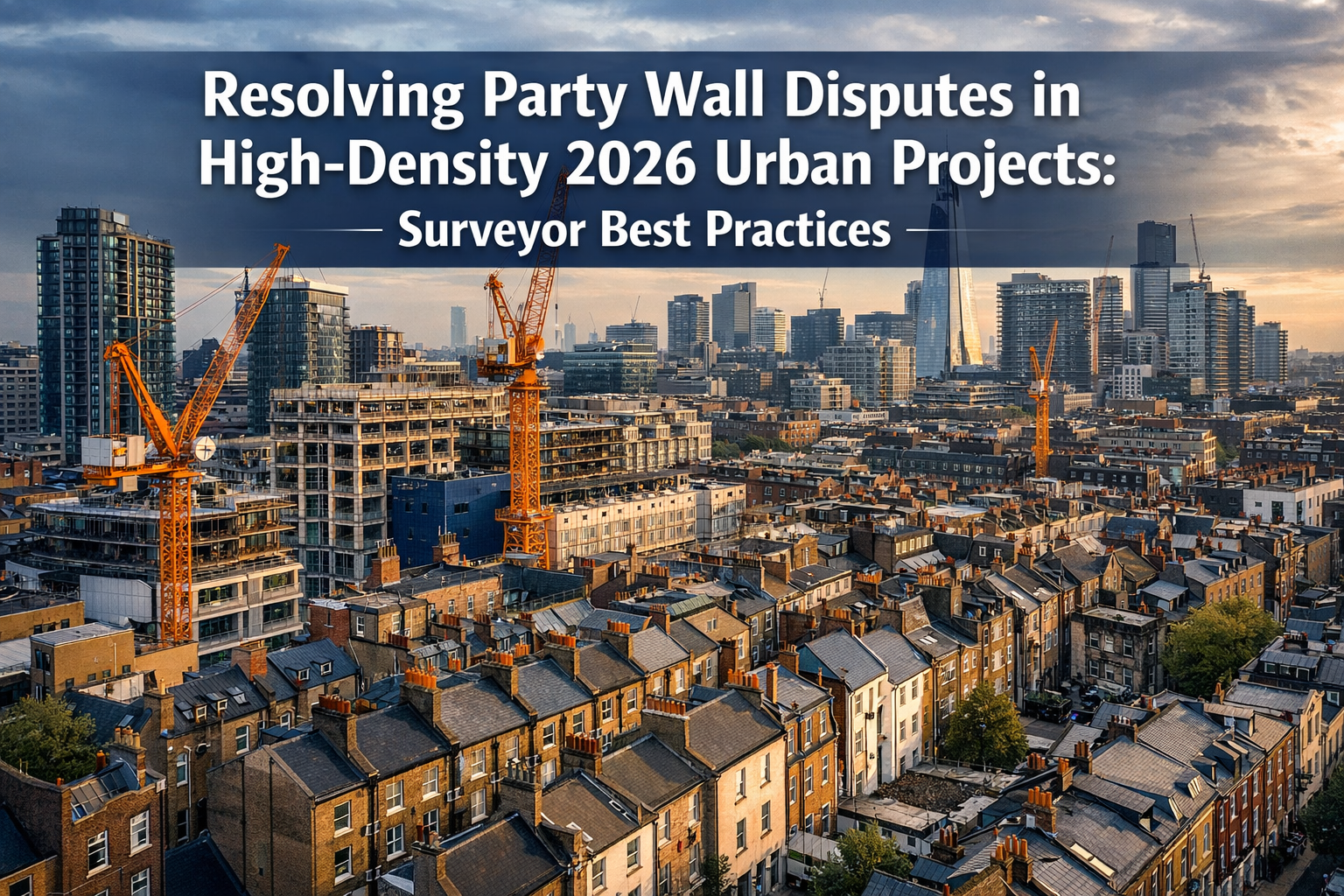
In the heart of London's bustling urban landscape, where buildings stand shoulder-to-shoulder and construction cranes dominate the skyline, a seemingly simple renovation can quickly become a legal minefield. Picture this: a homeowner in Central London decides to extend their Victorian terrace, only to face fierce opposition from neighbors concerned about structural damage. This scenario plays out hundreds of times each year across high-density urban areas, making Resolving Party Wall Disputes in High-Density 2026 Urban Projects: Surveyor Best Practices more critical than ever for property developers, homeowners, and construction professionals navigating the complexities of shared boundaries.
As urban densification accelerates in 2026, the importance of professional party wall surveyors has never been more pronounced. These specialists serve as mediators, technical advisors, and legal interpreters, ensuring that construction projects proceed smoothly while protecting the rights of all parties involved. Understanding the best practices for dispute resolution can save thousands of pounds, prevent costly delays, and maintain neighborly relationships in crowded city environments.
Key Takeaways
✅ Professional surveyors accredited by RICS or the Faculty of Party Wall Surveyors are essential for navigating complex party wall legislation in high-density developments[1]
✅ Proper notice timing is critical—serve party wall notices 2 months before construction (1 month for excavation) to avoid legal complications[1][5]
✅ Comprehensive schedules of condition protect both building and adjoining owners by documenting pre-construction property states with photographic evidence
✅ Party wall awards must include detailed drawings, method statements, working hour restrictions, and damage remediation provisions to prevent future disputes[4]
✅ Early engagement and transparent communication significantly reduce the likelihood of disputes escalating to costly multi-surveyor appointments
Understanding Party Wall Legislation in 2026 Urban Contexts
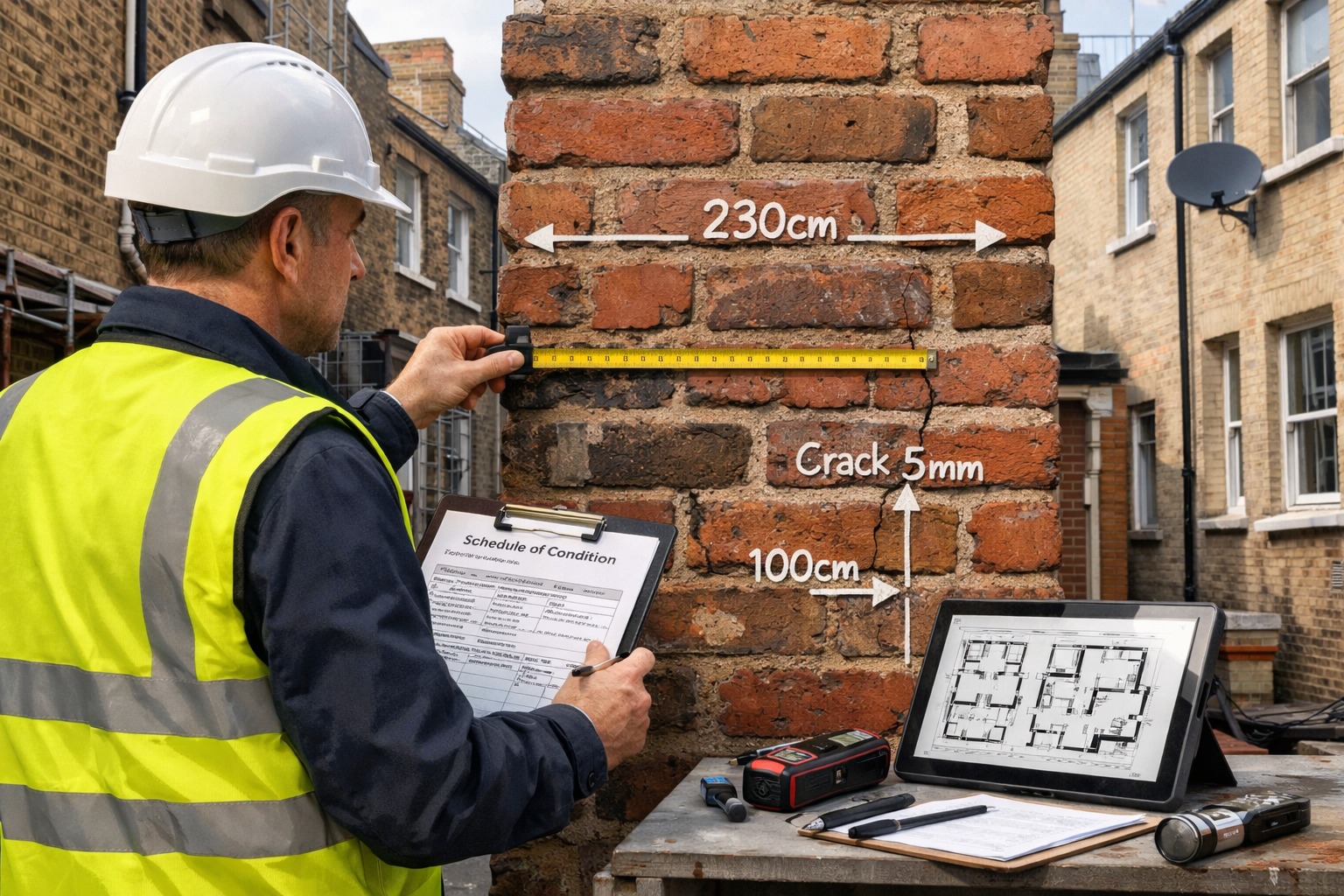
The Party Wall etc. Act 1996 remains the cornerstone of party wall legislation in England and Wales, but its application in 2026's high-density urban environments presents unique challenges. The Act governs three primary types of work: building on or at the boundary line, work directly to an existing party wall, and excavation within specific distances of neighboring structures.
What Constitutes a Party Wall Dispute?
A party wall dispute arises when a building owner (the person undertaking construction work) and an adjoining owner (the neighbor) cannot reach agreement about proposed works affecting shared structures. In densely populated areas like Central London, North London, or South London, these disputes can involve:
- 🏗️ Structural alterations to shared walls between terraced or semi-detached properties
- 🔨 Basement excavations that may affect neighboring foundations
- 📐 New boundary walls built at the property line
- 🏢 High-rise developments impacting multiple adjacent properties simultaneously
The complexity intensifies in 2026 urban projects where buildings are closely packed, construction sites are confined, and the potential for disruption affects numerous stakeholders.
The Role of Professional Party Wall Surveyors
Professional party wall surveyors act as impartial technical experts who ensure compliance with the Party Wall etc. Act 1996. According to industry standards, qualified surveyors should hold accreditation from respected bodies such as RICS (Royal Institution of Chartered Surveyors) or the Faculty of Party Wall Surveyors[1].
These professionals perform several critical functions:
| Surveyor Responsibility | Description | Impact on Dispute Resolution |
|---|---|---|
| Technical Assessment | Evaluate proposed works and potential impacts | Provides objective analysis of risks |
| Notice Preparation | Draft and serve proper party wall notices | Ensures legal compliance from the outset |
| Award Drafting | Create comprehensive party wall awards | Establishes clear parameters for work |
| Condition Surveys | Document pre-construction property state | Protects all parties from false claims |
| Dispute Mediation | Facilitate communication between parties | Reduces escalation and legal costs |
The expertise that surveyors bring becomes particularly valuable when dealing with types of party wall works in constrained urban environments where traditional construction methods may need adaptation.
Best Practices for Resolving Party Wall Disputes in High-Density 2026 Urban Projects: Surveyor Best Practices
Effective dispute resolution in crowded urban settings requires a strategic approach that combines legal knowledge, technical expertise, and interpersonal skills. Drawing from insights shared by RICS experts and the Pyramus & Thisbe Society[2], professional surveyors have developed proven methodologies for navigating contentious situations.
Early Engagement and Transparent Communication
The foundation of successful dispute resolution begins long before the first brick is laid. Proactive communication stands as the single most effective strategy for preventing disputes from escalating.
Best Practice #1: Pre-Notice Consultation
Before serving formal party wall notices, experienced surveyors recommend informal discussions with adjoining owners. This approach:
- Explains the proposed works in accessible language
- Addresses concerns before they become formal objections
- Builds trust and demonstrates respect for neighbors' interests
- Identifies potential issues that can be resolved through design modifications
Best Practice #2: Comprehensive Notice Documentation
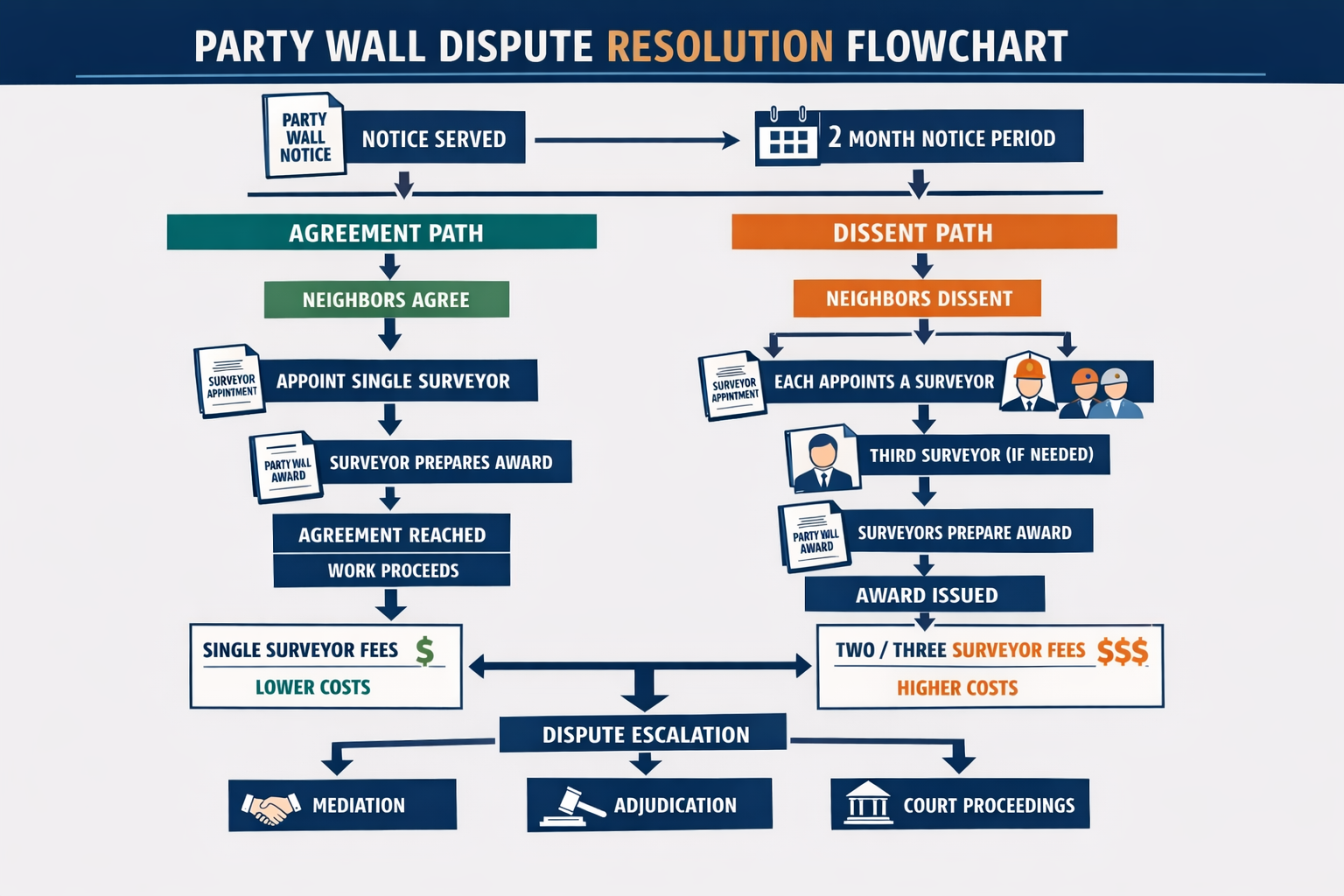
When formal notices must be served, precision matters. Party wall notices must be served 2 months before construction work begins (or 1 month for excavation work)[1][5]. The notice should include:
✔️ Detailed descriptions of proposed works with architectural drawings
✔️ Expected start dates and project duration
✔️ Contact information for the building owner and their surveyor
✔️ Clear explanation of the adjoining owner's rights and response options
Many disputes arise from inadequate or confusing notices. Professional surveyors ensure that documentation meets legal requirements while remaining comprehensible to non-technical recipients.
Appointing the Right Surveyors
The surveyor appointment process significantly influences dispute outcomes. When an adjoining owner dissents to proposed works, the Act provides three options:
- Agreed Surveyor: Both parties appoint a single surveyor to act impartially
- Two Surveyors: Each party appoints their own surveyor, who then select a third surveyor
- Default Appointment: If the adjoining owner doesn't respond, the building owner may appoint a surveyor on their behalf
Cost Implications
Standard surveyor fees range from £850 to £1,300 per surveyor for average projects, based on 7-9 hours of work[2]. However, when neighbors dissent and multiple surveyors become involved, costs can escalate significantly[1][2]. Understanding how to keep party wall costs down becomes essential for budget-conscious projects.
The agreed surveyor approach offers the most cost-effective solution, but requires mutual trust. In high-density urban areas where relationships may already be strained, this option isn't always viable.
Preparing Thorough Schedules of Condition
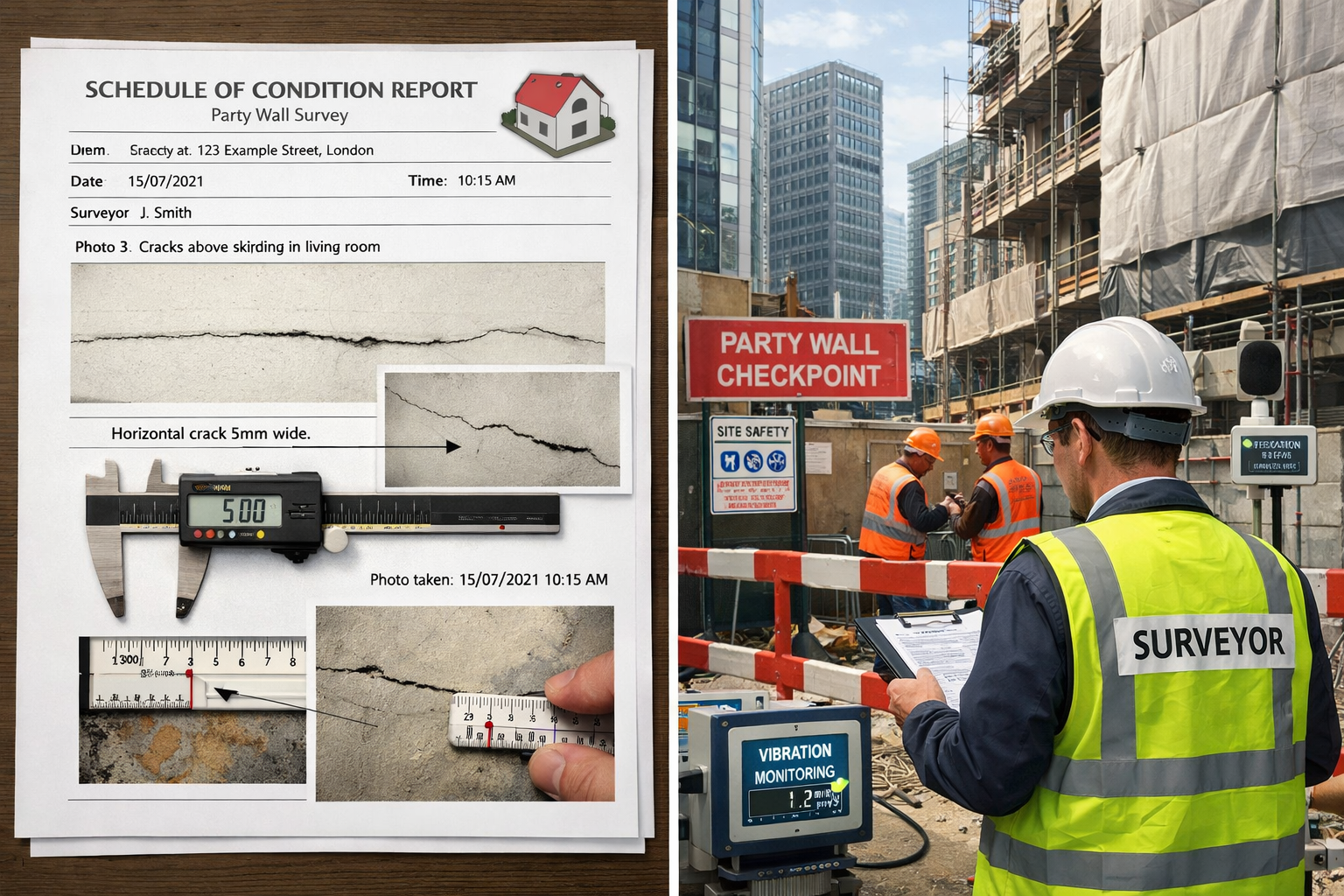
A schedule of condition represents one of the most powerful tools for preventing and resolving disputes. This detailed photographic and written record documents the existing state of the adjoining owner's property before construction begins.
Components of an Effective Schedule:
📸 High-quality photographs of all rooms, external elevations, and existing defects
📝 Written descriptions of structural conditions, cracks, settlements, and finishes
📏 Measurements of existing cracks or damage with precise locations
🗓️ Timestamps establishing the pre-construction baseline
Professional surveyors create comprehensive schedules of condition that serve multiple purposes:
- Evidence Protection: Provides irrefutable proof of pre-existing conditions
- Dispute Prevention: Eliminates false claims of construction-related damage
- Insurance Documentation: Supports claims if genuine damage occurs
- Relationship Management: Demonstrates professionalism and respect for neighbors' property
In 2026's litigious environment, the investment in thorough condition surveys pays dividends by preventing costly disputes over alleged damage.
Drafting Comprehensive Party Wall Awards
The party wall award serves as the legally binding document that governs how construction work proceeds. Awards typically include relevant drawings, method statements, condition schedules, working hour restrictions, and provisions for damage remediation[4].
Essential Award Components:
| Award Section | Purpose | Best Practice Guidelines |
|---|---|---|
| Works Description | Define permitted activities | Use precise technical language with reference drawings |
| Access Rights | Specify entry permissions | Include reasonable notice periods and timing restrictions |
| Working Hours | Limit noise and disruption | Consider local authority regulations and special circumstances |
| Protective Measures | Prevent damage | Detail specific protection methods for sensitive structures |
| Monitoring Provisions | Track structural movement | Specify crack monitoring, vibration limits, and inspection schedules |
| Dispute Resolution | Address future disagreements | Establish clear procedures for raising concerns |
Expert surveyors recognize that awards must balance the building owner's right to develop their property with the adjoining owner's right to protection. Overly restrictive awards can make projects impractical, while inadequate provisions leave neighbors vulnerable.
Advanced Dispute Resolution Strategies for Complex Urban Projects
High-density 2026 urban developments often involve multiple adjoining owners, complex structural considerations, and significant financial stakes. These scenarios demand sophisticated resolution strategies beyond standard procedures.
Managing Multi-Party Disputes
When a single project affects numerous neighbors—common in East London and West London terraced developments—coordination becomes paramount.
Strategy #1: Consolidated Communication
Rather than managing each adjoining owner separately, experienced surveyors organize group meetings where:
- All affected parties receive consistent information
- Common concerns are addressed collectively
- Neighbors can see that others' interests are being protected
- Economies of scale reduce individual costs
Strategy #2: Phased Award Approach
For large-scale developments, surveyors may recommend phased awards that:
- Address immediate works requiring urgent attention
- Allow time for detailed engineering solutions to complex issues
- Provide flexibility as project circumstances evolve
- Reduce upfront costs while maintaining legal compliance
Leveraging Technology for Dispute Prevention
Modern surveyors in 2026 employ advanced tools that weren't available when the Party Wall Act was drafted:
🖥️ Digital Condition Surveys: High-resolution photography, 3D scanning, and drone imagery create irrefutable baseline documentation
📊 Structural Monitoring Systems: Real-time sensors detect movement, vibration, and settlement during construction, providing objective data
📱 Communication Platforms: Secure portals allow all parties to access project updates, inspection reports, and documentation
🎯 Building Information Modeling (BIM): Detailed 3D models help neighbors visualize proposed works and understand impact mitigation measures
These technological solutions enhance transparency and provide objective evidence that can prevent disputes from arising or resolve them quickly when they do occur.
Enforcement and Remediation Procedures
Despite best efforts, some projects result in damage to adjoining properties. Professional surveyors establish clear enforcement mechanisms within awards:
Damage Assessment Protocol:
- Immediate Notification: Adjoining owners report concerns promptly
- Joint Inspection: Surveyors from both parties assess the situation together
- Cause Determination: Technical analysis establishes whether damage relates to party wall works
- Remediation Specification: Surveyors agree on appropriate repair methods
- Quality Verification: Final inspection confirms satisfactory completion
The building owner typically bears responsibility for genuine construction-related damage, making proper insurance coverage essential. Surveyors should verify that adequate public liability and professional indemnity insurance is in place before works commence.
Alternative Dispute Resolution Mechanisms
When standard surveyor-led processes fail to resolve disagreements, several escalation options exist:
Third Surveyor Determination
In the two-surveyor model, disputes between the appointed surveyors are resolved by the third surveyor they jointly selected. This professional makes binding determinations on contested matters, providing resolution without court involvement.
Mediation Services
For particularly contentious situations, formal mediation by a neutral third party can help parties find common ground. While not specifically mentioned in the Act, mediation has proven effective in preserving relationships while achieving practical solutions.
Court Proceedings
As a last resort, parties may appeal surveyor decisions to the County Court within 14 days. However, litigation is expensive, time-consuming, and unpredictable—making it the least desirable option for all involved.
Professional surveyors emphasize that the vast majority of disputes can be resolved through competent technical assessment, clear communication, and reasonable compromise, making court proceedings rare.
Implementing Surveyor Best Practices: A Practical Framework
For surveyors, developers, and property owners navigating party wall matters in 2026's high-density urban environments, implementing a structured framework ensures consistent, professional outcomes.
Pre-Construction Phase Checklist
✅ Engage qualified surveyor with relevant accreditation and urban project experience
✅ Conduct preliminary neighbor consultation before formal notices
✅ Prepare detailed drawings and specifications for proposed works
✅ Serve legally compliant notices within required timeframes
✅ Respond promptly to adjoining owner questions and concerns
✅ Arrange comprehensive schedules of condition for all affected properties
✅ Secure appropriate insurance coverage for the project
During Construction Best Practices
🔍 Regular monitoring: Implement agreed inspection schedules
📞 Open communication channels: Maintain accessible contact for concerns
🛡️ Protective measures compliance: Ensure contractors follow award specifications
📸 Photographic documentation: Record work progress and protective installations
⚠️ Immediate issue response: Address problems before they escalate
Post-Construction Procedures
🔎 Final joint inspection with all surveyors to confirm satisfactory completion
📋 Damage assessment comparing final condition to baseline schedules
🔧 Remediation completion for any construction-related damage
📄 Documentation archival for future reference and potential disputes
🤝 Relationship closure with professional courtesy and thanks
Common Pitfalls to Avoid
Even experienced professionals can fall into traps that exacerbate disputes. Awareness of these common mistakes helps surveyors maintain best practices:
❌ Inadequate notice descriptions that leave neighbors confused about proposed works
❌ Rushed schedules of condition that miss existing defects later blamed on construction
❌ Vague award language creating ambiguity about permitted activities
❌ Poor contractor communication where site workers don't understand award requirements
❌ Delayed response to concerns allowing minor issues to become major disputes
❌ Assuming cooperation rather than documenting all agreements in writing
Understanding whether having a party wall agreement without a surveyor is advisable helps parties make informed decisions about professional engagement.
Professional Development and Continuing Education
The party wall field continues evolving with new case law, construction techniques, and urban development patterns. Leading surveyors in 2026 maintain expertise through:
📚 Continuing Professional Development (CPD) courses addressing emerging issues
🎓 RICS Building Surveying Conferences featuring expert presentations on best practices[6]
💬 Professional networks like the Faculty of Party Wall Surveyors for knowledge sharing
📖 Case law analysis understanding how courts interpret the Act in novel situations
🔬 Technical training on new construction methods and monitoring technologies
This commitment to ongoing learning ensures surveyors can handle increasingly complex urban projects with confidence and competence.
Conclusion: Excellence in Party Wall Dispute Resolution
As urban densification continues reshaping cities in 2026, the role of professional party wall surveyors becomes increasingly vital to successful development. Resolving Party Wall Disputes in High-Density 2026 Urban Projects: Surveyor Best Practices requires a sophisticated blend of technical knowledge, legal understanding, communication skills, and practical experience.
The most effective surveyors recognize that their primary objective extends beyond mere legal compliance—they facilitate construction projects that respect all parties' rights while maintaining community relationships in crowded urban environments. By implementing the best practices outlined in this guide, surveyors can:
🎯 Prevent disputes through early engagement and transparent communication
💰 Control costs by avoiding unnecessary multi-surveyor appointments
⚖️ Ensure fairness through impartial technical assessment
🏗️ Enable development while protecting adjoining owners' interests
🤝 Preserve relationships between neighbors sharing party walls
Actionable Next Steps
For Building Owners Planning Construction:
- Engage a qualified party wall surveyor at the project planning stage, not as an afterthought
- Review the costs of party wall processes to budget appropriately
- Initiate informal neighbor discussions before serving formal notices
- Ensure your contractor understands and commits to following award specifications
For Adjoining Owners Receiving Notices:
- Respond promptly to party wall notices—silence can limit your options
- Consider appointing your own surveyor to protect your interests
- Request a comprehensive schedule of condition before works begin
- Maintain open communication with the building owner's surveyor
For Professional Surveyors:
- Invest in continuing education to stay current with evolving best practices
- Leverage technology for more thorough documentation and monitoring
- Develop strong communication skills to complement technical expertise
- Build relationships with other professionals for complex multi-party situations
The party wall process, when managed by competent professionals following established best practices, protects property rights, prevents costly disputes, and enables the urban development that cities need. As London and other high-density areas continue growing vertically and intensively, the surveyor's role as mediator, technical expert, and problem-solver will only become more essential.
By embracing these best practices and maintaining the highest professional standards, party wall surveyors ensure that 2026's ambitious urban projects proceed smoothly, fairly, and successfully—benefiting building owners, adjoining owners, and the broader community alike.
References
[1] Mastering Party Wall Agreements A Comprehensive Breakdown For Homeowners – https://kandasurveyors.co.uk/about-surveys/mastering-party-wall-agreements-a-comprehensive-breakdown-for-homeowners/
[2] A Comprehensive Guide To Party Wall Agreements – https://www.risedesignstudio.co.uk/blog/a-comprehensive-guide-to-party-wall-agreements
[3] Knowledge Article Party Wall Notice – https://www.aylingassociates.com/knowledge-article-party-wall-notice.html
[4] Surveying Party Walls – https://www.isurv.com/downloads/20/surveying_party_walls
[5] How To Invoke The Party Wall Act And Can Surveyors Determine That It Doesnt Apply – https://www.adamjoseph.co.uk/how-to-invoke-the-party-wall-act-and-can-surveyors-determine-that-it-doesnt-apply
[6] Rics Building Surveying Conference – https://www.rics.org/training-events/conferences/rics-building-surveying-conference
[7] Faqs – https://westvilleassociates.com/party-wall-surveyor/faqs
[8] Three Steps To Becoming A Great Party Wall Surveyor With Alistair Redler – https://partywallpro.co.uk/podcast/three-steps-to-becoming-a-great-party-wall-surveyor-with-alistair-redler/
