
When a neighbour's building project threatens to shake the foundations of your property—literally and figuratively—the party wall surveyor becomes the crucial mediator between cooperation and costly legal battles. Yet this trusted professional faces an increasingly complex ethical landscape in 2026, where traditional independence requirements now intersect with artificial intelligence governance, enhanced professional development standards, and evolving expectations for transparency. Understanding RICS Ethical Standards in Party Wall Surveying: Avoiding Conflicts in 2026 has never been more critical for property owners, building professionals, and surveyors themselves.
The Royal Institution of Chartered Surveyors (RICS) has fundamentally reshaped its ethical framework over recent years, with landmark changes taking effect throughout 2026 that directly impact how party wall surveyors navigate conflicts of interest, maintain independence, and serve their clients under the Party Wall etc. Act 1996[1]. These standards don't merely supplement legal requirements—they establish a higher professional benchmark that RICS members must meet to maintain their chartered status[1].
Key Takeaways
- ✅ New AI Governance Standard takes effect March 9, 2026, requiring party wall surveyors to demonstrate transparency, accountability, and fairness when using artificial intelligence tools[2][8]
- ✅ Enhanced CPD Framework launched January 2026 shifts focus from hour-counting to demonstrating genuine professional growth and improved practice quality[3]
- ✅ Five Core Ethical Principles—honesty, integrity, competence, service, and respect—form the foundation of all RICS member conduct in party wall work[4]
- ✅ Independence Requirements demand surveyors avoid conflicts of interest and maintain objectivity even when appointed by one party under the Act[1]
- ✅ Professional Standards Exceed Legal Minimums, requiring RICS members to deliver higher-quality service than the Party Wall etc. Act 1996 technically mandates[1]
Understanding the RICS Ethical Framework for Party Wall Surveyors
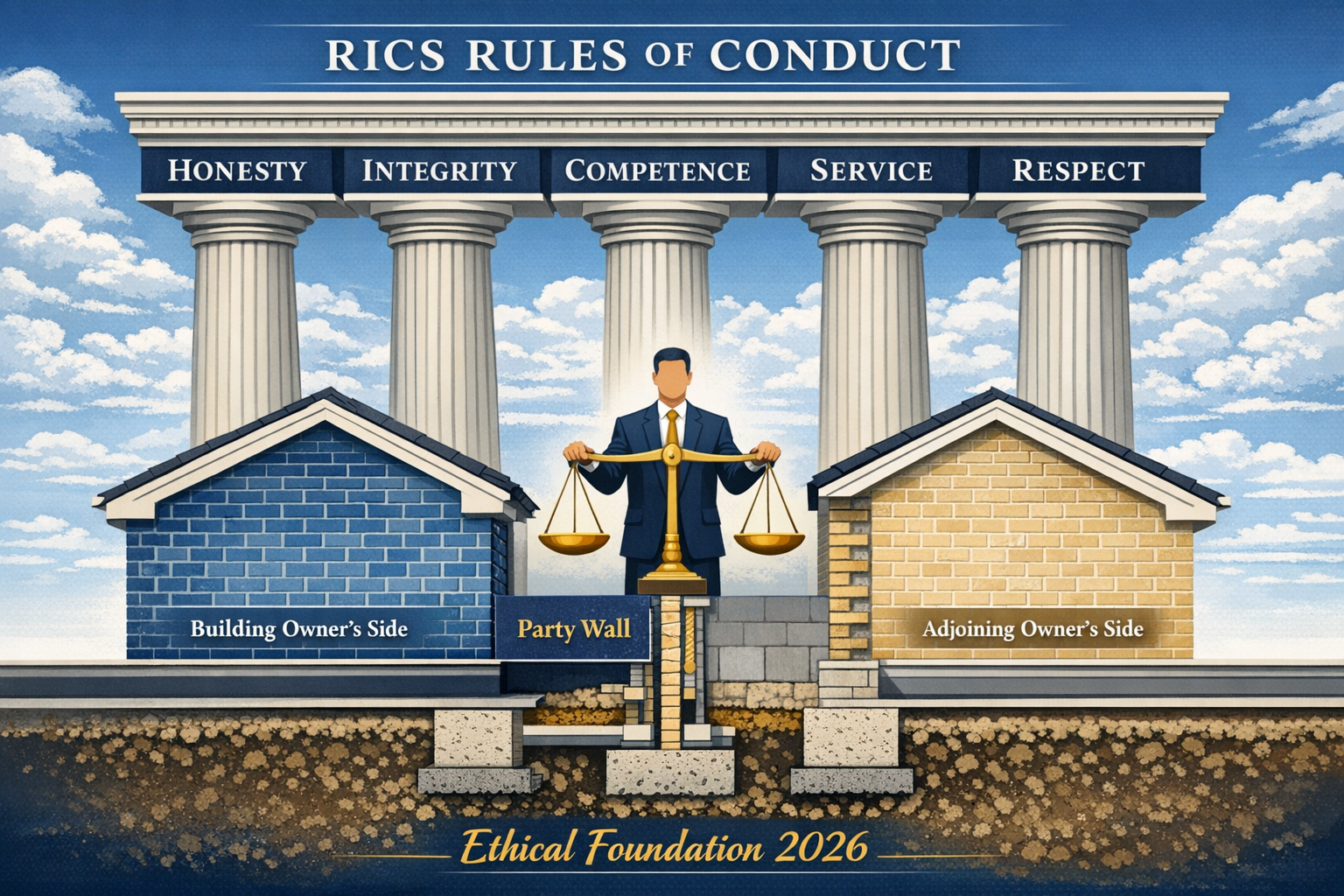
The Five Pillars of RICS Professional Conduct
The RICS Rules of Conduct, which became effective in February 2022, establish five fundamental ethical principles that govern all chartered surveyors, including those specializing in party wall matters[4]. These principles create the ethical foundation upon which all professional decisions must rest:
- Honesty – Members must be truthful and transparent in all professional dealings
- Integrity – Members must act consistently with professional standards and avoid conflicts
- Competence – Members must maintain appropriate skills and knowledge for their work
- Service – Members must provide excellent client service while balancing all stakeholder interests
- Respect – Members must treat everyone with courtesy and consideration
For party wall surveyors, these principles translate into concrete obligations. When serving party wall notices or preparing awards, surveyors cannot simply fulfill the minimum statutory requirements. They must demonstrate the higher professional standards expected of RICS membership[1].
"RICS members accepting instructions as party wall surveyors are expected to meet professional and ethical standards of behaviour commensurate with membership, which exceeds the minimal obligations of the Party Wall etc. Act 1996."[1]
How Party Wall Legislation Integrates with RICS Standards
The Party Wall etc. Act 1996 provides the legal framework for resolving disputes between building owners and their neighbours when construction work affects shared structures. However, the Act itself contains minimal guidance on professional conduct or ethical behaviour. This is where RICS standards become essential.
The RICS Party Wall Legislation and Procedure standard, most recently updated in May 2023, provides mandatory procedures for RICS members working under the Act[1]. This guidance document clarifies how chartered surveyors should:
- Accept appointments appropriately
- Maintain independence and objectivity
- Communicate with all parties transparently
- Prepare comprehensive schedules of condition
- Draft fair and enforceable awards
- Handle fee disputes professionally
Understanding the Party Wall etc. Act 1996 is fundamental, but RICS members must go further by applying ethical principles to every decision. This dual framework—legal compliance plus professional ethics—defines modern party wall practice in 2026.
The 2026 Evolution: New Standards Affecting Party Wall Work
Two major RICS initiatives launched in early 2026 have transformed professional expectations for party wall surveyors:
1. The AI Governance Standard (Effective March 9, 2026)
RICS's Professional Standard on Artificial Intelligence Governance represents the institution's first comprehensive attempt to regulate how surveyors use AI technologies[2][8]. This standard applies across all surveying disciplines, including building surveying and party wall work[5].
The standard establishes mandatory requirements for:
- Transparency – Disclosing when AI systems inform professional judgments
- Accountability – Maintaining human oversight of AI-generated recommendations
- Fairness – Ensuring AI tools don't introduce bias into party wall assessments
For party wall surveyors in 2026, this means that using AI to analyze structural damage, estimate repair costs, or draft award language now requires explicit disclosure to clients and compliance with governance protocols[2][8].
2. The Revised CPD Framework (Effective January 2026)
The refreshed Continuing Professional Development framework shifts emphasis from tracking hours to demonstrating impact[3]. While the annual requirement remains 20 hours (with at least 10 hours of structured learning), members must now focus on how their professional development improves practice quality[3].
For party wall surveyors, this means CPD activities should demonstrably enhance:
- Technical knowledge of construction methods and structural issues
- Understanding of legal precedents and case law developments
- Ethical decision-making capabilities in conflict situations
- Communication skills for managing neighbour disputes
The framework encourages surveyors to reflect on learning outcomes rather than simply accumulating course attendance certificates[3].
RICS Ethical Standards in Party Wall Surveying: Avoiding Conflicts in 2026 Through Independence
Defining Conflicts of Interest in Party Wall Appointments
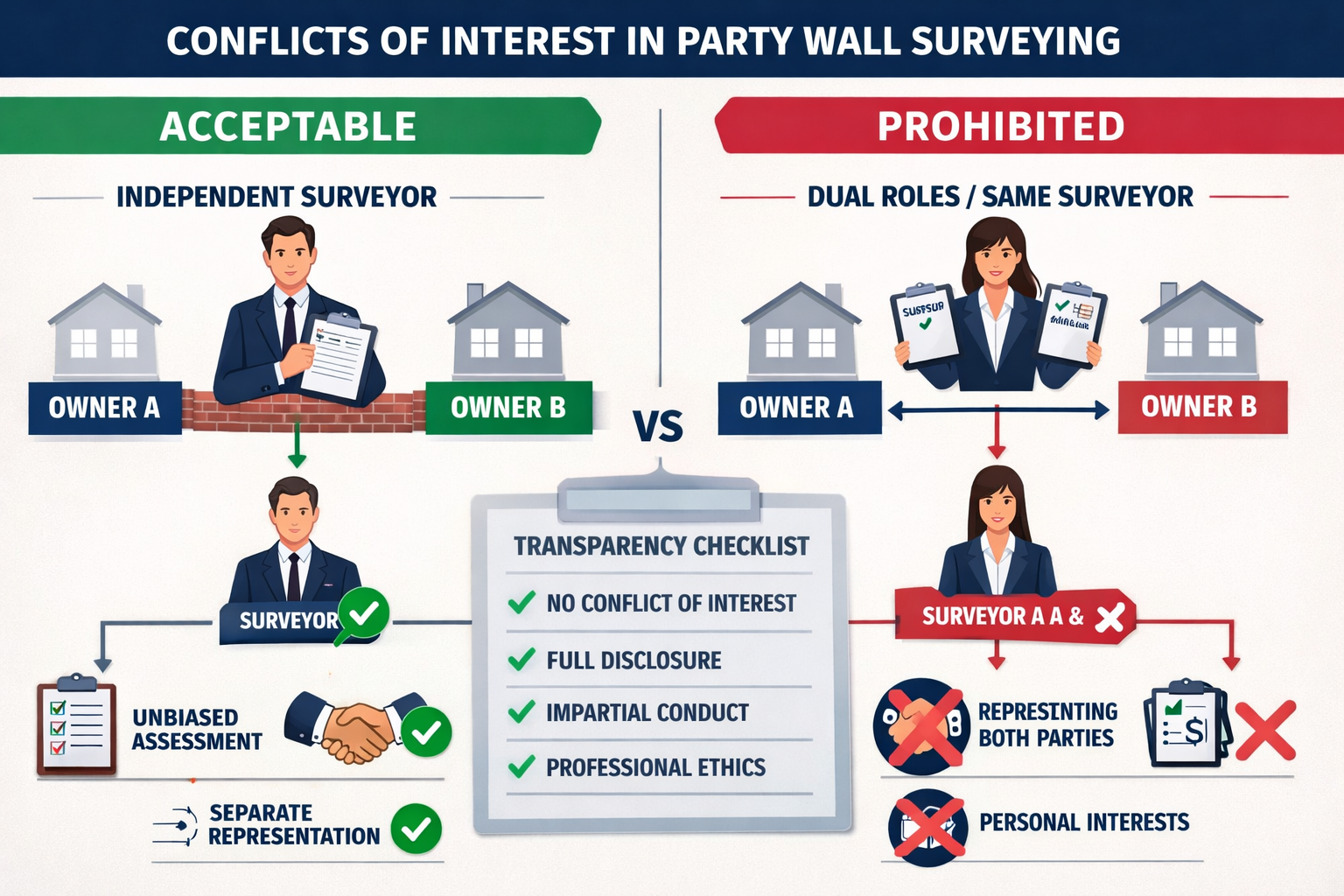
Conflicts of interest represent the most significant ethical challenge in party wall surveying. Unlike many professional relationships, the Party Wall etc. Act 1996 creates an unusual dynamic: the building owner typically pays both surveyors' fees, yet each surveyor owes duties to their appointing party[1].
Common conflict scenarios include:
| Conflict Type | Description | Ethical Risk |
|---|---|---|
| Prior Relationship | Surveyor has worked for building owner on previous projects | May compromise objectivity when assessing neighbour's concerns |
| Financial Dependency | Building owner represents significant portion of surveyor's income | Pressure to favour building owner's interests |
| Dual Appointments | Same surveyor appointed for both parties (as "agreed surveyor") | Difficult to advocate equally for opposing interests |
| Personal Connections | Surveyor has family or social ties to one party | Perception or reality of bias |
| Organizational Conflicts | Surveyor's firm provides other services to building owner | Institutional pressure to maintain broader client relationship |
RICS standards require surveyors to identify, disclose, and manage all potential conflicts before accepting appointments[4]. When conflicts cannot be adequately managed, surveyors must decline the instruction.
The Independence Paradox: Serving One Party While Remaining Impartial
Party wall surveyors face a unique professional paradox. Under the Act, they are appointed by and represent either the building owner or the adjoining owner. Yet RICS ethical standards demand they maintain objectivity and fairness throughout the process[1].
This doesn't mean party wall surveyors act as neutral arbitrators—they legitimately advocate for their appointing party's interests. However, this advocacy must occur within ethical boundaries:
✅ Acceptable Advocacy:
- Ensuring the award adequately protects the appointing party's property
- Negotiating reasonable working hours and access arrangements
- Requesting appropriate security for expenses when justified
- Challenging unreasonable demands from the other party
❌ Unacceptable Bias:
- Deliberately omitting damage from schedules of condition
- Recommending unnecessary protective works to increase costs
- Refusing to communicate professionally with the other surveyor
- Misrepresenting technical facts to favour one party
The key distinction lies in honest representation versus deception. Party wall surveyors can vigorously represent their client's legitimate interests while maintaining professional integrity[4].
Practical Strategies for Maintaining Independence
Experienced party wall surveyors employ several practical techniques to maintain independence and avoid conflicts:
🔍 Pre-Appointment Conflict Checks
Before accepting any party wall instruction, conduct thorough conflict searches:
- Review existing client relationships with both parties
- Check for personal connections to either property owner
- Identify any prior work on the properties in question
- Assess whether fee dependency creates undue influence
- Document the conflict assessment in writing
📋 Transparent Disclosure
When potential conflicts exist but can be managed, full disclosure is essential:
- Inform the appointing party of all relevant relationships
- Explain how the conflict will be managed
- Obtain written consent to proceed despite the conflict
- Document the disclosure and consent in appointment letters
⚖️ Structural Independence Measures
Build independence into your practice structure:
- Maintain diverse client base to avoid financial dependency
- Establish internal review procedures for contentious decisions
- Create physical and informational barriers between different matters
- Implement fee policies that don't incentivize prolonged disputes
🤝 Professional Communication Standards
How surveyors communicate signals their commitment to ethics:
- Respond promptly to the other surveyor's correspondence
- Maintain courteous tone even during disagreements
- Share information transparently as required by the Act
- Avoid ex parte communications that exclude the other surveyor
For those seeking professional assistance, finding an experienced party wall surveyor in South London, West London, or other areas who demonstrates these independence practices is crucial.
Navigating Multi-Party Disputes Under RICS Ethical Standards in Party Wall Surveying: Avoiding Conflicts in 2026
When Multiple Neighbours Are Affected
Many building projects affect multiple adjoining properties simultaneously, creating complex ethical dynamics. Consider a terrace house conversion where works impact neighbours on both sides, or a basement excavation affecting several properties on adjacent streets.
In multi-party scenarios, RICS ethical standards require surveyors to:
Identify All Affected Parties
The building owner must serve notices on all adjoining owners whose properties fall within the Act's scope[1]. Surveyors advising building owners have an ethical obligation to ensure comprehensive notice service, even when this increases project complexity.
Manage Collective Appointments
When multiple adjoining owners appoint the same surveyor, that professional must:
- Ensure no conflicts exist between the various adjoining owners' interests
- Communicate equally with all appointing parties
- Avoid favouring one adjoining owner over others
- Disclose if interests diverge and conflicts emerge
Coordinate Fair Outcomes
The party wall awards must address each affected property appropriately. Ethical practice demands that surveyors don't sacrifice one neighbour's protection to expedite agreement with others.
The Agreed Surveyor Role: Enhanced Ethical Obligations
When both parties jointly appoint a single "agreed surveyor," that professional assumes heightened ethical responsibilities. The agreed surveyor must simultaneously:
- Understand and protect both parties' legitimate interests
- Remain genuinely impartial throughout the process
- Avoid even the appearance of favouring one party
- Communicate equally and transparently with both sides
This role demands exceptional professional judgment and integrity. RICS members serving as agreed surveyors should:
- Establish Clear Ground Rules – Define communication protocols and decision-making processes at the outset
- Document Everything – Maintain meticulous records showing balanced consideration of both parties' concerns
- Manage Expectations – Explain that neither party will get everything they want
- Decline When Appropriate – Recognize when genuine impartiality isn't possible and suggest separate surveyors instead
The agreed surveyor arrangement can reduce costs and expedite resolution, but only when the surveyor possesses the ethical commitment to serve both parties fairly[1].
Fee Disputes and Ethical Considerations
Fee disagreements represent a common source of ethical tension in party wall work. Under the Act, the building owner typically pays all reasonable surveyor fees, but disputes arise over what constitutes "reasonable."
RICS ethical standards require transparent fee arrangements:
At Appointment:
- Provide clear fee estimates or hourly rates in writing
- Explain the basis for fee calculations
- Disclose any factors that might increase costs
- Obtain written agreement to fee terms
During the Matter:
- Track time and expenses accurately
- Communicate promptly if fees will exceed estimates
- Avoid unnecessary work that inflates fees
- Maintain detailed fee records for later justification
When Disputes Arise:
- Engage constructively with fee challenges
- Provide detailed fee breakdowns when requested
- Consider reasonable fee reductions to resolve disputes
- Avoid holding awards hostage to fee payment
The principle of service from the RICS Rules of Conduct requires that fee practices prioritize fair value delivery over revenue maximization[4]. For guidance on managing expenses, see our article on how to keep party wall costs down.
Practical Application: RICS Ethical Standards in Party Wall Surveying: Avoiding Conflicts in 2026 in Common Scenarios
Scenario 1: The Basement Excavation
Situation: A building owner in Central London plans a basement excavation extending 3 meters below ground level, affecting four adjoining properties. The owner appoints you as their surveyor and offers a substantial ongoing relationship for future projects.
Ethical Considerations:
🔴 Conflict Risk: The promise of future work creates financial incentive to favour the building owner's interests over proper protection for neighbours.
✅ RICS-Compliant Approach:
- Disclose the Relationship – Inform the building owner that professional obligations require objective assessment regardless of future work prospects
- Recommend Comprehensive Protection – Specify appropriate underpinning, monitoring, and protective measures based on technical merit, not relationship considerations
- Engage Transparently – Communicate openly with adjoining owners' surveyors about excavation risks
- Document Technical Rationale – Ensure all recommendations can be justified on engineering grounds
- Consider Declining – If the relationship pressure feels too strong, recommend the building owner appoint a different surveyor
For complex projects like this, understanding the types of party wall works and their specific requirements is essential.
Scenario 2: The Disputed Damage Claim
Situation: You're appointed by an adjoining owner after construction work. The neighbour claims significant cracking occurred during the works, but the building owner's surveyor disputes the damage is construction-related. Pre-construction photographs are ambiguous.
Ethical Considerations:
The competence and integrity principles require accurate damage assessment, even when it disadvantages your appointing party[4].
✅ RICS-Compliant Approach:
- Conduct Thorough Investigation – Inspect carefully, review all available evidence, consult structural engineers if needed
- Apply Technical Expertise – Distinguish construction-related damage from pre-existing conditions based on crack patterns, timing, and building movement
- Communicate Honestly – If evidence suggests damage pre-dates construction, advise your client truthfully rather than pursuing unfounded claims
- Seek Expert Input – When technical questions exceed your competence, engage appropriate specialists
- Document Findings – Prepare detailed reports explaining technical conclusions
Maintaining a comprehensive schedule of condition before works commence prevents many such disputes.
Scenario 3: The AI-Assisted Assessment
Situation: You're using new AI software in 2026 that analyzes photographs to identify structural damage and estimate repair costs. The AI suggests significantly higher repair costs than your professional judgment indicates.
Ethical Considerations:
The new AI Governance Standard requires transparency, accountability, and fairness when using AI tools[2][8].
✅ RICS-Compliant Approach:
- Maintain Human Oversight – Recognize that you, not the AI, bear professional responsibility for conclusions
- Disclose AI Use – Inform all parties that AI tools assisted your assessment
- Explain Methodology – Describe how the AI analysis informed your professional judgment
- Apply Critical Thinking – Question AI outputs that seem inconsistent with your expertise
- Document Decision Process – Record how you integrated AI insights with professional judgment
- Ensure Fairness – Verify the AI hasn't introduced bias (e.g., systematically over-estimating damage in certain property types)
The AI Governance Standard emphasizes that technology should enhance rather than replace professional judgment[2][8].
Scenario 4: The Neighbour Relationship Conflict
Situation: You're asked to act as agreed surveyor for a loft conversion, but you discover the building owner is your appointing party's business partner in an unrelated venture.
Ethical Considerations:
This personal connection creates both actual conflict (difficulty remaining impartial) and perceived conflict (appearance of bias)[4].
✅ RICS-Compliant Approach:
- Identify the Conflict – Recognize that the business relationship compromises genuine impartiality
- Disclose Immediately – Inform both parties of the connection before accepting appointment
- Recommend Alternative Structure – Suggest each party appoint separate surveyors rather than using an agreed surveyor
- Decline if Necessary – If parties insist on agreed surveyor arrangement, decline the instruction
- Document Decision – Record the conflict identification and resolution in writing
Integrity requires declining lucrative work when conflicts cannot be adequately managed[4].
The Role of CPD in Maintaining Ethical Standards
How the 2026 CPD Framework Supports Ethical Practice
The revised CPD framework that took effect in January 2026 represents a fundamental shift in how RICS approaches professional development[3]. Rather than simply accumulating hours, members must now demonstrate how learning activities improve their practice quality.
For party wall surveyors, this means CPD should enhance ethical decision-making capabilities:
Reflective Learning Approach:
Instead of: "Attended 2-hour webinar on Party Wall Act updates"
Better: "Attended webinar on recent case law developments. Identified three scenarios from my practice where new precedents apply. Revised my standard advice to building owners to incorporate these legal developments. Result: More accurate risk assessments and better client protection."
The framework encourages surveyors to:
- Identify Knowledge Gaps – Recognize areas where competence needs strengthening
- Engage in Targeted Learning – Select CPD activities addressing specific practice needs
- Apply New Knowledge – Implement learning in actual party wall matters
- Reflect on Outcomes – Assess whether learning improved practice quality
- Document Impact – Record how CPD enhanced professional performance
This outcomes-focused approach directly supports the competence principle from the Rules of Conduct[4].
Essential CPD Topics for Party Wall Surveyors in 2026
To maintain ethical standards and technical competence, party wall surveyors should pursue CPD in these key areas:
📚 Legal and Regulatory Updates
- Recent case law affecting party wall practice
- Changes to building regulations impacting party wall works
- Updates to RICS guidance documents
- Emerging legal interpretations of the Act
🏗️ Technical Construction Knowledge
- Modern construction methods and their party wall implications
- Structural engineering principles for damage assessment
- Basement construction and underpinning techniques
- Sustainable building practices affecting party walls
⚖️ Ethics and Professional Conduct
- Conflict of interest identification and management
- Ethical decision-making frameworks
- Professional communication skills
- Dispute resolution techniques
💻 Technology and Innovation
- AI governance and responsible technology use
- Digital surveying tools and their limitations
- Data security and client confidentiality
- Remote inspection techniques and protocols
🤝 Soft Skills Development
- Negotiation and mediation capabilities
- Client relationship management
- Cross-cultural communication (especially in diverse urban areas)
- Stress management for contentious disputes
The 20-hour annual requirement (10 hours structured) provides ample opportunity to address these topics systematically[3].
Creating a Personal Ethics Development Plan
Beyond mandatory CPD, leading party wall surveyors in 2026 are developing personal ethics frameworks to guide difficult decisions. Consider creating your own ethics development plan:
Step 1: Assess Current Practice
- Review recent matters for ethical challenges encountered
- Identify situations where ethical decisions felt unclear
- Seek feedback from colleagues on your ethical approach
- Analyze any complaints or disputes for ethical dimensions
Step 2: Identify Development Priorities
- Which ethical principles (honesty, integrity, competence, service, respect) need strengthening?
- What types of conflicts cause you most difficulty?
- Where do you need additional technical knowledge to make sound ethical judgments?
Step 3: Design Learning Activities
- Select CPD addressing priority areas
- Find mentors or peer discussion groups for ethical dilemmas
- Study RICS case studies and disciplinary decisions
- Engage with professional ethics literature
Step 4: Implement and Reflect
- Apply new frameworks to actual party wall matters
- Document how ethical approaches improved outcomes
- Adjust practices based on experience
- Share learning with professional community
This structured approach transforms ethics from abstract principles into practical decision-making tools.
Building Owner and Adjoining Owner Perspectives
What Building Owners Should Expect from RICS Members
Building owners planning construction work affecting party walls should understand the ethical standards their surveyor must uphold. This knowledge helps set appropriate expectations and identify professional conduct issues.
RICS-qualified building owners' surveyors should:
✅ Provide Competent Technical Advice
- Accurately identify which works require party wall notices
- Recommend appropriate protective measures based on engineering principles
- Prepare technically sound specifications for awards
- Engage specialists when matters exceed their expertise
✅ Maintain Honest Communication
- Provide realistic timelines and cost estimates
- Disclose potential complications or risks
- Communicate transparently about fee arrangements
- Report accurately on negotiations with adjoining owners' surveyors
✅ Balance Interests Appropriately
- Advocate for the building owner's legitimate interests
- Acknowledge when adjoining owners raise valid concerns
- Recommend fair compromise positions when appropriate
- Avoid unnecessary adversarial approaches that increase costs
✅ Demonstrate Professional Integrity
- Disclose any conflicts of interest before accepting appointment
- Refuse instructions when conflicts cannot be managed
- Maintain independence despite fee payment arrangements
- Comply with RICS standards even when inconvenient
For those planning construction projects, understanding the costs of the party wall process helps set realistic budgets.
What Adjoining Owners Should Demand from Their Surveyors
Adjoining owners receiving party wall notices should select surveyors who demonstrate strong ethical commitment. Key qualities to seek:
✅ Independence and Objectivity
- No prior relationship with the building owner or their surveyor
- Financial independence (not reliant on building owner's future work)
- Reputation for balanced, fair assessments
- Willingness to challenge unreasonable building owner demands
✅ Technical Competence
- Relevant experience with similar construction types
- Understanding of structural engineering principles
- Ability to identify potential damage risks
- Knowledge of appropriate protective measures
✅ Effective Advocacy
- Clear communication about your rights under the Act
- Vigorous representation of your legitimate interests
- Practical advice on protecting your property
- Realistic assessment of dispute prospects
✅ Professional Communication
- Prompt responses to your questions and concerns
- Regular updates on negotiation progress
- Clear explanations of technical issues
- Transparent fee arrangements
Adjoining owners can find qualified professionals through resources like party wall surveyor in North London or East London directories.
Red Flags: Identifying Ethical Concerns
Both building owners and adjoining owners should watch for warning signs suggesting ethical problems:
🚩 Conflict of Interest Red Flags:
- Surveyor has undisclosed relationship with the other party
- Surveyor pressures you to accept unfavourable terms
- Surveyor seems more concerned with pleasing the building owner (who pays fees) than protecting your interests
- Surveyor discourages you from seeking second opinions
🚩 Competence Red Flags:
- Surveyor lacks relevant experience with your construction type
- Surveyor cannot explain technical recommendations clearly
- Surveyor dismisses legitimate concerns without investigation
- Surveyor delays unreasonably without explanation
🚩 Integrity Red Flags:
- Surveyor suggests misrepresenting facts in documentation
- Surveyor proposes ex parte communications excluding the other surveyor
- Surveyor inflates fees through unnecessary work
- Surveyor threatens or bullies rather than negotiating professionally
When red flags appear, property owners should:
- Document Concerns – Keep written records of problematic conduct
- Seek Second Opinion – Consult another RICS member about the situation
- Raise Issues Directly – Give the surveyor opportunity to address concerns
- Consider Replacement – Exercise right to appoint different surveyor if problems persist
- Report Serious Misconduct – File RICS complaints for significant ethical violations
Enforcement and Accountability in 2026

RICS Disciplinary Processes
RICS maintains robust disciplinary procedures to enforce ethical standards and protect the public. When party wall surveyors violate professional standards, they face potential consequences ranging from advice and warnings to expulsion from membership.
The Disciplinary Process:
Stage 1: Complaint Receipt
- Anyone can file complaints against RICS members
- Complaints submitted through RICS online portal
- Initial assessment determines if allegations warrant investigation
Stage 2: Investigation
- RICS staff gather evidence and member responses
- Technical experts may review party wall matters
- Investigation typically takes several months
Stage 3: Assessment
- Head of Regulation decides whether case proceeds to hearing
- Minor issues may be resolved through undertakings or advice
- Serious matters referred to disciplinary panels
Stage 4: Hearing
- Independent panel hears evidence from both sides
- Member has right to legal representation
- Panel determines if standards were breached
Stage 5: Sanctions
- Sanctions range from warnings to expulsion
- Common sanctions include fines, conditions on practice, and publication of findings
- Members can appeal decisions
Published Disciplinary Decisions:
RICS publishes disciplinary outcomes to:
- Deter misconduct through transparency
- Educate members about ethical standards
- Protect public by identifying sanctioned members
- Demonstrate accountability
Party wall surveyors should regularly review published decisions to understand how RICS interprets and enforces ethical standards in practice.
Case Examples: Learning from Ethical Failures
While specific recent party wall disciplinary cases aren't publicly detailed in available sources, historical patterns reveal common ethical failures:
Common Disciplinary Issues:
Conflict of Interest Violations
- Failing to disclose relationships with building owners
- Accepting appointments despite clear conflicts
- Favouring parties with whom surveyor has financial relationships
Competence Failures
- Accepting instructions outside area of expertise
- Failing to identify necessary protective works
- Providing technically incorrect advice
Communication Breakdowns
- Ignoring correspondence from other surveyors
- Failing to keep appointing parties informed
- Misrepresenting facts in awards or reports
Fee Misconduct
- Charging excessive fees without justification
- Failing to provide fee estimates
- Holding awards hostage to fee payment
Integrity Violations
- Making false statements in professional documents
- Backdating schedules of condition
- Colluding with one party against the other
Each of these violations stems from failure to apply RICS ethical principles consistently[4].
Self-Regulation and Professional Responsibility
While RICS enforcement provides external accountability, the most effective ethical compliance comes from internal professional commitment. Leading party wall surveyors in 2026 embrace self-regulation through:
Personal Accountability Practices:
📋 Regular Ethics Audits
- Periodically review recent matters for ethical issues
- Identify patterns suggesting vulnerability to conflicts
- Adjust practices to strengthen ethical safeguards
🤝 Peer Review and Consultation
- Discuss difficult ethical dilemmas with trusted colleagues
- Seek second opinions before making contentious decisions
- Participate in professional discussion groups
📚 Continuous Ethics Education
- Engage with ethics-focused CPD beyond minimum requirements
- Study philosophical frameworks for ethical decision-making
- Learn from other professions' ethics approaches
💭 Reflective Practice
- Maintain journal documenting ethical challenges and responses
- Analyze decisions retrospectively to identify improvements
- Develop personal ethics statement guiding practice
🏆 Commitment to Excellence
- Set personal standards exceeding RICS minimums
- View ethics as competitive advantage, not compliance burden
- Build reputation on ethical reliability
This culture of ethical excellence benefits individual practitioners through enhanced reputation, the profession through public trust, and property owners through better service quality.
Future Trends: RICS Ethical Standards Beyond 2026
Emerging Ethical Challenges
The party wall surveying profession will face new ethical challenges in coming years:
🤖 Advanced AI Integration
As artificial intelligence becomes more sophisticated, ethical questions will intensify:
- When can AI systems make autonomous recommendations?
- How much human oversight is sufficient?
- Who bears liability when AI errors cause problems?
- How should surveyors disclose AI limitations to clients?
The March 2026 AI Governance Standard provides initial framework, but technology will evolve faster than standards[2][8]. Party wall surveyors must develop ethical judgment that adapts to technological change.
🌍 Climate Change and Sustainability
Environmental considerations increasingly affect party wall work:
- How should surveyors balance immediate party interests against broader environmental concerns?
- What ethical obligations exist regarding sustainable construction methods?
- Should awards require environmentally responsible approaches even when not legally mandated?
The responsibility principle from RICS Rules of Conduct may expand to encompass environmental stewardship[4].
🏘️ Housing Density and Urban Intensification
As cities densify, party wall work becomes more complex:
- Multiple parties with competing interests
- Cumulative impacts from successive developments
- Vulnerable populations in older housing stock
- Gentrification pressures affecting neighbour relationships
Ethical practice will require enhanced sensitivity to power imbalances and social justice considerations.
💻 Remote and Hybrid Practice
Technology enables remote party wall surveying, raising questions:
- Can surveyors maintain competence without physical site visits?
- How does remote practice affect relationship building and trust?
- What ethical obligations exist regarding technology access and digital literacy?
The competence principle requires honest assessment of whether remote methods provide adequate basis for professional judgments[4].
Anticipated RICS Guidance Development
RICS continues developing standards to address evolving practice needs. Anticipated future guidance includes:
📱 Digital Practice Standards
Comprehensive guidance on:
- Remote inspection protocols and limitations
- Digital communication with clients and other surveyors
- Data security and confidentiality in cloud-based practice
- Electronic document authentication and signing
🌱 Sustainability Integration
Standards addressing:
- Environmental impact assessment in party wall work
- Sustainable construction method recommendations
- Climate resilience considerations
- Circular economy principles in repair specifications
🤝 Dispute Resolution Enhancement
Updated guidance on:
- Alternative dispute resolution techniques
- Mediation skills for party wall surveyors
- Early conflict identification and prevention
- Cultural competence in diverse communities
📊 Quality Assurance Frameworks
Systematic approaches to:
- Practice quality monitoring and improvement
- Peer review protocols
- Client feedback integration
- Outcome measurement and benchmarking
Party wall surveyors should engage with RICS consultation processes to shape these emerging standards based on practical experience.
Building an Ethical Practice Culture
Forward-thinking party wall surveying firms are building organizational cultures that embed ethics throughout their operations:
Structural Ethics Integration:
🎯 Mission and Values
- Articulate ethical commitment in firm mission statements
- Define core values guiding all practice decisions
- Communicate values consistently to clients and staff
📋 Policies and Procedures
- Develop written ethics policies addressing common dilemmas
- Create conflict-checking systems and databases
- Establish approval processes for contentious decisions
- Implement quality assurance reviews
👥 Training and Development
- Provide ethics training for all staff, not just qualified surveyors
- Use case studies and role-playing for practical ethics education
- Encourage open discussion of ethical challenges
- Celebrate ethical decision-making even when costly
🔍 Monitoring and Accountability
- Track ethics-related metrics (complaints, conflicts, etc.)
- Conduct regular ethics audits of practice systems
- Establish confidential reporting channels for ethics concerns
- Hold leadership accountable for ethical culture
🏆 Recognition and Incentives
- Reward ethical behavior in performance reviews
- Promote based partly on ethical track record
- Avoid compensation structures that incentivize unethical shortcuts
- Publicly acknowledge ethical excellence
Organizations that systematically integrate ethics into their culture outperform competitors through enhanced reputation, reduced risk, and higher client satisfaction.
Conclusion: Excellence Through Ethics
RICS Ethical Standards in Party Wall Surveying: Avoiding Conflicts in 2026 represents far more than regulatory compliance—it embodies a commitment to professional excellence that benefits surveyors, property owners, and the broader community. The five core principles of honesty, integrity, competence, service, and respect provide a robust framework for navigating the complex interpersonal, technical, and legal challenges inherent in party wall work[4].
The landmark changes taking effect in 2026—particularly the AI Governance Standard and revised CPD framework—signal RICS's determination to maintain professional standards in a rapidly evolving practice environment[2][3][8]. Party wall surveyors who embrace these standards position themselves as trusted advisors capable of managing the most complex neighbour disputes with fairness and technical excellence.
Key Implementation Steps
For party wall surveyors seeking to strengthen ethical practice in 2026:
-
✅ Review Current Practice Against RICS Standards – Conduct honest assessment of how well current practices align with the five ethical principles[4]
-
✅ Implement Robust Conflict Checking – Develop systematic processes for identifying and managing conflicts of interest before accepting appointments
-
✅ Embrace the New CPD Framework – Shift focus from hour-counting to demonstrating genuine professional development impact[3]
-
✅ Prepare for AI Governance Requirements – If using AI tools, ensure compliance with transparency, accountability, and fairness requirements effective March 9, 2026[2][8]
-
✅ Strengthen Independence Safeguards – Build structural protections that maintain objectivity despite fee payment arrangements
-
✅ Enhance Communication Practices – Develop professional communication protocols that demonstrate respect for all parties
-
✅ Invest in Technical Competence – Pursue CPD addressing knowledge gaps in construction methods, structural engineering, and legal developments
-
✅ Build Ethics Support Networks – Establish peer consultation relationships for discussing difficult ethical dilemmas
-
✅ Document Decision Processes – Maintain detailed records showing ethical considerations in contentious matters
-
✅ Commit to Continuous Improvement – Regularly reflect on practice quality and identify opportunities for ethical enhancement
For Property Owners
Building owners and adjoining owners should:
- Select RICS-Qualified Surveyors – Ensure your surveyor is bound by professional ethical standards
- Ask About Conflicts – Inquire about potential conflicts of interest before appointment
- Expect Professional Communication – Demand transparent, timely, and respectful interactions
- Understand Your Rights – Familiarize yourself with both legal rights under the Act and professional standards your surveyor must meet
- Report Ethical Concerns – Don't hesitate to raise issues with surveyors directly or file RICS complaints when warranted
The Path Forward
The party wall surveying profession stands at an important juncture in 2026. Technology offers unprecedented capabilities for damage assessment, cost estimation, and communication. Urban densification creates growing demand for professional party wall services. Yet these opportunities bring heightened ethical challenges requiring wisdom, judgment, and unwavering commitment to professional standards.
RICS members who view ethics as the foundation of professional excellence rather than a compliance burden will thrive in this environment. They will build reputations as trusted advisors capable of navigating the most contentious neighbour disputes with fairness and technical competence. Their practices will attract discerning clients who value integrity alongside expertise.
The journey toward ethical excellence is continuous, requiring regular reflection, learning, and adaptation. But the destination—a party wall surveying profession characterized by public trust, professional pride, and outstanding service quality—makes the effort worthwhile.
For those embarking on party wall matters in 2026, whether as building owners planning construction, adjoining owners protecting their properties, or surveyors guiding the process, the message is clear: ethical practice isn't optional—it's essential. The RICS framework provides the roadmap. Professional commitment supplies the motivation. And the result is a party wall surveying profession worthy of public confidence and professional respect.
References
[1] Party Wall Legislation And Procedure – https://www.isurv.com/downloads/download/159/party_wall_legislation_and_procedure
[2] Rics Launches Landmark Global Standard On Responsible Use Of Ai In Surveying – https://www.rics.org/news-insights/rics-launches-landmark-global-standard-on-responsible-use-of-ai-in-surveying
[3] Revised Cpd Framework Effective 2026 New App – https://www.rics.org/news-insights/revised-cpd-framework-effective-2026-new-app
[4] Rules Of Conduct – https://www.rics.org/profession-standards/rics-standards-and-guidance/conduct-competence/rules-of-conduct
[5] Rics Building Surveying Conference – https://www.rics.org/training-events/conferences/rics-building-surveying-conference
[6] The Evolution Of Surveying Decisive Milestones In Rics Standards – https://www.adamjoseph.co.uk/the-evolution-of-surveying-decisive-milestones-in-rics-standards
[8] Rics Launches Global Standard For Ai In Surveying – https://nicholassurveyors.com/news-and-insights/2025/09/18/rics-launches-global-standard-for-ai-in-surveying/