


Over 40% of party wall disputes that escalate to formal legal proceedings in England involve work that went beyond the original agreed scope — with unplanned excavations near boundaries being the single most common trigger. Scope creep in boundary works: protecting party wall awards from unplanned excavations is not a niche concern for specialist surveyors. It is an everyday legal risk that affects homeowners, developers, and contractors across London and beyond.
When a building owner receives a Party Wall Award, they gain a carefully defined legal permission to carry out specific works. The moment those works expand — even slightly — without a fresh agreement, the legal protection offered by that award evaporates. Excavation projects are especially vulnerable because ground conditions, design changes, and contractor decisions can shift the depth and footprint of a dig without anyone raising a formal flag.
This article explains why scope creep happens, what the legal consequences are in 2026, and how to protect a party wall award from being undermined by unplanned excavations.
Key Takeaways 📋
- A Party Wall Award only protects work that is explicitly described within it — any excavation beyond that scope is legally unprotected.
- Unplanned deeper or wider excavations near a boundary are the most common form of scope creep in party wall projects.
- Building owners must serve a fresh notice and obtain an amended or new award before expanding excavation works.
- A Schedule of Condition is a critical protective document for adjoining owners when excavation is involved.
- Injunctions and compensation claims are real 2026 risks for building owners who allow scope creep to go unchecked.
What Is Scope Creep in Party Wall and Boundary Works?
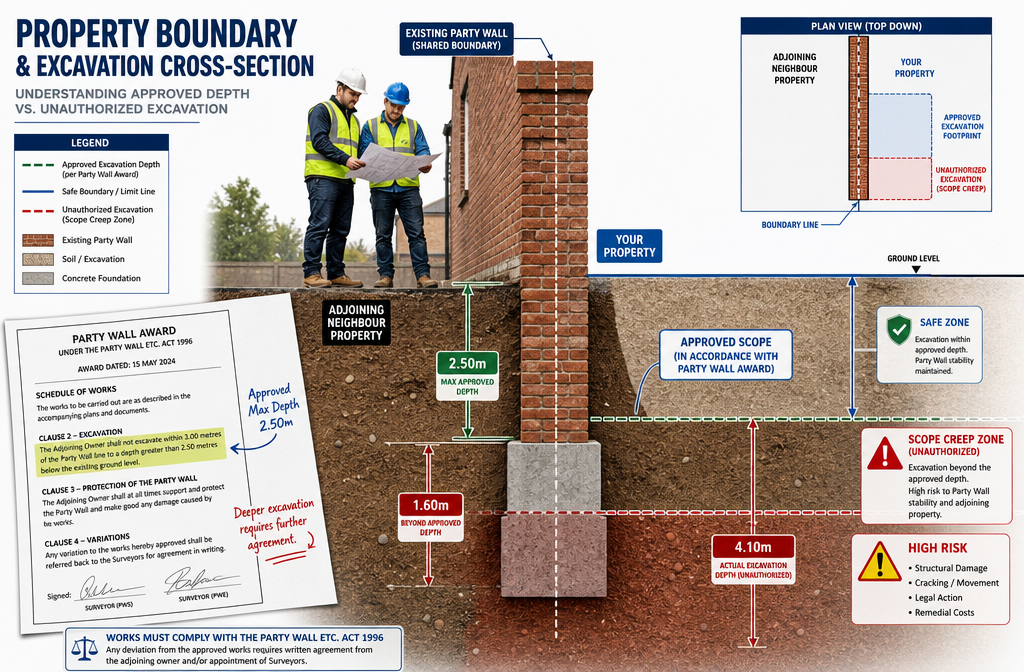
Scope creep refers to the gradual or sudden expansion of construction work beyond what was originally agreed, planned, and authorised. In the context of party wall projects, it means doing structural or excavation work that is not described in the Party Wall Award.
Common Examples of Scope Creep in Excavation Projects
Scope creep rarely announces itself. It tends to happen quietly, often driven by practical decisions made on site:
| Type of Scope Creep | Example |
|---|---|
| Deeper excavation | Basement planned to 2.5m but dug to 3.2m due to structural redesign |
| Wider footprint | Foundation trenches extended closer to the boundary than the award specifies |
| Additional underpinning | Contractor adds underpinning not listed in the award |
| New drainage runs | Drainage trenches cut near the boundary without separate consent |
| Retaining wall changes | Retaining wall position or depth altered during construction |
💬 Pull Quote: "Building owners sometimes extend work beyond what the award covers, whether intentionally or through scope creep — and any work not specified in the award requires separate consent and/or a fresh notice." — 2026 professional commentary on party wall awards [7]
The Party Wall etc. Act 1996 is precise: the award governs the works described within it. Nothing more, nothing less. This means that a building owner who digs 60cm deeper than the award permits is, from the moment that spade goes in, working without legal cover [1].
Why Excavation Works Are Particularly Vulnerable
Excavation is inherently unpredictable. Soil conditions vary. Structural engineers revise designs. Contractors make on-site decisions. Unlike above-ground construction — where changes are visible and easier to document — underground work can deviate significantly before anyone notices.
Section 6 of the Party Wall etc. Act 1996 specifically addresses excavations within 3 metres of a neighbouring building where the excavation goes deeper than the neighbour's foundations, and within 6 metres where a line of 45 degrees from the base of the excavation would intersect the neighbour's foundations [5]. These are statutory thresholds, and exceeding them without proper notice is a serious legal breach.
The Legal Risks of Scope Creep in Boundary Works: Protecting Party Wall Awards from Unplanned Excavations
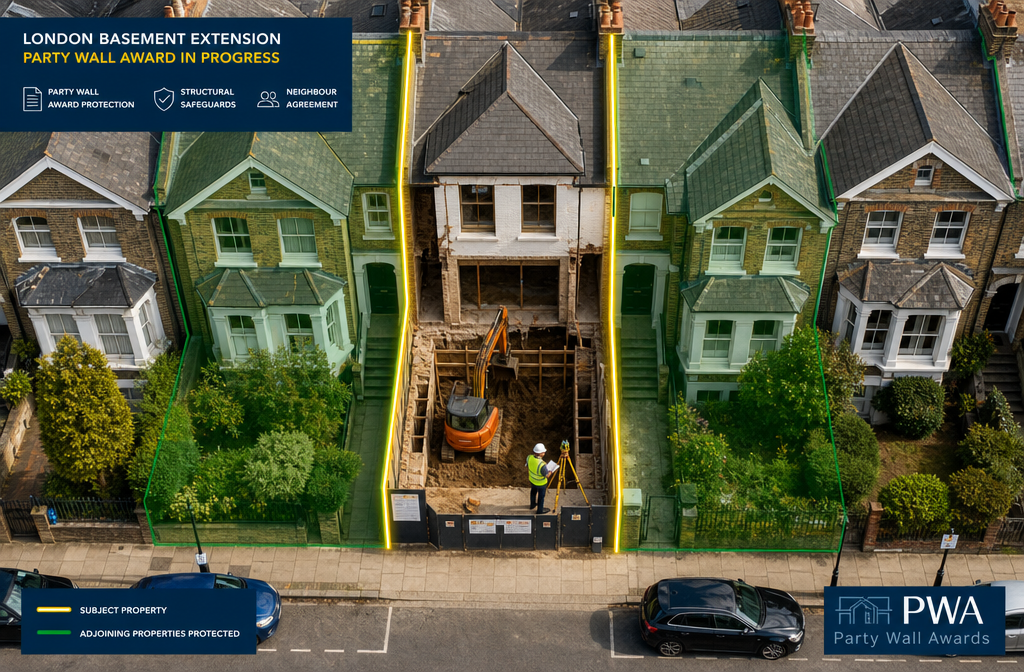
Understanding the legal exposure is essential for both building owners and adjoining owners. In 2026, enforcement of party wall awards has become more robust, with courts taking a firmer stance on breaches [7].
What Happens When Work Exceeds the Award?
When excavation work goes beyond the scope of a Party Wall Award, several consequences can follow:
1. Loss of Statutory Protection
The award provides immunity from certain legal actions for work carried out within its scope. Work outside the award loses this protection entirely [2].
2. Injunctions
An adjoining owner can apply to the County Court for an injunction to stop the works immediately. Courts in 2026 have shown willingness to grant emergency injunctions where structural risk to neighbouring property is demonstrated [7].
3. Compensation Claims
Under Section 7(2) of the Party Wall etc. Act 1996, a building owner is liable for any loss or damage caused to an adjoining owner. Scope creep that causes subsidence, cracking, or structural movement creates direct financial liability [4].
4. Trespass and Nuisance
If excavation physically crosses the boundary or causes vibration/noise damage beyond what the award permits, trespass and nuisance claims become available to the adjoining owner [10].
5. Retrospective Award Challenges
An adjoining owner can challenge the validity of the original award if they can demonstrate the works carried out were materially different from those described [6].
The Role of the Schedule of Condition
One of the most important protective tools — for both parties — is a Schedule of Condition. This is a detailed photographic and written record of the adjoining property's condition before works begin.
Without a Schedule of Condition, it becomes extremely difficult to prove whether cracks or structural issues existed before the excavation or were caused by it. For adjoining owners facing deep digs near their foundations, this document is non-negotiable.
Notice Requirements Under the Act
The types of party wall works that require formal notice include:
- Line of Junction Notice — for new walls at or astride the boundary
- Party Structure Notice — for works to an existing party wall or structure
- Section 6 Notice — for excavations within 3 or 6 metres of a neighbouring structure
If excavation depth or footprint changes materially during construction, a fresh Section 6 Notice must be served before the expanded work begins. There is no grace period and no informal workaround [8].
⚠️ Important: Serving a notice after the work has already started does not retrospectively authorise it. The notice must precede the work.
How to Protect a Party Wall Award from Unplanned Excavations: Practical Steps and Templates
Preventing scope creep requires proactive management at every stage of a project. The following framework applies whether acting as a building owner, an adjoining owner, or a surveyor.
Step 1: Draft the Award with Precision
A vague Party Wall Award is an invitation for scope creep. The award should specify:
- Exact excavation depths (in metres below existing ground level)
- Horizontal distances from the boundary at each depth
- Foundation types and dimensions
- Drainage routes and depths
- Retaining structures — type, position, and depth
- Working hours and access arrangements
- Methodology for monitoring ground movement
Awards that use phrases like "approximately" or "as required by the engineer" create ambiguity that contractors may exploit, intentionally or otherwise [1][9].
Step 2: Build in a Change Control Mechanism
One of the most effective — and underused — tools is a change control clause within the award itself. This clause sets out the procedure for dealing with variations before they happen.
Sample Award Amendment Clause (Template):
"Should the Building Owner's contractor or engineer determine that any variation to the excavation depth, footprint, or methodology described in this Award is necessary, the Building Owner shall immediately notify the Adjoining Owner's Surveyor in writing. No varied works shall commence until either: (a) a supplementary award has been agreed and issued by the appointed surveyor(s); or (b) written consent has been obtained from the Adjoining Owner. Any works carried out in breach of this clause shall be deemed to fall outside the scope of this Award."
This clause does not replace the statutory notice requirements but creates a contractual framework that makes scope creep harder to ignore [9].
Step 3: Appoint a Surveyor with Site Monitoring Authority
The appointed surveyor's role does not end when the award is signed. Building owners and adjoining owners should ensure the award explicitly grants the surveyor authority to:
- Conduct unannounced site inspections
- Require the contractor to pause works if deviations are observed
- Issue a variation notice if scope changes are identified
For adjoining owners who are concerned about deep excavations, appointing a dedicated Adjoining Owner's Surveyor provides an independent expert who is legally obligated to protect their interests.
Step 4: Monitor During Construction
Monitoring is not optional on high-risk excavation projects. The award should specify:
| Monitoring Type | Purpose | Frequency |
|---|---|---|
| Crack monitoring gauges | Detect structural movement in adjoining property | Weekly minimum |
| Settlement markers | Track ground movement near boundary | Fortnightly |
| Photographic surveys | Document ongoing condition | At each key stage |
| Engineer's sign-off | Confirm depth compliance at each excavation stage | Per stage |
Results should be shared with the adjoining owner's surveyor as a matter of course, not only when problems arise [4].
Step 5: Serve a Fresh Notice When Scope Changes
If excavation scope does change — for any reason — the correct legal response is straightforward:
- Stop the varied works immediately
- Notify the adjoining owner in writing
- Serve a fresh Section 6 Notice describing the revised excavation
- Wait for the statutory response period (14 days for consent; dispute triggers surveyor appointment)
- Obtain an amended or new award before resuming
This process protects the building owner from liability and gives the adjoining owner the opportunity to assess the new risk [8][6].
💡 Pro Tip: Keep a site log that records excavation depths at each stage. If a dispute arises, this contemporaneous record is far more persuasive than contractor recollections.
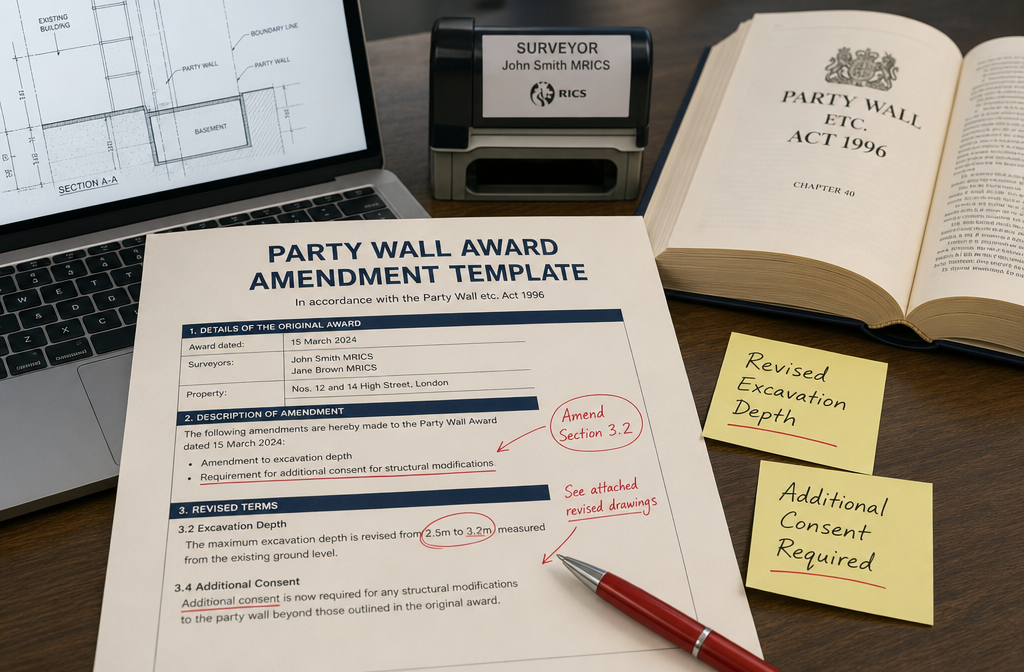
Understanding Award Amendments vs. Fresh Awards
Not every scope change requires a completely new award. The distinction matters:
- Award Amendment — appropriate where the change is minor and does not introduce a new category of work (e.g., excavation 20cm deeper than specified within the same 3-metre zone)
- Fresh Award — required where the change introduces a new type of work, crosses a new statutory threshold, or affects a different part of the boundary
When in doubt, a fresh notice and award is always the safer option [2][9].
Protecting Adjoining Owners: Rights and Remedies
Adjoining owners are not passive participants in this process. The Party Wall etc. Act 1996 gives them meaningful rights, and understanding those rights is the first line of defence against scope creep.
Rights of the Adjoining Owner
- Right to appoint a surveyor at the building owner's expense in most cases
- Right to receive a copy of the award before works begin
- Right to inspect works through the appointed surveyor
- Right to require a Schedule of Condition before excavation starts
- Right to compensation for damage caused by works [5][10]
If a building owner refuses to serve a fresh notice when scope has clearly changed, the adjoining owner can:
- Write formally to the building owner demanding compliance
- Contact the appointed surveyor to raise a formal dispute
- Apply to the County Court for an injunction
- Pursue a compensation claim under Section 7 of the Act
For those in specific areas of London, specialist local expertise is available — including party wall surveyors in North London, South London, and East London — where basement extensions and deep excavations are particularly common.
What Adjoining Owners Should Check Before Works Begin
✅ Has a valid Party Wall Notice been served?
✅ Does the award describe the excavation in specific detail?
✅ Has a Schedule of Condition been completed?
✅ Is there a change control mechanism in the award?
✅ Has the surveyor confirmed monitoring arrangements?
Reviewing the party wall notices served and the award documentation carefully before works begin is far less costly than pursuing remedies after damage has occurred.
Conclusion: Staying Ahead of Scope Creep in 2026
Scope creep in boundary works: protecting party wall awards from unplanned excavations is a challenge that sits at the intersection of construction management and property law. The good news is that it is entirely preventable with the right tools and processes in place.
Actionable Next Steps
For Building Owners:
- Ensure the Party Wall Award describes excavation works in precise, measurable terms
- Include a change control clause in every award involving excavation
- Brief contractors clearly: any deviation from the award requires a formal process before work continues
- Budget time for the statutory notice period if design changes are anticipated
For Adjoining Owners:
- Appoint a dedicated surveyor before the award is finalised
- Insist on a Schedule of Condition covering all areas potentially affected by excavation
- Request monitoring arrangements be written into the award
- Keep copies of all notices, the award, and any correspondence
For Both Parties:
- Treat scope creep as a legal risk, not just a project management issue
- Act early — the cost of a fresh notice and amended award is a fraction of the cost of an injunction or compensation claim
- Seek specialist advice from a qualified party wall surveyor at the first sign that works are deviating from the agreed scope
The Party Wall etc. Act 1996 was designed to protect neighbours while enabling legitimate construction. Scope creep undermines that balance. By building robust protections into awards from the outset — and by responding promptly when changes arise — both building owners and adjoining owners can keep their projects, and their relationships, on solid ground.
References
[1] Understanding Party Wall Award Comprehensive Guide Novellosurveyors – https://www.linkedin.com/pulse/understanding-party-wall-award-comprehensive-guide-novellosurveyors-uuf0e
[2] Party Wall Awards A Simple Guide – https://www.delvearchitects.com/stories/party-wall-awards-a-simple-guide
[4] Party Wall Common Questions – https://www.hsa-surveyors.com/party-wall-common-questions/
[5] Party Wall Agreement – https://hoa.org.uk/advice/guides-for-homeowners/i-am-improving/party-wall-agreement/
[6] Difference Between Party Wall Notices And Awards – https://www.partywallslimited.com/blog/difference-between-party-wall-notices-and-awards
[7] Party Wall Awards Explained Enforcing Agreements And Avoiding Injunctions In 2026 – https://www.canterburysurveyors.com/blog/party-wall-awards-explained-enforcing-agreements-and-avoiding-injunctions-in-2026/
[8] How To Respond To A Party Wall Notice For Adjoining Owners – https://www.ansteyhorne.co.uk/news/how-to-respond-to-a-party-wall-notice-for-adjoining-owners
[9] Party Wall Award – https://partywallsurveyorlondon.uk/blogs/party-wall-award/
[10] Seven Commonly Asked Questions About Party Wall Issues – https://www.squarepointsurveyors.co.uk/blog/seven-commonly-asked-questions-about-party-wall-issues/