


When planning to dig foundations for an extension or basement in 2026, many property owners discover an unexpected legal obligation: Section 6 of the Party Wall Act: When Excavation Triggers Notice Requirements. With modern building standards pushing foundation depths deeper than ever before under BS 8004:2015, understanding when excavation work requires formal notice to neighbours has become critical for avoiding costly delays and legal disputes.
Section 6 of the Party Wall Act governs excavation work near neighbouring properties, establishing clear distance and depth thresholds that trigger mandatory notice procedures. Whether digging foundations for a single-storey extension or underpinning an existing structure, these requirements protect adjoining owners from the risk of subsidence and structural damage.
Key Takeaways
- Three-metre rule: Any excavation within 3 metres of a neighbour's building that goes deeper than their foundations requires formal Section 6 notice[1]
- Six-metre extended zone: Excavations between 3-6 metres away still trigger notice requirements if they're deeper than the neighbouring foundations[1]
- One-month minimum notice: Building owners must serve Section 6 notices at least one month before starting excavation work[1]
- Formal procedures are mandatory: Even with a neighbour's verbal agreement, proper written notice must be served and the full legal process followed[3]
- Modern depths increase compliance: Contemporary foundation standards mean more projects now fall within Section 6 thresholds than in previous decades
🏗️ Understanding Section 6 of the Party Wall Act: When Excavation Triggers Notice Requirements
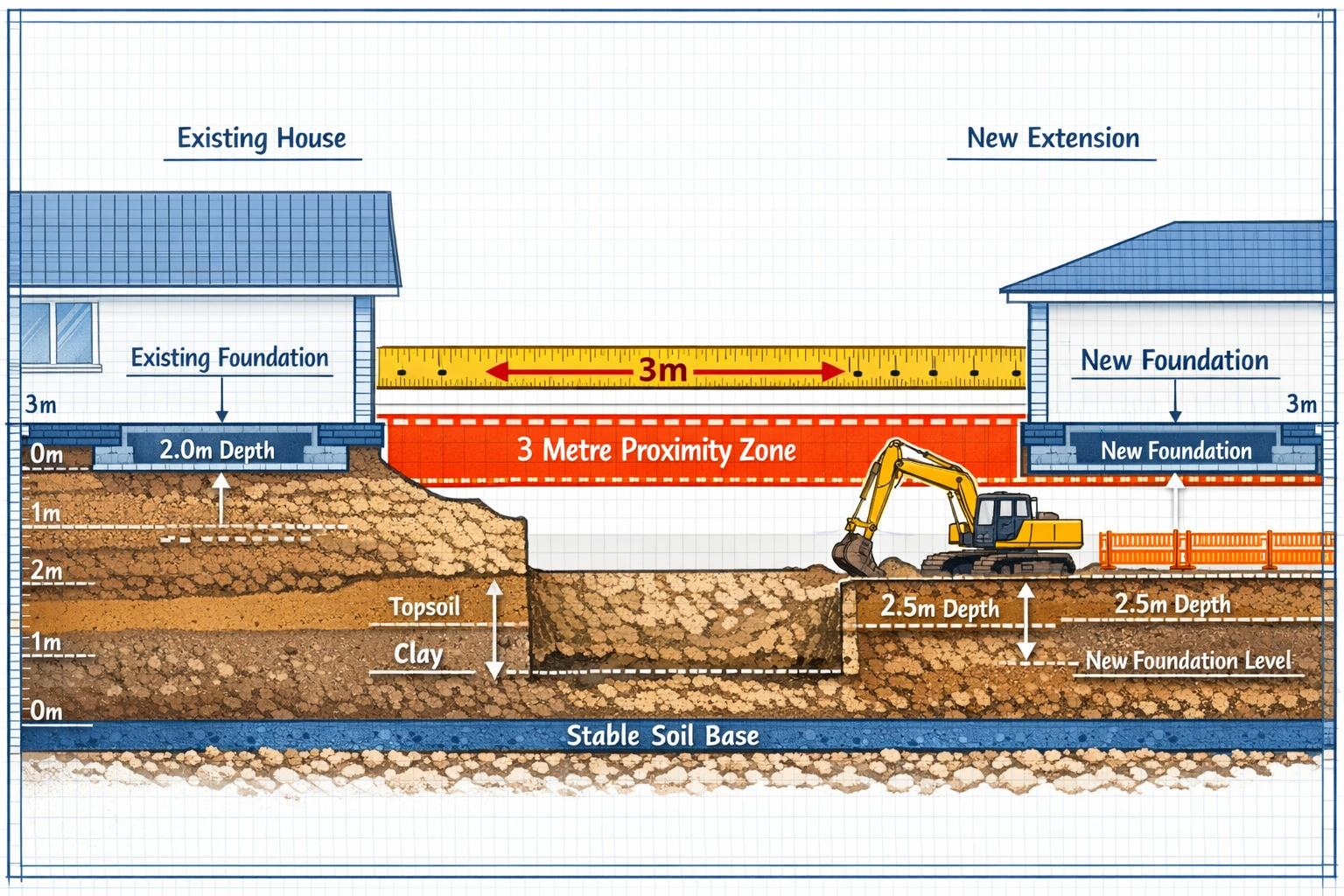
The Party Wall etc. Act 1996 applies to properties throughout England and Wales, establishing statutory procedures for construction work that could affect neighbouring buildings. Section 6 specifically addresses excavation and foundation work—activities that present genuine risks of undermining adjacent structures.
Unlike Sections 1 and 2 of the Act, which deal with work directly on or to party walls and structures, Section 6 focuses exclusively on excavation proximity. The legislation recognizes that digging near a neighbour's property creates a "bona fide risk" of destabilizing their foundations, regardless of whether any shared wall exists between the properties[2].
Why Section 6 Matters in 2026
Modern building regulations have significantly increased typical foundation depths. BS 8004:2015 requires foundations to extend below frost action depth and bear on suitable ground, often resulting in excavations of 1.2 to 1.5 metres for standard extensions—and considerably deeper for basement conversions or properties on challenging soil conditions.
This regulatory evolution means that excavation work that might not have triggered Section 6 requirements decades ago now frequently does. A modest single-storey extension can easily require notice if the neighbouring property has shallow Victorian foundations.
Common Excavation Works Covered
Section 6 applies to various excavation activities, including:
- Foundation digging for extensions and new buildings
- Underpinning works to strengthen existing foundations
- Basement excavations and conversions
- Drainage installation requiring deep trenches
- Swimming pool construction below ground level
- Underground utility installations near boundaries
Any of these projects may trigger notice requirements depending on their proximity to neighbouring structures and relative depth to existing foundations.
The Three Critical Distance Rules for Section 6 Compliance
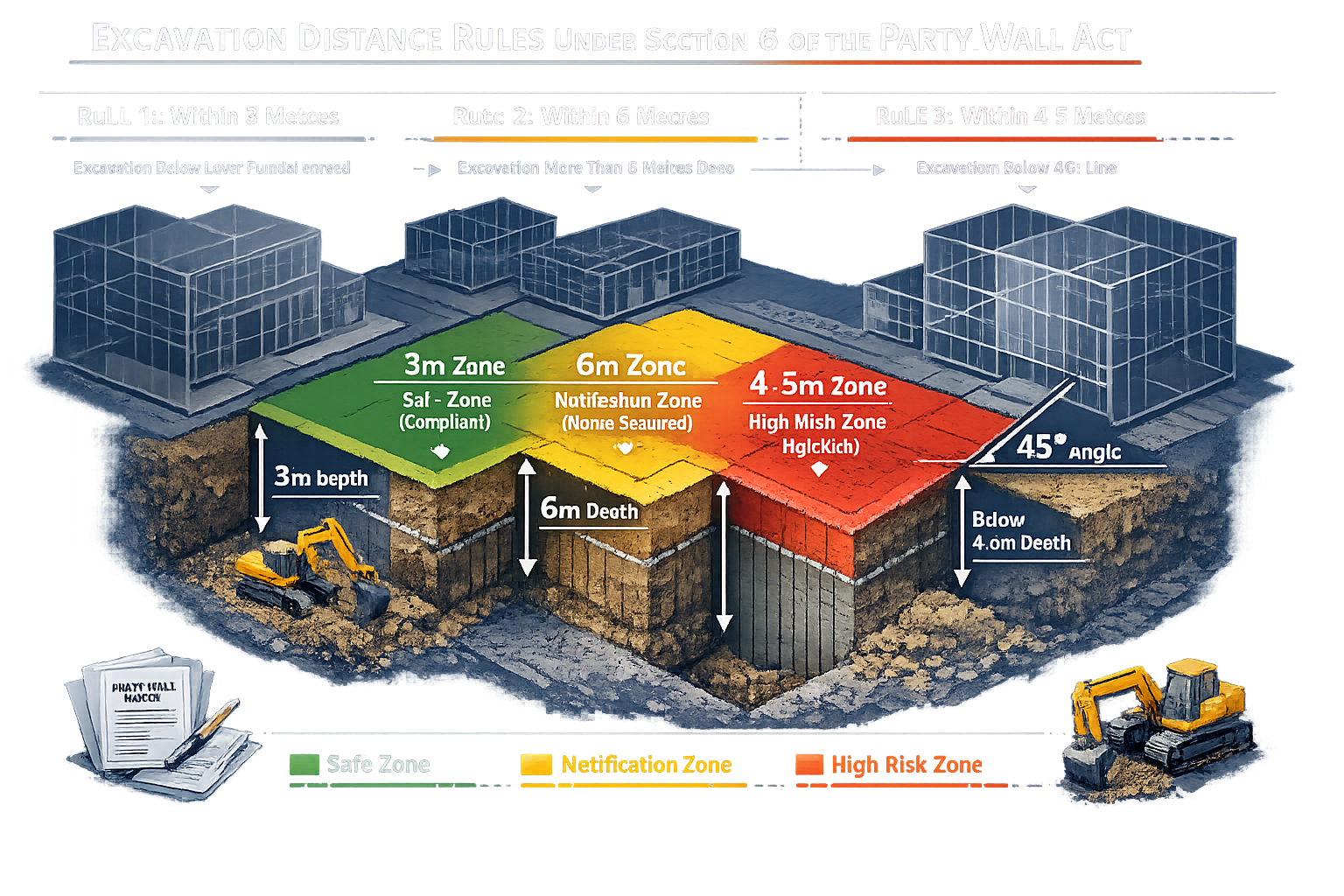
Section 6 of the Party Wall Act: When Excavation Triggers Notice Requirements operates on three distinct distance-based thresholds. Understanding these rules determines whether formal notice must be served.
Rule 1: The Three-Metre Proximity Zone ⚠️
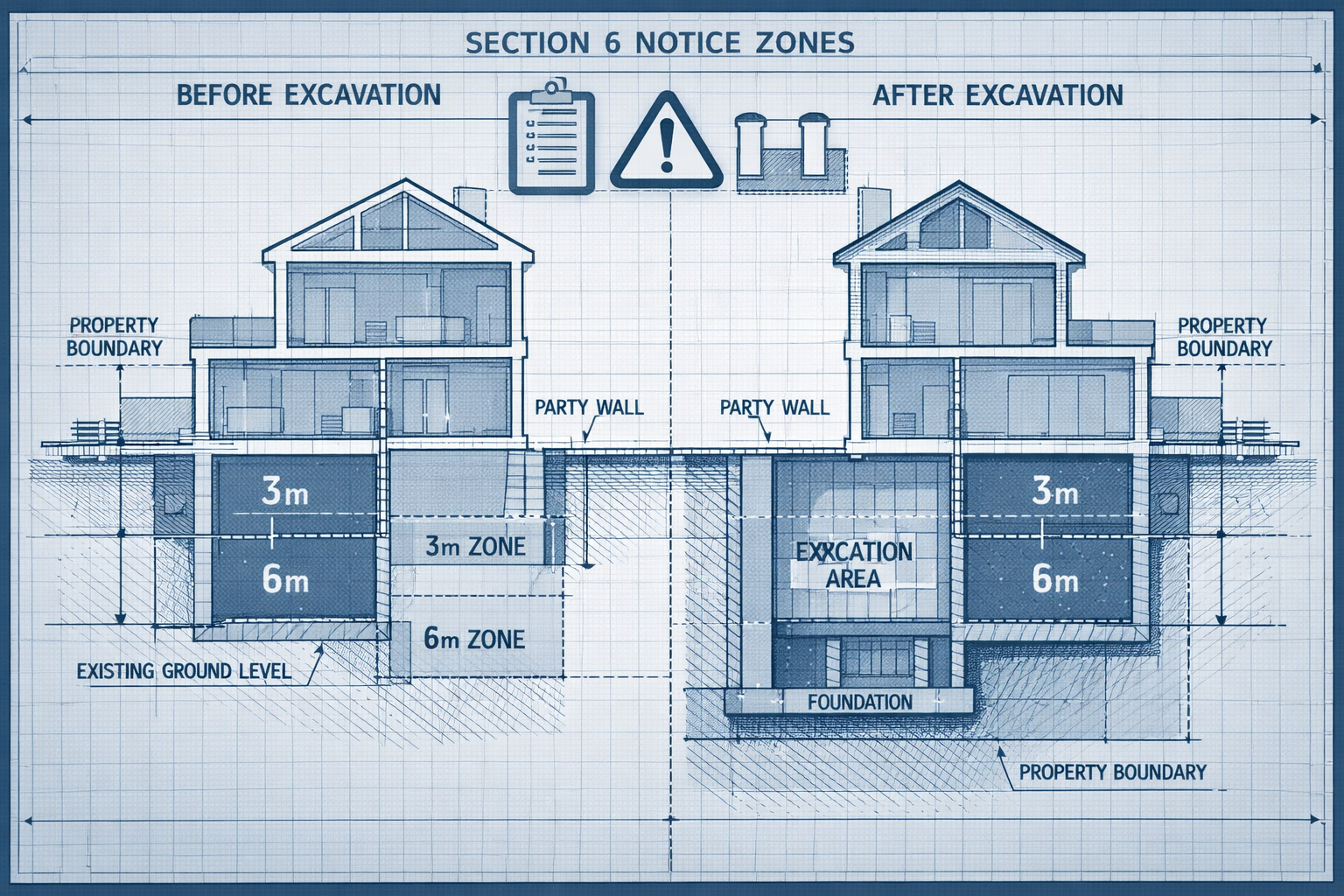
Any excavation within 3 metres of a neighbouring building or structure that goes deeper than the base of their foundations triggers Section 6 notice requirements[1].
This rule applies regardless of how much deeper the excavation goes. Even excavating just 10 centimetres below the neighbour's foundation base activates the notice requirement if within the 3-metre zone.
| Distance from Neighbour | Excavation Depth | Notice Required? |
|---|---|---|
| 2.5 metres | Below neighbour's foundation | ✅ Yes |
| 2.5 metres | Above neighbour's foundation | ❌ No |
| 3.5 metres | Below neighbour's foundation | See Rule 2 |
Important consideration: The 3-metre distance is measured from the nearest point of the neighbouring building or structure, not necessarily the boundary line. A building set back from the boundary extends the measurement zone accordingly.
Rule 2: The Six-Metre Extended Zone 📏
Excavations within 6 metres of an adjoining owner's building or structure require notice if they extend to a depth greater than the neighbouring structure's foundations[1].
This extended zone recognizes that deeper excavations can affect stability even at greater distances. The critical factor here is relative depth—the excavation must be deeper than the existing foundations to trigger notice requirements.
For properties with particularly deep foundations, such as piled foundations, this 6-metre rule becomes the primary consideration rather than the 3-metre threshold[3].
Rule 3: The 45-Degree Angle Calculation 📐
The most technical aspect of Section 6 involves the 45-degree plane rule. When excavations fall within a plane drawn downwards at a 45-degree angle from the bottom level of the neighbouring foundations, Section 6 notice requirements apply[1].
This geometric calculation accounts for the natural angle at which ground movement and subsidence pressure can affect adjacent structures. Even excavations beyond the 6-metre distance may trigger notice if they're sufficiently deep to intersect this 45-degree plane.
"The 45-degree rule ensures that very deep excavations—such as multi-level basements—cannot avoid notice requirements simply by maintaining horizontal distance while digging significantly below neighbouring foundation levels."
Practical Application Example
Consider a typical scenario in 2026:
Your project: Two-storey rear extension requiring foundations 1.5 metres deep, located 2 metres from the boundary
Neighbour's property: Victorian terrace with original foundations at 0.8 metres depth
Analysis:
- Distance from neighbour's building: 2.5 metres (within 3-metre zone) ✅
- Your excavation depth (1.5m) exceeds neighbour's foundation depth (0.8m) ✅
- Result: Section 6 notice required
Understanding these distance rules helps determine early in the planning process whether party wall notices will be necessary, allowing proper timeline and budget allocation.
The Section 6 Notice Process: Timeline and Procedures
Once a building owner determines that Section 6 of the Party Wall Act: When Excavation Triggers Notice Requirements applies to their project, specific procedural steps must be followed. The legislation mandates formal processes that cannot be circumvented, even with neighbourly goodwill.
Serving the Section 6 Notice
Timing requirement: Notice must be served at least one month before excavation works commence[1]. This minimum period gives adjoining owners time to review proposals, seek professional advice, and respond appropriately.
The notice must include:
- Detailed description of the proposed excavation work
- Depth and extent of excavation
- Plans and drawings showing the work's location
- Proposed commencement date
- Building owner's details and contact information
Unlike informal communication, formal notice must be served even if the neighbour has verbally indicated consent[3]. A casual conversation over the fence does not satisfy statutory requirements.
The 14-Day Response Period
After receiving a Section 6 notice, the adjoining owner has 14 days to respond in one of three ways:
- Consent in writing to the proposed works
- Dissent (refuse consent or not respond within 14 days)
- Request additional information before deciding
If the adjoining owner consents, work may proceed after the one-month notice period expires. However, if they dissent or fail to respond within 14 days, a dispute is deemed to exist under the Act, triggering the surveyor appointment process.
Appointing Party Wall Surveyors
When a dispute arises, the Act requires surveyor involvement to resolve matters and authorize work to proceed. Learn more about what party wall notices are and how to respond to them properly.
Surveyor appointment options:
- Agreed Surveyor: Both parties jointly appoint a single impartial surveyor
- Two Surveyors: Each party appoints their own surveyor, who then select a Third Surveyor to resolve any disagreements
The surveyor assessment process involves[4]:
- Site inspections of both properties
- Review of excavation proposals and structural calculations
- Risk assessment for potential damage
- Preparation of a Schedule of Condition documenting the adjoining property's current state
- Drafting a Party Wall Award setting out the work authorized and protective conditions
The Party Wall Award
The culminating document is the Party Wall Award—a legally binding agreement that must be signed by the appointed surveyor(s) and served on both building owner and adjoining owner before work can legally commence[4].
The Award typically includes:
- ✅ Authorization for specific excavation work
- ✅ Protective measures and working methods required
- ✅ Access rights for monitoring and inspection
- ✅ Schedule of Condition baseline documentation
- ✅ Cost allocation for surveyor fees
- ✅ Dispute resolution procedures
Timeline consideration: The entire process from serving notice to receiving an executed Award typically takes 6-10 weeks minimum. Building owners should factor this into project schedules to avoid costly delays.
For guidance on managing expenses, review our tips on how to keep party wall costs down throughout the process.
Common Misconceptions About Section 6 Requirements
Several persistent misunderstandings about Section 6 of the Party Wall Act: When Excavation Triggers Notice Requirements can lead property owners into compliance problems.
❌ Myth 1: "My neighbour agreed verbally, so I don't need formal notice"
Reality: Formal written notice must be served regardless of informal agreements[3]. The Act's procedural requirements exist to protect both parties legally and cannot be waived through casual conversation. Even the most cooperative neighbour relationship requires proper documentation.
❌ Myth 2: "Section 6 only applies if I'm building right on the boundary"
Reality: Section 6 can apply to excavations up to 6 metres away from a neighbouring building[1], and even further in cases involving the 45-degree plane calculation. Distance from the boundary line is irrelevant—what matters is proximity to the neighbouring structure and relative foundation depths.
❌ Myth 3: "The Party Wall Award covers my entire extension project"
Reality: Section 6 Awards specifically authorize only the excavation and foundation work[3]. If a building owner constructs a large extension set back slightly from the boundary, the party wall procedures cover only the foundation excavation, not the entire superstructure construction. Separate building regulations approval and planning permission may still be required.
❌ Myth 4: "I can start work once I've served the notice"
Reality: The one-month notice period is a minimum waiting time, not authorization to proceed[1]. If the adjoining owner dissents or doesn't respond, the surveyor appointment and Award process must be completed before any excavation begins. Starting work prematurely constitutes a breach of the Act.
❌ Myth 5: "Section 6 doesn't apply to small projects"
Reality: The Act makes no distinction based on project size or cost. A modest garden wall requiring 1-metre-deep foundations can trigger Section 6 requirements just as readily as a major basement conversion, provided the proximity and depth thresholds are met.
Special Considerations and Edge Cases
Certain scenarios present unique challenges when assessing Section 6 of the Party Wall Act: When Excavation Triggers Notice Requirements.
Properties with Unknown Foundation Depths
Victorian and Edwardian properties often lack documentation of original foundation depths. In such cases:
- Conservative assumption: Assume shallow foundations (typically 0.6-0.9 metres for properties of this era)
- Trial pit investigation: Consider excavating small test pits to determine actual foundation depth before finalizing excavation plans
- Professional survey: Engage a structural engineer to assess likely foundation construction
When foundation depth cannot be determined with certainty, serving a Section 6 notice provides legal protection even if it later proves unnecessary.
Multiple Adjoining Owners
Terraced properties and semi-detached houses may have multiple adjoining owners potentially affected by excavation work:
- Separate notices must be served on each adjoining owner
- Each owner has independent right to consent or dissent
- Different surveyors may be appointed by different neighbours
- Multiple Awards may result from a single excavation project
This multiplicity can significantly extend timelines and costs. For comprehensive information about different types of party wall works, consult specialist resources.
Stepped or Sloping Sites
Properties on sloping terrain present measurement challenges:
- Foundation depths vary along the building's length
- The deepest point of the neighbour's foundation determines the threshold
- Excavation depths must be measured relative to the corresponding section of neighbouring foundations
- Professional surveying may be necessary to establish accurate levels
Boundary Walls and Outbuildings
Section 6 applies to excavations near any building or structure, not just the main dwelling[1]. This includes:
- Detached garages and garden buildings
- Boundary walls (see our guide on boundary wall rules and differences between party fence walls and boundary walls)
- Conservatories and extensions
- Retaining walls
A project well clear of the main house might still trigger Section 6 requirements due to proximity to a boundary wall or outbuilding.
Regional Considerations and Professional Support
While the Party Wall etc. Act 1996 applies uniformly across England and Wales, local building practices and soil conditions create regional variations in how Section 6 requirements typically manifest.
London-Specific Factors
The capital's dense housing stock and challenging ground conditions make Section 6 compliance particularly common:
- Clay soil predominance: London clay's shrink-swell behavior necessitates deeper foundations
- Terraced housing density: Close proximity between properties increases likelihood of triggering distance thresholds
- Basement conversions: The popularity of basement extensions in London frequently invokes Section 6
Specialist party wall surveyors operate throughout the capital's regions, including Central London, North London, South London, East London, and West London.
When to Engage Professional Help
While property owners can technically serve Section 6 notices themselves, professional support often proves valuable:
Consider professional assistance when:
- Foundation depths are uncertain or complex
- Multiple adjoining owners are affected
- The project involves deep excavations (basements, underpinning)
- Neighbouring properties show existing structural issues
- The adjoining owner has appointed a surveyor
Professional party wall surveyors can:
- Accurately assess whether Section 6 applies
- Draft compliant notices with appropriate technical detail
- Negotiate with adjoining owners and their surveyors
- Prepare robust Party Wall Awards protecting all parties
- Provide Schedule of Condition documentation
- Monitor work to ensure Award compliance
For those considering the DIY approach, resources on having a party wall agreement without a surveyor provide useful guidance, though professional involvement often saves time and reduces dispute risk.
Cost Implications and Budget Planning
Understanding the financial aspects of Section 6 compliance helps building owners budget appropriately for excavation projects.
Typical Cost Components
Surveyor fees constitute the primary expense:
| Service | Typical Cost Range (2026) |
|---|---|
| Building Owner's Surveyor | £700 – £1,500 |
| Adjoining Owner's Surveyor | £700 – £1,500 |
| Schedule of Condition | £300 – £600 |
| Party Wall Award preparation | Included in surveyor fees |
Important: Under the Act, the building owner typically pays all reasonable surveyor fees—both their own surveyor's costs and the adjoining owner's surveyor fees[3]. This can represent a significant project expense, particularly when multiple neighbours are affected.
Additional costs may include:
- Structural engineer reports (£500 – £1,500)
- Trial pit investigations (£400 – £800)
- Insurance premium increases
- Project delays if notice procedures aren't followed
For detailed breakdowns, consult our comprehensive guide on costs of party wall procedures and the process.
Cost Management Strategies
Reduce expenses by:
- Serving notices early to avoid rushed fees for expedited service
- Proposing an Agreed Surveyor (single surveyor for both parties) rather than separate appointments
- Providing comprehensive technical information with initial notices
- Maintaining good communication with neighbours to facilitate consent
- Scheduling work to minimize disruption and monitoring requirements
Hidden Costs of Non-Compliance
Failing to follow Section 6 procedures can prove far more expensive than compliance:
- Injunctions: Adjoining owners can obtain court orders stopping work
- Damages: Liability for any structural damage caused
- Retrospective Awards: More expensive and complex than proactive compliance
- Project delays: Weeks or months of construction stoppage
- Legal fees: Dispute resolution through courts rather than surveyors
Prevention is invariably cheaper than cure when it comes to party wall compliance.
Conclusion: Navigating Section 6 Requirements Successfully
Section 6 of the Party Wall Act: When Excavation Triggers Notice Requirements represents a critical legal framework that protects both building owners and their neighbours during excavation projects. As foundation depths continue to increase under modern building standards in 2026, understanding these requirements has become essential for anyone planning construction work near property boundaries.
The three core distance rules—3 metres, 6 metres, and the 45-degree plane calculation—provide clear thresholds for when formal notice becomes mandatory. While the procedural requirements may initially seem burdensome, they exist to prevent disputes, protect property values, and ensure construction proceeds safely for all parties.
Actionable Next Steps
Before starting any excavation project:
- Measure accurately: Determine the distance from your proposed excavation to neighbouring buildings and structures
- Investigate foundation depths: Research or investigate both your planned excavation depth and neighbouring foundation levels
- Assess early: Determine whether Section 6 applies before finalizing project timelines
- Serve notice promptly: Allow minimum 6-8 weeks for the complete notice and Award process
- Engage professionals: Consider appointing an experienced party wall surveyor, particularly for complex projects
- Budget appropriately: Include surveyor fees and potential delays in project financial planning
- Communicate proactively: Inform neighbours of plans early, even before formal notice
For comprehensive support throughout the process, explore our party wall awards services and download our sample party wall agreement template to understand documentation requirements.
Understanding Section 6 requirements transforms what might seem like a legal obstacle into a structured process that protects everyone's interests. With proper planning, professional guidance where needed, and adherence to statutory timelines, excavation projects can proceed smoothly while maintaining positive neighbourly relations and full legal compliance.
References
[1] Notifiable Works – https://www.home-approved.com/party-wall-advice/notifiable-works/
[2] Three Types Of Party Wall Notices – https://stokemont.com/advice/three-types-of-party-wall-notices/
[3] The Party Wall Act Common Misunderstandings – https://www.peterbarry.co.uk/blog/the-party-wall-act-common-misunderstandings/
[4] Party Wall My Neighbour Is Undertaking Works Which Invoke Party Wall Act – https://grahamkinnear.com/landing-pages/party-wall-my-neighbour-is-undertaking-works-which-invoke-party-wall-act/
[5] Understanding The Party Structure Notice What It Is And When It Needs To Be Issued – https://www.adamjoseph.co.uk/understanding-the-party-structure-notice-what-it-is-and-when-it-needs-to-be-issued