

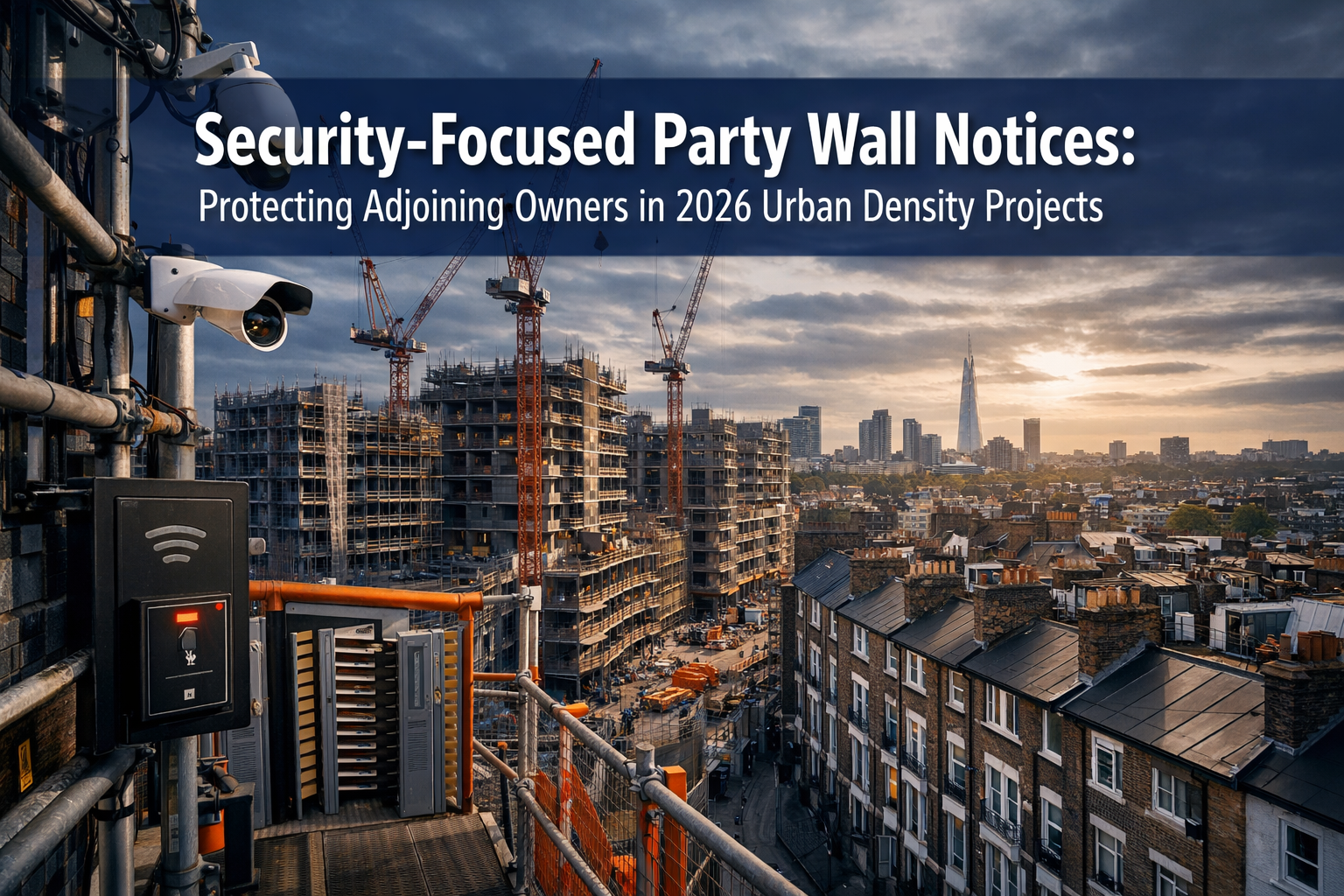
As London and other UK cities experience unprecedented vertical growth in 2026, a new challenge emerges at the intersection of construction law and urban security. Security-Focused Party Wall Notices: Protecting Adjoining Owners in 2026 Urban Density Projects has become essential as scaffolding towers over neighboring gardens, cranes swing across property lines, and construction access points create vulnerabilities for adjoining homeowners. The traditional party wall process now must address not just structural concerns, but also access controls, surveillance protocols, and security measures that protect neighbors during intensive urban development.
The surge in high-density residential projects has transformed how party wall notices function. Building owners can no longer simply notify neighbors of planned works—they must now demonstrate comprehensive security arrangements that safeguard adjoining properties from unauthorized access, theft, and privacy breaches during construction phases that may last months or years.
Key Takeaways
- 🔒 Security protocols must now be embedded in party wall agreements, covering access controls, surveillance systems, and monitoring arrangements for scaffolding and crane oversails
- 📋 Enhanced documentation requirements in 2026 include detailed security schedules, access logs, and emergency contact procedures as standard components of party wall awards
- ⚖️ Adjoining owner rights have expanded to include approval of security measures, oversight of contractor access, and compensation for security-related disruptions
- 🏗️ Urban density projects require specialized party wall surveyors who understand both construction law and modern security considerations
- 💰 Cost implications for security measures are typically borne by building owners but must be reasonable, proportionate, and clearly documented
Understanding Security-Focused Party Wall Notices in Modern Urban Development
What Makes Party Wall Notices Security-Focused in 2026?
Traditional party wall procedures focused primarily on structural integrity and damage prevention. However, the 2026 urban landscape demands a broader approach. Security-focused party wall notices incorporate multiple layers of protection that address:
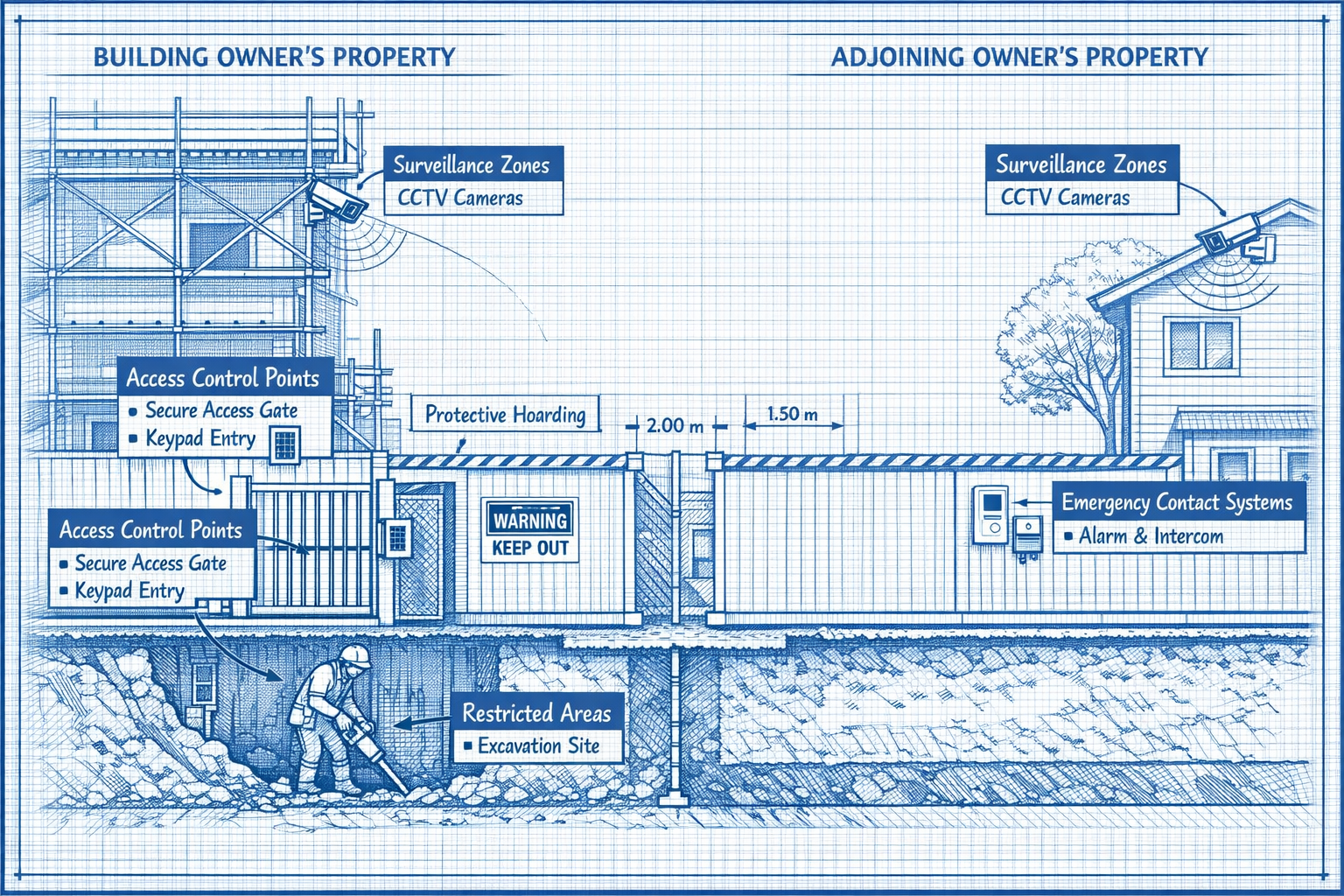
- Physical access control: Secure gates, locked scaffolding access points, and controlled entry systems
- Surveillance and monitoring: CCTV coverage of shared boundaries and oversail zones
- Privacy protection: Screening for scaffolding that overlooks neighboring properties
- Contractor vetting: Background checks and identification systems for workers accessing sensitive areas
- Emergency protocols: Clear communication channels and rapid response procedures
The Federation of Master Builders emphasizes that proper party wall agreements should establish clear rights and responsibilities between neighbors [2]. In 2026, these responsibilities extend to security arrangements that weren't contemplated when the Party Wall etc. Act 1996 was originally drafted.
The Legal Framework for Security Provisions
The Party Wall etc. Act 1996 provides the statutory foundation, but modern security concerns require creative application of its principles. Section 1 (new building on the line of junction), Section 2 (work to existing party walls), and Section 6 (excavation near neighboring buildings) all create situations where security measures become necessary.
Key legal considerations include:
| Security Aspect | Legal Basis | Practical Application |
|---|---|---|
| Access rights | Implied easement during works | Controlled, documented entry only |
| Privacy protection | Common law duty of care | Screening, camera restrictions |
| Property security | Duty to prevent foreseeable harm | Locked access, monitoring systems |
| Contractor conduct | Vicarious liability | Vetting, identification, supervision |
When serving party structure notices, building owners must now anticipate security questions from adjoining owners and their surveyors. Failure to address these concerns proactively can delay projects and increase costs significantly.
Critical Security Elements in 2026 Urban Density Projects
Scaffolding and Oversail Security Protocols
Scaffolding that extends over neighboring properties creates multiple security vulnerabilities. In dense urban areas where properties are tightly packed, scaffolding can provide direct access to upper-floor windows, roof spaces, and previously secure areas.
Essential scaffolding security measures include:
- Locked access points at ground level with key control systems
- Anti-climb devices on external scaffolding faces
- Sheeting and netting that prevents visibility into neighboring properties
- CCTV coverage of scaffolding access routes and oversail areas
- Daily security checks documented and shared with adjoining owners
- Lighting systems that illuminate scaffolding areas without creating nuisance
The adjoining owner has the right to request reasonable security measures as a condition of consent. Party wall awards should specify exactly what security provisions will be implemented, who bears the cost, and how compliance will be monitored.
Crane Swing and Oversail Considerations
Tower cranes operating in high-density developments regularly swing loads over multiple neighboring properties. This creates both physical and security risks that must be addressed in party wall documentation.
Crane-related security provisions should cover:
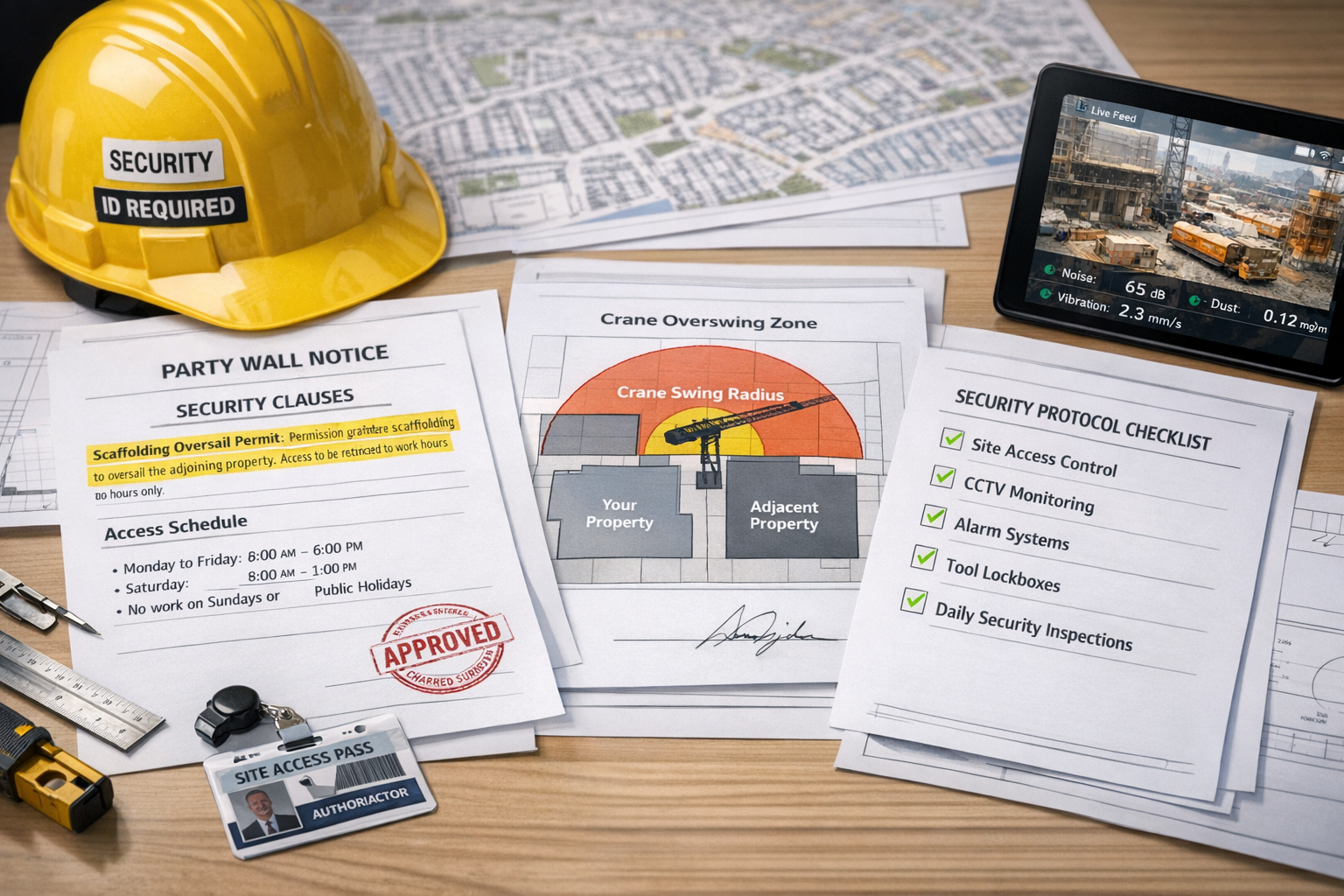
- Advance notification of crane operation schedules
- Exclusion zones where neighbors should avoid during lifting operations
- Load securing protocols to prevent dropped objects
- Emergency stop procedures and contact information
- Insurance coverage specifically for oversail operations
- Photographic evidence of pre-existing conditions in oversail zones
According to legal guidance on party wall applications, proper documentation protects all parties involved [3]. For crane operations, this means detailed schedules, risk assessments, and security protocols that give adjoining owners confidence in the safety measures.
Access Control and Contractor Management
Urban density projects often require construction access through or adjacent to neighboring properties. Managing contractor access while protecting adjoining owner security requires systematic approaches:
Effective contractor management includes:
- ✅ Identification systems: All contractors wear visible ID badges with photos
- ✅ Access logs: Digital or physical records of who enters and exits
- ✅ Restricted hours: Construction access limited to agreed times
- ✅ Supervised access: Site manager presence during sensitive operations
- ✅ Background checks: Vetting for contractors working in residential areas
- ✅ Code of conduct: Written behavioral standards for all site personnel
Building owners bear responsibility for contractor conduct. Party wall awards should specify that building owners remain liable for any security breaches or property violations committed by their contractors or subcontractors.
Implementing Security-Focused Party Wall Notices: A Practical Guide
For Building Owners: Proactive Security Planning
Building owners initiating types of party wall works in high-density areas should integrate security planning from the earliest stages:
Step 1: Security Risk Assessment
Before serving notices, conduct a comprehensive security assessment that identifies:
- Potential access vulnerabilities created by the project
- Privacy concerns from scaffolding or elevated work platforms
- Existing security features on neighboring properties that must be maintained
- Special circumstances (elderly residents, home businesses, valuable collections)
Step 2: Design Security Measures
Work with your building owner's surveyor to design proportionate security measures:
- Specify equipment (locks, cameras, lighting, barriers)
- Define protocols (access procedures, monitoring schedules, reporting systems)
- Establish costs and responsibility for installation and maintenance
- Create contingency plans for security incidents
Step 3: Enhanced Notice Content
When serving party wall notices, include a dedicated security section that outlines:
"The building owner commits to implementing the following security measures to protect adjoining owner interests during construction: [detailed list]. These measures will be installed before works commence and maintained throughout the project duration."
Step 4: Ongoing Communication
Establish regular communication channels:
- Weekly security updates to adjoining owners
- Immediate notification of any security incidents
- Monthly review meetings to address concerns
- Clear escalation procedures for urgent issues
For Adjoining Owners: Protecting Your Rights and Property
Adjoining owners receiving party wall notices for major urban density projects should take security concerns seriously and ensure adequate protections:
Appoint a Qualified Surveyor
Engage an adjoining owner's surveyor with experience in high-density urban projects. Your surveyor should:
- Review proposed security measures for adequacy
- Negotiate additional protections where necessary
- Ensure security provisions are included in the party wall award
- Monitor compliance throughout the construction period
Request Comprehensive Security Schedules
Don't accept vague commitments. Insist on detailed schedules that specify:
| Security Element | Required Detail |
|---|---|
| Access control | Lock types, key holders, access hours, log procedures |
| Surveillance | Camera locations, recording duration, data protection compliance |
| Screening | Materials, height, coverage areas, maintenance schedule |
| Lighting | Locations, intensity, timing, nuisance prevention |
| Emergency contacts | 24/7 phone numbers, response time commitments |
Document Pre-Existing Security
Before works commence, thoroughly document your existing security arrangements:
- Photograph all locks, alarms, cameras, and barriers
- Record serial numbers and specifications of security equipment
- Note any security-related landscaping (hedges, fencing, lighting)
- Create a schedule of condition that includes security features
Understand Cost Responsibilities
The costs of party wall processes typically fall to building owners, including reasonable security measures. However, "reasonable" can be contentious. Your surveyor should negotiate:
- Who pays for security equipment installation
- Responsibility for ongoing monitoring costs
- Compensation for any security downgrade during construction
- Restoration or upgrade of security features upon completion
The Role of Party Wall Awards in Security Protection
Party wall awards serve as the enforceable agreement between parties. In 2026 urban density projects, awards must contain robust security provisions:
Essential Award Components:
-
Security Schedule: Detailed appendix listing all security measures, specifications, and implementation timelines
-
Access Protocols: Clear procedures for when and how building owner's contractors may access or work near adjoining property
-
Monitoring and Reporting: Requirements for security checks, incident reporting, and regular updates to adjoining owners
-
Breach Remedies: Specific consequences for security failures, including work stoppages and compensation mechanisms
-
Insurance Requirements: Minimum coverage levels for security-related incidents, including theft, damage, and privacy breaches
-
Dispute Resolution: Fast-track procedures for addressing security concerns without halting entire projects
Party wall surveyors drafting awards for high-density projects should reference precedents from similar developments and stay current with evolving security standards in the construction industry.
Regional Considerations Across London's Urban Density Zones
Central and Inner London Challenges
Central London projects face unique security challenges due to extreme property density, high property values, and diverse property types:
- Mixed-use developments: Commercial ground floors with residential above require sophisticated access control separating construction zones from occupied spaces
- Heritage properties: Listed buildings need security measures that don't compromise historic fabric
- High-value contents: Properties in premium areas often contain valuable art, antiques, or business assets requiring enhanced protection
Outer London and Suburban Density Projects
North London, South London, East London, and West London areas experiencing densification present different security considerations:
- Garden access: Scaffolding over gardens creates security and privacy concerns requiring extensive screening
- Family homes: Properties with children need additional safety and security measures
- Established communities: Longer-term residents may have stronger concerns about construction-related security disruptions
Cost Management for Security-Enhanced Party Wall Processes
Balancing Security and Budget
Security measures add costs to construction projects, but these costs are generally recoverable and justifiable. Building owners can keep party wall costs down while maintaining adequate security by:
Prioritizing Risk-Based Measures
Not every project needs maximum security. Assess actual risks:
- Ground-floor scaffolding in high-crime areas: Enhanced locks and CCTV essential
- Upper-floor work with no oversail: Basic measures may suffice
- Excavation work away from boundaries: Minimal security additions needed
Leveraging Existing Systems
Integrate with building owner's existing site security:
- Extend site CCTV to cover party wall areas
- Include party wall zones in site security patrols
- Use project-wide access control systems for all contractors
Negotiating Reasonable Standards
Work with adjoining owners to agree proportionate measures:
- Avoid gold-plated solutions that provide minimal additional protection
- Focus on measures that address specific, identified risks
- Consider temporary security that can be removed as work progresses
Typical Cost Ranges for Security Measures:
| Security Measure | Estimated Cost Range | Duration |
|---|---|---|
| Basic scaffolding locks | £200-500 | One-time installation |
| CCTV system (4 cameras) | £1,500-3,500 | Project duration |
| Security screening/sheeting | £500-2,000 | Project duration |
| Access control system | £1,000-3,000 | Project duration |
| Security lighting | £300-1,000 | Project duration |
| Professional security monitoring | £500-1,500/month | As required |
These costs should be documented in the party wall award and are typically recoverable from the building owner as part of the necessary expenses of the works [1].
Dispute Resolution and Enforcement
Common Security-Related Disputes
Even with comprehensive party wall awards, security disputes may arise:
Typical Issues:
- 🔧 Agreed security measures not installed or poorly maintained
- 👁️ Surveillance systems creating privacy concerns beyond what was agreed
- 🚪 Contractors accessing adjoining property without proper authorization
- 🌙 Security lighting causing nuisance to neighbors
- 📱 Inadequate communication about security incidents
Resolution Mechanisms
When security disputes arise, parties should follow escalation procedures:
Level 1: Direct Communication
Building owner and adjoining owner (or their representatives) discuss the issue and seek immediate resolution.
Level 2: Surveyor Intervention
Party wall surveyors review the award provisions and determine whether security measures comply with agreed terms. Surveyors can issue directions requiring compliance.
Level 3: Third Surveyor
If appointed surveyors disagree, the third surveyor makes binding determinations on security disputes.
Level 4: Legal Action
As a last resort, parties may seek court enforcement of party wall awards, though this is expensive and time-consuming.
Pro Tip: Include mediation clauses in party wall awards for security disputes. A half-day mediation session often resolves issues that might otherwise require months of legal proceedings.
Future Trends: Security-Focused Party Wall Notices Beyond 2026
Emerging Technologies and Practices
The integration of security considerations into party wall processes will continue evolving:
Digital Monitoring Systems
- Real-time access tracking via smartphone apps
- Automated alerts for security breaches
- Digital evidence trails for compliance verification
- Blockchain-based immutable records of site access
Enhanced Privacy Protections
- AI-powered cameras that blur neighboring properties
- Acoustic monitoring to prevent eavesdropping concerns
- Drone detection systems for high-density areas
- Privacy impact assessments as standard party wall documents
Regulatory Developments
Industry bodies and government agencies are considering:
- Standardized security schedules for party wall awards
- Mandatory security provisions for projects above certain scales
- Professional indemnity insurance requirements covering security breaches
- Enhanced penalties for security-related party wall violations
Best Practices for Professionals
Party wall surveyors, architects, and construction professionals should:
- Stay Current: Regularly update knowledge of security technologies and legal developments
- Build Networks: Connect with security consultants who understand construction environments
- Document Thoroughly: Create comprehensive records of security measures and compliance
- Communicate Proactively: Keep all parties informed of security arrangements and any changes
- Learn from Precedents: Study how security issues were handled in comparable projects
Conclusion: Balancing Progress and Protection in 2026
Security-Focused Party Wall Notices: Protecting Adjoining Owners in 2026 Urban Density Projects represents the evolution of construction law to meet contemporary urban challenges. As cities grow denser and construction projects become more complex, the traditional party wall framework must expand to address security, privacy, and access concerns that weren't prominent when the legislation was drafted.
The key to successful implementation lies in proactive planning, clear communication, and proportionate measures. Building owners who integrate security considerations from the earliest planning stages avoid delays and disputes. Adjoining owners who engage qualified surveyors and clearly articulate their security concerns receive adequate protections without unreasonably obstructing legitimate development.
Actionable Next Steps
For Building Owners Planning Urban Projects:
- Conduct security risk assessments before serving party wall notices
- Budget for reasonable security measures as part of project costs
- Engage experienced party wall surveyors familiar with high-density developments
- Establish communication protocols with neighbors from the outset
- Review and learn from party wall agreement templates that include security provisions
For Adjoining Owners Receiving Notices:
- Don't ignore party wall notices—respond promptly to protect your rights
- Appoint a surveyor with urban density project experience
- Document your existing security arrangements thoroughly
- Request detailed security schedules in the party wall award
- Establish monitoring procedures to ensure compliance throughout construction
For Property Professionals:
- Develop expertise in security-enhanced party wall procedures
- Create standard security schedules adaptable to different project types
- Build relationships with security consultants and technology providers
- Advocate for industry standards that balance development and protection
- Share knowledge through professional networks and publications
The urban landscape of 2026 demands that party wall procedures evolve beyond structural concerns to encompass the full range of impacts that construction creates for neighboring properties. By embracing Security-Focused Party Wall Notices: Protecting Adjoining Owners in 2026 Urban Density Projects, the construction industry can maintain the delicate balance between enabling necessary development and protecting the rights and security of existing property owners.
As cities continue to grow vertically and density increases, the principles established now will shape urban development for decades to come. Property owners, surveyors, and construction professionals who master these security-focused approaches will be best positioned to navigate the complex party wall landscape of modern urban development.
References
[1] All You Need To Know About Party Wall Notices – https://www.stephensons.co.uk/site/blog/consumer-law-blog/all-you-need-to-know-about-party-wall-notices
[2] Party Wall Agreements What You Need To Know – https://www.fmb.org.uk/find-a-builder/ultimate-guides-to-home-renovation/party-wall-agreements-what-you-need-to-know.html
[3] How To Apply For A Party Wall Notice – https://www.uklegalguides.com/how-to-apply-for-a-party-wall-notice/