


.
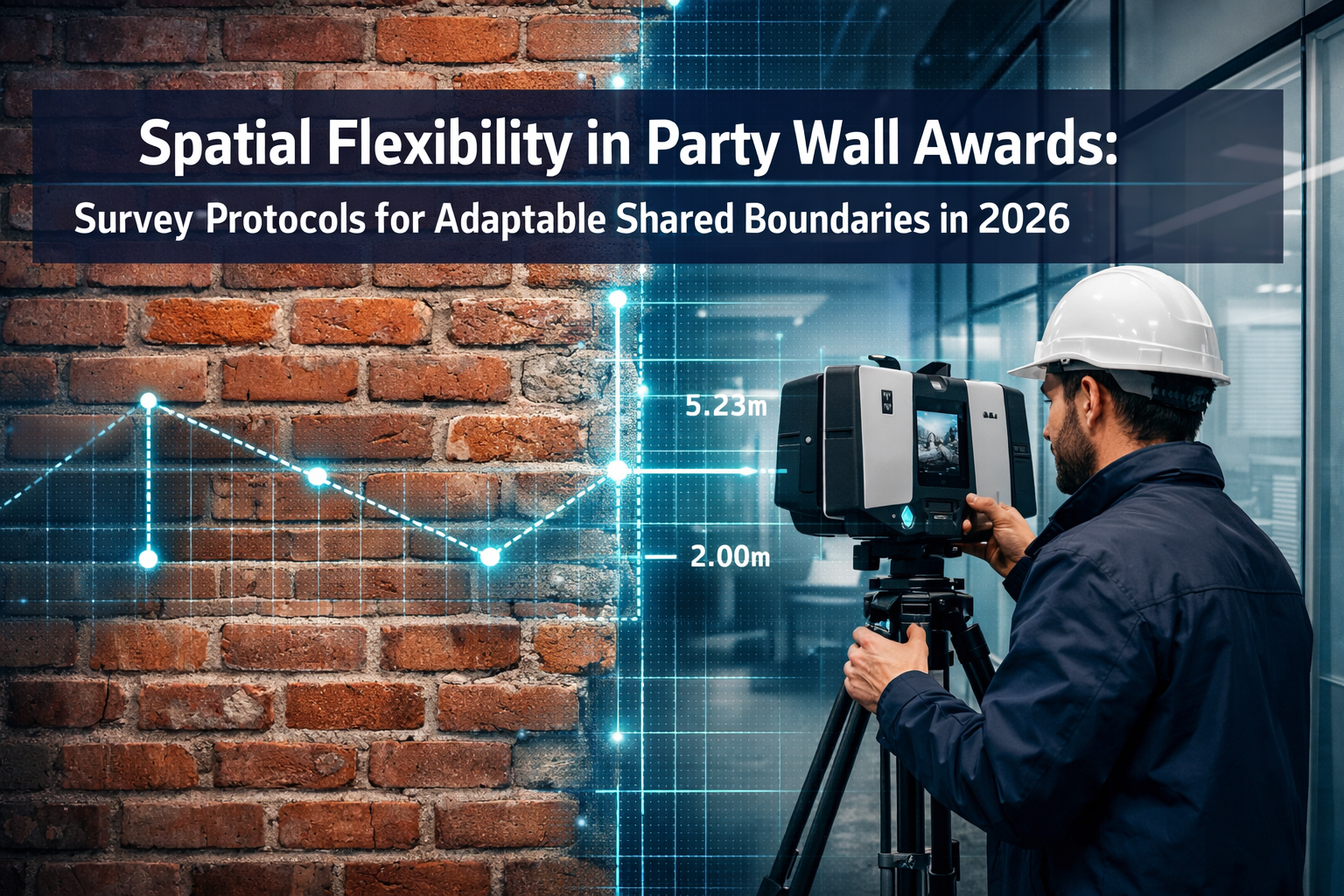
Property owners and developers in 2026 face an unprecedented challenge: creating spaces that can evolve with changing needs while respecting the legal boundaries between adjoining properties. As urban densification accelerates and commercial spaces transform into mixed-use developments, the traditional approach to party wall agreements no longer suffices. Spatial Flexibility in Party Wall Awards: Survey Protocols for Adaptable Shared Boundaries in 2026 represents a paradigm shift in how surveyors document, assess, and protect shared boundaries that must accommodate future modifications like mezzanines, internal reconfigurations, and structural adaptations.
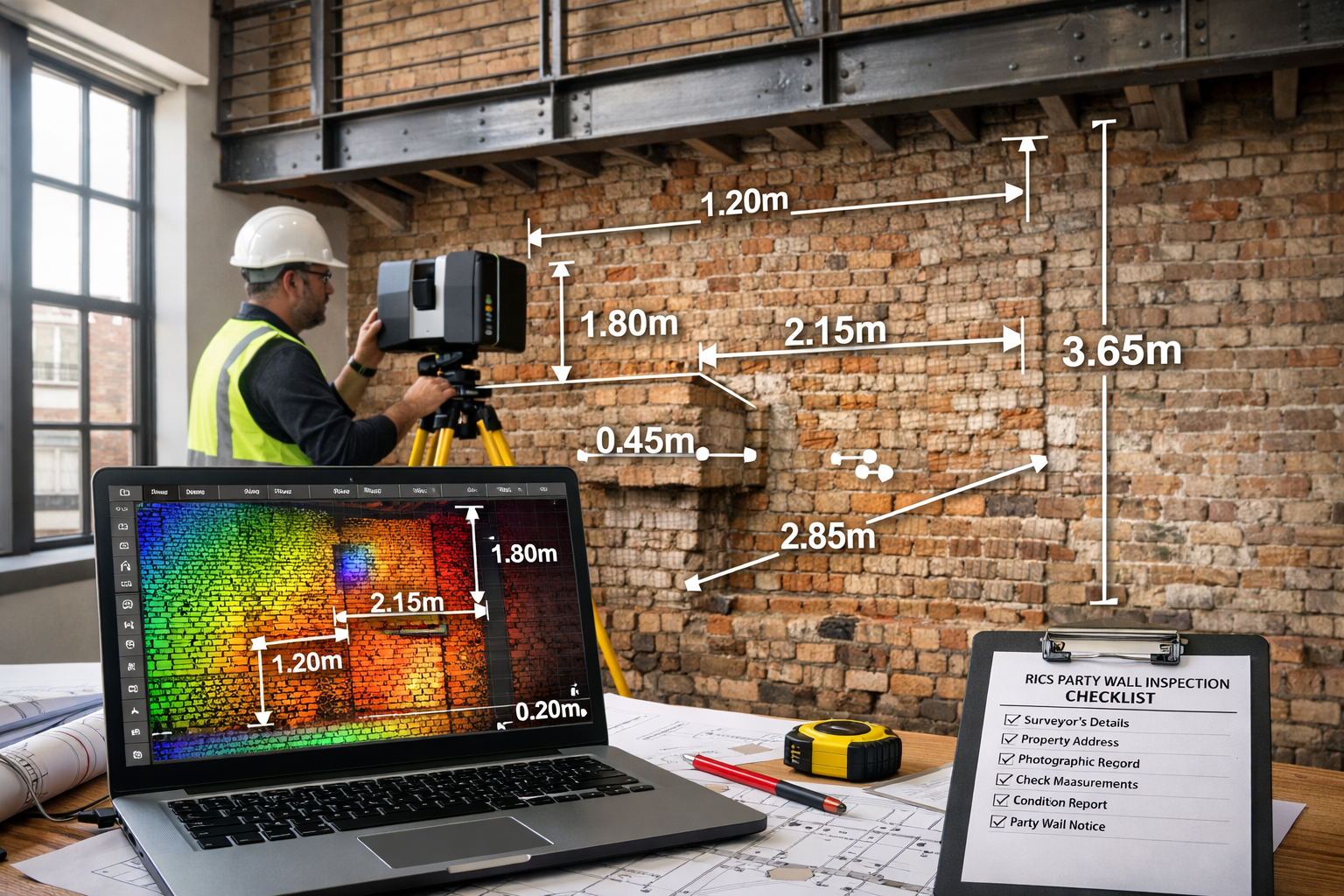
Modern surveyors now employ reality capture technology—including 3D laser scanning and photogrammetry—to create comprehensive digital records of party walls. These detailed surveys form the foundation for awards that anticipate rather than simply react to property changes. This forward-thinking approach protects both building owners and adjoining owners while enabling the flexible spaces that contemporary property use demands.
Key Takeaways
- Reality capture technology enables surveyors to document party walls with millimeter precision, creating digital records that support future-proof awards accommodating spatial reconfigurations
- Flexible party wall awards in 2026 include provisions for anticipated modifications like mezzanine installations, partition changes, and load redistributions without requiring new notices
- RICS protocols now emphasize adaptable survey methodologies that assess not just current conditions but potential future uses of shared boundaries
- Digital documentation reduces disputes by providing objective baseline records that both parties can reference throughout the property lifecycle
- Proactive surveying saves time and costs by anticipating common modifications and establishing parameters within initial awards
Understanding Spatial Flexibility in Modern Party Wall Awards
The Evolution of Party Wall Surveying
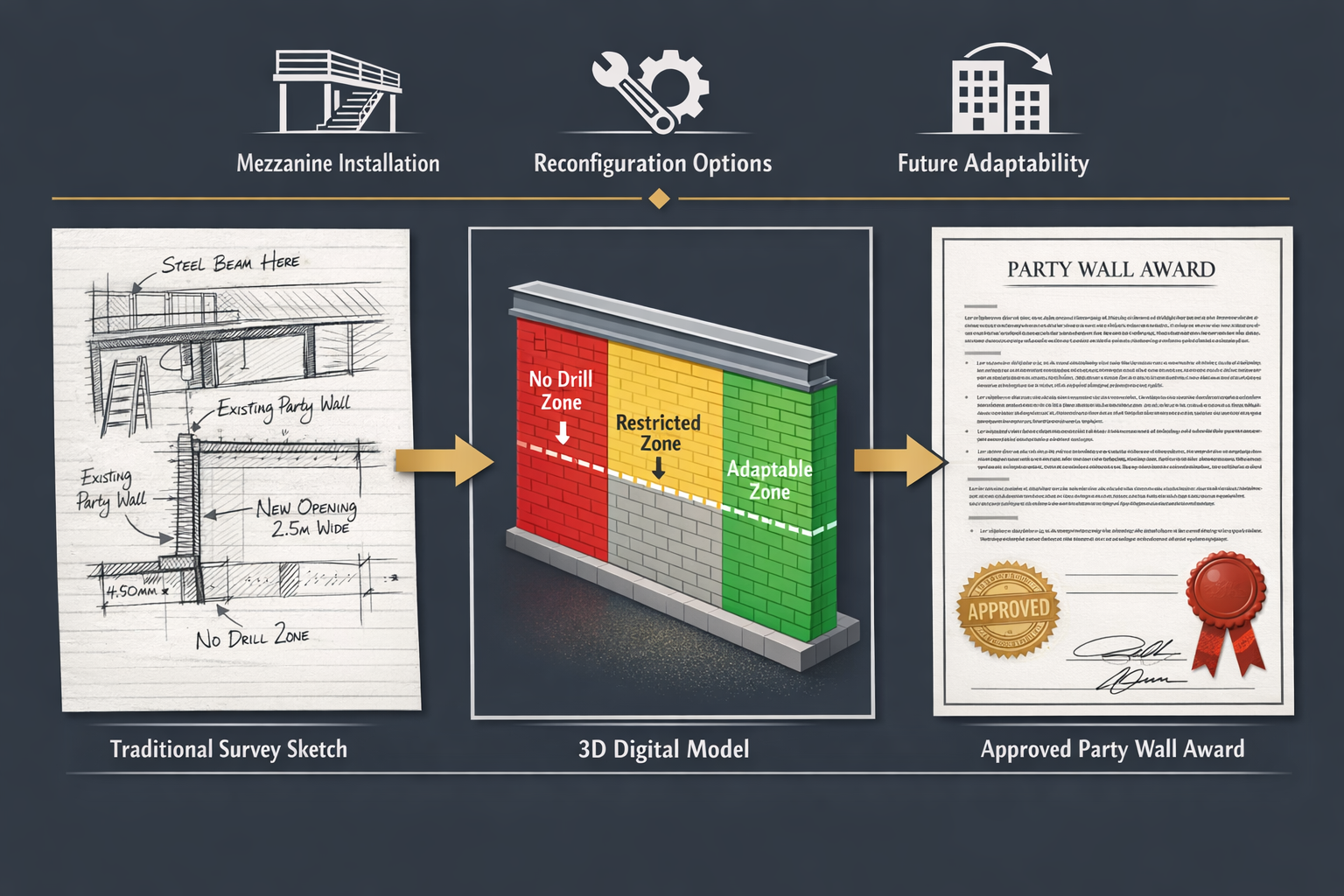
Traditional party wall surveying focused on documenting existing conditions at a specific moment in time. A surveyor would measure, photograph, and describe the party wall's current state, then issue an award based solely on the proposed works outlined in the notice. This reactive approach created problems when building owners later wanted to add mezzanines, reconfigure internal layouts, or make other modifications affecting the shared boundary.
In 2026, the property market demands greater flexibility. Office spaces convert to residential units, retail areas become co-working hubs, and residential properties add rental suites. Each transformation potentially impacts party walls, yet serving new notices for every minor modification creates administrative burden and neighbor friction.
Spatial Flexibility in Party Wall Awards: Survey Protocols for Adaptable Shared Boundaries in 2026 addresses this challenge by incorporating adaptability into the initial survey and award process. Surveyors now assess party walls not just for immediate works but for a range of potential future uses, establishing parameters that allow modifications within agreed boundaries.
Key Components of Flexible Survey Protocols
Modern survey protocols for adaptable boundaries include several critical elements:
Reality Capture Technology 📐
- 3D laser scanning creates point cloud data with sub-millimeter accuracy
- Photogrammetry produces detailed visual records from multiple angles
- Digital models enable virtual inspections and measurements years after initial survey
- Baseline documentation supports comparison after modifications
Load Capacity Assessment 🏗️
- Structural engineers evaluate party wall capacity for various loading scenarios
- Calculations include potential mezzanine installations, floor additions, and equipment mounting
- Safety factors account for future modifications within defined parameters
- Documentation specifies allowable load ranges rather than single-use cases
Acoustic and Fire Performance Baselines 🔥
- Initial testing establishes sound transmission and fire resistance ratings
- Awards specify minimum performance standards that must be maintained
- Protocols outline testing requirements after modifications
- Compliance pathways defined for common reconfiguration scenarios
Modification Zones ✅
- Party walls divided into zones with different flexibility levels
- Restricted zones preserve structural integrity and essential separations
- Flexible zones permit specified modifications without new notices
- Transition zones require consultation but streamlined approval
The Party Wall etc. Act 1996 provides the legal framework, but 2026 best practices extend beyond statutory minimums to create genuinely adaptable agreements.
Survey Protocols for Adaptable Shared Boundaries: Technical Implementation
Reality Capture Methodology
Professional surveyors implementing Spatial Flexibility in Party Wall Awards: Survey Protocols for Adaptable Shared Boundaries in 2026 follow systematic reality capture procedures that transform traditional surveying practices.
Pre-Survey Planning
Before conducting reality capture surveys, surveyors must:
- Identify anticipated modifications through client consultation
- Review architectural plans for proposed and potential future works
- Assess access requirements for comprehensive scanning coverage
- Coordinate with adjoining owners to document both sides of party walls
- Select appropriate technology based on property characteristics
Scanning Execution
The scanning process typically involves:
| Stage | Activity | Technology | Output |
|---|---|---|---|
| Initial Setup | Position scanning equipment at strategic locations | 3D laser scanner | Control point network |
| Primary Capture | Complete scan of party wall from multiple positions | Laser scanning | Point cloud data |
| Detail Capture | High-resolution imaging of critical features | Photogrammetry | Textured 3D models |
| Verification | Cross-reference measurements and overlap zones | Total station | Accuracy validation |
| Processing | Align scans and create unified model | Software processing | Digital twin |
This comprehensive approach creates a digital twin of the party wall that serves as the foundation for flexible awards. The digital record captures not just dimensions but material conditions, existing defects, and structural characteristics that inform future modification decisions.
Developing Adaptable Award Provisions
Once surveyors complete reality capture and analysis, they draft award provisions that enable spatial flexibility while protecting both parties' interests. A party wall surveyor in Central London working on a 2026 office retrofit might include provisions such as:
Mezzanine Installation Parameters 🏢
- Maximum additional load per square meter on party wall
- Required connection details and fixings specifications
- Acoustic performance standards for new floor structures
- Notification requirements (inspection rather than new notice)
Partition Reconfiguration Allowances 🔧
- Permitted locations for non-structural partition connections
- Prohibited zones where connections could compromise party wall
- Standard fixing methods that don't require individual approval
- Inspection protocols to verify compliance
Services and Penetrations ⚡
- Pre-approved locations and sizes for conduit penetrations
- Fire-stopping and acoustic sealing requirements
- Maximum number of penetrations per zone
- Remediation standards if penetrations later removed
Future Access Provisions 🚪
- Inspection schedules to monitor party wall condition
- Access arrangements for maintenance and modifications
- Notice periods for non-emergency inspections
- Documentation requirements for completed modifications
These provisions transform party wall awards from static documents into living frameworks that support property evolution. The approach particularly benefits properties in areas like North London and South London, where property values incentivize maximizing spatial utility.
Integration with RICS Standards
The Royal Institution of Chartered Surveyors (RICS) has evolved guidance to support flexible party wall surveying. While maintaining core principles of accuracy, impartiality, and protection for all parties, RICS now encourages surveyors to consider property lifecycle needs when preparing awards[3].
Key RICS considerations for 2026 include:
- Proportionality: Survey detail should match the complexity and anticipated flexibility needs
- Technology adoption: Embracing reality capture where it provides superior documentation
- Future-proofing: Considering reasonably foreseeable modifications during initial surveys
- Digital record-keeping: Maintaining accessible archives of baseline conditions
- Professional judgment: Balancing flexibility with appropriate protections
Surveyors must still comply with statutory requirements under the Party Wall etc. Act 1996, but flexible protocols enhance rather than replace these foundations. The goal is creating awards that reduce future disputes by establishing clear parameters for common modifications.
Practical Applications: Case Studies and Implementation
Office Retrofit Scenarios
The 2026 London property market demonstrates strong demand for office retrofits that create flexible workspaces. These projects exemplify why Spatial Flexibility in Party Wall Awards: Survey Protocols for Adaptable Shared Boundaries in 2026 has become essential practice.
Consider a typical scenario in East London where a building owner converts a traditional office building into flexible co-working space. The conversion involves:
- Installing mezzanines to increase usable floor area
- Creating modular meeting rooms with movable partitions
- Adding kitchenettes and breakout spaces
- Upgrading mechanical and electrical services
Each element potentially affects party walls shared with adjoining properties. Traditional surveying would require separate notices and awards for each phase, creating delays and costs. Flexible survey protocols instead:
- Document the entire party wall using 3D laser scanning
- Assess structural capacity for anticipated mezzanine loads
- Establish modification zones where partitions can connect
- Pre-approve service penetrations within specified parameters
- Create inspection schedules rather than repeated notice requirements
This approach, as noted in recent industry analysis, helps navigate market conditions while maintaining proper protections[1]. The initial survey investment pays dividends through streamlined future modifications.
Residential Extensions and Conversions
Residential properties increasingly require adaptability as household needs evolve. A homeowner in West London might initially extend their property to add a home office, then later want to convert that space into a rental unit with separate access.
Flexible party wall awards anticipate such scenarios by:
Establishing baseline conditions through comprehensive reality capture that documents party wall integrity before any works commence. This creates an objective reference point that protects both the building owner undertaking works and the adjoining owner whose property shares the boundary.
Defining modification parameters that specify what changes can occur without new notices, such as internal partition adjustments, minor service installations, or non-structural alterations within agreed zones. Understanding types of party wall works helps property owners recognize which modifications fall within flexible provisions versus those requiring new procedures.
Setting performance standards that must be maintained regardless of internal configurations, including acoustic separation, fire resistance, and structural integrity. These standards protect adjoining owners while giving building owners freedom to adapt spaces.
Creating notification protocols that require informing (but not obtaining permission from) adjoining owners about modifications within agreed parameters, maintaining transparency without administrative burden.
Commercial-to-Residential Conversions
Perhaps the most complex application of flexible party wall protocols involves converting commercial buildings to residential use. These projects, common across London in 2026, require party walls to meet entirely different performance standards while accommodating diverse residential layouts.
A party wall surveyor managing such conversions must address:
- Acoustic requirements: Residential use demands higher sound insulation than commercial
- Fire safety: Residential classifications require different fire resistance ratings
- Structural modifications: Creating residential units often involves removing or adding walls
- Services distribution: Residential properties need different utility configurations
Flexible survey protocols support these complex projects by establishing a framework that anticipates the conversion's full scope rather than treating each element as a separate issue. The initial comprehensive survey and award reduce the need for multiple supplementary agreements as the project progresses.
Challenges and Solutions in Implementing Flexible Protocols
Technology Adoption Barriers
Despite clear benefits, implementing Spatial Flexibility in Party Wall Awards: Survey Protocols for Adaptable Shared Boundaries in 2026 faces practical challenges. Reality capture technology requires significant investment in equipment and training. Smaller surveying practices may find the initial costs prohibitive.
Solutions include:
- Equipment sharing arrangements between surveying practices
- Outsourcing scanning services to specialized providers
- Phased technology adoption starting with photogrammetry before investing in laser scanning
- Training partnerships with technology vendors and professional organizations
The long-term efficiency gains typically justify initial investments, particularly for surveyors handling multiple party wall matters annually.
Legal and Regulatory Considerations
Party wall law in England and Wales derives from the Party Wall etc. Act 1996, which doesn't explicitly address flexible awards or future modifications. Surveyors must ensure flexible provisions remain within statutory authority.
Key legal considerations:
✅ Awards must address specific works described in notices, though they can include reasonable provisions for related future modifications
✅ Adjoining owner protections cannot be diminished by flexibility provisions—rights to object to future works remain
✅ Statutory timeframes for serving notices and responding apply regardless of flexible provisions in previous awards
✅ Enforcement mechanisms must be clearly defined if building owners exceed flexible provisions
Consulting party wall contract templates helps ensure flexible provisions align with established legal frameworks while pushing boundaries appropriately.
Adjoining Owner Concerns
Adjoining owners may view flexible provisions with suspicion, fearing they grant building owners excessive freedom to modify shared boundaries. Effective communication addresses these concerns:
Transparency: Clearly explaining what modifications flexible provisions permit versus those still requiring notices
Protections: Emphasizing performance standards and inspection rights that protect adjoining owners
Limitations: Defining restricted zones and prohibited activities that preserve adjoining owner interests
Benefits: Highlighting how flexible provisions reduce future disruption by streamlining minor modifications
Many adjoining owners appreciate that flexible protocols reduce the frequency of notices and surveys while maintaining appropriate protections. Understanding how to respond to party wall notices helps adjoining owners engage constructively with flexible proposals.
Cost Considerations
Reality capture surveys and comprehensive structural assessments cost more than traditional party wall surveys. Building owners may resist the additional expense, particularly if they don't immediately anticipate future modifications.
Cost-benefit analysis shows:
| Traditional Approach | Flexible Protocol Approach |
|---|---|
| Lower initial survey cost | Higher initial survey cost |
| Multiple future surveys needed | Fewer future surveys required |
| Repeated notice procedures | Streamlined modification process |
| Potential delays and disputes | Reduced conflict and faster approvals |
| Higher cumulative costs | Lower lifetime costs |
For properties where modifications are reasonably foreseeable—particularly commercial spaces and properties in high-value areas—flexible protocols deliver superior value despite higher initial investment. Resources on keeping party wall costs down help property owners optimize their approach.
Best Practices for Surveyors and Property Owners
For Surveyors Implementing Flexible Protocols
Professional surveyors adopting Spatial Flexibility in Party Wall Awards: Survey Protocols for Adaptable Shared Boundaries in 2026 should follow these best practices:
1. Comprehensive Initial Consultation 🗣️
- Discuss property owner's current plans and potential future modifications
- Assess whether flexible provisions provide value for specific circumstances
- Explain benefits and limitations to both building and adjoining owners
- Document discussions to support award provisions
2. Thorough Technical Assessment 📊
- Conduct reality capture surveys with appropriate technology
- Engage structural engineers for load capacity analysis
- Test acoustic and fire performance where relevant
- Create detailed digital records accessible for future reference
3. Clear Award Drafting 📝
- Define modification zones with precise boundaries
- Specify performance standards using measurable criteria
- Establish notification and inspection procedures
- Include enforcement mechanisms for violations
4. Stakeholder Communication 💬
- Explain flexible provisions in plain language
- Provide visual aids showing permitted modifications
- Address concerns proactively
- Maintain accessible records for all parties
5. Post-Award Support 🤝
- Offer guidance when building owners plan modifications
- Conduct inspections to verify compliance with flexible provisions
- Mediate disputes about interpretation
- Update digital records as modifications occur
For Building Owners
Property owners considering works affecting party walls should:
Engage surveyors early in project planning to determine whether flexible protocols suit their needs. Early engagement allows surveyors to conduct comprehensive baseline surveys before any works commence.
Consider future uses when planning modifications. Even if immediate plans don't require extensive flexibility, anticipating potential future needs may justify comprehensive initial surveys.
Invest in quality documentation. Reality capture surveys cost more initially but provide valuable records that support future modifications and protect against disputes.
Maintain good neighbor relations. Flexible provisions work best when adjoining owners trust that building owners will respect agreed parameters and maintain transparency.
Keep records accessible. Digital survey records, awards, and modification documentation should be organized and readily available for future reference.
For Adjoining Owners
Adjoining owners receiving notices for works involving flexible provisions should:
Understand the provisions by carefully reviewing proposed awards and asking questions about what modifications they permit.
Verify protections ensure performance standards, inspection rights, and restricted zones adequately protect your interests.
Consider appointing a surveyor even when flexible provisions seem reasonable. An adjoining owner's surveyor can review technical aspects and negotiate appropriate terms.
Document baseline conditions through your own photographs and notes, supplementing the building owner's reality capture survey.
Maintain communication with building owners about planned modifications, even those within flexible provisions, to avoid surprises.
Future Trends in Party Wall Surveying
Emerging Technologies
Beyond current reality capture methods, emerging technologies promise to further enhance Spatial Flexibility in Party Wall Awards: Survey Protocols for Adaptable Shared Boundaries in 2026:
Artificial Intelligence 🤖
- Automated defect detection in point cloud data
- Predictive analysis of party wall condition over time
- Pattern recognition identifying modification risks
- Natural language processing for award drafting
Building Information Modeling (BIM) 🏗️
- Integration of party wall data with broader building models
- Real-time collaboration between surveyors, architects, and engineers
- Lifecycle management of party wall conditions
- Automated compliance checking for proposed modifications
Blockchain Documentation 🔗
- Immutable records of baseline conditions and modifications
- Smart contracts automating notification and inspection procedures
- Transparent audit trails for all parties
- Reduced disputes through objective documentation
Augmented Reality 👓
- On-site visualization of modification zones and restrictions
- Virtual inspections reducing access requirements
- Training tools for surveyors and property owners
- Enhanced communication of complex technical information
Regulatory Evolution
As flexible party wall protocols become standard practice, regulatory frameworks may evolve to explicitly support them. Potential developments include:
- Statutory recognition of flexible provisions in party wall legislation
- Standard templates for common modification scenarios
- Digital notice procedures replacing paper-based systems
- National databases of party wall awards and baseline surveys
Industry organizations like RICS continue developing guidance that balances innovation with protection for all parties. Surveyors should stay informed about evolving standards and contribute to their development through professional engagement.
Market Drivers
Several market forces will continue driving adoption of flexible party wall protocols:
Urban densification increases the proportion of properties sharing party walls, making efficient procedures more valuable.
Property value optimization incentivizes maximizing spatial utility through adaptable configurations.
Sustainability requirements favor retrofitting and adapting existing buildings over new construction.
Remote work trends create demand for flexible residential and commercial spaces that can evolve with changing needs.
Technology costs declining make reality capture increasingly accessible to surveyors and property owners.
These drivers suggest that Spatial Flexibility in Party Wall Awards: Survey Protocols for Adaptable Shared Boundaries in 2026 represents not a temporary trend but a fundamental shift in party wall surveying practice.
Conclusion
Spatial Flexibility in Party Wall Awards: Survey Protocols for Adaptable Shared Boundaries in 2026 represents a significant evolution in how surveyors, property owners, and adjoining owners approach shared boundaries. By combining reality capture technology with forward-thinking award provisions, modern party wall practice enables the flexible spaces that contemporary property use demands while maintaining appropriate protections for all parties.
The shift from reactive, single-purpose surveys to comprehensive, adaptable documentation requires initial investment in technology and expertise. However, the long-term benefits—reduced administrative burden, fewer disputes, faster modifications, and lower cumulative costs—justify this investment for properties where spatial flexibility provides value.
Key Implementation Steps
For property owners and surveyors ready to adopt flexible protocols:
- Assess suitability: Determine whether your property's anticipated uses justify comprehensive flexible provisions
- Engage qualified surveyors: Select professionals with reality capture capabilities and experience drafting flexible awards
- Invest in baseline documentation: Conduct thorough initial surveys creating robust digital records
- Draft comprehensive awards: Include clear modification parameters, performance standards, and procedures
- Maintain records: Keep digital surveys, awards, and modification documentation organized and accessible
- Foster communication: Build positive relationships with adjoining owners through transparency and respect
Looking Forward
As 2026 progresses, flexible party wall protocols will likely become standard practice rather than innovative approaches. Property owners planning works affecting party walls should consider whether traditional reactive surveying meets their needs or whether investing in comprehensive adaptable documentation better serves their long-term interests.
The integration of reality capture technology, structural analysis, and forward-thinking legal frameworks creates party wall awards that support rather than constrain property evolution. By anticipating common modifications and establishing clear parameters, surveyors reduce future conflicts while enabling the spatial flexibility that modern properties require.
Whether you're a building owner planning modifications, an adjoining owner receiving notices, or a surveyor developing your practice, understanding and implementing Spatial Flexibility in Party Wall Awards: Survey Protocols for Adaptable Shared Boundaries in 2026 positions you for success in an evolving property landscape.
For professional guidance on party wall matters incorporating flexible protocols, consult experienced surveyors who combine technical expertise with innovative approaches to shared boundary management. The future of party wall surveying lies in creating frameworks that protect all parties while enabling the adaptable spaces that 2026 and beyond demand.
References
[1] Party Wall Agreements For Office Retrofit Expansions 2026 Navigating Underpriced London Market Recovery – https://nottinghillsurveyors.com/blog/party-wall-agreements-for-office-retrofit-expansions-2026-navigating-underpriced-london-market-recovery
[3] Party Wall Challenges In Scotlands 2026 Property Surge Rics Protocols For Cross Border Extension Projects – https://nottinghillsurveyors.com/blog/party-wall-challenges-in-scotlands-2026-property-surge-rics-protocols-for-cross-border-extension-projects
[4] 92662 International Ideas Competition For Young Architects To Transform Party Walls – https://www.buildingenclosureonline.com/articles/92662-international-ideas-competition-for-young-architects-to-transform-party-walls