


Surveyor Social Housing: The Complete Guide to Professional Inspections and Compliance in 2026
When social housing tenants discover structural issues or when housing associations plan major renovations, one critical professional stands between safety and disaster: the surveyor social housing specialist. In 2026, with over 4 million social housing units across the UK requiring regular inspections and maintenance, the role of qualified surveyors has never been more vital to ensuring safe, compliant, and well-maintained properties for vulnerable communities.
Social housing presents unique challenges that distinguish it from private residential surveying. From navigating complex ownership structures involving local authorities and housing associations to managing the expectations of multiple stakeholders, surveyors working in this sector require specialized knowledge and experience. Whether you’re a housing association manager, a building owner planning works adjacent to social housing, or a tenant concerned about structural issues, understanding the role of a surveyor social housing expert is essential.
Key Takeaways
- Specialized expertise required: Surveyors working with social housing need specific knowledge of public sector regulations, funding constraints, and tenant welfare considerations beyond standard residential surveying
- Party wall implications: Social housing developments frequently involve party wall matters that require careful navigation, particularly when properties share boundaries with private residences
- Compliance obligations: Housing associations and local authorities must meet strict regulatory standards, making professional surveyor involvement mandatory for many projects
- Cost management: Budget limitations in social housing mean surveyors must balance thorough inspections with cost-effective solutions
- Tenant protection: Surveyors play a crucial role in safeguarding resident welfare through comprehensive condition assessments and safety compliance checks
Understanding the Role of a Surveyor in Social Housing
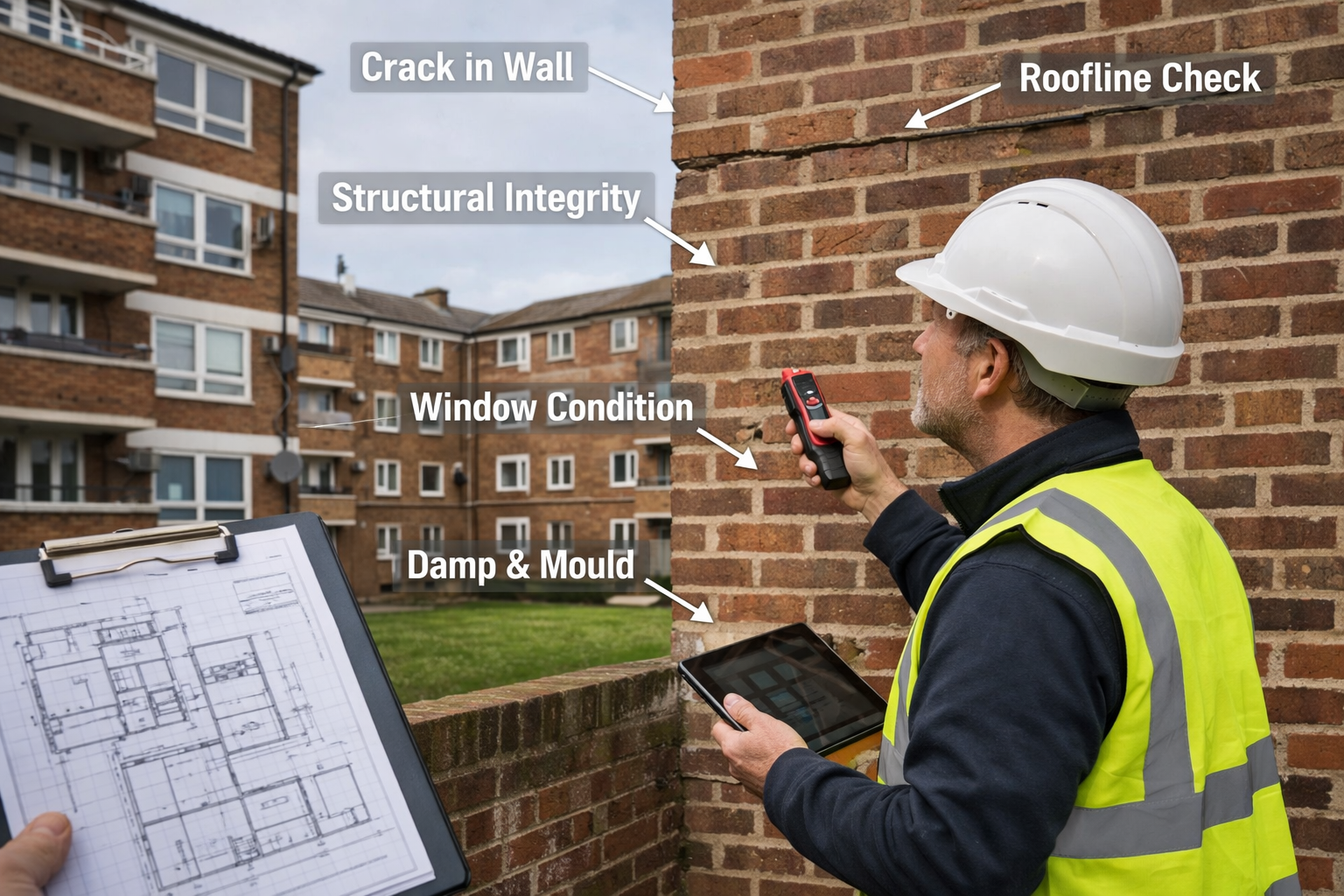
The surveyor social housing professional occupies a unique position within the property industry. Unlike surveyors working exclusively in the private sector, these specialists must balance technical expertise with an understanding of social welfare, public accountability, and often limited budgets.
Core Responsibilities
Social housing surveyors typically handle several critical functions:
📋 Property Condition Assessments: Regular inspections to identify maintenance needs, structural defects, and safety hazards before they escalate into serious problems.
🏗️ Pre-Construction Surveys: Detailed evaluations before renovation or extension projects, including schedule of condition documentation to protect all parties involved.
⚖️ Regulatory Compliance: Ensuring properties meet current building regulations, fire safety standards, and accessibility requirements mandated for social housing providers.
🔍 Defect Analysis: Investigating reported issues such as damp, structural movement, or building envelope failures that commonly affect older social housing stock.
💰 Budget Planning: Providing accurate cost estimates for repairs and improvements to help housing associations allocate limited resources effectively.
Qualifications and Expertise
Professional surveyors working in social housing typically hold RICS (Royal Institution of Chartered Surveyors) accreditation and possess specific experience with:
- Multi-occupancy buildings and apartment blocks
- Local authority procurement processes
- Social housing regulations and standards
- Tenant liaison and communication
- Value engineering for cost-constrained projects
The complexity of social housing stock—ranging from Victorian terraces to 1960s tower blocks and modern developments—demands versatile technical knowledge and problem-solving capabilities.
Party Wall Matters in Social Housing Developments
One of the most frequently encountered challenges for surveyor social housing professionals involves party wall procedures. When social housing properties share walls, floors, or boundaries with neighboring properties—whether other social housing units or private residences—the Party Wall etc. Act 1996 applies.
Common Party Wall Scenarios
Social housing developments commonly trigger party wall requirements in these situations:
| Scenario | Party Wall Implications | Surveyor Role |
|---|---|---|
| Estate Regeneration | Demolition and rebuilding affecting multiple adjoining properties | Coordinate notices, manage multiple appointments, oversee dispute resolution |
| Loft Conversions | Raising roof heights or adding dormers in terraced social housing | Assess structural impact, prepare awards, monitor construction |
| Basement Extensions | Excavating below neighboring foundations for additional space | Conduct foundation investigations, establish protection measures |
| External Wall Insulation | Upgrading thermal performance affecting party walls | Evaluate structural capacity, coordinate access arrangements |
| Structural Repairs | Underpinning or rebuilding shared walls due to subsidence | Document existing conditions, specify remedial works, verify completion |
The Appointment Process
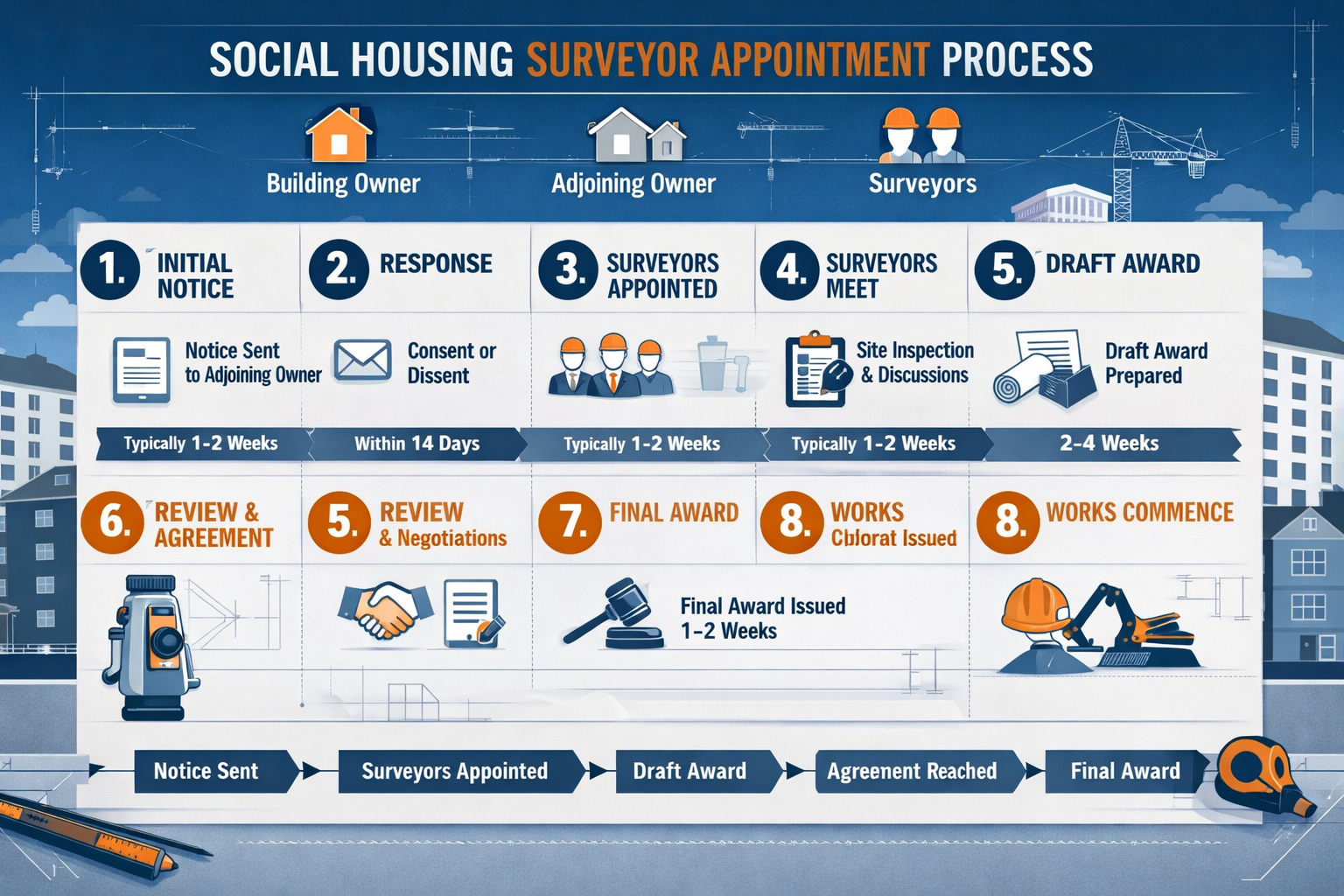
When a housing association or local authority plans works requiring party wall procedures, the process typically unfolds as follows:
1️⃣ Notice Serving: The building owner (housing association) must serve appropriate party wall notices to all affected adjoining owners, whether they’re other social housing tenants, private homeowners, or commercial properties.
2️⃣ Response Period: Adjoining owners have 14 days to consent or dissent to the proposed works.
3️⃣ Surveyor Appointment: If consent isn’t given, surveyors must be appointed. This is where experienced party wall surveyors become essential to the process.
4️⃣ Award Preparation: The appointed surveyor(s) prepare a party wall award detailing how works will proceed, protective measures, and dispute resolution mechanisms.
5️⃣ Works Monitoring: Surveyors may conduct inspections during construction to ensure compliance with the award terms.
Understanding how to keep party wall costs down becomes particularly important for social housing providers working within tight budgets while maintaining legal compliance.
Special Considerations for Social Housing
Party wall matters in social housing contexts present unique challenges:
Multiple Stakeholders: Housing associations must balance tenant welfare, regulatory obligations, and budgetary constraints while managing party wall procedures.
Tenant Communication: Unlike private homeowners who directly engage with party wall processes, social housing tenants may require additional support and explanation from surveyors about their rights and the implications of planned works.
Funding Constraints: Social housing budgets are typically more restricted than private developments, making cost-effective surveyor appointments and efficient dispute resolution essential.
Regulatory Oversight: Local authorities and housing associations face greater public scrutiny, requiring meticulous documentation and transparent processes throughout party wall procedures.
When your neighbor is carrying out works adjacent to social housing, understanding these dynamics helps ensure fair treatment for all parties involved.
Types of Surveys Required for Social Housing Properties
The surveyor social housing sector encompasses various inspection types, each serving distinct purposes within the property lifecycle.
Stock Condition Surveys
Housing associations and local authorities conduct regular stock condition surveys to:
- Assess the current state of their entire property portfolio
- Identify immediate repair needs and future maintenance requirements
- Plan capital investment programs over 30-year cycles
- Comply with Decent Homes Standards and other regulatory frameworks
- Prioritize spending based on property condition and tenant need
These comprehensive assessments typically occur every 5 years and form the foundation for long-term asset management strategies.
Pre-Acquisition Surveys
Before purchasing properties to expand social housing stock, thorough surveys identify:
✅ Structural soundness and remaining lifespan
✅ Hidden defects that might require immediate remediation
✅ Compliance with current building regulations
✅ Accessibility features and potential for adaptation
✅ Energy efficiency and improvement opportunities
These surveys protect public investment by ensuring properties represent good value and won’t require excessive maintenance expenditure.
Disrepair Inspections
When tenants report maintenance issues or raise formal disrepair claims, independent surveyors conduct detailed inspections to:
- Verify the existence and extent of reported defects
- Determine causation and responsibility
- Assess whether conditions breach tenancy obligations
- Recommend appropriate remedial actions
- Provide expert evidence for potential legal proceedings
Impartiality is crucial in these situations, as surveyors must objectively assess conditions without bias toward either the housing provider or tenant.
Fire Safety Assessments
Following the Grenfell Tower tragedy and subsequent regulatory changes, fire safety surveys have become mandatory for many social housing buildings, particularly:
🔥 High-rise residential buildings (above 18 meters)
🔥 Buildings with vulnerable residents
🔥 Properties with cladding systems
🔥 Converted buildings with complex layouts
Specialist surveyors assess fire risk, evaluate existing safety measures, and recommend improvements to meet current standards.
Energy Performance Assessments
With increasing focus on sustainability and fuel poverty reduction, social housing surveyors frequently conduct Energy Performance Certificate (EPC) assessments and recommend cost-effective improvements to:
- Reduce tenant energy bills
- Meet minimum energy efficiency standards (currently EPC rating E or above)
- Access government funding for retrofit programs
- Contribute to carbon reduction targets
Navigating Regulatory Requirements and Standards
Social housing operates within a complex regulatory framework that significantly impacts surveyor responsibilities and methodologies.
The Decent Homes Standard
All social housing must meet the Decent Homes Standard, which requires properties to:
- Meet the current statutory minimum standard for housing
- Be in a reasonable state of repair
- Have reasonably modern facilities and services
- Provide a reasonable degree of thermal comfort
Surveyors assess compliance with these criteria and identify necessary improvements when properties fall short.
Building Safety Act 2022
The Building Safety Act 2022 introduced sweeping changes affecting social housing, particularly for higher-risk buildings. Surveyors now play expanded roles in:
- Safety case reporting: Contributing technical expertise to demonstrate building safety
- Golden thread documentation: Maintaining comprehensive digital records of building information throughout the property lifecycle
- Competence requirements: Ensuring all professionals involved in building work meet prescribed competence standards
Consumer Standards and Tenant Protection
The Regulator of Social Housing enforces consumer standards that indirectly affect surveyor work:
- Home Standard: Requires landlords to maintain properties in good repair, which necessitates regular surveyor inspections
- Tenancy Standard: Ensures fair tenancy management, with surveyors providing objective evidence in disputes
- Neighbourhood and Community Standard: Addresses environmental quality, with surveyors identifying issues affecting the wider estate
Understanding these regulatory contexts enables surveyors to provide advice that goes beyond technical matters to encompass compliance obligations.
Challenges Unique to Social Housing Surveying
Working as a surveyor social housing specialist presents distinct challenges not typically encountered in private residential work.
Budget Constraints
💷 Limited Resources: Social housing providers operate within tight financial constraints, requiring surveyors to:
- Prioritize essential repairs over desirable improvements
- Identify cost-effective solutions that maximize value
- Recommend phased approaches to major works
- Balance immediate safety needs against long-term planning
This financial reality demands creativity and pragmatism from surveyors who must maintain standards while respecting budgetary limitations.
Occupied Properties
Unlike many private developments where properties can be vacated during major works, social housing typically remains occupied throughout construction:
- Surveyors must minimize disruption to residents
- Access arrangements require coordination with tenants
- Health and safety considerations are heightened
- Decanting (temporary rehousing) adds complexity and cost
These factors influence survey recommendations and construction methodologies.
Diverse Building Stock
Social housing portfolios often include:
🏘️ Victorian and Edwardian terraces
🏢 Post-war system-built properties
🏗️ 1960s-70s tower blocks
🏡 Modern energy-efficient developments
Each building type presents unique structural characteristics, common defects, and maintenance challenges requiring specialized knowledge.
Vulnerable Residents
Social housing serves populations with diverse needs, including:
- Elderly residents requiring accessibility features
- Families with children needing safe environments
- People with disabilities requiring adapted properties
- Individuals experiencing financial hardship
Surveyors must consider these human factors when assessing properties and recommending works, ensuring solutions don’t inadvertently create hardship or safety risks for vulnerable occupants.
Stakeholder Management
Social housing projects typically involve multiple stakeholders:
👥 Tenants: Directly affected by works and entitled to consultation
🏛️ Housing Associations: Responsible for property management and compliance
🏢 Local Authorities: May own properties or provide funding
🔧 Contractors: Execute remedial works based on surveyor specifications
⚖️ Regulators: Oversee standards and investigate complaints
Effective communication across these diverse groups requires diplomatic skills alongside technical expertise.
Selecting the Right Surveyor for Social Housing Projects
Choosing an appropriate surveyor social housing professional significantly impacts project outcomes, costs, and compliance.
Essential Qualifications
Look for surveyors with:
✔️ RICS Membership: Chartered status demonstrates professional competence and adherence to ethical standards
✔️ Social Housing Experience: Specific familiarity with public sector procurement, regulations, and stakeholder management
✔️ Relevant Specializations: Depending on project needs, expertise in structural engineering, building pathology, or party wall matters
✔️ Professional Indemnity Insurance: Adequate coverage protecting against potential errors or omissions
Questions to Ask Prospective Surveyors
When evaluating surveyor candidates, consider asking:
- How many social housing projects have you completed in the past 12 months?
- What is your experience with party wall procedures in multi-occupancy buildings?
- Can you provide references from other housing associations or local authorities?
- How do you approach cost management within constrained budgets?
- What is your typical turnaround time for survey reports?
- How do you handle tenant communication and access arrangements?
Geographic Considerations
For London-based social housing, working with surveyors who have specific local knowledge proves advantageous. Whether properties are located in North London, South London, East London, West London, or Central London, familiarity with local building characteristics, planning authorities, and common issues enhances service quality.
Cost Structures
Social housing surveyor fees typically follow these models:
| Fee Structure | Description | Best For |
|---|---|---|
| Fixed Fee | Agreed price for defined scope | Standard surveys with clear parameters |
| Hourly Rate | Time-based charging | Complex investigations with uncertain scope |
| Percentage of Works | Fee calculated as percentage of construction value | Major projects with substantial budgets |
| Framework Agreement | Pre-negotiated rates for ongoing work | Housing associations with regular surveyor needs |
Transparent fee structures help housing providers budget accurately and avoid unexpected costs.
The Future of Social Housing Surveying in 2026 and Beyond
The surveyor social housing profession continues evolving in response to technological advances, regulatory changes, and shifting societal priorities.
Digital Transformation
Modern surveyors increasingly leverage technology:
📱 Mobile Survey Apps: Capture data, photographs, and measurements on-site with instant cloud synchronization
🤖 Building Information Modeling (BIM): Create comprehensive digital twins of social housing assets
🚁 Drone Surveys: Safely inspect roofs, chimneys, and high-level elements without scaffolding
🔬 Thermal Imaging: Identify insulation defects, moisture ingress, and heat loss patterns
📊 Predictive Analytics: Use historical data to forecast maintenance needs and optimize investment
These innovations improve accuracy, reduce costs, and enhance safety while providing housing associations with richer data for decision-making.
Sustainability Focus
Climate change imperatives drive increased emphasis on:
🌱 Retrofit Assessments: Evaluating properties for energy efficiency improvements
♻️ Circular Economy Principles: Recommending repair and reuse over replacement
🌍 Carbon Reduction: Helping social housing providers meet net-zero targets
💧 Water Efficiency: Identifying opportunities to reduce consumption and costs
Surveyors with sustainability expertise become increasingly valuable as social housing providers pursue environmental goals.
Resident Engagement
Progressive housing associations recognize the importance of tenant involvement in asset management decisions. Surveyors increasingly:
- Present findings in accessible, jargon-free language
- Attend resident meetings to explain proposed works
- Incorporate tenant feedback into recommendations
- Use visual aids and technology to improve communication
This collaborative approach improves project outcomes and resident satisfaction.
Regulatory Evolution
Ongoing regulatory developments will continue shaping surveyor responsibilities:
⚖️ Anticipated updates to building regulations
🏗️ Enhanced fire safety requirements
🏘️ Stricter energy performance standards
📋 Expanded competence frameworks for building professionals
Staying current with these changes through continuing professional development remains essential for surveyors serving the social housing sector.
Conclusion: The Vital Role of Surveyors in Social Housing
The surveyor social housing professional serves as a critical guardian of property standards, tenant welfare, and public investment. From conducting comprehensive condition assessments to navigating complex party wall procedures, these specialists bring technical expertise and social awareness to one of society’s most important sectors.
As social housing faces mounting challenges—aging building stock, tightening budgets, evolving regulations, and increasing tenant expectations—the value of qualified, experienced surveyors continues growing. Their work ensures that millions of UK residents enjoy safe, decent, and well-maintained homes while helping housing associations and local authorities fulfill their obligations efficiently and cost-effectively.
Next Steps
For Housing Associations and Local Authorities:
- Review your current surveyor arrangements to ensure they meet evolving regulatory requirements
- Consider establishing framework agreements with qualified surveyors for ongoing support
- Invest in digital survey technologies to improve data quality and asset management
- Explore our general FAQs for additional guidance on party wall matters
For Building Owners Planning Works:
- Understand your obligations under the Party Wall etc. Act 1996 when working adjacent to social housing
- Engage qualified surveyors early in the planning process
- Communicate proactively with neighboring social housing providers and tenants
- Learn more about professional party wall services
For Social Housing Tenants:
- Know your rights regarding property condition and maintenance standards
- Report defects promptly to your housing provider
- Understand the party wall process if your landlord or neighbor plans construction works
- Seek independent advice if you have concerns about proposed works affecting your home
The intersection of professional surveying and social housing represents more than technical assessments and regulatory compliance—it embodies a commitment to providing dignified, safe, and sustainable homes for communities across the UK. By understanding the role, challenges, and value of surveyors in this sector, all stakeholders can work together to maintain and improve our vital social housing stock for generations to come.