


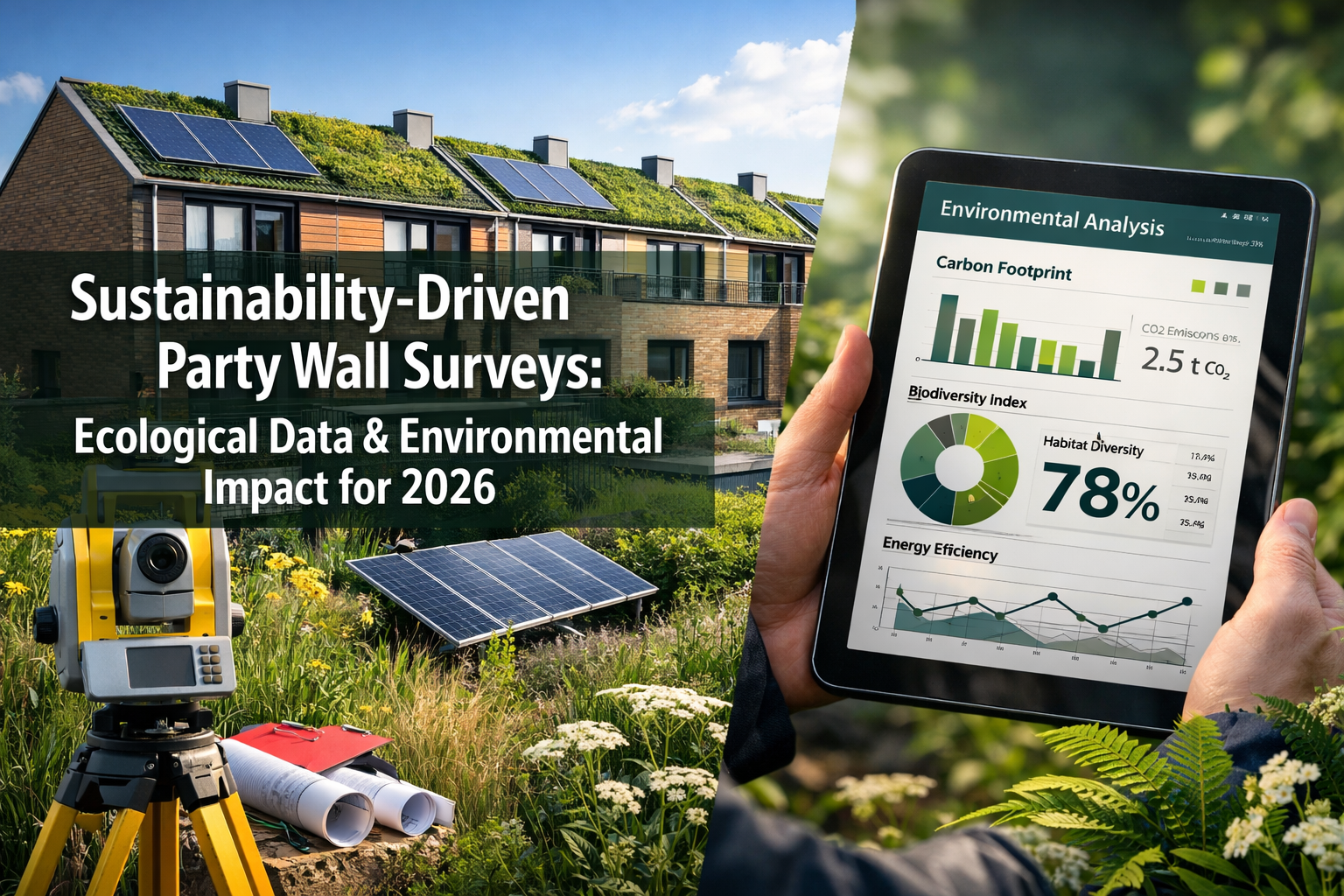
Environmental consciousness is no longer optional in property development—it's essential. As London and cities worldwide face urgent climate challenges, even traditional property procedures are evolving. Sustainability-Driven Party Wall Surveys: Capturing Ecological Data and Environmental Impact Forecasting for 2026 Developments represents a groundbreaking shift in how surveyors approach shared boundary work. This emerging practice transforms standard party wall assessments into comprehensive environmental evaluations that protect both property rights and ecological systems. 🌱
The integration of ecological data collection into party wall notices and awards marks a significant evolution in responsible development practices. As we navigate 2026, property owners, developers, and surveyors increasingly recognize that sustainable construction isn't just about individual buildings—it extends to every shared boundary, every party wall, and every development decision affecting neighboring properties.
Key Takeaways
- Ecological integration: Modern party wall surveys now incorporate biodiversity assessments, carbon impact calculations, and habitat preservation data alongside traditional structural evaluations
- Regulatory evolution: Private sector sustainability initiatives are driving environmental considerations in party wall procedures, even beyond current statutory requirements
- Technology enablement: Digital tools, AI-powered analytics, and environmental sensors enable surveyors to capture and forecast ecological impacts with unprecedented accuracy
- Value proposition: Sustainability-driven surveys protect long-term property values, reduce environmental risks, and demonstrate corporate responsibility for 2026 developments
- Practical implementation: Integrating environmental data requires minimal additional time but delivers substantial benefits for all parties involved in party wall matters
Understanding Sustainability-Driven Party Wall Surveys in 2026
What Makes a Party Wall Survey "Sustainability-Driven"?
Traditional party wall surveys under the Party Wall etc. Act 1996 focus primarily on structural integrity, damage prevention, and property rights protection. While these remain essential, sustainability-driven party wall surveys expand the assessment framework to include:
Environmental data capture 📊
- Biodiversity assessments of affected areas
- Carbon footprint calculations for proposed works
- Material sustainability ratings and sourcing information
- Water usage and drainage impact evaluations
- Air quality measurements and projections
Ecological impact forecasting 🌍
- Habitat disruption predictions
- Species displacement risk assessments
- Long-term environmental consequence modeling
- Climate resilience evaluations
- Green infrastructure integration opportunities
Sustainable alternatives documentation ♻️
- Eco-friendly material recommendations
- Energy-efficient construction method suggestions
- Waste reduction strategies
- Circular economy approaches to party wall works
This comprehensive approach doesn't replace traditional party wall procedures—it enhances them. The schedule of condition still documents pre-work property status, but now includes environmental baseline data. Party wall awards still outline rights and responsibilities, but incorporate sustainability commitments and environmental protection measures.
The 2026 Sustainability Context
The shift toward sustainability-driven party wall surveys reflects broader construction industry trends. Research indicates that private sector initiatives are set to overtake government regulations as the main driver of corporate sustainability in 2026 [1]. This means property developers, building owners, and construction firms are voluntarily adopting environmental standards that exceed statutory minimums.
Key sustainability trends shaping 2026 developments include:
| Trend | Impact on Party Wall Surveys |
|---|---|
| Climate-responsive design | Surveys assess how party wall works affect thermal performance and energy efficiency of adjacent properties |
| Adaptive reuse prioritization | Greater focus on preserving existing party walls rather than demolition and rebuild |
| AI adoption in construction | Automated environmental impact calculations and predictive modeling integrated into survey processes |
| Biodiversity net gain requirements | Documentation of ecological value before and after party wall works |
| Circular economy principles | Assessment of material reuse potential and waste minimization strategies |
These trends, identified by industry analysts [2], demonstrate that sustainability considerations permeate every aspect of modern construction—including the specialized field of party wall surveying.
Capturing Ecological Data During Party Wall Assessments
Practical Methods for Environmental Data Collection
Integrating ecological data capture into party wall surveys requires minimal additional time when approached systematically. Professional surveyors working across North London, Central London, and other areas are developing standardized protocols for environmental assessment.
Pre-Work Environmental Baseline Documentation 🔍
Before any types of party wall works commence, surveyors establish environmental baselines:
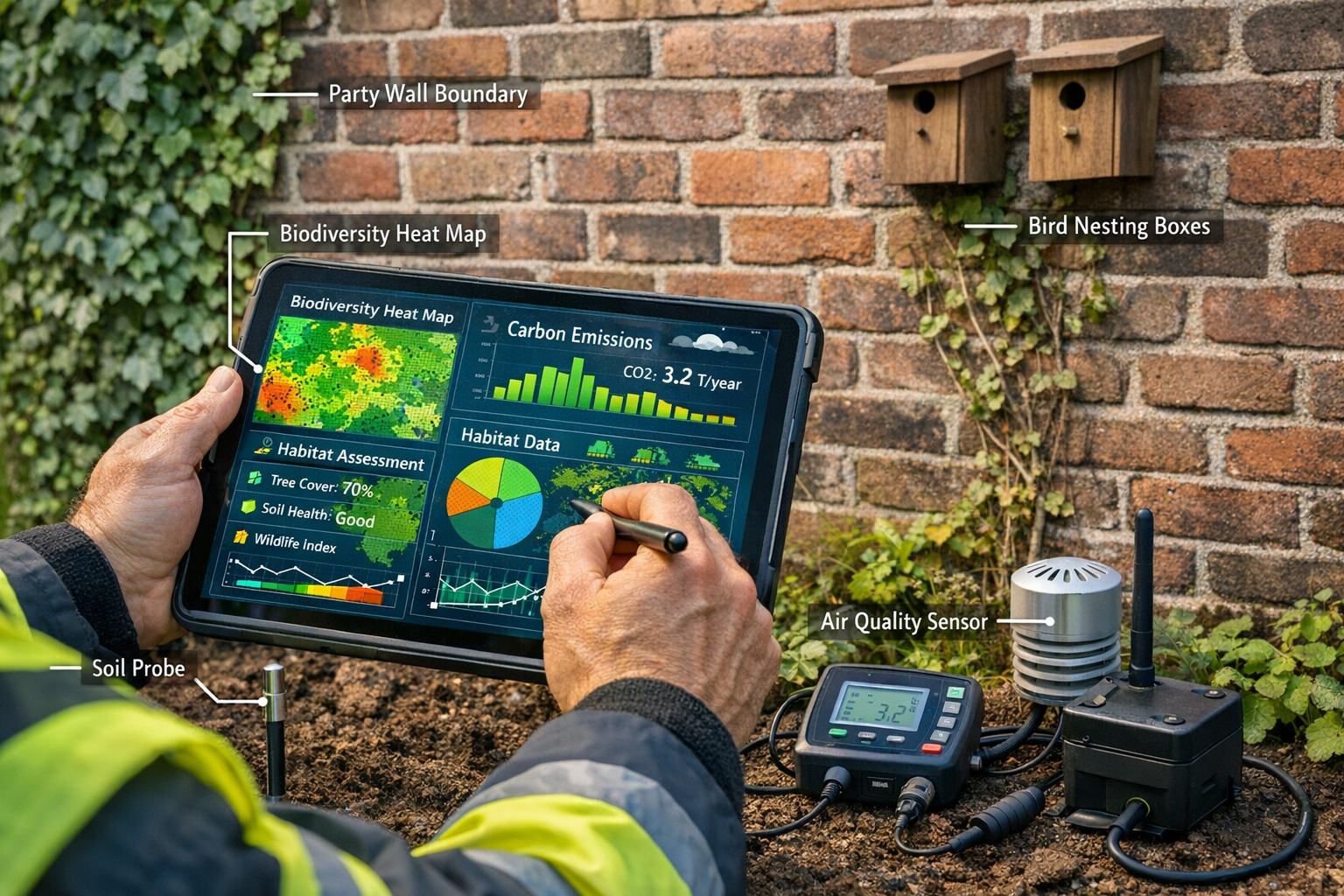
- Biodiversity surveys: Document existing flora and fauna along party wall boundaries, including nesting birds, climbing plants, and established ecosystems
- Material assessments: Identify existing materials in party walls, noting sustainability characteristics, embodied carbon, and reuse potential
- Microclimate measurements: Record temperature, humidity, and air quality data that might be affected by proposed works
- Habitat mapping: Photograph and catalog ecological features like bird boxes, insect hotels, or established vegetation
- Carbon calculations: Establish baseline carbon footprint of existing structures
Technology-Enhanced Data Capture 💻
Modern surveying technology enables precise environmental data collection:
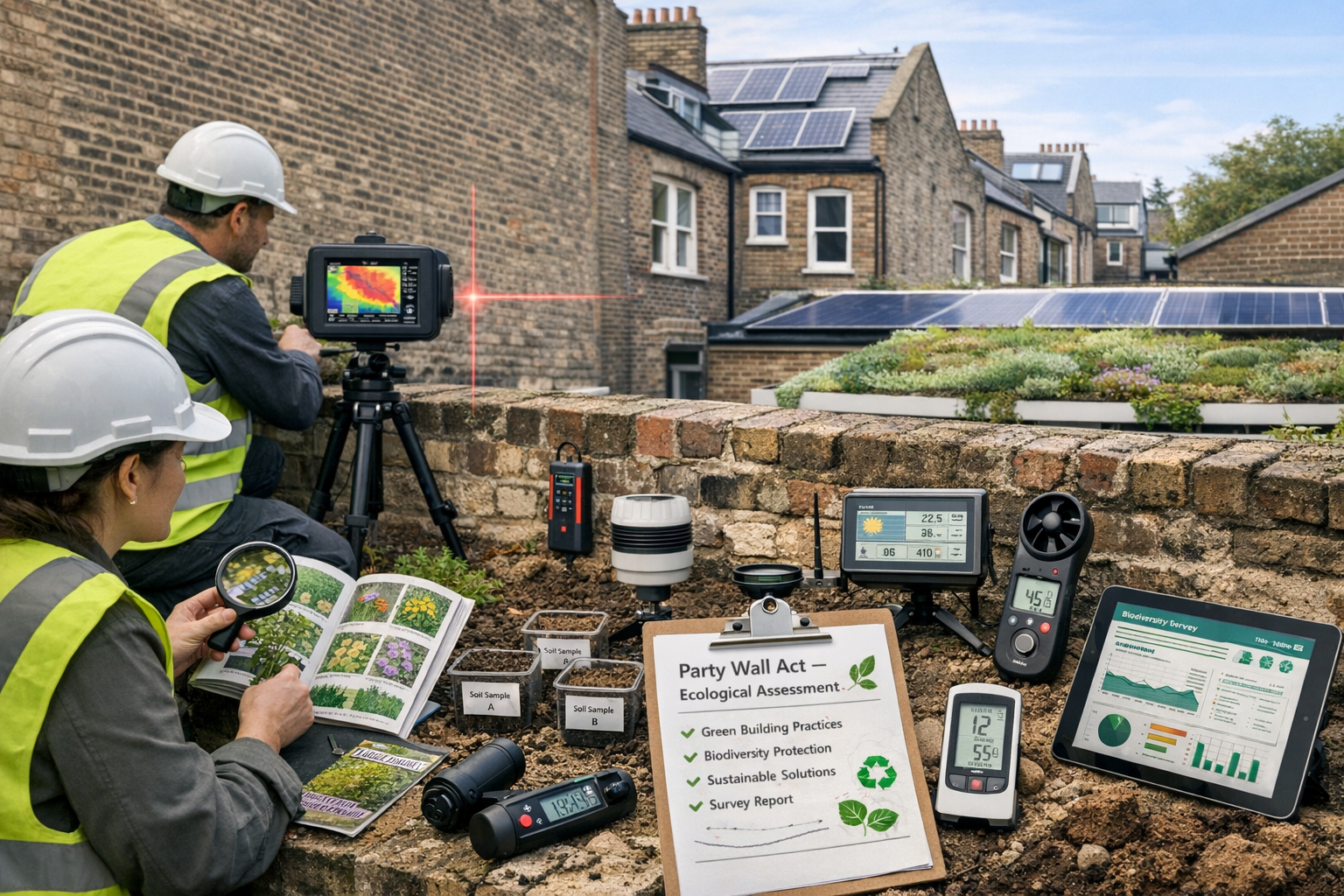
- Digital measurement tools: Laser scanners and photogrammetry create detailed 3D models showing environmental features
- Environmental sensors: Portable devices measure air quality, noise levels, and particulate matter
- Drone surveys: Aerial imagery captures roof-level ecology, solar panel positioning, and green infrastructure
- Mobile applications: Custom apps streamline data entry, photo documentation, and GPS-tagged observations
- AI-powered analysis: Machine learning algorithms identify species, assess habitat quality, and calculate environmental metrics
These technologies integrate seamlessly with traditional party wall survey procedures, enhancing rather than complicating the assessment process.
Integrating Environmental Data into Party Wall Documentation
The ecological information gathered during surveys must be formally incorporated into party wall documentation to ensure enforceability and accountability.
Enhanced Party Wall Notices 📋
When serving party wall notices, building owners can include supplementary environmental information:
- Summary of proposed works' environmental impact
- Sustainability credentials of planned materials
- Measures to protect existing ecological features
- Commitments to biodiversity enhancement
- Carbon reduction strategies
This transparency helps adjoining owners understand not just structural implications but environmental consequences of proposed works.
Sustainability Clauses in Party Wall Awards
Party wall awards can incorporate specific environmental provisions:
"The Building Owner shall ensure that all works preserve existing bird nesting sites on the party wall and shall install replacement habitat boxes of equivalent or superior quality before commencement of works affecting current nesting locations."
"Materials used in party wall reconstruction shall achieve a minimum sustainability rating of A or B under recognized environmental assessment schemes, with preference given to reclaimed or recycled materials where structurally appropriate."
These clauses create legally binding environmental obligations that protect ecological interests alongside property rights.
Environmental Impact Statements
For significant developments, surveyors may prepare dedicated environmental impact statements as appendices to party wall awards, documenting:
- Baseline environmental conditions
- Predicted impacts of proposed works
- Mitigation measures and alternatives considered
- Monitoring protocols during construction
- Post-completion environmental restoration commitments
This comprehensive documentation ensures environmental considerations receive appropriate weight in party wall matters.
Environmental Impact Forecasting for 2026 Developments
Predictive Modeling and Impact Assessment
Sustainability-Driven Party Wall Surveys: Capturing Ecological Data and Environmental Impact Forecasting for 2026 Developments relies heavily on accurate prediction of environmental consequences. Advanced forecasting methods enable surveyors to anticipate and mitigate ecological impacts before they occur.
Carbon Footprint Projections 🏗️
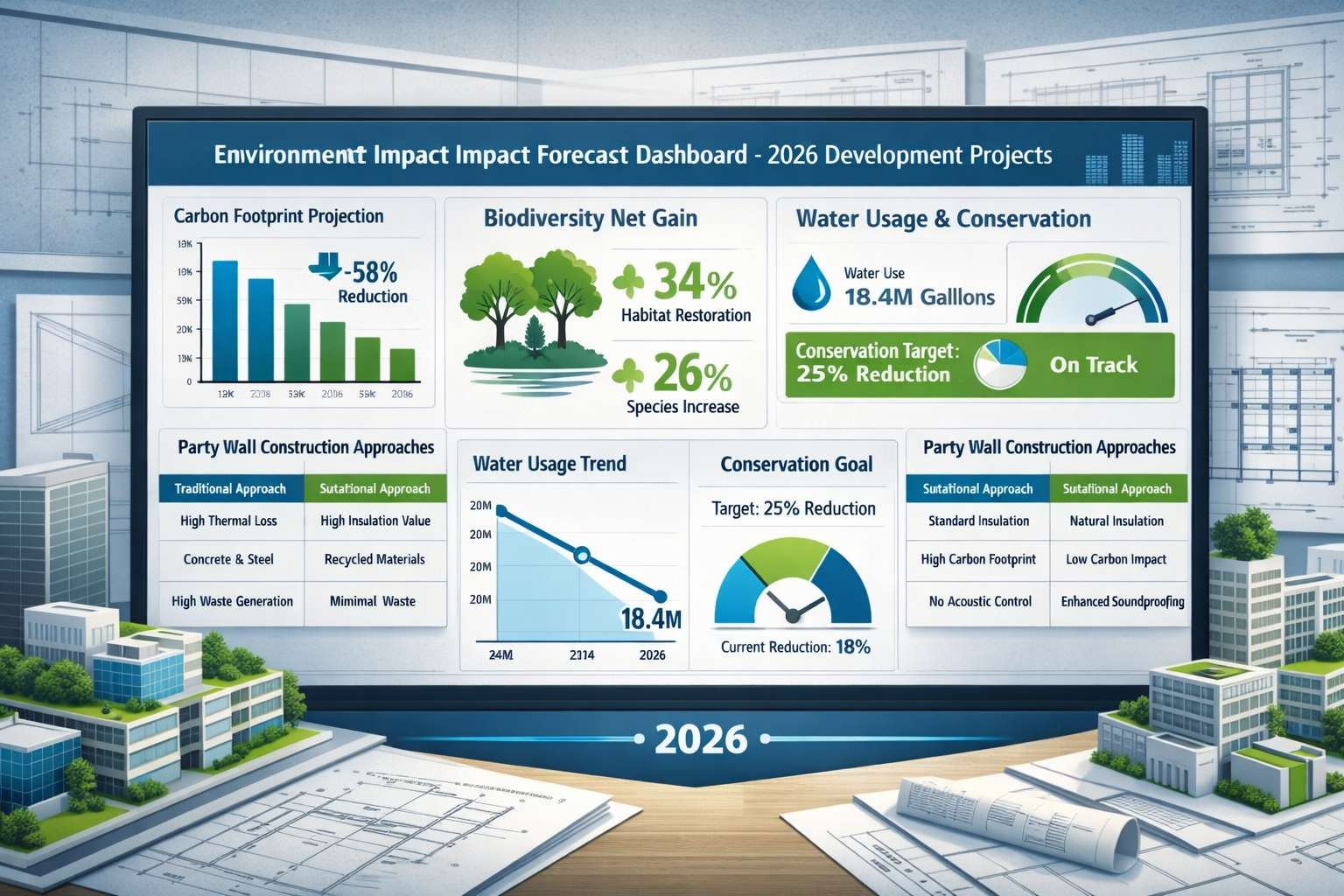
Party wall works contribute to construction industry carbon emissions through:
- Embodied carbon: Manufacturing and transporting materials
- Construction emissions: Equipment operation and waste generation
- Operational impacts: Changes to building thermal performance affecting long-term energy use
Sustainability-driven surveys calculate these impacts using standardized methodologies:
- Material carbon accounting: Assess embodied carbon of proposed materials versus sustainable alternatives
- Construction phase emissions: Estimate fuel consumption, electricity use, and waste disposal impacts
- Lifecycle analysis: Project long-term carbon implications over 30-50 year building lifespans
- Offset opportunities: Identify carbon reduction measures that can neutralize unavoidable emissions
For example, replacing a traditional party wall section with sustainably sourced timber framing instead of concrete blocks might reduce embodied carbon by 40-60%, a significant contribution toward net-zero development goals.
Biodiversity Net Gain Calculations 🦋
Many 2026 developments voluntarily commit to biodiversity net gain—ensuring projects leave natural environments in better condition than before. Party wall surveys contribute by:
- Habitat unit assessments: Quantify ecological value of existing party wall features using standardized metrics
- Impact predictions: Calculate habitat units lost through proposed works
- Enhancement planning: Design interventions that create net positive biodiversity outcomes
- Monitoring frameworks: Establish protocols to verify biodiversity gains post-completion
Even modest party wall projects offer biodiversity enhancement opportunities: installing swift bricks, creating green walls, or incorporating native plant species along boundaries.
Water and Resource Impact Forecasting 💧
Sustainable party wall surveys assess resource consumption implications:
- Water usage: Construction phase requirements and long-term drainage impacts
- Material quantities: Volume of new materials versus reused/recycled content
- Waste generation: Predicted demolition and construction waste with diversion rates
- Energy consumption: Construction equipment and long-term building performance effects
This comprehensive resource accounting enables informed decision-making about construction methods and materials.
AI and Technology in Environmental Forecasting
The integration of artificial intelligence into construction represents a major 2026 trend [2], with particular relevance to environmental impact forecasting in party wall surveys.
Machine Learning Applications 🤖
AI-powered tools enhance forecasting accuracy:
- Pattern recognition: Analyzing historical data from thousands of party wall projects to predict environmental outcomes
- Optimization algorithms: Identifying material and method combinations that minimize environmental impact while meeting structural requirements
- Risk assessment: Calculating probability and severity of various environmental impacts
- Alternative scenario modeling: Rapidly comparing environmental consequences of different design approaches
Digital Twin Technology 🏘️
Creating digital replicas of party wall structures enables:
- Virtual testing: Simulating environmental impacts before physical work begins
- Performance monitoring: Tracking actual versus predicted environmental outcomes during construction
- Adaptive management: Adjusting approaches in real-time based on environmental monitoring data
- Long-term tracking: Maintaining environmental performance records throughout building lifecycles
These technologies transform environmental impact forecasting from educated estimation to data-driven precision.
Practical Implementation: Integrating Sustainability into Party Wall Procedures
For Building Owners and Developers
Property owners initiating party wall works can embrace sustainability-driven approaches through several practical steps:
Early Planning Integration 📝
- Engage sustainability-conscious surveyors: Select professionals experienced in environmental assessment alongside traditional party wall expertise
- Budget for environmental enhancements: Allocate resources for sustainable materials and ecological improvements
- Set environmental objectives: Define clear sustainability goals for party wall works beyond statutory minimums
- Communicate environmental commitments: Share sustainability intentions with neighbors when serving party wall notices
Material Selection Strategies 🧱
Choosing sustainable materials for party wall works delivers environmental benefits:
| Material Category | Sustainable Options | Environmental Benefits |
|---|---|---|
| Structural | Reclaimed bricks, FSC timber, recycled steel | Reduced embodied carbon, waste diversion |
| Insulation | Sheep's wool, recycled cellulose, hemp fiber | Natural materials, carbon sequestration |
| Finishes | Lime mortar, natural paints, clay plasters | Breathability, low VOC emissions |
| Foundations | Ground screws, recycled aggregate concrete | Reduced excavation, material reuse |
Working with experienced professionals helps identify appropriate sustainable alternatives for specific party wall applications.
Cost Considerations 💰
Sustainability-driven party wall surveys typically add modest costs—often 5-15% to standard survey fees—while delivering substantial value:
- Risk mitigation: Identifying environmental issues early prevents costly remediation
- Property value enhancement: Documented sustainability credentials increase market appeal
- Regulatory future-proofing: Exceeding current standards reduces adaptation costs as regulations tighten
- Relationship management: Demonstrating environmental responsibility improves neighbor relations
For guidance on managing overall expenses, review strategies for keeping party wall costs down while maintaining quality and sustainability standards.
For Adjoining Owners
Neighboring property owners affected by party wall works can advocate for sustainability considerations:
Requesting Environmental Information 🔎
When receiving party wall notices, adjoining owners can:
- Ask building owners about environmental impact assessments
- Request information on material sustainability and carbon footprint
- Inquire about measures to protect existing ecological features
- Suggest environmental enhancements that benefit both properties
Appointing Sustainability-Aware Surveyors 👷
Adjoining owners' surveyors can incorporate environmental considerations into their protective role:
- Ensuring party wall awards include environmental protection clauses
- Advocating for sustainable material alternatives
- Monitoring environmental compliance during construction
- Documenting environmental conditions in schedules of condition
Collaborative Opportunities 🤝
Party wall matters offer opportunities for neighbors to collaborate on sustainability:
- Shared green infrastructure: Joint investment in green walls or living roofs spanning party walls
- Coordinated improvements: Aligning party wall works with complementary sustainability upgrades
- Biodiversity corridors: Creating connected habitats across adjacent properties
- Resource sharing: Pooling knowledge about sustainable contractors and materials
This collaborative approach transforms party wall procedures from potential conflicts into opportunities for mutual environmental benefit.
For Professional Surveyors
Quantity surveyors and party wall specialists can develop expertise in sustainability-driven assessments to meet evolving client expectations and industry standards [3].
Professional Development Priorities 📚
- Environmental assessment training: Courses in biodiversity surveying, carbon accounting, and sustainable construction
- Technology proficiency: Mastering digital tools for environmental data capture and analysis
- Regulatory knowledge: Understanding emerging environmental regulations affecting construction
- Interdisciplinary collaboration: Building relationships with ecologists, environmental consultants, and sustainability specialists
Service Enhancement Strategies 🎯
Surveyors can differentiate their practices by:
- Offering sustainability-enhanced party wall surveys as standard or premium services
- Developing proprietary environmental assessment frameworks
- Creating client-facing sustainability reports and impact visualizations
- Building case study portfolios demonstrating environmental outcomes
Quality Assurance ✅
Maintaining high standards in sustainability-driven surveys requires:
- Documented methodologies for environmental data collection
- Peer review processes for environmental impact forecasts
- Continuous improvement based on post-project outcome monitoring
- Professional indemnity insurance covering environmental advice
As sustainability becomes increasingly central to construction, surveyors who develop environmental expertise position themselves as essential advisors for responsible development.
Regulatory Context and Future Developments
Current Legal Framework
The Party Wall etc. Act 1996 doesn't explicitly require environmental considerations in party wall procedures. However, several regulatory frameworks intersect with sustainability-driven approaches:
Building Regulations 🏛️
Current building regulations increasingly incorporate environmental performance standards that affect party wall works:
- Part L (Conservation of fuel and power): Thermal performance requirements affecting party wall insulation
- Part F (Ventilation): Air quality standards relevant to party wall modifications
- Future Homes Standard: Emerging requirements for low-carbon heating and high energy efficiency
Planning Policy 📑
Local planning authorities increasingly require sustainability statements and biodiversity net gain plans for developments, creating context for environmental considerations in party wall matters.
Voluntary Standards 🌟
Many developers voluntarily adopt standards exceeding statutory minimums:
- BREEAM certification: Comprehensive environmental assessment of buildings
- Passivhaus standards: Ultra-low energy building performance
- WELL Building Standard: Health and wellness-focused design
- Living Building Challenge: Regenerative design framework
These voluntary commitments create strong incentives for sustainability-driven party wall approaches even without specific legal requirements.
Emerging Trends and Future Requirements
The trajectory of environmental regulation suggests sustainability considerations will become increasingly mandatory in construction, including party wall procedures.
Anticipated Regulatory Developments 🔮
- Mandatory biodiversity net gain: Potential extension to smaller projects currently exempt
- Embodied carbon limits: Possible introduction of maximum carbon budgets for construction materials
- Circular economy requirements: Mandated material reuse and waste reduction targets
- Climate resilience standards: Requirements for adaptation to changing environmental conditions
Industry Self-Regulation 🏗️
Professional bodies are developing guidance on sustainability in surveying practice, potentially including:
- Environmental competency requirements for chartered surveyors
- Standardized methodologies for sustainability assessment
- Ethical obligations regarding environmental advice
- Continuing professional development in sustainability topics
Surveyors who develop environmental expertise now will be well-positioned as these requirements formalize.
Benefits of Sustainability-Driven Party Wall Surveys
Environmental Advantages
The primary purpose of integrating ecological data and impact forecasting into party wall procedures is environmental protection:
Biodiversity Conservation 🦎
- Identifying and protecting habitats during construction
- Creating net positive outcomes for urban wildlife
- Maintaining ecological connectivity across property boundaries
- Supporting urban ecosystem resilience
Carbon Reduction 🌡️
- Minimizing embodied carbon through sustainable material selection
- Improving thermal performance to reduce operational emissions
- Optimizing construction methods to reduce waste and energy consumption
- Contributing to net-zero development goals
Resource Efficiency ♻️
- Maximizing material reuse and recycling
- Reducing construction waste sent to landfill
- Minimizing water consumption during construction
- Promoting circular economy principles
Property and Financial Benefits
Beyond environmental advantages, sustainability-driven party wall surveys deliver tangible property and financial benefits:
Enhanced Property Values 💎
Properties with documented sustainability credentials command premium prices:
- Buyers increasingly prioritize environmental performance
- Green building certifications enhance marketability
- Future-proofing against tightening regulations protects long-term value
- Lower operating costs through improved energy efficiency
Risk Mitigation 🛡️
Comprehensive environmental assessment reduces various risks:
- Early identification of ecological constraints prevents project delays
- Documented sustainability compliance protects against regulatory challenges
- Proactive environmental management reduces liability exposure
- Improved neighbor relations through demonstrated responsibility
Corporate Responsibility 🏢
For developers and construction firms, sustainability-driven approaches support:
- Environmental, Social, and Governance (ESG) reporting requirements
- Corporate sustainability commitments and targets
- Reputation management and brand differentiation
- Stakeholder expectations for responsible development
Social and Community Benefits
Sustainability-driven party wall surveys contribute to broader social objectives:
Community Relations 👥
- Demonstrating environmental consideration builds trust with neighbors
- Collaborative sustainability initiatives create positive interactions
- Transparent environmental communication reduces conflicts
- Shared ecological improvements benefit entire communities
Urban Livability 🌆
- Cumulative environmental improvements enhance neighborhood quality
- Biodiversity enhancements support urban nature connection
- Sustainable construction reduces noise, dust, and disruption
- Climate-responsive design improves comfort and resilience
Intergenerational Responsibility 🌱
- Sustainable development practices protect future generations' interests
- Environmental stewardship demonstrates long-term thinking
- Ecological preservation maintains natural heritage
- Climate action contributes to broader societal goals
Conclusion
Sustainability-Driven Party Wall Surveys: Capturing Ecological Data and Environmental Impact Forecasting for 2026 Developments represents more than a procedural evolution—it reflects a fundamental shift in how we approach shared boundaries and neighboring property relationships. As environmental consciousness permeates every aspect of construction and development, party wall procedures must adapt to incorporate ecological considerations alongside traditional structural and legal concerns.
The integration of biodiversity assessments, carbon calculations, and environmental impact forecasting into party wall surveys delivers benefits across multiple dimensions: protecting urban ecosystems, reducing carbon emissions, enhancing property values, mitigating risks, and demonstrating corporate responsibility. These advantages accrue to building owners, adjoining owners, developers, and communities alike.
Key Implementation Steps
For those ready to embrace sustainability-driven party wall approaches:
Building Owners 🏠
- Engage surveyors with environmental expertise when planning party wall works
- Set clear sustainability objectives beyond statutory minimums
- Budget for sustainable materials and ecological enhancements
- Communicate environmental commitments transparently with neighbors
Adjoining Owners 🏘️
- Request environmental information when receiving party wall notices
- Appoint surveyors who prioritize sustainability considerations
- Advocate for environmental protection clauses in party wall awards
- Explore collaborative sustainability opportunities with neighbors
Professional Surveyors 📐
- Develop environmental assessment competencies through training and collaboration
- Invest in technology for ecological data capture and impact forecasting
- Create standardized methodologies for sustainability-driven surveys
- Build case studies demonstrating environmental outcomes and client value
Developers and Construction Firms 🏗️
- Integrate sustainability requirements into project specifications from inception
- Establish environmental performance targets for party wall works
- Document sustainability credentials for ESG reporting and marketing
- Share best practices across projects to drive continuous improvement
Looking Forward
As we progress through 2026 and beyond, the convergence of regulatory requirements, market expectations, and technological capabilities will make sustainability-driven party wall surveys increasingly standard practice. Early adopters gain competitive advantages, contribute meaningfully to environmental protection, and position themselves as responsible stewards of the built environment.
The transformation of party wall procedures from purely structural and legal assessments to comprehensive environmental evaluations exemplifies how sustainability can be integrated into every aspect of construction—even specialized, technical processes governed by century-old legislation. By capturing ecological data, forecasting environmental impacts, and implementing sustainable alternatives, party wall surveys become powerful tools for responsible development.
Whether you're planning construction works requiring party wall notices, responding as an adjoining owner, or providing professional surveying services, embracing sustainability-driven approaches protects both property interests and environmental values. The future of party wall surveying is green—and that future is now.
For expert guidance on integrating sustainability into your party wall procedures, consult with experienced professionals who understand both traditional requirements and emerging environmental best practices. Together, we can ensure that every shared boundary, every party wall, and every development contributes to a more sustainable built environment.
References
[1] Private Sector Set To Overtake Government As Main Driver Of Corporate Sustainability In 2026 Report Suggests – https://the-european.eu/story-53702/private-sector-set-to-overtake-government-as-main-driver-of-corporate-sustainability-in-2026-report-suggests.html
[2] 4 Sustainable Construction Trends 2026 – https://trellis.net/article/4-sustainable-construction-trends-2026/
[3] Leading The Way How Sustainability Is Shaping The Future Of Quantity Surveying – https://www.oseimc.com/leading-the-way-how-sustainability-is-shaping-the-future-of-quantity-surveying