


The construction landscape has shifted dramatically in 2026. Nearly one-third of construction firms have accelerated material purchases to avoid tariff impacts, while others have pivoted to domestic suppliers amid unprecedented supply chain disruption[5]. For property owners planning building works that require party wall agreements, these economic pressures create a critical challenge: how do you serve accurate notices when material delays and cost inflation make traditional timelines obsolete?
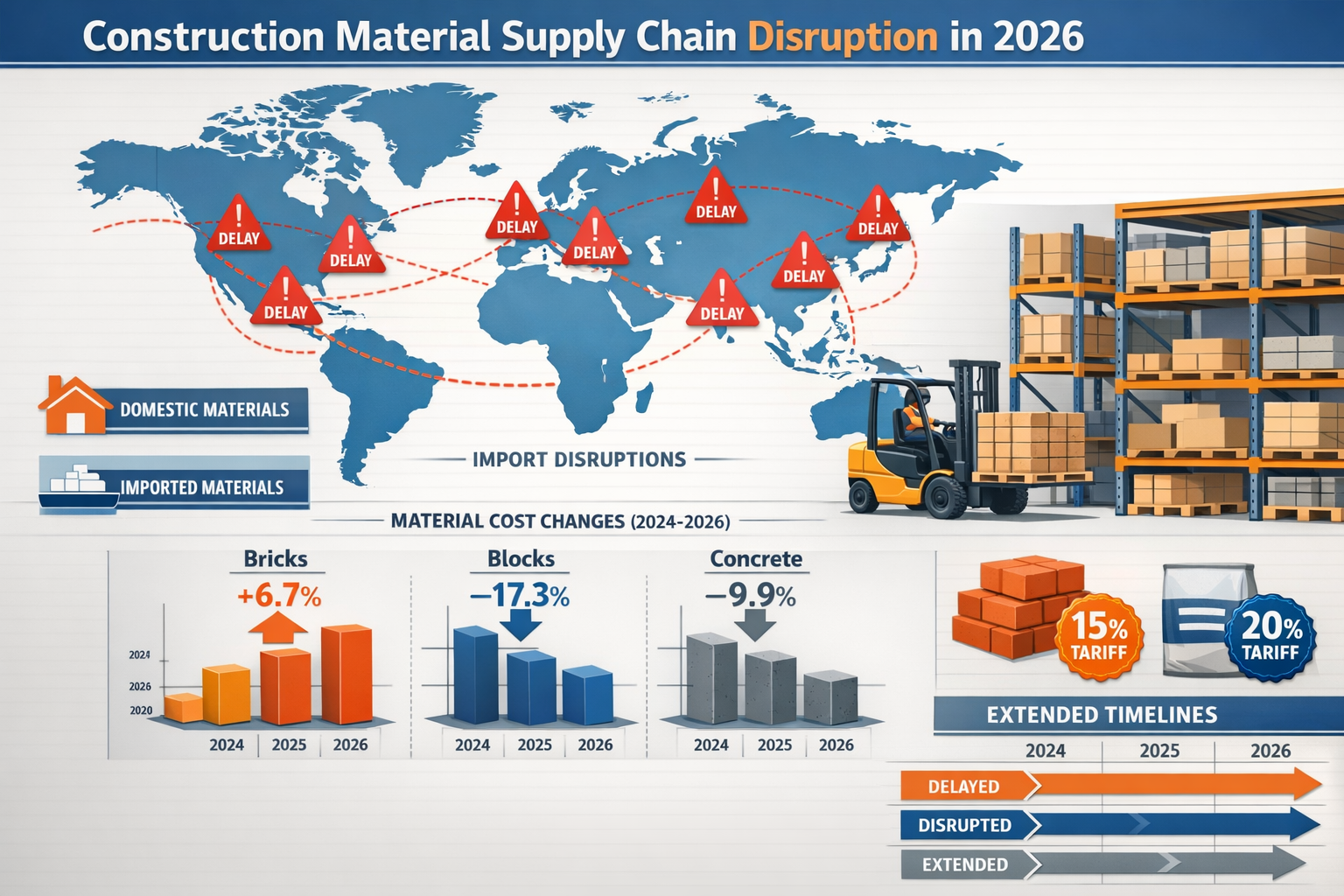
Understanding tariff impacts on construction timelines: how party wall notices must account for 2026 material delays has become essential for surveyors, building owners, and adjoining owners alike. With brick deliveries down 6.7% and block deliveries plummeting 17.3% compared to 2024[1], the standard notice periods outlined in the Party Wall etc. Act 1996 may no longer align with real-world project execution.
Key Takeaways
- 🏗️ Material shortages are severe: Concrete demand fell 9.9%, bricks down 6.7%, and blocks down 17.3% in 2025, creating significant procurement delays[1][2]
- 📅 Notice periods need reassessment: Traditional two-month party wall notice periods may be insufficient given extended material lead times in 2026
- 💰 Cost inflation continues: Construction material prices increased 3.3% year-on-year, requiring updated cost estimates in party wall awards[1]
- 🔄 Supply chain adaptation: One-third of firms are switching suppliers or accelerating purchases, affecting project scheduling and notice accuracy[5]
- 📋 Documentation is critical: Party wall notices must include realistic timelines and contingency provisions to account for tariff-related delays
Understanding the 2026 Construction Material Crisis
The Scale of Material Shortages
The construction industry faces its most challenging material environment in recent history. Total construction output fell by 1.1% in the three months to November 2025—the largest decline since March 2023[1]. This contraction reflects more than simple market fluctuation; it represents a fundamental disruption in material availability and cost structures.
Key material categories show alarming trends:
| Material Type | Year-on-Year Change (2025) | Impact on Construction |
|---|---|---|
| Concrete | -9.9% demand[2] | Historic low sales volumes |
| Bricks | -6.7% deliveries[1] | Reduced new build activity |
| Blocks | -17.3% deliveries[1] | Severe supply constraints |
| Aggregates | -1.6% demand[2] | Fourth consecutive year of decline |
| Asphalt | -1.1% demand[2] | Infrastructure project delays |
In London specifically, the situation is even more acute. Ready-mixed concrete demand fell by 27% annually in 2025, severely constraining new build activity across the capital[2]. For property owners planning extensions, loft conversions, or basement excavations that require party wall notices, these shortages translate directly into extended project timelines.
Tariff-Driven Price Inflation
Beyond availability issues, material cost inflation continues to accelerate. The material price index for 'All Work' increased by 3.3% in December 2025 compared with December 2024[1]. The Tender Price Index (TPI) is projected at 3.5% for 2026, reflecting ongoing uncertainty and contractor caution[4].
This inflation affects party wall procedures in two critical ways:
-
Initial cost estimates become outdated quickly: When serving a party wall notice, building owners must provide realistic cost projections. With material prices rising faster than anticipated, these estimates may be significantly understated by the time work commences.
-
Dispute resolution becomes more complex: Adjoining owners may challenge notices based on outdated cost information, creating delays and requiring revised party wall awards.
Industry Response: Accelerated Purchasing and Supplier Switching
Facing these challenges, construction firms have adopted defensive strategies. Nearly one-third of construction companies have accelerated material purchases to avoid further tariff impacts, while others have switched to domestic producers[5]. This behavior creates a ripple effect throughout the supply chain:
- Bulk purchasing depletes available inventory for smaller projects
- Domestic suppliers face capacity constraints as demand shifts away from imports
- Lead times extend unpredictably as suppliers struggle to meet accelerated demand
- Quality variations emerge as firms source from unfamiliar suppliers
For party wall work, these dynamics mean that the traditional assumption of readily available materials no longer holds. A basement excavation requiring specific concrete grades or a loft conversion needing particular brick types may face weeks or months of procurement delays that weren't factored into the original notice period.
Tariff Impacts on Construction Timelines: How Party Wall Notices Must Account for 2026 Material Delays in Practice
Reassessing Standard Notice Periods
The Party Wall etc. Act 1996 establishes specific notice periods:
- Two months for Line of Junction notices (new walls on boundaries)
- Two months for Party Structure notices (work to existing party walls)
- One month for excavation notices (work within 3-6 meters of adjoining structures)
These timeframes were established when material supply chains operated predictably. In 2026's volatile environment, these statutory minimums may prove inadequate for actual project execution.
"Planning delays and budget uncertainty are slowing activity across the sector, with delays at the Building Safety Regulator and planning bottlenecks impacting site viability and delivery timelines."[3]
Consider a typical scenario: A building owner in North London serves a Party Structure Notice for a rear extension requiring significant brickwork. The notice indicates work will commence in two months. However:
- Week 1-2: Planning approval delayed due to Building Safety Regulator backlog
- Week 3-6: Contractor struggles to source matching bricks due to 6.7% delivery reduction
- Week 7-10: Alternative supplier identified but requires 8-week lead time
- Week 11+: Work finally commences, three months beyond the original notice period
This delay doesn't just inconvenience the building owner—it potentially invalidates the original notice and creates liability issues if work proceeds without proper authorization.
Incorporating Material Procurement Timelines
To address tariff impacts on construction timelines: how party wall notices must account for 2026 material delays, surveyors must fundamentally rethink how notices are prepared and served.
Best practices for 2026 include:
✅ Conduct pre-notice material availability assessments: Before serving notices, building owners should verify actual lead times for critical materials with multiple suppliers
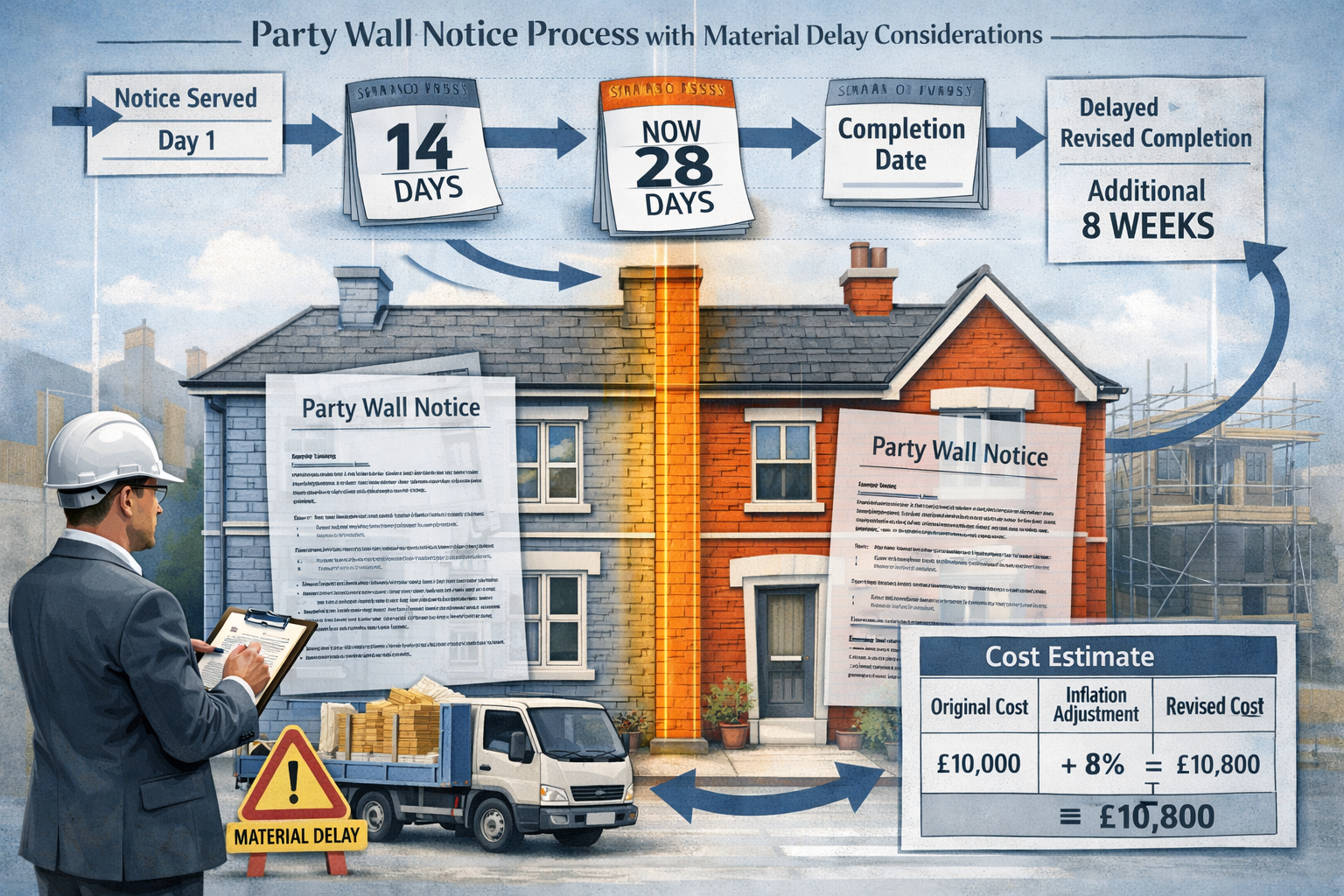
✅ Build contingency periods into notice timelines: Add 4-8 weeks beyond statutory minimums to account for procurement delays
✅ Specify material alternatives in notices: Identify acceptable substitute materials to provide flexibility if primary choices become unavailable
✅ Include price escalation clauses: Acknowledge that material costs may increase between notice service and work commencement
✅ Establish communication protocols: Define how building owners will notify adjoining owners of material-related delays
For those managing costs of the party wall process, these additional steps may increase upfront surveyor fees but significantly reduce the risk of disputes and project delays.
Updating Party Wall Awards for Material Realities
Party wall awards serve as the binding agreement between building and adjoining owners. In 2026, these documents must explicitly address material uncertainty.
Essential award provisions for the current environment:
📋 Revised timeline provisions: Awards should specify that commencement dates are contingent on material availability, with notification requirements if delays exceed specified thresholds
📋 Cost adjustment mechanisms: Include formulas for updating cost estimates based on documented material price increases, protecting both parties from unexpected inflation
📋 Material substitution protocols: Define the process for approving alternative materials if specified products become unavailable
📋 Supply chain documentation requirements: Require building owners to provide evidence of material procurement efforts and delays
📋 Extended validity periods: Consider awards that remain valid for 18-24 months rather than the traditional 12 months, acknowledging procurement uncertainties
These provisions transform party wall awards from static documents into adaptive frameworks that accommodate 2026's volatile construction environment while protecting all parties' interests.
Strategic Approaches for Different Types of Party Wall Works
Excavation and Foundation Works
Types of party wall works involving excavation face particular challenges in 2026. Concrete and aggregate shortages directly impact foundation work, while specialized materials like waterproofing membranes may have extended lead times.
Excavation-specific considerations:
- Concrete pour scheduling: With ready-mixed concrete demand down 27% in London[2], coordinate pour dates well in advance and include backup suppliers in project plans
- Shoring material availability: Temporary works materials (steel props, timber walings) may face availability issues; verify stock before serving notices
- Specialist subcontractor scheduling: Underpinning specialists may have extended booking periods due to industry-wide delays
For basement excavations in Central London or East London, where space constraints make material storage difficult, just-in-time delivery becomes risky. Notices should account for the possibility of phased material deliveries and extended work periods.
Building Up: Extensions and Loft Conversions
Vertical building works face the full impact of brick and block shortages. The 17.3% reduction in block deliveries[1] particularly affects load-bearing elements of extensions.
Masonry work considerations:
🧱 Brick matching challenges: Period properties requiring specific brick types may face months-long sourcing delays; identify acceptable alternatives before serving notices
🧱 Block specification flexibility: With severe block shortages, specify performance requirements rather than specific manufacturers to maximize supplier options
🧱 Structural steel alternatives: Consider steel frame construction where masonry shortages make traditional methods impractical
🧱 Roofing material lead times: Tiles, slates, and specialized roofing materials may have extended procurement periods
For party fence walls and boundary walls, the material challenges extend beyond the primary structure to ancillary elements that may seem minor but can delay project completion.
Internal Alterations to Party Walls
Even relatively minor works like removing chimney breasts or creating openings in party walls face material challenges in 2026.
Internal works considerations:
- Steel beam availability: RSJs (Rolled Steel Joists) for structural support may have 4-6 week lead times
- Matching materials: Plaster, bricks for making good, and decorative finishes matching existing work may require specialty suppliers
- Acoustic insulation products: Specialized sound-dampening materials for party walls may face supply constraints
When preparing a party structure notice, even for seemingly straightforward internal alterations, verify that all necessary materials—including finishing materials—are available within the proposed timeline.
Practical Guidance for Building Owners and Surveyors
Pre-Notice Material Due Diligence
Before serving any party wall notice in 2026, building owners should complete a material availability assessment:
Step 1: Material Inventory
- List all critical materials required for the proposed works
- Identify items with no acceptable substitutes (matching bricks, specialty products)
- Categorize materials by procurement complexity
Step 2: Supplier Engagement
- Contact at least three suppliers for each critical material
- Request current lead times and minimum order quantities
- Verify price validity periods (many suppliers now limit quotes to 30-60 days)
- Document all supplier communications for potential dispute resolution
Step 3: Timeline Modeling
- Create a procurement-inclusive project timeline
- Add contingency periods for high-risk materials (typically 25-50% of quoted lead times)
- Identify critical path items that could delay the entire project
Step 4: Alternative Planning
- Develop specifications for acceptable alternative materials
- Pre-qualify backup suppliers
- Establish decision points for switching to alternatives
This due diligence may add 2-4 weeks to the pre-notice phase but dramatically reduces the risk of notice invalidity due to unrealistic timelines.
Serving Notices with Material Delay Provisions
When serving notices in 2026, transparency about material challenges protects all parties and reduces dispute potential.
Enhanced notice content should include:
📝 Material procurement schedule: Attach a detailed timeline showing when critical materials will be ordered and expected delivery dates
📝 Supplier documentation: Include supplier quotes or correspondence confirming lead times
📝 Contingency provisions: Explicitly state that work commencement is contingent on material availability and define notification procedures for delays
📝 Cost estimate caveats: Note that estimates are based on current material prices and may be adjusted based on documented price increases
📝 Alternative material specifications: List pre-approved alternatives to avoid re-serving notices if primary materials become unavailable
For those wondering how to keep party wall costs down, this enhanced documentation may seem like additional expense. However, it prevents far costlier disputes and delays later in the process.
Managing Adjoining Owner Concerns
Adjoining owners naturally worry about extended construction timelines and cost uncertainties. Proactive communication addresses these concerns while maintaining good neighbor relations.
Effective communication strategies:
💬 Early informal discussion: Before serving formal notices, discuss material challenges and realistic timelines with neighbors
💬 Regular updates: Commit to monthly updates on material procurement progress, even during the notice period
💬 Transparent documentation: Share supplier correspondence and delivery schedules to demonstrate good faith efforts
💬 Contingency planning: Explain how material delays will be managed to minimize disruption to adjoining properties
💬 Professional surveyor involvement: Engage experienced party wall surveyors who understand 2026's material environment and can mediate concerns
For adjoining owners receiving notices, understanding tariff impacts on construction timelines: how party wall notices must account for 2026 material delays helps evaluate whether proposed timelines are realistic or require negotiation.
Adapting Awards Mid-Project
Despite best planning, material situations can change rapidly in 2026. Party wall awards should include mechanisms for adaptation without requiring complete re-negotiation.
Flexible award provisions:
🔄 Material substitution approval process: Define how building owners can request approval for alternative materials (e.g., written notice with technical specifications, 14-day review period)
🔄 Timeline extension protocols: Establish thresholds for automatic extensions (e.g., documented material delays beyond 4 weeks trigger automatic 2-week extension) versus those requiring surveyor approval
🔄 Cost variation procedures: Define how material cost increases will be documented and shared, with caps on building owner liability for adjoining owner surveyor fees related to cost reviews
🔄 Dispute escalation: Specify expedited dispute resolution for material-related issues to avoid project paralysis
These provisions maintain the legal validity of awards while acknowledging the practical realities of construction in 2026's challenging environment.
Regional Considerations Across London
Material Availability Variations by Area
London's construction material challenges vary significantly by location, affecting how party wall notices should be prepared.
North and East London: Areas like North London and East London with active development face particularly acute material shortages as large-scale projects consume available supply. Smaller residential party wall projects may struggle to secure materials that developers have pre-purchased.
Central London: Central London projects face access and storage challenges that compound material delays. Limited space for material storage means deliveries must be precisely timed, increasing vulnerability to supply chain disruptions.
South and West London: South London and West London areas with more established housing stock may require specialty heritage materials with even longer lead times than standard products.
Coordinating with Local Planning Authorities
Material delays intersect with planning delays to create compounding timeline challenges. Delays at the Building Safety Regulator and planning bottlenecks are impacting site viability and delivery timelines across the sector[3].
Coordination strategies:
- Parallel processing: Submit planning applications while conducting material availability assessments
- Pre-commencement conditions: Identify planning conditions requiring material approvals and factor into timelines
- Building Control coordination: Engage Building Control early to discuss material alternatives and approval processes
- Heritage considerations: For conservation areas, verify that alternative materials meet planning requirements before including in party wall notices
The interaction between planning, building regulations, and party wall procedures requires integrated timeline planning that accounts for all regulatory touchpoints.
Looking Ahead: Construction Outlook for Late 2026 and Beyond
Projected Market Recovery
UK construction output is forecast to grow by 2.8% in 2026, with modest positive growth expected by mid-2026[3]. However, this recovery will be gradual and uneven across sectors and material categories.
Material-specific projections:
- Concrete and aggregates: Demand may stabilize in late 2026 as infrastructure projects commence, but supply constraints will persist
- Bricks and blocks: Manufacturing capacity increases may ease shortages by Q4 2026, though lead times will remain elevated
- Imported materials: Tariff impacts will continue, making domestic alternatives increasingly preferred despite higher costs
- Specialty products: High-performance and heritage materials will face ongoing availability challenges
For party wall planning, this means 2026 remains a challenging year requiring careful material planning, with gradual improvement expected in 2027.
Adapting Party Wall Practice for the Long Term
The material challenges of 2026 may represent a permanent shift in construction economics rather than a temporary disruption. Party wall practice must evolve accordingly.
Long-term adaptations:
📊 Enhanced material due diligence as standard practice: Material availability assessments should become routine for all party wall notices, not emergency measures
📊 Longer standard notice periods: Industry practice may shift toward 3-4 month notice periods for significant works, exceeding statutory minimums
📊 Dynamic pricing mechanisms: Awards may increasingly include formula-based cost adjustments tied to published material indices
📊 Collaborative procurement: Building owners undertaking similar works may coordinate material purchases to improve supply access
📊 Digital material tracking: Technology platforms that provide real-time material availability and pricing data may become standard surveyor tools
These changes reflect a construction industry adapting to persistent uncertainty rather than temporary disruption.
Conclusion
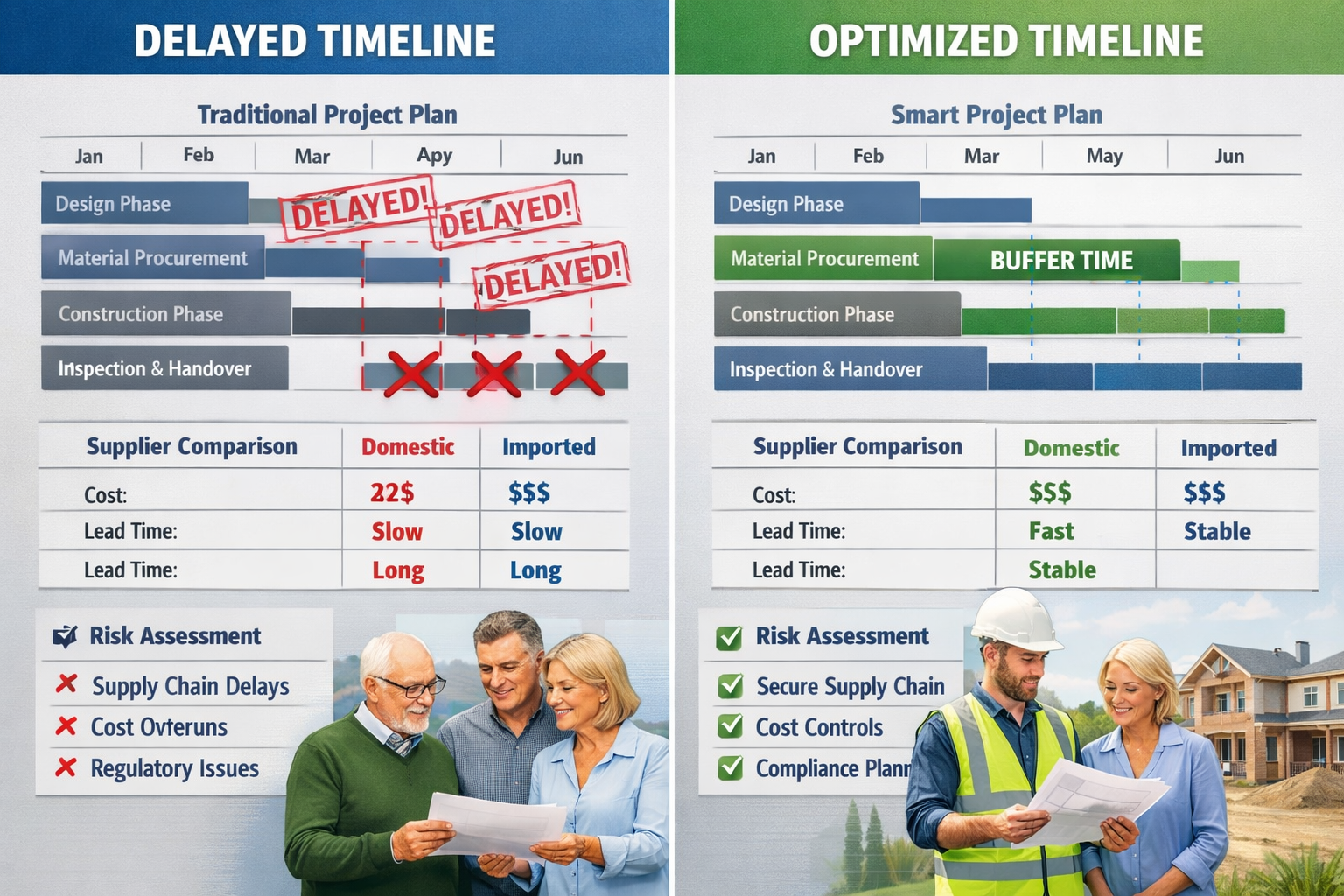
Tariff impacts on construction timelines: how party wall notices must account for 2026 material delays represents more than a technical adjustment to standard procedures—it requires a fundamental rethinking of how building owners, adjoining owners, and surveyors approach party wall works in an era of supply chain volatility.
With concrete demand down 9.9%, brick deliveries down 6.7%, and block deliveries plummeting 17.3%[1][2], the traditional assumptions underlying party wall notice periods no longer hold. Material procurement timelines now rival or exceed statutory notice periods, creating risks of invalid notices, project delays, and neighbor disputes.
The path forward requires:
✅ Comprehensive material due diligence before serving notices, including supplier engagement and lead time verification
✅ Enhanced notice content that acknowledges material uncertainties and establishes contingency provisions
✅ Adaptive party wall awards with mechanisms for managing material substitutions, timeline extensions, and cost variations
✅ Transparent communication between building owners and adjoining owners about material challenges and realistic timelines
✅ Professional surveyor expertise in navigating 2026's complex material environment and regulatory landscape
For building owners planning works requiring party wall procedures, the key is to start earlier, plan more comprehensively, and communicate more transparently than ever before. For adjoining owners, understanding material realities helps distinguish legitimate delays from poor planning.
The construction industry faces significant headwinds in 2026, but with proper planning and adaptive party wall procedures, projects can proceed successfully while maintaining legal compliance and neighbor relations. The surveyors and building owners who recognize these challenges and proactively address them in their notices and awards will navigate 2026's material environment most successfully.
Next Steps
If you're planning building works requiring party wall notices in 2026:
- Engage a qualified party wall surveyor early to assess your specific material challenges
- Conduct material availability assessments at least 3-4 months before intended work commencement
- Communicate proactively with adjoining owners about realistic timelines
- Build comprehensive contingencies into project schedules and budgets
- Document all material procurement efforts to support potential timeline extensions
The challenges are significant, but with proper planning and professional guidance, your party wall works can proceed successfully despite 2026's material constraints.
References
[1] Construction Building Materials Commentary January 2025 – https://www.gov.uk/government/statistics/building-materials-and-components-statistics-january-2026/construction-building-materials-commentary-january-2025
[2] Release02 – https://www.mineralproducts.org/News/2026/release02.aspx
[3] Uk Construction Market Outlook 2026 – https://tricelwater.co.uk/water-industry-insights/uk-construction-market-outlook-2026/
[4] Uk Construction Perspective – https://www.jll.com/en-uk/insights/uk-construction-perspective
[5] What Challenges Are Being Forecast For The Commercial Construction Industry In 2026 And Beyond – https://virtus-contracts.co.uk/blog/what-challenges-are-being-forecast-for-the-commercial-construction-industry-in-2026-and-beyond/