


The construction industry in 2026 faces an unprecedented challenge: tariff-induced supply chain disruptions are fundamentally reshaping how party wall surveyors approach notice timing and project scheduling. With eight in ten UK companies now impacted by tariffs and materials procurement timelines extending by months rather than weeks, the traditional party wall notice framework requires urgent adaptation[3]. The convergence of trade policy uncertainty, materials cost volatility, and extended contractor lead times means that surveyors can no longer rely on conventional notice periods to adequately protect both building and adjoining owners.
Understanding Tariff-Induced Project Delays and Party Wall Notice Timing: Adapting Surveyor Protocols for 2026's Supply Chain Uncertainty has become essential for construction professionals navigating this complex landscape. The February 2026 US Supreme Court ruling, which struck down certain tariffs only to see them replaced by a new 10% global tariff under alternative legal powers, exemplifies the ongoing policy instability that makes project planning increasingly difficult[1]. For party wall surveyors, this translates directly into longer notice periods, more flexible award conditions, and enhanced communication protocols with all stakeholders.
Key Takeaways
✅ Extended Notice Periods Required: Party wall surveyors must now factor in 3-5 month procurement delays when timing notices, rather than traditional 2-month windows, to accommodate tariff-related supply chain disruptions.
✅ Flexible Award Conditions: Party wall awards in 2026 need built-in contingency clauses addressing materials cost escalation and project timeline extensions triggered by tariff changes.
✅ Enhanced Stakeholder Communication: Surveyors must establish proactive communication protocols with contractors, suppliers, and neighbors to manage expectations around extended project durations.
✅ Risk Mitigation Strategies: Building owners should implement early materials procurement, diversified supplier networks, and tariff contingency reserves to minimize mid-project disruptions.
✅ Documentation Requirements: Comprehensive record-keeping of tariff impacts, supplier communications, and timeline adjustments protects all parties under party wall agreements.
Understanding the 2026 Tariff Landscape and Construction Impact
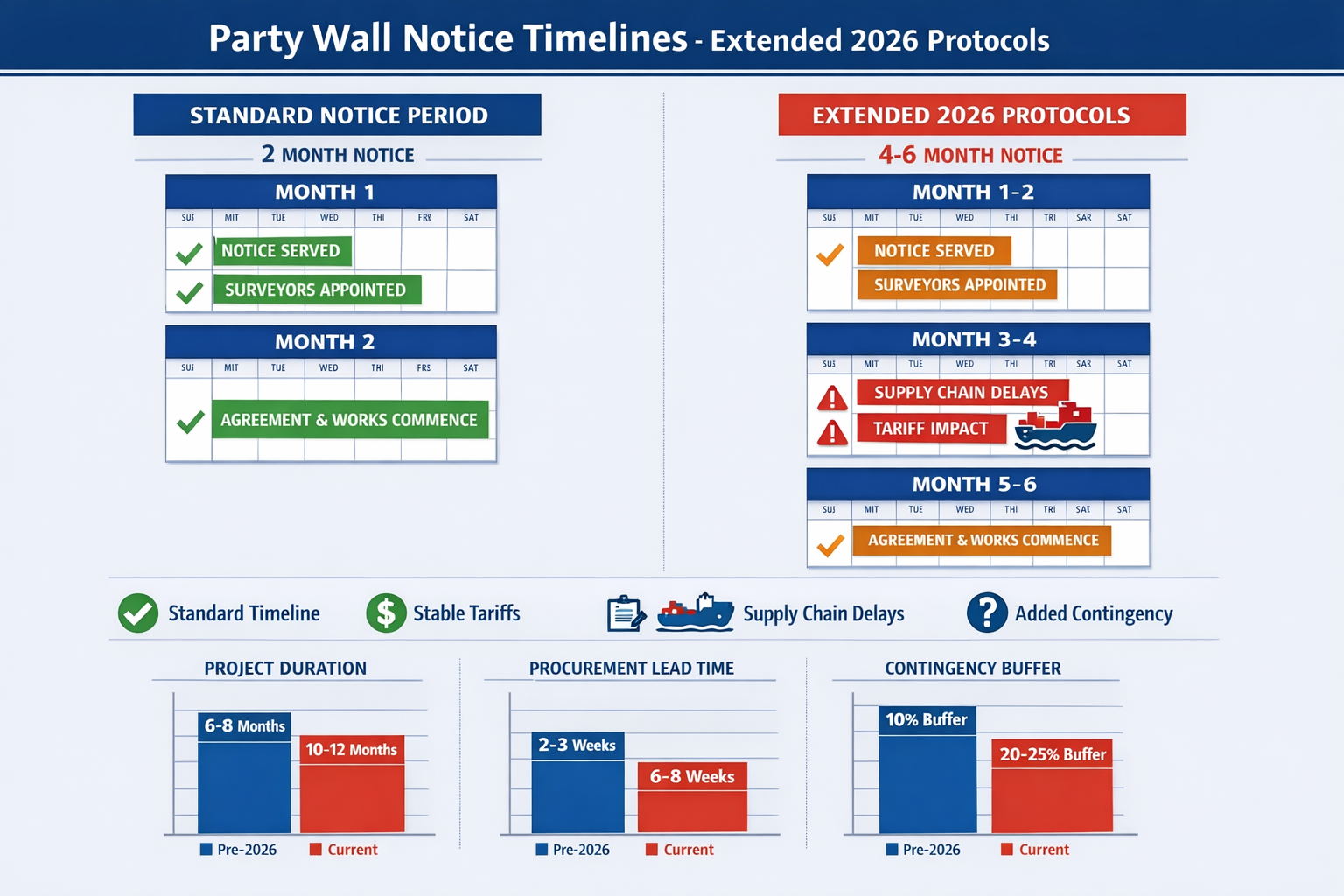
The tariff environment of 2026 presents unique challenges that extend far beyond simple cost increases. The International Trade Trends Survey 2026 revealed that 58% of UK companies cite tariffs and trade rules as major obstacles to export activities[3]. For the construction sector, this manifests in multiple ways that directly affect party wall procedures.
Current Tariff Situation and Policy Uncertainty
The February 2026 Supreme Court decision created what many industry experts describe as a "false dawn" for construction cost relief. While certain tariffs imposed under the International Emergency Economic Powers Act (IEEPA) were struck down, the immediate introduction of a new 10% global tariff under alternative US legal powers meant that cost pressures continued unabated[1]. This policy whiplash has made long-term project planning exceptionally difficult.
The UK Department for Business and Trade's tariff suspension review, which opened applications on December 12, 2025 and closed on February 4, 2026, offers some potential relief. However, with 300 duty suspensions expiring on June 30, 2026, and feedback being solicited on extending them through the end of 2028, uncertainty remains the dominant theme[2].
Materials Cost Volatility and Fixed-Price Contracts
Many UK construction projects operate under fixed-price contracts with long procurement lead times and thin profit margins. This business model creates significant exposure to mid-project tariff changes. According to industry analysis, these circumstances can trigger "change in law" claims under both JCT and NEC contractual frameworks[1].
The statistics are sobering:
- One in four UK manufacturers report balance sheet losses directly linked to added costs from US tariffs
- Nearly a quarter of manufacturers accelerated exports to the US in early 2025 to avoid anticipated tariff increases
- Almost one in four manufacturers have shifted focus towards non-US markets
- One in five have already stopped or reduced exports to the US altogether[3]
For party wall surveyors, these figures translate into practical challenges: contractors are delaying project starts, materials suppliers cannot guarantee pricing beyond 30-60 days, and project timelines are extending by months.
Tariff-Induced Project Delays and Party Wall Notice Timing: Critical Adjustments for 2026
The traditional approach to party wall notices assumed relatively stable supply chains and predictable contractor availability. The 2026 environment requires fundamental reconsideration of these assumptions.
Extended Notice Period Requirements
Under the Party Wall etc. Act 1996, building owners must serve notice at least two months before commencing certain works. However, tariff-induced procurement delays now routinely extend project preparation phases by 3-5 months beyond traditional timelines[6].
Recommended 2026 Notice Timeline Adjustments:
| Project Type | Traditional Notice Period | 2026 Recommended Period | Reason for Extension |
|---|---|---|---|
| Standard excavation works | 2 months | 4-5 months | Materials procurement delays, contractor scheduling uncertainty |
| Foundation underpinning | 2 months | 5-6 months | Specialized materials subject to tariffs, limited supplier availability |
| Structural alterations to party walls | 2 months | 4-5 months | Steel and timber cost volatility, extended fabrication timelines |
| New building at boundary | 2 months | 5-7 months | Comprehensive materials packages affected by multiple tariff categories |
These extended periods allow adequate time for:
- Materials price stabilization and procurement commitment
- Contractor availability confirmation amid industry-wide scheduling delays
- Contingency planning for potential tariff changes during project execution
- Neighbor consultation with realistic project timeline expectations
Adapting Surveyor Protocols for Supply Chain Uncertainty
Party wall surveyors must now incorporate supply chain risk assessment into their standard protocols. This represents a significant expansion of traditional surveying responsibilities.
Key Protocol Adaptations:
📋 Pre-Notice Supply Chain Assessment: Before serving notice, surveyors should work with building owners to obtain written confirmation from contractors regarding materials availability and pricing validity periods.
📋 Tariff Contingency Clauses: Party wall awards should explicitly address potential cost escalations and timeline extensions triggered by tariff changes, protecting both building and adjoining owners from unexpected disputes.
📋 Flexible Commencement Dates: Rather than specifying fixed start dates, awards should incorporate "ready to proceed" language tied to materials procurement milestones.
📋 Enhanced Communication Requirements: Building owners should be required to provide regular updates to adjoining owners regarding supply chain status and any anticipated delays.
📋 Materials Substitution Protocols: Awards should establish clear procedures for approving alternative materials if specified products become unavailable or prohibitively expensive due to tariffs.
Mid-sized surveying firms reported that implementing these enhanced protocols added 3-5 business days to their initial project assessment timelines during the early months of 2026[6]. However, this upfront investment significantly reduced mid-project disputes and costly delays.
Investment Delays and Their Impact on Party Wall Procedures
The tariff uncertainty of 2026 has created a decision paralysis among property developers and funders. This phenomenon directly affects party wall surveyors' workload patterns and procedural approaches.
Developer Hesitation and Project Postponements
Developers are increasingly delaying project approvals as they await greater clarity on trade policy direction. Funders, meanwhile, are requiring higher contingency reserves before releasing capital for construction projects[1]. This affects several key development sectors:
- Build-to-rent schemes: Multi-unit residential developments with long construction timelines face particular exposure to tariff changes
- Commercial developments: Office and retail projects with complex materials specifications struggle with pricing uncertainty
- Infrastructure procurement pipelines: Public sector projects face budget pressure from materials cost escalation
For party wall surveyors working in areas like South London, East London, and West London, these delays create unique challenges. Notices may be served, then projects postponed indefinitely, creating confusion about whether notices remain valid or must be re-served.
Managing Notice Validity During Extended Planning Phases
The Party Wall Act does not specify an expiration date for served notices, but practical considerations require surveyors to address extended planning phases proactively.
Best Practice Recommendations:
🔹 Notice Refresh Communications: If more than six months elapse between notice service and project commencement, surveyors should facilitate updated communications between building and adjoining owners confirming continued intent.
🔹 Award Validity Clauses: Include explicit language in awards addressing the validity period and circumstances requiring award amendment or renewal.
🔹 Project Status Updates: Establish quarterly update requirements for building owners to inform adjoining owners of project status during extended planning phases.
🔹 Materials Specification Updates: Allow for materials specification updates within awards if significant time elapses and originally specified materials become unavailable.
These protocols help maintain the spirit of the Party Wall Act—facilitating neighborly cooperation and preventing disputes—even when external economic factors disrupt traditional project timelines.
Tariff-Induced Project Delays and Party Wall Notice Timing: Practical Strategies for Building Owners
Building owners initiating works in 2026 face a complex landscape requiring strategic planning beyond traditional construction project management. Understanding how to navigate types of party wall works in this environment is crucial.
Early Materials Procurement and Supplier Relationships
One of the most effective strategies for mitigating tariff-related delays involves early materials procurement. Building owners should consider:
Strategic Procurement Approaches:
-
Advanced Ordering: Place materials orders 4-6 months before anticipated construction start, locking in prices before potential tariff increases
-
Supplier Diversification: Establish relationships with multiple suppliers across different geographic regions to reduce exposure to single-country tariff policies
-
Materials Stockpiling: For projects with flexible timelines, purchasing and storing critical materials during tariff suspension periods can generate significant cost savings
-
Price Guarantee Negotiations: Work with suppliers to obtain extended price validity guarantees, even at a slight premium, to enable accurate project budgeting
-
Alternative Materials Research: Identify acceptable substitute materials from different tariff categories before finalizing project specifications
These strategies require coordination with party wall surveyors to ensure that procurement timelines align with notice periods and award conditions.
Contingency Planning and Budget Reserves
The costs of party wall processes now must account for tariff-related contingencies. Financial planning should incorporate:
Recommended Contingency Levels for 2026:
- Standard residential extensions: 15-20% contingency (up from traditional 10%)
- Complex structural works: 20-25% contingency
- Commercial developments: 25-30% contingency
- Projects with imported specialty materials: 30-35% contingency
These elevated contingency levels reflect both materials cost volatility and potential timeline extensions that increase overall project costs through extended professional fees, insurance, and financing charges.
Communication Strategies with Adjoining Owners
Transparent communication with neighbors becomes even more critical when projects face tariff-induced uncertainties. Building owners should:
✉️ Provide Context: When serving party wall notices, include supplementary information explaining potential timeline uncertainties due to supply chain factors
✉️ Set Realistic Expectations: Avoid overly optimistic project completion dates that may need revision due to materials delays
✉️ Establish Update Protocols: Commit to regular progress updates, particularly if delays occur, to maintain positive neighbor relationships
✉️ Offer Flexibility: Where possible, demonstrate willingness to accommodate adjoining owners' scheduling preferences within the constraints of materials availability
✉️ Document Everything: Maintain comprehensive records of all communications regarding timeline changes and reasons for delays
These communication practices help prevent the escalation of minor frustrations into formal disputes that require third surveyor intervention.
Adapting Surveyor Protocols for 2026's Supply Chain Uncertainty: Professional Responsibilities
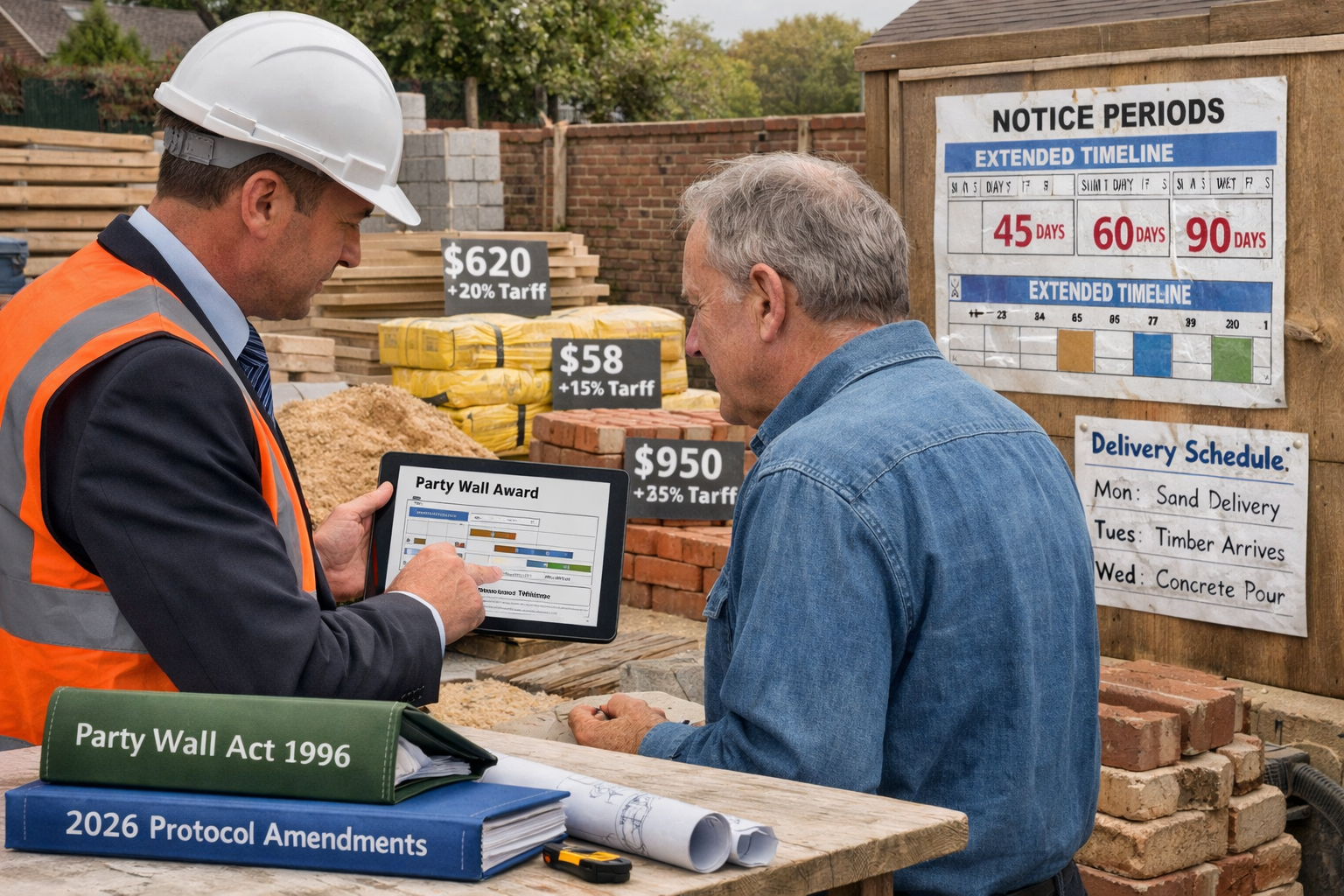
Party wall surveyors face expanded professional responsibilities in 2026 as they navigate the intersection of traditional statutory duties and modern supply chain complexities. Whether acting as a building owner's surveyor or an adjoining owner's surveyor, understanding these new dimensions is essential.
Enhanced Due Diligence Requirements
Surveyors must now conduct more comprehensive due diligence before finalizing party wall awards. This includes:
Expanded Surveyor Responsibilities:
🔍 Supply Chain Verification: Request and review contractor documentation regarding materials sourcing, supplier reliability, and procurement timelines
🔍 Tariff Impact Assessment: Evaluate which project materials fall under current or potential future tariff categories and assess associated cost risks
🔍 Contractor Financial Stability: Given that one in four manufacturers report balance sheet losses from tariff impacts[3], surveyors should verify contractor financial stability to reduce abandonment risk
🔍 Alternative Specifications Review: Assess feasibility of alternative materials specifications that might reduce tariff exposure while maintaining project quality
🔍 Timeline Realism Testing: Challenge optimistic contractor schedules by incorporating known supply chain delays and materials procurement lead times
These enhanced due diligence practices protect both building and adjoining owners from preventable disputes arising from unrealistic project planning.
Drafting Flexible Party Wall Awards
The traditional party wall award format requires adaptation to address 2026's uncertainties. Surveyors should incorporate:
Essential Award Provisions for 2026:
📄 Materials Cost Escalation Clauses: "If materials costs increase by more than [X%] due to tariff changes implemented after the date of this award, the building owner shall provide updated cost documentation and revised project schedules to the adjoining owner within 14 days of becoming aware of such changes."
📄 Timeline Extension Provisions: "Project timelines specified in this award are based on current materials availability. If procurement delays extend the project schedule by more than [X weeks], the building owner shall notify the adjoining owner and surveyors, and parties shall meet to discuss reasonable timeline adjustments."
📄 Materials Substitution Protocols: "Should specified materials become unavailable or subject to tariff increases exceeding [X%], the building owner may propose alternative materials of equivalent or superior quality, subject to surveyor approval and adjoining owner notification."
📄 Communication Requirements: "The building owner shall provide monthly project status updates to the adjoining owner during any period when works are delayed due to materials procurement or supply chain factors."
📄 Dispute Resolution Procedures: "Should disputes arise regarding timeline extensions or cost escalations related to tariff changes, parties agree to [mediation/third surveyor determination] before pursuing other remedies."
These provisions create a framework for managing uncertainty while maintaining the protective intent of the Party Wall Act.
Managing Multi-Party Situations in Central London
Surveyors working in densely developed areas like Central London or North London often deal with projects affecting multiple adjoining owners. Tariff-induced delays complicate these already complex situations.
Strategies for Multi-Party Coordination:
👥 Unified Communication: Establish a single communication channel for all adjoining owners to receive consistent project updates
👥 Staggered Notice Service: When materials uncertainty is high, consider staggered notice service to different neighbors based on which properties will be affected at different project phases
👥 Collective Meetings: Organize group meetings with all affected adjoining owners to explain tariff-related uncertainties and establish shared expectations
👥 Consistent Award Terms: Ensure all awards affecting the same project contain consistent provisions regarding timeline extensions and materials substitutions
👥 Coordinated Schedule of Condition: Conduct comprehensive schedules of condition for all affected properties before any works commence, recognizing that extended project timelines increase damage risk
These coordination strategies become particularly important when projects experience multiple delays affecting different neighbors at different times.
Risk Mitigation Strategies for All Stakeholders
Successfully navigating Tariff-Induced Project Delays and Party Wall Notice Timing: Adapting Surveyor Protocols for 2026's Supply Chain Uncertainty requires coordinated risk mitigation by all parties involved in construction projects.
For Building Owners
Building owners initiating works should implement comprehensive risk management strategies:
Building Owner Risk Mitigation Checklist:
✔️ Engage Surveyors Early: Consult with party wall surveyors during initial project planning, before finalizing contractor agreements or materials specifications
✔️ Obtain Multiple Contractor Quotes: Request detailed quotes from at least three contractors, with explicit breakdown of materials costs and procurement timelines
✔️ Verify Materials Sourcing: Ask contractors to identify country of origin for all major materials and assess tariff exposure
✔️ Build Extended Timelines: Add 40-50% to traditional project timelines when planning and communicating with neighbors
✔️ Secure Flexible Financing: Ensure construction financing includes provisions for timeline extensions and cost escalations
✔️ Maintain Contingency Reserves: Keep accessible financial reserves equal to 25-30% of total project costs
✔️ Document All Decisions: Create comprehensive records of all decisions regarding materials selection, contractor choice, and timeline planning
✔️ Consider Phased Approaches: Break large projects into phases that can be completed as materials become available, rather than requiring all materials simultaneously
For Adjoining Owners
Adjoining owners receiving party wall notices in 2026 should take a more active role in understanding project uncertainties:
Adjoining Owner Protection Strategies:
✔️ Ask Detailed Questions: When receiving notice, request specific information about materials sourcing, procurement timelines, and potential delay factors
✔️ Appoint Experienced Surveyors: Select surveyors with demonstrated experience in managing complex projects and supply chain issues
✔️ Request Regular Updates: Ensure party wall awards include mandatory update provisions if projects experience delays
✔️ Understand Your Rights: Review resources on what to do when your neighbor is carrying out works to understand your protections
✔️ Document Pre-Existing Conditions: Insist on comprehensive schedules of condition before works commence, recognizing that extended project timelines increase damage risk
✔️ Maintain Communication: Establish direct communication channels with building owners to address concerns before they escalate
✔️ Review Award Terms Carefully: Pay particular attention to provisions addressing timeline extensions and materials substitutions
For Party Wall Surveyors
Surveyors must balance traditional statutory duties with new responsibilities arising from supply chain uncertainty:
Surveyor Professional Standards for 2026:
✔️ Continuous Education: Stay informed about current tariff policies, supply chain conditions, and construction materials markets
✔️ Enhanced Documentation: Maintain detailed records of all advice provided regarding timeline uncertainties and materials risks
✔️ Proactive Communication: Establish regular communication protocols with both building and adjoining owners throughout project duration
✔️ Realistic Scheduling: Challenge unrealistic contractor timelines and ensure awards reflect achievable schedules
✔️ Contingency Planning: Include comprehensive contingency provisions in all awards addressing potential delays and cost escalations
✔️ Professional Liability Review: Ensure professional indemnity insurance adequately covers expanded advisory responsibilities regarding supply chain matters
✔️ Collaborative Approach: Work cooperatively with surveyors appointed by other parties to establish consistent approaches to tariff-related uncertainties
✔️ Template Updates: Revise standard award templates to incorporate 2026-appropriate provisions addressing supply chain risks
Case Studies: Tariff Impacts on Recent London Projects
Examining real-world examples illustrates how tariff-induced delays affect party wall procedures in practice.
Case Study 1: Residential Extension in South London
A homeowner planned a two-story rear extension requiring excavation within three meters of the neighboring property. Traditional timeline: 4-6 months from notice to completion.
2026 Reality:
- Notice served in October 2025 with anticipated March 2026 construction start
- Contractor notified building owner in February 2026 that steel beam delivery would be delayed 8-10 weeks due to tariff-related supplier backlog
- Party wall surveyor facilitated communication with neighbor explaining delay
- Award included provision allowing timeline extension for materials procurement delays
- Actual construction start: June 2026 (3 months later than anticipated)
- Neighbor relationship preserved through transparent communication
Key Lessons:
- Extended notice periods (6+ months) would have better accommodated procurement uncertainties
- Award flexibility provisions prevented dispute when delays materialized
- Proactive surveyor communication maintained positive neighbor relations
Case Study 2: Commercial Development in Central London
A developer planned a five-story mixed-use building affecting seven adjoining properties. Traditional timeline: 18-24 months construction.
2026 Reality:
- Initial notices served with 3-month lead time (insufficient for 2026 conditions)
- Multiple materials categories affected by tariffs: structural steel, curtain wall systems, mechanical systems
- Developer delayed project start by 5 months to secure materials pricing guarantees
- Party wall awards required amendment to reflect revised timelines
- Two adjoining owners expressed frustration with extended uncertainty period
- Third surveyor intervention required to resolve dispute over timeline extensions
Key Lessons:
- Complex projects require 6-9 month notice periods in current environment
- Initial awards should include comprehensive timeline extension provisions
- Multi-party projects need exceptionally clear communication protocols
- Developer materials procurement strategy should be finalized before serving notices
Case Study 3: Foundation Underpinning in North London
A terraced house required foundation underpinning affecting both neighboring properties. Traditional timeline: 3-4 months.
2026 Reality:
- Surveyor conducted pre-notice supply chain assessment with contractor
- Identified that specialized underpinning materials had 12-week procurement lead time (up from traditional 4 weeks)
- Served notices with 5-month lead time and detailed explanation of procurement requirements
- Building owner secured materials pricing guarantee valid for 6 months
- Award included specific materials substitution protocols if specified products became unavailable
- Project completed on revised schedule without disputes
Key Lessons:
- Pre-notice supply chain assessment prevented surprises
- Extended notice periods aligned with actual procurement realities
- Materials pricing guarantees provided cost certainty
- Comprehensive award provisions addressed potential contingencies
Future Outlook: Preparing for Continued Uncertainty
The tariff landscape of 2026 appears unlikely to stabilize quickly. Party wall surveyors must prepare for continued uncertainty extending into 2027 and beyond.
Monitoring Policy Developments
Several key policy developments will affect construction supply chains:
Critical Dates and Developments to Monitor:
📅 June 30, 2026: Expiration of 300 UK duty suspensions currently under review[2]
📅 End of 2026: Potential implementation of extended duty suspensions through 2028 if approved[2]
📅 Ongoing: US trade policy evolution under changing political leadership
📅 Quarterly: UK Department for Business and Trade tariff reviews and updates
Surveyors should establish systems for monitoring these developments and communicating implications to clients.
Technology and Process Innovation
Some surveying firms are adopting technological solutions to manage supply chain uncertainties:
Emerging Tools and Practices:
💻 Supply Chain Tracking Software: Integration of materials tracking platforms into project management systems
💻 Digital Award Templates: Cloud-based award templates with built-in contingency provisions and automated update capabilities
💻 Collaborative Communication Platforms: Secure portals allowing building owners, adjoining owners, and surveyors to share real-time project updates
💻 Materials Cost Databases: Subscription services tracking construction materials costs and tariff impacts across categories
💻 Automated Notice Timing Calculators: Tools that factor in current supply chain conditions when recommending notice service timing
These innovations can help surveyors provide more sophisticated advice and manage complex projects more efficiently.
Professional Development Priorities
Party wall surveyors should prioritize professional development in several areas:
Recommended Training and Knowledge Areas:
📚 International Trade Fundamentals: Basic understanding of tariff structures, trade agreements, and policy mechanisms
📚 Supply Chain Management: Principles of construction supply chain logistics and procurement strategies
📚 Contract Law Updates: Understanding how JCT and NEC contracts address "change in law" provisions and cost escalations
📚 Advanced Communication Skills: Techniques for managing stakeholder expectations during uncertain conditions
📚 Risk Assessment Methodologies: Frameworks for evaluating and communicating project risks beyond traditional structural concerns
📚 Alternative Dispute Resolution: Enhanced mediation and negotiation skills for resolving tariff-related disputes
Professional organizations should develop continuing education programs addressing these emerging competency areas.
Regulatory Considerations and Compliance
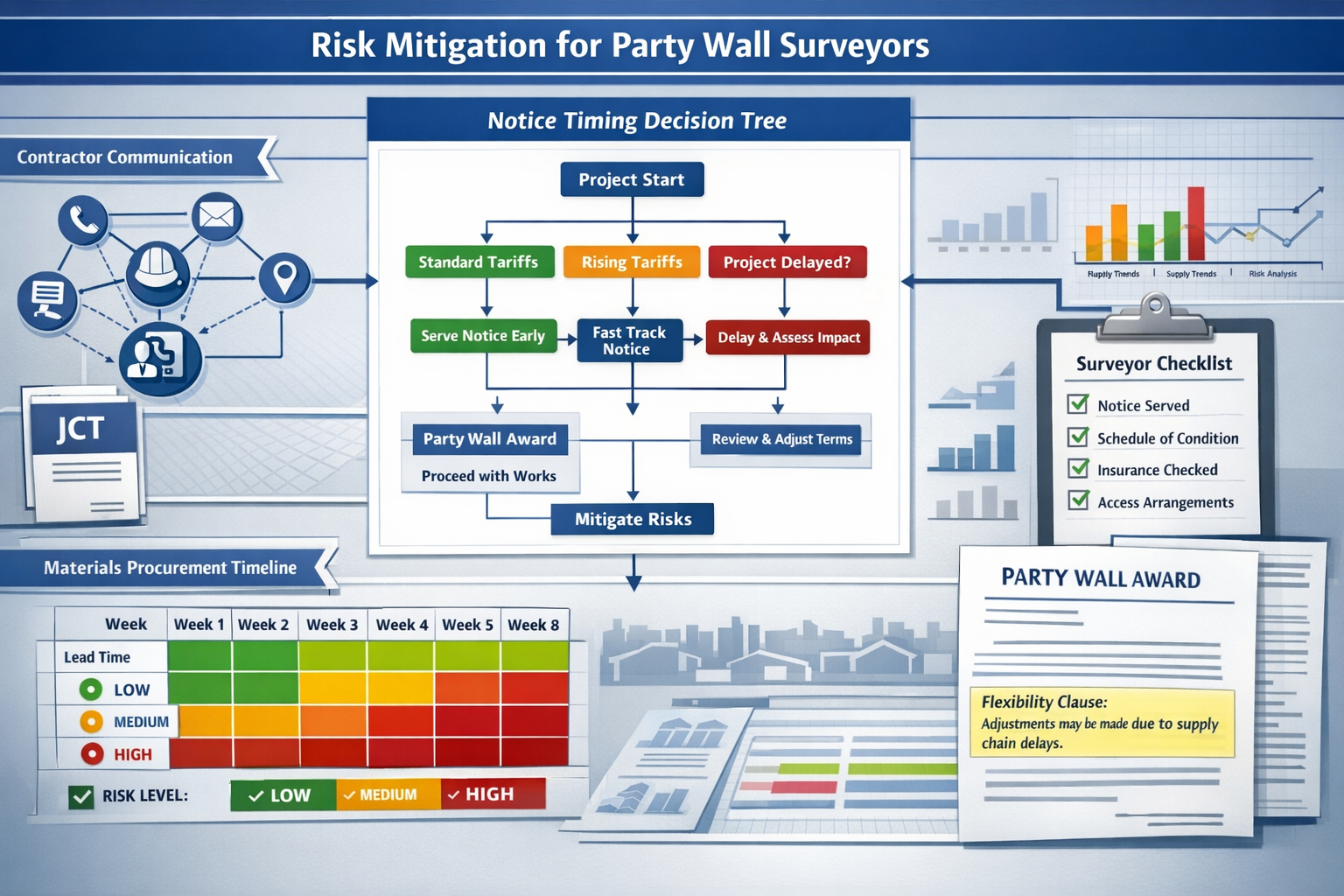
While the Party Wall etc. Act 1996 remains unchanged, its application in the context of tariff-induced delays raises important regulatory considerations.
Statutory Notice Period Compliance
The Act specifies minimum notice periods, but does not prohibit longer periods. Surveyors should understand:
Notice Period Flexibility:
- Two-month minimum for excavation and construction notices remains legally binding
- Longer periods are permissible and increasingly advisable in 2026 conditions
- Notice validity does not expire, but practical considerations may require refresh communications
- Revised notices may be appropriate if project scope changes substantially during extended planning phases
Surveyors should document the reasoning for extended notice periods to demonstrate professional judgment if questioned.
Award Enforceability Considerations
Party wall awards must remain legally enforceable while incorporating flexibility provisions. Key considerations:
Balancing Flexibility and Enforceability:
⚖️ Specific vs. General Terms: Awards should be specific enough to be enforceable but flexible enough to accommodate reasonable contingencies
⚖️ Objective Standards: Flexibility provisions should reference objective standards (e.g., "materials cost increases exceeding 15%") rather than subjective determinations
⚖️ Dispute Resolution Mechanisms: Include clear procedures for resolving disagreements about whether contingency provisions apply
⚖️ Documentation Requirements: Specify what documentation building owners must provide to invoke contingency provisions
⚖️ Time Limits: Include reasonable time limits for invoking contingency provisions to prevent indefinite uncertainty
These considerations help ensure that awards remain enforceable while addressing 2026's unique challenges.
Insurance and Liability Implications
Tariff-related delays create potential liability exposure for various parties:
Liability Considerations:
🛡️ Surveyor Professional Liability: Failure to advise clients about supply chain risks could constitute professional negligence
🛡️ Contractor Performance Bonds: Extended timelines may affect contractor bonding requirements and coverage
🛡️ Project Insurance: Construction all-risk policies may require notification of substantial timeline extensions
🛡️ Adjoining Owner Protection: Awards should clearly specify building owner responsibilities for damage occurring during extended project timelines
All parties should review insurance coverage with advisors to ensure adequate protection in the current environment.
Practical Implementation Guide
For surveyors ready to implement adapted protocols, this practical guide provides a structured approach.
Step-by-Step Protocol for 2026 Party Wall Projects
Phase 1: Initial Consultation (Weeks 1-2)
- Meet with building owner to understand project scope and objectives
- Request preliminary contractor quotes and materials specifications
- Conduct supply chain risk assessment for major materials categories
- Identify tariff exposure and procurement lead times
- Recommend appropriate notice timing based on supply chain analysis
- Discuss contingency planning and budget reserves
Phase 2: Pre-Notice Preparation (Weeks 3-6)
- Finalize contractor selection and obtain detailed materials sourcing information
- Verify supplier reliability and pricing guarantee periods
- Prepare comprehensive project timeline incorporating procurement lead times
- Draft notice documents with supplementary supply chain context
- Prepare building owner for potential adjoining owner questions about timelines
- Coordinate with building owner's other consultants (architects, engineers, contractors)
Phase 3: Notice Service and Initial Response (Weeks 7-10)
- Serve notices with recommended extended lead times
- Provide supplementary information about project timelines and potential uncertainties
- Respond promptly to adjoining owner inquiries
- Facilitate surveyor appointments for non-consenting adjoining owners
- Conduct initial surveyor meetings to establish collaborative approach
- Begin schedule of condition preparations
Phase 4: Award Preparation (Weeks 11-16)
- Conduct comprehensive site inspections and schedules of condition
- Review contractor method statements and timeline projections
- Draft awards incorporating 2026-appropriate contingency provisions
- Include specific provisions addressing materials cost escalation and timeline extensions
- Establish communication protocols for project updates
- Obtain surveyor agreement on award terms
- Serve awards on all parties
Phase 5: Pre-Commencement Period (Weeks 17+)
- Monitor materials procurement progress
- Facilitate communication between building owner and adjoining owners regarding project status
- Address any concerns or questions arising during extended planning phase
- Confirm contractor readiness and materials availability before authorizing commencement
- Conduct final pre-commencement inspections
- Document project commencement date and notify all parties
Phase 6: Construction Period Monitoring
- Maintain regular communication with all parties
- Monitor compliance with award conditions
- Address any issues arising from materials delays or substitutions
- Document any timeline extensions and reasons
- Facilitate dispute resolution if disagreements arise
- Conduct periodic inspections to verify work quality and neighbor property protection
Phase 7: Project Completion
- Conduct final inspections comparing to schedules of condition
- Address any damage claims promptly
- Obtain completion confirmations from all parties
- Archive comprehensive project documentation
- Conduct post-project review to identify lessons learned
Customizable Award Template Provisions
Surveyors can adapt these template provisions for incorporation into awards:
Materials Cost Escalation Provision:
"The building owner has budgeted for this project based on materials costs current as of [DATE]. Should tariffs, duties, or other governmental charges imposed after this date increase the cost of materials specified in this award by more than fifteen percent (15%), the building owner shall provide written notice to the adjoining owner and appointed surveyors within fourteen (14) days of becoming aware of such increases. Such notice shall include documentation from suppliers evidencing the cost increases and their causes. The parties acknowledge that such cost increases, if properly documented, constitute circumstances beyond the building owner's reasonable control and shall not constitute grounds for disputing the building owner's good faith performance under this award."
Timeline Extension Provision:
"The project timeline specified in this award assumes materials availability consistent with procurement lead times current as of [DATE]. Should materials procurement delays extend the anticipated project commencement date by more than thirty (30) days, the building owner shall provide written notice to the adjoining owner explaining the nature of the delay and providing a revised project schedule. The adjoining owner acknowledges that such delays, if caused by supply chain factors beyond the building owner's reasonable control and properly documented, shall not constitute breach of this award. However, if project commencement is delayed by more than ninety (90) days beyond the anticipated commencement date specified herein, either party may request a review meeting with both appointed surveyors to discuss whether award amendments are appropriate."
Materials Substitution Provision:
"The building owner shall use materials specified in this award or materials of equivalent or superior quality. Should specified materials become unavailable or subject to cost increases exceeding twenty percent (20%) due to tariff changes or supply chain disruptions, the building owner may propose alternative materials. Such proposals shall be submitted in writing to the appointed surveyors with documentation demonstrating that proposed alternatives meet or exceed the performance characteristics, aesthetic qualities, and durability of originally specified materials. The surveyors shall evaluate such proposals within fourteen (14) days and may approve alternatives that adequately protect the interests of both building and adjoining owners. The adjoining owner shall be notified of any approved materials substitutions before their incorporation into the works."
Communication Protocol Provision:
"The building owner shall provide project status updates to the adjoining owner at the following intervals: (1) written notice at least seven (7) days before project commencement; (2) monthly progress updates during active construction; (3) immediate notice of any circumstances causing work stoppage exceeding seven (7) days; (4) immediate notice of any materials procurement delays affecting the project timeline by more than fourteen (14) days; and (5) written notice of project completion. Updates may be provided via email to [CONTACT INFORMATION] or such other method as the parties may agree."
These provisions can be customized based on specific project circumstances and local practices.
Conclusion: Navigating the New Normal
Tariff-Induced Project Delays and Party Wall Notice Timing: Adapting Surveyor Protocols for 2026's Supply Chain Uncertainty represents more than a temporary challenge—it signals a fundamental shift in how construction projects must be planned and managed. The convergence of trade policy volatility, materials cost uncertainty, and extended procurement timelines requires party wall surveyors to expand their professional capabilities beyond traditional structural and procedural expertise.
The statistics are clear: with eight in ten UK companies impacted by tariffs and one in four manufacturers reporting balance sheet losses from tariff-related costs, the construction industry faces sustained pressure that will continue affecting project timelines and costs[3]. Party wall surveyors who adapt their protocols now will better serve their clients and protect all stakeholders from preventable disputes.
Key Success Factors
Successful navigation of this environment requires:
🎯 Extended Planning Horizons: Notice periods of 4-7 months rather than traditional 2 months accommodate realistic procurement timelines
🎯 Comprehensive Risk Assessment: Surveyors must evaluate supply chain risks alongside traditional structural and procedural considerations
🎯 Flexible Award Provisions: Party wall awards need built-in contingency mechanisms addressing cost escalation and timeline extensions
🎯 Enhanced Communication: Proactive, transparent communication with all stakeholders prevents minor uncertainties from escalating into major disputes
🎯 Continuous Monitoring: Ongoing attention to trade policy developments and supply chain conditions enables timely advice to clients
🎯 Professional Development: Surveyors must develop competencies in supply chain management, international trade basics, and advanced stakeholder communication
Actionable Next Steps
For building owners planning projects in 2026 and beyond:
✅ Engage party wall surveyors during initial project planning, before finalizing contractor agreements or materials specifications
✅ Request supply chain risk assessments as part of surveyor services
✅ Build extended timelines into project plans, adding 40-50% to traditional schedules
✅ Secure materials pricing guarantees from suppliers before serving party wall notices
✅ Maintain contingency reserves equal to 25-30% of total project costs
✅ Establish transparent communication with neighbors from the outset
For adjoining owners receiving party wall notices:
✅ Ask detailed questions about materials sourcing and procurement timelines
✅ Appoint experienced surveyors familiar with supply chain issues
✅ Request comprehensive schedules of condition before works commence
✅ Ensure awards include mandatory update provisions if projects experience delays
✅ Maintain open communication with building owners to address concerns early
For party wall surveyors:
✅ Update standard templates to incorporate 2026-appropriate contingency provisions
✅ Develop supply chain assessment capabilities and resources
✅ Establish monitoring systems for trade policy developments affecting construction materials
✅ Invest in professional development covering supply chain management and international trade fundamentals
✅ Review professional liability insurance to ensure adequate coverage for expanded advisory responsibilities
✅ Create client education materials explaining tariff impacts and recommended protocol adaptations
The party wall surveying profession has always adapted to changing circumstances while maintaining its core mission: facilitating construction projects while protecting the rights and interests of all affected parties. The tariff-induced uncertainties of 2026 require another evolution in professional practice. Surveyors who embrace these changes, develop new competencies, and implement adapted protocols will continue providing essential services that enable construction projects to proceed smoothly despite external economic pressures.
By extending notice periods, incorporating flexible award provisions, enhancing communication protocols, and conducting comprehensive supply chain risk assessments, party wall surveyors can successfully navigate Tariff-Induced Project Delays and Party Wall Notice Timing: Adapting Surveyor Protocols for 2026's Supply Chain Uncertainty. These adaptations protect building owners from cost overruns and timeline disputes, protect adjoining owners from prolonged uncertainty and inadequate notice, and protect the surveying profession's reputation for competent, client-focused service.
The challenges of 2026 are significant, but they are manageable with proper planning, realistic expectations, and collaborative approaches among all stakeholders. The party wall surveying profession has the expertise and adaptability to guide clients through this uncertain period while maintaining the high professional standards that have long characterized the field.
References
[1] Trump 10 Percent Tariffs Uk Construction Impact – https://www.constructionmagazine.uk/2026/02/trump-10-percent-tariffs-uk-construction-impact.html
[2] United Kingdom Uk Tariff Suspensions December 2025 Update – https://www.fas.usda.gov/data/united-kingdom-uk-tariff-suspensions-december-2025-update
[3] International Trade Trends Survey Uk Manufacturers Recalibrate Trade Strategies As Tariffs Bite – https://zenoot.com/articles/international-trade-trends-survey-uk-manufacturers-recalibrate-trade-strategies-as-tariffs-bite/
[4] Us Tariff Proposal Called Off How Can Uk Businesses Prepare For Future Trade Uncertainty – https://www.macalvins.com/blog/us-tariff-proposal-called-off-how-can-uk-businesses-prepare-for-future-trade-uncertainty/
[6] Post Alta Nsps 2026 Standards Implementation Challenges And Success Stories For Property Surveyors – https://nottinghillsurveyors.com/blog/post-alta-nsps-2026-standards-implementation-challenges-and-success-stories-for-property-surveyors