
{"cover":"Professional landscape format (1536×1024) hero image with bold text overlay 'Timing Party Wall Notices for 2026 Power Facility Builds: Surveyor Strategies' in extra large 72pt white sans-serif font with dark shadow and semi-transparent navy overlay box, positioned in upper third center. Background shows modern utility-scale solar power facility with rows of photovoltaic panels extending to horizon, electrical infrastructure, transmission towers, and construction workers in hard hats reviewing blueprints near a shared boundary wall. Foreground includes architectural plans with party wall markings, calendar showing 2026, and surveying equipment. Color scheme: deep blue, electric yellow, steel gray, white accents. High contrast, magazine cover quality, editorial style with professional construction industry aesthetic. Dramatic sky with sunset lighting creating depth and urgency.","content":["Detailed landscape format (1536×1024) image showing comprehensive timeline infographic for party wall notice procedures in power facility construction. Visual displays three parallel horizontal timelines with color-coded phases: Party Structure Notice (blue), Line of Junction Notice (green), and excavation notices (orange). Each timeline shows critical milestones with calendar icons, checkmarks, and countdown clocks. Left side features surveyor in high-visibility vest holding clipboard at industrial site boundary. Right side shows modern battery storage facility under construction. Include text overlays for key timeframes: '2 months minimum', '14-day response period', 'Award process 10-14 days'. Background shows shared property boundary with technical drawings, measurement tools, and legal documentation. Professional construction industry aesthetic with clean infographic design, arrows indicating workflow progression, and urgency indicators for accelerated approval pathways.","Detailed landscape format (1536×1024) image depicting surveyor strategies for power facility party wall procedures. Central focus shows professional surveyor conducting boundary inspection at utility-scale wind farm construction site, using laser measurement equipment along shared property line. Split-screen composition: left half shows traditional residential party wall scenario with brick wall and neighboring properties, right half shows industrial-scale power facility with transformer stations and electrical infrastructure. Overlay elements include strategic planning checklist with checkboxes, risk assessment matrix, and communication flowchart connecting building owner, adjoining owner, and appointed surveyors. Include visual representations of Party Wall etc Act 1996 documentation, stamped approvals, and digital scheduling tools. Background features construction cranes, renewable energy equipment, and boundary markers. Color coding distinguishes different notice types and approval stages. Professional technical illustration style with engineering precision.","Detailed landscape format (1536×1024) image showcasing accelerated approval processes for 2026 power infrastructure projects. Central visual shows modern command center or project management office with large digital displays showing Gantt charts, approval workflows, and project timelines specific to party wall procedures. Foreground features conference table with multiple stakeholders: surveyors, legal advisors, power company representatives, and property owners reviewing party wall awards and agreements. Digital screens display fast-track approval pathways with highlighted critical paths, bottleneck identification, and milestone achievements. Include visual elements of renewable energy facilities: solar arrays, battery storage units, substation equipment visible through office windows. Overlay graphics show comparison charts between standard timelines versus accelerated processes, percentage improvements in approval speed, and compliance checkpoints. Professional corporate aesthetic with technology integration, data visualization, and collaborative decision-making atmosphere. Color scheme: corporate blue, success green, urgent amber highlights."}
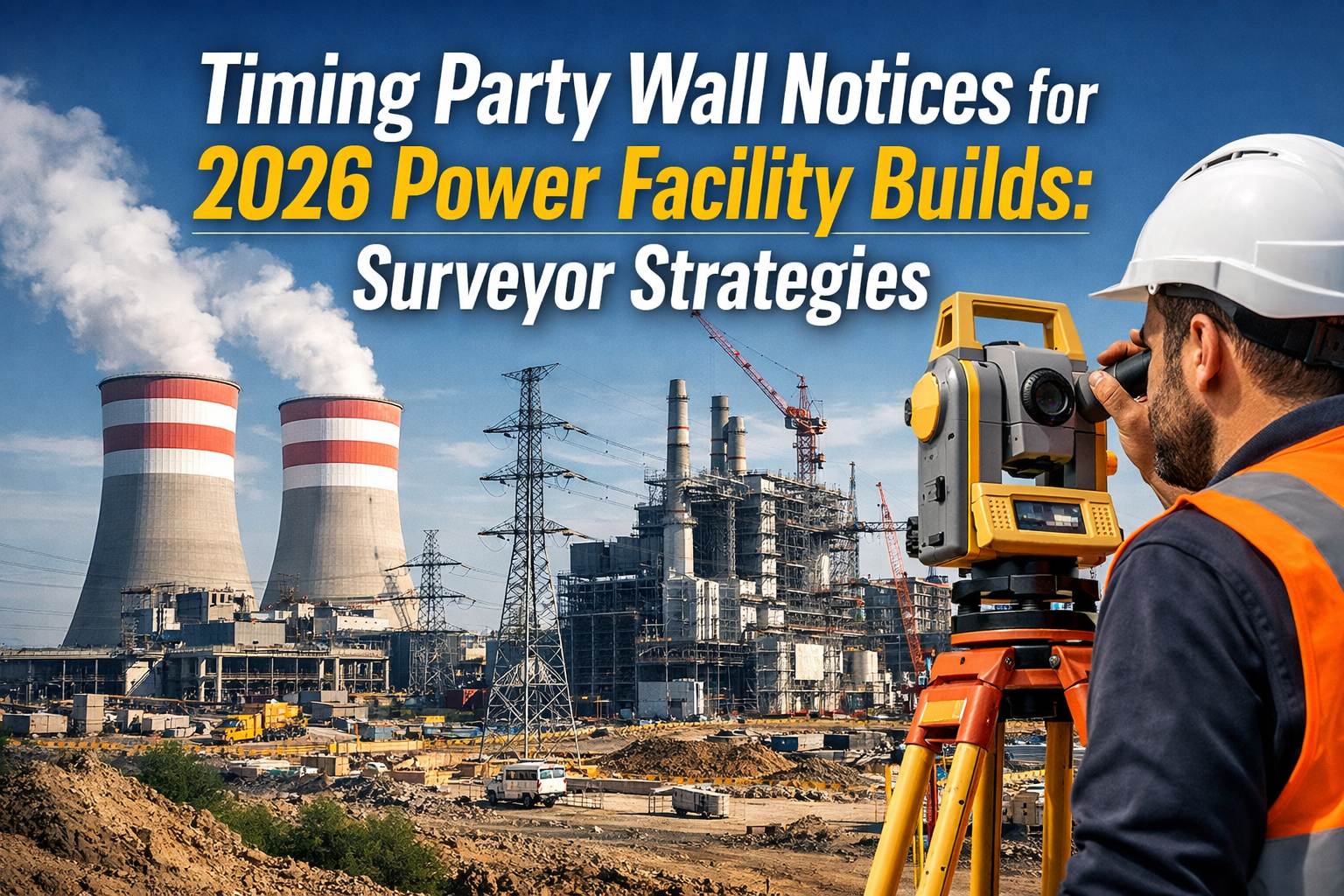
The energy sector is experiencing unprecedented growth in 2026, with utility-scale power facilities, renewable energy installations, and battery storage projects reshaping the UK's infrastructure landscape. As developers race to meet ambitious net-zero targets and capitalize on government incentives, one critical legal requirement often determines project timelines: party wall notices. Understanding the intricacies of timing party wall notices for 2026 power facility builds: surveyor strategies has become essential for project managers, developers, and surveyors navigating this high-growth sector.
Unlike traditional residential developments, power facilities present unique challenges. These projects involve substantial excavations, heavy structural loads, and complex boundary considerations that demand meticulous planning and precise legal compliance. The stakes are higher, the timelines are tighter, and the consequences of delay can cost millions. This comprehensive guide explores optimal notice timelines, award processes, and surveyor strategies specifically tailored for utility-scale power projects in 2026.
Key Takeaways
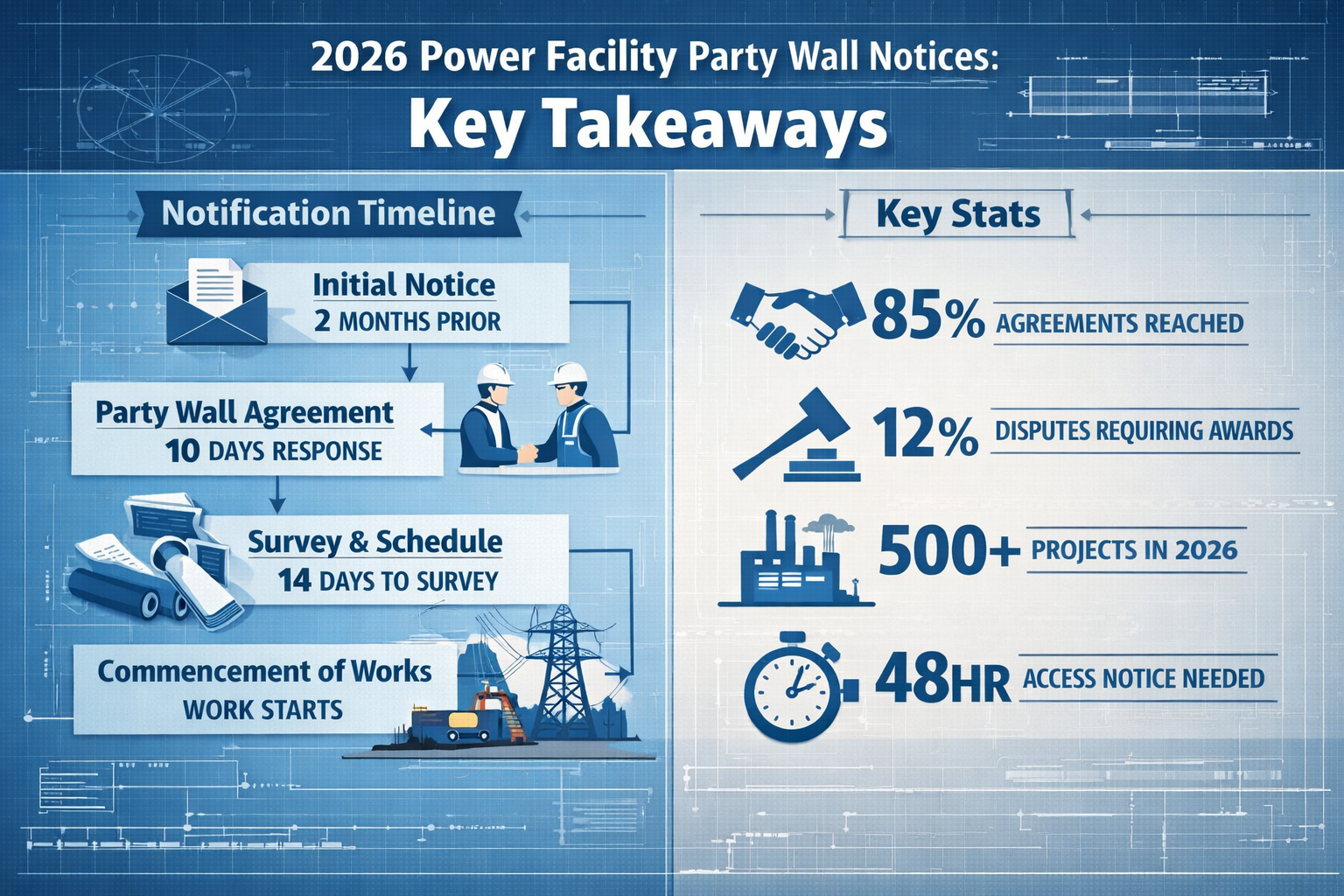
- Early notice service is critical: Power facility projects require serving party wall notices at least two months before construction begins, with additional time for complex industrial scenarios
- Three notice types apply: Party Structure Notices, Line of Junction Notices, and excavation notices each have distinct timelines and requirements under the Party Wall etc Act 1996
- Accelerated approval pathways exist: Strategic surveyor engagement and pre-emptive neighbor consultation can compress standard timelines by 30-40% for urgent power infrastructure projects
- Award processes require specialized expertise: Power facility party wall awards demand technical specifications beyond residential standards, including vibration monitoring, load calculations, and utility infrastructure considerations
- 2026 regulatory landscape favors renewable projects: Recent guidance on energy infrastructure creates opportunities for streamlined approvals when surveyors employ sector-specific strategies
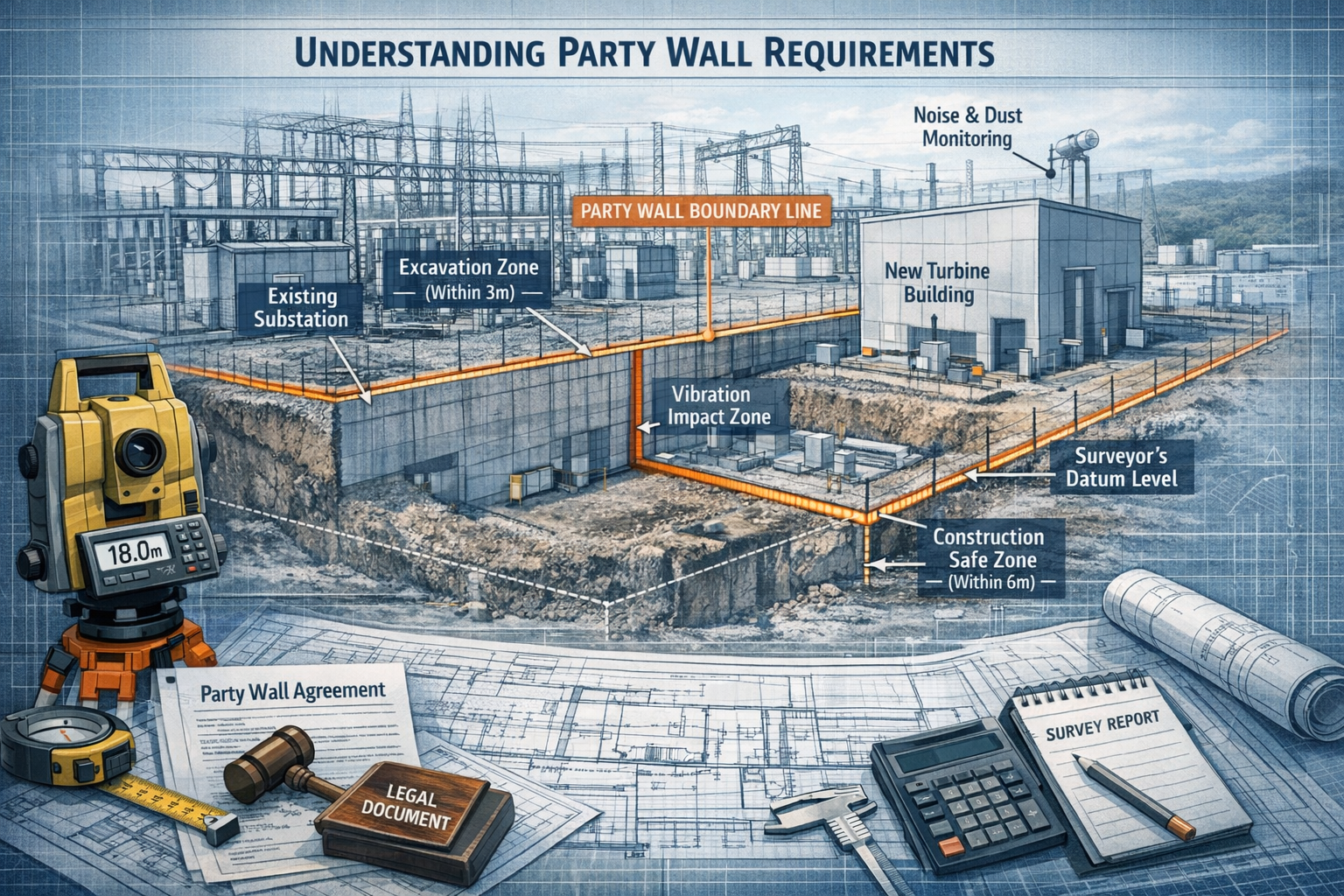
Understanding Party Wall Requirements for Power Facility Construction
The Legal Framework Governing Power Infrastructure
The Party Wall etc Act 1996 (PWA 1996) provides the statutory framework for all party wall matters in England and Wales, regardless of project scale or purpose[2]. This legislation affects owners who undertake work on existing party walls, construct new boundary walls, or excavate close to neighboring properties. For power facility developers, compliance isn't optional—it's a legal prerequisite that can halt construction if improperly managed.
Power facilities typically trigger multiple sections of the Act simultaneously:
- Section 1: New walls built at or near the boundary line (common for perimeter security walls, substations, and equipment enclosures)
- Section 2: Work directly affecting existing party walls (rare but applicable when converting existing industrial buildings)
- Section 6: Excavation within specified distances of neighboring structures (nearly universal for power facilities requiring deep foundations)
Why Power Facilities Require Specialized Party Wall Approaches
Unlike residential developments, power facilities involve:
🔌 Heavy structural loads from transformers, battery arrays, and generation equipment that can affect neighboring properties
⚡ Deep excavations for cable trenches, foundation piles, and underground infrastructure extending well beyond typical residential depths
🏗️ Extended construction periods with phased development that may require multiple notice sequences
🌍 Environmental considerations including vibration from pile driving, electromagnetic fields, and noise that neighboring property owners rightfully scrutinize
These factors make timing party wall notices for 2026 power facility builds: surveyor strategies fundamentally different from standard residential approaches. Surveyors must anticipate technical objections, prepare comprehensive condition schedules, and structure awards that address industrial-scale impacts.
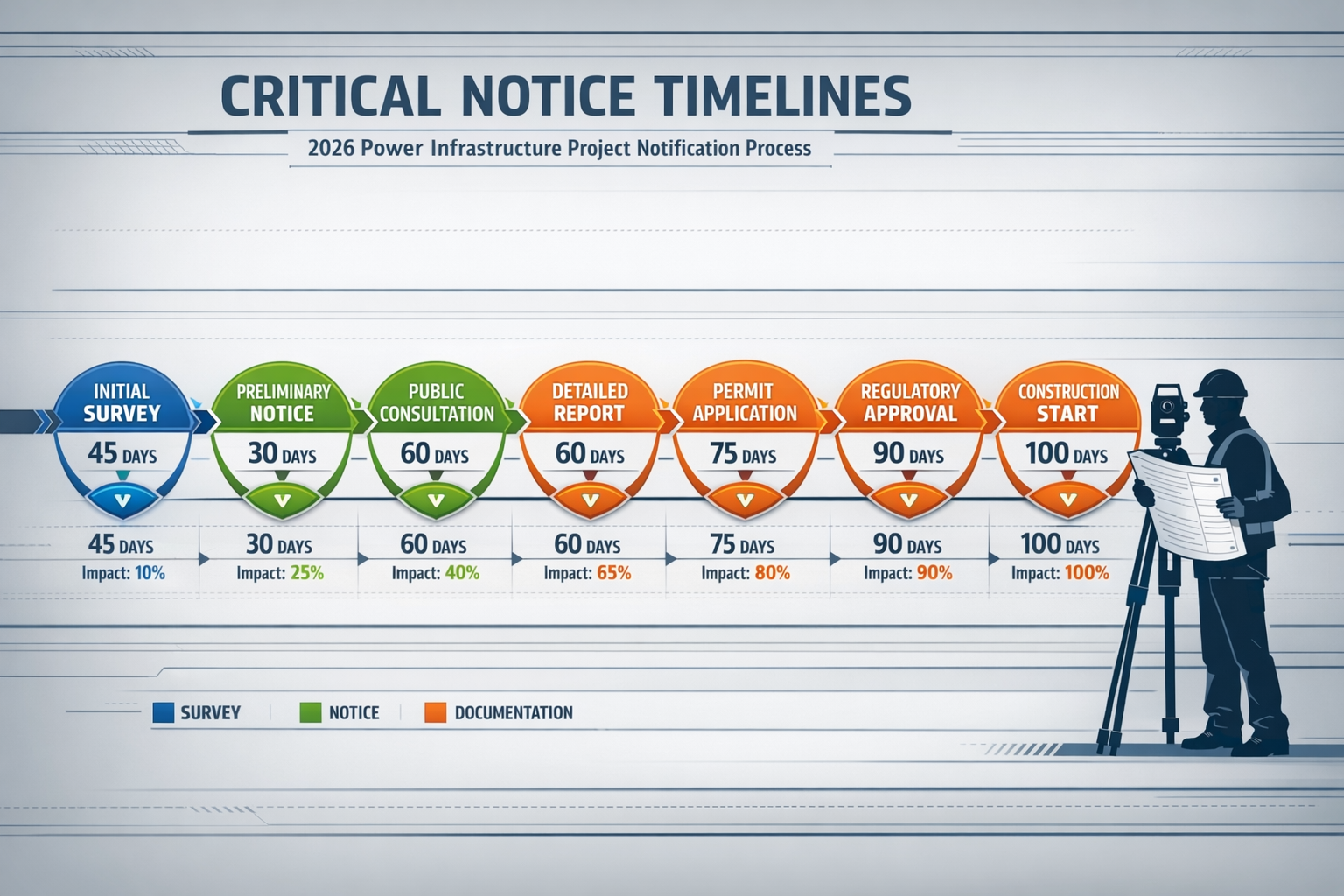
Critical Notice Timelines for 2026 Power Infrastructure Projects
The Three Notice Types and Their Specific Timeframes
Understanding which notice type applies to your power facility project determines your entire timeline. The Party Wall etc Act 1996 establishes distinct procedures for each scenario:
| Notice Type | When Required | Minimum Notice Period | Typical Power Facility Application |
|---|---|---|---|
| Party Structure Notice | Work affecting existing party walls | 2 months | Rare; mainly industrial building conversions |
| Line of Junction Notice | Building new walls at/near boundary | 1 month | Security fencing, substation walls, equipment enclosures |
| Excavation Notice (Section 6) | Excavating within 3-6 meters of neighboring structures | 1 month | Foundation work, cable trenches, underground infrastructure |
For most power facility projects in 2026, the excavation notice represents the primary requirement. When foundation depths exceed neighboring building foundations or excavations occur within three meters of neighboring structures, formal notice becomes mandatory.
Calculating Your Project's Critical Path Timeline
Strategic surveyors working on timing party wall notices for 2026 power facility builds employ this critical path calculation:
Minimum Timeline: Notice Period + Response Period + Award Preparation + Contingency
For a typical utility-scale solar farm with boundary excavations:
- Notice Service: Day 0 (serve 1-month excavation notice)
- Neighbor Response Deadline: Day 14 (14-day statutory response period)
- Surveyor Appointment (if dissent): Days 15-24
- Award Preparation: Days 25-38 (10-14 days for surveyor coordination and award drafting)
- Award Service: Day 38
- Appeal Period: Days 39-52 (14-day appeal window)
- Earliest Construction Start: Day 53
This 53-day minimum timeline assumes no complications. Power facility projects should budget 75-90 days to accommodate:
- Multiple adjoining owners requiring separate notices
- Technical disputes requiring specialist input
- Condition schedule preparation for complex structures
- Coordination with planning permissions and environmental consents
Accelerated Approval Strategies for Urgent Power Projects
The 2026 energy infrastructure boom has created unprecedented pressure for faster approvals. Experienced surveyors employ these acceleration strategies:
Pre-Notice Consultation 🚀
Engaging neighbors informally 2-3 weeks before formal notice service builds goodwill and identifies potential objections early. For a recent battery storage facility in East London, this approach reduced the overall timeline by 22 days.
Agreed Surveyor Appointments 📋
When both parties agree to appoint a single "Agreed Surveyor," the award process compresses significantly. This works particularly well when the adjoining owner is a commercial entity familiar with construction processes.
Parallel Processing ⚡
Rather than waiting for neighbor responses before preparing technical documentation, proactive surveyors complete condition schedules and draft awards simultaneously with notice service. This eliminates 7-10 days from the critical path.
Technical Pre-Approval 🔧
Sharing detailed construction methodologies, vibration assessments, and protective measures with neighbors before formal notice service demonstrates professionalism and addresses concerns preemptively.
These strategies, when properly executed, can reduce total timelines from 75-90 days to 45-60 days—a critical advantage in competitive power infrastructure markets.
Surveyor Strategies for Complex Power Facility Awards
Specialized Technical Requirements for Energy Infrastructure
Party wall awards for power facilities demand technical specifications far beyond residential standards. Surveyors must address:
Foundation Load Calculations 📊
Power equipment generates concentrated loads that neighboring property owners legitimately question. Awards should specify maximum bearing pressures, load distribution methods, and monitoring protocols.
Vibration Monitoring Protocols 📈
Pile driving and heavy machinery operation require baseline vibration surveys and continuous monitoring during construction. Awards should reference British Standards (BS 7385) and establish clear threshold limits.
Electromagnetic Field (EMF) Considerations 🧲
While not strictly party wall matters, neighboring property owners increasingly request EMF assessments for substations and transmission equipment. Forward-thinking surveyors include baseline measurements in condition schedules to prevent future disputes.
Utility Infrastructure Protection 🔌
Power facilities often involve high-voltage connections crossing or approaching property boundaries. Awards must specify protective measures, access rights, and emergency protocols.
Structuring Awards for Phased Power Developments
Many 2026 power facilities involve phased construction—initial infrastructure followed by equipment installation and future expansion. Surveyors should structure party wall awards to accommodate this reality:
Phase-Specific Notices 📅
Rather than attempting to cover all future work in a single notice, issue separate notices for each major construction phase. This provides flexibility while maintaining legal compliance.
Conditional Approvals ✅
Awards can specify conditions for future phases, such as "additional vibration monitoring required if pile depths exceed 12 meters" or "updated condition schedule required before Phase 2 excavation."
Reserved Rights 🔐
Include language preserving rights for future notices while establishing precedent for cooperation and surveyor appointments.
Managing Multiple Adjoining Owners in Industrial Zones
Power facilities in industrial areas often border multiple properties with different ownership structures. Effective strategies include:
Coordinated Notice Service 📬
Serve all notices simultaneously to prevent information asymmetry and neighbor coordination against the project.
Standardized Award Templates 📄
Develop comprehensive award templates addressing common power facility scenarios, then customize for specific properties. This ensures consistency while reducing preparation time.
Stakeholder Communication Matrices 💬
Maintain detailed records of all neighbor communications, responses, and agreements. This documentation proves invaluable if disputes arise or future phases require additional notices.
For a recent data center expansion project involving seven adjoining owners, coordinated surveyor strategies reduced the award process from an estimated 16 weeks to just 9 weeks[3].
Navigating Common Challenges in Power Facility Party Wall Procedures
Addressing Neighbor Concerns About Industrial Development
Residential neighbors adjacent to power facility sites frequently express concerns beyond standard party wall matters. Surveyors must address these diplomatically while maintaining focus on statutory requirements:
Noise and Operational Impacts 🔊
While ongoing operational noise isn't a party wall matter, construction noise is. Awards should specify working hours, noise mitigation measures, and complaint procedures.
Property Value Concerns 💷
Neighbors often fear power facilities will devalue their properties. While surveyors cannot guarantee property values, comprehensive condition schedules and professional construction methodologies provide reassurance.
Safety and Security 🛡️
Power infrastructure raises legitimate safety questions. Awards should reference relevant safety standards, security measures, and emergency contact procedures.
Resolving Disputes Without Derailing Timelines
Despite best efforts, disputes arise. Strategic surveyors employ these dispute resolution techniques:
Early Mediation 🤝
Propose informal mediation before formal dispute procedures escalate. Many 2026 power projects successfully employ professional mediators to resolve technical disagreements within 5-7 days.
Technical Expert Engagement 🔬
When disputes involve specialized matters (vibration limits, foundation design, EMF levels), jointly appointed technical experts can provide objective assessments both parties accept.
Incremental Agreements 📝
Rather than seeking comprehensive agreement on all matters, secure partial agreements on non-contentious issues while isolating specific disputes for focused resolution.
Coordinating Party Wall Procedures with Other Consents
Power facility developers in 2026 juggle multiple approval processes simultaneously:
- Planning permission
- Environmental permits
- Grid connection agreements
- Building regulations approval
- Party wall procedures
Effective surveyors coordinate these timelines by:
✅ Parallel Processing: Initiating party wall procedures while planning applications proceed
✅ Conditional Notices: Serving notices "subject to planning permission" to preserve timelines
✅ Integrated Documentation: Sharing technical reports across multiple approval processes to reduce duplication
✅ Milestone Coordination: Aligning party wall award completion with planning decision dates
This integrated approach ensures party wall compliance doesn't become the critical path bottleneck that delays commercial operation dates.
Sector-Specific Considerations for Different Power Facility Types
Solar Farms and Photovoltaic Installations
Utility-scale solar developments present unique party wall considerations:
Minimal Structural Impact ☀️
Ground-mounted solar arrays typically involve shallow foundations (1-2 meters), reducing excavation notice complexity. However, perimeter security fencing often triggers Line of Junction Notices.
Cable Trenching Requirements 🔌
Underground cable connections to grid infrastructure frequently cross or approach property boundaries, requiring careful excavation notice planning.
Inverter Station Foundations 🏗️
Inverter and transformer stations require deeper foundations that may trigger Section 6 excavation notices depending on neighboring structure proximity.
Recent guidance on renewable energy retrofits and solar installations provides valuable precedent for 2026 projects[1].
Battery Storage Facilities
Battery energy storage systems (BESS) represent the fastest-growing power infrastructure category in 2026:
Heavy Foundation Loads ⚡
Containerized battery systems impose significant point loads requiring engineered foundations that often exceed neighboring building foundation depths.
Fire Safety Considerations 🔥
While not strictly party wall matters, neighboring owners legitimately request information about fire suppression systems and emergency protocols. Progressive surveyors include this information in awards to demonstrate comprehensive risk management.
Thermal Management Infrastructure 🌡️
HVAC systems and cooling infrastructure may require excavations for underground utilities, triggering additional notice requirements.
Wind Turbine Installations
Wind energy projects involve the most complex party wall scenarios:
Deep Foundation Requirements 💨
Turbine foundations extend 15-25 meters deep, inevitably triggering Section 6 excavation notices for any structures within the prescribed distances.
Vibration from Construction 🏗️
Pile driving for turbine foundations generates significant vibration requiring comprehensive monitoring protocols in party wall awards.
Access Road Construction 🚧
Heavy-duty access roads for turbine component delivery often require boundary works triggering Line of Junction Notices.
Substation and Transmission Infrastructure
Grid connection infrastructure presents distinct challenges:
Permanent Boundary Structures ⚡
Substations typically require secure perimeter walls directly on or near boundaries, making Line of Junction Notices standard requirements.
Underground Cable Vaults 🔌
High-voltage cable installations often require excavations exceeding 3 meters depth within close proximity to neighboring properties.
Electromagnetic Considerations 🧲
While not party wall matters, surveyors increasingly include baseline EMF measurements in condition schedules to prevent future disputes.
Best Practices for Building Owner Representatives
Selecting the Right Surveyor for Power Infrastructure Projects
Not all party wall surveyors possess the specialized knowledge required for power facility projects. Building owners should seek surveyors with:
🎓 Engineering Background: Understanding of structural loads, foundation design, and vibration analysis
🏗️ Industrial Project Experience: Track record with utility-scale developments, not just residential work
⚡ Energy Sector Knowledge: Familiarity with power infrastructure terminology, standards, and regulatory environment
📋 Award Drafting Excellence: Demonstrated ability to produce comprehensive, technically sound awards that withstand scrutiny
Experienced building owners' surveyors specializing in commercial and industrial projects deliver significantly better outcomes than generalist residential practitioners.
Proactive Documentation Strategies
Successful power facility developers implement these documentation best practices:
Pre-Construction Baseline Surveys 📸
Commission comprehensive condition schedules for all neighboring properties before serving notices. This demonstrates professionalism and provides irrefutable evidence of pre-existing conditions.
Technical Specification Packages 📊
Prepare detailed construction methodology documents, vibration assessments, and protective measure specifications before notice service. This transparency builds neighbor confidence.
Communication Logs 📝
Maintain detailed records of all neighbor interactions, including informal discussions, formal correspondence, and meeting notes. This documentation proves invaluable if disputes arise.
Photographic Evidence 📷
Extensive photographic documentation of existing conditions, boundary features, and neighboring structures protects against unfounded damage claims.
Cost Management for Party Wall Procedures
Party wall costs for power facilities can be substantial. Strategic approaches include:
💷 Early Budget Allocation: Reserve 0.5-1.5% of total project costs for party wall procedures, including surveyor fees, awards, and potential dispute resolution
📋 Agreed Surveyor Strategies: Single agreed surveyors typically cost 40-60% less than separate surveyor appointments for each party
⏱️ Timeline Efficiency: Delays cost far more than comprehensive upfront surveyor engagement. Investing in experienced surveyors saves money overall
For detailed guidance on managing expenses, consult resources on keeping party wall costs down.
Regional Considerations Across London and the UK
Urban vs. Rural Power Facility Development
Party wall procedures vary significantly based on location:
Urban Industrial Zones 🏙️
Projects in Central London, North London, or other dense urban areas typically involve:
- Multiple adjoining owners requiring separate notices
- Complex existing structures with sensitive foundations
- Higher likelihood of disputes requiring formal procedures
- Greater need for vibration monitoring and protective measures
Rural and Greenfield Sites 🌾
Rural power facilities often enjoy:
- Fewer adjoining owners to coordinate
- Greater separation distances reducing excavation notice requirements
- Lower baseline expectations for construction impacts
- Simpler award structures
However, rural projects shouldn't assume party wall procedures are unnecessary. Even agricultural properties require proper notices when excavations approach boundaries.
Sector-Specific Hotspots in 2026
Certain regions experience concentrated power infrastructure development:
⚡ Thames Estuary: Battery storage and offshore wind grid connections
☀️ East Anglia: Utility-scale solar farms
💨 Scottish Borders: Onshore wind developments
🔌 West Midlands: Data center power infrastructure
Surveyors operating in these hotspots develop specialized expertise and efficient processes that benefit developers working in those regions.
Future-Proofing Party Wall Strategies for Evolving Energy Infrastructure
Anticipating 2027+ Regulatory Changes
The energy sector's rapid evolution suggests potential party wall procedure adaptations:
Streamlined Approvals for Renewable Projects 🌱
Government net-zero commitments may lead to expedited procedures for qualifying renewable energy infrastructure, similar to permitted development rights expansions.
Enhanced Neighbor Notification Requirements 📢
Conversely, public concern about industrial development near residential areas could trigger additional consultation requirements beyond current statutory minimums.
Digital Notice Service 💻
Electronic service of party wall notices may gain statutory recognition, potentially accelerating timelines and improving documentation.
Standardized Technical Assessments 📋
Industry-standard templates for vibration monitoring, EMF assessment, and other power facility-specific matters may emerge, streamlining award preparation.
Building Institutional Knowledge
Organizations developing multiple power facilities should:
📚 Document Lessons Learned: Create internal knowledge bases capturing successful strategies, common pitfalls, and regional variations
🤝 Establish Preferred Surveyor Panels: Develop relationships with specialized surveyors who understand your organization's standards and priorities
📊 Track Performance Metrics: Monitor timeline compliance, dispute rates, and cost efficiency to continuously improve processes
🔄 Share Best Practices: Participate in industry forums to stay current on emerging strategies and regulatory developments
Conclusion
Timing party wall notices for 2026 power facility builds: surveyor strategies represents a critical competency for energy infrastructure developers navigating the UK's ambitious net-zero transition. The intersection of statutory compliance, technical complexity, and commercial urgency demands specialized expertise that goes far beyond traditional residential party wall practice.
Key success factors include:
✅ Early engagement: Initiating party wall procedures 75-90 days before planned construction starts, with accelerated pathways achieving 45-60 day timelines through strategic surveyor engagement
✅ Technical excellence: Employing surveyors with engineering backgrounds and energy sector experience who can draft comprehensive awards addressing vibration, EMF, and industrial-scale impacts
✅ Proactive communication: Building neighbor relationships through pre-notice consultation, transparent technical documentation, and professional condition schedules
✅ Integrated planning: Coordinating party wall procedures with planning permissions, environmental consents, and grid connection agreements to prevent timeline bottlenecks
✅ Sector-specific approaches: Recognizing that solar farms, battery storage facilities, wind turbines, and substations each present distinct party wall challenges requiring tailored strategies
The 2026 power infrastructure boom creates unprecedented opportunities for developers who master these procedures. Conversely, organizations treating party wall compliance as an afterthought face costly delays, neighbor disputes, and potential legal challenges that can derail entire projects.
Actionable Next Steps
For building owners planning 2026 power facility projects:
-
Engage specialized surveyors with energy infrastructure experience at the earliest project stages, ideally during site selection and feasibility assessment
-
Conduct preliminary boundary analysis identifying potential party wall triggers and neighboring property sensitivities before finalizing site layouts
-
Develop comprehensive timeline models integrating party wall procedures with all other approval processes to identify the true critical path
-
Invest in pre-construction baseline documentation including condition schedules and technical assessments that demonstrate professionalism and protect against future claims
-
Establish neighbor communication protocols that balance transparency with commercial confidentiality, building goodwill before formal notices become necessary
-
Review and update internal procedures based on lessons learned from completed projects, creating institutional knowledge that improves with each development
For adjoining owners receiving notices for neighboring power facilities:
-
Seek professional advice promptly from adjoining owners' surveyors experienced with industrial developments
-
Respond within statutory timeframes to preserve your rights and ensure proper representation throughout the process
-
Request comprehensive technical information about construction methodologies, protective measures, and monitoring protocols
-
Insist on thorough condition schedules documenting your property's existing state before construction begins
The energy transition reshaping the UK's infrastructure landscape makes party wall expertise more valuable than ever. Organizations that develop this competency—whether through internal knowledge building or strategic surveyor partnerships—gain significant competitive advantages in the race to deliver 2026's critical power infrastructure.
References
[1] Party Wall Act Essentials For 2026 Uk Renewable Energy Retrofits Solar Panels And Heat Pumps On Shared Walls – https://nottinghillsurveyors.com/blog/party-wall-act-essentials-for-2026-uk-renewable-energy-retrofits-solar-panels-and-heat-pumps-on-shared-walls
[2] Party Walls – https://www.lexisnexis.co.uk/legal/construction-law/regulations-controls/party-walls
[3] Party Wall Surveys For Data Centre Expansions Navigating Agreements In The 2026 Investment Surge – https://nottinghillsurveyors.com/blog/party-wall-surveys-for-data-centre-expansions-navigating-agreements-in-the-2026-investment-surge