


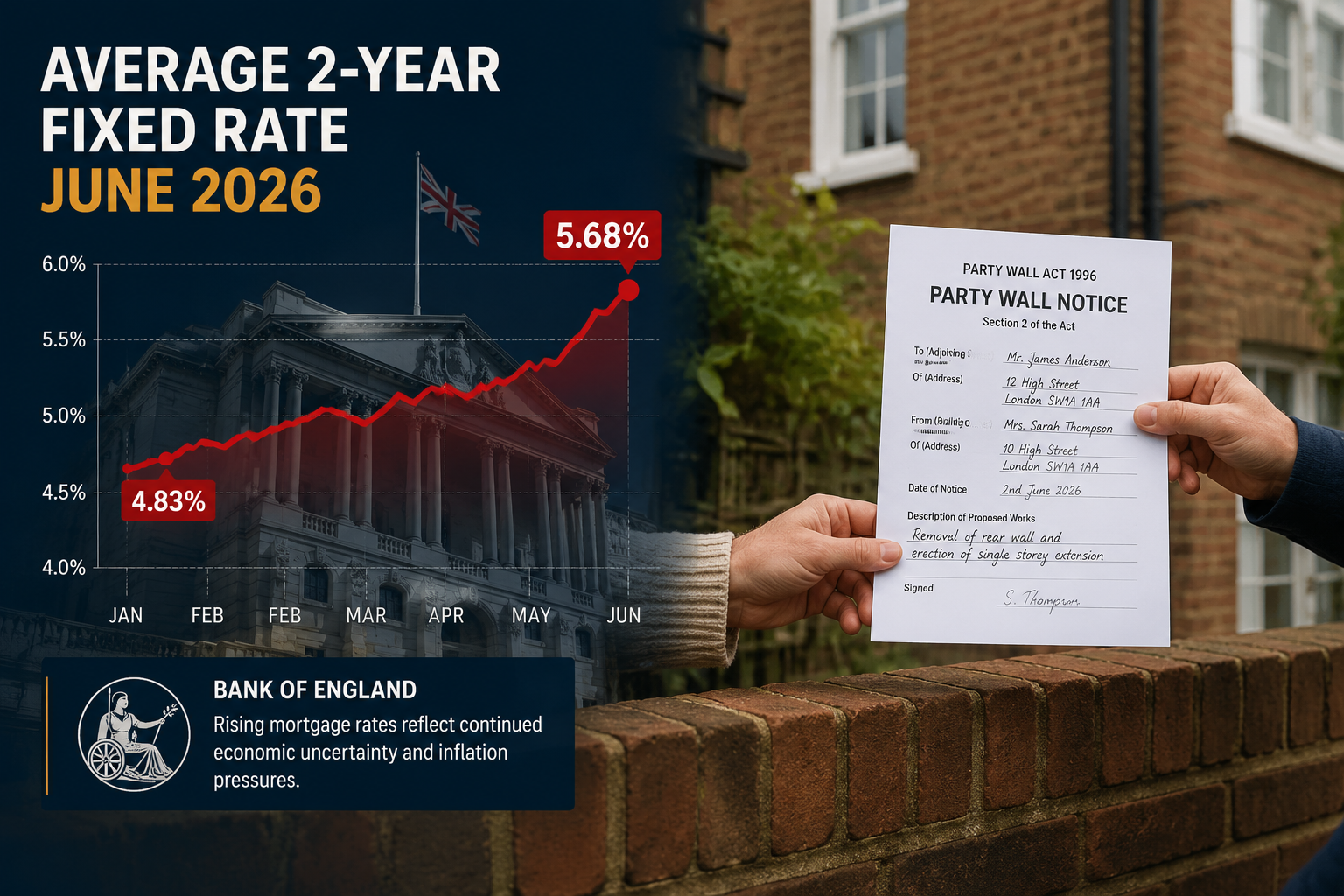
The average two-year fixed mortgage rate hit 5.68% on 1 June 2026 — up from 4.83% in early March — driven by swap rate surges tied to escalating Middle East conflict. For London homeowners mid-way through planning a rear extension, loft conversion, or basement dig, that 85-basis-point jump is not an abstract headline. It is a direct threat to project viability, refinancing timelines, and the carefully constructed budgets that underpin every party wall notice and contractor mobilisation plan. Understanding how UK mortgage rates 5.68% June 2026 London party wall extension projects budgeting intersects with the Party Wall etc. Act 1996 is now essential reading for any building owner in the capital.
Key Takeaways
- The average 2-year fixed mortgage rate reached 5.68% as of 1 June 2026, up sharply from 4.83% in March, squeezing household budgets.
- The Bank of England base rate remains at 3.75%, with the next decision due 18 June 2026; markets expect a hold but rate pressure is rising.
- CPI inflation at 3.3% is eroding contractor quotes and materials costs simultaneously.
- Party Wall notices carry mandatory one-month or two-month waiting periods; delays can push borrowers off favourable fixed-rate deals.
- Serving notices early, using an agreed surveyor, and building a financial contingency are the three most effective cost-control strategies available right now.
Table of Contents
- The Rate Shock in Context
- How Higher Mortgage Costs Are Reshaping Extension Decisions
- Party Wall Timelines and the Refinancing Trap
- UK Mortgage Rates 5.68% June 2026: Budgeting for Party Wall Fees and Contractor Costs
- Practical Steps: Serving Notices Early and Choosing the Right Surveyor
- UK Mortgage Rates 5.68% June 2026 London Party Wall Extension Projects Budgeting — Risk Management
- FAQ
- Conclusion
The Rate Shock in Context
The Bank of England held its base rate at 3.75% at its May 2026 meeting, and markets broadly expect another hold at the 18 June 2026 decision. Yet the base rate is only part of the story. Swap rates — the instruments that lenders use to price fixed-rate mortgages — have moved sharply higher in response to geopolitical risk. According to Uswitch mortgage data, the average two-year fix crossed 5.68% at the start of June, a level not seen since late 2023.
With CPI running at 3.3%, real household purchasing power is under sustained pressure. For London homeowners, where property values are high and extension projects routinely cost £80,000 to £250,000 or more, the combined effect of higher borrowing costs and rising material prices is significant.
The HomeOwners Alliance has noted that many homeowners are reconsidering the scale of planned works rather than cancelling entirely — a pragmatic response that has direct implications for how Party Wall matters are scoped and managed.
How Higher Mortgage Costs Are Reshaping Extension Decisions
Higher rates are creating three distinct behavioural shifts among London building owners:
1. Acceleration of projects already in planning
Homeowners on expiring fixed deals are rushing to complete works before remortgaging onto a higher rate. Every week of delay costs money twice: once in lost construction time and once in the higher monthly payments that begin when the fixed deal expires.
2. Descoping of works
Some owners are reducing a planned wraparound extension to a simple rear extension, or converting a full basement dig to a more modest lower-ground-floor refurbishment. This affects the types of party wall works that need to be notified and can sometimes reduce the number of adjoining owners who must be served.
3. Postponement — and the associated risks
A minority are pausing entirely, which carries its own risk: contractor availability windows close, planning permissions expire, and neighbours who had informally agreed to works may change their position.
"The worst financial outcome is a project that starts late, runs over budget, and completes just as a borrower rolls onto a revert-to-variable rate. Party Wall delays are a controllable variable — and they should be controlled."
Party Wall Timelines and the Refinancing Trap
The Party Wall etc. Act 1996 imposes mandatory notice periods that cannot be waived:
| Notice Type | Trigger | Minimum Notice Period |
|---|---|---|
| Party Structure Notice | Works to a shared wall (e.g., rear extension, loft) | Two months |
| Line of Junction Notice | Building on or at the boundary | One month |
| Three-Metre / Six-Metre Notice | Excavations near adjoining foundations | One month |
These are statutory minimums. If a neighbour dissents and appoints a separate surveyor, the Party Wall Award process typically adds a further four to eight weeks before works can legally commence.
The refinancing trap works like this: A homeowner's two-year fix expires in October 2026. They plan to start a rear extension in August to complete before winter. If they serve a Party Structure Notice in late June, the two-month period expires in late August — leaving almost no buffer for a dissent scenario. A dispute pushes the start date to October, construction runs to March 2027, and the borrower has been on a standard variable rate for five months. At current SVR levels of approximately 7.5–8%, that is a material cost.
The solution is straightforward: serve notices as early as legally and practically possible.
UK Mortgage Rates 5.68% June 2026: Budgeting for Party Wall Fees and Contractor Costs
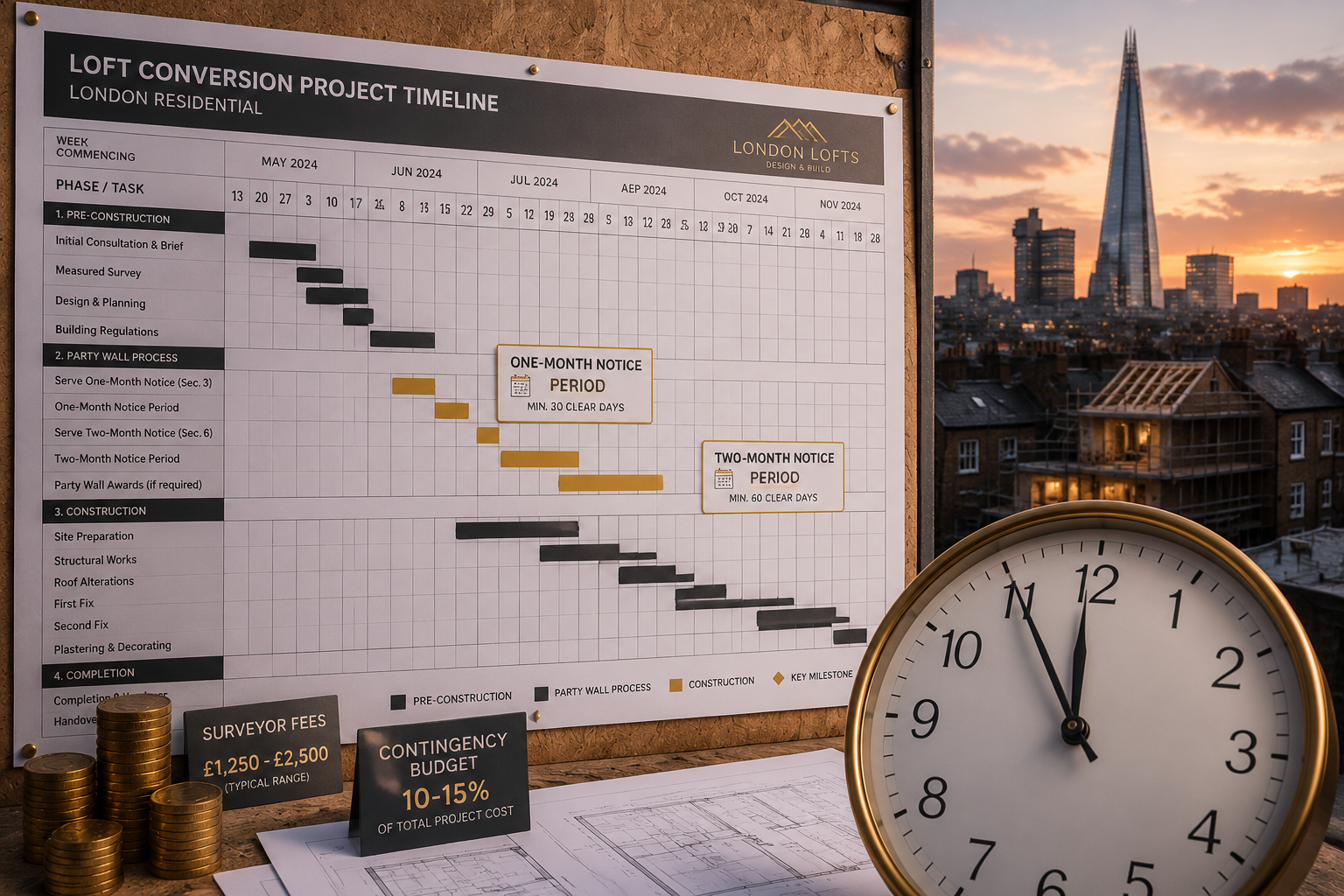
Accurate budgeting for party wall works in the current rate environment requires accounting for several cost layers. For detailed guidance on what to expect, the costs of party wall process page provides a useful framework.
Typical Party Wall surveyor fees in London (2026):
- Agreed surveyor (both parties use one surveyor): £900 – £1,800 per Award
- Building owner's surveyor: £800 – £1,500
- Adjoining owner's surveyor (paid by building owner in dispute): £900 – £1,600
- Schedule of condition survey: £300 – £600 per property
Contractor cost pressures: CPI at 3.3% means that quotes obtained in January 2026 may already be 2–3% below current market rates. Builders are also pricing in their own financing costs. Homeowners should request updated quotes and build a 10–15% contingency into the overall project budget — not the traditional 5–10% that was standard before 2022.
Financing the works: Many homeowners are using further advance products or secured loans rather than remortgaging the entire balance, specifically to avoid triggering a full rate reset. This is a sensible approach where equity permits, but it requires lender approval timelines to be factored into the overall project schedule alongside the party wall notice periods.
For tips on managing costs, see the guide on how to keep party wall costs down.
Practical Steps: Serving Notices Early and Choosing the Right Surveyor
The single most effective action a London building owner can take right now is to serve party wall notices at the earliest possible moment — ideally before finalising contractor appointments, not after.
Step-by-step approach:
- Confirm which notices are required. A rear extension will typically require a Party Structure Notice; excavations within three or six metres of an adjoining foundation require a separate notice. Read the guide on what is a Party Structure Notice and how to serve it.
- Serve notices correctly. Errors in service restart the clock. Use a professional surveyor or at minimum a reliable party wall notice template to avoid procedural mistakes.
- Propose an agreed surveyor. If neighbours are on good terms, an agreed surveyor — one professional acting for both parties — is the fastest and cheapest route to an Award. It removes the risk of a second surveyor's fees landing on the building owner's bill.
- Instruct a local specialist. Surveyors with strong local knowledge of specific London boroughs can often anticipate neighbour concerns and draft Awards that minimise dispute risk. Coverage is available across East London, West London, South London, North London, and Central London.
- Commission a schedule of condition. A schedule of condition protects both parties and reduces the likelihood of post-works disputes that can delay final sign-off.
UK Mortgage Rates 5.68% June 2026 London Party Wall Extension Projects Budgeting — Risk Management
The intersection of UK mortgage rates 5.68% June 2026 London party wall extension projects budgeting creates a specific risk profile that homeowners must plan around explicitly.
Key risks and mitigations:
| Risk | Likelihood | Mitigation |
|---|---|---|
| Neighbour dissent adding 6–8 weeks | Moderate | Early notice service; agreed-surveyor proposal |
| Contractor price escalation | High (CPI 3.3%) | Lock in quotes with fixed-price contracts; 15% contingency |
| Fixed-rate deal expiry during works | High for 2024 fixers | Align notice service with mortgage expiry calendar |
| Award challenge or injunction | Low | Use experienced, accredited surveyor |
| Further rate rises post-June BoE decision | Moderate | Consider rate-lock products if remortgaging |
The BoE's 18 June 2026 decision is the next significant market event. Even a hold — the expected outcome — may not ease swap rates if the accompanying Monetary Policy Committee commentary signals prolonged elevated rates. Homeowners should treat the current 5.68% average not as a ceiling but as a planning baseline.
FAQ
Q: Does the Party Wall etc. Act 1996 apply to all London extension projects?
A: It applies whenever works affect a shared wall, are built on or at the boundary, or involve excavations within three or six metres of a neighbour's foundations. Most rear extensions, loft conversions, and basement works in London will trigger at least one notice requirement.
Q: Can works start before the notice period expires?
A: No. The statutory notice periods are mandatory. Starting works early exposes the building owner to injunction risk and potential liability for neighbour costs.
Q: How long does a Party Wall Award typically take to produce?
A: Once the notice period expires and surveyors are appointed, an Award is usually produced within four to eight weeks, depending on complexity and whether an agreed surveyor is used.
Q: Who pays the adjoining owner's surveyor fees?
A: In most cases, the building owner pays all reasonable surveyor fees, including those of the adjoining owner's surveyor. This makes the agreed-surveyor route significantly cheaper when relations with neighbours are positive.
Q: How does the current mortgage rate environment affect party wall fee negotiations?
A: It does not directly affect statutory fees, but it does increase the financial cost of delays. Choosing an agreed surveyor and serving notices early are the most effective ways to control the total cost of the party wall process in a high-rate environment.
Q: Should homeowners delay projects until rates fall?
A: The HomeOwners Alliance advises against open-ended delays. Construction costs are also rising with inflation, and contractor availability is finite. A well-managed project with proper party wall procedures in place is generally preferable to an indefinite wait for rate relief that may not materialise quickly.
Conclusion
With the average two-year fixed mortgage at 5.68% as of June 2026 and the Bank of England base rate held at 3.75% pending the 18 June decision, London homeowners planning extensions face a tighter financial environment than at any point in the past two years. The good news is that the party wall process — often seen as an administrative burden — is one of the few project variables that is genuinely within a building owner's control.
Actionable next steps:
- Identify which party wall notices are required for your specific project immediately.
- Serve notices at the earliest legally permissible date, well ahead of contractor mobilisation.
- Propose an agreed surveyor to your neighbour to reduce cost and timeline risk.
- Build a 10–15% financial contingency into your project budget to absorb rate and materials volatility.
- Map your mortgage expiry date against the realistic project completion date and adjust the schedule accordingly.
- Consult a specialist party wall surveyor in your London area before making any final decisions on project scope or timing.
The rate environment will evolve. The statutory notice periods will not. Getting the party wall process right — and getting it started early — is the most cost-effective decision a London homeowner can make in June 2026.