


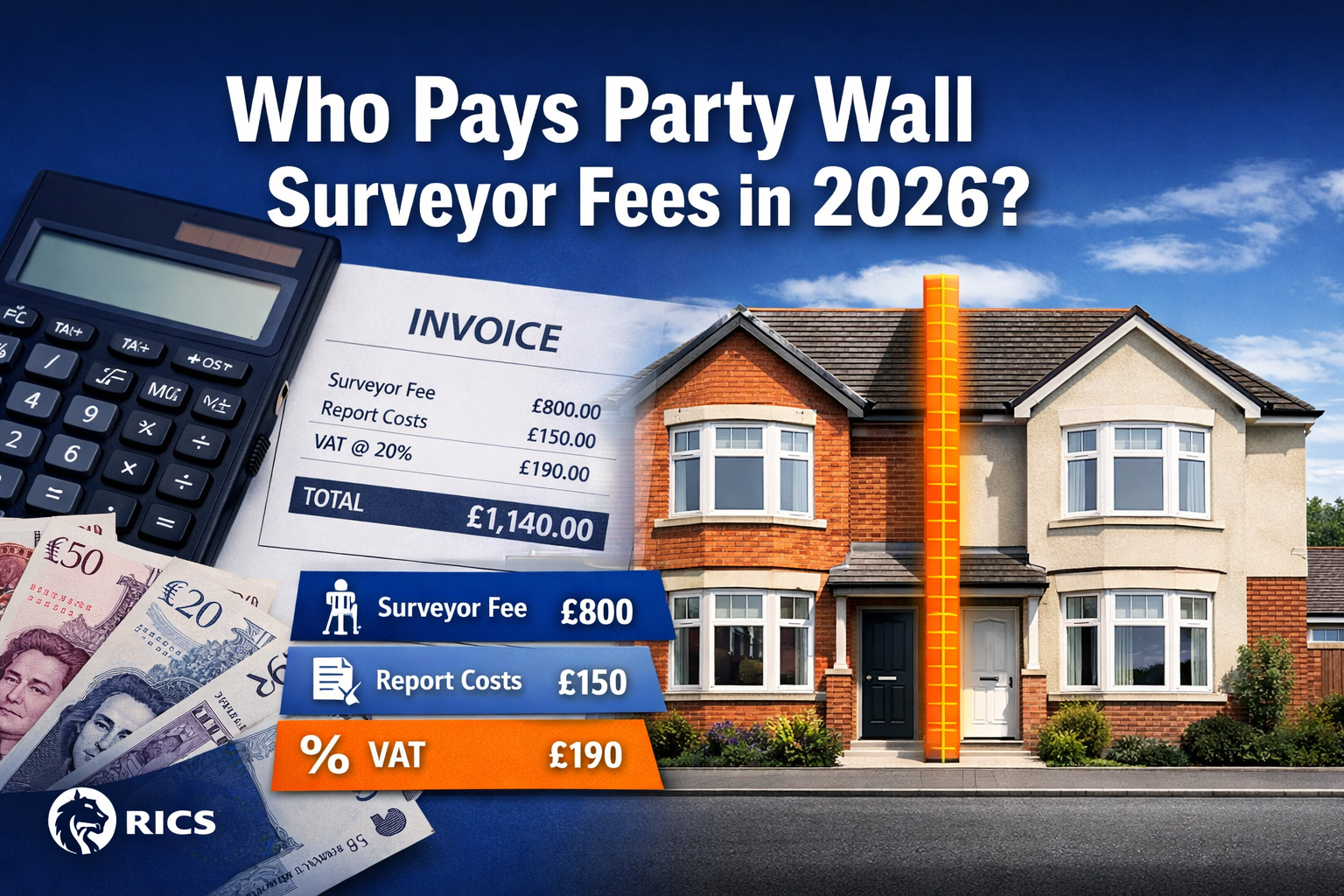
Party wall surveyor fees are climbing sharply in 2026, with typical costs for straightforward residential projects now ranging between £700-£1,500 per surveyor—a 12-18% increase from 2024 levels driven by inflation, operational expenses, and increasingly complex building regulations. Understanding who pays party wall surveyor fees in 2026, cost breakdowns, recovery tactics, and RICS guidelines has become essential for building owners facing these rising expenses. The financial responsibility typically falls squarely on the building owner initiating the works, including payment for both their own surveyor and the adjoining owner's appointed surveyor—a reality that catches many property developers off guard.
This comprehensive guide examines the complete financial landscape of party wall surveyor fees in 2026, breaking down typical cost structures, identifying the factors that drive fees higher, and revealing proven strategies to control and potentially recover these expenses through properly structured awards.
Key Takeaways
- Building owners carrying out works pay all surveyor fees, including those of the adjoining owner's surveyor, as established under the Party Wall etc. Act 1996
- Fees are trending upward in 2026 due to inflation, increased operational costs, and growing project complexity, with typical residential projects costing £700-£1,500 per surveyor
- Four main fee structures exist: fixed fees for specific services, award fees for comprehensive work, hourly rates for bespoke projects, and variable fees based on complexity
- Strategic planning 8-12 weeks before work commencement significantly reduces costs by avoiding rushed processes and minimizing disputes
- Using an agreed surveyor for straightforward projects can reduce overall fees compared to appointing separate surveyors for each party
Understanding the Legal Framework: Who Pays Party Wall Surveyor Fees in 2026?
The Party Wall etc. Act 1996 establishes clear principles regarding financial responsibility for surveyor fees, though many building owners remain unaware of their obligations until deep into the process. Under Section 10 of the Act, the building owner—the party carrying out or proposing to carry out works—bears responsibility for all reasonable costs incurred in connection with party wall matters.[1]
This financial obligation extends beyond simply paying for your own building owner's surveyor. When an adjoining owner exercises their right to appoint their own surveyor, the building owner must also cover those fees. This dual payment requirement often surprises property developers who budget only for their own professional costs.
The Scope of Recoverable Fees
Recoverable fees under the Act include:
- Initial consultation and advice provided to adjoining owners
- Review and analysis of party wall notices and proposed works
- Site inspections and preparation of schedules of condition
- Negotiation and drafting of party wall awards
- Follow-up inspections during and after construction
- Dispute resolution and third surveyor appointments if necessary
The Act requires that fees be "reasonable," though it provides no statutory definition or fee schedule. This ambiguity creates tension between building owners seeking cost control and surveyors charging market rates for professional services. RICS (Royal Institution of Chartered Surveyors) guidance emphasizes that fees should reflect the time, skill, and responsibility required for each specific case.
Cost Breakdowns: Typical Party Wall Surveyor Fees in 2026
Understanding the fee structures available helps building owners budget accurately and negotiate effectively. Party wall surveyor fees in 2026 typically follow four distinct pricing models, each suited to different project types and complexity levels.[1]

Fixed Fee Structures
Many surveyors offer fixed fees for specific services, providing cost certainty for straightforward projects. Typical fixed fee ranges in 2026 include:
| Service Type | Typical Fee Range (2026) |
|---|---|
| Notice preparation and service | £150 – £350 |
| Basic party wall award (single neighbor) | £700 – £1,200 |
| Schedule of condition | £300 – £600 |
| Simple loft conversion award | £800 – £1,400 |
| Basement excavation award | £1,500 – £3,000 |
Fixed fees work best for projects with clearly defined scope, minimal complexity, and cooperative neighbors. They eliminate billing surprises and facilitate easier budget planning.
Award Fee Arrangements
Award fees represent comprehensive charges covering all party wall services from initial notice through to final award issuance. These fees typically range from £700 to £2,500 per surveyor depending on project complexity, number of adjoining owners, and anticipated time requirements.[1]
Award fees generally include:
- ✅ Initial consultation and advice
- ✅ Notice review and response
- ✅ Site inspections and condition surveys
- ✅ Award drafting and negotiation
- ✅ Standard correspondence and administration
Additional charges may apply for extraordinary circumstances such as protracted disputes, multiple site visits beyond the standard two inspections, or involvement of third surveyors.
Hourly Rate Billing
For complex or unpredictable projects, surveyors may charge hourly rates ranging from £150 to £300 per hour in 2026, depending on experience level and location. London-based surveyors typically command the higher end of this range, while regional practitioners charge less.
Hourly billing provides flexibility but creates budget uncertainty. Building owners should request detailed time records and regular cost updates when working under hourly arrangements. For guidance on keeping party wall costs down, consider establishing maximum fee caps even within hourly arrangements.
Variable Fees Based on Complexity
Some surveyors structure fees around project-specific factors including:
- Number of adjoining owners affected (£500-£800 additional per extra neighbor)
- Type of work proposed (excavation work commands premium fees)
- Property value and risk exposure
- Geographic location and travel requirements
- Anticipated dispute likelihood
This pricing model attempts to match fees directly to work required, though it can make initial budgeting challenging.
Key Factors Driving Party Wall Surveyor Fees Higher in 2026
Several interconnected factors influence the final cost of party wall services, with some elements within building owners' control and others representing market realities.[1]
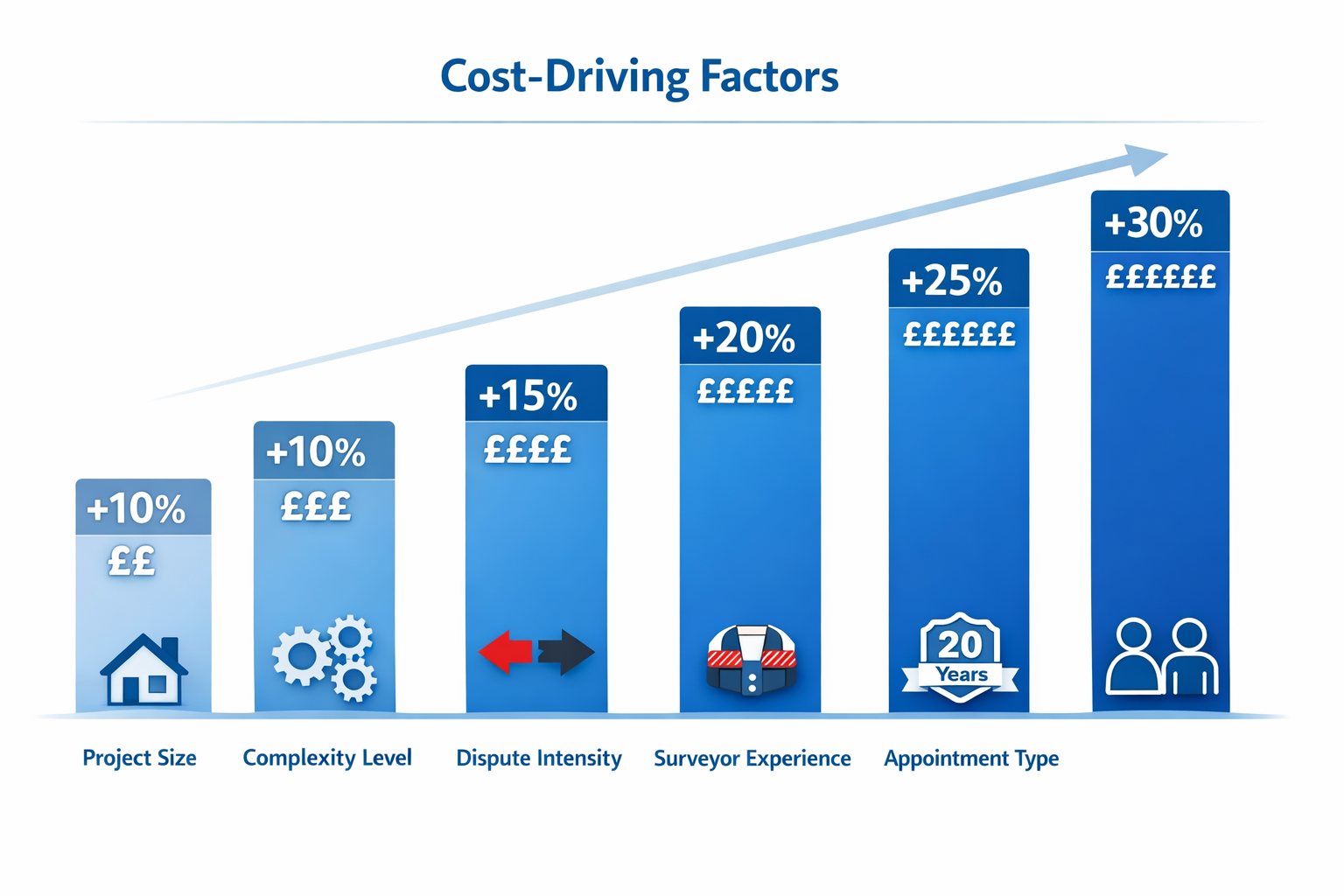
Project Size and Scope 🏗️
Larger projects naturally generate higher fees due to increased documentation requirements, more extensive condition surveys, and greater potential for complications. A single-story rear extension typically incurs lower fees than a basement excavation affecting multiple neighbors.
Complexity of Proposed Works
Technical complexity significantly impacts surveyor time requirements. Straightforward projects like simple loft conversions with minimal structural alterations require less surveyor involvement than complex basement excavations with underpinning requirements affecting multiple party walls.
Projects involving boundary wall considerations or unusual structural configurations demand additional analysis and documentation, increasing billable hours.
Dispute Intensity and Relationship Quality
Disputes represent the single largest cost multiplier in party wall matters.[2] When neighbors maintain adversarial positions, surveyors must invest substantially more time in:
- Extended negotiations and correspondence
- Multiple site meetings and inspections
- Detailed technical justifications
- Potential third surveyor appointments
- Legal review and dispute resolution procedures
Conversely, cooperative relationships between neighbors can reduce surveyor time by 40-60%, translating directly into lower fees.
Surveyor Experience and Reputation
Senior surveyors with extensive experience and RICS accreditation command premium fees reflecting their expertise, professional indemnity insurance costs, and reputation. While hiring experienced professionals increases upfront costs, their efficiency and authority often reduce overall project expenses by avoiding errors, minimizing disputes, and expediting the award process.
Single vs. Dual Surveyor Appointments
Appointing an agreed surveyor—a single professional acting for both parties—can substantially reduce total fees compared to separate surveyors for building and adjoining owners.[2] This approach works best for:
- Simple, straightforward projects
- Cooperative neighbor relationships
- Low-risk construction work
- Projects with clear, uncontested scope
However, adjoining owners retain the absolute right to appoint their own surveyor, and building owners cannot force the agreed surveyor approach regardless of potential cost savings.
Geographic Location
Location significantly affects fees, with surveyors in Central London typically charging 20-40% more than those in North London, South London, East London, or West London areas due to higher operational costs and demand.
Recovery Tactics: How Building Owners Can Control and Reclaim Party Wall Costs
While building owners bear initial financial responsibility for surveyor fees, strategic approaches can minimize total costs and, in some circumstances, enable partial recovery through properly structured awards and agreements.
Strategic Planning and Early Engagement ⏰
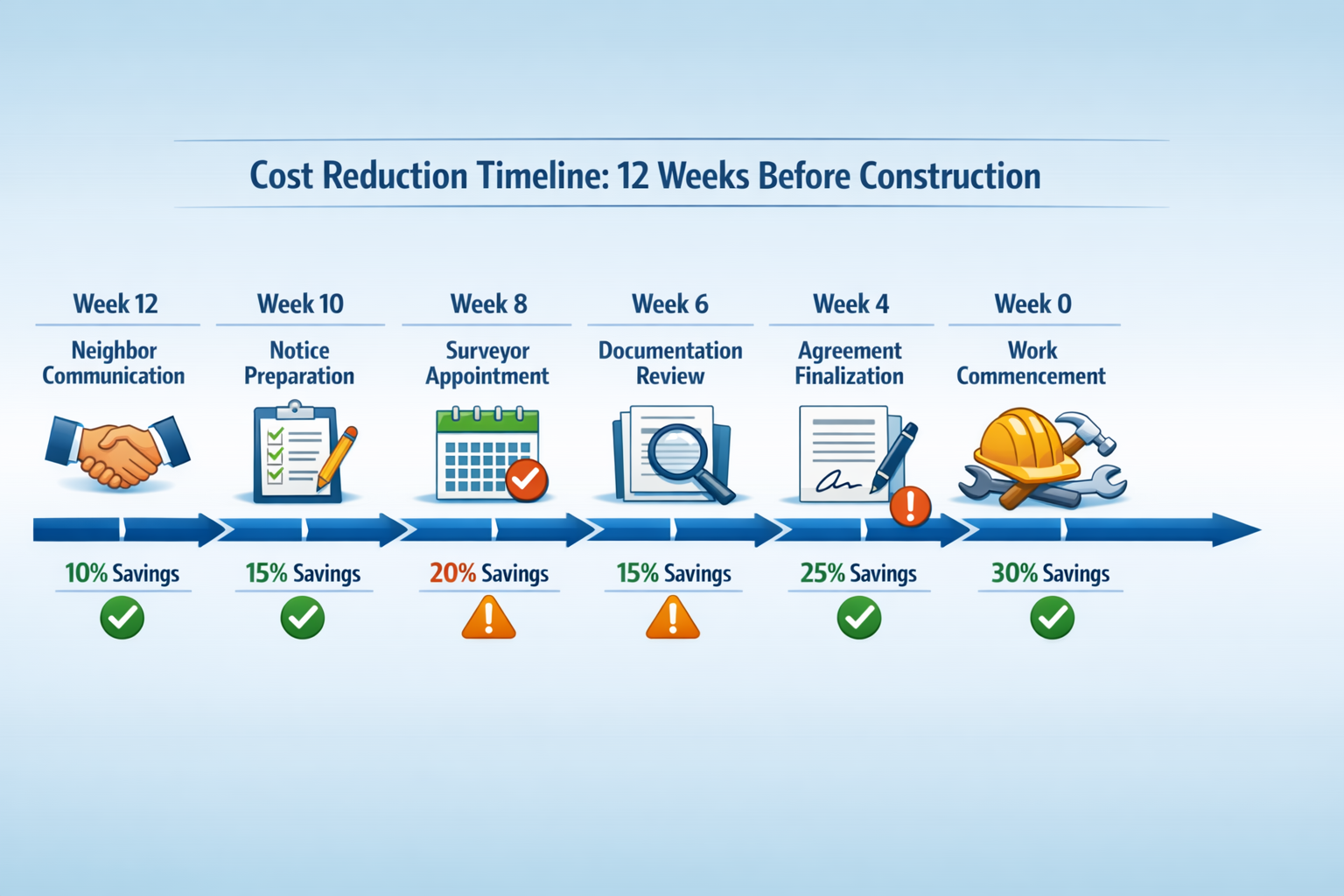
Starting the party wall process 8-12 weeks before intended work commencement represents the single most effective cost control measure.[2] Early planning provides:
- Time for proper notice preparation, reducing errors that require re-service and timeline restarts
- Flexibility for surveyors to schedule inspections efficiently without rush fees
- Opportunity for neighbor communication before formal notices create defensive positions
- Buffer for unexpected complications without delaying construction schedules
Rushed party wall processes invariably cost more due to expedited fees, increased mistakes, and heightened neighbor anxiety that triggers disputes.
Pre-Notice Neighbor Communication
Speaking with neighbors before serving formal party wall notices significantly reduces the likelihood of immediate dissent and unnecessary surveyor appointments.[2] This informal communication should:
- Explain the proposed works in plain language
- Show drawings or plans for clarity
- Address potential concerns proactively
- Demonstrate consideration for neighbor convenience
- Establish reasonable expectations for timing and disruption
While this approach cannot guarantee consent, it substantially reduces defensive reactions that escalate costs. Understanding what party wall notices are and how to respond helps frame these conversations effectively.
Ensuring Notice Validity and Accuracy
Invalid notices represent a costly yet entirely preventable problem.[2] Common errors that require re-service and restart timelines include:
- ❌ Serving notices on tenants rather than property owners
- ❌ Incorrect property descriptions or addresses
- ❌ Insufficient detail about proposed works
- ❌ Wrong notice type for the work planned
- ❌ Missing required information under the Act
Each notice re-service adds surveyor time and delays projects. Investing in proper party wall notice preparation from the outset prevents these expensive mistakes.
Providing Complete, Clear Documentation
Documentation quality directly impacts surveyor efficiency and billable time.[2] Building owners should provide:
- Clear, scaled drawings showing all proposed works
- Written summaries explaining construction methods
- Realistic intended start dates and project timelines
- Contact information for all relevant parties
- Structural engineer reports if applicable
Complete documentation enables surveyors to work efficiently, reducing time-based fees and minimizing back-and-forth clarification requests.
Negotiating Fixed Fee Agreements
Many surveyors offer fixed fee arrangements for specific services, providing cost certainty and budget protection.[1] Building owners should:
- Request fixed fee quotes from multiple surveyors
- Clearly define scope of work included in fixed fees
- Establish what circumstances trigger additional charges
- Document fee agreements in writing before work commences
- Request itemized invoices showing work performed
Fixed fees eliminate billing surprises and create incentives for surveyor efficiency. For more guidance, review our costs of party wall process breakdown.
Considering Agreed Surveyor Appointments
For straightforward projects, proposing an agreed surveyor can reduce total fees by 30-50% compared to separate surveyor appointments.[2] This approach works best when:
- Works are simple and low-risk
- Neighbors have expressed general support
- No significant disputes exist
- Project scope is clearly defined
Building owners should suggest respected, experienced surveyors as agreed surveyors to increase neighbor acceptance. However, remember that adjoining owners cannot be compelled to accept this arrangement.
Monitoring Surveyor Time and Billing
Building owners have the right to question unreasonable fees. Best practices include:
- Requesting detailed time records and billing breakdowns
- Comparing fees against RICS guidance and market rates
- Questioning charges that seem disproportionate to work performed
- Seeking second opinions on disputed fee claims
- Understanding that "reasonable" fees must reflect actual work required
While surveyors deserve fair compensation for professional services, building owners need not accept inflated or unjustified charges.
Award Provisions for Cost Recovery
In certain circumstances, party wall awards can include provisions shifting some costs to adjoining owners, particularly when:
- Adjoining owners have acted unreasonably or obstructively
- Delays result from adjoining owner actions rather than building owner conduct
- Adjoining owners have refused reasonable agreed surveyor proposals without justification
- Works provide mutual benefit to both properties
Such cost-shifting remains exceptional rather than routine, requiring clear evidence of unreasonable conduct. Most awards follow the standard principle of building owner financial responsibility.
RICS Guidelines and Professional Standards for Party Wall Fees in 2026
The Royal Institution of Chartered Surveyors (RICS) provides professional guidance governing surveyor conduct and fee structures, though these guidelines carry persuasive rather than binding legal authority.
RICS Principles on Reasonable Fees
RICS guidance emphasizes that party wall surveyor fees should be:
- Proportionate to the complexity and value of works
- Transparent with clear explanations of charges
- Reasonable in relation to time and skill required
- Consistent with market rates for comparable services
- Justified by documented work performed
These principles provide benchmarks for assessing whether specific fee claims meet professional standards.
Professional Conduct Requirements
RICS-registered surveyors must adhere to professional conduct standards including:
- 🎯 Competence – only undertaking work within their expertise
- 🎯 Independence – avoiding conflicts of interest
- 🎯 Transparency – providing clear fee information upfront
- 🎯 Accountability – maintaining proper records and documentation
- 🎯 Client care – communicating effectively and managing expectations
Building owners should verify surveyor RICS membership and can report professional conduct concerns through RICS complaint procedures.
Fee Dispute Resolution Mechanisms
When fee disputes arise, several resolution pathways exist:
- Direct negotiation with the surveyor to resolve billing concerns
- Third surveyor determination if fees relate to award matters
- RICS dispute resolution service for professional conduct issues
- County court proceedings for contested fee recovery attempts
- Professional indemnity claims for surveyor negligence or misconduct
Most fee disputes resolve through negotiation when building owners present clear evidence questioning specific charges.
Common Mistakes That Inflate Party Wall Surveyor Costs
Avoiding these frequent errors helps building owners control expenses:
Delaying the Party Wall Process
Waiting until construction is imminent forces rushed processes, creates neighbor anxiety, and increases surveyor fees through expedited service charges and compressed timelines.[2]
Failing to Communicate with Neighbors
Serving formal notices without prior conversation often triggers defensive reactions and unnecessary surveyor appointments that could have been avoided through simple communication.[2]
Providing Incomplete Information
Vague or incomplete documentation forces surveyors to spend additional billable time requesting clarifications, conducting extra site visits, and piecing together project details.[2]
Ignoring Notice Requirements
Proceeding with work without proper party wall compliance exposes building owners to injunctions, damage claims, and substantially higher costs than proper advance compliance would have required.
Choosing Inexperienced Surveyors
Selecting surveyors based solely on lowest fees often backfires when inexperience leads to errors, disputes, delays, and ultimately higher total costs than hiring qualified professionals initially.
Allowing Disputes to Escalate
Failing to address neighbor concerns promptly allows minor disagreements to escalate into formal disputes requiring extensive surveyor involvement and third surveyor appointments.[2]
Alternative Approaches: Can You Avoid Surveyors Entirely?
Some building owners wonder whether party wall matters can proceed without professional surveyor involvement. The answer depends on specific circumstances.
When Surveyor Appointment Is Optional
If an adjoining owner consents to proposed works in writing within 14 days of receiving notice, no surveyor appointment is legally required. However, even with consent, many building owners choose to prepare a party wall agreement documenting the arrangement and protecting both parties.
For guidance on having a party wall agreement without a surveyor, consider using professionally prepared templates that address key protection elements.
When Professional Involvement Is Essential
Surveyor involvement becomes necessary when:
- Adjoining owners dissent or fail to respond within 14 days
- Works involve significant structural alterations or excavation
- Multiple party walls or adjoining owners are affected
- Dispute potential exists regarding work scope or methods
- Properties have high value or unusual construction
For complex projects, professional surveyor involvement provides essential protection worth the associated costs.
Free Resources and Templates
Building owners seeking cost-effective approaches can access:
- Free party wall agreement templates for simple projects
- Party wall contract templates and award guides for understanding documentation
- Types of party wall works information to assess project requirements
These resources help building owners understand requirements before engaging professional services.
Regional Variations in Party Wall Surveyor Fees Across London
Fee structures vary significantly across London regions, reflecting different market conditions, property values, and operational costs.
Central London Premium
Surveyors practicing in prime Central London areas typically charge 20-40% above regional averages due to higher operational costs, greater property values, and increased complexity of works in densely built environments.
Suburban London Rates
Areas in North, South, East, and West London generally see more moderate fees, though variations exist based on specific neighborhood characteristics and surveyor availability.
Factors Affecting Regional Pricing
- Property values and associated risk exposure
- Density of development and typical project complexity
- Surveyor competition and market saturation
- Travel requirements and accessibility
- Local building practices and common construction types
Building owners should obtain quotes from surveyors familiar with their specific area to ensure accurate pricing.
Future Outlook: Party Wall Surveyor Fee Trends Beyond 2026
Several factors suggest continued upward pressure on party wall surveyor fees in coming years:
Inflationary Pressures
General inflation affecting operational costs, professional indemnity insurance, and staff wages will likely drive baseline fee increases of 3-5% annually.[1]
Regulatory Complexity
Evolving building regulations, particularly regarding structural safety following recent construction failures, increase surveyor due diligence requirements and associated time costs.[1]
Technology Integration
While digital tools may eventually improve efficiency, initial technology investments and training requirements may temporarily increase overhead costs reflected in fees.
Market Demand
Continued strong demand for residential development and renovation in urban areas, particularly London, supports sustained fee levels absent significant market corrections.
Building owners should anticipate continued fee growth and budget accordingly for projects planned beyond 2026.
Conclusion: Taking Control of Party Wall Surveyor Costs in 2026
Understanding who pays party wall surveyor fees in 2026, cost breakdowns, recovery tactics, and RICS guidelines empowers building owners to navigate this complex area effectively while controlling expenses. While the legal framework places financial responsibility squarely on building owners initiating works, strategic approaches can significantly reduce total costs.
Actionable Next Steps
Building owners planning construction projects should:
- Start the party wall process 8-12 weeks before intended work commencement to avoid rushed procedures and associated premium charges
- Communicate with neighbors before serving formal notices to reduce defensive reactions and unnecessary surveyor appointments
- Ensure notice validity and completeness to avoid costly re-service requirements and timeline restarts
- Request fixed fee quotes from multiple qualified surveyors to establish cost certainty and enable comparison
- Provide complete, clear documentation to minimize surveyor time and billable hours
- Consider agreed surveyor appointments for straightforward projects where neighbor cooperation exists
- Monitor surveyor billing and question charges that appear disproportionate to work performed
By implementing these strategies, building owners can navigate the party wall process efficiently while minimizing the financial impact of necessary professional services. While surveyor fees represent an unavoidable cost of compliant construction, informed building owners can control these expenses through planning, communication, and strategic decision-making.
For building owners facing party wall matters in 2026, professional guidance remains valuable despite associated costs. The expense of proper party wall compliance pales in comparison to the potential costs of injunctions, damage claims, and construction delays resulting from non-compliance or inadequate professional involvement.
References
[1] Will Party Wall Surveyor Fees Go Up In 2026 – https://www.simplesurvey.co.uk/article/will-party-wall-surveyor-fees-go-up-in-2026/
[2] Building Owner Advice In 2026 That Can Control Your Party Wall Fees – https://www.simplesurvey.co.uk/article/building-owner-advice-in-2026-that-can-control-your-party-wall-fees/
