


Planning a home extension, loft conversion, or basement excavation in 2026? Before the first brick is laid or foundation dug, homeowners face a crucial legal step that many discover too late: the Party Wall etc. Act 1996. Understanding why every 2026 homeowner needs a party wall surveyor: from notice to award essentials can mean the difference between a smooth construction project and costly legal disputes with neighbors. With construction activity surging and economic delays creating additional pressure, navigating the party wall process correctly has never been more important.
The party wall journey—from serving initial notices to receiving formal awards—involves specific timelines, legal obligations, and decision points that can confuse even experienced property owners. This comprehensive guide demystifies the entire process, providing homeowners with practical checklists, fee breakdowns, and clear guidance on when professional surveyor involvement becomes essential.
Key Takeaways
- Surveyors aren't always mandatory: Written neighbor consent within 14 days eliminates the legal requirement for formal surveyor appointment, though professional guidance remains advisable[1]
- Building owners bear legal responsibility: Contractors cannot serve notices on your behalf—compliance with the Party Wall Act rests solely with the property owner[1]
- Average costs are predictable: Party wall awards typically cost around £1,000, with surveyor hourly rates ranging £150-£200 per hour[2]
- Three trigger categories exist: The Act covers work to existing shared structures, new boundary walls, and excavation within specified distances of neighboring properties[1]
- Strategic surveyor appointment protects interests: Even with neighbor consent, condition surveys minimize future dispute risks and provide crucial documentation[2]
Understanding the Party Wall etc. Act 1996: What Triggers the Process
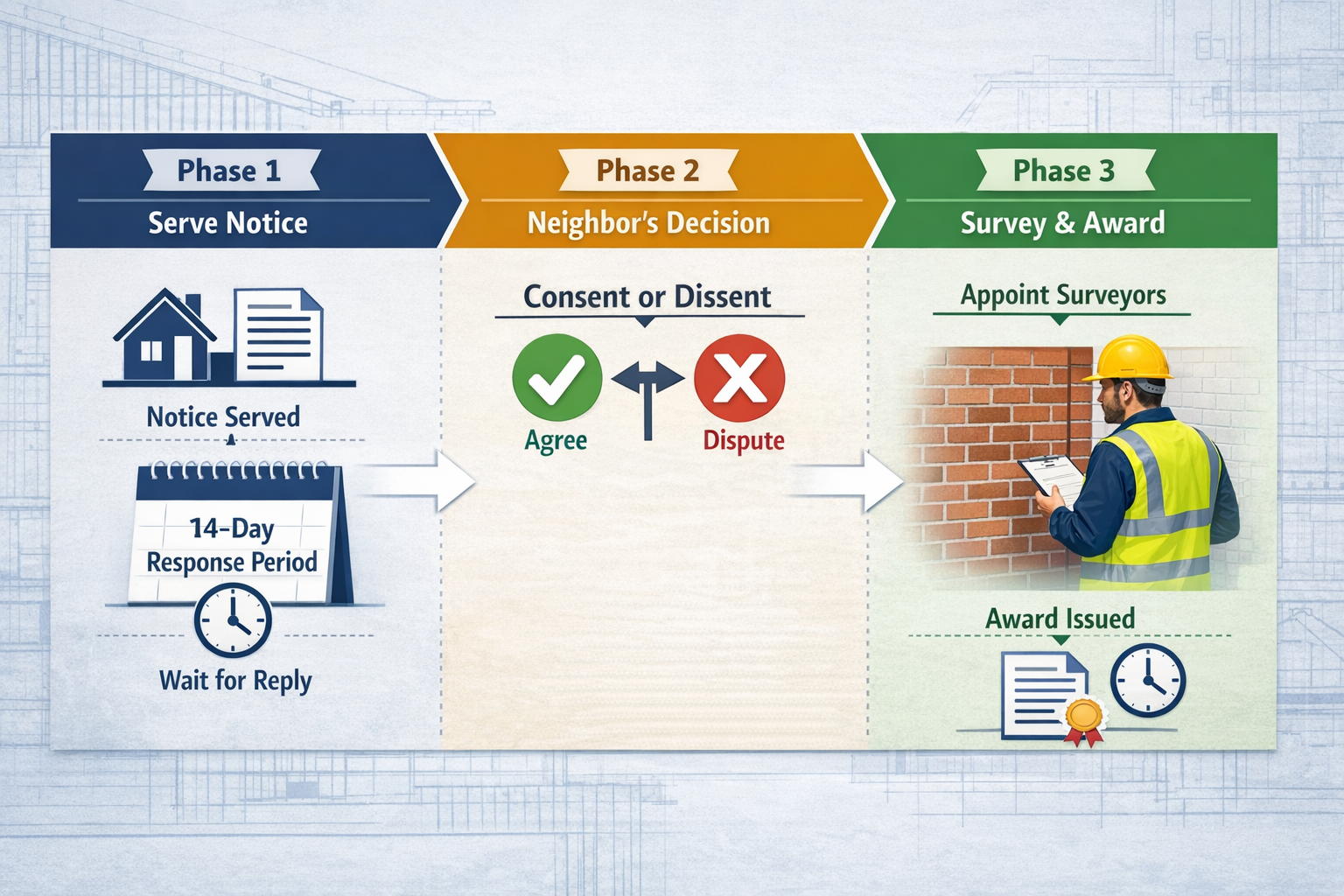
The Party Wall etc. Act 1996 exists to protect both building owners and their neighbors during construction work affecting shared structures or boundaries. Many homeowners mistakenly believe the Act applies to all renovation work, but understanding the specific triggers helps determine when formal procedures become necessary.
Three Main Categories of Notifiable Works
The legislation covers three distinct scenarios that require serving party wall notices:
1. Work to Existing Party Walls or Structures 🏘️
This includes modifications to walls, floors, or structures already shared with neighbors. Common examples include:
- Cutting into party walls for loft conversion beams
- Raising or rebuilding shared walls
- Removing chimney breasts on party walls
- Inserting damp-proof courses
- Underpinning existing party walls
2. New Party Fence Walls on Boundary Lines
Constructing new walls directly on property boundaries requires notice, even when built entirely on your land.
3. Excavation Near Neighboring Properties 🏗️
Digging foundations or basements within specific distances triggers notice requirements:
- Within 3 meters of a neighbor's structure if excavating deeper than their foundations
- Within 6 meters if excavating deeper than a line drawn at 45 degrees from the bottom of their foundations[1]
Works That Don't Require Party Wall Procedures
Not every home improvement project falls under the Act. Minor internal works such as plastering, electrical installations, drilling for kitchen units, or mounting shelving do not require party wall agreements—even when performed on shared walls[2]. Understanding these distinctions prevents unnecessary paperwork and expense.
For detailed guidance on types of party wall works, homeowners should consult the specific categories outlined in the legislation.
The Party Wall Notice Process: Timing, Serving, and Neighbor Responses
Serving proper notice represents the critical first step in party wall compliance. The process follows strict timelines and format requirements that homeowners must understand before commencing any notifiable works.
Notice Timing Requirements ⏰
Different work types require different notice periods:
| Work Type | Minimum Notice Period |
|---|---|
| Party Structure Notice (work to existing shared walls) | 2 months before work starts |
| Party Fence Wall Notice (new boundary walls) | 1 month before work starts |
| Excavation Notice (foundation work near boundaries) | 1 month before work starts |
These periods are minimum requirements—providing longer notice demonstrates good faith and allows neighbors adequate time to consider the proposals[1].
What a Valid Notice Must Include
A proper party wall notice contains specific information:
- Clear description of the proposed works
- Commencement date for the project
- Your details as the building owner
- Property address where works will occur
- Drawings or plans showing the work scope
Homeowners often wonder about having a party wall agreement without a surveyor—this remains possible when neighbors provide written consent.
The Critical 14-Day Response Window
After receiving notice, adjoining owners have 14 days to respond in one of three ways:
✅ Consent in Writing: Neighbor agrees to the works, no surveyor required (though still recommended)[1][2]
❌ Dissent or Counter-Notice: Neighbor objects or proposes modifications, triggering surveyor appointment
⏸️ No Response: Silence equals dissent under the Act, requiring formal dispute resolution[1]
Understanding party wall act notices and how to respond helps both building and adjoining owners navigate this crucial decision point.
When Multiple Neighbors Are Affected
Terraced properties, corner plots, and flats often involve serving notices to multiple adjoining owners. Each neighbor responds independently, meaning one may consent while another dissents. This complexity makes professional surveyor guidance particularly valuable for properties with multiple shared boundaries[1].
Why Every 2026 Homeowner Needs a Party Wall Surveyor: Scenarios Requiring Professional Help
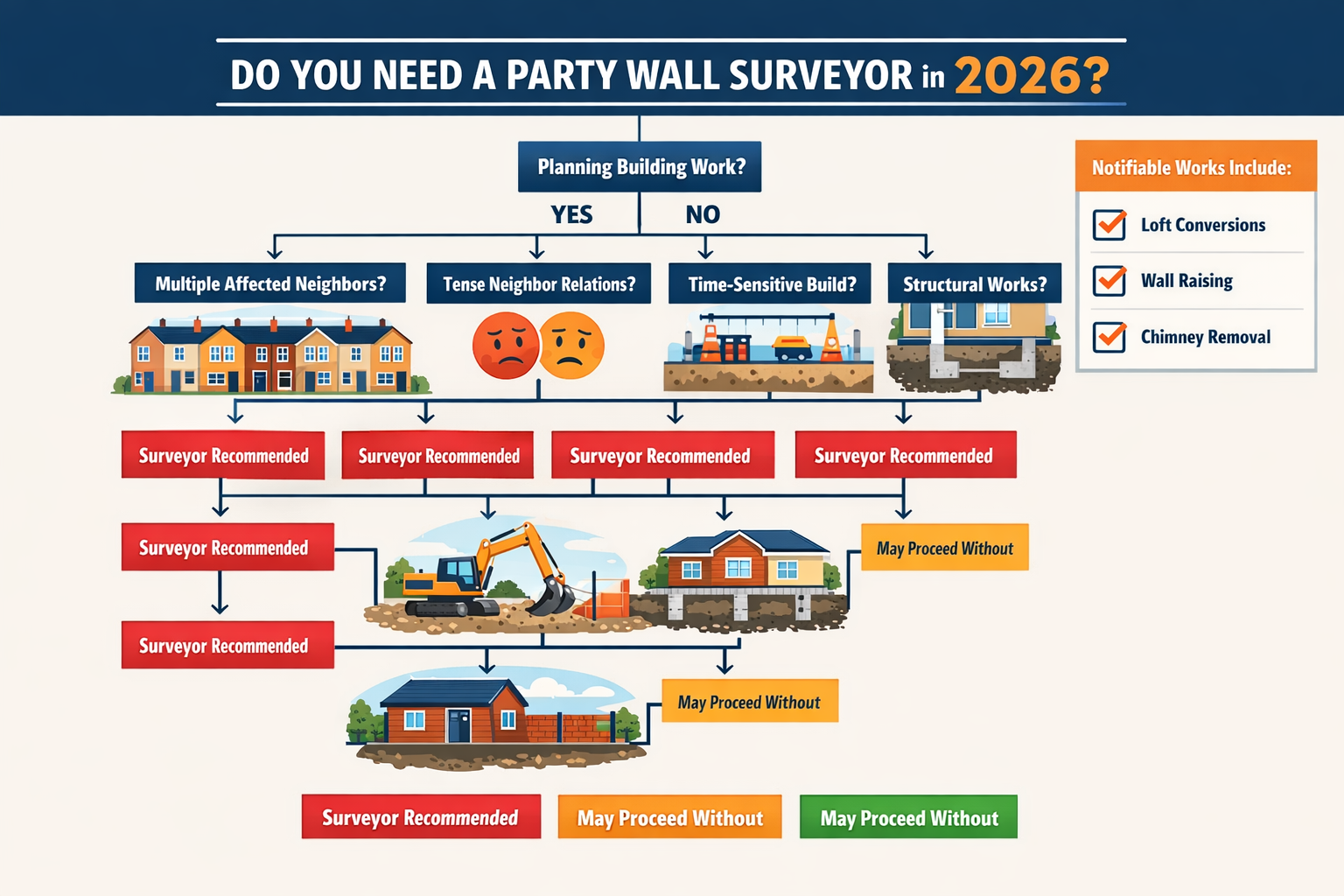
The question "do I need a party wall surveyor?" doesn't have a universal answer. While surveyors aren't legally mandatory when neighbors consent[1], several scenarios make professional appointment strategically essential for protecting homeowner interests.
Mandatory Surveyor Situations
Surveyor appointment becomes legally required when:
- Neighbors dissent to your notice within 14 days
- Neighbors fail to respond within the 14-day period (silence equals dissent)[1]
- Neighbors serve a counter-notice proposing work modifications
In these circumstances, the Party Wall Act's dispute resolution mechanism activates automatically, requiring either:
- Each party appointing their own surveyor (two surveyors), or
- Both parties agreeing to a single agreed surveyor[2]
Highly Recommended Surveyor Scenarios 📋
Even when neighbors provide written consent, professional surveyor involvement proves valuable in these situations:
Complex Property Configurations
- Multiple affected neighbors: Terraced houses, semi-detached properties, or flats where several parties require coordination[1]
- Corner plots: Properties sharing boundaries with multiple neighbors on different sides
Relationship Considerations
- Tense neighbor relationships: Existing disputes or poor communication make formal documentation essential[1]
- New neighbor relationships: Unknown neighbors where trust hasn't been established
Project Characteristics
- Time-sensitive builds: Construction schedules with strict deadlines cannot afford delays from later disputes[1]
- Structurally significant projects: Major excavations, structural alterations, or foundation work carrying higher risk[1]
- High-value properties: Where potential damage claims could be substantial
Risk Mitigation
- Condition survey protection: Professional photographic documentation of neighbor's property before work starts prevents false damage claims[2]
- Clear work scope definition: Detailed party wall awards eliminate ambiguity about permitted work
The Building Owner's Legal Responsibility
A critical point many homeowners miss: contractors cannot fulfill Party Wall Act obligations on your behalf. As the building owner, legal responsibility for proper notice service and compliance rests entirely with you, regardless of what your builder promises[1]. This makes understanding the process—or appointing a building owners surveyor to handle it—essential.
For homeowners in specific areas, finding qualified professionals through services like a party wall surveyor in Central London or party wall surveyor in West London ensures local expertise and regulatory knowledge.
From Surveyor Appointment to Party Wall Award: The Formal Process
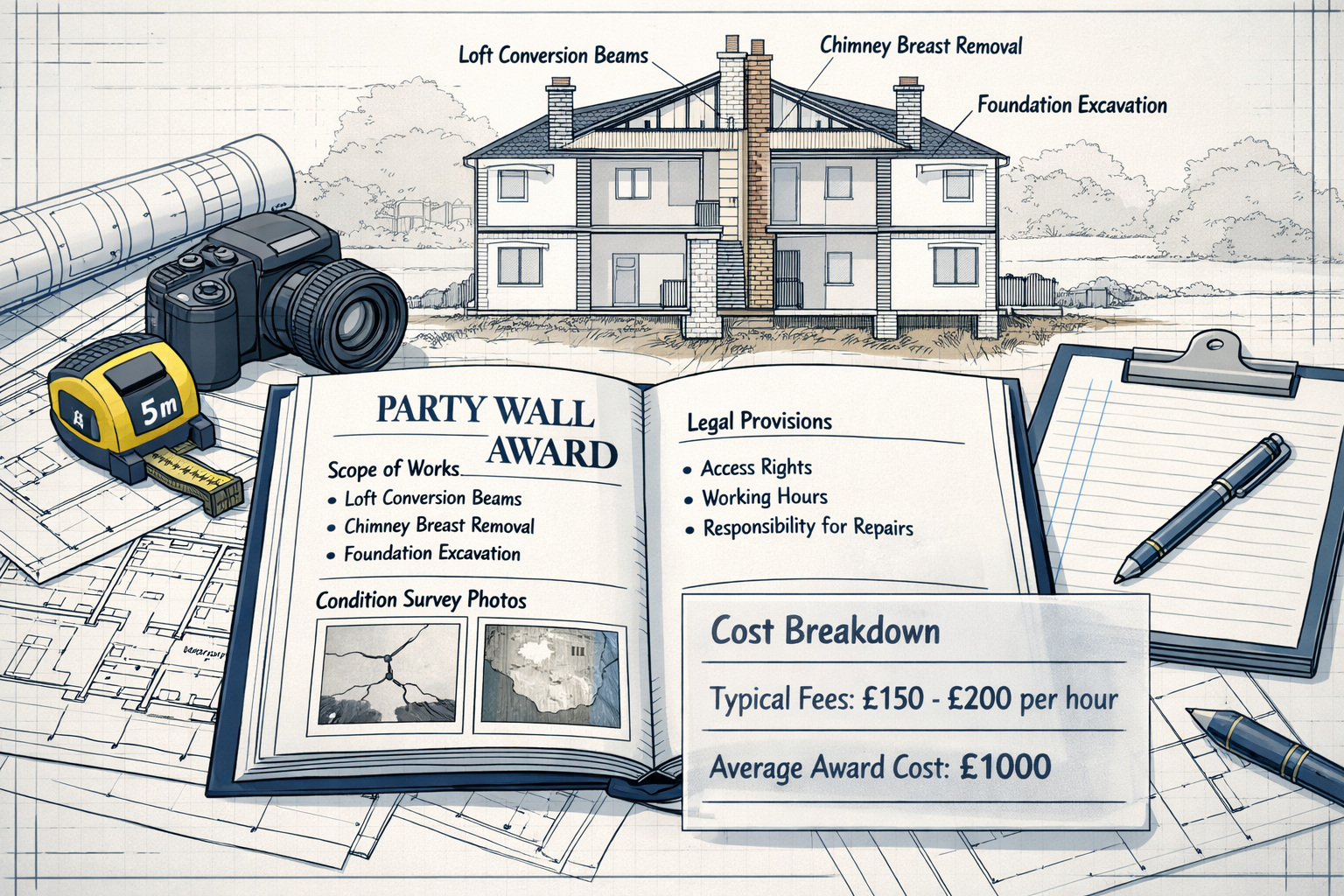
When surveyor involvement becomes necessary—whether mandatory due to dissent or voluntary for protection—the process follows a structured pathway culminating in a formal party wall award document.
Choosing Between Two Surveyors or an Agreed Surveyor
Parties facing party wall procedures have two appointment options:
Option 1: Two Surveyors (One Each)
- Building owner appoints their surveyor
- Adjoining owner appoints a separate surveyor
- The two surveyors work together and may appoint a third surveyor if they cannot agree
- Each party typically pays their own surveyor's fees initially, though the building owner usually bears all costs ultimately
Option 2: Agreed Surveyor (Single Appointment)
- Both parties consent to one impartial surveyor
- More cost-effective approach
- Faster resolution typically
- Critical requirement: The agreed surveyor must be genuinely independent and cannot be the same surveyor the building owner consulted initially[2]
The agreed surveyor route often proves more economical and efficient, but requires mutual trust and cooperation between neighbors.
What Surveyors Actually Do 🔍
Professional party wall surveyors perform several essential functions:
- Validate Notices: Ensure served notices meet legal requirements
- Conduct Condition Surveys: Photograph and document the adjoining owner's property condition before works commence[2]
- Negotiate Work Scope: Mediate between parties on work details and timing
- Draft the Award: Create the formal legal document governing the works
- Specify Protections: Include working hours, access requirements, and protective measures
- Resolve Disputes: Address disagreements about work methods or scope
Understanding the Party Wall Award Document
The party wall award represents the formal legal agreement governing your construction project. This comprehensive document typically includes:
Essential Award Components:
- Detailed work description: Precisely what works are permitted
- Photographic schedule: Complete condition survey of neighbor's property[2]
- Access provisions: When and how building owner can access adjoining property
- Working hours: Permitted construction times
- Protective measures: Required precautions during construction
- Dispute resolution: Procedures for handling issues during works
Awards become legally binding once served on both parties. Homeowners can review party wall contract template guides to understand typical award structures.
Timeline from Appointment to Award ⏱️
The surveyor appointment to award process typically follows this timeline:
| Stage | Typical Duration |
|---|---|
| Surveyor appointment after dissent | Immediate |
| Initial property inspection and condition survey | 1-2 weeks |
| Award drafting | 2-3 weeks |
| Award service and potential appeals | 14 days (appeal period) |
| Total typical timeline | 4-6 weeks |
Economic delays in 2026 may extend these timelines, particularly for surveyors handling high volumes during construction upturns[3]. Planning ahead prevents project delays.
Party Wall Surveyor Costs and Fee Structures in 2026
Understanding party wall costs helps homeowners budget appropriately and avoid financial surprises. The building owner typically bears all reasonable costs associated with the party wall process, including fees for both their own surveyor and the adjoining owner's surveyor (if two are appointed).
Average Party Wall Award Costs 💷
Current market rates for 2026 indicate:
- Average party wall award cost: Approximately £1,000[2]
- Surveyor hourly rates: Typically £150-£200 per hour[2]
- Simple projects: £700-£1,200
- Complex projects (multiple neighbors, extensive works): £1,500-£3,000+
These figures vary significantly based on:
- Geographic location: London and Southeast England command premium rates
- Project complexity: Extensive excavation or structural work requires more surveyor time
- Number of affected neighbors: Each additional adjoining owner increases costs
- Dispute complexity: Contentious relationships require more negotiation time
Cost Breakdown: What You're Paying For
Party wall surveyor fees cover specific services:
Initial Consultation and Notice Review (£200-£400)
- Assessing whether works require notices
- Reviewing and validating notice documents
- Initial neighbor communication
Condition Survey (£300-£600)
- Comprehensive photographic documentation
- Detailed written descriptions
- Video evidence where appropriate
Award Preparation (£400-£800)
- Legal document drafting
- Work specification development
- Protective measure design
Ongoing Project Monitoring (£150-£200 per visit)
- Periodic inspections during construction
- Damage assessment if issues arise
- Final completion verification
For detailed guidance on costs of party wall processes, homeowners should request itemized quotes from prospective surveyors.
Strategies for Keeping Party Wall Costs Down
Homeowners can minimize expenses through several approaches:
✅ Early neighbor communication: Informal discussions before formal notices can build goodwill
✅ Agreed surveyor appointment: Single surveyor costs less than two separate appointments
✅ Clear project scope: Well-defined works reduce surveyor time requirements
✅ Organized documentation: Providing complete plans and specifications upfront
✅ Reasonable timeline: Avoiding rushed projects that require premium rates
Additional strategies appear in guides on how to keep party wall costs down.
Who Pays What: Fee Responsibility
The building owner (person carrying out works) bears responsibility for:
- Their own surveyor's fees
- The adjoining owner's surveyor's fees (when two surveyors appointed)
- The agreed surveyor's fees (when single surveyor appointed)
- Any third surveyor fees if appointed to resolve surveyor disagreements
This cost structure exists because the building owner initiates the works requiring party wall procedures. However, if an adjoining owner makes unreasonable requests or causes unnecessary delays, surveyors may apportion some costs differently in the award.
Navigating Neighbor Refusals and Disputes in 2026
Even with proper notices and professional surveyors, some party wall situations escalate into disputes requiring careful management. Understanding how to navigate neighbor refusals prevents project delays and maintains community relationships.
What Happens When Neighbors Refuse Consent
Neighbor dissent doesn't stop your project—it triggers the formal dispute resolution process:
- Automatic Dispute Status: Refusal or silence within 14 days creates a formal dispute under the Act[1]
- Mandatory Surveyor Appointment: Both parties must appoint surveyors (or agree to one)
- Award Replaces Consent: The surveyor-prepared award provides legal authority to proceed
- Work Can Proceed: Once the award is served, construction may commence regardless of neighbor preferences
Important: Neighbors cannot veto works permitted under the Party Wall Act. The legislation exists precisely to allow necessary building work while protecting adjoining owners' interests through proper procedures and protections[4].
Common Reasons for Neighbor Objections
Understanding why neighbors dissent helps address concerns proactively:
- Lack of information: Unclear or incomplete notice details
- Timing concerns: Proposed work schedule conflicts with personal circumstances
- Access worries: Concerns about construction workers entering their property
- Noise and disruption: Fear of excessive disturbance
- Property damage: Anxiety about potential structural damage
- Property value: Concerns about impact on their property's worth
- Previous disputes: Historical conflicts coloring current interactions
Addressing these concerns through clear communication—ideally before serving formal notices—often prevents formal dissent.
The Role of the Adjoining Owner's Surveyor
When neighbors appoint their own surveyor (or share an agreed surveyor), that professional protects the adjoining owner's interests by:
- Reviewing work proposals for potential impact
- Negotiating protective measures during construction
- Ensuring adequate access provisions
- Documenting pre-work conditions thoroughly
- Monitoring construction for compliance
- Assessing any damage that occurs
Homeowners can learn more about this role through adjoining owners surveyor resources.
Dispute Resolution Mechanisms 🤝
When surveyors cannot agree on award terms, the Act provides resolution:
- Third Surveyor Appointment: The two appointed surveyors select an impartial third surveyor
- Third Surveyor Decision: This professional makes binding determinations on disputed points
- Award Finalization: The award incorporates the third surveyor's decisions
- Appeal Rights: Parties may appeal to county court within 14 days of award service
This structured process ensures disputes resolve without indefinite delays, though it adds time and cost to projects.
Practical Tips for Difficult Neighbor Situations
Before Serving Formal Notice:
- Have informal conversations explaining your plans
- Show preliminary drawings or sketches
- Discuss timing and potential disruption
- Address concerns proactively
- Consider minor modifications that accommodate neighbor preferences
After Dissent:
- Remain professional and courteous
- Let surveyors handle negotiations
- Document all communications
- Avoid direct confrontation
- Focus on legal compliance rather than persuasion
During Construction:
- Adhere strictly to award terms
- Communicate about schedule changes
- Address concerns promptly
- Keep work areas clean and organized
- Minimize disruption where possible
For homeowners dealing with neighbor construction, resources on my neighbour is carrying out works provide guidance from the adjoining owner perspective.
Practical Checklists: Your 2026 Party Wall Action Plan
Successful party wall compliance requires organized planning and execution. These practical checklists guide homeowners through each stage of the process.
Pre-Construction Planning Checklist ✅
6-8 Weeks Before Construction:
- Review architectural plans to identify party wall implications
- Determine which types of party wall works apply to your project
- Identify all affected neighbors (don't forget basement flats or upper-floor apartments)
- Research party wall surveyors in your area
- Obtain initial cost estimates for surveyor fees
- Budget for party wall costs in overall project finances
4-6 Weeks Before Construction:
- Have informal conversations with affected neighbors
- Explain your project plans and timeline
- Address initial concerns or questions
- Gauge neighbor receptiveness to works
2-3 Months Before Construction (for party structure work):
- Prepare formal party wall notices with complete work descriptions
- Include detailed drawings and specifications
- Serve notices via recorded delivery or hand delivery with signature
- Keep proof of service for all notices
- Mark calendar for 14-day response deadline
Notice Service and Response Checklist 📬
Immediately After Serving Notice:
- Create file for all party wall documentation
- Log service dates for each neighbor
- Set calendar reminders for 14-day response deadlines
- Prepare for potential surveyor appointment
During 14-Day Response Period:
- Monitor for neighbor responses
- Answer neighbor questions promptly and professionally
- Provide additional information if requested
- Avoid making commitments outside the formal process
After 14 Days:
- Categorize each neighbor response: consent, dissent, or silence
- For consents: Obtain written confirmation and file securely
- For dissents/silence: Initiate surveyor appointment process
- Contact selected surveyor to begin formal procedures
Surveyor Appointment and Award Checklist 🔨
Surveyor Selection:
- Request quotes from multiple qualified surveyors
- Verify RICS membership or equivalent qualifications
- Check surveyor experience with similar projects
- Confirm surveyor availability aligns with construction timeline
- Review surveyor's fee structure and payment terms
- Appoint surveyor formally in writing
During Award Preparation:
- Provide surveyor with complete project documentation
- Facilitate surveyor access for condition surveys
- Respond promptly to surveyor questions
- Review draft award carefully before finalization
- Clarify any unclear award provisions
- Ensure award addresses all relevant work aspects
Award Finalization:
- Receive and review final party wall award
- Confirm award service to all parties
- Note 14-day appeal period
- Provide copy to contractor before work commences
- Store award securely for project duration and beyond
Construction Phase Checklist 🏗️
Before Work Starts:
- Provide contractor with copy of party wall award
- Review award requirements with construction team
- Establish communication protocol for neighbor concerns
- Confirm working hours and access provisions
- Set up site to minimize neighbor disruption
During Construction:
- Adhere strictly to award terms and conditions
- Maintain communication with neighbors about progress
- Address concerns or complaints immediately
- Document any unexpected issues or damage
- Contact surveyor if award modifications become necessary
- Keep work area clean and organized
After Completion:
- Arrange final surveyor inspection if required
- Address any identified damage or issues
- Obtain completion documentation from surveyor
- Maintain party wall records with property documents
- Consider thank-you gesture to cooperative neighbors
Regional Considerations: Party Wall Compliance Across London
Party wall requirements remain consistent across England and Wales, but practical implementation varies by location. London homeowners face unique considerations due to property density, construction activity levels, and local surveyor availability.
London-Specific Challenges
High Property Density 🏘️
London's terraced housing and apartment buildings mean most construction projects affect multiple neighbors. A typical mid-terrace renovation might require serving notices to:
- Both immediate neighbors (left and right)
- Properties behind (if excavating)
- Upper and lower flats (in converted buildings)
- Diagonal neighbors (for corner properties)
This multiplies complexity and potential costs significantly compared to detached properties in less dense areas.
Construction Activity Surges
The 2026 construction uptick creates surveyor availability challenges. High demand means:
- Longer wait times for surveyor appointments
- Premium rates during peak periods
- Extended timelines from notice to award
- Greater importance of early planning[3]
Regional Surveyor Resources
Homeowners in different London areas can access specialized local expertise:
- Party wall surveyor in North London
- Party wall surveyor in South London
- Party wall surveyor in East London
Local surveyors understand area-specific construction patterns, typical property configurations, and regional cost norms.
Economic Delays and 2026 Planning Implications
Current economic conditions create additional party wall considerations:
Material and Labor Shortages
Construction delays may extend project timelines beyond initially planned dates, potentially requiring:
- Award amendments if work doesn't commence within specified timeframes
- Additional surveyor fees for timeline extensions
- Re-serving notices if delays exceed reasonable periods
Increased Construction Costs
Rising building costs make party wall protection more valuable:
- Higher project values increase potential damage claim amounts
- More expensive materials justify comprehensive condition surveys
- Greater financial stakes warrant professional surveyor involvement
Neighbor Financial Pressures
Economic uncertainty may affect neighbor responses:
- Greater sensitivity to noise and disruption
- Increased concern about property value impacts
- More defensive postures requiring careful negotiation
Conclusion: Protecting Your 2026 Construction Investment
Understanding why every 2026 homeowner needs a party wall surveyor: from notice to award essentials empowers property owners to navigate construction projects confidently and legally. While surveyors aren't mandatory in every situation—particularly when neighbors provide written consent within 14 days[1]—the strategic value of professional involvement extends far beyond legal compliance.
The party wall process protects both building owners and neighbors through structured procedures, clear documentation, and impartial professional oversight. From serving initial notices with proper timing to receiving comprehensive awards detailing work scope and protections, each step serves a crucial purpose in minimizing disputes and preventing costly delays.
Key Success Factors for 2026 Homeowners
Early Planning Wins ⏰
Starting party wall procedures 2-3 months before planned construction prevents rushed timelines and allows proper neighbor consultation. Current surveyor demand makes early appointment essential for securing qualified professionals.
Professional Guidance Pays
Average party wall award costs of £1,000[2] represent valuable insurance against disputes potentially costing thousands in legal fees, construction delays, and damaged neighbor relationships. The investment in proper procedures protects much larger construction budgets.
Communication Matters
Informal neighbor discussions before formal notices often prevent dissent and build goodwill. Even when surveyors handle formal procedures, maintaining respectful communication throughout construction preserves community relationships.
Documentation Protects
Comprehensive condition surveys, detailed awards, and careful record-keeping provide essential protection against false damage claims and misunderstandings about work scope. These documents prove invaluable if disputes arise during or after construction.
Your Next Steps
Ready to start your construction project with proper party wall compliance? Take these immediate actions:
- Assess Your Project: Review plans to identify party wall implications and affected neighbors
- Research Surveyors: Obtain quotes from qualified professionals in your area
- Budget Appropriately: Include party wall costs in overall project finances
- Plan Timeline: Add 6-8 weeks to construction schedule for party wall procedures
- Communicate Early: Have informal conversations with neighbors before formal notices
- Serve Proper Notices: Use correct notice types with complete information and adequate timing
- Appoint Surveyors: Select qualified professionals when neighbor consent isn't obtained
For comprehensive guidance on party wall procedures, homeowners can explore additional resources on general FAQs or consult with qualified professionals who understand current 2026 market conditions and regulatory requirements.
The party wall process—from notice to award—need not be intimidating. With proper understanding, early planning, and professional guidance when needed, homeowners can protect their construction investments while maintaining positive neighbor relationships and full legal compliance. Your renovation or extension project deserves the solid foundation that proper party wall procedures provide.
References
[1] Do I Really Need A Party Wall Surveyor In 2026 – https://www.simplesurvey.co.uk/article/do-i-really-need-a-party-wall-surveyor-in-2026/
[2] Party Wall Agreement – https://hoa.org.uk/advice/guides-for-homeowners/i-am-improving/party-wall-agreement/
[3] Party Wall Surveys And Neighbour Disputes During 2026s Construction Uptick Rics Compliance Framework – https://nottinghillsurveyors.com/blog/party-wall-surveys-and-neighbour-disputes-during-2026s-construction-uptick-rics-compliance-framework
[4] Legal Tips For Kent Property Owners On Party Walls – https://fpws-kent.co.uk/legal-tips-for-kent-property-owners-on-party-walls/