


The construction industry faces an unprecedented crisis in 2026, with approximately 500,000 workers needed to meet project demands [1]. For party wall surveyors, this shortage creates both challenges and opportunities. As traditional expertise becomes scarcer and technology advances rapidly, Workforce Adaptation in Party Wall Surveying: Upskilling for 2026 Digital and Labor Challenges has emerged as the defining issue for firms seeking to maintain competitiveness while delivering accurate, timely awards under the Party Wall etc. Act 1996.
The landscape is shifting beneath surveyors' feet. Immigration enforcement now affects approximately one-quarter of the construction workforce [1], while younger professionals demand digital tools and flexible working arrangements. Meanwhile, property owners expect faster turnaround times and more transparent processes. This perfect storm demands a strategic response that balances technological adoption with preservation of essential Act expertise.

Key Takeaways
- Labor shortage crisis: The construction sector needs 500,000 workers in 2026, directly impacting party wall surveying capacity and project timelines
- Digital transformation imperative: AI-powered documentation, reality capture technology, and automated workflows can reduce award preparation time by 40-60%
- Dual competency requirement: Successful surveyors must master both traditional Party Wall Act knowledge and emerging digital tools
- Strategic upskilling roadmap: Firms implementing structured training programs see 35% higher retention rates and improved service delivery
- Competitive advantage: Early adopters of integrated technology platforms gain significant market share while maintaining regulatory compliance
Understanding the 2026 Workforce Crisis in Party Wall Surveying
The Scale of the Shortage
The construction industry's workforce deficit extends far beyond general laborers. Specialized professionals, including party wall surveyors, face mounting pressure as project volumes increase while qualified personnel become scarcer. Immigration policy changes have removed approximately 28% of workers from construction firms [1], creating ripple effects throughout the sector.
For party wall surveying practices, this translates to:
- Extended timelines for party wall awards and dispute resolution
- Increased workload on remaining experienced surveyors
- Higher costs passed to building and adjoining owners
- Quality concerns as rushed assessments become more common
- Recruitment challenges competing with other construction disciplines
Generational Shifts and Expectations
The surveying workforce is experiencing a demographic transformation. Experienced professionals who built their careers on traditional methods approach retirement, while younger surveyors enter the field with different expectations:
| Traditional Surveyor Profile | 2026 Emerging Surveyor Profile |
|---|---|
| Paper-based documentation | Cloud-native digital workflows |
| Site visits with manual measurements | Reality capture technology integration |
| Sequential project management | Concurrent multi-project handling |
| Office-based report writing | Remote work flexibility |
| Individual expertise focus | Collaborative platform approach |
This generational divide creates both friction and opportunity. Firms that successfully bridge this gap through Workforce Adaptation in Party Wall Surveying: Upskilling for 2026 Digital and Labor Challenges initiatives position themselves for sustained growth.
Digital Technologies Transforming Party Wall Practice

Reality Capture and 3D Documentation
Modern reality capture technology has revolutionized how surveyors document existing conditions. Laser scanning and photogrammetry enable comprehensive site documentation in minutes rather than hours, creating detailed 3D models that serve multiple purposes:
- Precise measurements for schedules of condition
- Visual evidence for dispute resolution
- Baseline data for monitoring settlement or damage
- Enhanced communication with property owners
- Integration with Building Information Modeling (BIM)
Surveyors trained in reality capture technology report 60% faster site documentation while capturing significantly more detail than traditional methods. This efficiency directly addresses workforce shortage pressures by enabling each surveyor to handle more cases without compromising quality.
AI-Powered Documentation and Award Preparation
Artificial intelligence tools are transforming the administrative burden of party wall surveying. Natural language processing can:
✅ Analyze party wall notices and extract key information automatically
✅ Generate initial draft awards based on site data and regulatory requirements
✅ Flag potential compliance issues with the Party Wall Act
✅ Suggest appropriate conditions based on historical precedent
✅ Automate routine correspondence and scheduling
These capabilities don't replace surveyor judgment—they enhance it. By handling repetitive tasks, AI allows professionals to focus on complex technical assessments and relationship management with building and adjoining owners.
Cloud-Based Collaboration Platforms
Modern party wall practices operate across multiple locations, often serving areas like North London, Central London, and South London simultaneously. Cloud platforms enable:
- Real-time document sharing with all parties
- Version control for awards and amendments
- Secure client portals for transparency
- Mobile access for site-based decision-making
- Integrated project management and billing
Firms adopting integrated platforms report 40% reduction in administrative overhead and significantly improved client satisfaction scores.
Strategic Upskilling Framework for Party Wall Surveyors
Core Competency Assessment
Before implementing training programs, firms must honestly assess current capabilities across their workforce. A comprehensive audit should evaluate:
Technical Knowledge Areas:
- Party Wall Act statutory requirements and case law
- Building construction methods and materials
- Structural engineering principles
- Dispute resolution procedures
- Health and safety regulations
Digital Competency Areas:
- Basic software proficiency (documentation, spreadsheets)
- Reality capture equipment operation
- 3D modeling and visualization tools
- AI-assisted documentation platforms
- Cloud collaboration systems
This assessment reveals skill gaps and helps prioritize training investments. Many firms discover that even experienced surveyors lack confidence with digital tools, while junior staff may need deeper grounding in Party Wall Act fundamentals.
Structured Learning Pathways
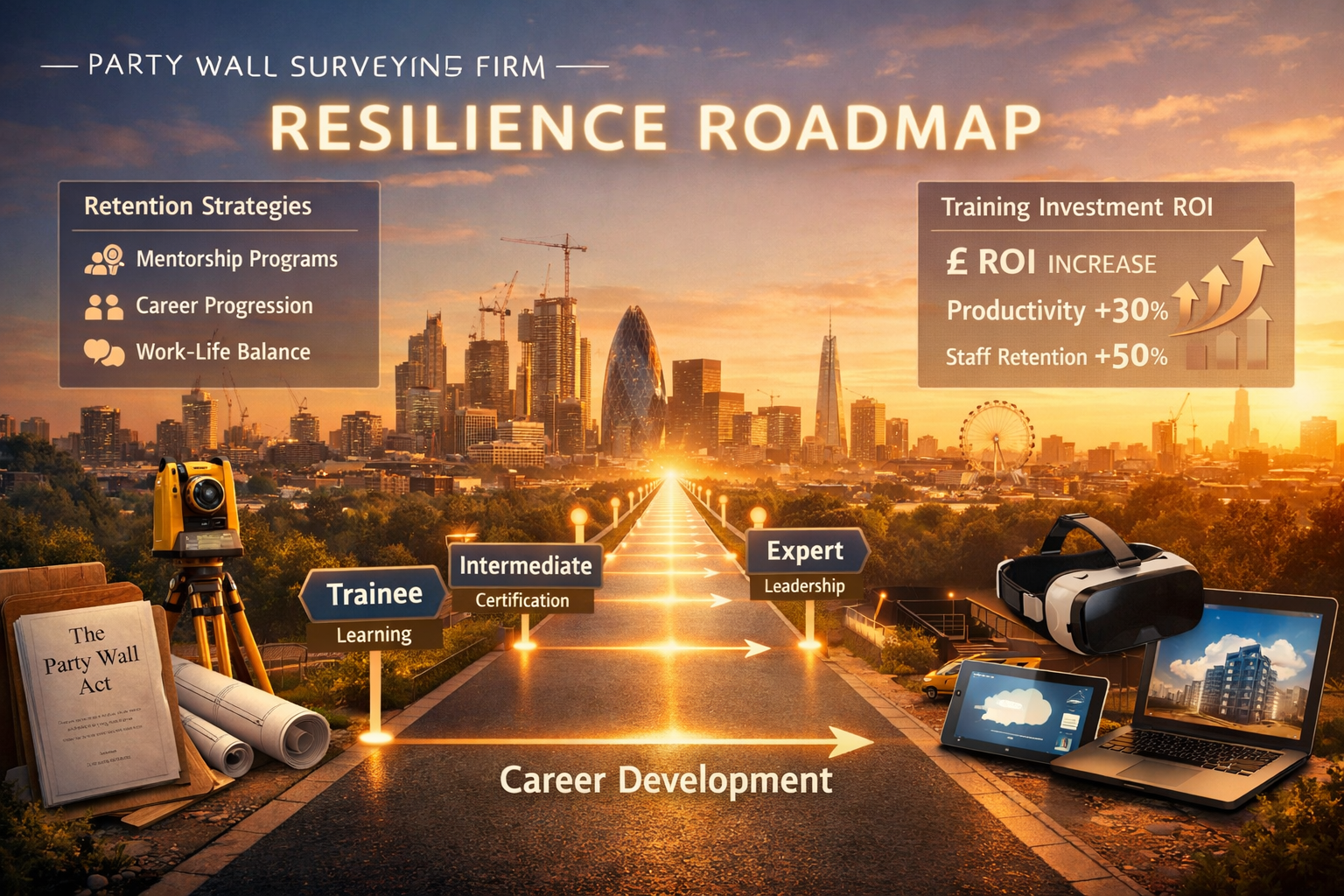
Effective Workforce Adaptation in Party Wall Surveying: Upskilling for 2026 Digital and Labor Challenges requires deliberate learning pathways rather than ad-hoc training. Consider implementing:
Foundation Level (0-2 years experience):
- Comprehensive Party Wall Act training
- Understanding types of party wall works
- Basic site documentation techniques
- Introduction to digital tools
- Mentorship pairing with senior surveyors
Intermediate Level (2-5 years experience):
- Advanced dispute resolution
- Reality capture technology certification
- AI documentation platform mastery
- Complex structural assessment
- Client relationship management
Advanced Level (5+ years experience):
- Emerging technology evaluation
- Team leadership and training delivery
- Strategic business development
- Expert witness preparation
- Innovation implementation
Practical Implementation Strategies
Theory alone won't drive workforce adaptation. Firms achieving success implement practical, hands-on approaches:
🔧 Pilot Projects: Select straightforward cases for technology testing before full deployment
🔧 Peer Learning: Create internal knowledge-sharing sessions where staff demonstrate new tools
🔧 External Partnerships: Collaborate with technology vendors for customized training
🔧 Certification Incentives: Reward skill acquisition with recognition and compensation increases
🔧 Continuous Feedback: Regular check-ins to identify obstacles and refine training approaches
One London-based firm implemented a "digital champion" program where each surveyor specialized in one technology area and became the internal expert, dramatically accelerating adoption across the team.
Balancing Technology Adoption with Traditional Expertise
The Irreplaceable Human Element
Despite technological advances, party wall surveying remains fundamentally a relationship-driven profession. Technology cannot replace:
- Nuanced judgment in complex structural situations
- Diplomatic negotiation between conflicting parties
- Contextual understanding of neighborhood dynamics
- Ethical decision-making in ambiguous scenarios
- Empathetic communication during stressful construction projects
The goal of Workforce Adaptation in Party Wall Surveying: Upskilling for 2026 Digital and Labor Challenges is enhancement, not replacement. The most successful surveyors use technology to eliminate tedious tasks, freeing time for high-value human interactions.
Maintaining Act Compliance in Digital Workflows
As surveyors adopt new tools, maintaining strict compliance with the Party Wall etc. Act 1996 remains paramount. Digital transformation must support, not compromise, statutory requirements:
Critical Compliance Areas:
- Proper service of notices with required content
- Statutory timeframes for responses and appeals
- Impartiality requirements for agreed surveyors
- Documentation standards for awards
- Security and confidentiality of party information
Technology platforms should include built-in compliance checks that flag potential issues before they become problems. For example, automated notice generation systems must ensure all statutory language appears correctly, while scheduling tools should track critical deadlines.
Knowledge Transfer and Succession Planning
The workforce shortage makes knowledge preservation critically important. Experienced surveyors possess decades of practical wisdom about boundary wall rules, construction techniques, and dispute resolution that cannot be easily replaced.
Effective succession planning includes:
- Structured mentorship programs pairing senior and junior surveyors
- Case study documentation capturing decision-making rationale
- Video knowledge bases where experts explain complex scenarios
- Collaborative site visits for hands-on learning
- Gradual responsibility transfer with oversight and feedback
Firms that formalize knowledge transfer see significantly better outcomes when senior professionals retire or transition to advisory roles.
Building Firm Resilience Through Workforce Adaptation
Recruitment and Retention Strategies
Addressing the workforce crisis requires both attracting new talent and retaining existing professionals. Successful firms implement comprehensive strategies:
Attraction Tactics:
- Competitive compensation reflecting market conditions
- Clear career progression pathways
- Investment in cutting-edge technology
- Flexible working arrangements
- Professional development budgets
Retention Tactics:
- Regular skill development opportunities
- Recognition and reward programs
- Work-life balance support
- Collaborative culture building
- Transparent communication about firm direction
Firms offering robust upskilling programs report 35% lower turnover than industry averages, directly addressing workforce shortage pressures.
Financial Investment and ROI
Implementing comprehensive Workforce Adaptation in Party Wall Surveying: Upskilling for 2026 Digital and Labor Challenges requires significant investment. However, the return on investment typically manifests within 12-18 months through:
💰 Increased capacity: Each surveyor handles 30-50% more cases
💰 Reduced errors: Digital workflows minimize costly mistakes
💰 Faster turnaround: Clients receive awards weeks earlier
💰 Premium pricing: Advanced capabilities justify higher fees
💰 Lower recruitment costs: Better retention reduces hiring expenses
When calculating training budgets, consider both direct costs (software licenses, equipment, training fees) and indirect costs (time away from billable work). Most firms allocate 3-5% of revenue to workforce development, with higher percentages during transformation periods.
Measuring Success and Continuous Improvement
Workforce adaptation is not a one-time project but an ongoing process. Establish clear metrics to track progress:
Quantitative Metrics:
- Average time from notice to award completion
- Number of cases handled per surveyor
- Client satisfaction scores
- Error rates and dispute frequency
- Technology adoption rates across staff
Qualitative Metrics:
- Staff confidence with new tools
- Client feedback on communication quality
- Peer recognition and industry reputation
- Innovation suggestions from team members
- Cross-functional collaboration effectiveness
Regular review of these metrics enables course correction and identifies areas requiring additional support or training.
Practical Steps for Immediate Implementation
For Individual Surveyors
Whether employed or operating independently, individual surveyors can take immediate action:
- Assess current skills honestly against 2026 requirements
- Identify one digital tool to master in the next quarter
- Join professional forums discussing technology adoption
- Attend webinars on AI and reality capture applications
- Practice on personal projects before client implementation
- Seek mentorship from digitally-advanced peers
- Budget for equipment and software investments
Even small steps toward digital competency compound over time, positioning surveyors for long-term success despite workforce challenges.
For Surveying Firms
Firm leaders should develop comprehensive adaptation strategies:
Immediate Actions (0-3 months):
- Conduct workforce skills audit
- Research available technology platforms
- Establish training budget and timeline
- Identify internal digital champions
- Begin pilot program with one technology
Medium-term Actions (3-12 months):
- Roll out primary technology platforms firm-wide
- Implement structured learning pathways
- Develop knowledge transfer protocols
- Refine recruitment messaging
- Measure initial ROI and adjust approach
Long-term Actions (12+ months):
- Achieve full digital integration across operations
- Establish firm as innovation leader
- Develop proprietary tools or processes
- Expand service offerings based on new capabilities
- Mentor other firms through transformation
For Industry Stakeholders
Professional bodies, educators, and technology vendors all play crucial roles in supporting Workforce Adaptation in Party Wall Surveying: Upskilling for 2026 Digital and Labor Challenges:
- Professional associations should develop digital competency standards and certification programs
- Educational institutions must update curricula to include modern technology alongside traditional knowledge
- Technology vendors should create surveyor-specific solutions rather than generic tools
- Regulatory bodies should clarify how digital workflows comply with statutory requirements
- Industry publications should showcase successful adaptation case studies
Collective action accelerates individual firm progress and strengthens the entire profession.
Overcoming Common Implementation Challenges
Resistance to Change
Technology adoption often faces internal resistance, particularly from experienced professionals comfortable with established methods. Address this through:
- Demonstrating value with concrete time savings and quality improvements
- Involving skeptics in technology selection and testing
- Providing adequate training so competence builds confidence
- Celebrating early wins to build momentum
- Addressing concerns openly and adjusting implementation based on feedback
Resistance typically stems from fear of obsolescence or inadequacy rather than genuine opposition to improvement. Empathetic leadership makes the difference.
Budget Constraints
Smaller firms may struggle with upskilling investments during challenging economic conditions. Consider:
- Phased implementation spreading costs over multiple years
- Open-source alternatives to expensive proprietary software
- Equipment sharing arrangements with peer firms
- Grant programs from professional associations
- ROI-focused prioritization starting with highest-impact tools
Understanding the true costs of party wall processes helps justify investments that improve efficiency and reduce long-term expenses.
Technical Integration Issues
Implementing new technology alongside existing systems creates integration challenges. Mitigate these through:
- Selecting platforms with robust API capabilities
- Working with vendors on custom integration solutions
- Accepting temporary parallel workflows during transition
- Documenting processes clearly for consistency
- Building internal technical expertise or partnering with IT consultants
Most integration issues resolve within 3-6 months as workflows stabilize and staff become proficient.
Future Outlook: Party Wall Surveying in 2030 and Beyond
Emerging Technologies on the Horizon
While focusing on 2026 challenges, forward-thinking surveyors should monitor technologies that will shape the next decade:
🔮 Augmented reality for on-site visualization of proposed works
🔮 Blockchain for immutable award records and dispute history
🔮 IoT sensors for continuous monitoring of party wall structures
🔮 Advanced AI capable of complex structural analysis
🔮 Virtual reality for remote inspections and client consultations
Early experimentation with emerging technologies positions firms as innovation leaders when these tools mature.
Evolving Regulatory Landscape
Technology adoption may eventually influence regulatory frameworks. Potential developments include:
- Digital-first notice and award procedures
- Electronic service of documents as standard
- Centralized party wall registries
- Enhanced transparency requirements
- Technology-assisted dispute resolution mechanisms
Surveyors participating in industry discussions help shape these developments to benefit both professionals and property owners.
The Resilient Surveying Practice
Firms successfully navigating Workforce Adaptation in Party Wall Surveying: Upskilling for 2026 Digital and Labor Challenges emerge stronger and more competitive. The resilient practice of the future features:
✨ Hybrid expertise combining deep Act knowledge with digital fluency
✨ Flexible capacity to scale services up or down based on demand
✨ Client-centric delivery with transparency and rapid communication
✨ Continuous learning culture embracing change as opportunity
✨ Strategic positioning as trusted advisors beyond basic compliance
These characteristics enable sustained success regardless of workforce fluctuations or technological disruption.
Conclusion
The construction workforce crisis of 2026 presents party wall surveyors with a defining challenge that demands strategic response. With approximately 500,000 workers needed across the sector [1], firms cannot rely on traditional recruitment alone to maintain service levels. Workforce Adaptation in Party Wall Surveying: Upskilling for 2026 Digital and Labor Challenges has transitioned from optional enhancement to business imperative.
The path forward requires balancing technological adoption with preservation of essential Party Wall Act expertise. Reality capture technology, AI-powered documentation, and cloud collaboration platforms offer dramatic efficiency gains—reducing award preparation time by 40-60% while improving quality and client satisfaction. However, these tools enhance rather than replace the nuanced judgment, diplomatic skill, and ethical decision-making that define excellent surveying practice.
Successful adaptation follows a structured approach: honest assessment of current capabilities, development of clear learning pathways, practical hands-on implementation, and continuous measurement of results. Firms investing 3-5% of revenue in workforce development see significant returns through increased capacity, reduced errors, faster turnaround, and improved retention rates.
Actionable Next Steps
For immediate implementation:
- Conduct a skills audit across your workforce this month
- Select one technology (reality capture or AI documentation) for pilot testing
- Establish a training budget and timeline for the next 12 months
- Identify digital champions within your team to lead adoption
- Join professional forums discussing technology in party wall surveying
- Review your recruitment messaging to attract digitally-skilled talent
- Document your knowledge transfer processes to preserve institutional expertise
The surveyors and firms that embrace this transformation will not merely survive the workforce crisis—they will thrive, delivering superior service while building sustainable competitive advantages. Those who delay adaptation risk obsolescence as clients increasingly demand the speed, transparency, and quality that modern technology enables.
The future of party wall surveying belongs to professionals who master both the timeless principles of the Party Wall etc. Act 1996 and the transformative potential of 2026's digital tools. Begin your adaptation journey today to secure your position in tomorrow's marketplace.
References
[1] Half A Million Short The Construction Workforce Crisis Reshaping Project Delivery – https://cicconstruction.com/blog/half-a-million-short-the-construction-workforce-crisis-reshaping-project-delivery/
[2] National Surveyors Week Policy Commentary – https://amerisurv.com/2026/03/23/national-surveyors-week-policy-commentary/
[3] Global Workplace Survey 2026 – https://www.gensler.com/gri/global-workplace-survey-2026
[4] 2026 Construction Outlook Mixed Trends – https://dailyreporter.com/2026/01/14/2026-construction-outlook-mixed-trends/
[5] 97954 2026 Construction Forecast – https://www.wconline.com/articles/97954-2026-construction-forecast