

The construction industry faces an unprecedented challenge in 2026. Immigration enforcement raids have reached historic levels, with over 17,400 business inspections conducted between July 2024 and December 2025—a staggering 77% surge.[1] For party wall surveyors, these enforcement actions create a ripple effect that extends far beyond the building sites themselves. With one-third of construction firms reporting immigration enforcement impacts and 11% experiencing direct worker absences, understanding Workforce Disruptions and Party Wall Surveying: Adapting to 2026's Immigration Enforcement Challenges has become essential for professionals navigating project timelines, notice periods, and award deadlines.
The landscape has fundamentally shifted. Construction sites that once operated with predictable workforce availability now face sudden disruptions when enforcement officers arrive with body-worn cameras and digital verification systems. Party wall surveyors must adapt their practices to account for these new realities, ensuring compliance procedures don't derail critical statutory timelines.
Key Takeaways
- 🚨 Immigration enforcement raids increased 77% between July 2024 and December 2025, with construction sites among the primary targets, directly impacting project timelines and party wall procedures
- ⏰ Workforce disruptions affect statutory deadlines for party wall notices, awards, and schedules of condition, requiring surveyors to build additional time buffers into project planning
- 📋 Right-to-work verification now extends to gig workers and subcontractors, creating new compliance obligations that affect the entire construction supply chain
- 💷 Nearly 2,000 sponsor licences were revoked in 2025, primarily due to documentation failures, emphasizing the critical importance of proper workforce verification
- 🔄 Digital ID systems and extended settlement pathways (now 10 years instead of 5) will reshape workforce availability and require long-term planning adjustments for construction projects
Understanding the 2026 Immigration Enforcement Landscape
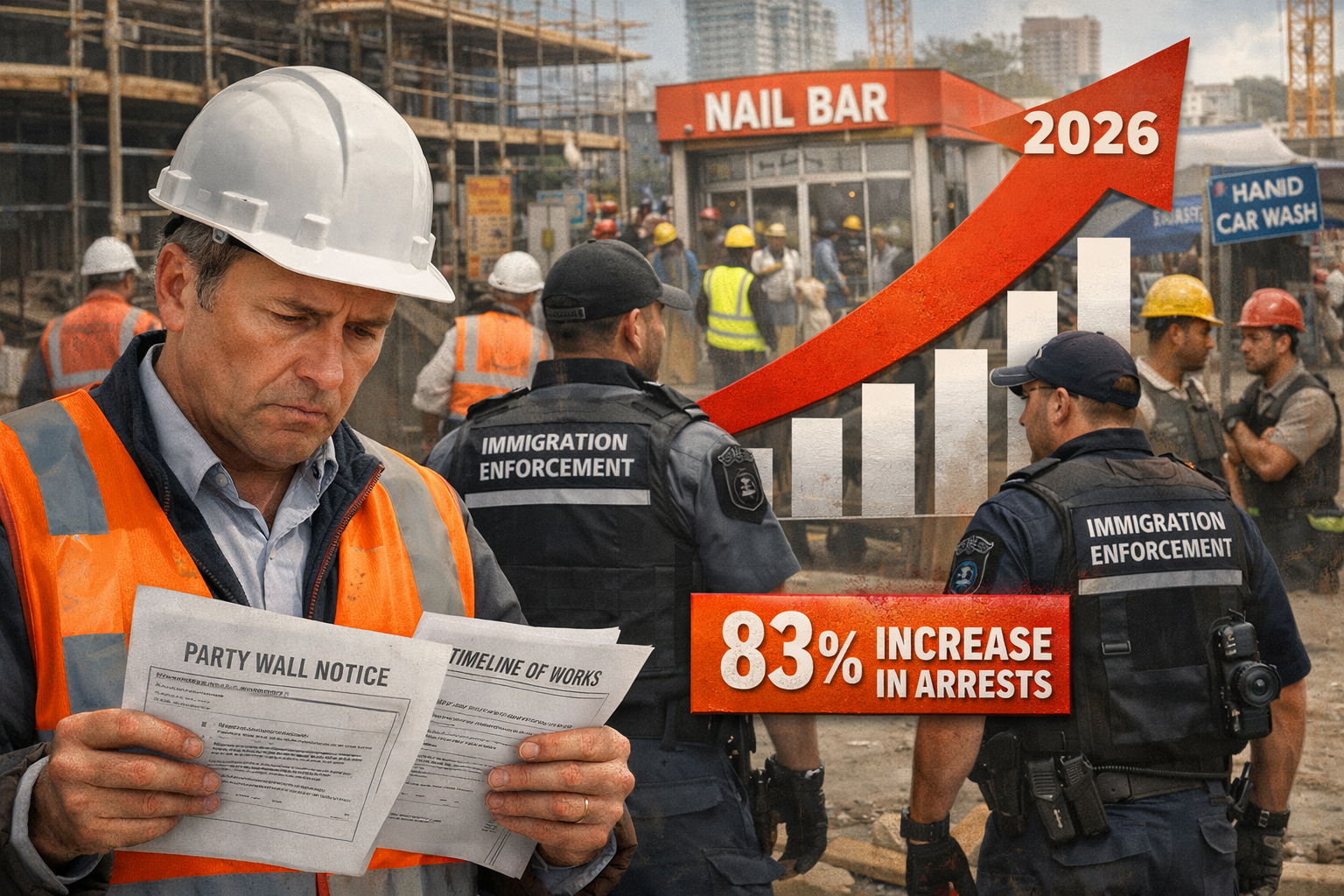
The enforcement environment in 2026 represents a dramatic escalation from previous years. The Home Office invested an additional £5 million in Immigration Enforcement during 2024-2025, funding that translated directly into increased raid frequency and arrest numbers.[1]
Record-Breaking Enforcement Statistics
The numbers paint a stark picture of the current enforcement climate:
| Metric | 2024-2025 Period | Increase |
|---|---|---|
| Business Raids | 17,400+ | 77% ⬆️ |
| Arrests Made | 12,300+ | 83% ⬆️ |
| Wales Raids | 1,320 | 103% ⬆️ |
| Wales Arrests | 649 | 85% ⬆️ |
| Sponsor Licences Revoked | ~2,000 | Significant increase |
These enforcement actions specifically target high-risk sectors including construction sites, warehouses, nail bars, car washes, barbers, and takeaway shops—industries that frequently intersect with construction and renovation projects requiring party wall procedures.[1]
New Enforcement Technologies and Methods
Immigration Enforcement officers now deploy body-worn video technology as standard equipment across all UK teams, a rollout that began in September 2025.[1] This technology serves dual purposes: strengthening arrest documentation and building more robust prosecution cases. For construction sites, this means enforcement visits are thoroughly documented, creating permanent records of any compliance failures.
The introduction of mandatory digital ID systems by the end of Parliament represents another significant shift. This system will simplify employer compliance checks while simultaneously restricting employment options for workers without proper authorization.[1]
How Workforce Disruptions Impact Party Wall Surveying Procedures
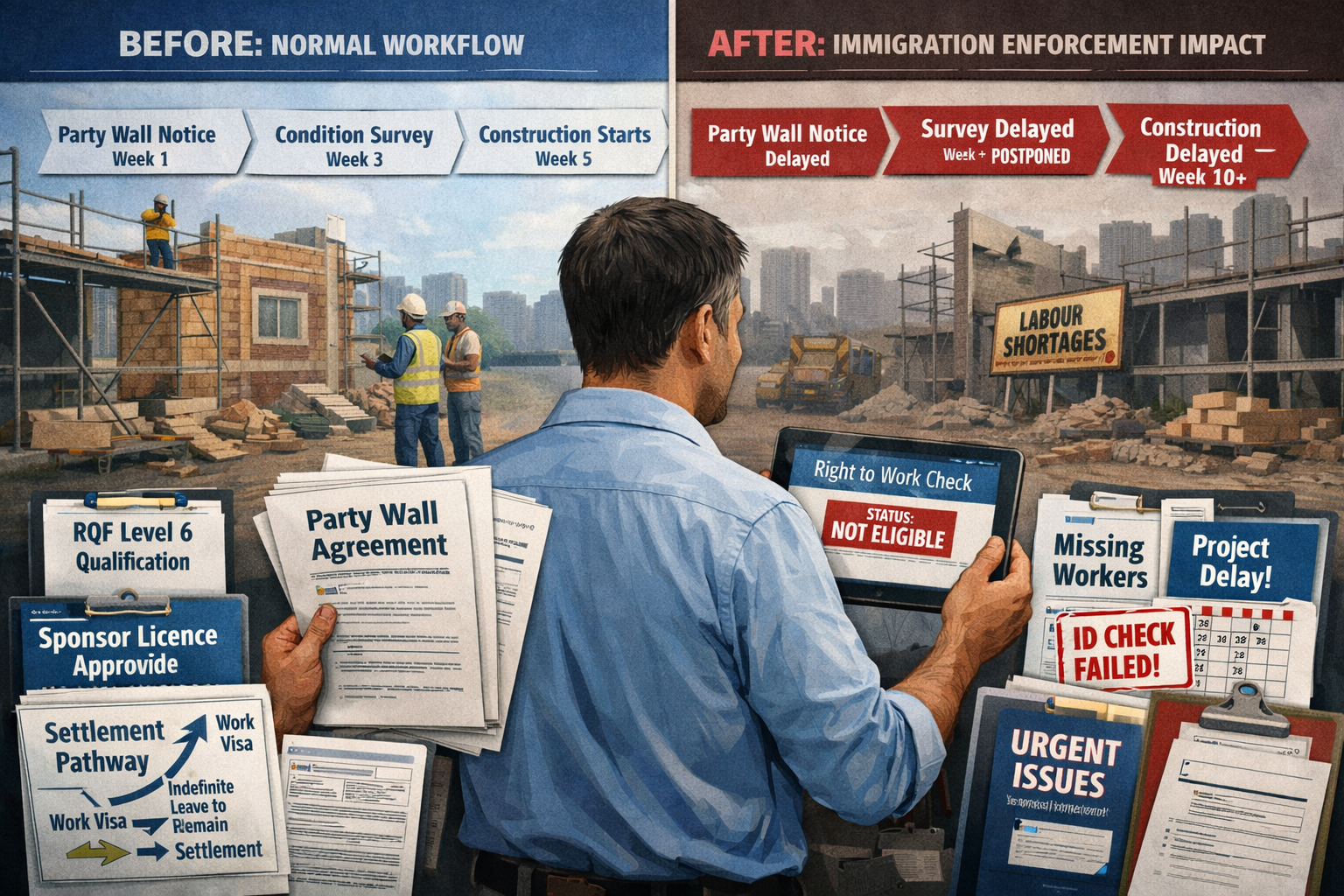
The connection between immigration enforcement and party wall surveying might not be immediately obvious, but the practical implications are substantial. When construction workers are arrested or sites are shut down for compliance violations, the carefully orchestrated timeline of party wall notices and awards can collapse.
Timeline Disruptions and Statutory Deadlines
Party wall procedures operate within strict statutory frameworks. The Party Wall etc. Act 1996 establishes specific notice periods and response timeframes that cannot be simply paused when workforce issues arise. When immigration enforcement actions remove workers from a site, several critical challenges emerge:
Notice Period Complications ⏳
Building owners must serve party wall notices well in advance of planned works. However, if the contractor's workforce faces enforcement action during the notice period, the entire project timeline shifts. This creates a cascade effect:
- Original notice periods may expire before work can actually commence
- New notices may need to be served with updated commencement dates
- Adjoining owners may withdraw consent based on changed circumstances
- Party wall awards may require revision
Schedule of Condition Challenges 📸
Schedules of condition document the pre-work state of adjoining properties. These surveys must be completed before works commence, but workforce disruptions can create problematic gaps:
- Scheduled inspections may be delayed or cancelled
- Extended delays between survey and work commencement reduce the schedule's protective value
- Re-surveys may become necessary, increasing costs for all parties
Financial Implications for All Parties
The costs of party wall procedures typically fall to the building owner. When workforce disruptions extend project timelines, these costs multiply:
- Extended surveyor engagement periods increase professional fees
- Multiple site visits due to delayed commencement add inspection costs
- Revised awards and documentation require additional administrative work
- Dispute resolution becomes more likely when projects face repeated delays
"One-third of construction firms now report direct impacts from immigration enforcement activities, with 11% experiencing actual worker absences. These disruptions don't just affect the building site—they cascade through every aspect of project management, including statutory party wall obligations."
Workforce Disruptions and Party Wall Surveying: Key Regulatory Changes Affecting Construction
Beyond enforcement intensity, several fundamental regulatory changes in 2025-2026 have reshaped the construction workforce landscape, creating new challenges for party wall surveyors and building owners.
Skilled Worker Visa Threshold Increases
The Skilled Worker visa skill threshold increased to RQF Level 6 (bachelor's degree equivalent) effective 2025-2026, removing 111 jobs from the eligible occupation list.[4] This change directly impacts the construction sector's ability to recruit skilled tradespeople from overseas, potentially creating:
- Reduced workforce availability for specialized construction tasks
- Increased competition for qualified workers among contractors
- Higher labor costs as demand outstrips supply
- Extended project timelines due to worker shortages
For party wall surveyors working in areas like West London or North London, where construction activity remains high, these workforce constraints create scheduling challenges that must be factored into party wall planning.
Extended Settlement Pathways
The settlement qualifying period increased from 5 to 10 years under the Border Security, Asylum and Immigration Act.[2] While high earners (over £125,140 annually for three years) can reduce this period by up to seven years, the change creates workforce uncertainty:
- Workers may leave the UK rather than commit to extended settlement periods
- Construction firms face higher turnover rates
- Long-term project planning becomes more complex
- Workforce stability decreases across the industry
Expanded Right-to-Work Verification Requirements
Perhaps most significantly for construction, the Border Security, Asylum and Immigration Act extends right-to-work verification to gig economy, casual, subcontracted, and temporary workers—categories previously exempt.[1] This expansion directly affects construction's traditional reliance on flexible labor arrangements.
Construction projects often utilize:
- Subcontractors for specialized tasks
- Temporary workers for peak demand periods
- Casual labor for short-duration projects
- Gig workers for specific skill requirements
All these categories now require the same rigorous verification as permanent employees, creating administrative burdens and compliance risks for contractors—and by extension, timeline uncertainties for party wall procedures.
EU Settlement Scheme Documentation
EU nationals who previously held automatic work rights must now possess appropriate documentation under the EU Settlement Scheme.[3] Employers face fines and legal challenges for non-compliance, creating additional verification requirements that affect:
- Contractor workforce composition
- Documentation requirements for site access
- Compliance verification timelines
- Risk assessment for building owners
Electronic Travel Authorisation Enforcement
ETA enforcement began February 25, 2026, affecting visa-free travelers from 85 countries.[6][7] While this primarily impacts short-term visitors, it creates complications for:
- International consultants and specialists
- Equipment suppliers and technical experts
- Overseas property owners managing UK renovations
- Cross-border construction firms
Practical Strategies for Party Wall Surveyors in 2026
Given these challenges, party wall surveyors must adapt their practices to account for Workforce Disruptions and Party Wall Surveying: Adapting to 2026's Immigration Enforcement Challenges. Several practical strategies can help mitigate risks and maintain project timelines.
Enhanced Timeline Planning 📅
Build substantial buffers into all project timelines. The traditional approach of calculating minimum statutory notice periods no longer provides adequate protection. Consider:
- Adding 25-30% contingency time to standard notice periods
- Planning for potential workforce disruptions when scheduling critical milestones
- Communicating realistic timelines to building owners and adjoining owners
- Documenting assumptions about workforce availability in party wall awards
Contractor Due Diligence 🔍
Party wall surveyors should advise building owners to conduct enhanced due diligence on contractors:
Verification Checklist:
✅ Valid sponsor licence (if employing overseas workers)
✅ Documented right-to-work verification procedures
✅ Compliance history with immigration enforcement
✅ Workforce contingency plans
✅ Subcontractor verification protocols
✅ Insurance coverage for compliance-related delays
Flexible Award Structures
When preparing party wall awards, incorporate flexibility to accommodate potential workforce disruptions:
- Conditional commencement clauses that account for workforce availability
- Extended validity periods for schedules of condition
- Revision procedures that don't require complete re-negotiation
- Force majeure provisions specifically addressing enforcement actions
Communication Protocols 📞
Establish clear communication protocols with all parties:
- Regular status updates to adjoining owners about project progress
- Early warning systems for potential workforce issues
- Documented notification procedures when delays occur
- Stakeholder management to maintain relationships during disruptions
Geographic Considerations
Different London areas experience varying enforcement intensities. Surveyors working in South London, East London, or Central London should:
- Monitor local enforcement patterns
- Adjust timeline buffers based on regional risk
- Develop relationships with compliant contractors in each area
- Share intelligence about enforcement activities (while respecting confidentiality)
Risk Mitigation for Building Owners and Adjoining Owners
Both building owners and adjoining owners face unique risks from workforce disruptions affecting party wall procedures. Understanding these risks enables better protection strategies.
For Building Owners 🏗️
Building owners initiating works bear primary responsibility for party wall compliance and face the greatest exposure to workforce disruption risks:
Financial Risks:
- Extended surveyor fees due to prolonged timelines
- Increased contractor costs from workforce uncertainties
- Potential penalties for notice period violations
- Dispute resolution costs if adjoining owners object to delays
Mitigation Strategies:
- Select contractors with proven compliance records
- Include workforce disruption clauses in construction contracts
- Maintain contingency budgets for timeline extensions
- Consider insurance products covering compliance-related delays
For Adjoining Owners 🏘️
Adjoining owners must protect their properties while neighboring works proceed, but workforce disruptions create unique vulnerabilities:
Protection Concerns:
- Delayed schedules of condition reduce protective value
- Extended exposure to construction risks
- Uncertainty about actual work commencement
- Difficulty planning around neighbor's construction
Mitigation Strategies:
- Request detailed contractor compliance information
- Insist on comprehensive schedules of condition
- Establish clear communication expectations in awards
- Consider appointing your own surveyor for complex projects (learn more about adjoining owners' surveyors)
Understanding Different Types of Party Wall Works in the Current Climate
Different types of party wall works face varying levels of workforce disruption risk. Understanding these distinctions helps surveyors provide targeted advice.
High-Risk Work Categories
Foundation and Structural Works 🏗️
Works involving excavation near neighboring properties or structural modifications to party walls require specialized skilled labor—exactly the workforce category most affected by visa threshold increases. These projects face:
- Higher likelihood of skilled worker shortages
- Greater dependence on overseas labor
- More complex compliance requirements
- Extended timelines due to specialist availability
Medium-Risk Work Categories
Building on Party Walls
Construction of new walls or buildings astride boundary lines involves standard construction labor, which faces moderate workforce disruption risks:
- Mixed skill requirements reduce single-point vulnerabilities
- Greater flexibility in workforce sourcing
- Standard compliance requirements
- Moderate timeline extension risks
Lower-Risk Work Categories
Minor Repairs and Maintenance
Simple repairs to existing party structures typically require minimal specialized labor and face lower workforce disruption risks:
- Smaller workforce requirements
- Greater domestic labor availability
- Simplified compliance verification
- Lower timeline extension probability
The Role of Digital Systems and Technology
The shift toward digital ID systems and electronic verification presents both challenges and opportunities for party wall surveying in 2026.
Digital ID Implementation
The government's planned mandatory digital ID system for proving right-to-work eligibility will fundamentally change contractor compliance verification.[1] For party wall procedures, this creates:
Opportunities:
- Faster verification of contractor workforce compliance
- Real-time validation of worker authorization
- Reduced documentation burden for legitimate contractors
- Enhanced transparency in workforce composition
Challenges:
- Technology adoption costs for smaller contractors
- System reliability and downtime risks
- Privacy concerns and data management requirements
- Digital exclusion for some workforce segments
Electronic Documentation
Party wall surveyors increasingly utilize electronic systems for notices, awards, and schedules. This technological shift aligns well with broader digital ID implementation:
- Electronic service of party wall notices improves documentation
- Digital schedules of condition with timestamped photographs provide better evidence
- Cloud-based award management enables real-time updates and revisions
- Electronic signatures expedite agreement processes
Case Studies: Real-World Impacts
While specific case details remain confidential, general patterns illustrate how Workforce Disruptions and Party Wall Surveying: Adapting to 2026's Immigration Enforcement Challenges manifest in practice.
Scenario 1: Basement Excavation Delay
A building owner in a dense residential area served party wall notices for a basement excavation project. Three weeks before scheduled commencement, immigration enforcement conducted a raid on the contractor's primary site, resulting in multiple arrests. The contractor's workforce was depleted, forcing a six-week delay.
Impact:
- Original party wall notices expired
- New notices required with updated commencement dates
- Adjoining owner withdrew initial consent
- Dispute resolution process added three months
- Total project delay: five months
- Additional surveyor fees: £4,200
Lesson: Enhanced contractor due diligence and timeline buffers could have mitigated some delays.
Scenario 2: Loft Conversion Timeline Extension
A loft conversion project involving party wall works proceeded smoothly until the contractor's sponsor licence was revoked due to documentation failures. The contractor could no longer legally employ several key skilled workers.
Impact:
- Work stoppage during contractor transition
- New contractor required re-familiarization with party wall award
- Schedule of condition validity questioned
- Supplementary inspections necessary
- Total project delay: eight weeks
- Relationship strain with adjoining owner
Lesson: Verifying contractor sponsor licence status before project commencement is essential.
Future Outlook: What Comes Next

The trajectory of immigration enforcement and construction workforce regulation suggests several likely developments beyond 2026.
Anticipated Regulatory Evolution
Increased Automation in Verification 🤖
Digital ID systems will likely expand to include:
- Automated site access control linked to work authorization
- Real-time compliance monitoring for construction sites
- Integrated verification across contractor supply chains
- Blockchain-based credential verification
Enhanced Penalty Structures ⚖️
Expect escalating consequences for compliance failures:
- Higher fines for right-to-work violations
- Personal liability for directors and officers
- Expanded sponsor licence revocation criteria
- Criminal sanctions for systematic violations
Industry Adaptation Strategies
The construction industry will necessarily adapt to the new enforcement environment:
Workforce Development 📚
- Increased investment in domestic training programs
- Apprenticeship expansion to reduce overseas labor dependence
- Skill development initiatives for existing workforce
- Technology adoption to reduce labor requirements
Supply Chain Restructuring 🔗
- Pre-qualified contractor networks with verified compliance
- Integrated verification systems across supply chains
- Risk-sharing arrangements for workforce disruptions
- Insurance products specifically addressing compliance risks
Conclusion: Navigating the New Normal
Workforce Disruptions and Party Wall Surveying: Adapting to 2026's Immigration Enforcement Challenges represents more than a temporary inconvenience—it signals a fundamental shift in how construction projects must be planned, managed, and executed. With immigration enforcement raids reaching historic levels and regulatory requirements expanding dramatically, party wall surveyors must evolve their practices to protect clients and maintain professional standards.
The 77% surge in enforcement raids and 83% increase in arrests between July 2024 and December 2025 demonstrate the government's commitment to immigration enforcement.[1] The construction sector, as a primary target, will continue experiencing workforce disruptions that cascade through every aspect of project delivery, including party wall procedures.
Actionable Next Steps for Party Wall Surveyors
Immediate Actions (Next 30 Days):
- Review current projects for workforce disruption vulnerabilities
- Develop enhanced timeline templates incorporating 25-30% contingency buffers
- Create contractor verification checklists covering sponsor licences, right-to-work procedures, and compliance history
- Update standard award language to address workforce disruption scenarios
- Establish communication protocols for informing clients about enforcement risks
Medium-Term Actions (Next 3-6 Months):
- Build relationships with compliant contractors across all service areas
- Develop expertise in immigration compliance relevant to construction
- Create client education materials explaining workforce disruption risks
- Implement digital systems for notices, awards, and schedules of condition
- Network with other surveyors to share intelligence about enforcement patterns
Long-Term Strategic Actions:
- Monitor regulatory developments affecting construction workforce availability
- Participate in industry discussions about compliance best practices
- Invest in technology that streamlines verification and documentation
- Develop specialized expertise in high-risk project categories
- Build contingency planning into all party wall procedures as standard practice
Final Thoughts
The intersection of immigration enforcement and party wall surveying may seem unlikely, but the practical connections are undeniable. Every construction project requiring party wall procedures depends on workforce availability, and that availability now faces unprecedented uncertainty. Party wall surveyors who adapt their practices to account for these realities will better serve their clients, protect adjoining owners, and maintain professional standards in an increasingly complex regulatory environment.
For building owners planning works, the message is clear: early planning, enhanced due diligence, and realistic timelines are no longer optional—they're essential. For adjoining owners, understanding these dynamics helps set appropriate expectations and protect property interests. And for party wall surveyors, embracing these challenges as opportunities for professional development and enhanced client service will distinguish leaders in the field.
The construction industry has weathered countless changes throughout history. The current immigration enforcement environment represents another adaptation challenge, but one that can be successfully navigated with proper planning, professional expertise, and realistic expectations. By understanding Workforce Disruptions and Party Wall Surveying: Adapting to 2026's Immigration Enforcement Challenges, all stakeholders can work together to maintain the essential protections that party wall procedures provide while acknowledging the new realities of construction workforce management.
For additional guidance on party wall procedures, explore our comprehensive resources on party wall agreement templates, boundary wall rules, and keeping party wall costs down.
References
[1] Immigration Enforcement Raids Reach Highest Level In History – https://www.gov.uk/government/news/immigration-enforcement-raids-reach-highest-level-in-history
[2] Regulatory Outlook January 2026 Employment Contingent Workforce Immigration – https://www.osborneclarke.com/insights/regulatory-outlook-january-2026-employment-contingent-workforce-immigration
[3] Brexit Update – https://axis.lawyer/brexit-update/
[4] Uk Immigration 2026 Changes – https://www.centuroglobal.com/article/uk-immigration-2026-changes/
[5] A Fairer Pathway To Settlement In The Uk Preparing Your Workforce For Change – https://www.employmentlawworldview.com/a-fairer-pathway-to-settlement-in-the-uk-preparing-your-workforce-for-change/
[6] Uk To Enforce Eta Requirement From February 2026 – https://newlandchase.com/uk-to-enforce-eta-requirement-from-february-2026/
[7] January 2026 Global Immigration Recap Emea – https://www.clarkhill.com/news-events/news/january-2026-global-immigration-recap-emea/