


Agreed Surveyor Party Wall: Your Complete Guide to Streamlining the Party Wall Process in 2025
When neighbours embark on construction projects that affect shared walls, fences, or boundaries, the agreed surveyor party wall approach can transform a potentially contentious process into a smooth, cost-effective experience. Imagine cutting your surveyor fees in half while maintaining complete impartiality and professional expertise—that’s the power of appointing a single agreed surveyor to represent both parties under the Party Wall etc. Act 1996.
Whether you’re planning a loft conversion, basement excavation, or structural alterations to a shared wall, understanding how an agreed surveyor party wall arrangement works can save you time, money, and neighbourly relationships. This comprehensive guide explores everything property owners need to know about this efficient alternative to appointing separate surveyors.
Key Takeaways
- 🤝 An agreed surveyor party wall appointment allows both neighbours to share one impartial surveyor, typically reducing costs by 40-50% compared to appointing separate surveyors
- ⚖️ The agreed surveyor must remain completely impartial and act fairly for both the building owner and adjoining owner throughout the entire process
- 📋 Both parties must formally consent in writing to appoint an agreed surveyor, and either party can withdraw consent and appoint their own surveyor at any time
- 💰 Cost savings are significant, but the agreed surveyor’s fees are usually split equally or paid by the building owner depending on the agreement
- ✅ The agreed surveyor produces the same legally binding party wall award as would be created if two separate surveyors were appointed
What Is an Agreed Surveyor Party Wall Arrangement?
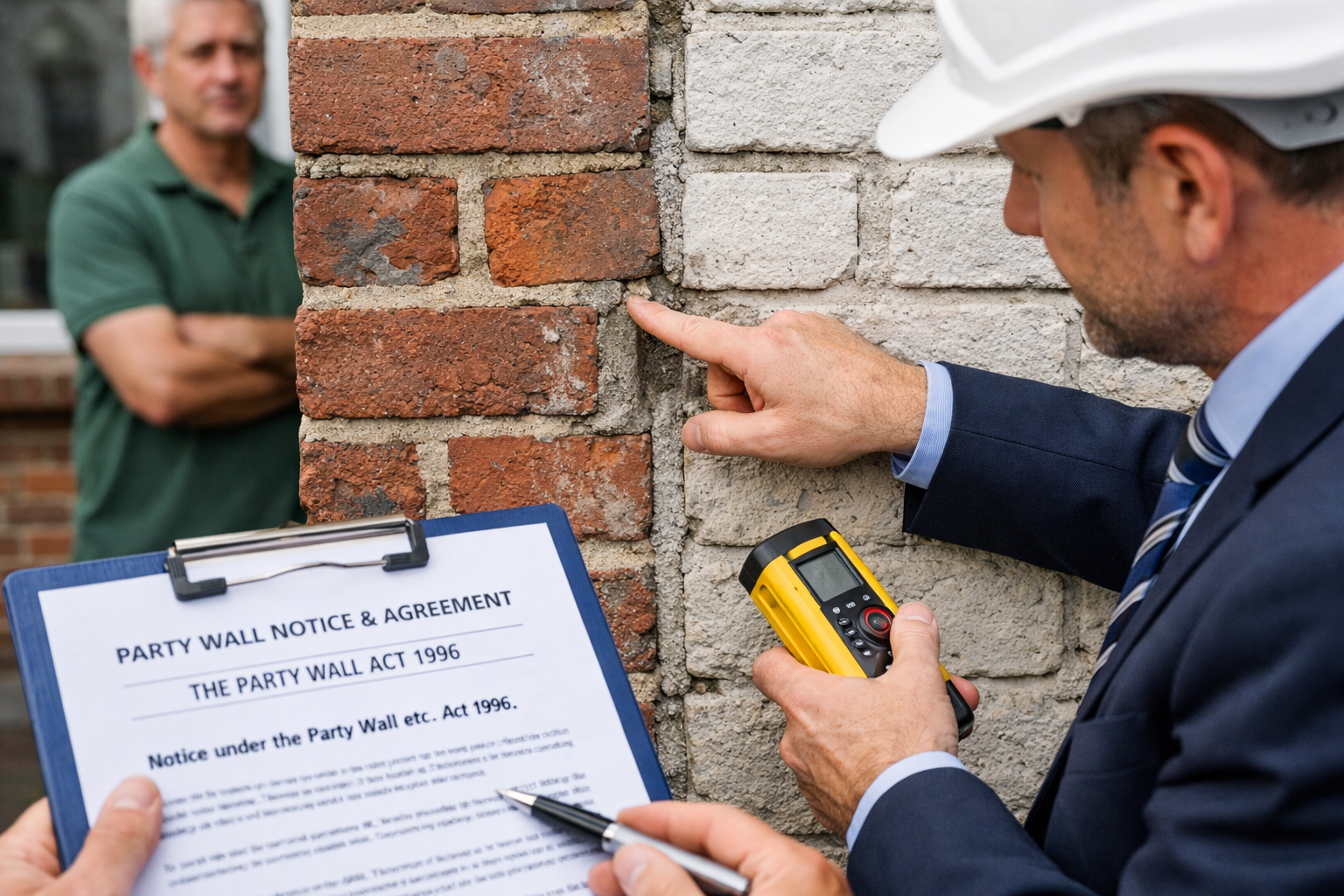
An agreed surveyor party wall arrangement is a provision under the Party Wall etc. Act 1996 that allows neighbouring property owners to appoint a single surveyor to act on behalf of both parties during party wall matters. Rather than each party appointing their own surveyor—the building owner appointing a building owner’s surveyor and the adjoining owner appointing an adjoining owner’s surveyor—both parties mutually agree to share one professional.
This single surveyor assumes the responsibilities of both roles simultaneously, maintaining strict impartiality while ensuring both parties’ interests are protected throughout the process. The agreed surveyor examines the proposed works, prepares schedules of condition, drafts the party wall award, and oversees the construction work just as two separate surveyors would.
The Legal Framework Behind Agreed Surveyors
The Party Wall etc. Act 1996 specifically provides for agreed surveyor appointments in Section 10. This legislation recognizes that not all party wall matters require adversarial representation, especially when neighbours maintain good relationships and trust a single professional to act fairly.
Key legal points include:
- Both parties must provide written consent to the agreed surveyor appointment
- The agreed surveyor must be impartial and cannot favour either party
- Either party can revoke the agreement and appoint their own surveyor at any stage
- The agreed surveyor has the same powers and duties as two separate surveyors would have
- The agreed surveyor must produce a valid party wall award that binds both parties
How Does an Agreed Surveyor Party Wall Process Work?
Understanding the step-by-step process helps property owners navigate the agreed surveyor route with confidence. Here’s how the process typically unfolds:
Step 1: Service of Party Wall Notice
The building owner must first serve appropriate party wall notices to the adjoining owner, detailing the proposed works. This formal notification starts the statutory process, regardless of whether an agreed surveyor will eventually be appointed.
The notice must include:
- Details of the proposed works
- The anticipated start date
- Technical drawings or plans where applicable
- Information about the building owner’s rights under the Act
Step 2: Adjoining Owner’s Response
After receiving the notice, the adjoining owner has 14 days to respond in one of three ways:
- Consent to the works – ending the party wall process (though a surveyor may still be advisable for record-keeping)
- Dissent or fail to respond – triggering the dispute resolution mechanism
- Suggest an agreed surveyor – proposing the streamlined single-surveyor approach
Step 3: Mutual Agreement on Surveyor Selection
If both parties wish to pursue the agreed surveyor party wall route, they must:
✅ Identify a qualified, impartial surveyor acceptable to both parties
✅ Confirm the surveyor’s willingness to act in this capacity
✅ Provide written consent to the appointment
✅ Agree on fee arrangements (typically shared equally or paid by the building owner)
The chosen surveyor should have no prior relationship with either party that could compromise their impartiality. Many property owners find suitable professionals through party wall surveyor services that specialize in impartial appointments.
Step 4: The Agreed Surveyor’s Duties
Once appointed, the agreed surveyor undertakes comprehensive responsibilities:
| Duty | Description |
|---|---|
| Site Inspection | Thoroughly examines both properties and the party wall structure |
| Schedule of Condition | Documents the pre-work state of the adjoining owner’s property with photographs and detailed notes |
| Award Preparation | Drafts the party wall award outlining permissions, conditions, and timelines |
| Impartial Advice | Provides balanced guidance to both parties throughout the process |
| Work Monitoring | Oversees construction to ensure compliance with the award |
| Dispute Resolution | Addresses any concerns that arise during the works |
Step 5: Issuing the Party Wall Award
The agreed surveyor prepares and serves a legally binding party wall award to both parties. This document includes:
- Permission for the specified works to proceed
- Conditions and safeguards protecting the adjoining owner
- Working hours and access arrangements
- Schedule of condition as an appendix
- Details of any compensation (if applicable)
- The agreed surveyor’s fees and how they’ll be apportioned
Both parties receive identical copies of the award, which becomes enforceable once served.
Benefits of Choosing an Agreed Surveyor Party Wall Approach
The agreed surveyor route offers substantial advantages for property owners who can work collaboratively:
💰 Significant Cost Savings
Perhaps the most compelling benefit is the reduced financial burden. When two separate surveyors are appointed, each charges professional fees typically ranging from £700-£1,500 or more, depending on the complexity of the works and location. The building owner usually pays both sets of fees.
With an agreed surveyor party wall arrangement:
- Only one set of professional fees is incurred
- Total costs typically range from £800-£1,800 for straightforward cases
- Savings of 40-50% are common compared to the two-surveyor route
- Fee sharing can be negotiated between parties
For more information on managing expenses, explore tips on how to keep party wall costs down.
⏱️ Faster Resolution
With a single surveyor coordinating the entire process:
- Communication is streamlined
- No need for surveyors to correspond back and forth
- Scheduling inspections and meetings is simpler
- Awards are typically produced more quickly
- Disputes can be addressed immediately by one professional
🤝 Preserving Neighbourly Relations
The collaborative nature of agreeing on a single surveyor often:
- Demonstrates mutual trust and goodwill
- Reduces the adversarial atmosphere
- Encourages cooperative problem-solving
- Maintains positive long-term relationships between neighbours
- Creates a less stressful experience for all involved
📋 Simplified Administration
Property owners benefit from:
- Single point of contact for all queries
- Unified documentation and correspondence
- Consistent advice and guidance
- Reduced paperwork and administrative burden
- Clear accountability
Potential Drawbacks and Considerations
While the agreed surveyor party wall approach offers many advantages, property owners should consider potential limitations:
⚠️ Perceived Lack of Dedicated Representation
Some adjoining owners may feel more comfortable with their own surveyor who:
- Focuses exclusively on protecting their interests
- Provides confidential advice without considering the other party
- Acts as their advocate throughout the process
- Offers a second professional opinion on technical matters
This concern is particularly relevant when:
- The proposed works are extensive or complex
- There’s a history of disputes between neighbours
- The adjoining owner lacks construction knowledge
- Significant property value or structural issues are at stake
🔄 Right to Withdraw
Either party can revoke their consent to the agreed surveyor appointment at any time and appoint their own surveyor. This means:
- The agreed surveyor arrangement isn’t guaranteed to continue
- If one party withdraws, costs may increase as a second surveyor joins
- The process may be delayed while a new surveyor gets up to speed
- Previous work by the agreed surveyor still needs to be paid for
⚖️ Balancing Impartiality
The agreed surveyor must maintain strict neutrality, which means:
- Neither party receives “preferential” treatment
- The surveyor cannot provide confidential strategic advice to either party
- Decisions must be fair and balanced, which may not fully satisfy either party
- Some property owners prefer a dedicated advocate
When Is an Agreed Surveyor Party Wall Arrangement Most Appropriate?
The agreed surveyor route works best in specific circumstances:
✅ Ideal Scenarios
Good neighbourly relations exist – When property owners communicate well and trust each other, the collaborative approach flourishes.
Straightforward works are planned – Simple projects like:
- Single-storey rear extensions
- Loft conversions without complex structural changes
- Minor repairs to party walls
- Standard beam insertions
Both parties want to minimize costs – When budget considerations are important for both neighbours, sharing one surveyor makes financial sense.
Quick resolution is desired – Projects with tight timelines benefit from the streamlined single-surveyor process.
Previous successful collaboration – Neighbours who have worked together positively on other matters often continue this approach.
❌ Less Suitable Scenarios
Complex or extensive works – Major projects such as:
- Multi-storey basement excavations
- Substantial structural alterations
- Works affecting multiple party walls
- Projects with unusual technical challenges
Strained relationships – When neighbours have existing disputes or mistrust, separate representation provides peace of mind.
Significant property value concerns – High-value properties or works that could substantially affect property values may warrant dedicated representation.
Previous disputes – A history of disagreements suggests separate surveyors would be more appropriate.
Vulnerable parties – When one party lacks construction knowledge or feels disadvantaged, having their own surveyor provides essential protection.
For guidance on specific scenarios, consult resources for building owners and adjoining owners.
How to Select the Right Agreed Surveyor
Choosing the appropriate professional is crucial for a successful agreed surveyor party wall arrangement. Consider these essential factors:
Professional Qualifications
Look for surveyors with:
- RICS membership (Royal Institution of Chartered Surveyors) – ideally MRICS or FRICS
- Specific party wall expertise – not just general building surveying experience
- Professional indemnity insurance – adequate coverage for the work involved
- Local knowledge – familiarity with construction practices in your area
- Proven track record – experience with similar types of works
Impartiality and Independence
Ensure the surveyor:
- Has no prior relationship with either party
- Has not previously worked for either property owner
- Demonstrates no financial interest in the outcome
- Maintains professional distance from both parties
- Can provide references from previous agreed surveyor appointments
Communication Skills
The ideal agreed surveyor should:
- Explain technical matters in plain language
- Respond promptly to queries from both parties
- Provide clear, written documentation
- Be accessible throughout the process
- Demonstrate patience and diplomacy
Fee Transparency
Before appointment, clarify:
- The total estimated fees for the entire process
- What services are included in the quoted price
- How fees will be apportioned between parties
- Payment terms and schedules
- Any additional costs that might arise
- Whether VAT is included in quoted figures
Questions to Ask Potential Agreed Surveyors
📋 Experience Questions:
- How many agreed surveyor appointments have you completed?
- What types of party wall works do you specialize in?
- Have you handled projects similar to ours?
📋 Process Questions:
- What is your typical timeline for completing the award?
- How do you ensure impartiality between both parties?
- What happens if a dispute arises during the works?
📋 Practical Questions:
- How quickly can you begin the process?
- What information do you need from both parties?
- How will you communicate with us throughout?
The Agreed Surveyor’s Fees: Who Pays and How Much?
Understanding the financial arrangements for an agreed surveyor party wall appointment helps both parties budget appropriately.
Typical Fee Structures
Standard agreed surveyor fees generally range from:
| Work Complexity | Typical Fee Range |
|---|---|
| Simple works (minor alterations) | £800 – £1,200 |
| Moderate works (extensions, loft conversions) | £1,200 – £1,800 |
| Complex works (basements, major structural changes) | £1,800 – £3,000+ |
These fees typically cover:
- Initial consultations with both parties
- Site inspections and surveys
- Preparation of schedules of condition
- Drafting and serving the party wall award
- Reasonable monitoring during construction
- Addressing queries and minor disputes
Fee Apportionment Options
Option 1: Building Owner Pays All Fees
The most common arrangement under the Party Wall Act is for the building owner (the party undertaking the works) to pay all surveyor fees. This applies to agreed surveyor appointments just as it would to separate surveyors.
Advantages:
- Aligns with standard Party Wall Act practice
- Adjoining owner incurs no costs
- Simplifies financial arrangements
Option 2: Equal Sharing
Some neighbours agree to split the agreed surveyor’s fees equally, particularly when:
- Both parties benefit from cost savings
- The relationship is collaborative
- The adjoining owner wants to contribute to maintaining good relations
Advantages:
- Demonstrates shared commitment
- Further reduces building owner’s costs
- Creates sense of partnership
Option 3: Custom Arrangements
Parties can negotiate any fee-sharing arrangement that suits their circumstances, such as:
- Percentage splits (e.g., 70/30, 60/40)
- Building owner pays initial fees, adjoining owner contributes to monitoring
- Conditional arrangements based on specific outcomes
Additional Costs to Consider
Beyond the agreed surveyor’s fees, budget for:
- Third surveyor fees (if a dispute requires third surveyor appointment): £1,500-£3,000+
- Remedial works (if damage occurs): Variable, covered by building owner
- Legal fees (if disputes escalate beyond the Act): £2,000+
- Additional inspections (if works deviate from the award): £200-£500 per visit
For comprehensive cost information, review the costs of party wall process.
Common Misconceptions About Agreed Surveyor Party Wall Appointments
Several myths persist about the agreed surveyor route. Let’s clarify the facts:
❌ Myth 1: “The Agreed Surveyor Favors the Building Owner”
✅ Reality: A professional agreed surveyor must maintain strict impartiality. Their duty is to act fairly for both parties, and any bias would constitute professional misconduct. The surveyor’s reputation and RICS membership depend on maintaining neutrality.
❌ Myth 2: “You Can’t Change Your Mind Once You Agree”
✅ Reality: Either party can withdraw consent at any time and appoint their own surveyor. The Party Wall Act specifically protects this right, ensuring no one is locked into an arrangement they’re uncomfortable with.
❌ Myth 3: “Agreed Surveyors Produce Less Thorough Awards”
✅ Reality: The agreed surveyor must produce the same comprehensive, legally binding award as would result from two separate surveyors. The documentation, schedules of condition, and protective measures are identical in scope and detail.
❌ Myth 4: “It’s Always Cheaper to Use an Agreed Surveyor”
✅ Reality: While the agreed surveyor’s fees are typically lower than combined fees for two surveyors, if one party later withdraws and appoints their own surveyor, total costs can exceed the two-surveyor route from the outset. The agreed surveyor’s work still must be paid for, plus the new surveyor’s fees.
❌ Myth 5: “The Adjoining Owner Loses Protection”
✅ Reality: The adjoining owner receives the same legal protections under the Party Wall Act regardless of whether an agreed surveyor or separate surveyors are appointed. The award must still protect their property, provide schedules of condition, and set appropriate safeguards.
❌ Myth 6: “You Don’t Need a Surveyor If Neighbours Agree”
✅ Reality: Even with friendly neighbours, professional surveying ensures proper documentation, protects both parties legally, and provides expert oversight. Having a party wall agreement without a surveyor can create future problems if disputes arise or damage occurs.
Alternatives to the Agreed Surveyor Party Wall Route
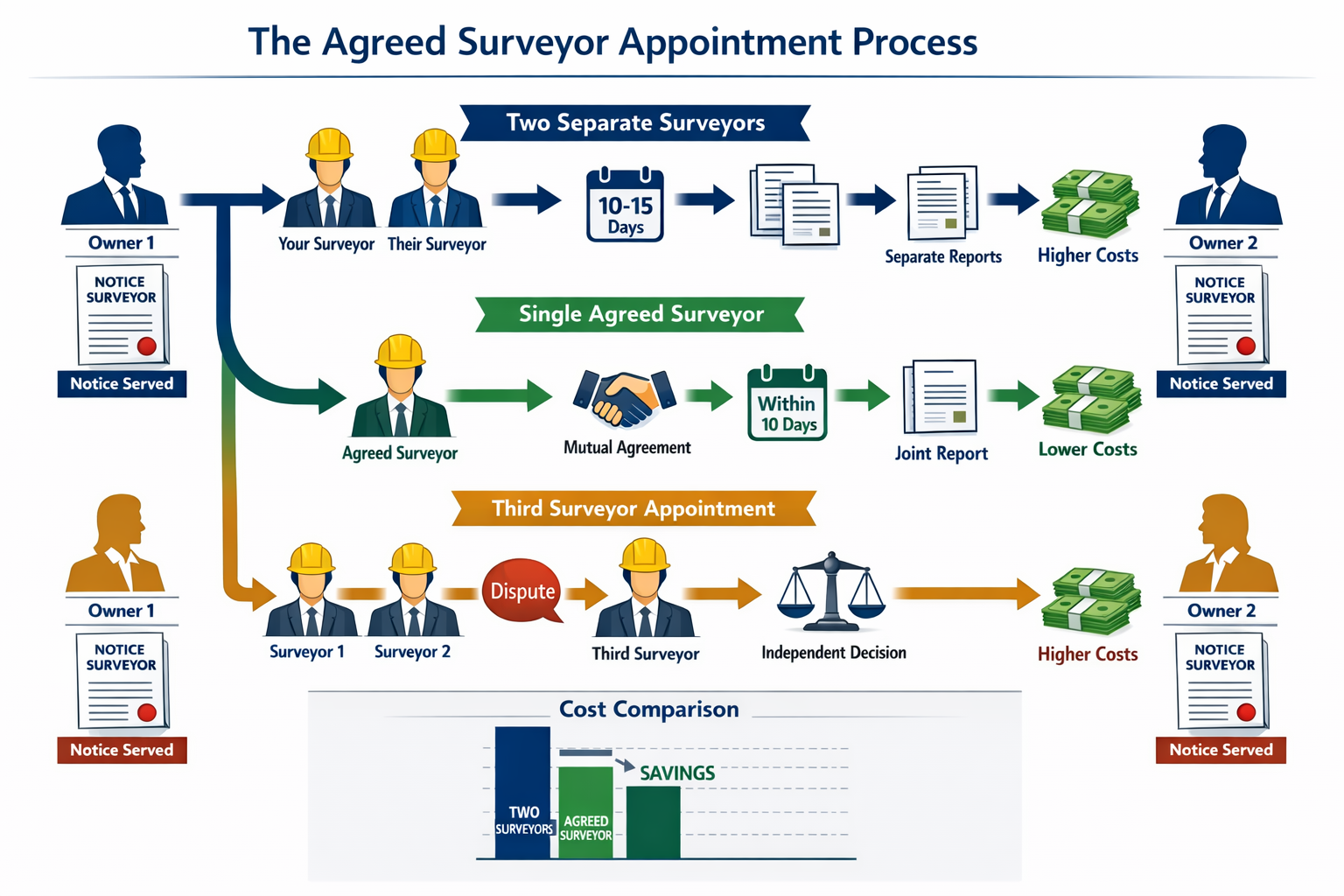
When the agreed surveyor approach isn’t suitable, property owners have other options:
Two Separate Surveyors
The traditional approach involves:
- Building owner’s surveyor: Appointed by the party undertaking works to represent their interests
- Adjoining owner’s surveyor: Appointed by the neighbouring property owner to protect their interests
Advantages:
- Dedicated representation for each party
- Confidential advice for both sides
- Two professional opinions on technical matters
- Greater sense of protection for the adjoining owner
Disadvantages:
- Higher total costs (typically double the agreed surveyor route)
- Longer timelines due to surveyor correspondence
- More formal, potentially adversarial atmosphere
- Additional administrative complexity
Learn more about building owner’s surveyors and adjoining owner’s surveyors.
Third Surveyor Appointment
When the two appointed surveyors cannot agree on specific matters, they may appoint a third surveyor to make a binding decision. This is rare but provides a resolution mechanism.
When it occurs:
- Disagreement on technical aspects of the award
- Disputes about appropriate safeguards
- Conflicts over fee apportionment
- Differing opinions on damage assessment
Process:
- Both surveyors must agree on the third surveyor selection
- If they cannot agree, either party can request the appointing officer (usually the local authority) to select one
- The third surveyor’s decision is final and binding
- Additional costs apply (typically £1,500-£3,000+)
Consent Without Surveyor Involvement
If the adjoining owner consents to the works in writing within 14 days of receiving notice, the party wall process technically ends. However, this approach carries risks:
Risks for adjoining owners:
- No professional assessment of potential damage
- No schedule of condition documenting pre-work property state
- Difficult to prove damage was caused by the works
- No formal mechanism for addressing concerns during works
Risks for building owners:
- Adjoining owner may later claim damage without baseline documentation
- No formal award providing legal protection
- Potential for disputes without clear resolution framework
Most experts recommend professional involvement even when neighbours are friendly. For template guidance, see the party wall agreement template.
Practical Tips for a Successful Agreed Surveyor Party Wall Experience
Maximize the benefits of the agreed surveyor route with these practical strategies:
🗣️ Communicate Early and Openly
- Discuss your plans with your neighbour before serving formal notices
- Explain the benefits of the agreed surveyor approach
- Address any concerns or questions they may have
- Maintain friendly, respectful communication throughout
📄 Document Everything
- Keep copies of all notices, correspondence, and agreements
- Maintain a file of the surveyor’s communications
- Photograph the party wall and adjoining property before works begin
- Save emails and written confirmations
🤝 Choose Your Surveyor Together
- Involve both parties in the selection process
- Interview multiple candidates if necessary
- Ensure both parties are comfortable with the chosen professional
- Confirm the surveyor’s availability and timeline
💬 Establish Clear Expectations
- Discuss and agree on fee arrangements upfront
- Clarify the surveyor’s scope of work
- Set realistic timelines for the award preparation
- Understand the process for addressing concerns during works
📞 Maintain Professional Boundaries
- Direct all party wall queries to the agreed surveyor
- Avoid discussing technical matters directly with your neighbour
- Let the surveyor mediate any disagreements
- Trust the professional process
⚡ Act Promptly
- Respond quickly to surveyor requests for information
- Provide access for inspections as scheduled
- Review and comment on draft awards within reasonable timeframes
- Don’t delay the process unnecessarily
🔍 Review the Award Carefully
- Read the entire party wall award thoroughly
- Ask the surveyor to explain any unclear terms
- Ensure all your concerns are addressed
- Confirm you understand your rights and obligations
What Happens If Things Go Wrong?
Even with an agreed surveyor party wall arrangement, issues can arise. Here’s how to address common problems:
If One Party Wants to Withdraw
The process:
- Party notifies the agreed surveyor in writing of their intention to appoint their own surveyor
- The agreed surveyor’s appointment ends (though fees for work completed remain payable)
- The party appoints their own surveyor who coordinates with the other party’s surveyor
- The two surveyors prepare the award jointly or appoint a third surveyor if they disagree
Financial implications:
- The agreed surveyor’s fees for work completed must still be paid
- Additional fees for the newly appointed surveyor apply
- Total costs typically exceed what they would have been with two surveyors from the start
If Damage Occurs During Works
Steps to take:
- Document the damage immediately with photographs and written descriptions
- Notify the agreed surveyor without delay
- The surveyor inspects and assesses the damage
- The surveyor determines whether the damage resulted from the notified works
- If so, the building owner must remedy the damage at their expense
The agreed surveyor’s role:
- Impartially assesses the cause and extent of damage
- Determines appropriate remedial works
- Oversees repairs to ensure proper completion
- Mediates any disagreements about the damage
If the Building Owner Deviates from the Award
When works proceed differently than specified in the award:
Consequences:
- The building owner may be in breach of the award
- Work may need to stop until the issue is resolved
- Additional surveyor fees for reassessment and award variation
- Potential legal action by the adjoining owner
Resolution:
- The agreed surveyor assesses the deviation
- Determines whether it’s material or minor
- May require a supplemental award for significant changes
- Ensures the adjoining owner’s interests remain protected
If You’re Unhappy with the Agreed Surveyor
Options available:
- Discuss concerns directly – Many issues can be resolved through clear communication
- Request written explanations – The surveyor should clarify their decisions and reasoning
- Withdraw and appoint your own surveyor – Exercise your right to separate representation
- Appeal to the third surveyor – Once your own surveyor is appointed, disputes can be referred to a third surveyor
- Formal complaint – Report professional misconduct to RICS if appropriate
Regional Considerations for Agreed Surveyor Party Wall Appointments
The agreed surveyor approach works similarly across England and Wales, but local factors can influence the process:
London and Urban Areas
In densely populated areas like London, agreed surveyor appointments are particularly common because:
- Properties are closely spaced, making party wall matters frequent
- Neighbours often prioritize cost savings due to high property values
- Experienced party wall surveyors are readily available
- The culture of party wall procedures is well-established
Find specialists in Central London, North London, South London, East London, and West London.
Suburban and Rural Areas
In less densely populated regions:
- Party wall matters may be less frequent
- Fewer specialists may be available, making agreed surveyor selection more limited
- Neighbours may be less familiar with party wall procedures
- Travel costs for surveyors may be higher
Wales
The Party Wall etc. Act 1996 applies in Wales as it does in England, with identical provisions for agreed surveyor appointments. Welsh language documentation may be available from some surveyors.
Scotland and Northern Ireland
Important note: The Party Wall etc. Act 1996 does NOT apply in Scotland or Northern Ireland. These regions have different legal frameworks for boundary and shared wall matters. Property owners in these areas should seek local legal advice rather than following party wall procedures.
The Future of Agreed Surveyor Party Wall Arrangements in 2025
As we progress through 2025, several trends are shaping the agreed surveyor landscape:
📱 Digital Documentation
Modern agreed surveyors increasingly use:
- Digital photography and video for schedules of condition
- Cloud-based document sharing for instant access
- Electronic signatures for faster award execution
- Project management software for transparent tracking
- Virtual meetings to reduce scheduling delays
🌍 Sustainability Considerations
Party wall awards now often address:
- Sustainable construction methods
- Minimizing environmental impact during works
- Energy efficiency improvements affecting party walls
- Recycling of materials from party wall works
📊 Increased Transparency
Professional bodies and consumer advocates are pushing for:
- Standardized fee structures
- Clear explanations of surveyor duties
- Better public education about party wall rights
- More accessible dispute resolution mechanisms
🤖 Technology Integration
Emerging technologies supporting the process include:
- 3D scanning for precise condition documentation
- Structural monitoring sensors to detect movement during works
- AI-assisted damage assessment
- Blockchain-based award registration for permanent records
Frequently Asked Questions About Agreed Surveyor Party Wall Matters
Can I suggest an agreed surveyor even if my neighbour has already appointed their own surveyor?
Yes, you can propose switching to an agreed surveyor arrangement at any time before the award is finalized. However, your neighbour must consent, and their already-appointed surveyor’s fees for work completed will still need to be paid. The potential cost savings may be reduced if significant work has already been done.
What qualifications should an agreed surveyor have?
Look for a chartered surveyor (MRICS or FRICS) with specific party wall expertise. They should have professional indemnity insurance, local knowledge, and a proven track record of agreed surveyor appointments. Membership in the Faculty of Party Wall Surveyors (FPWS) or Pyramus & Thisbe Club demonstrates specialized expertise.
How long does the agreed surveyor party wall process typically take?
From initial appointment to award issuance, expect 3-6 weeks for straightforward cases. Complex projects may take 8-12 weeks. Factors affecting timeline include: property access for inspections, complexity of the works, responsiveness of both parties, and the surveyor’s current workload.
Can the agreed surveyor refuse to act?
Yes. A surveyor can decline the appointment if they: have a conflict of interest, lack expertise for the specific works, are too busy to complete the work in a reasonable timeframe, or believe the parties’ expectations are unreasonable. They should decline if they cannot maintain complete impartiality.
What if I disagree with the agreed surveyor’s award?
You have several options: discuss your concerns with the surveyor and request written clarification, withdraw consent and appoint your own surveyor (who can then dispute aspects of the award with the building owner’s surveyor), or seek legal advice if you believe the surveyor has acted improperly. The award is legally binding once served unless successfully challenged.
Do I need an agreed surveyor for boundary wall issues?
Party wall procedures only apply to walls directly on the boundary line or structures within certain distances of the boundary. For pure boundary disputes, you may need different legal assistance. However, many party wall matters involve boundary considerations. Review guidance on boundary wall rules and boundary proximity.
Can an agreed surveyor handle multiple properties?
Yes. If your works affect multiple adjoining properties, a single agreed surveyor can act for all parties if everyone consents. This can provide even greater cost savings. However, the more parties involved, the more complex the impartiality requirements become.
What’s included in a schedule of condition?
A comprehensive schedule of condition documents the adjoining owner’s property before works begin, including: detailed written descriptions of all rooms and external areas, photographs of walls, ceilings, floors, and external structures, notes on existing cracks, defects, or damage, measurements and technical observations, and dated evidence creating a baseline for comparison if damage claims arise later. Learn more about schedules of condition.
Conclusion: Making the Right Choice for Your Party Wall Matters
The agreed surveyor party wall approach represents an efficient, cost-effective alternative to appointing separate surveyors, particularly when neighbours maintain good relationships and the proposed works are relatively straightforward. By sharing a single impartial professional, property owners can save 40-50% on surveyor fees while ensuring full compliance with the Party Wall etc. Act 1996.
However, this collaborative approach isn’t suitable for every situation. Complex projects, strained neighbourly relations, or significant property value concerns may warrant the additional protection of dedicated representation through separate surveyors.
Key Considerations When Deciding
✅ Choose an agreed surveyor when:
- You have a good relationship with your neighbour
- The proposed works are straightforward
- Both parties want to minimize costs
- Quick resolution is important
- Previous collaboration has been successful
❌ Consider separate surveyors when:
- The works are complex or extensive
- Neighbourly relations are strained
- Significant property value is at stake
- Either party feels uncomfortable with shared representation
- Previous disputes suggest adversarial representation would be safer
Your Next Steps
If you’re considering the agreed surveyor route:
- Discuss with your neighbour – Gauge their interest in the collaborative approach and address any concerns
- Research qualified surveyors – Identify RICS-qualified professionals with party wall expertise in your area
- Request quotes – Contact multiple surveyors to compare fees, experience, and availability
- Verify credentials – Check RICS membership, insurance, and references
- Formalize the appointment – Ensure both parties provide written consent to the selected surveyor
- Stay engaged – Respond promptly to requests and maintain communication throughout the process
For professional guidance tailored to your specific situation, contact experienced party wall surveyors who can assess whether an agreed surveyor appointment suits your needs.
Remember, the Party Wall etc. Act 1996 exists to protect both building owners and adjoining owners while facilitating necessary construction work. Whether you choose an agreed surveyor or separate surveyors, professional expertise ensures your rights are protected, your obligations are met, and your property interests are safeguarded throughout the process.
The agreed surveyor party wall approach demonstrates that even in legal and construction matters, collaboration and mutual respect can create outcomes that benefit everyone involved. By understanding your options, rights, and responsibilities, you can navigate party wall matters with confidence and maintain positive relationships with your neighbours for years to come.