
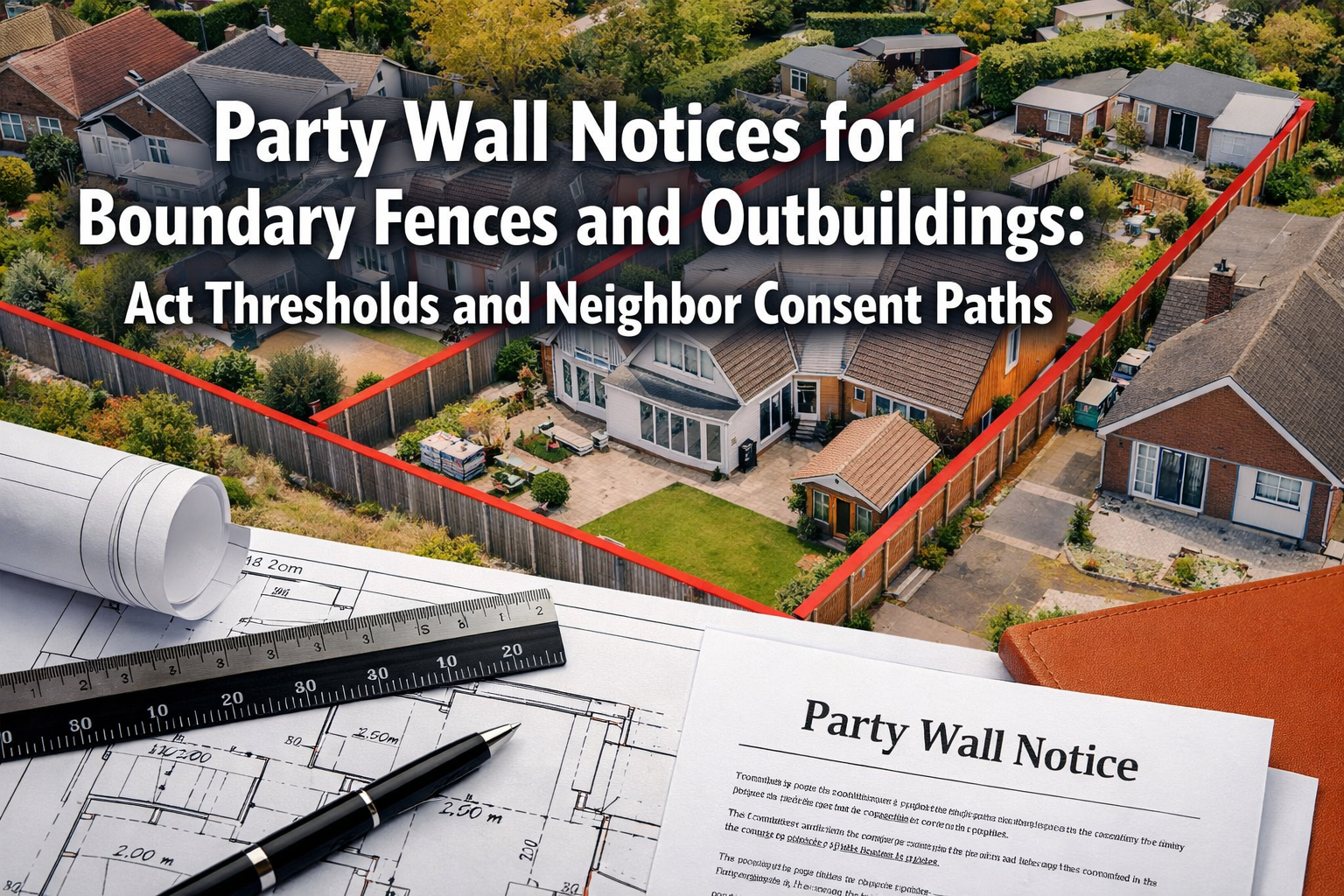
How close can my neighbour build to my fence? In short: your neighbour can usually build right up to the boundary line on their own land — but the moment foundations come within 3 metres of your building (or 6 metres for deep foundations), the Party Wall etc. Act 1996 gives you legal protection, and building astride the boundary needs your consent. Here is what the boundary rules actually say, and the notices your neighbour must serve.
Building up to the boundary line: the basic rule
There is no general law preventing an owner from building a wall or extension up to the edge of their own land. Permitted development rights let many single-storey rear extensions be built to the boundary without planning permission, subject to height limits (3 metres for a flat roof up to the boundary, 4 metres maximum). What your neighbour cannot do is trespass: gutters, footings and scaffolding must not cross the line without your agreement or rights under the Party Wall Act.
The 3-metre rule: excavation next to your property
Section 6 of the Party Wall Act applies when someone excavates within 3 metres of a neighbouring building and deeper than that building’s foundations — which covers almost every extension built close to a fence in London, because Victorian foundations are shallow. Your neighbour must serve an excavation notice at least one month before digging, with drawings showing depth and position. Read our full guide to the 3 and 6 metre rule.
The 6-metre rule: deep foundations and basements
Where piling or a basement takes foundations deeper, the Act extends protection to 6 metres: if a line drawn at 45 degrees down from the bottom of your foundations would be cut by the excavation, notice is required. Basement projects in London almost always trigger this rule.
Building a wall astride the fence line
If your neighbour wants the new wall to sit on the boundary itself — a party fence wall — Section 1 requires a line of junction notice and your written consent. Without it, the wall must stay wholly on their side, with only the footings permitted to project under your land in limited circumstances.
How close can a neighbour build to my house?
A detached structure can, in planning terms, be built very close to your house if it is on their land and within permitted development limits. Your protections come from: the Party Wall Act (structural safeguards and a schedule of condition before work starts), planning rules on overshadowing and outlook where permission is needed, and the law of nuisance for loss of light — see rights of light.
Your rights when a notice arrives
- Consent — work proceeds, but you keep all rights under the Act.
- Dissent and appoint a surveyor — a party wall award records the condition of your property and sets working hours, protection measures and access rules. The building owner normally pays your surveyor’s fee.
- Do nothing — after 14 days a dispute is deemed and surveyors are appointed anyway.
If work has already started without notice, see our guide on what to do when a neighbour starts work without a party wall agreement.
Frequently asked questions
How close can my neighbour build to my fence without planning permission?
Right up to the boundary for many single-storey extensions under permitted development — but party wall notices are still required if excavation comes within 3 metres of your building.
Can I stop my neighbour building on the boundary line?
You can refuse consent to a wall astride the line, forcing it wholly onto their land. You cannot normally stop a lawful build on their own side, but the Act protects your property while it happens.
What is the minimum distance between a new build and an existing fence?
None in law — distance limits come from planning conditions, not a fixed national minimum gap.
Worried about a neighbour’s build? Talk to us
Our RICS party wall surveyors act for adjoining owners across London — usually at no cost to you, as the building owner pays. Call 0204 579 8270 or get free advice today.
Speak to a RICS chartered party wall surveyor
Free initial consultation. Notices, awards and schedules of condition across London and nationwide.