
RICS
Looking for expert solutions?
Request a Quote

Category: Uncategorized

  • Training Tomorrow’s Party Wall Surveyors: Upskilling for AI and Reality Capture in 2026 Workflows

    }

    Only 34% of construction professionals surveyed in early 2026 felt fully confident using AI-assisted documentation tools in their daily practice, yet those tools are already reshaping how party wall work gets done. For party wall surveyors, that confidence gap is not just a professional inconvenience; it carries real legal and statutory risk. Training Tomorrow’s Party Wall Surveyors: Upskilling for AI and Reality Capture in 2026 Workflows is no longer a forward-looking aspiration. It is an immediate operational priority.

    The party wall surveyor’s role is anchored in statute. The Party Wall etc. Act 1996 demands impartial, legally sound decisions from appointed surveyors [8]. No AI tool changes that obligation. What technology does change is the speed, accuracy, and volume of work that surveyors are expected to manage. Understanding how to supervise AI outputs, interpret reality capture data, and maintain RICS compliance within automated workflows is the defining skill challenge of 2026.

    Key Takeaways

    • The statutory and ethical duties of party wall surveyors remain unchanged; technology training must reinforce, not replace, legal and procedural knowledge.
    • AI tools now automate notice generation and document drafting, creating an urgent need for surveyors trained in quality control and prompt design.
    • Reality capture technologies, including SLAM LiDAR and 3D laser scanning, are entering mainstream party wall practice, requiring new spatial literacy skills.
    • RICS CPD frameworks and specialist short courses provide structured pathways for upskilling in 2026.
    • Firms that invest in blended training programmes, combining legal procedure, AI workflow design, and reality capture literacy, will hold a measurable competitive advantage.

    The Skill Gap Facing Party Wall Surveyors in 2026

    The gap between what party wall surveyors currently know and what 2026 workflows demand is widening at pace. Two forces are driving this divergence: the rapid deployment of AI-assisted documentation platforms, and the mainstreaming of reality capture hardware in residential and commercial surveying.

    What the Traditional Training Model Covered

    Historically, party wall surveyor training focused on three pillars:

    • Statutory procedure under the Party Wall etc. Act 1996, including the correct service of party wall notices and the preparation of party wall awards
    • Legal impartiality, with surveyors trained to act independently of the appointing owner and resolve disputes without bias [8]
    • Condition recording, including schedules of condition prepared before notifiable works begin

    These remain foundational. RICS guidance is explicit that a surveyor appointed under section 10 of the Act must be a disinterested person whose primary obligation is to the award, not the appointing party [8][12]. No amount of technological change modifies that statutory position.

    Where the New Gaps Sit

    The gaps emerging in 2026 are not replacements for traditional knowledge, they are additions to it. Surveyors now encounter:

    • AI platforms that auto-generate party wall proposals, notices, and award templates based on user inputs and regulatory databases [1]
    • 3D laser scanners and SLAM LiDAR devices capable of producing millimetre-accurate point clouds of party wall structures [4][5]
    • Cloud-based project management systems that centralise documentation, client communications, and condition records
    • Drone-mounted LiDAR tools that capture full-site spatial data in a single pass [7]

    Without training in these systems, surveyors risk either avoiding them, losing efficiency, or using them uncritically, which creates compliance and liability exposure.


    Understanding the Technology: AI and Reality Capture in Party Wall Practice

    Before surveyors can be trained effectively, the technologies themselves need to be understood in the context of party wall work specifically.

    AI-Assisted Documentation: Opportunity and Risk

    AI-driven services now offer automated generation of party wall proposals based on user input, referencing regulatory databases to produce tailored documentation for construction projects, including notices and agreement proposals [1]. A dedicated pipeline of user input, AI processing, and customised document output is already in commercial use, reflecting a shift toward semi-automated front-end advice and document drafting [1].

    Pull quote: “AI can draft a party wall notice in seconds. A trained surveyor still needs to verify every line against the Act.”

    This creates a specific training need: surveyors must learn to act as quality controllers of AI output rather than passive recipients of it. That means understanding:

    • Prompt design, how to instruct AI tools to produce outputs aligned with RICS guidance and the Act
    • Template governance, maintaining firm-level templates that constrain AI-generated content within legally compliant parameters
    • Verification procedures, systematic checks that AI-generated notices, awards, and schedules meet statutory requirements before service or publication

    One independent analysis found that while AI tools can recite party wall legislation accurately, they struggle with nuanced, site-specific judgements, particularly around disputed boundaries and structural risk assessments [3]. This reinforces that AI is a productivity tool, not a decision-maker.

    For surveyors working across London, whether as a building owner’s surveyor or an adjoining owner’s surveyor, the ability to supervise AI-generated documentation while maintaining independent professional judgement is a critical 2026 competency.

    Reality Capture: LiDAR, SLAM, and Point Clouds

    Reality capture refers to technologies that create precise digital representations of physical environments. In party wall practice, the most relevant tools are:

    Technology Application in Party Wall Work Key Benefit
    SLAM LiDAR Scanning party walls, basements, and loft spaces Fast, accurate capture without fixed targets
    Terrestrial 3D laser scanning Detailed structural condition records Millimetre accuracy for pre- and post-works comparison
    Drone LiDAR Full-site capture for large or complex projects Covers inaccessible areas efficiently
    360-degree imagery Photographic condition records integrated with spatial data Visual evidence for schedules of condition

    The 2026 landscape for 3D laser scanning has shifted significantly, with cloud-based processing, AI-assisted point cloud interpretation, and real-time data sharing becoming standard features of leading platforms [5]. Emesent’s all-in-one SLAM LiDAR, RTK, and 360-degree imagery scanner is a recent example of hardware convergence that packages multiple capture modalities into a single device [4].

    For party wall surveyors, the practical application is the schedule of condition, the pre-works record that protects both building owners and adjoining owners from disputed damage claims. A LiDAR-generated point cloud, combined with 360-degree imagery, produces a defensible, objective condition record that is far more robust than photographs alone.


    Certification Paths and Training Frameworks for Upskilling in 2026

    Training Tomorrow’s Party Wall Surveyors: Upskilling for AI and Reality Capture in 2026 Workflows requires a structured approach to professional development. The good news is that multiple pathways exist, from RICS-endorsed CPD to specialist technology training.

    RICS CPD Requirements and Resources

    RICS members are required to complete a minimum of 20 hours of CPD per year, with at least 10 hours in formal learning. In 2026, RICS has expanded its guidance on technology integration in surveying practice, and the 7th edition of Party Wall Legislation and Procedure remains the authoritative reference for statutory procedure training [8].

    Key RICS-aligned CPD topics relevant to party wall surveyors in 2026 include:

    • Party wall law and procedure, covering the Act, dispute resolution, and the surveyor’s statutory duties [8]
    • Digital surveying tools, including reality capture, BIM integration, and data management
    • Professional ethics and AI, addressing the use of AI tools within RICS Rules of Conduct
    • Risk management, particularly around AI-generated documentation and data security

    RICS also provides consumer-facing guidance that surveyors should be familiar with, as it shapes client expectations around how and when works are carried out and the surveyor’s role in determining those conditions [10].

    Specialist Short Courses and Micro-Credentials

    Beyond RICS CPD, a growing ecosystem of specialist training providers offers focused upskilling in the specific tools entering party wall practice:

    AI and documentation tools:

    • Workflow automation courses covering AI prompt engineering for legal documents
    • Quality assurance training for AI-generated party wall notices and awards
    • Data governance and GDPR compliance for cloud-based surveying platforms

    Reality capture and spatial data:

    • LiDAR operation and data processing courses (often offered by hardware manufacturers and specialist training firms)
    • Point cloud interpretation and BIM integration training
    • Drone operations certification (CAA-regulated in the UK for commercial use)

    Blended party wall practice:

    • Specialist party wall surveying courses that integrate technology modules alongside statutory procedure
    • Mentored practice programmes pairing junior surveyors with experienced practitioners on live projects [9]

    Building a Firm-Level Training Programme

    Individual upskilling matters, but the most effective training for AI and reality capture in 2026 workflows happens at the firm level. A structured internal programme might include:

    1. Skills audit, assessing current competency levels across statutory procedure, AI tool use, and reality capture
    2. Prioritised learning pathways, directing surveyors toward the CPD most relevant to their current skill gaps
    3. Tool governance protocols, establishing firm-wide standards for AI output verification and data management
    4. Supervised practice, requiring junior surveyors to have AI-generated documents reviewed by a senior before service
    5. Regular review cycles, updating training content as tools and RICS guidance evolve

    Firms operating across different parts of London, from South London to North London and Central London, face varied project types and client expectations. A firm-level training programme can be tailored to reflect the specific structural and legal challenges common in each area, from Victorian terrace party walls in inner London to newer-build developments on the urban fringe.


    Keeping Statutory Duties at the Centre of Technology Training

    The most important principle in Training Tomorrow’s Party Wall Surveyors: Upskilling for AI and Reality Capture in 2026 Workflows is that technology training must never displace statutory and ethical training. It must sit alongside it.

    The Statutory Foundation Cannot Be Automated

    The party wall surveyor is a statutory appointment. Under section 10 of the Party Wall etc. Act 1996, the surveyor must act as an independent, disinterested decision-maker [8]. No AI platform can hold that appointment. No point cloud can exercise professional judgement on a disputed boundary. The legal and procedural knowledge that underpins party wall awards, the correct service of party wall notices, and the impartial resolution of disputes remains entirely human territory.

    This means training programmes must maintain a strong core of:

    • Statutory procedure, the Act’s requirements for notice, consent, and dispute resolution
    • Award drafting, understanding what makes a legally sound and enforceable party wall award
    • Professional ethics, RICS Rules of Conduct, independence, and conflict of interest management
    • Client communication, explaining complex statutory processes clearly to building owners and adjoining owners

    Understanding the costs of the party wall process and how to advise clients on proportionate expenditure also remains a core professional skill, one that AI tools can inform but not replace.

    Technology as an Amplifier, Not a Substitute

    The correct framing for 2026 upskilling is that AI and reality capture tools amplify the surveyor’s capabilities. A surveyor who understands the Act and can also operate a SLAM LiDAR scanner produces better, faster, more defensible work than one who can do only one of those things.

    Firms that have integrated drone and LiDAR technology into their surveying workflows report significant improvements in site data quality, reduced revisit rates, and stronger condition records that hold up under scrutiny [7]. Digital surveying investment is accelerating across the profession, with firms doubling down on technology adoption to meet client expectations and competitive pressures [2].

    The surveyors best positioned for 2026 and beyond are those who treat technology literacy as a professional obligation, not an optional extra, while keeping their statutory duties firmly in view.


    Conclusion

    The profession of party wall surveying is not being replaced by AI or reality capture technology. It is being reshaped by it. Surveyors who invest in structured upskilling, covering AI workflow design, point cloud literacy, and quality control alongside their statutory and ethical foundations, will deliver faster, more accurate, and more defensible work in 2026 and beyond.

    Actionable next steps for party wall surveyors and firms:

    • Conduct a skills audit across your team, mapping current competencies against the AI and reality capture tools now entering party wall practice
    • Enrol in RICS-endorsed CPD covering both statutory procedure and digital surveying tools, targeting the 20-hour annual minimum as a floor, not a ceiling
    • Establish AI governance protocols at firm level, including mandatory verification of AI-generated notices and awards before service
    • Invest in reality capture training relevant to schedule of condition work, prioritising LiDAR and 360-degree imagery skills
    • Stay current with RICS guidance, the 7th edition of Party Wall Legislation and Procedure remains the authoritative reference [8], and updates should be tracked as standard professional practice
    • Pair junior surveyors with experienced practitioners on live projects to build supervised competency in both statutory procedure and new technology workflows

    The surveyors who will define the profession in the years ahead are those training today, not just in the law, but in the tools that will carry that law into practice.


    References

    [1] Party Wall Survey Service – https://logicballs.com/tools/party-wall-survey-service

    [2] Doubling Down On Digital – https://amerisurv.com/2026/02/01/doubling-down-on-digital/

    [3] Does Chatgpt Know More Than Your Party Wall Surveyor – https://www.peterbarry.co.uk/blog/does-chatgpt-know-more-than-your-party-wall-surveyor/

    [4] Emesent Launches An All In One Slam Lidar Rtk And 360 Imagery Scanner – https://www.geoweeknews.com/articles/emesent-launches-an-all-in-one-slam-lidar-rtk-and-360-imagery-scanner/

    [5] 3d Laser Scanning In 2026 Major Technology And Workflow Shifts – https://www.enginyring.com/en/blog/3d-laser-scanning-in-2026-major-technology-and-workflow-shifts

    [7] Seeing The Whole Site How Thomas Hutton Uses Drone And Lidar Technology To Elevate Surveying – https://www.thomasandhutton.com/2026/04/13/seeing-the-whole-site-how-thomas-hutton-uses-drone-and-lidar-technology-to-elevate-surveying/

    [8] Jan 22 Party Wall Legislation And Procedure 7th Edition – https://www.rics.org/content/dam/ricsglobal/documents/standards/jan_22_party_wall_legislation_and_procedure_7th_edition.pdf

    [9] Party Wall Surveying – https://www.coaleypeak.co.uk/industries/property-valuation-and-surveying/party-wall-surveying

    [10] Rics Consumer Guide Party Walls – https://www.houricanassociates.com/media/1877/rics-consumer-guide-party-walls.pdf

  • Surge in London basement and loft conversions: avoiding Party Wall Agreement disputes

    {“cover”:”Professional landscape format (1536×1024) hero image with bold text overlay (≤42 chars): ‘London Basement & Loft Conversions’ in crisp white bold sans-serif on a deep navy semi-transparent overlay panel, centered with 8% safe margins from every edge. Background: stunning aerial editorial photograph of a row of classic London Victorian terraced houses in warm afternoon light, showing rooftop loft extensions and excavated basement light wells visible from above, rich brick tones, golden hour palette, magazine cover aesthetic with high contrast and editorial polish.”,”content”:[“Isometric flat-vector illustration in bright editorial style showing a cross-section cutaway of a London terraced house with a basement dig underway on the left and a loft dormer conversion on the right, construction workers in hard hats on scaffolding, neighboring house shown adjacent with a glowing dotted boundary line labeled ‘Party Wall’ in bold 4-word label, clean pastel color palette of navy blue, warm amber, and white, Pinterest-worthy infographic quality, 1536×1024 landscape format.”,”Editorial split-screen landscape photograph (1536×1024): left half shows a calm professional meeting between a Black female homeowner and a South Asian male party wall surveyor at a kitchen table, documents and architectural drawings spread out, warm natural daylight from a window, relaxed cooperative mood; right half shows a tense scene of two neighbors standing at a garden fence with arms crossed, brick wall between them, overcast grey sky, high-contrast editorial photography style, magazine quality composition.”,”Step-by-step flat-vector diagram (1536×1024 landscape) showing the Party Wall Agreement process as a clean horizontal timeline with 5 labeled nodes: ‘Notice Served’, ‘Response’, ‘Surveyor Appointed’, ‘Award Issued’, ‘Works Begin’, each node a bold icon in a bright teal and white color scheme on a light grey background, clean sans-serif labels under each icon (max 3 words each), modern infographic style with connecting arrows, no tables or pricing grids, editorial quality.”]

    London’s planning authorities recorded a sharp rise in basement and loft conversion applications throughout the early 2020s, and that momentum has continued into 2026. Neighbour complaints related to construction works have climbed alongside it, with many homeowners caught off guard by a piece of legislation that has been in force for nearly three decades. The surge in London basement and loft conversions, and the Party Wall Agreement disputes that follow, is now one of the most common sources of residential conflict in the capital. Understanding the rules before breaking ground is not optional; it is the single most effective way to protect a project, a budget, and a neighbourly relationship.

    Key Takeaways

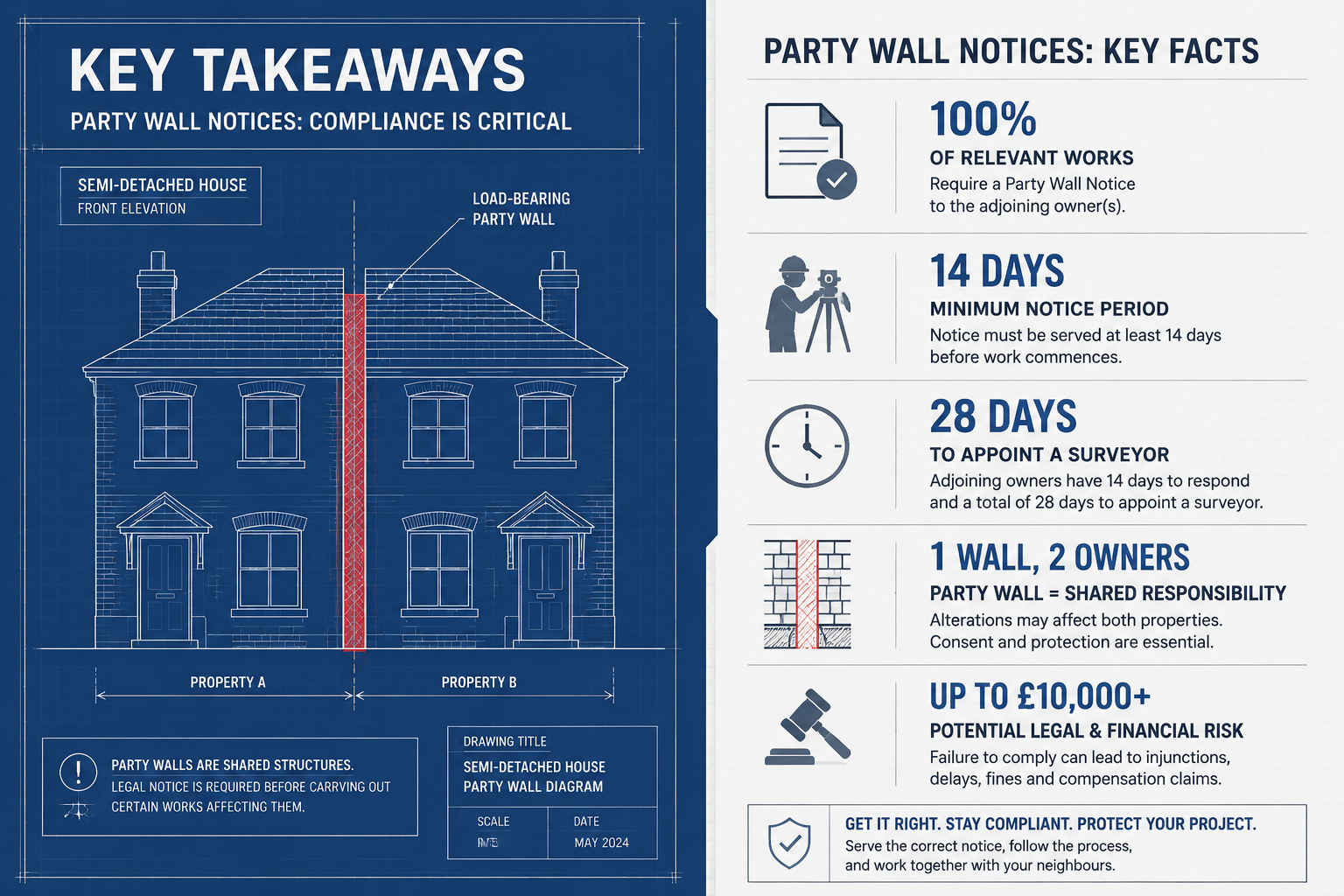
    • The Party Wall etc. Act 1996 applies to most basement digs and loft conversions in London terraced and semi-detached properties.
    • Serving the correct notice on adjoining owners before works begin is a legal requirement, not a courtesy.
    • Failure to comply can result in injunctions, costly delays, and neighbour disputes that outlast the build itself.
    • Appointing a qualified party wall surveyor early reduces the risk of disputes and keeps costs predictable.
    • A properly drafted Party Wall Award protects both the building owner and the adjoining owner throughout the works.

    Why London Is Seeing a Surge in Basement and Loft Conversions

    London’s chronic housing shortage, combined with high property values and strict planning restrictions in many boroughs, has pushed homeowners to build inward and upward rather than outward. A loft conversion can add a bedroom and bathroom without requiring planning permission in many cases, while a basement excavation can double the usable footprint of a Victorian terrace. Both options are expensive, but they typically deliver a strong return on investment in London’s market.

    Several factors are driving the current surge:

    • Permitted Development Rights: Many loft conversions fall within permitted development, removing a significant planning hurdle.
    • Rising mortgage rates: Homeowners are choosing to extend rather than move, avoiding stamp duty and transaction costs.
    • Remote working: The demand for home offices and additional living space remains elevated well into 2026.
    • Equity release: High property values have given many London homeowners the equity to fund major works.

    The problem is that this surge in London basement and loft conversions is generating a parallel surge in Party Wall Agreement disputes. Neighbours who were once indifferent to a loft conversion become actively hostile when excavation begins next door, vibrations travel through shared walls, and cracks appear in their plasterwork.


    What the Party Wall etc. Act 1996 Actually Covers

    The Party Wall etc. Act 1996 is the primary legislation governing works that affect shared walls, floors, and boundaries in England and Wales. It is not about planning permission or building regulations, it operates entirely separately and applies regardless of whether planning consent has been granted.

    The Act covers three main categories of work:

    Category Typical Examples
    Works to a party wall or structure Cutting into a shared wall, raising a party wall, inserting beams
    Excavations near a neighbour’s foundations Basement digs within 3 or 6 metres of an adjoining structure
    New walls at or near the boundary Building a new wall astride or along the boundary line

    For loft conversions, the most common trigger is cutting into or raising a party wall to install steel beams or extend the roof structure. For basement conversions, the excavation provisions are almost always engaged because digging close to a shared boundary or adjoining foundations falls squarely within the Act’s scope.

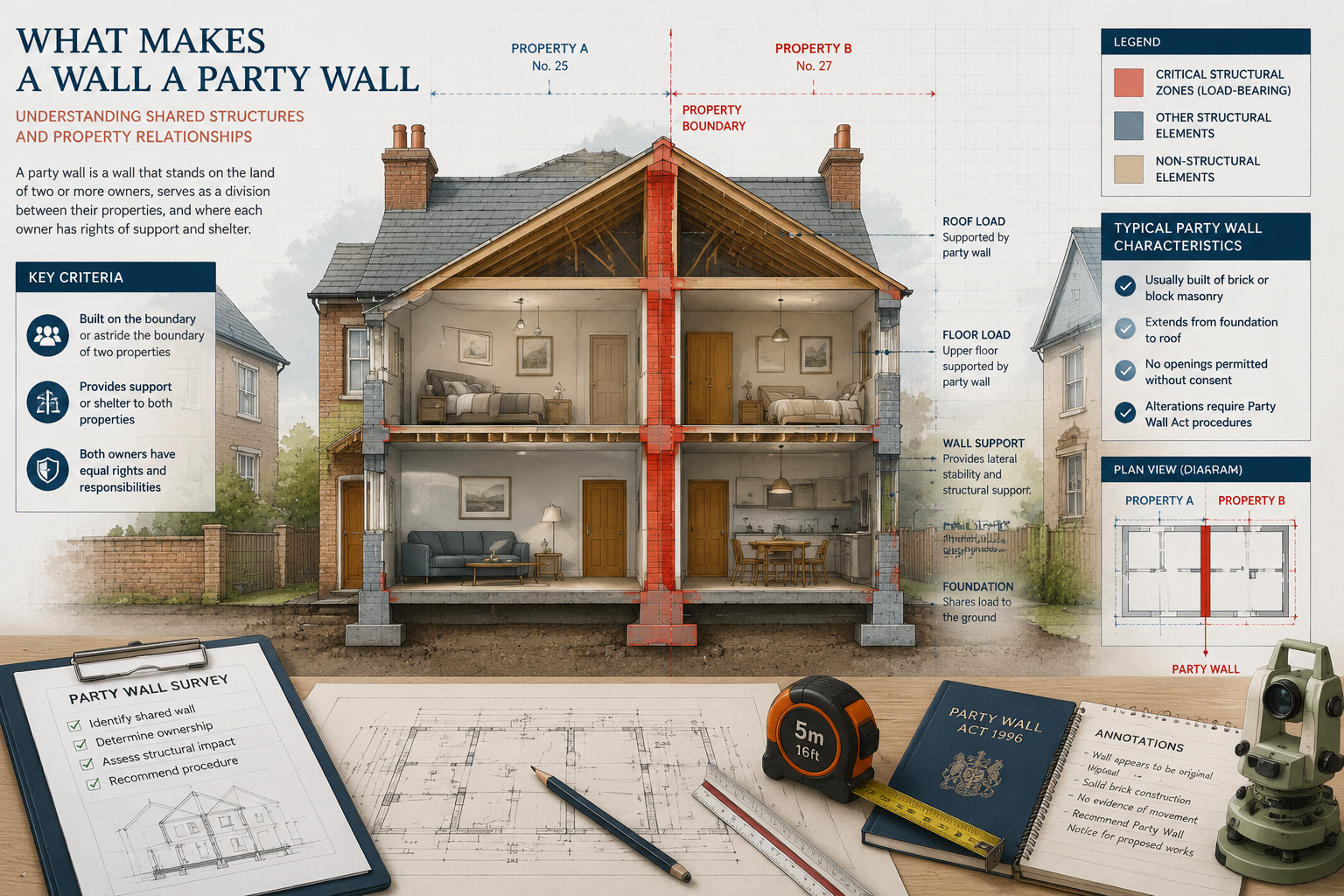
    Understanding what constitutes a party structure is essential before any works are planned. A party wall is not simply any wall shared with a neighbour, the legal definition is specific, and misidentifying it is a common early mistake.


    The Notice Requirement: Where Most Disputes Begin

    The most frequent cause of Party Wall Agreement disputes is straightforward: the building owner fails to serve notice before starting work. The Act requires written notice to be given to all adjoining owners within specific timeframes:

    • Party structure notice: At least two months before works begin on a party wall or structure.
    • Line of junction notice: At least one month before building a new wall at the boundary.
    • Excavation notice: At least one month before beginning excavation works.

    Once notice is served, the adjoining owner has 14 days to respond. They can:

    1. Consent in writing, works can proceed without a formal Award.
    2. Dissent and agree to appoint a single agreed surveyor, one surveyor acts for both parties.
    3. Dissent and appoint their own surveyor, two surveyors then select a third if they cannot agree.

    Silence after 14 days is treated as dissent, triggering the surveyor appointment process automatically.

    Key point: Serving notice is not a bureaucratic formality. It is the legal mechanism that protects both parties. Building owners who skip this step expose themselves to injunctions that can halt a project mid-excavation, sometimes for months.

    For a clear overview of party wall notices and how to respond to them, reviewing the specific requirements before drafting any correspondence is strongly recommended.


    The Party Wall Award: What It Is and Why It Matters

    When an adjoining owner dissents, the process culminates in a Party Wall Award, a legally binding document prepared by the appointed surveyor or surveyors. The Award sets out:

    • The precise works to be carried out
    • The method and timing of those works
    • Access rights for the building owner
    • Protective measures for the adjoining property
    • A schedule of condition of the adjoining property before works begin

    The Party Wall Award is one of the most misunderstood documents in residential construction. Many building owners view it as an obstacle. In reality, it is a shield. If a neighbour later claims that cracks in their wall were caused by the loft conversion or basement dig, the pre-works schedule of condition provides an objective baseline. Without it, liability disputes can drag on for years.

    A schedule of condition is a photographic and written record of the adjoining property’s state before works begin. It is one of the most cost-effective protections a building owner can obtain, yet it is routinely overlooked by those who attempt to manage the process without professional help.


    Surge in London Basement and Loft Conversions: Avoiding Party Wall Agreement Disputes in Practice

    The gap between knowing the rules and applying them correctly is where most disputes take root. Here are the most common practical mistakes, and how to avoid them.

    Mistake 1: Assuming Consent Was Given Verbally

    Verbal agreements with neighbours carry no legal weight under the Act. Consent must be given in writing. A neighbour who verbally agrees to a basement dig and later changes their mind can still trigger the formal dispute resolution process, and the building owner will have no documented protection.

    Mistake 2: Serving Notice Too Late

    Contractors often set start dates before the notice period has expired. A two-month notice period for party wall works means that notice must be served two months before the planned start date, not two months before the anticipated completion. Late notice is one of the most common reasons projects are delayed.

    Mistake 3: Using an Incomplete or Incorrect Notice

    A party wall notice must contain specific information: the building owner’s name and address, a description of the proposed works, and the intended start date. Generic letters or informal emails rarely meet the statutory requirements. A free sample party wall agreement template can provide a useful starting point, but professional review is advisable for complex works.

    Mistake 4: Underestimating the Scope of Excavation Works

    Basement conversions in London frequently involve excavation within three metres of an adjoining structure, and sometimes within six metres. Both distances trigger different notice requirements under Section 6 of the Act. Many building owners, and even some contractors, are unaware that the six-metre rule exists, leading to notices that are technically deficient.

    Mistake 5: Attempting to Manage the Process Without a Surveyor

    The Act does permit a building owner to attempt the process without professional help in some circumstances, but the risks are significant. For a detailed look at the limitations of having a party wall agreement without a surveyor, the complexity involved in basement and loft conversion works almost always justifies professional appointment.


    Choosing the Right Party Wall Surveyor in London

    Not all party wall surveyors have equal experience with basement excavations or complex loft conversions. When selecting a surveyor, consider the following:

    • Membership of a recognised professional body such as the Faculty of Party Wall Surveyors (FPWS) or the Pyramus and Thisbe Club.
    • Specific experience with the type of works planned, a surveyor familiar with underpinning and basement tanking will approach an excavation notice very differently from one whose practice is primarily loft conversions.
    • Local knowledge, London’s geology varies significantly across boroughs, and a surveyor with experience in your specific area will understand the ground conditions that affect excavation risk.
    • Responsiveness, delays in the surveyor appointment process can hold up a project just as effectively as a formal dispute.

    London is a large and varied city. Whether the project is in a dense inner-city borough or a leafier outer area, local expertise matters. Specialist surveyors operating across North London, South London, East London, West London, and Central London bring area-specific knowledge that can make a material difference to the speed and outcome of the process.


    Managing Costs Without Cutting Corners

    Party wall surveyor fees are a legitimate project cost, and they are almost always recoverable from the building owner under the Act. The adjoining owner’s reasonable surveyor fees are typically paid by the building owner. This is not a negotiable point, it is a statutory requirement.

    That said, costs can be managed sensibly. Appointing a single agreed surveyor (where both parties are comfortable with this arrangement) rather than two separate surveyors reduces fees significantly. Serving notice early, keeping communication with neighbours transparent, and providing clear and complete documentation all reduce the time surveyors need to spend resolving disputes.

    For practical guidance on how to keep party wall costs down, the key principle is simple: the more cooperative and well-prepared the process, the lower the cost for everyone involved.


    The Surge in London Basement and Loft Conversions: What Adjoining Owners Need to Know

    The focus of most party wall guidance falls on building owners, but adjoining owners, the neighbours, have significant rights and responsibilities too.

    If a neighbour serves a party wall notice, the adjoining owner should:

    • Read the notice carefully and seek professional advice if the proposed works are complex or extensive.
    • Respond within 14 days, silence triggers dissent by default, which may not be the intended outcome.
    • Request a schedule of condition of their property before works begin, even if they consent to the works.
    • Understand that dissenting does not stop the works, it simply triggers the formal Award process, which provides protections for both sides.

    Adjoining owners who feel overwhelmed by the process can access dedicated guidance for those in this position. Understanding the rights available to adjoining owners is the first step toward protecting a property without unnecessarily obstructing a neighbour’s legitimate development.


    Conclusion: Act Early, Communicate Clearly, Appoint Wisely

    The surge in London basement and loft conversions shows no sign of slowing in 2026. As more homeowners choose to extend rather than move, the volume of Party Wall Agreement notices, and the disputes that arise when the process is mishandled, will continue to rise.

    The good news is that the vast majority of party wall disputes are entirely avoidable. The Party Wall etc. Act 1996 is not a hostile piece of legislation; it is a framework designed to allow building works to proceed while protecting the legitimate interests of neighbours. When it is followed correctly, it works.

    Actionable next steps for building owners:

    1. Identify whether the proposed works engage the Act before appointing a contractor.
    2. Serve the correct notice at least two months (or one month, depending on the works) before the planned start date.
    3. Appoint a qualified party wall surveyor with specific experience in basement or loft conversion works.
    4. Commission a schedule of condition of all adjoining properties before works begin.
    5. Maintain open, documented communication with neighbours throughout the project.

    Actionable next steps for adjoining owners:

    1. Respond to any party wall notice in writing within 14 days.
    2. Seek independent surveyor advice if the proposed works are extensive.
    3. Request a pre-works schedule of condition as a matter of course.

    The cost of getting the party wall process right is modest relative to the cost of a construction injunction, a neighbour dispute that ends in court, or a project that stalls mid-excavation. Investing time and professional expertise at the outset is not caution, it is common sense.


  • Overcoming Surveyor Shortages in Party Wall Projects: Training for 2026 Demand Surge

    By 2028, the UK surveying profession faces a shortfall of more than 20,000 qualified practitioners, a figure that makes overcoming surveyor shortages in party wall projects: training for 2026 demand surge not just a professional priority but an urgent structural challenge for the entire construction sector [3][10]. With London’s residential development pipeline accelerating and the Party Wall etc. Act 1996 governing an ever-growing volume of works, the gap between demand and qualified supply is widening at precisely the wrong moment.

    This article examines the root causes of the shortage, the technologies and training pathways reshaping the profession, and the practical strategies that firms and individual surveyors can deploy right now to stay ahead of 2026 pressures.


    Key Takeaways

    • The UK faces a surveyor shortfall projected to exceed 20,000 by 2028, directly threatening party wall project timelines.
    • Retirement attrition and insufficient graduate pipeline are the two primary structural drivers of the skills gap.
    • AI-assisted tools and reality capture technology are enabling individual surveyors to process more party wall cases with greater accuracy.
    • Agreed surveyor appointments, where one surveyor acts for both parties, offer a proven efficiency mechanism under current labour constraints.
    • Structured upskilling programmes, including RICS-aligned CPD and digital tool training, are the most actionable short-term response to the 2026 demand surge.

    The Scale of the Shortage Hitting Party Wall Work in 2026

    The surveying skills crisis did not appear overnight. Decades of underinvestment in technical education, combined with an ageing workforce, have created a compounding deficit that is now acute [8][9]. According to industry analysis, approximately 40% of currently practising chartered surveyors are expected to retire within the next decade, with the heaviest attrition concentrated among those specialising in building and party wall surveying [10].

    RICS data and sector commentary from spring 2026 confirm that demand for building surveyors is outpacing supply across virtually every UK region [2][6]. Construction output is rising, retrofit programmes are scaling, and urban densification is pushing more residential projects into party wall territory. Every loft conversion, basement excavation, and side-return extension in a terrace of Victorian or Edwardian housing triggers obligations under the Party Wall etc. Act 1996.

    Understanding the types of party wall works that require formal surveyor involvement helps clarify just how broad the demand base is. From notifiable excavations near neighbouring foundations to structural work on shared walls, the Act casts a wide net, and every notifiable project needs at least one qualified surveyor to reach a valid award.

    The recruitment pressure is quantifiable:

    Pressure Factor Impact Level
    Retirement of senior surveyors by 2028 Critical
    Graduate output vs. vacancy growth High
    Increased party wall notifications in London High
    Digital skills gap within existing workforce Moderate

    Sources confirm that vacancy rates for building surveyors reached multi-year highs in 2025 and have continued rising into 2026, with firms reporting average time-to-hire extending beyond three months for experienced party wall specialists [4][5].

    “The skills shortage is not a future problem. It is a present operational constraint that is already delaying party wall awards and adding cost to projects across London.” [4]

    This reality is particularly acute in high-density urban areas. Surveyors covering East London, West London, and Central London are managing caseloads that were previously handled by larger teams, increasing the risk of errors, delays, and disputes.


    AI and Reality Capture: Upskilling Strategies for the 2026 Demand Surge

    Overcoming surveyor shortages in party wall projects: training for 2026 demand surge requires more than hiring, it requires making each qualified surveyor significantly more productive. Two technology domains are proving transformative: artificial intelligence-assisted workflows and reality capture tools.

    Reality Capture and 3D Scanning

    Reality capture refers to the use of laser scanners, photogrammetry drones, and LiDAR-enabled devices to create precise digital models of existing structures. For party wall surveyors, the implications are substantial:

    • Schedule of condition surveys that previously required hours of manual photography and note-taking can be completed in a fraction of the time using handheld scanners.
    • Point-cloud models provide defensible, timestamped records of pre-works conditions, reducing post-project disputes.
    • Remote assessment of accessible areas reduces site visit frequency without sacrificing accuracy.

    The schedule of condition is one of the most time-intensive components of party wall practice. Digitising this process through reality capture tools directly addresses the throughput bottleneck created by staff shortages.

    Training programmes are now emerging from RICS-affiliated providers and specialist technology vendors that combine party wall legal knowledge with hands-on instruction in scanning hardware and point-cloud software. A surveyor who completes a 20-hour upskilling module in reality capture can realistically double the number of condition surveys completed per week [5].

    AI-Assisted Award Drafting and Document Management

    Artificial intelligence tools are entering the party wall workflow at the document production stage. Natural language processing platforms can now:

    • Generate first-draft party wall awards from structured input data, reducing drafting time by 40-60%
    • Flag missing statutory requirements against a checklist derived from the Party Wall etc. Act 1996
    • Cross-reference party wall notices against award content to identify inconsistencies before service

    These tools do not replace surveyor judgement, they eliminate the administrative burden that consumes a disproportionate share of a qualified surveyor’s working day. When a surveyor spends less time on template population and more time on site assessment and dispute resolution, effective capacity increases without adding headcount.

    Key upskilling areas for 2026:

    • Reality capture hardware operation (LiDAR, photogrammetry)
    • Point-cloud processing software (e.g., Leica Cyclone, Matterport)
    • AI document drafting platforms with party wall Act compliance modules
    • Digital notice management and case tracking systems
    • BIM coordination for complex party wall scenarios

    RICS has signalled its commitment to integrating digital competencies into CPD frameworks, and firms facing the 2026 demand surge are advised to treat technology training as a core operational investment rather than an optional enhancement [6][2].


    Agreed Surveyor Efficiency: A Structural Solution to Labour Gaps

    Overcoming surveyor shortages in party wall projects: training for 2026 demand surge also means using the legal framework itself more intelligently. The Party Wall etc. Act 1996 provides a mechanism that is underutilised relative to its efficiency potential: the agreed surveyor appointment.

    Under Section 10 of the Act, both the building owner and the adjoining owner may jointly appoint a single surveyor, the agreed surveyor, to act impartially on behalf of both parties. This arrangement has significant advantages in a constrained labour market:

    • One surveyor handles the full process, from notice response through to award, eliminating the coordination overhead of a two or three-surveyor panel.
    • Faster award timescales result from removing the need to align diaries, exchange correspondence between surveyor teams, and resolve inter-surveyor disagreements.
    • Lower costs for both parties, which is particularly relevant given rising surveyor day rates driven by scarcity [7].

    The agreed surveyor model is not appropriate in all cases, where there is genuine conflict between the parties’ interests, independent representation is essential. However, for straightforward projects such as loft conversions, single-storey extensions, and minor structural works on party walls, the agreed surveyor route can reduce award timescales from weeks to days.

    Firms should be actively training surveyors to manage agreed appointments competently and ethically. This includes:

    1. Clear communication protocols that demonstrate impartiality to both parties
    2. Structured conflict-of-interest assessment at the outset of each appointment
    3. Documented decision-making trails that withstand challenge

    For building owners considering their options, understanding the costs of the party wall process is an important first step. The agreed surveyor route frequently represents a meaningful saving, and in a market where surveyor availability is stretched, it can also mean the difference between a project starting on schedule or facing a statutory delay.

    Practical Efficiency Gains from the Agreed Surveyor Model

    Research into party wall practice under labour shortages identifies several consistent efficiency gains from the agreed surveyor approach [7]:

    • Average award completion time reduced by 35-50% compared to two-surveyor appointments
    • Administrative correspondence volume reduced by approximately 60%
    • Client satisfaction scores higher due to single point of contact

    These gains are amplified when the agreed surveyor also employs the digital tools described above, AI drafting assistance combined with reality capture condition surveys can compress a typical straightforward award from three weeks to under one week.


    Building the Pipeline: Training Pathways for New Party Wall Surveyors

    Addressing the immediate 2026 demand surge through technology and process efficiency is necessary but not sufficient. The profession also needs a credible pipeline of new entrants trained specifically in party wall practice.

    Graduate and Apprenticeship Routes

    RICS-accredited degree programmes in building surveying provide the academic foundation, but party wall practice is a specialist discipline that requires additional structured learning. The most effective pipeline-building strategies currently in use include:

    • Structured mentorship programmes pairing newly qualified surveyors with experienced party wall practitioners for 12-24 months
    • Degree apprenticeships that embed party wall Act training within employer-sponsored study, allowing firms to grow their own talent
    • Conversion pathways for surveyors from adjacent disciplines (quantity surveying, valuation) who wish to move into building and party wall work [3][4]

    The conversion pathway is particularly valuable given the current surplus of quantity surveyor graduates relative to available roles in some market segments, combined with the acute shortage in building and party wall surveying [3].

    CPD and Short-Course Upskilling

    For existing practitioners, the fastest route to increased party wall capacity is targeted CPD. Recommended short-course content for 2026 includes:

    • Party Wall etc. Act 1996 refresher and case law updates
    • Serving and responding to party wall notices correctly in complex multi-party scenarios
    • Reality capture technology fundamentals
    • AI-assisted award drafting workshops
    • Agreed surveyor ethics and impartiality training

    Firms in North London and South London, where residential development density is particularly high, are reporting that surveyors who complete digital upskilling modules are managing 30-40% more cases per quarter without a proportional increase in hours worked [5].

    Retaining Experienced Surveyors

    Retirement attrition is the single largest driver of the skills gap. Firms that invest in flexible working arrangements, reduced-hours consultancy contracts, and knowledge transfer programmes for senior surveyors approaching retirement age are significantly better positioned than those that allow institutional knowledge to walk out the door [8][10].

    A structured knowledge transfer programme might include:

    • Documented case study libraries capturing complex award decisions
    • Video-recorded expert commentary on edge cases and dispute resolution
    • Mentorship obligations built into senior surveyor employment contracts

    Regulatory and Market Context for 2026

    The regulatory environment is not standing still. RICS continues to update its guidance on surveyor competencies, and the 2026 market context includes several factors that amplify the urgency of addressing party wall surveyor shortages:

    • Increased retrofit activity driven by energy efficiency mandates is generating new categories of party wall works in older housing stock [2][5]
    • Planning policy changes favouring densification are increasing the proportion of new residential development that triggers party wall obligations
    • Rising dispute rates as project complexity increases are placing greater demands on surveyor expertise and time [7]

    Homeowners and developers who want to understand their obligations under the Act, including whether they can proceed without a surveyor in certain circumstances, need clear, accurate information. Surveyors who can communicate the Act’s requirements accessibly are better positioned to convert enquiries into appointments and to reduce the volume of disputes arising from misunderstanding.


    Conclusion

    The surveyor shortage affecting party wall projects in 2026 is real, quantified, and worsening. But it is not unmanageable. The firms and individual practitioners who will thrive are those taking concrete action now across three fronts.

    Actionable next steps:

    1. Invest in reality capture training, Enrol at least one surveyor per firm in a certified LiDAR or photogrammetry course before the end of 2026. The throughput gains justify the cost within months.

    2. Adopt AI drafting tools, Evaluate at least one AI-assisted award drafting platform against your current workflow. Pilot it on straightforward agreed surveyor cases first to build confidence and measure time savings.

    3. Promote the agreed surveyor model, Where appropriate, actively recommend agreed surveyor appointments to clients. Faster awards, lower costs, and reduced administrative burden make this the most immediately deployable efficiency lever available under the existing legal framework.

    4. Build a structured CPD calendar, Map your team’s party wall competencies against the 2026 demand profile and identify specific gaps. Commission targeted short courses rather than generic CPD.

    5. Start a knowledge transfer programme, Identify senior surveyors within five years of retirement and formalise a structured handover of case knowledge, client relationships, and specialist expertise.

    The Party Wall etc. Act 1996 framework is robust. The challenge is ensuring enough qualified practitioners exist to operate it effectively. By combining technological upskilling with smarter use of the agreed surveyor mechanism and a genuine commitment to pipeline development, the profession can meet the 2026 demand surge without compromising the quality and impartiality that party wall practice demands.


    References

    [1] Watch – https://www.youtube.com/watch?v=U8oCnx7DKqo

    [2] Spring 2026 Hot Topics For Uk Building Surveyors Rics Insights On Market Shifts And Valuation Challenges – https://princesurveyors.co.uk/blog/spring-2026-hot-topics-for-uk-building-surveyors-rics-insights-on-market-shifts-and-valuation-challenges/

    [3] The Quantity Surveyor Shortage A Technical Outlook For 2026 – https://www.onboard-jobs.co.uk/resources/industry-news/the-quantity-surveyor-shortage-a-technical-outlook-for-2026

    [4] Quantity Surveyor Shortages Impacting Building Surveys Adaptation Tactics For Chartered Surveyors In 2026 Projects – https://princesurveyors.co.uk/blog/quantity-surveyor-shortages-impacting-building-surveys-adaptation-tactics-for-chartered-surveyors-in-2026-projects/

    [5] Skills Shortage In Building Surveying Rics 2025 Strategies For Firms Facing 2026 Infrastructure And Retrofit Demands – https://princesurveyors.co.uk/blog/skills-shortage-in-building-surveying-rics-2025-strategies-for-firms-facing-2026-infrastructure-and-retrofit-demands/

    [6] Update From Justin Young Rics Ceo May 2026 – https://www.rics.org/news-insights/update-from-justin-young-rics-ceo-may-2026

    [7] Drafting Party Wall Awards Under Labour Shortages Best Practices For Chartered Surveyors In 2026 – https://princesurveyors.co.uk/blog/drafting-party-wall-awards-under-labour-shortages-best-practices-for-chartered-surveyors-in-2026/

    [8] Uk Construction Skills Shortage Explained – https://www.surveyorsuccess.co.uk/article/uk-construction-skills-shortage-explained

    [9] Skills Gaps – https://journals.cices.org/ces/ces-june-2025/features/skills-gaps

    [10] Rics Surveying Skills Report – https://www.atkinssearch.co.uk/insights/rics-surveying-skills-report/


  • Excavating Foundations Near Party Walls: Depth Rules, Notices, and Protection Methods

    Fewer construction disputes end up in court more reliably than those triggered by excavation work near a shared boundary, and in most cases, the legal exposure was entirely preventable. Under the Party Wall etc. Act 1996, excavating foundations near party walls carries specific statutory obligations that many building owners overlook until damage has already occurred. Understanding the depth rules, notice requirements, and structural protection methods involved in excavating foundations near party walls is not just good practice; it is a legal necessity that protects both the building owner and the adjoining neighbour.

    Key Takeaways

    • Section 6 of the Party Wall etc. Act 1996 is triggered whenever excavation work falls within 3 metres or 6 metres of an adjoining structure, depending on the depth of the proposed foundations.
    • A formal Section 6 Notice must be served on the adjoining owner at least one month before excavation begins.
    • If the adjoining owner dissents or fails to respond, a party wall surveyor must be appointed to produce a Party Wall Award.
    • A Schedule of Condition survey should be completed before any excavation starts to record the existing state of the neighbouring property.
    • Underpinning, contiguous piled walls, and temporary propping are the most common methods used to protect adjoining structures during deep excavations.

    What Section 6 of the Party Wall Act Actually Covers

    The Party Wall etc. Act 1996 is divided into several operative sections, each addressing a different type of work. Section 2 covers works to an existing party wall. Section 3 deals with new walls on the line of junction. Section 6, however, is the provision specifically concerned with excavation.

    Section 6 is triggered in two distinct scenarios:

    Scenario A, Within 3 metres: The proposed excavation will be carried out within 3 metres of any part of a neighbouring building or structure, and the bottom of the new foundation will be lower than the bottom of the neighbour’s foundations.

    Scenario B, Within 6 metres: The proposed excavation will be carried out within 6 metres of any part of a neighbouring building or structure, and the bottom of the new foundation will fall within a 45-degree line drawn downward from the base of the neighbour’s foundations.

    “The 45-degree rule under Section 6 is one of the most misunderstood triggers in construction law. Many building owners assume that being more than 3 metres away from a neighbour’s wall puts them in the clear, it does not.”

    These two distance thresholds reflect the angle at which ground movement and load transfer can affect an adjacent structure. Soil type, groundwater conditions, and the age of the neighbouring foundations all influence the actual risk, but the statutory thresholds apply regardless of site-specific conditions.

    To understand the full scope of works that fall under the Act, reviewing the types of party wall works covered by the legislation provides a useful starting point.


    The Notice Requirements for Excavating Foundations Near Party Walls

    Serving a Valid Section 6 Notice

    When excavating foundations near party walls triggers Section 6, the building owner must serve a formal written notice on every adjoining owner. This notice must be served at least one month before the planned start date of the excavation works.

    A valid Section 6 Notice must include:

    • The full name and address of the building owner
    • The address of the building where works will take place
    • A description of the proposed excavation works
    • Plans and sections showing the site and depth of the proposed excavation
    • The proposed start date of the works

    Serving the notice correctly is critical. Errors in the notice, such as omitting plans, serving it on the wrong party, or giving insufficient notice period, can invalidate the process and expose the building owner to injunctions or claims for damages.

    For a detailed breakdown of how party wall notices work and how to respond to them, the guide on party wall act notices, what they are and how to respond covers the process thoroughly.

    What Happens After the Notice Is Served

    Once a Section 6 Notice is served, the adjoining owner has several options:

    Adjoining Owner’s Response Outcome
    Consents in writing within 14 days Works may proceed; no Award required
    Dissents or appoints a surveyor Dispute resolution process begins
    Fails to respond within 14 days Deemed to have dissented; dispute process begins

    If the adjoining owner dissents, or simply does not respond, both parties must appoint surveyors. The surveyors then produce a Party Wall Award, which is a legally binding document setting out how the works are to be carried out, when they can take place, and what protections must be in place.

    The costs associated with this process are a common concern. The costs of the party wall process are generally borne by the building owner carrying out the works, though this can vary depending on the circumstances.


    Conducting a Schedule of Condition Before Excavation

    Before any excavation begins near a party wall, a Schedule of Condition is one of the most important protective steps a building owner can take. This is a detailed photographic and written record of the current state of the adjoining property, walls, ceilings, floors, external brickwork, and any pre-existing cracks or defects.

    Why does this matter?

    Without a Schedule of Condition, any crack or settlement that appears in the neighbouring property after excavation begins can be attributed to the works, even if it existed beforehand. A thorough pre-works record protects the building owner from exaggerated or unfounded claims and gives the adjoining owner confidence that any genuine new damage will be identified and addressed.

    The schedule of condition process is typically carried out by the appointed party wall surveyor before works commence and forms part of the Party Wall Award documentation.


    Structural Protection Methods for Deep Excavations

    When excavating foundations near party walls at significant depths, structural protection is not optional, it is a requirement embedded in the Party Wall Award and, in many cases, in Building Regulations approval. The method chosen depends on the depth of excavation, soil conditions, proximity to the adjoining structure, and the type of foundations already in place.

    Underpinning

    Underpinning is the most widely used method for supporting an existing foundation while excavation takes place alongside or beneath it. The process involves strengthening or deepening the existing foundation so that it bears on a more stable layer of soil or transfers load to a deeper point.

    Mass concrete underpinning (traditional pit underpinning) is the conventional approach. It involves excavating a series of sequential bays beneath the existing foundation and filling each one with concrete before moving to the next. The sequential approach is critical, working in alternate bays prevents simultaneous removal of support from adjacent sections.

    Mini-pile underpinning is used where access is restricted or where the depth required makes traditional pit underpinning impractical. Steel piles are driven or bored to the required depth and connected to the existing structure via a needle beam. This method is common in London’s dense urban environment where basement extensions are excavated alongside Victorian terraced houses.

    Contiguous and Secant Piled Walls

    Where a deep basement excavation is planned close to a party wall, a contiguous piled wall or secant piled wall can be constructed along the line of excavation to retain the surrounding soil and prevent lateral movement.

    • Contiguous piled walls consist of individual piles placed close together but not touching, with gaps filled by the soil between them. Suitable for sites above the water table.
    • Secant piled walls use interlocking piles, alternating hard and soft piles, to create a watertight retaining structure. Used where groundwater is present.

    Temporary Propping and Needling

    For shorter-term excavations or where the adjoining foundation needs to be transferred temporarily, needling involves inserting horizontal steel beams (needles) through the wall above the excavation zone. The needles transfer the load of the wall to temporary props or permanent new supports while the ground beneath is removed and replaced with new foundation material.

    Monitoring During Works

    Regardless of the protection method chosen, continuous structural monitoring is standard practice during excavation near party walls. This typically involves:

    • Installing crack monitors on existing cracks in the adjoining property
    • Setting up settlement gauges on the party wall
    • Regular surveyor inspections at agreed intervals

    Monitoring data is documented and shared with both parties. If movement exceeds agreed trigger levels, works must pause until the cause is identified and remedied.


    Common Mistakes When Excavating Near Party Walls

    Even experienced contractors make avoidable errors when navigating the legal and technical requirements of excavating foundations near party walls. The most frequent mistakes include:

    Failing to check whether Section 6 applies. Building owners sometimes assume that because they are not touching the party wall itself, no notice is required. The 3-metre and 6-metre distance rules apply regardless of whether the wall is physically disturbed.

    Serving notice too late. The one-month minimum notice period is a statutory requirement, not a guideline. Starting works before the notice period expires, even with the neighbour’s informal verbal agreement, creates legal exposure.

    Not appointing a surveyor when required. Some building owners attempt to proceed without professional involvement to save costs. This approach often results in higher costs later when disputes arise. For those considering this route, the article on having a party wall agreement without a surveyor explains the risks clearly.

    Inadequate foundation drawings. Section 6 Notices must be accompanied by plans showing the depth and location of the proposed excavation. Vague or incomplete drawings delay the process and may invalidate the notice.

    Ignoring the adjoining owner’s concerns. Even where the building owner has legal authority to proceed, failing to communicate openly with neighbours often escalates disputes unnecessarily. Proactive communication reduces friction and speeds up the Award process.


    The Role of the Party Wall Surveyor in Excavation Projects

    A party wall surveyor plays a central role in excavation projects that trigger Section 6. Their responsibilities extend well beyond paperwork, they act as an impartial technical and legal expert whose primary duty is to the Act itself, not to either party.

    In an excavation context, the surveyor will:

    • Review the proposed excavation drawings and assess the risk to the adjoining structure
    • Agree on the appropriate protection method with the opposing surveyor
    • Draft the Party Wall Award, including method statements and working hours
    • Commission or review the Schedule of Condition
    • Oversee monitoring arrangements during the works
    • Resolve any disputes about damage that arise during or after excavation

    Both the building owner and the adjoining owner may appoint their own surveyor, or they may agree to appoint a single agreed surveyor who acts for both. The building owner’s surveyor and the adjoining owner’s surveyor each have defined roles under the Act.

    For those carrying out works in specific areas of London, local expertise matters. Surveyors familiar with the particular soil conditions and housing stock in areas such as South London or North London bring practical knowledge that generic advice cannot replicate.


    Conclusion

    Excavating foundations near party walls is one of the most technically and legally demanding activities in residential and commercial construction. The depth rules under Section 6 of the Party Wall etc. Act 1996, the 3-metre and 6-metre thresholds, exist to protect adjoining structures from the ground movement and load transfer that deep excavation inevitably causes.

    Actionable next steps for building owners planning excavation works:

    1. Confirm whether your proposed excavation falls within the 3-metre or 6-metre zones relative to any neighbouring structure.
    2. Engage a qualified party wall surveyor early, before drawings are finalised, to ensure the notice process can begin on time.
    3. Serve a valid Section 6 Notice with full plans at least one month before the planned start date.
    4. Commission a Schedule of Condition on the adjoining property before any ground is broken.
    5. Agree on a structural protection method, underpinning, piled wall, or temporary propping, that is proportionate to the depth and proximity of the excavation.
    6. Maintain open communication with the adjoining owner throughout the project.

    Failing to follow these steps does not just risk a legal dispute, it risks causing real, costly damage to a neighbour’s home. The Party Wall etc. Act 1996 provides a clear framework precisely because excavation near shared boundaries is high-risk work. Using that framework correctly protects everyone involved.


  • Digital service of Party Wall Notices and awards: are email and online platforms legally valid?

    Nearly one in three party wall disputes in England and Wales now involves a question about how a notice was served, and in 2026, that question increasingly centres on whether an email or online platform message actually counts. The shift toward digital communication has transformed how building owners and adjoining owners interact, yet many remain uncertain whether electronic service of party wall notices and awards carries the same legal weight as a letter through the letterbox. This article examines the statutory framework, the conditions that must be met, and the practical steps that ensure digital service of Party Wall Notices and awards, whether by email or online platforms, is legally valid.

    Key Takeaways

    • The Party Wall etc. Act 1996, as amended by the Electronic Communications Order 2016, expressly permits electronic service of notices and awards.
    • Valid email service requires the recipient’s prior consent, an unwithdrawal of that consent, and use of the specific email address they provided.
    • The Court of Appeal case Knight v Goulandris (2018) broadened acceptance of email service even in the absence of formal written consent.
    • Online platforms can be used, but they must meet the same statutory conditions as email to be legally compliant.
    • When in doubt, combining electronic service with a physical backup is the safest approach.

    The Statutory Framework: How the Law Evolved to Permit Digital Service

    Understanding whether digital service of Party Wall Notices and awards is legally valid requires going back to the primary legislation. The Party Wall etc. Act 1996 sets out the rules for serving notices and awards between building owners and adjoining owners. When it was originally enacted, electronic communication was not contemplated as a formal service method.

    That changed with the Party Wall etc. Act 1996 (Electronic Communications) Order 2016 (SI 2016/335), which amended the Act to bring it in line with modern practice [6]. The Order inserted provisions allowing notices, counter-notices, and awards to be served electronically, provided that specific conditions are satisfied. This was a significant legislative update, and it means that email service is no longer a legal grey area; it is expressly authorised by statute [8].

    The government’s own explanatory booklet on the Act confirms this position, stating that electronic service is valid where the recipient has agreed to receive documents by electronic communication [2]. This guidance is clear and authoritative, though it is worth noting that the conditions attached to that permission are not optional, they are mandatory requirements.

    What the Electronic Communications Order 2016 Actually Says

    The Order sets out three cumulative conditions that must all be satisfied for electronic service to be valid [6][3]:

    1. The recipient must have stated a willingness to receive documents by electronic communication.
    2. That statement must not have been withdrawn at the time of service.
    3. The document must be sent to the specific electronic address (for example, the email address) that the recipient provided.

    If any one of these three conditions is not met, the electronic service may be invalid, potentially exposing the building owner to serious procedural and legal risk. This is why professional surveyors and solicitors always advise confirming consent in writing before relying on email service alone [4].

    “Electronic service is not simply a matter of convenience, it is a matter of compliance. The conditions in the 2016 Order are not suggestions; they are legal requirements.”


    Does Email Service Work in Practice? Key Cases and Conditions

    The question of whether digital service of Party Wall Notices and awards, including email and online platforms, is legally valid has been tested in the courts, and the results are instructive.

    Knight v Goulandris (2018): A Landmark Decision

    The Court of Appeal decision in Knight v Goulandris [2018] EWCA Civ 237 is the most important case on this issue. The court held that email service of a party wall award was valid even though there had been no formal written consent from the recipient to receive documents electronically [3]. The court took a pragmatic approach, finding that where a party had previously communicated by email and had not objected to receiving documents that way, it was reasonable to treat that conduct as implied consent.

    This decision significantly broadened the practical scope of email service. It confirmed that surveyors and building owners do not necessarily need a signed consent form on file, but they do need to be able to demonstrate that the recipient had, through their conduct, indicated a willingness to receive documents electronically [3][7].

    However, it is important not to over-read this case. The safest interpretation remains that express, documented consent is always preferable to relying on implied consent. Implied consent is harder to prove and more likely to be challenged.

    What Counts as Valid Consent?

    Consent can take several forms, but each carries a different level of risk:

    Form of Consent Risk Level Notes
    Written confirmation (email or letter) Low Best practice; clear and documented
    Verbal agreement, followed by email confirmation Low-Medium Confirm in writing immediately
    Prior email exchanges between parties Medium Implied consent per Knight v Goulandris
    No prior contact at all High Electronic service likely invalid

    The safest approach is to obtain written confirmation, even a simple reply email saying “I am happy to receive party wall notices at this address”, before serving any notice or award electronically [1][4].

    Serving a Party Wall Notice by Email: Step-by-Step

    For building owners planning to serve a party wall notice by email, the following process reduces the risk of a defective service:

    1. Contact the adjoining owner in advance and ask them to confirm in writing that they consent to receiving party wall notices by email.
    2. Ask them to confirm the specific email address to which notices should be sent.
    3. Keep a record of their confirmation (a forwarded email thread is sufficient).
    4. Serve the notice to that exact email address, attaching the notice as a PDF or similar document.
    5. Request a read receipt or delivery confirmation where possible.
    6. Keep copies of all correspondence as part of the party wall file.

    For guidance on what a valid notice must contain, the detailed breakdown of Party Wall Act notices, what they are and how to respond is a useful starting point.


    Online Platforms, Digital Portals, and the Legal Position in 2026

    Beyond email, a growing number of online platforms and digital portals now offer party wall notice services. These range from dedicated party wall software used by surveyors to generic document-sharing platforms. The question of whether digital service of Party Wall Notices and awards via these platforms is legally valid follows the same statutory framework as email, but with additional practical considerations.

    Do Online Platforms Meet the Legal Requirements?

    An online platform can be a valid method of service, provided [6][7][8]:

    • The recipient has consented to receive documents via that specific platform or method.
    • The consent has not been withdrawn.
    • The document is sent to the correct account or address on that platform.

    The challenge with online platforms is that consent is often less clearly documented than with email. If a building owner uses a portal that the adjoining owner has never heard of, there is a real risk that service will be found to be defective. The adjoining owner must actively agree to use the platform, simply creating an account on their behalf is not sufficient.

    Risks of Relying Solely on Digital Service

    Even where the legal conditions are met, there are practical risks to relying exclusively on digital service:

    • Delivery failures: Emails can go to spam folders; platform notifications can be missed.
    • Proof of receipt: Unlike recorded delivery, email does not automatically generate a legally recognised proof of receipt.
    • Withdrawal of consent: If the recipient withdraws their consent to electronic service between the time it was given and the time of service, the service is invalid [3].
    • Wrong address: Sending to an outdated email address, even one previously provided, may not satisfy the statutory requirement if the recipient has since changed it.

    For these reasons, many professional surveyors recommend a belt-and-braces approach: serve electronically and follow up with a physical copy by first-class post or hand delivery. This approach is particularly advisable for party wall awards, which carry greater legal weight and are more likely to be challenged.

    Party Wall Awards: Higher Stakes for Digital Service

    A party wall award is a formal legal document that resolves a dispute between building and adjoining owners. It sets out the rights and obligations of each party and is enforceable in the county court. Given this significance, the consequences of defective service of an award are more serious than for a notice.

    The same statutory conditions apply to awards as to notices [6][9]. However, surveyors should be especially careful to document consent and to confirm the correct electronic address before serving an award digitally. Some surveyors choose to serve awards by recorded delivery as a matter of professional practice, even where email consent has been given, precisely because of the legal importance of the document.

    Practical Guidance for Adjoining Owners

    Adjoining owners who receive a party wall notice or award by email or online platform should be aware of their rights. If they did not consent to electronic service, they may have grounds to challenge the validity of the service. Equally, if they respond to an electronically served notice without raising an objection, they may be taken to have accepted the service as valid.

    If a neighbour is carrying out works and has served a notice electronically without prior consent, it is worth seeking professional advice promptly. The page on what to do when a neighbour is carrying out works sets out the options available to adjoining owners in this situation.


    Common Questions About Digital Service of Party Wall Notices

    Can a building owner serve a notice by WhatsApp or text message?

    There is no statutory authority for service by WhatsApp, SMS, or social media messaging. The Electronic Communications Order 2016 refers to electronic communications in a general sense, but the practical and evidential difficulties of proving service via messaging apps make this approach inadvisable. Email remains the recognised and safest form of electronic service [1][7].

    What happens if the adjoining owner ignores an email notice?

    Under the Party Wall etc. Act 1996, if an adjoining owner does not respond to a notice within 14 days, they are deemed to be in dispute with the building owner. This triggers the appointment of surveyors. The same rule applies whether the notice was served by post or email, provided the email service was valid [2][5].

    Does the building owner need to prove the email was received?

    Strictly speaking, the Act requires service, not receipt. However, if the validity of service is challenged, the building owner will need to demonstrate that the email was sent to the correct address and that consent had been given. Keeping records of sent emails and consent confirmations is therefore essential [3][4].

    Are there costs implications to getting service wrong?

    Yes. Defective service can invalidate the entire party wall process, requiring the building owner to start again. This causes delays and additional costs. For guidance on managing the financial side of the process, the resource on how to keep party wall costs down is worth reviewing.


    Conclusion: Actionable Steps for Legally Valid Digital Service

    The law in England and Wales is clear: email and online platforms can be legally valid methods of serving party wall notices and awards, but only when the statutory conditions are met. The Electronic Communications Order 2016 opened the door to digital service, and the courts have confirmed that a pragmatic approach to consent is acceptable. However, the conditions of prior consent, non-withdrawal, and correct address are not formalities to be glossed over; they are the legal foundation on which valid electronic service rests.

    Actionable steps for building owners and surveyors in 2026:

    • Always obtain and document the adjoining owner’s consent to electronic service before relying on it.
    • Confirm the specific email address or platform account to which documents should be sent.
    • Serve to that exact address, not a general contact address or a different account.
    • Keep comprehensive records of all consent confirmations and sent documents.
    • For party wall awards and other high-stakes documents, consider supplementing electronic service with physical delivery.
    • If there is any doubt about the validity of service, seek advice from a qualified party wall surveyor.

    For those planning works or dealing with a notice from a neighbour, consulting a specialist is the most reliable way to ensure compliance. Whether you are in East London, West London, or elsewhere in the capital, professional guidance on the correct service of party wall notices is always available.


    References

    [1] Can I Serve Party Wall Notice Via Email – https://iconsurveyors.co.uk/faqs/can-i-serve-party-wall-notice-via-email/

    [2] The Party Wall Etc Act 1996 Explanatory Booklet – https://www.gov.uk/government/publications/preventing-and-resolving-disputes-in-relation-to-party-walls/the-party-wall-etc-act-1996-explanatory-booklet

    [3] Service By E Mail In Party Wall Matters – https://www.boundariesbook.co.uk/service-by-e-mail-in-party-wall-matters/

    [4] Serving A Party Wall Notice A Complete Guide – https://www.ansteyhorne.co.uk/news/serving-a-party-wall-notice-a-complete-guide

    [5] Simple Guide To Party Wall Notice Reply – https://fpws.uk/simple-guide-to-party-wall-notice-reply/

    [6] Made – https://www.legislation.gov.uk/uksi/2016/335/article/2/made

    [7] Electronic Party Wall Notices – https://stokemont.com/advice/electronic-party-wall-notices/

    [8] Party Wall Act Updates Notices – https://www.simplesurvey.co.uk/uncategorised/party-wall-act-updates-notices/

    [9] Dclg The Party Wall Etc. Act 1996 Electronic Communications – https://assets.publishing.service.gov.uk/media/5afc0444e5274a25e1eb0905/DCLG_The_Party_Wall_etc._Act_1996__Electronic_Communications_.pdf


  • How recent Building Safety reforms are reshaping Party Wall Awards in London

    London’s construction sector processed over 90,000 party wall notices in a single recent year, yet the legal framework governing those notices was written before the Grenfell Tower fire changed everything. How recent Building Safety reforms are reshaping Party Wall Awards in London is now one of the most pressing questions facing property owners, developers, and surveyors working in the capital’s densely built urban environment. The Building Safety Act 2022 introduced sweeping new duties, gateway processes, and accountabilities that do not exist in isolation from the Party Wall etc. Act 1996. Understanding where the two frameworks intersect, and where they create friction, is essential for anyone planning notifiable works in 2026.

    Key Takeaways

    • The Building Safety Act 2022 introduced new duty-holder roles and gateway approvals that directly affect how Party Wall Awards are drafted and enforced in London.
    • Higher-Risk Buildings (HRBs), broadly, residential buildings over 18 metres, face the most significant procedural changes when party wall works are involved.
    • Party Wall Awards must now be drafted with explicit awareness of BSA compliance obligations, particularly around design documentation and fire safety.
    • Surveyors and building owners who fail to align party wall procedures with BSA requirements risk delays, enforcement action, and potential award invalidation.
    • Early engagement with a qualified party wall surveyor is more important than ever in 2026, especially for works near or within higher-risk structures.

    The Building Safety Act 2022, What Changed and Why It Matters for Party Walls

    The Building Safety Act 2022 (BSA) was the government’s legislative response to the Grenfell Tower disaster and the subsequent Hackitt Review. Its core purpose is to create clearer accountability throughout the life cycle of buildings, particularly those deemed higher-risk. While the Act is primarily associated with fire safety and cladding remediation, its reach extends into the day-to-day mechanics of construction, including works that trigger obligations under the Party Wall etc. Act 1996.

    The Three-Gateway System

    The BSA introduced a mandatory three-gateway approval process for higher-risk buildings:

    • Gateway 1, Planning permission stage: fire safety information must be submitted with the planning application.
    • Gateway 2, Before construction begins: detailed building control approval is required, and work cannot start until this is granted by the Building Safety Regulator (BSR).
    • Gateway 3, Before occupation: a completion certificate is issued only after the BSR is satisfied the building meets all requirements.

    For party wall purposes, Gateway 2 is the critical pinch point. Any notifiable works under the Party Wall etc. Act that affect a higher-risk building cannot legally commence until Gateway 2 approval is in place. This means a Party Wall Award, which traditionally authorised the start of works, no longer operates as a standalone green light when an HRB is involved.

    Duty-Holder Roles and Their Impact

    The BSA created formal duty-holder roles: the Principal Designer, the Principal Contractor, and the Client. Each carries specific legal responsibilities for safety in design and construction. These roles overlap with the party wall process in important ways:

    BSA Duty-Holder Relevance to Party Wall Works
    Principal Designer Must ensure design information in the Award reflects BSA-compliant specifications
    Principal Contractor Responsible for ensuring site operations comply with both the Award and BSA requirements
    Client (Building Owner) Bears ultimate accountability for BSA compliance, not just party wall obligations

    When a Party Wall Award is drawn up, it must now be drafted with an awareness of which duty-holders are in place and what their BSA obligations require. A surveyor who drafts an Award without considering these roles may inadvertently create a document that conflicts with the building’s safety case.


    How Recent Building Safety Reforms Are Reshaping Party Wall Awards in London, The Practical Implications

    The intersection of the BSA and the Party Wall etc. Act 1996 is not theoretical. It is playing out on construction sites across London right now, from basement excavations in Kensington to loft conversions in Hackney. Understanding the practical implications helps owners and surveyors navigate the new landscape without costly errors.

    Documentation Standards Have Risen Sharply

    Under the BSA’s “golden thread” principle, accurate and up-to-date building information must be maintained throughout a structure’s life. For party wall works, this has direct consequences:

    • Schedules of Condition must be more thorough than ever, capturing pre-existing fire-stopping measures, structural elements, and any relevant safety features of the shared wall.
    • Method Statements appended to Awards must align with the Principal Designer’s approved design documentation.
    • Drawings and specifications referenced in the Award must be consistent with the information submitted at Gateway 2.

    A schedule of condition that was once a relatively straightforward photographic record now needs to capture fire safety-relevant details, particularly where the party wall forms part of a compartment boundary.

    Higher-Risk Buildings Require a Different Approach

    For works involving buildings over 18 metres (or those with ten or more storeys), the standard party wall process requires significant adaptation. The Building Safety Regulator must be notified of certain changes, and any variation to approved designs, including changes that might arise during party wall works, must go through a formal change control process.

    This creates a practical tension. Party wall works often involve unexpected discoveries, unforeseen structural conditions, hidden voids, or deteriorated materials. Under the old regime, a surveyor could issue an amended Award relatively quickly. Under the BSA, if those discoveries affect the approved design for an HRB, a change must be logged and potentially re-approved before work continues.

    Building owners carrying out works in Central London, where high-density residential towers are common, should seek specialist advice early. A party wall surveyor in Central London familiar with BSA requirements can help ensure the Award is structured to accommodate this change-control reality.

    The Award as a Safety Document

    Traditionally, a Party Wall Award was primarily a legal instrument resolving a dispute or providing consent for works. It set out the scope of work, working hours, access rights, and compensation provisions. Under the new regime, it is increasingly functioning as a safety document as well.

    Surveyors are now expected to:

    1. Confirm that notifiable works do not compromise fire compartmentation without appropriate remediation.
    2. Reference relevant BSA-compliant specifications within the Award.
    3. Flag any conditions that could trigger a Gateway 2 change control obligation.
    4. Ensure that the Award’s method statements are consistent with the Principal Designer’s safety case.

    This shift in the Award’s character means that surveyors without up-to-date knowledge of the BSA are a liability, not an asset, on complex London projects.


    Navigating the Overlap, Guidance for Building Owners and Adjoining Owners

    How recent Building Safety reforms are reshaping Party Wall Awards in London is not just a concern for surveyors. Building owners and their neighbours are equally affected, and understanding the new obligations is essential for protecting both property and legal position.

    What Building Owners Must Do Differently in 2026

    Before serving a Party Wall Notice:

    • Confirm whether the building or the adjoining owner’s building meets the HRB threshold.
    • Ensure Gateway 2 approval is in place (or in progress) before committing to a start date.
    • Appoint a Principal Designer and Principal Contractor if not already done, and share their details with the party wall surveyor.

    When instructing a surveyor:

    • Choose a surveyor with demonstrable knowledge of both the Party Wall etc. Act 1996 and the BSA 2022.
    • Provide full design documentation so the Award can be drafted in alignment with the approved safety case.
    • Budget for a more detailed and time-consuming Award process, the documentation requirements are substantially higher.

    For a clear overview of the types of party wall works that trigger these obligations, reviewing the full scope of notifiable works is a useful starting point.

    What Adjoining Owners Should Know

    Adjoining owners in London have always had the right to appoint their own surveyor under the Party Wall etc. Act. Under the BSA, that right carries new weight. An adjoining owner whose building is an HRB has a legitimate interest in ensuring that any Award affecting their structure is BSA-compliant, because they, too, bear duties as an Accountable Person under the Act.

    Key points for adjoining owners:

    • Do not assume the building owner’s surveyor has considered BSA implications. Appoint an independent surveyor with relevant expertise.
    • Request confirmation that the proposed works have received Gateway 2 approval before consenting to any Award.
    • Retain copies of all documentation for the golden thread, the BSA requires that building information is kept current and accessible.

    Adjoining owners in areas with significant high-rise stock, such as South London’s regeneration zones or East London’s riverside developments, face particular exposure. A party wall surveyor in South London or a party wall surveyor in East London with HRB experience can provide the specialist support needed.

    The Role of the Party Wall Notice

    The Party Wall Notice itself has not changed in legal form, it is still governed by the 1996 Act. However, the information that should accompany it has expanded. Best practice in 2026 includes:

    • Attaching a brief summary of the BSA duty-holder appointments.
    • Noting whether Gateway 2 approval has been obtained or is pending.
    • Identifying any HRB-specific constraints on working methods or timelines.

    This additional transparency helps adjoining owners make informed decisions about whether to consent or dissent, and reduces the risk of disputes later in the process.


    Common Pitfalls and How to Avoid Them

    The overlap between the BSA and the Party Wall etc. Act is generating a new category of disputes and delays on London construction sites. The following pitfalls are among the most frequently encountered in 2026.

    Pitfall 1: Starting works before Gateway 2 approval
    Some building owners, accustomed to the old regime, assume that a Party Wall Award is sufficient authority to begin. For HRBs, it is not. Starting works before Gateway 2 approval can result in enforcement action by the BSR, stop notices, and potential criminal liability.

    Pitfall 2: Appointing surveyors without BSA knowledge
    A surveyor who drafts an Award without understanding the BSA’s documentation requirements may produce a document that is legally valid under the 1996 Act but operationally unworkable under the 2022 Act. This creates costly rework.

    Pitfall 3: Failing to update the Award after design changes
    The BSA’s change control process means that design changes during construction must be formally recorded. If those changes affect the scope of party wall works, the Award must be updated accordingly. Failure to do so can expose both the building owner and the surveyor to liability.

    Pitfall 4: Overlooking fire compartmentation in the schedule of condition
    A schedule of condition that fails to record the pre-existing state of fire-stopping measures in a party wall leaves the building owner exposed if compartmentation is later found to be compromised.

    “The party wall process and the Building Safety Act are not parallel tracks, they are converging ones. Surveyors and owners who treat them separately do so at their peril.”

    For those managing costs on complex projects, understanding the costs of the party wall process in the context of BSA compliance is equally important. The additional documentation and coordination required will affect fees, and budgeting accordingly from the outset avoids unwelcome surprises.


    Conclusion

    How recent Building Safety reforms are reshaping Party Wall Awards in London is a question with real consequences for every stakeholder in the capital’s construction ecosystem. The Building Safety Act 2022 has not replaced the Party Wall etc. Act 1996, but it has fundamentally changed the context in which that Act operates, particularly for higher-risk buildings.

    Actionable next steps for 2026:

    1. Identify HRB status early. Before serving any party wall notice, confirm whether either building meets the 18-metre threshold. This single determination shapes the entire process.

    2. Appoint BSA-aware surveyors. Both building owners and adjoining owners should instruct surveyors who understand the interaction between the two legislative regimes.

    3. Align Gateway 2 and party wall timelines. Build Gateway 2 approval into the project programme before committing to party wall notice periods and Award timelines.

    4. Enhance documentation from the outset. Treat the schedule of condition and method statements as safety documents, not just legal formalities.

    5. Seek specialist advice in London’s high-density areas. Whether works are in North London or West London, local surveyors with HRB experience provide the most relevant guidance.

    The party wall process has always been about managing risk between neighbours. In 2026, that risk management must extend to building safety compliance. Owners and surveyors who embrace this broader responsibility will deliver better outcomes, for their projects, their clients, and the people who ultimately live and work in London’s buildings.


  • Multi-Storey Party Wall Awards: Coordinating Notices and Agreements

    A single basement excavation in a converted Victorian terrace can legally require separate party wall notices served on five or more different parties — the freeholder, multiple leaseholders above, and neighbouring flat owners on either side. Yet many building owners discover this only after work has already started. In 2026, as urban densification drives more homeowners to extend, excavate, and reconfigure leasehold flats, understanding Multi-Storey Party Wall Awards: Coordinating Notices and Agreements Across Flats and Leasehold Properties has never been more critical.

    The Party Wall etc. Act 1996 was designed primarily with straightforward terraced and semi-detached houses in mind. Applying it to the layered world of leasehold flats, converted period buildings, and purpose-built apartment blocks introduces a level of complexity that demands specialist surveyor strategies, careful notice sequencing, and precisely drafted awards.

    Multi-storey party wall building cross-section with highlighted party walls


    Key Takeaways 📋

    • Multiple owners = multiple notices: In leasehold and multi-storey buildings, every affected party — freeholder and leaseholders alike — must receive a correctly served party wall notice.
    • Vertical structures create layered obligations: Works affecting floors, ceilings, and structural columns can trigger obligations to owners both above and below the building works.
    • A single award rarely covers everyone: Complex buildings often require coordinated, sometimes sequential, party wall awards to properly protect all parties.
    • The building owner pays all reasonable costs, including the surveyor fees of every adjoining owner who dissents [1].
    • Early engagement and a schedule of condition are the most effective tools for preventing disputes and litigation in multi-unit developments [2].

    Why Multi-Storey Buildings Multiply Party Wall Complexity

    In a standard semi-detached house, the party wall relationship is relatively simple: one building owner, one adjoining owner, one shared wall. The moment a property is divided into flats — whether by conversion or purpose-built design — that simplicity evaporates.

    The Leasehold Layer Problem

    Leasehold tenure fundamentally changes who has a legal interest in a party structure. Under the Party Wall etc. Act 1996, notices must be served on all adjoining owners, which includes anyone with a freehold or leasehold interest of more than one year in the adjoining property [2]. In a converted Victorian house split into three flats, a ground-floor leaseholder planning a rear extension may need to serve notices on:

    • The freeholder of their own building (who may own the structural fabric)
    • The leaseholder(s) above whose floors form the ceiling of the proposed works
    • The adjoining freeholder next door
    • Any long leaseholders in the adjoining property

    💡 Pull Quote: “Failing to identify every qualifying adjoining owner in a leasehold building is one of the most common — and most costly — mistakes building owners make under the Party Wall Act.”

    This is not a theoretical concern. In 2026, with London’s construction activity at elevated levels driven by housing demand [3], surveyors are routinely encountering scenarios where building owners have served notice on only one party in a multi-owner building, leaving the award legally vulnerable and the works exposed to injunction.

    Vertical Structures: Who Owns What?

    In purpose-built apartment blocks and converted buildings, the party structure is not just the wall between two houses — it is also the floor/ceiling between flats, structural columns, and shared foundations. The Act’s definition of a “party structure” covers floors separating vertically divided buildings, meaning works such as:

    • Underpinning or excavating near shared foundations
    • Cutting into a structural floor to install services
    • Raising the height of a shared wall or parapet
    • Removing chimney breasts that form part of a shared flank wall

    …can all trigger obligations to owners both laterally and vertically. Understanding the types of party wall works that apply in your specific building type is the essential first step.


    Coordinating Notices and Agreements Across Flats and Leasehold Properties: A Surveyor’s Strategy

    Party wall notice documents and schedule of condition on surveyor's desk

    Experienced surveyors working on multi-storey party wall awards do not simply replicate the standard residential approach. They apply a structured coordination strategy that accounts for the layered ownership, the sequencing of notices, and the interdependence of multiple awards.

    Step 1: Ownership Mapping Before Any Notice Is Served

    Before a single notice is drafted, a competent surveyor will conduct a thorough ownership audit. This involves:

    Action Purpose
    Search HM Land Registry title registers Identify all freehold and leasehold interests
    Review lease plans and demise extents Confirm which structural elements fall within each demise
    Check for management company involvement Determine if the freeholder has delegated maintenance obligations
    Identify any intermediate leasehold interests Catch any sub-leases or shared ownership arrangements

    This mapping exercise determines exactly how many party wall notices need to be served and to whom. Skipping this step is the primary cause of invalid notices in multi-storey settings.

    Step 2: Sequencing the Notices Correctly

    In multi-storey buildings, the type of notice depends on the nature of the works:

    • Party Structure Notice: Required for works to a party structure (floor/ceiling, shared wall). Must be served at least two months before works begin. Learn more about what a Party Structure Notice is and how to serve it.
    • Line of Junction Notice: Required when building on or near the boundary line.
    • Three-Metre/Six-Metre Notice: Required for excavation works near neighbouring foundations.

    A basement excavation beneath a converted terrace might require all three notice types, served simultaneously to multiple parties. Once served, the building owner has up to one year to start work [2], which provides some scheduling flexibility — but the clock starts ticking from the date of service, not the date of consent.

    ⚠️ Important: If any adjoining owner dissents (or fails to respond within 14 days), a dispute is deemed to have arisen, and the parties must appoint surveyors to resolve it via a formal party wall award.

    Step 3: Managing Multiple Surveyor Appointments

    When multiple adjoining owners dissent, the situation can involve:

    • An agreed surveyor (one surveyor acting for both building owner and one adjoining owner)
    • Two surveyors (one for the building owner, one for a specific adjoining owner)
    • A third surveyor (appointed in advance to resolve disagreements between the two appointed surveyors)

    In a building with four dissenting adjoining owners, a building owner could theoretically face four separate surveyor pairs, each producing their own award. In practice, experienced surveyors work to consolidate appointments where possible — often through an agreed surveyor arrangement — to reduce costs and avoid conflicting award terms. Understanding how to keep party wall costs down is particularly valuable in these multi-party scenarios.

    The building owner is responsible for paying all reasonable costs, including the fees of every adjoining owner’s surveyor [1]. In London, surveyor rates typically run between £150–£200 per hour, with a standard award costing approximately £1,000 [2]. Multiply that across four adjoining owners, and costs can reach £5,000–£8,000 or more before construction even begins.

    Step 4: Drafting Coordinated Party Wall Awards

    This is where multi-storey party wall awards diverge most sharply from standard residential awards. A well-drafted award in a leasehold or multi-unit context must:

    Identify each adjoining owner precisely, including their leasehold interest and demise extent
    Define the party structure with reference to lease plans and structural drawings
    Specify working hours, access arrangements, and dust/noise mitigation tailored to occupied residential flats
    Include a detailed schedule of condition — with photographs — for each affected unit [2]
    Address the rights of leaseholders above and below separately from the freeholder’s rights
    Anticipate phased works and include provisions for supplementary awards if plans change [2]

    💡 Pull Quote: “A schedule of condition is not optional in a multi-storey award — it is the primary evidence base if a leaseholder above claims their ceiling cracked during your basement dig.”

    For building owners embarking on complex multi-unit projects, engaging a surveyor with specific leasehold experience before the design stage is strongly advisable.


    Multi-Storey Party Wall Awards: Coordinating Notices and Agreements Across Flats and Leasehold Properties — Common Pitfalls and How to Avoid Them

    Surveyors discussing party wall award with building owner in London flat

    Even experienced developers encounter specific traps in multi-storey party wall scenarios. The following are the most frequently encountered — and most avoidable.

    Pitfall 1: Serving Notice Only on the Freeholder

    A common misconception is that serving notice on the freeholder covers all occupants of a building. It does not. Long leaseholders (those with leases exceeding one year) are separate “adjoining owners” under the Act and must each receive their own notice. Failure to serve them renders any subsequent award potentially invalid and opens the building owner to injunction proceedings [4].

    Pitfall 2: Ignoring the Floor/Ceiling as a Party Structure

    Many leaseholders focus exclusively on the walls between properties and overlook that the floor slab between their flat and the one above is also a party structure. Works that cut through, attach to, or load this structure require a Party Structure Notice to the flat above — even if the works appear to be entirely within the lower flat’s demise.

    Pitfall 3: Inconsistent Award Terms Across Multiple Awards

    When separate awards are produced for different adjoining owners, inconsistencies in working hours, access routes, or protective measures can create practical chaos on site. A surveyor managing multiple awards for the same project must ensure cross-referencing and consistency across all documents. This is a skill that goes beyond basic party wall knowledge and requires genuine project coordination experience.

    Pitfall 4: Failing to Account for Management Companies

    In purpose-built apartment blocks, a residents’ management company or right-to-manage company may hold structural responsibilities under the terms of the leases. These entities may themselves qualify as adjoining owners or may need to provide consent for access to common parts. Surveyors must review the lease structure carefully to determine whether the management company needs to be a party to the notice process.

    Pitfall 5: Missing the Appeal Window

    Both building owners and adjoining owners have 14 days to appeal a party wall award to the County Court [2]. In multi-party scenarios, this window can run at different times for different awards. Building owners who begin work before all appeal periods have expired risk having an award overturned mid-construction — a potentially catastrophic outcome. For detailed guidance on the full process, the party wall awards overview provides a clear reference point.


    Practical Checklist for Multi-Storey Party Wall Projects in 2026 ✅

    Use this checklist before starting any works in a leasehold or multi-unit building:

    • Conduct a full HM Land Registry ownership search for all adjoining titles
    • Identify every leaseholder with a term exceeding one year in affected properties
    • Determine which notice type(s) apply to the proposed works
    • Serve all required notices simultaneously, with correct statutory notice periods
    • Confirm third surveyor appointments in advance for each surveyor pair
    • Commission a schedule of condition for every affected unit before works start
    • Ensure all awards are cross-referenced for consistency
    • Allow all 14-day appeal periods to expire before commencing works
    • Retain copies of all notices, consents, and awards throughout the project

    For those navigating this process for the first time, understanding party wall act notices — what they are and how to respond provides a solid foundation before engaging a specialist.


    When to Seek Specialist Help

    The complexity of multi-storey party wall awards is not a reason to avoid necessary building works — it is a reason to engage the right expertise early. A specialist party wall surveyor with leasehold experience can:

    • Reduce the total number of surveyor appointments through agreed surveyor arrangements
    • Draft awards that anticipate phased works and avoid costly supplementary awards
    • Manage communications between multiple adjoining owners to prevent disputes escalating
    • Ensure schedules of condition are thorough enough to protect the building owner if damage claims arise

    For those carrying out works in London, location-specific expertise matters. Whether the project is in North London, South London, or Central London, local surveyors understand the specific building stock, tenure patterns, and common structural configurations that affect how notices and awards are handled.

    In 2026, with construction activity in UK housing markets running at elevated levels [4], the demand for surveyors who can manage these multi-party scenarios is outpacing supply. Booking early — ideally at the design stage — is no longer optional; it is a practical necessity.


    Conclusion: Actionable Next Steps

    Multi-Storey Party Wall Awards: Coordinating Notices and Agreements Across Flats and Leasehold Properties is one of the most technically demanding areas of UK property law in practice. The layered ownership structures of leasehold buildings, the vertical complexity of shared floors and ceilings, and the requirement to serve and manage multiple simultaneous awards demand a level of expertise that goes well beyond the standard residential party wall process.

    Here are the immediate next steps for anyone planning works in a multi-unit or leasehold building:

    1. Commission an ownership audit before any design work is finalised — knowing who must receive a notice shapes the entire project timeline.
    2. Engage a specialist party wall surveyor with demonstrable leasehold experience at the earliest possible stage.
    3. Budget realistically — in complex multi-party scenarios, party wall costs of £5,000–£10,000 are not unusual and should be built into the project budget from day one [1].
    4. Serve all notices simultaneously and allow statutory periods to run before committing to a construction start date.
    5. Insist on a thorough schedule of condition for every affected unit — this single document provides the most effective protection against spurious damage claims.

    The Party Wall etc. Act 1996 exists to protect all parties fairly. In multi-storey and leasehold settings, that protection only works when the process is followed with precision, expertise, and genuine coordination across every affected owner.


    References

    [1] Party Wall Award Costs Explained What You Should Budget For – https://thepartywallguru.com/party-wall-award-costs-explained-what-you-should-budget-for/
    [2] Party Wall Agreement – https://hoa.org.uk/advice/guides-for-homeowners/i-am-improving/party-wall-agreement/
    [3] Party Wall Surveys And Neighbour Disputes During 2026s Construction Uptick Rics Compliance Framework – https://nottinghillsurveyors.com/blog/party-wall-surveys-and-neighbour-disputes-during-2026s-construction-uptick-rics-compliance-framework
    [4] Party Wall Surveys Amid 2026 Construction Boom Handling Disputes In High Demand Uk Housing Markets – https://nottinghillsurveyors.com/blog/party-wall-surveys-amid-2026-construction-boom-handling-disputes-in-high-demand-uk-housing-markets


  • Multi-Storey Party Wall Awards: Coordinating Notices and Agreements

    A single basement excavation in a converted Victorian terrace can legally require separate party wall notices served on five or more different parties — the freeholder, multiple leaseholders above, and neighbouring flat owners on either side. Yet many building owners discover this only after work has already started. In 2026, as urban densification drives more homeowners to extend, excavate, and reconfigure leasehold flats, understanding Multi-Storey Party Wall Awards: Coordinating Notices and Agreements Across Flats and Leasehold Properties has never been more critical.

    The Party Wall etc. Act 1996 was designed primarily with straightforward terraced and semi-detached houses in mind. Applying it to the layered world of leasehold flats, converted period buildings, and purpose-built apartment blocks introduces a level of complexity that demands specialist surveyor strategies, careful notice sequencing, and precisely drafted awards.

    Multi-storey party wall building cross-section with highlighted party walls


    Key Takeaways 📋

    • Multiple owners = multiple notices: In leasehold and multi-storey buildings, every affected party — freeholder and leaseholders alike — must receive a correctly served party wall notice.
    • Vertical structures create layered obligations: Works affecting floors, ceilings, and structural columns can trigger obligations to owners both above and below the building works.
    • A single award rarely covers everyone: Complex buildings often require coordinated, sometimes sequential, party wall awards to properly protect all parties.
    • The building owner pays all reasonable costs, including the surveyor fees of every adjoining owner who dissents [1].
    • Early engagement and a schedule of condition are the most effective tools for preventing disputes and litigation in multi-unit developments [2].

    Why Multi-Storey Buildings Multiply Party Wall Complexity

    In a standard semi-detached house, the party wall relationship is relatively simple: one building owner, one adjoining owner, one shared wall. The moment a property is divided into flats — whether by conversion or purpose-built design — that simplicity evaporates.

    The Leasehold Layer Problem

    Leasehold tenure fundamentally changes who has a legal interest in a party structure. Under the Party Wall etc. Act 1996, notices must be served on all adjoining owners, which includes anyone with a freehold or leasehold interest of more than one year in the adjoining property [2]. In a converted Victorian house split into three flats, a ground-floor leaseholder planning a rear extension may need to serve notices on:

    • The freeholder of their own building (who may own the structural fabric)
    • The leaseholder(s) above whose floors form the ceiling of the proposed works
    • The adjoining freeholder next door
    • Any long leaseholders in the adjoining property

    💡 Pull Quote: “Failing to identify every qualifying adjoining owner in a leasehold building is one of the most common — and most costly — mistakes building owners make under the Party Wall Act.”

    This is not a theoretical concern. In 2026, with London’s construction activity at elevated levels driven by housing demand [3], surveyors are routinely encountering scenarios where building owners have served notice on only one party in a multi-owner building, leaving the award legally vulnerable and the works exposed to injunction.

    Vertical Structures: Who Owns What?

    In purpose-built apartment blocks and converted buildings, the party structure is not just the wall between two houses — it is also the floor/ceiling between flats, structural columns, and shared foundations. The Act’s definition of a “party structure” covers floors separating vertically divided buildings, meaning works such as:

    • Underpinning or excavating near shared foundations
    • Cutting into a structural floor to install services
    • Raising the height of a shared wall or parapet
    • Removing chimney breasts that form part of a shared flank wall

    …can all trigger obligations to owners both laterally and vertically. Understanding the types of party wall works that apply in your specific building type is the essential first step.


    Coordinating Notices and Agreements Across Flats and Leasehold Properties: A Surveyor’s Strategy

    Party wall notice documents and schedule of condition on surveyor's desk

    Experienced surveyors working on multi-storey party wall awards do not simply replicate the standard residential approach. They apply a structured coordination strategy that accounts for the layered ownership, the sequencing of notices, and the interdependence of multiple awards.

    Step 1: Ownership Mapping Before Any Notice Is Served

    Before a single notice is drafted, a competent surveyor will conduct a thorough ownership audit. This involves:

    Action Purpose
    Search HM Land Registry title registers Identify all freehold and leasehold interests
    Review lease plans and demise extents Confirm which structural elements fall within each demise
    Check for management company involvement Determine if the freeholder has delegated maintenance obligations
    Identify any intermediate leasehold interests Catch any sub-leases or shared ownership arrangements

    This mapping exercise determines exactly how many party wall notices need to be served and to whom. Skipping this step is the primary cause of invalid notices in multi-storey settings.

    Step 2: Sequencing the Notices Correctly

    In multi-storey buildings, the type of notice depends on the nature of the works:

    • Party Structure Notice: Required for works to a party structure (floor/ceiling, shared wall). Must be served at least two months before works begin. Learn more about what a Party Structure Notice is and how to serve it.
    • Line of Junction Notice: Required when building on or near the boundary line.
    • Three-Metre/Six-Metre Notice: Required for excavation works near neighbouring foundations.

    A basement excavation beneath a converted terrace might require all three notice types, served simultaneously to multiple parties. Once served, the building owner has up to one year to start work [2], which provides some scheduling flexibility — but the clock starts ticking from the date of service, not the date of consent.

    ⚠️ Important: If any adjoining owner dissents (or fails to respond within 14 days), a dispute is deemed to have arisen, and the parties must appoint surveyors to resolve it via a formal party wall award.

    Step 3: Managing Multiple Surveyor Appointments

    When multiple adjoining owners dissent, the situation can involve:

    • An agreed surveyor (one surveyor acting for both building owner and one adjoining owner)
    • Two surveyors (one for the building owner, one for a specific adjoining owner)
    • A third surveyor (appointed in advance to resolve disagreements between the two appointed surveyors)

    In a building with four dissenting adjoining owners, a building owner could theoretically face four separate surveyor pairs, each producing their own award. In practice, experienced surveyors work to consolidate appointments where possible — often through an agreed surveyor arrangement — to reduce costs and avoid conflicting award terms. Understanding how to keep party wall costs down is particularly valuable in these multi-party scenarios.

    The building owner is responsible for paying all reasonable costs, including the fees of every adjoining owner’s surveyor [1]. In London, surveyor rates typically run between £150–£200 per hour, with a standard award costing approximately £1,000 [2]. Multiply that across four adjoining owners, and costs can reach £5,000–£8,000 or more before construction even begins.

    Step 4: Drafting Coordinated Party Wall Awards

    This is where multi-storey party wall awards diverge most sharply from standard residential awards. A well-drafted award in a leasehold or multi-unit context must:

    Identify each adjoining owner precisely, including their leasehold interest and demise extent
    Define the party structure with reference to lease plans and structural drawings
    Specify working hours, access arrangements, and dust/noise mitigation tailored to occupied residential flats
    Include a detailed schedule of condition — with photographs — for each affected unit [2]
    Address the rights of leaseholders above and below separately from the freeholder’s rights
    Anticipate phased works and include provisions for supplementary awards if plans change [2]

    💡 Pull Quote: “A schedule of condition is not optional in a multi-storey award — it is the primary evidence base if a leaseholder above claims their ceiling cracked during your basement dig.”

    For building owners embarking on complex multi-unit projects, engaging a surveyor with specific leasehold experience before the design stage is strongly advisable.


    Multi-Storey Party Wall Awards: Coordinating Notices and Agreements Across Flats and Leasehold Properties — Common Pitfalls and How to Avoid Them

    Surveyors discussing party wall award with building owner in London flat

    Even experienced developers encounter specific traps in multi-storey party wall scenarios. The following are the most frequently encountered — and most avoidable.

    Pitfall 1: Serving Notice Only on the Freeholder

    A common misconception is that serving notice on the freeholder covers all occupants of a building. It does not. Long leaseholders (those with leases exceeding one year) are separate “adjoining owners” under the Act and must each receive their own notice. Failure to serve them renders any subsequent award potentially invalid and opens the building owner to injunction proceedings [4].

    Pitfall 2: Ignoring the Floor/Ceiling as a Party Structure

    Many leaseholders focus exclusively on the walls between properties and overlook that the floor slab between their flat and the one above is also a party structure. Works that cut through, attach to, or load this structure require a Party Structure Notice to the flat above — even if the works appear to be entirely within the lower flat’s demise.

    Pitfall 3: Inconsistent Award Terms Across Multiple Awards

    When separate awards are produced for different adjoining owners, inconsistencies in working hours, access routes, or protective measures can create practical chaos on site. A surveyor managing multiple awards for the same project must ensure cross-referencing and consistency across all documents. This is a skill that goes beyond basic party wall knowledge and requires genuine project coordination experience.

    Pitfall 4: Failing to Account for Management Companies

    In purpose-built apartment blocks, a residents’ management company or right-to-manage company may hold structural responsibilities under the terms of the leases. These entities may themselves qualify as adjoining owners or may need to provide consent for access to common parts. Surveyors must review the lease structure carefully to determine whether the management company needs to be a party to the notice process.

    Pitfall 5: Missing the Appeal Window

    Both building owners and adjoining owners have 14 days to appeal a party wall award to the County Court [2]. In multi-party scenarios, this window can run at different times for different awards. Building owners who begin work before all appeal periods have expired risk having an award overturned mid-construction — a potentially catastrophic outcome. For detailed guidance on the full process, the party wall awards overview provides a clear reference point.


    Practical Checklist for Multi-Storey Party Wall Projects in 2026 ✅

    Use this checklist before starting any works in a leasehold or multi-unit building:

    • Conduct a full HM Land Registry ownership search for all adjoining titles
    • Identify every leaseholder with a term exceeding one year in affected properties
    • Determine which notice type(s) apply to the proposed works
    • Serve all required notices simultaneously, with correct statutory notice periods
    • Confirm third surveyor appointments in advance for each surveyor pair
    • Commission a schedule of condition for every affected unit before works start
    • Ensure all awards are cross-referenced for consistency
    • Allow all 14-day appeal periods to expire before commencing works
    • Retain copies of all notices, consents, and awards throughout the project

    For those navigating this process for the first time, understanding party wall act notices — what they are and how to respond provides a solid foundation before engaging a specialist.


    When to Seek Specialist Help

    The complexity of multi-storey party wall awards is not a reason to avoid necessary building works — it is a reason to engage the right expertise early. A specialist party wall surveyor with leasehold experience can:

    • Reduce the total number of surveyor appointments through agreed surveyor arrangements
    • Draft awards that anticipate phased works and avoid costly supplementary awards
    • Manage communications between multiple adjoining owners to prevent disputes escalating
    • Ensure schedules of condition are thorough enough to protect the building owner if damage claims arise

    For those carrying out works in London, location-specific expertise matters. Whether the project is in North London, South London, or Central London, local surveyors understand the specific building stock, tenure patterns, and common structural configurations that affect how notices and awards are handled.

    In 2026, with construction activity in UK housing markets running at elevated levels [4], the demand for surveyors who can manage these multi-party scenarios is outpacing supply. Booking early — ideally at the design stage — is no longer optional; it is a practical necessity.


    Conclusion: Actionable Next Steps

    Multi-Storey Party Wall Awards: Coordinating Notices and Agreements Across Flats and Leasehold Properties is one of the most technically demanding areas of UK property law in practice. The layered ownership structures of leasehold buildings, the vertical complexity of shared floors and ceilings, and the requirement to serve and manage multiple simultaneous awards demand a level of expertise that goes well beyond the standard residential party wall process.

    Here are the immediate next steps for anyone planning works in a multi-unit or leasehold building:

    1. Commission an ownership audit before any design work is finalised — knowing who must receive a notice shapes the entire project timeline.
    2. Engage a specialist party wall surveyor with demonstrable leasehold experience at the earliest possible stage.
    3. Budget realistically — in complex multi-party scenarios, party wall costs of £5,000–£10,000 are not unusual and should be built into the project budget from day one [1].
    4. Serve all notices simultaneously and allow statutory periods to run before committing to a construction start date.
    5. Insist on a thorough schedule of condition for every affected unit — this single document provides the most effective protection against spurious damage claims.

    The Party Wall etc. Act 1996 exists to protect all parties fairly. In multi-storey and leasehold settings, that protection only works when the process is followed with precision, expertise, and genuine coordination across every affected owner.


    References

    [1] Party Wall Award Costs Explained What You Should Budget For – https://thepartywallguru.com/party-wall-award-costs-explained-what-you-should-budget-for/
    [2] Party Wall Agreement – https://hoa.org.uk/advice/guides-for-homeowners/i-am-improving/party-wall-agreement/
    [3] Party Wall Surveys And Neighbour Disputes During 2026s Construction Uptick Rics Compliance Framework – https://nottinghillsurveyors.com/blog/party-wall-surveys-and-neighbour-disputes-during-2026s-construction-uptick-rics-compliance-framework
    [4] Party Wall Surveys Amid 2026 Construction Boom Handling Disputes In High Demand Uk Housing Markets – https://nottinghillsurveyors.com/blog/party-wall-surveys-amid-2026-construction-boom-handling-disputes-in-high-demand-uk-housing-markets


  • Party Wall Awards for Structural Repairs vs. Renovations: When

    Nearly one in three homeowners who carry out work on or near a shared wall in England and Wales do so without realising they may have a legal obligation to notify their neighbour first. The line between a simple repair and a notifiable structural change is thinner than most people think — and crossing it without the right paperwork can stop a project dead in its tracks.

    Party Wall Awards for Structural Repairs vs. Renovations: When Maintenance Work Triggers Notice Requirements sits at the heart of countless neighbour disputes every year in 2026. Understanding how surveyors draw the line between routine maintenance and notifiable works is not just useful — it can save thousands of pounds in legal fees, delays, and damaged relationships.

    This guide breaks down exactly when the Party Wall etc. Act 1996 kicks in, how Party Wall Awards are applied differently to repairs versus renovations, and what every building owner and adjoining owner needs to know before lifting a trowel.


    Key Takeaways 📋

    • Routine maintenance (plastering, painting, drilling for shelves) does not require a Party Wall Notice or Award.
    • Structural work affecting a shared wall — including underpinning, cutting openings, or removing sections — almost always triggers notice requirements under the Party Wall Act 1996.
    • A Party Structure Notice requires a minimum two-month notice period before work begins [2].
    • Neighbours have 14 days to consent or dissent after a notice is served [2].
    • Failing to serve notice can result in an injunction stopping all work and significant legal liability [3].

    What the Party Wall Act Actually Covers (and What It Doesn’t)

    The Party Wall etc. Act 1996 governs work that affects shared walls, boundaries, and structures between two properties. But it does not apply to every single thing a homeowner does near a shared wall [1].

    Works That Are Exempt From Notice

    Many homeowners are surprised to learn how much they can do without triggering any formal notice requirements. The following do not require a Party Wall Agreement or Notice [3]:

    • 🖌️ Plastering or re-plastering an internal wall
    • 🔌 Electrical work on internal surfaces
    • 🪛 Drilling into a party wall to hang shelves or pictures
    • 🚿 Fitting kitchen or bathroom units against a shared wall
    • 🎨 Painting or decorating on either side of a wall

    These are considered routine maintenance — they do not alter the structure of the wall or affect the adjoining property.

    Works That Typically Do Require Notice

    The Act becomes relevant when work goes beyond surface-level maintenance. The following categories generally do trigger notice requirements:

    Type of Work Notice Type Required Notice Period
    Cutting into a party wall Party Structure Notice 2 months [2]
    Removing or rebuilding a party wall Party Structure Notice 2 months [2]
    Underpinning foundations Party Structure Notice 2 months [2]
    Excavating near a neighbour’s foundations Line of Junction / Excavation Notice 1 month [2]
    Building on or at the boundary line Line of Junction Notice 1 month [2]

    💡 Pull Quote: “The critical test is not how much work is being done — it is whether the work affects the structural integrity or use of the shared wall.”


    Party Wall Awards for Structural Repairs vs. Renovations: When Maintenance Work Triggers Notice Requirements

    Party wall surveyor conducting Schedule of Condition inspection

    This is where the distinction becomes genuinely complex — and where professional surveyor judgement matters most.

    The Repair vs. Renovation Spectrum

    Not all repairs are minor. Not all renovations are major. The challenge lies in the grey zone between the two.

    Consider these examples:

    Scenario A — Clearly Exempt:
    A homeowner notices damp on an internal party wall. They hire a plasterer to hack off the old render and re-plaster the surface. This is maintenance. No notice required.

    Scenario B — Clearly Notifiable:
    A homeowner plans to knock through a party wall to create an open-plan kitchen between two semi-detached properties. This is structural work. A Party Structure Notice must be served with a minimum two-month notice period [2].

    Scenario C — The Grey Zone:
    A homeowner discovers that a section of the party wall has deteriorated significantly. To repair it properly, the contractor needs to remove and rebuild a 1.5-metre section of brickwork. This looks like a repair — but because it involves rebuilding part of the shared structure, it almost certainly triggers notice requirements.

    How Surveyors Make the Distinction

    Professional party wall surveyors assess several factors when determining whether work is notifiable:

    1. Does the work affect the structural fabric of the wall? Replacing like-for-like materials in a damaged section may still be notifiable if the wall’s load-bearing function is affected.
    2. Does the work reduce the wall’s thickness or height? Any reduction in the structural mass of a shared wall is notifiable.
    3. Does the work involve cutting, chasing, or penetrating through the full depth of the wall? Running new pipes or cables through the full thickness of a party wall triggers the Act.
    4. Could the work cause vibration, movement, or settlement affecting the adjoining property? If yes, the Act almost certainly applies.

    For a full overview of what types of works fall under the Act, the types of party wall works guide provides detailed breakdowns by category.

    Structural Repairs That Surprise Homeowners

    Several common repair scenarios catch homeowners off guard:

    • Repointing a party wall — Usually exempt if superficial, but notifiable if it involves significant removal of mortar and brickwork.
    • Damp-proofing injection — Drilling a series of holes through a party wall for chemical DPC injection is notifiable.
    • Lintel replacement — Replacing a failed lintel above a shared opening almost always requires a Party Structure Notice.
    • Roof repairs at a shared gable — Work on a shared chimney stack or gable end wall where both properties are affected is notifiable.

    The Party Wall Award Process: From Notice to Completion

    Understanding the Party Wall Award process helps both building owners and adjoining owners know what to expect — and how to protect their interests.

    Step 1: Serve the Correct Notice

    The building owner (the person carrying out the work) must serve the appropriate notice on all adjoining owners. For most structural repair and renovation scenarios, this is a Party Wall Notice served in writing [1].

    Key notice rules:

    • Party Structure Notices require 2 months’ notice before work starts [2]
    • Excavation notices require 1 month’s notice [2]
    • Once served, the building owner has up to one year to begin work [3]

    Step 2: The Neighbour’s Response Window

    After the notice is served, the adjoining owner has 14 days to respond [2]. Their options are:

    • Consent in writing — Work can proceed once the full notice period elapses
    • Dissent — A dispute is deemed to have arisen; surveyors must be appointed
    • 🔇 No response — After 14 days, a dispute is automatically deemed to have arisen [2]

    Step 3: Appointing Surveyors and Issuing the Award

    When a dispute arises (or is deemed to arise), both parties appoint surveyors. The surveyors then work together to produce a Party Wall Award — a legally binding document that sets out:

    • The exact scope of permitted works
    • Working hours and access arrangements
    • A Schedule of Condition of the adjoining property before work begins
    • Compensation and repair obligations if damage occurs

    💡 Pull Quote: “The Schedule of Condition is the single most important document in any party wall dispute — it establishes what damage existed before work began, and what was caused by the works.” [2]

    Who Pays for the Party Wall Award?

    In most cases, the building owner (the person carrying out the work) bears the cost of the surveyor fees and the Party Wall Award process [1]. However, if the adjoining owner requests specific additional conditions or their own surveyor, costs can be shared depending on the circumstances.

    For a detailed breakdown, the costs of party wall process page provides current fee guidance.


    Party Wall Awards for Structural Repairs vs. Renovations: Liability, Damage, and Compensation

    Party wall notice process timeline flowchart

    One of the most significant practical differences between repair work and renovation work relates to liability for damage.

    The Schedule of Condition: Your Legal Baseline

    Before any notifiable work begins, a qualified surveyor must inspect and document the condition of the adjoining property [2]. This Schedule of Condition typically includes:

    • Photographs of all existing cracks, defects, and structural features
    • Written descriptions of wall, ceiling, and floor conditions
    • Measurements of existing cracks (to detect any movement during works)

    Without this document, it becomes extremely difficult to prove which damage was caused by the construction work versus pre-existing conditions [3]. This is why failing to serve notice is so risky — it removes the legal protection that the Schedule of Condition provides for both parties.

    What Happens When Damage Occurs?

    If the adjoining owner’s property is damaged as a result of the notifiable works, they have two options [2]:

    1. Allow the building owner’s contractor to carry out remedial repairs
    2. Receive monetary compensation to hire their own contractor

    A recent Court of Appeal ruling has clarified an important boundary: building owners are legally obligated to compensate for damage caused by their works, but they should not be held liable for pre-existing structural issues that the works merely bring to light [2]. This distinction is particularly relevant when structural repair work reveals hidden defects in an already compromised shared wall.

    The Risk of Skipping Notice

    Proceeding without serving the required notice carries serious consequences [3]:

    • ⚠️ The adjoining owner can apply for a court injunction to halt all work immediately
    • ⚠️ Without a pre-work Schedule of Condition, all damage may be attributed to the building owner by default
    • ⚠️ Legal costs can far exceed the original cost of serving notice correctly
    • ⚠️ The building owner may face retrospective surveyor appointments and Awards imposed without their input

    For adjoining owners who believe their neighbour is carrying out work without proper notice, the my neighbour is carrying out works resource outlines the steps available to protect their property.


    Practical Guidance for Building Owners in 2026

    If planning any work near, on, or below a shared wall or boundary in 2026, the following checklist helps determine whether notice is required.

    Quick Decision Checklist ✅

    Ask these questions before starting any work:

    • Does the work involve cutting into, through, or removing any part of a shared wall?
    • Does the work involve underpinning or altering the foundations near a shared boundary?
    • Does the work involve excavating within 3–6 metres of an adjoining building’s foundations?
    • Does the work involve rebuilding or raising a shared wall, even as part of a repair?
    • Could the work cause vibration, movement, or structural stress to the adjoining property?

    If the answer to any of these is YES, a Party Wall Notice is almost certainly required. Consulting a qualified party wall surveyor before starting work is strongly recommended.

    For building owners who are ready to begin the process, the building owners page provides a clear starting point for understanding obligations and next steps.

    Tips for Keeping the Process Smooth

    1. Serve notice early — The two-month notice period means planning ahead is essential
    2. Communicate with neighbours before serving formal notice — many disputes are avoided through early conversation
    3. Use a qualified surveyor — Attempting to navigate Party Wall Awards without professional guidance increases risk significantly
    4. Keep records — Document all correspondence, notices, and responses in writing
    5. Don’t assume repairs are exempt — When in doubt, seek professional advice before assuming no notice is needed

    For those looking to manage costs effectively, the tips on how to keep party wall costs down guide offers practical strategies without cutting corners on legal compliance.


    Conclusion: Get the Distinction Right Before Work Begins

    The difference between a routine repair and a notifiable structural alteration is not always obvious — but getting it wrong carries real legal and financial consequences. Party Wall Awards for Structural Repairs vs. Renovations: When Maintenance Work Triggers Notice Requirements is not an abstract legal question. It is a practical decision that affects project timelines, neighbour relationships, and liability for damage.

    The core principle is straightforward: if work affects the structural fabric of a shared wall, boundary, or foundation, the Party Wall etc. Act 1996 almost certainly applies — regardless of whether the motivation is repair or renovation.

    Actionable Next Steps 🎯

    1. Assess the scope of your planned work using the checklist above before assuming it is exempt.
    2. Consult a qualified party wall surveyor early — even a brief initial consultation can clarify whether notice is required.
    3. Serve the correct notice with the appropriate lead time (two months for party structure work, one month for excavations).
    4. Commission a Schedule of Condition before any notifiable work begins to protect both parties.
    5. If in doubt, serve notice anyway — the cost of doing so is always lower than the cost of an injunction or a disputed damage claim.

    Taking these steps in 2026 ensures that structural repairs and renovations proceed legally, safely, and with the confidence that both the building owner and the adjoining owner are protected under the law.


    References

    [1] Understanding Party Wall Act What Homeowners Need Know Before Renovating – https://www.partywallslimited.com/blog/understanding-party-wall-act-what-homeowners-need-know-before-renovating

    [2] Party Wall Dispute – https://onlinearchitecturalservices.com/party-wall-dispute/

    [3] Party Wall Agreement – https://hoa.org.uk/advice/guides-for-homeowners/i-am-improving/party-wall-agreement/

    [4] Adjacent Wall Vs Party Wall Key Structural And Legal Differences – https://www.coohom.com/article/adjacent-wall-vs-party-wall-key-structural-and-legal-differences


  • Party Wall Notices for Internal Structural Changes: When Cutting Into

    Nearly one in three Party Wall Act disputes in England and Wales stems from homeowners beginning internal structural work without realising the law applied to them. The assumption is understandable — if you’re working inside your own home, why would your neighbour’s legal rights be involved? The answer lies in the physics of shared walls and the reach of the Party Wall etc. Act 1996.

    This guide addresses Party Wall Notices for Internal Structural Changes: When Cutting Into Load-Bearing Walls Requires Surveyor Intervention head-on. It explains exactly when internal renovations cross the legal threshold, what notices must be served, and when a qualified surveyor stops being optional and becomes essential.

    ⚠️ Important: The Party Wall etc. Act 1996 applies to England and Wales only. It does not extend to Scotland or Northern Ireland, which operate under separate legal frameworks. [1]


    Key Takeaways

    • ✅ Cutting into a load-bearing party wall to insert steel beams or structural supports triggers a Section 3 Party Structure Notice — even if the work happens entirely inside your home.
    • ✅ Neighbours have 14 days to respond to a Party Wall Notice; failure to respond automatically triggers the dispute resolution process and mandatory surveyor appointment. [1]
    • ✅ A two-month notice period must be observed before any structural work affecting a party wall can begin. [3]
    • ✅ Notices containing vague descriptions or incorrect owner names can be rendered legally invalid, causing costly delays. [3]
    • ✅ A schedule of condition must be completed before work starts to protect both parties in any future dispute. [1]

    Key Takeaways section infographic with split-screen visual: Left side shows blueprint-style diagram of semi-detached house

    What Makes a Wall a “Party Wall” — And Why Internal Work Still Counts

    Many homeowners picture a party wall as the fence or boundary between two gardens. In legal terms, the definition is far more precise — and far more relevant to internal renovations.

    Under the Party Wall etc. Act 1996, a party wall is a wall that:

    • Stands on the boundary between two properties and is shared by both owners, or
    • Forms part of one building but is built up to or astride the boundary line

    This means the brick or block wall separating your living room from your neighbour’s in a terraced or semi-detached property is almost certainly a party wall. When that wall is also load-bearing — supporting floor joists, roof structures, or upper storeys — any structural interference with it falls squarely within the Act’s scope.

    Common Internal Works That Trigger the Act

    Type of Work Party Wall Act Triggered?
    Cutting into party wall for RSJ/steel beam ✅ Yes — Section 3 Notice required
    Loft conversion with party wall modifications ✅ Yes — very common trigger [1]
    Removing or altering load-bearing wall sections ✅ Yes
    Inserting new damp proof course ✅ Yes [1]
    Excavation within 3–6 metres of neighbour’s structure ✅ Yes [5]
    Purely cosmetic internal decoration ❌ No
    Non-structural internal partition walls ❌ No

    The critical distinction is whether the work physically affects the shared structure. Painting a wall? No notice needed. Cutting into it to seat a steel beam? That’s a different matter entirely.

    For a broader overview of the types of work covered, see the full guide to types of party wall works.


    Understanding Party Wall Notices for Internal Structural Changes: When Cutting Into Load-Bearing Walls Requires Surveyor Intervention

    The Section 3 Party Structure Notice

    When work involves cutting into, exposing, or structurally modifying a party wall, the correct legal instrument is a Section 3 Party Structure Notice. This is distinct from the Line of Junction Notice (for new walls on boundaries) and the Section 6 Notice (for excavation works).

    A Section 3 Notice must be served at least two months before work begins. [3] This is not a guideline — it is a statutory requirement. Starting work before this period expires exposes the building owner to injunctions and potential liability for any resulting damage.

    What must the notice include?

    • Full name and address of the building owner
    • Full address of the property where work will take place
    • A specific description of the proposed work — vague terms like “renovation works” or “extension” are not acceptable [3]
    • The proposed start date

    💬 “The notice must state specifically: ‘Cut into the party wall to accommodate steel beams at ground floor level.’ Vague descriptions risk invalidating the entire notice.” [3]

    Incorrect owner names are another common pitfall. Always verify ownership through HM Land Registry before serving — errors here can render the notice void and restart the clock entirely. [3]

    For detailed guidance on how to serve a notice correctly, the Party Wall Act Notices guide provides a practical walkthrough.

    The 14-Day Response Window

    Once a valid notice is served, the adjoining owner has exactly 14 days to respond in writing. [1] Three outcomes are possible:

    1. Written consent — Work can proceed after the two-month notice period. No surveyor is required (though one is still advisable).
    2. Written dissent — A party wall surveyor must be appointed. The dispute resolution process begins.
    3. No response — Legally treated as dissent. Surveyor appointment becomes mandatory. [1]

    This is the point at which surveyor intervention moves from recommended to legally required.


    Section exploring 'What Makes a Wall a Party Wall' featuring architectural cutaway illustration showing two connected

    When Surveyor Intervention Becomes Mandatory

    Dissent and the Dispute Resolution Process

    If a neighbour dissents or simply ignores the notice, the building owner cannot proceed without going through the Act’s formal dispute resolution mechanism. This involves:

    1. Appointing a party wall surveyor — either an agreed single surveyor for both parties, or one surveyor each
    2. Surveyor inspection and assessment — the surveyor(s) review the proposed works, the condition of the shared structure, and any risks to the adjoining property
    3. Issuing a Party Wall Award — a legally binding document setting out what work can be done, how, and under what conditions [2]

    The Party Wall Award process adds time to any project timeline. Depending on complexity and surveyor availability, obtaining an Award can take several weeks beyond the initial notice period. [2] Factoring this into project planning from day one avoids costly delays.

    The Schedule of Condition: Non-Negotiable Protection

    Before any structural work begins, a schedule of condition must be prepared. This is a detailed photographic and written record of the current state of the adjoining property — walls, ceilings, floors, and any existing cracks or defects. [1]

    Why does this matter? If the neighbour later claims the building work caused a crack in their plaster or damaged their foundations, the schedule of condition is the primary evidence used to determine whether the damage pre-existed or was caused by the works. Without it, the building owner has no defence.

    A professional schedule of condition is typically prepared by the party wall surveyor as part of the Award process, but it can also be commissioned independently.

    Loft Conversions: A Particularly Common Trigger

    Loft conversions are among the most frequent scenarios where homeowners are surprised to find the Party Wall Act applies. [1] When a loft conversion requires:

    • Cutting into the party wall to seat new structural timbers or steel beams
    • Raising or altering the party wall itself
    • Installing new floor joists that bear on the shared wall

    …a Section 3 Notice is required. Many loft conversion contractors overlook this step, leaving homeowners exposed to legal action mid-project.


    Navigating the Process: A Step-by-Step Overview

    Here is a simplified timeline for internal structural work affecting a party wall:

    Step 1 — Confirm the wall’s status
    Check whether the wall is a party wall under the Act. When in doubt, consult a party wall surveyor before any planning begins.

    Step 2 — Prepare the Section 3 Notice
    Draft the notice with precise descriptions of the work. Verify owner details via HM Land Registry. For a template to get started, a sample party wall agreement template can be a useful reference.

    Step 3 — Serve the notice
    Serve at least two months before the intended start date. Keep proof of service (recorded delivery or hand-delivered with witness).

    Step 4 — Await response (14-day window)
    If consent is given in writing, proceed after the notice period. If dissent or no response, move to Step 5.

    Step 5 — Appoint a surveyor
    Both parties appoint surveyors (or agree on one). The surveyor assesses the works and prepares the Party Wall Award.

    Step 6 — Schedule of condition
    The surveyor documents the condition of the adjoining property before work begins.

    Step 7 — Proceed under the Award
    Work begins in accordance with the Award’s terms. Any deviations must be agreed in writing.


    Split-composition editorial image: left half shows a stressed homeowner looking at a cracked wall with a shocked expression,

    Costs, Risks, and How to Keep Things Manageable

    Who Pays for the Surveyor?

    In most cases, the building owner (the person carrying out the work) pays the surveyor’s fees — including the adjoining owner’s surveyor if separate surveyors are appointed. [2] This is a significant cost consideration that should be built into any project budget from the outset.

    For practical strategies on managing these expenses, the guide on how to keep party wall costs down offers actionable advice.

    The Risks of Skipping the Process

    Proceeding without serving a valid notice or obtaining a Party Wall Award when one is required carries serious consequences:

    • 🚫 Injunctions — Neighbours can apply to court to halt work immediately
    • 💷 Damages — Liability for any structural damage caused, with no schedule of condition to limit claims
    • ⏱️ Delays — Retroactively obtaining an Award mid-project is far more disruptive than doing it correctly upfront
    • 📉 Property value impact — Unresolved party wall disputes can complicate future property sales

    Can You Do It Without a Surveyor?

    If a neighbour provides written consent within the 14-day window, a surveyor is not legally required. However, even in this scenario, having a surveyor prepare a schedule of condition is strongly advisable.

    For those considering whether to proceed without professional involvement, the article on having a party wall agreement without a surveyor outlines the specific circumstances where this is and isn’t appropriate.


    Frequently Asked Questions

    Q: Does the Act apply if the load-bearing wall is entirely within my property?
    Only if it is a party wall — i.e., shared with or built on the boundary with a neighbour. A purely internal wall with no connection to a shared boundary is not covered.

    Q: What if my neighbour is a tenant, not the owner?
    The notice must be served on the property owner, not the tenant. Always verify ownership through HM Land Registry.

    Q: Can I serve notice by email?
    The Act requires written notice. Email is generally accepted if the adjoining owner has agreed to receive notices electronically, but recorded post or hand delivery with proof is safer.

    Q: How long is a Party Wall Notice valid?
    A notice is valid for 12 months from the date of service. If work does not begin within that period, a new notice must be served.


    Conclusion: Act Early, Document Everything, and Get the Right Advice

    The core message of Party Wall Notices for Internal Structural Changes: When Cutting Into Load-Bearing Walls Requires Surveyor Intervention is simple: internal does not mean exempt. The moment a structural modification touches a shared wall, the Party Wall etc. Act 1996 comes into play — and the consequences of ignoring it are far more disruptive than the process itself.

    Actionable Next Steps

    1. Identify your wall’s status — Before any planning, confirm whether the wall in question is a party wall. If uncertain, consult a qualified surveyor.
    2. Serve notice early — Build the two-month notice period into your project timeline from day one. Delays here cascade through the entire schedule.
    3. Be specific in your notice — Describe the work precisely. Vague notices are invalid notices.
    4. Commission a schedule of condition — Protect yourself regardless of whether your neighbour consents.
    5. Budget for surveyor fees — If dissent is likely, factor in the cost of two surveyors and a Party Wall Award.
    6. Find a local expert — If you’re in London, specialist support is available across South London, North London, and beyond.

    The Party Wall Act exists to protect both building owners and their neighbours. Used correctly, it provides a clear, fair framework for getting structural work done without damaging relationships — or properties.


    References

    [1] Party Wall Agreement – https://hoa.org.uk/advice/guides-for-homeowners/i-am-improving/party-wall-agreement/

    [2] Party Wall Dispute – https://onlinearchitecturalservices.com/party-wall-dispute/

    [3] Party Wall Notices Explained A Simple Guide For Home Extensions – https://www.prideroad.co.uk/party-wall-notices-explained-a-simple-guide-for-home-extensions/

    [4] Party Wall Agreements What You Need To Know – https://www.fmb.org.uk/find-a-builder/ultimate-guides-to-home-renovation/party-wall-agreements-what-you-need-to-know.html

    [5] When Do You Need A Party Wall Agreement – https://westvilleassociates.com/blog/when-do-you-need-a-party-wall-agreement