
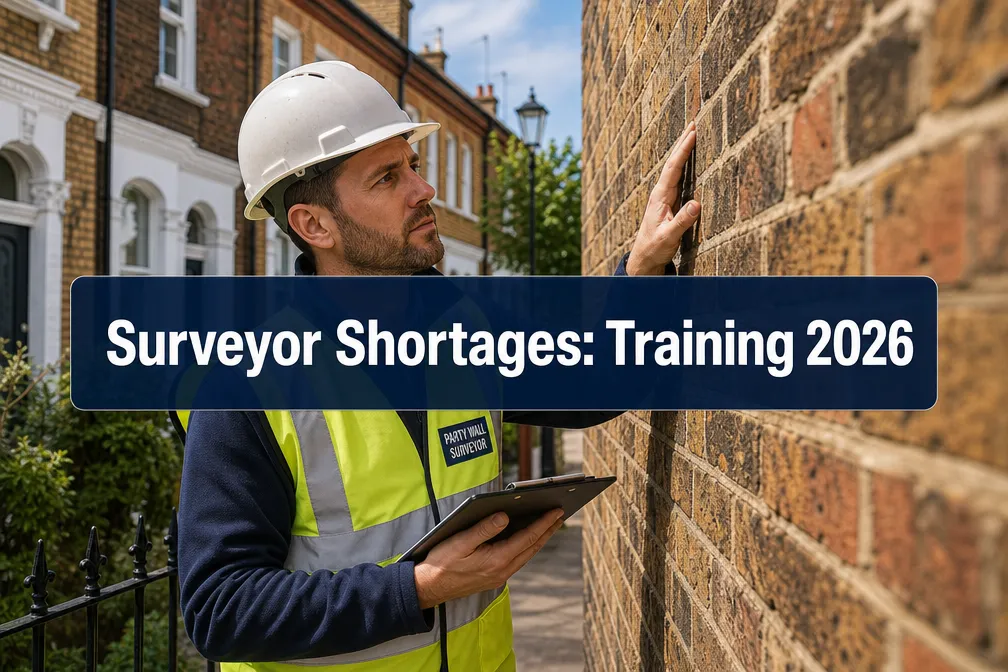
By 2028, the UK surveying profession faces a shortfall of more than 20,000 qualified practitioners, a figure that makes overcoming surveyor shortages in party wall projects: training for 2026 demand surge not just a professional priority but an urgent structural challenge for the entire construction sector [3][10]. With London’s residential development pipeline accelerating and the Party Wall etc. Act 1996 governing an ever-growing volume of works, the gap between demand and qualified supply is widening at precisely the wrong moment.
This article examines the root causes of the shortage, the technologies and training pathways reshaping the profession, and the practical strategies that firms and individual surveyors can deploy right now to stay ahead of 2026 pressures.
Key Takeaways
- The UK faces a surveyor shortfall projected to exceed 20,000 by 2028, directly threatening party wall project timelines.
- Retirement attrition and insufficient graduate pipeline are the two primary structural drivers of the skills gap.
- AI-assisted tools and reality capture technology are enabling individual surveyors to process more party wall cases with greater accuracy.
- Agreed surveyor appointments, where one surveyor acts for both parties, offer a proven efficiency mechanism under current labour constraints.
- Structured upskilling programmes, including RICS-aligned CPD and digital tool training, are the most actionable short-term response to the 2026 demand surge.
The Scale of the Shortage Hitting Party Wall Work in 2026
The surveying skills crisis did not appear overnight. Decades of underinvestment in technical education, combined with an ageing workforce, have created a compounding deficit that is now acute [8][9]. According to industry analysis, approximately 40% of currently practising chartered surveyors are expected to retire within the next decade, with the heaviest attrition concentrated among those specialising in building and party wall surveying [10].
RICS data and sector commentary from spring 2026 confirm that demand for building surveyors is outpacing supply across virtually every UK region [2][6]. Construction output is rising, retrofit programmes are scaling, and urban densification is pushing more residential projects into party wall territory. Every loft conversion, basement excavation, and side-return extension in a terrace of Victorian or Edwardian housing triggers obligations under the Party Wall etc. Act 1996.
Understanding the types of party wall works that require formal surveyor involvement helps clarify just how broad the demand base is. From notifiable excavations near neighbouring foundations to structural work on shared walls, the Act casts a wide net, and every notifiable project needs at least one qualified surveyor to reach a valid award.
The recruitment pressure is quantifiable:
| Pressure Factor | Impact Level |
|---|---|
| Retirement of senior surveyors by 2028 | Critical |
| Graduate output vs. vacancy growth | High |
| Increased party wall notifications in London | High |
| Digital skills gap within existing workforce | Moderate |
Sources confirm that vacancy rates for building surveyors reached multi-year highs in 2025 and have continued rising into 2026, with firms reporting average time-to-hire extending beyond three months for experienced party wall specialists [4][5].
“The skills shortage is not a future problem. It is a present operational constraint that is already delaying party wall awards and adding cost to projects across London.” [4]
This reality is particularly acute in high-density urban areas. Surveyors covering East London, West London, and Central London are managing caseloads that were previously handled by larger teams, increasing the risk of errors, delays, and disputes.
AI and Reality Capture: Upskilling Strategies for the 2026 Demand Surge
Overcoming surveyor shortages in party wall projects: training for 2026 demand surge requires more than hiring, it requires making each qualified surveyor significantly more productive. Two technology domains are proving transformative: artificial intelligence-assisted workflows and reality capture tools.
Reality Capture and 3D Scanning
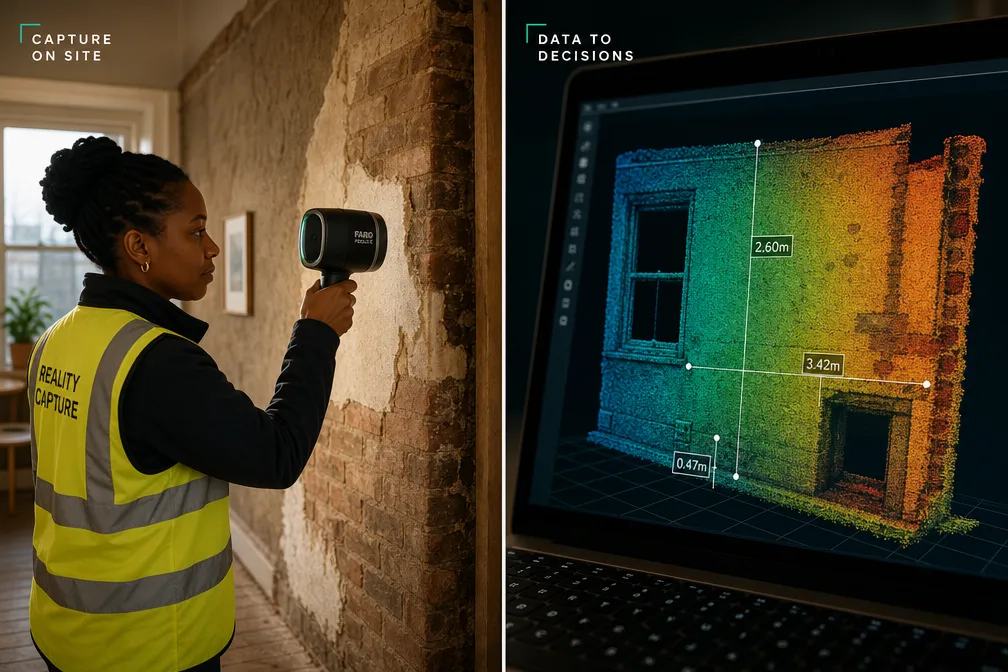
Reality capture refers to the use of laser scanners, photogrammetry drones, and LiDAR-enabled devices to create precise digital models of existing structures. For party wall surveyors, the implications are substantial:
- Schedule of condition surveys that previously required hours of manual photography and note-taking can be completed in a fraction of the time using handheld scanners.
- Point-cloud models provide defensible, timestamped records of pre-works conditions, reducing post-project disputes.
- Remote assessment of accessible areas reduces site visit frequency without sacrificing accuracy.
The schedule of condition is one of the most time-intensive components of party wall practice. Digitising this process through reality capture tools directly addresses the throughput bottleneck created by staff shortages.
Training programmes are now emerging from RICS-affiliated providers and specialist technology vendors that combine party wall legal knowledge with hands-on instruction in scanning hardware and point-cloud software. A surveyor who completes a 20-hour upskilling module in reality capture can realistically double the number of condition surveys completed per week [5].
AI-Assisted Award Drafting and Document Management
Artificial intelligence tools are entering the party wall workflow at the document production stage. Natural language processing platforms can now:
- Generate first-draft party wall awards from structured input data, reducing drafting time by 40-60%
- Flag missing statutory requirements against a checklist derived from the Party Wall etc. Act 1996
- Cross-reference party wall notices against award content to identify inconsistencies before service
These tools do not replace surveyor judgement, they eliminate the administrative burden that consumes a disproportionate share of a qualified surveyor’s working day. When a surveyor spends less time on template population and more time on site assessment and dispute resolution, effective capacity increases without adding headcount.
Key upskilling areas for 2026:
- Reality capture hardware operation (LiDAR, photogrammetry)
- Point-cloud processing software (e.g., Leica Cyclone, Matterport)
- AI document drafting platforms with party wall Act compliance modules
- Digital notice management and case tracking systems
- BIM coordination for complex party wall scenarios
RICS has signalled its commitment to integrating digital competencies into CPD frameworks, and firms facing the 2026 demand surge are advised to treat technology training as a core operational investment rather than an optional enhancement [6][2].
Agreed Surveyor Efficiency: A Structural Solution to Labour Gaps
Overcoming surveyor shortages in party wall projects: training for 2026 demand surge also means using the legal framework itself more intelligently. The Party Wall etc. Act 1996 provides a mechanism that is underutilised relative to its efficiency potential: the agreed surveyor appointment.
Under Section 10 of the Act, both the building owner and the adjoining owner may jointly appoint a single surveyor, the agreed surveyor, to act impartially on behalf of both parties. This arrangement has significant advantages in a constrained labour market:
- One surveyor handles the full process, from notice response through to award, eliminating the coordination overhead of a two or three-surveyor panel.
- Faster award timescales result from removing the need to align diaries, exchange correspondence between surveyor teams, and resolve inter-surveyor disagreements.
- Lower costs for both parties, which is particularly relevant given rising surveyor day rates driven by scarcity [7].
The agreed surveyor model is not appropriate in all cases, where there is genuine conflict between the parties’ interests, independent representation is essential. However, for straightforward projects such as loft conversions, single-storey extensions, and minor structural works on party walls, the agreed surveyor route can reduce award timescales from weeks to days.
Firms should be actively training surveyors to manage agreed appointments competently and ethically. This includes:
- Clear communication protocols that demonstrate impartiality to both parties
- Structured conflict-of-interest assessment at the outset of each appointment
- Documented decision-making trails that withstand challenge
For building owners considering their options, understanding the costs of the party wall process is an important first step. The agreed surveyor route frequently represents a meaningful saving, and in a market where surveyor availability is stretched, it can also mean the difference between a project starting on schedule or facing a statutory delay.
Practical Efficiency Gains from the Agreed Surveyor Model
Research into party wall practice under labour shortages identifies several consistent efficiency gains from the agreed surveyor approach [7]:
- Average award completion time reduced by 35-50% compared to two-surveyor appointments
- Administrative correspondence volume reduced by approximately 60%
- Client satisfaction scores higher due to single point of contact
These gains are amplified when the agreed surveyor also employs the digital tools described above, AI drafting assistance combined with reality capture condition surveys can compress a typical straightforward award from three weeks to under one week.
Building the Pipeline: Training Pathways for New Party Wall Surveyors
Addressing the immediate 2026 demand surge through technology and process efficiency is necessary but not sufficient. The profession also needs a credible pipeline of new entrants trained specifically in party wall practice.
Graduate and Apprenticeship Routes
RICS-accredited degree programmes in building surveying provide the academic foundation, but party wall practice is a specialist discipline that requires additional structured learning. The most effective pipeline-building strategies currently in use include:
- Structured mentorship programmes pairing newly qualified surveyors with experienced party wall practitioners for 12-24 months
- Degree apprenticeships that embed party wall Act training within employer-sponsored study, allowing firms to grow their own talent
- Conversion pathways for surveyors from adjacent disciplines (quantity surveying, valuation) who wish to move into building and party wall work [3][4]
The conversion pathway is particularly valuable given the current surplus of quantity surveyor graduates relative to available roles in some market segments, combined with the acute shortage in building and party wall surveying [3].
CPD and Short-Course Upskilling
For existing practitioners, the fastest route to increased party wall capacity is targeted CPD. Recommended short-course content for 2026 includes:
- Party Wall etc. Act 1996 refresher and case law updates
- Serving and responding to party wall notices correctly in complex multi-party scenarios
- Reality capture technology fundamentals
- AI-assisted award drafting workshops
- Agreed surveyor ethics and impartiality training
Firms in North London and South London, where residential development density is particularly high, are reporting that surveyors who complete digital upskilling modules are managing 30-40% more cases per quarter without a proportional increase in hours worked [5].
Retaining Experienced Surveyors
Retirement attrition is the single largest driver of the skills gap. Firms that invest in flexible working arrangements, reduced-hours consultancy contracts, and knowledge transfer programmes for senior surveyors approaching retirement age are significantly better positioned than those that allow institutional knowledge to walk out the door [8][10].
A structured knowledge transfer programme might include:
- Documented case study libraries capturing complex award decisions
- Video-recorded expert commentary on edge cases and dispute resolution
- Mentorship obligations built into senior surveyor employment contracts
Regulatory and Market Context for 2026
The regulatory environment is not standing still. RICS continues to update its guidance on surveyor competencies, and the 2026 market context includes several factors that amplify the urgency of addressing party wall surveyor shortages:
- Increased retrofit activity driven by energy efficiency mandates is generating new categories of party wall works in older housing stock [2][5]
- Planning policy changes favouring densification are increasing the proportion of new residential development that triggers party wall obligations
- Rising dispute rates as project complexity increases are placing greater demands on surveyor expertise and time [7]
Homeowners and developers who want to understand their obligations under the Act, including whether they can proceed without a surveyor in certain circumstances, need clear, accurate information. Surveyors who can communicate the Act’s requirements accessibly are better positioned to convert enquiries into appointments and to reduce the volume of disputes arising from misunderstanding.
Conclusion
The surveyor shortage affecting party wall projects in 2026 is real, quantified, and worsening. But it is not unmanageable. The firms and individual practitioners who will thrive are those taking concrete action now across three fronts.
Actionable next steps:
-
Invest in reality capture training, Enrol at least one surveyor per firm in a certified LiDAR or photogrammetry course before the end of 2026. The throughput gains justify the cost within months.
-
Adopt AI drafting tools, Evaluate at least one AI-assisted award drafting platform against your current workflow. Pilot it on straightforward agreed surveyor cases first to build confidence and measure time savings.
-
Promote the agreed surveyor model, Where appropriate, actively recommend agreed surveyor appointments to clients. Faster awards, lower costs, and reduced administrative burden make this the most immediately deployable efficiency lever available under the existing legal framework.
-
Build a structured CPD calendar, Map your team’s party wall competencies against the 2026 demand profile and identify specific gaps. Commission targeted short courses rather than generic CPD.
-
Start a knowledge transfer programme, Identify senior surveyors within five years of retirement and formalise a structured handover of case knowledge, client relationships, and specialist expertise.
The Party Wall etc. Act 1996 framework is robust. The challenge is ensuring enough qualified practitioners exist to operate it effectively. By combining technological upskilling with smarter use of the agreed surveyor mechanism and a genuine commitment to pipeline development, the profession can meet the 2026 demand surge without compromising the quality and impartiality that party wall practice demands.
References
[1] Watch – youtube.com
[2] Spring 2026 Hot Topics For Uk Building Surveyors Rics Insights On Market Shifts And Valuation Challenges – https://princesurveyors.co.uk/blog/spring-2026-hot-topics-for-uk-building-surveyors-rics-insights-on-market-shifts-and-valuation-challenges/
[3] The Quantity Surveyor Shortage A Technical Outlook For 2026 – onboard-jobs.co.uk
[4] Quantity Surveyor Shortages Impacting Building Surveys Adaptation Tactics For Chartered Surveyors In 2026 Projects – https://princesurveyors.co.uk/blog/quantity-surveyor-shortages-impacting-building-surveys-adaptation-tactics-for-chartered-surveyors-in-2026-projects/
[5] Skills Shortage In Building Surveying Rics 2025 Strategies For Firms Facing 2026 Infrastructure And Retrofit Demands – https://princesurveyors.co.uk/blog/skills-shortage-in-building-surveying-rics-2025-strategies-for-firms-facing-2026-infrastructure-and-retrofit-demands/
[6] Update From Justin Young Rics Ceo May 2026 – rics.org
[7] Drafting Party Wall Awards Under Labour Shortages Best Practices For Chartered Surveyors In 2026 – https://princesurveyors.co.uk/blog/drafting-party-wall-awards-under-labour-shortages-best-practices-for-chartered-surveyors-in-2026/
[8] Uk Construction Skills Shortage Explained – surveyorsuccess.co.uk
[9] Skills Gaps – journals.cices.org
[10] Rics Surveying Skills Report – atkinssearch.co.uk
Speak to a RICS chartered party wall surveyor
Free initial consultation. Notices, awards and schedules of condition across London and nationwide.