Nearly one in three homeowners who carry out work on or near a shared wall in England and Wales do so without realising they may have a legal obligation to notify their neighbour first. The line between a simple repair and a notifiable structural change is thinner than most people think — and crossing it without the right paperwork can stop a project dead in its tracks.
Party Wall Awards for Structural Repairs vs. Renovations: When Maintenance Work Triggers Notice Requirements sits at the heart of countless neighbour disputes every year in 2026. Understanding how surveyors draw the line between routine maintenance and notifiable works is not just useful — it can save thousands of pounds in legal fees, delays, and damaged relationships.
This guide breaks down exactly when the Party Wall etc. Act 1996 kicks in, how Party Wall Awards are applied differently to repairs versus renovations, and what every building owner and adjoining owner needs to know before lifting a trowel.
Key Takeaways 📋
- Routine maintenance (plastering, painting, drilling for shelves) does not require a Party Wall Notice or Award.
- Structural work affecting a shared wall — including underpinning, cutting openings, or removing sections — almost always triggers notice requirements under the Party Wall Act 1996.
- A Party Structure Notice requires a minimum two-month notice period before work begins [2].
- Neighbours have 14 days to consent or dissent after a notice is served [2].
- Failing to serve notice can result in an injunction stopping all work and significant legal liability [3].
What the Party Wall Act Actually Covers (and What It Doesn’t)
The Party Wall etc. Act 1996 governs work that affects shared walls, boundaries, and structures between two properties. But it does not apply to every single thing a homeowner does near a shared wall [1].
Works That Are Exempt From Notice
Many homeowners are surprised to learn how much they can do without triggering any formal notice requirements. The following do not require a Party Wall Agreement or Notice [3]:
- 🖌️ Plastering or re-plastering an internal wall
- 🔌 Electrical work on internal surfaces
- 🪛 Drilling into a party wall to hang shelves or pictures
- 🚿 Fitting kitchen or bathroom units against a shared wall
- 🎨 Painting or decorating on either side of a wall
These are considered routine maintenance — they do not alter the structure of the wall or affect the adjoining property.
Works That Typically Do Require Notice
The Act becomes relevant when work goes beyond surface-level maintenance. The following categories generally do trigger notice requirements:
| Type of Work | Notice Type Required | Notice Period |
|---|---|---|
| Cutting into a party wall | Party Structure Notice | 2 months [2] |
| Removing or rebuilding a party wall | Party Structure Notice | 2 months [2] |
| Underpinning foundations | Party Structure Notice | 2 months [2] |
| Excavating near a neighbour’s foundations | Line of Junction / Excavation Notice | 1 month [2] |
| Building on or at the boundary line | Line of Junction Notice | 1 month [2] |
💡 Pull Quote: “The critical test is not how much work is being done — it is whether the work affects the structural integrity or use of the shared wall.”
Party Wall Awards for Structural Repairs vs. Renovations: When Maintenance Work Triggers Notice Requirements

This is where the distinction becomes genuinely complex — and where professional surveyor judgement matters most.
The Repair vs. Renovation Spectrum
Not all repairs are minor. Not all renovations are major. The challenge lies in the grey zone between the two.
Consider these examples:
Scenario A — Clearly Exempt:
A homeowner notices damp on an internal party wall. They hire a plasterer to hack off the old render and re-plaster the surface. This is maintenance. No notice required.
Scenario B — Clearly Notifiable:
A homeowner plans to knock through a party wall to create an open-plan kitchen between two semi-detached properties. This is structural work. A Party Structure Notice must be served with a minimum two-month notice period [2].
Scenario C — The Grey Zone:
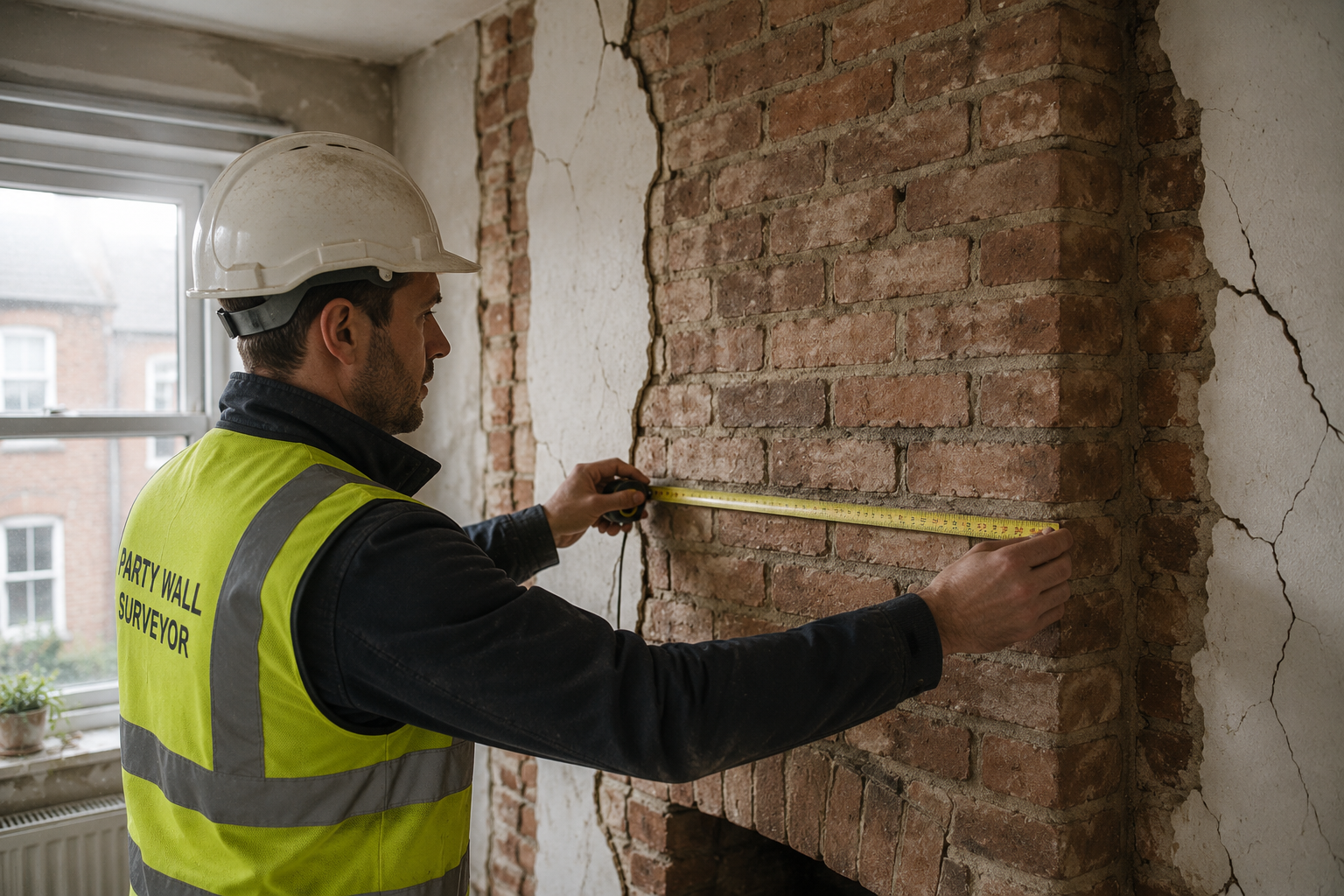
A homeowner discovers that a section of the party wall has deteriorated significantly. To repair it properly, the contractor needs to remove and rebuild a 1.5-metre section of brickwork. This looks like a repair — but because it involves rebuilding part of the shared structure, it almost certainly triggers notice requirements.
How Surveyors Make the Distinction
Professional party wall surveyors assess several factors when determining whether work is notifiable:
- Does the work affect the structural fabric of the wall? Replacing like-for-like materials in a damaged section may still be notifiable if the wall’s load-bearing function is affected.
- Does the work reduce the wall’s thickness or height? Any reduction in the structural mass of a shared wall is notifiable.
- Does the work involve cutting, chasing, or penetrating through the full depth of the wall? Running new pipes or cables through the full thickness of a party wall triggers the Act.
- Could the work cause vibration, movement, or settlement affecting the adjoining property? If yes, the Act almost certainly applies.
For a full overview of what types of works fall under the Act, the types of party wall works guide provides detailed breakdowns by category.
Structural Repairs That Surprise Homeowners
Several common repair scenarios catch homeowners off guard:
- Repointing a party wall — Usually exempt if superficial, but notifiable if it involves significant removal of mortar and brickwork.
- Damp-proofing injection — Drilling a series of holes through a party wall for chemical DPC injection is notifiable.
- Lintel replacement — Replacing a failed lintel above a shared opening almost always requires a Party Structure Notice.
- Roof repairs at a shared gable — Work on a shared chimney stack or gable end wall where both properties are affected is notifiable.
The Party Wall Award Process: From Notice to Completion
Understanding the Party Wall Award process helps both building owners and adjoining owners know what to expect — and how to protect their interests.
Step 1: Serve the Correct Notice
The building owner (the person carrying out the work) must serve the appropriate notice on all adjoining owners. For most structural repair and renovation scenarios, this is a Party Wall Notice served in writing [1].
Key notice rules:
- Party Structure Notices require 2 months’ notice before work starts [2]
- Excavation notices require 1 month’s notice [2]
- Once served, the building owner has up to one year to begin work [3]
Step 2: The Neighbour’s Response Window
After the notice is served, the adjoining owner has 14 days to respond [2]. Their options are:
- ✅ Consent in writing — Work can proceed once the full notice period elapses
- ❌ Dissent — A dispute is deemed to have arisen; surveyors must be appointed
- 🔇 No response — After 14 days, a dispute is automatically deemed to have arisen [2]
Step 3: Appointing Surveyors and Issuing the Award
When a dispute arises (or is deemed to arise), both parties appoint surveyors. The surveyors then work together to produce a Party Wall Award — a legally binding document that sets out:
- The exact scope of permitted works
- Working hours and access arrangements
- A Schedule of Condition of the adjoining property before work begins
- Compensation and repair obligations if damage occurs
💡 Pull Quote: “The Schedule of Condition is the single most important document in any party wall dispute — it establishes what damage existed before work began, and what was caused by the works.” [2]
Who Pays for the Party Wall Award?
In most cases, the building owner (the person carrying out the work) bears the cost of the surveyor fees and the Party Wall Award process [1]. However, if the adjoining owner requests specific additional conditions or their own surveyor, costs can be shared depending on the circumstances.
For a detailed breakdown, the costs of party wall process page provides current fee guidance.
Party Wall Awards for Structural Repairs vs. Renovations: Liability, Damage, and Compensation
One of the most significant practical differences between repair work and renovation work relates to liability for damage.
The Schedule of Condition: Your Legal Baseline
Before any notifiable work begins, a qualified surveyor must inspect and document the condition of the adjoining property [2]. This Schedule of Condition typically includes:
- Photographs of all existing cracks, defects, and structural features
- Written descriptions of wall, ceiling, and floor conditions
- Measurements of existing cracks (to detect any movement during works)
Without this document, it becomes extremely difficult to prove which damage was caused by the construction work versus pre-existing conditions [3]. This is why failing to serve notice is so risky — it removes the legal protection that the Schedule of Condition provides for both parties.
What Happens When Damage Occurs?
If the adjoining owner’s property is damaged as a result of the notifiable works, they have two options [2]:
- Allow the building owner’s contractor to carry out remedial repairs
- Receive monetary compensation to hire their own contractor
A recent Court of Appeal ruling has clarified an important boundary: building owners are legally obligated to compensate for damage caused by their works, but they should not be held liable for pre-existing structural issues that the works merely bring to light [2]. This distinction is particularly relevant when structural repair work reveals hidden defects in an already compromised shared wall.
The Risk of Skipping Notice
Proceeding without serving the required notice carries serious consequences [3]:
- ⚠️ The adjoining owner can apply for a court injunction to halt all work immediately
- ⚠️ Without a pre-work Schedule of Condition, all damage may be attributed to the building owner by default
- ⚠️ Legal costs can far exceed the original cost of serving notice correctly
- ⚠️ The building owner may face retrospective surveyor appointments and Awards imposed without their input
For adjoining owners who believe their neighbour is carrying out work without proper notice, the my neighbour is carrying out works resource outlines the steps available to protect their property.
Practical Guidance for Building Owners in 2026
If planning any work near, on, or below a shared wall or boundary in 2026, the following checklist helps determine whether notice is required.
Quick Decision Checklist ✅
Ask these questions before starting any work:
- Does the work involve cutting into, through, or removing any part of a shared wall?
- Does the work involve underpinning or altering the foundations near a shared boundary?
- Does the work involve excavating within 3–6 metres of an adjoining building’s foundations?
- Does the work involve rebuilding or raising a shared wall, even as part of a repair?
- Could the work cause vibration, movement, or structural stress to the adjoining property?
If the answer to any of these is YES, a Party Wall Notice is almost certainly required. Consulting a qualified party wall surveyor before starting work is strongly recommended.
For building owners who are ready to begin the process, the building owners page provides a clear starting point for understanding obligations and next steps.
Tips for Keeping the Process Smooth
- Serve notice early — The two-month notice period means planning ahead is essential
- Communicate with neighbours before serving formal notice — many disputes are avoided through early conversation
- Use a qualified surveyor — Attempting to navigate Party Wall Awards without professional guidance increases risk significantly
- Keep records — Document all correspondence, notices, and responses in writing
- Don’t assume repairs are exempt — When in doubt, seek professional advice before assuming no notice is needed
For those looking to manage costs effectively, the tips on how to keep party wall costs down guide offers practical strategies without cutting corners on legal compliance.
Conclusion: Get the Distinction Right Before Work Begins
The difference between a routine repair and a notifiable structural alteration is not always obvious — but getting it wrong carries real legal and financial consequences. Party Wall Awards for Structural Repairs vs. Renovations: When Maintenance Work Triggers Notice Requirements is not an abstract legal question. It is a practical decision that affects project timelines, neighbour relationships, and liability for damage.
The core principle is straightforward: if work affects the structural fabric of a shared wall, boundary, or foundation, the Party Wall etc. Act 1996 almost certainly applies — regardless of whether the motivation is repair or renovation.
Actionable Next Steps 🎯
- Assess the scope of your planned work using the checklist above before assuming it is exempt.
- Consult a qualified party wall surveyor early — even a brief initial consultation can clarify whether notice is required.
- Serve the correct notice with the appropriate lead time (two months for party structure work, one month for excavations).
- Commission a Schedule of Condition before any notifiable work begins to protect both parties.
- If in doubt, serve notice anyway — the cost of doing so is always lower than the cost of an injunction or a disputed damage claim.
Taking these steps in 2026 ensures that structural repairs and renovations proceed legally, safely, and with the confidence that both the building owner and the adjoining owner are protected under the law.
References
[1] Understanding Party Wall Act What Homeowners Need Know Before Renovating – partywallslimited.com
[2] Party Wall Dispute – onlinearchitecturalservices.com
[3] Party Wall Agreement – hoa.org.uk
[4] Adjacent Wall Vs Party Wall Key Structural And Legal Differences – https://www.coohom.com/article/adjacent-wall-vs-party-wall-key-structural-and-legal-differences
Speak to a RICS chartered party wall surveyor
Free initial consultation. Notices, awards and schedules of condition across London and nationwide.