
Fewer than 20% of building owners who start boundary construction projects in England and Wales serve their party wall notices correctly on the first attempt — and that single administrative failure can halt an entire development, trigger injunctions, and add thousands of pounds in delay costs. Whether constructing a new boundary wall astride the line of junction or raising an existing shared structure, understanding New Party Wall Construction on Boundaries: 2026 Notice Essentials, Surveyor Checklists, and Award Templates for Seamless Agreements is not optional — it is the legal foundation upon which every successful build rests.
This guide breaks down the Section 1 Line of Junction Notice (the “Type A” notice for new boundary builds), delivers surveyor-tested strategies to avoid dissent in high-demand housing markets, and provides RICS-aligned templates and checklists to keep projects moving without unnecessary dispute.
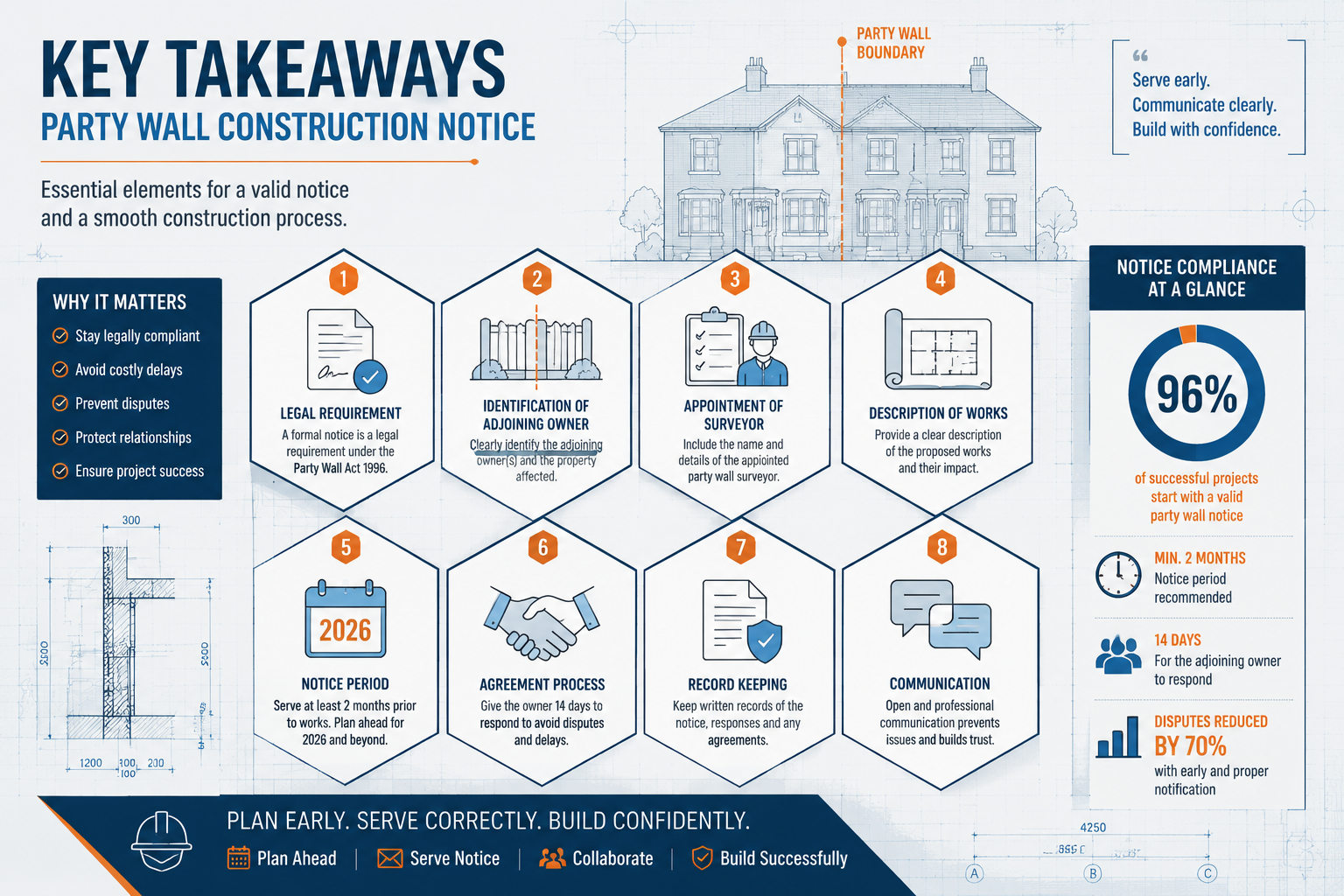
Key Takeaways 📋
- Section 1 notices govern new wall construction at or astride the boundary line and require a one-month notice period — shorter than the two months needed for existing party wall works [1]
- A valid notice must include the building owner’s full name, property address, precise work description, and intended start date — vague language is a common and costly mistake [1]
- Neighbours have 14 days to respond in writing; silence triggers an automatic dispute and the need for a Party Wall Award [4]
- Failing to serve notice can result in a court injunction stopping all works on site [2]
- Proactive surveyor engagement and well-drafted award templates dramatically reduce the risk of dissent in competitive urban housing markets
Understanding the Three Notice Types: Where New Boundary Construction Fits
The Party Wall etc. Act 1996 establishes three distinct categories of notice, each designed for a specific type of work [3]:
| Notice Type | Section | Trigger | Notice Period |
|---|---|---|---|
| Line of Junction Notice | Section 1 | New wall at/astride boundary | 1 month |
| Party Structure Notice | Section 3 | Works to existing party walls | 2 months |
| Excavation Notice | Section 6 | Digging near neighbour’s foundations | 1 month |
Section 1: The “Type A” Notice for New Boundary Walls
When a building owner intends to construct a brand-new wall on the line of junction between two properties — or entirely on their own land but up to the boundary — a Section 1 Line of Junction Notice must be served [1]. This is the primary notice for new party wall construction on boundaries.
💡 Pull Quote: “A Section 1 notice is not just a formality — it grants the building owner a legal right of access onto the adjoining owner’s land to carry out necessary works.” [3]
This legal right of access is especially valuable in urban areas where construction cannot physically proceed without temporarily using the neighbour’s land. Without the notice, that access has no legal basis.
Key distinction: Unlike Section 3 Party Structure Notices (which require two months’ notice for works to existing shared walls), the Section 1 notice only requires one month [1]. This shorter window makes it critical to serve it correctly the first time — there is less buffer to correct errors before a project’s start date.
When Section 3 and Section 6 Notices Also Apply
Many new boundary construction projects trigger multiple notice types simultaneously. For example, if a new boundary wall involves:
- Cutting into or modifying an existing shared wall → Section 3 notice required (2-month period) [1]
- Excavating within 3–6 metres of a neighbouring foundation → Section 6 notice required [3]
Understanding which types of party wall works apply to a specific project prevents costly omissions.
2026 Notice Essentials: What Every Valid Section 1 Notice Must Include
The legal requirements for a valid notice are non-negotiable. Courts and surveyors have consistently found notices invalid when key elements are missing [1][4]. For New Party Wall Construction on Boundaries: 2026 Notice Essentials, Surveyor Checklists, and Award Templates for Seamless Agreements, the following checklist applies to every Section 1 notice served this year.
✅ Mandatory Notice Content Checklist
Building Owner Information
- Full legal name of the building owner(s)
- Full address of the building owner
- Contact details (phone and email recommended)
Property and Works Information
- Full address of the property where works will occur
- Precise description of proposed works (see below)
- Intended start date of construction
- Supporting drawings or plans (strongly recommended for all boundary works)
Adjoining Owner Information
- Full name of the adjoining owner(s)
- Address of the adjoining property
- ⚠️ For leasehold properties: notice must be served on both the freeholder and the tenant(s) [5]
⚠️ The Vague Description Trap
One of the most common reasons notices are challenged is imprecise work descriptions. The law requires specificity [4]. Compare these two examples:
| ❌ Invalid Description | ✅ Valid Description |
|---|---|
| “Boundary wall works” | “Construction of a new 2.4m high brick boundary wall astride the line of junction at the rear of the property, requiring temporary access to the adjoining garden” |
| “Extension works” | “Cut into the party wall at ground floor level to accommodate two steel RSJ beams at 2.1m height” |
For detailed guidance on serving notices correctly, the Party Wall Act Notices guide provides practical examples for homeowners and developers alike.
Notice Validity Period and Timing
Once a party wall notice is served, the building owner has up to one year to commence the actual works [2]. This flexibility is valuable in high-demand housing markets where planning approvals, contractor availability, and financing can shift project timelines. Serving notices early — while ensuring all content is accurate — is a sound strategy.
Surveyor Checklists and Strategies to Avoid Dissent in High-Demand Markets
In London and other high-demand housing markets, neighbour disputes over boundary construction are increasingly common. Proactive surveyor engagement is the single most effective tool for keeping projects on track. This section of New Party Wall Construction on Boundaries: 2026 Notice Essentials, Surveyor Checklists, and Award Templates for Seamless Agreements focuses on practical strategies surveyors use to prevent dissent before it arises.
Why Dissent Happens — and How to Pre-empt It
Neighbours dissent for predictable reasons:
- Fear of structural damage to their property
- Lack of information about what the works actually involve
- Distrust of the building owner’s intentions
- Advice from third parties (often well-meaning but legally uninformed)
💡 Pull Quote: “The 14-day response window after notice is served is the most critical period in any boundary construction project — how it is managed determines whether a project runs smoothly or enters costly dispute.” [4]
If a neighbour does not respond within 14 days, a dispute is automatically deemed to have arisen, requiring surveyor appointment and a formal Party Wall Award [4][5].
Pre-Notice Engagement: The Surveyor’s Secret Weapon
Experienced surveyors in competitive urban markets recommend a pre-notice engagement strategy:
- 🤝 Informal neighbour meeting — explain the works, timeline, and protective measures before the formal notice is served
- 📄 Provide a plain-English summary of what the notice means and what rights the neighbour has
- 🏗️ Share preliminary drawings so neighbours can visualise the works
- 📞 Offer direct contact with the appointed surveyor for questions
This approach significantly increases the rate of consent within the 14-day window, avoiding the need for a formal award process entirely.
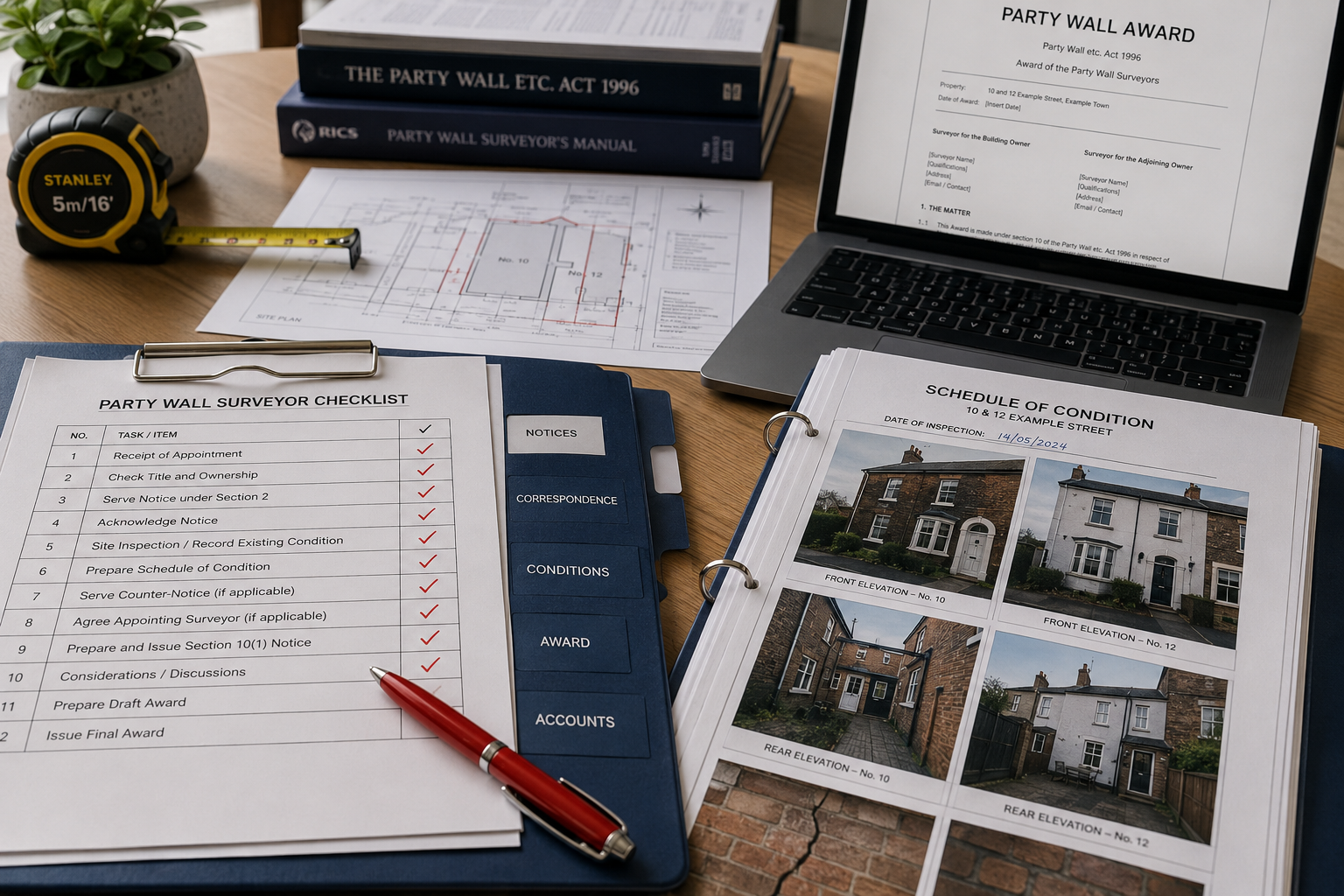
The Schedule of Condition: Non-Negotiable Protection
Before any boundary construction begins, a Schedule of Condition should be prepared — a detailed photographic and written record of the adjoining property’s current state. This document:
- Protects the building owner from spurious damage claims
- Protects the adjoining owner by establishing a pre-works baseline
- Forms a core component of any Party Wall Award
Without this record, establishing which damage (if any) was caused by the works versus pre-existing conditions becomes virtually impossible [2]. A professional schedule of condition is one of the most cost-effective investments in any boundary construction project.
Surveyor Selection: Agreed vs. Separate Appointments
When a dispute arises (or is deemed to arise), surveyors must be appointed. There are two routes:
| Route | Description | Best For |
|---|---|---|
| Agreed Surveyor | Both parties appoint one impartial surveyor | Straightforward projects, cooperative neighbours |
| Separate Surveyors | Each party appoints their own surveyor | Complex projects, high-value disputes |
For building owners, working with a dedicated building owner’s surveyor ensures their interests are properly represented throughout the award process. Adjoining owners benefit equally from their own adjoining owner’s surveyor.
Regional Considerations in 2026
High-density London boroughs continue to see the highest volume of party wall disputes in England. Surveyors operating across South London, North London, and East London report that new boundary wall projects — particularly rear extensions and side-return developments — account for a growing share of their caseloads in 2026.
Award Templates and Frameworks for Seamless Agreements
A Party Wall Award is the legally binding document that governs how works are carried out when a formal dispute arises (or is deemed to arise). For New Party Wall Construction on Boundaries: 2026 Notice Essentials, Surveyor Checklists, and Award Templates for Seamless Agreements, a well-structured award template is the difference between a project that proceeds smoothly and one that stalls in ongoing negotiation.
Core Components of a RICS-Compliant Party Wall Award
A robust party wall award for new boundary construction should include the following sections:
1. Recitals
- Names and addresses of all parties
- Description of the adjoining properties
- Reference to the notice served and date
2. Works Description
- Detailed scope of boundary construction works
- Reference to approved drawings (numbered and dated)
- Specification of materials to be used
3. Conditions of Award
- Working hours (typically 8am–6pm Monday–Friday, 8am–1pm Saturday)
- Dust, noise, and vibration control measures
- Access arrangements and notice requirements
- Protection measures for the adjoining property
4. Schedule of Condition
- Attached as an appendix with photographs
- Signed and dated by the appointed surveyor(s)
5. Dispute Resolution Provisions
- Process for raising concerns during works
- Surveyor contact details
- Appeal rights (14 days from award service to appeal to County Court)
6. Costs
- Confirmation of which party bears surveyor fees
- (Generally, the building owner pays all reasonable costs) [2]
Downloadable Template Resources
For those seeking a starting point, a free sample party wall agreement template provides a Word-format document that can be adapted for specific boundary construction scenarios. A comprehensive party wall contract template guide explains how each section of the award functions in practice.
Minor Works: When No Award Is Needed
Not every boundary-adjacent project requires a formal award. Certain minor works are exempt from the Act entirely [2]:
- ✅ Internal plastering
- ✅ Electrical work within the wall
- ✅ Drilling to fit shelving or kitchen units
- ✅ Painting and decorating
However, any structural work — including new wall construction at the boundary line — falls firmly within the Act’s scope.

Consequences of Getting It Wrong: Injunctions, Damage Claims, and Delays
The consequences of failing to comply with the Party Wall etc. Act 1996 in 2026 are significant and well-documented:
🚨 Injunctions
If a building owner proceeds without serving the required notice, the adjoining owner can apply to court for an injunction to stop all works until proper notice has been served [2]. In London’s busy construction market, this can mean weeks or months of delay — with contractor costs continuing to accrue.
🏚️ Damage Claims Without Protection
Without a pre-works Schedule of Condition, any damage claim made by a neighbour during or after construction becomes extremely difficult to defend. There is no baseline against which to compare the alleged damage [2].
💷 Cost Implications
Retrospective party wall compliance — serving notices after works have begun — is significantly more expensive than proactive compliance. For guidance on managing expenditure, the party wall costs guide outlines typical fee structures and how to keep costs proportionate to the project.
The Leasehold Complication
A frequently overlooked requirement: when the adjoining property is leasehold, both the freeholder and all tenants must receive notice [5]. Serving notice on only one party renders the notice invalid and restarts the clock — a painful and avoidable delay.
Conclusion: Actionable Next Steps for Boundary Construction in 2026
New party wall construction on boundaries is one of the most legally structured areas of residential and commercial development in England and Wales. The good news: with the right preparation, the process is entirely manageable.
✅ Your 2026 Action Plan
- Identify which notices apply — Section 1 for new boundary walls, Section 3 for existing party wall modifications, Section 6 for excavation near foundations
- Draft precise notice documents — include all mandatory fields and specific work descriptions; avoid vague language
- Serve notices at the right time — one month before works for Section 1; up to one year in advance is permitted
- Engage neighbours proactively — pre-notice conversations dramatically reduce the likelihood of formal dissent
- Commission a Schedule of Condition before any works begin
- Appoint qualified surveyors early — whether an agreed surveyor or separate appointments, professional guidance pays for itself
- Use RICS-compliant award templates — structured, comprehensive awards prevent disputes during and after construction
The framework established by the Party Wall etc. Act 1996 exists to protect all parties — building owners and neighbours alike. Treating it as a tool for collaboration rather than a bureaucratic hurdle is the mindset that separates projects that complete on time from those that become expensive legal battles.
For expert support with any aspect of boundary construction compliance in 2026, professional party wall surveyors are the most reliable resource available.
References
[1] Party Wall Notices The Complete Guide For Homeowners And Developers – aldsurveying.co.uk
[2] Party Wall Agreement – hoa.org.uk
[3] Three Types Of Party Wall Notices – stokemont.com
[4] Party Wall Notices Explained A Simple Guide For Home Extensions – prideroad.co.uk
[5] Party Wall Agreements What You Need To Know – fmb.org.uk
Speak to a RICS chartered party wall surveyor
Free initial consultation. Notices, awards and schedules of condition across London and nationwide.