
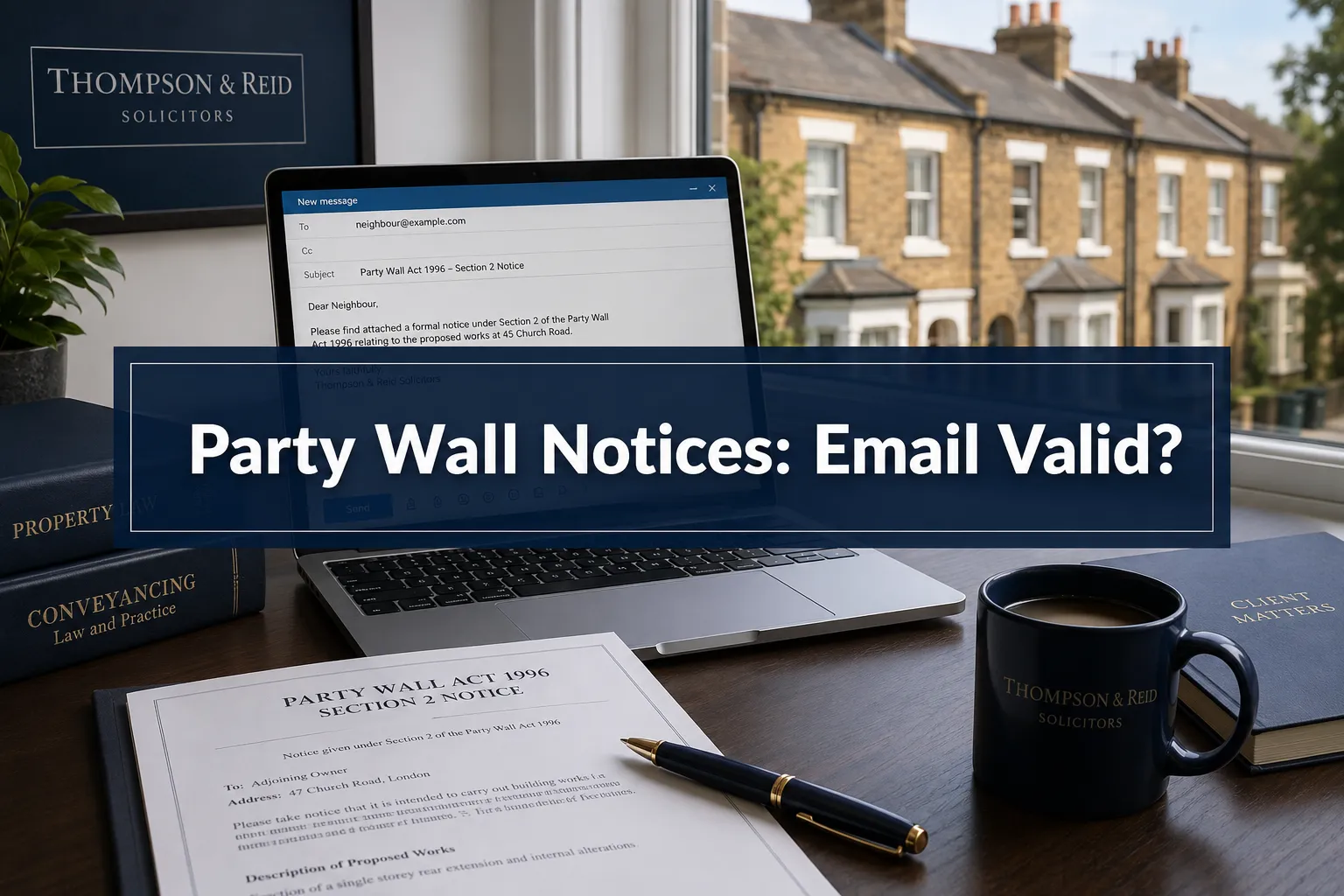
Nearly one in three party wall disputes in England and Wales now involves a question about how a notice was served, and in 2026, that question increasingly centres on whether an email or online platform message actually counts. The shift toward digital communication has transformed how building owners and adjoining owners interact, yet many remain uncertain whether electronic service of party wall notices and awards carries the same legal weight as a letter through the letterbox. This article examines the statutory framework, the conditions that must be met, and the practical steps that ensure digital service of Party Wall Notices and awards, whether by email or online platforms, is legally valid.
Key Takeaways
- The Party Wall etc. Act 1996, as amended by the Electronic Communications Order 2016, expressly permits electronic service of notices and awards.
- Valid email service requires the recipient’s prior consent, an unwithdrawal of that consent, and use of the specific email address they provided.
- The Court of Appeal case Knight v Goulandris (2018) broadened acceptance of email service even in the absence of formal written consent.
- Online platforms can be used, but they must meet the same statutory conditions as email to be legally compliant.
- When in doubt, combining electronic service with a physical backup is the safest approach.
The Statutory Framework: How the Law Evolved to Permit Digital Service
Understanding whether digital service of Party Wall Notices and awards is legally valid requires going back to the primary legislation. The Party Wall etc. Act 1996 sets out the rules for serving notices and awards between building owners and adjoining owners. When it was originally enacted, electronic communication was not contemplated as a formal service method.
That changed with the Party Wall etc. Act 1996 (Electronic Communications) Order 2016 (SI 2016/335), which amended the Act to bring it in line with modern practice [6]. The Order inserted provisions allowing notices, counter-notices, and awards to be served electronically, provided that specific conditions are satisfied. This was a significant legislative update, and it means that email service is no longer a legal grey area; it is expressly authorised by statute [8].
The government’s own explanatory booklet on the Act confirms this position, stating that electronic service is valid where the recipient has agreed to receive documents by electronic communication [2]. This guidance is clear and authoritative, though it is worth noting that the conditions attached to that permission are not optional, they are mandatory requirements.
What the Electronic Communications Order 2016 Actually Says
The Order sets out three cumulative conditions that must all be satisfied for electronic service to be valid [6][3]:
- The recipient must have stated a willingness to receive documents by electronic communication.
- That statement must not have been withdrawn at the time of service.
- The document must be sent to the specific electronic address (for example, the email address) that the recipient provided.
If any one of these three conditions is not met, the electronic service may be invalid, potentially exposing the building owner to serious procedural and legal risk. This is why professional surveyors and solicitors always advise confirming consent in writing before relying on email service alone [4].
“Electronic service is not simply a matter of convenience, it is a matter of compliance. The conditions in the 2016 Order are not suggestions; they are legal requirements.”
Does Email Service Work in Practice? Key Cases and Conditions
The question of whether digital service of Party Wall Notices and awards, including email and online platforms, is legally valid has been tested in the courts, and the results are instructive.
Knight v Goulandris (2018): A Landmark Decision
The Court of Appeal decision in Knight v Goulandris [2018] EWCA Civ 237 is the most important case on this issue. The court held that email service of a party wall award was valid even though there had been no formal written consent from the recipient to receive documents electronically [3]. The court took a pragmatic approach, finding that where a party had previously communicated by email and had not objected to receiving documents that way, it was reasonable to treat that conduct as implied consent.
This decision significantly broadened the practical scope of email service. It confirmed that surveyors and building owners do not necessarily need a signed consent form on file, but they do need to be able to demonstrate that the recipient had, through their conduct, indicated a willingness to receive documents electronically [3][7].
However, it is important not to over-read this case. The safest interpretation remains that express, documented consent is always preferable to relying on implied consent. Implied consent is harder to prove and more likely to be challenged.
What Counts as Valid Consent?
Consent can take several forms, but each carries a different level of risk:
| Form of Consent | Risk Level | Notes |
|---|---|---|
| Written confirmation (email or letter) | Low | Best practice; clear and documented |
| Verbal agreement, followed by email confirmation | Low-Medium | Confirm in writing immediately |
| Prior email exchanges between parties | Medium | Implied consent per Knight v Goulandris |
| No prior contact at all | High | Electronic service likely invalid |
The safest approach is to obtain written confirmation, even a simple reply email saying “I am happy to receive party wall notices at this address”, before serving any notice or award electronically [1][4].
Serving a Party Wall Notice by Email: Step-by-Step
For building owners planning to serve a party wall notice by email, the following process reduces the risk of a defective service:
- Contact the adjoining owner in advance and ask them to confirm in writing that they consent to receiving party wall notices by email.
- Ask them to confirm the specific email address to which notices should be sent.
- Keep a record of their confirmation (a forwarded email thread is sufficient).
- Serve the notice to that exact email address, attaching the notice as a PDF or similar document.
- Request a read receipt or delivery confirmation where possible.
- Keep copies of all correspondence as part of the party wall file.
For guidance on what a valid notice must contain, the detailed breakdown of Party Wall Act notices, what they are and how to respond is a useful starting point.
Online Platforms, Digital Portals, and the Legal Position in 2026
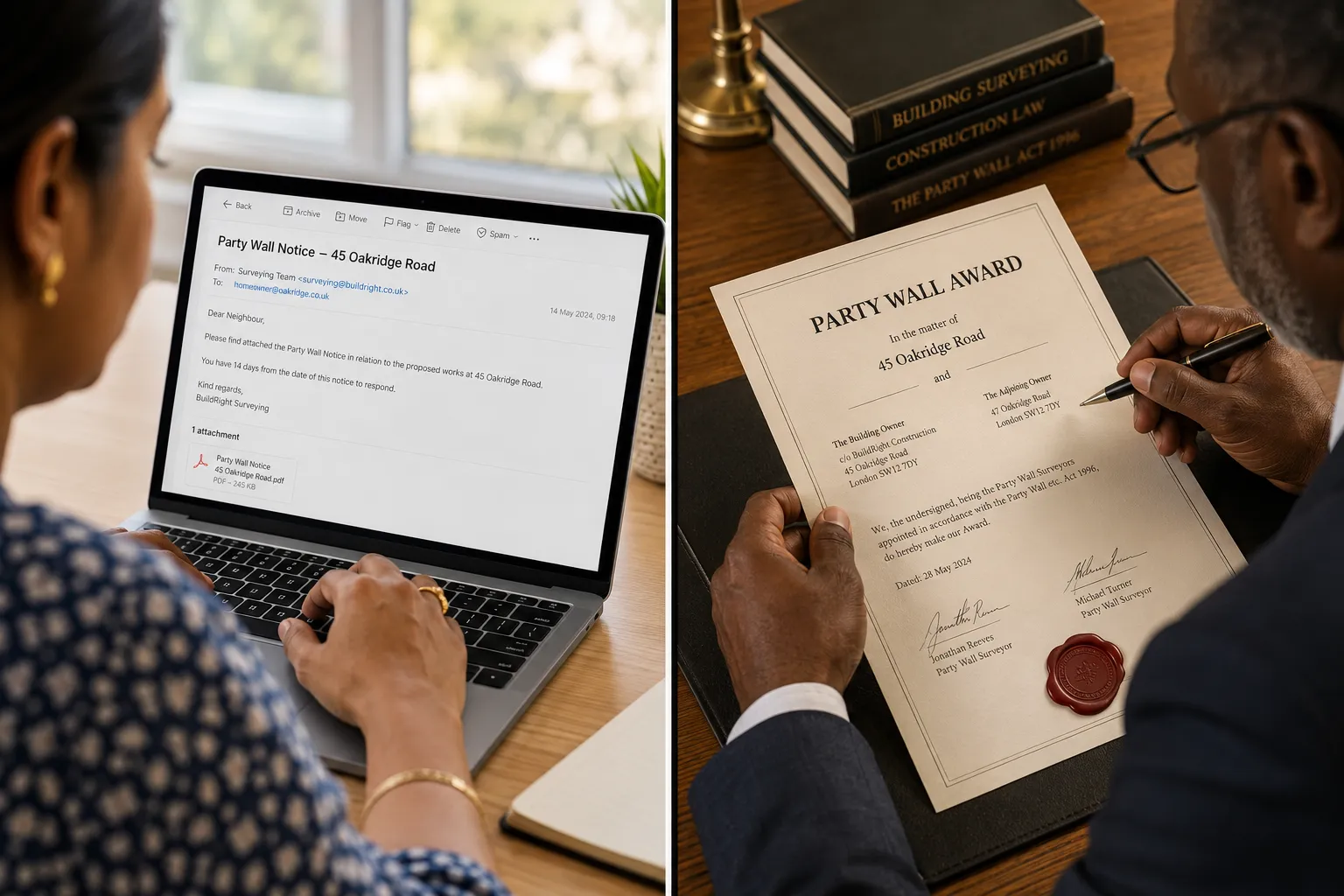
Beyond email, a growing number of online platforms and digital portals now offer party wall notice services. These range from dedicated party wall software used by surveyors to generic document-sharing platforms. The question of whether digital service of Party Wall Notices and awards via these platforms is legally valid follows the same statutory framework as email, but with additional practical considerations.
Do Online Platforms Meet the Legal Requirements?
An online platform can be a valid method of service, provided [6][7][8]:
- The recipient has consented to receive documents via that specific platform or method.
- The consent has not been withdrawn.
- The document is sent to the correct account or address on that platform.
The challenge with online platforms is that consent is often less clearly documented than with email. If a building owner uses a portal that the adjoining owner has never heard of, there is a real risk that service will be found to be defective. The adjoining owner must actively agree to use the platform, simply creating an account on their behalf is not sufficient.
Risks of Relying Solely on Digital Service
Even where the legal conditions are met, there are practical risks to relying exclusively on digital service:
- Delivery failures: Emails can go to spam folders; platform notifications can be missed.
- Proof of receipt: Unlike recorded delivery, email does not automatically generate a legally recognised proof of receipt.
- Withdrawal of consent: If the recipient withdraws their consent to electronic service between the time it was given and the time of service, the service is invalid [3].
- Wrong address: Sending to an outdated email address, even one previously provided, may not satisfy the statutory requirement if the recipient has since changed it.
For these reasons, many professional surveyors recommend a belt-and-braces approach: serve electronically and follow up with a physical copy by first-class post or hand delivery. This approach is particularly advisable for party wall awards, which carry greater legal weight and are more likely to be challenged.
Party Wall Awards: Higher Stakes for Digital Service
A party wall award is a formal legal document that resolves a dispute between building and adjoining owners. It sets out the rights and obligations of each party and is enforceable in the county court. Given this significance, the consequences of defective service of an award are more serious than for a notice.
The same statutory conditions apply to awards as to notices [6][9]. However, surveyors should be especially careful to document consent and to confirm the correct electronic address before serving an award digitally. Some surveyors choose to serve awards by recorded delivery as a matter of professional practice, even where email consent has been given, precisely because of the legal importance of the document.
Practical Guidance for Adjoining Owners
Adjoining owners who receive a party wall notice or award by email or online platform should be aware of their rights. If they did not consent to electronic service, they may have grounds to challenge the validity of the service. Equally, if they respond to an electronically served notice without raising an objection, they may be taken to have accepted the service as valid.
If a neighbour is carrying out works and has served a notice electronically without prior consent, it is worth seeking professional advice promptly. The page on what to do when a neighbour is carrying out works sets out the options available to adjoining owners in this situation.
Common Questions About Digital Service of Party Wall Notices
Can a building owner serve a notice by WhatsApp or text message?
There is no statutory authority for service by WhatsApp, SMS, or social media messaging. The Electronic Communications Order 2016 refers to electronic communications in a general sense, but the practical and evidential difficulties of proving service via messaging apps make this approach inadvisable. Email remains the recognised and safest form of electronic service [1][7].
What happens if the adjoining owner ignores an email notice?
Under the Party Wall etc. Act 1996, if an adjoining owner does not respond to a notice within 14 days, they are deemed to be in dispute with the building owner. This triggers the appointment of surveyors. The same rule applies whether the notice was served by post or email, provided the email service was valid [2][5].
Does the building owner need to prove the email was received?
Strictly speaking, the Act requires service, not receipt. However, if the validity of service is challenged, the building owner will need to demonstrate that the email was sent to the correct address and that consent had been given. Keeping records of sent emails and consent confirmations is therefore essential [3][4].
Are there costs implications to getting service wrong?
Yes. Defective service can invalidate the entire party wall process, requiring the building owner to start again. This causes delays and additional costs. For guidance on managing the financial side of the process, the resource on how to keep party wall costs down is worth reviewing.
Conclusion: Actionable Steps for Legally Valid Digital Service
The law in England and Wales is clear: email and online platforms can be legally valid methods of serving party wall notices and awards, but only when the statutory conditions are met. The Electronic Communications Order 2016 opened the door to digital service, and the courts have confirmed that a pragmatic approach to consent is acceptable. However, the conditions of prior consent, non-withdrawal, and correct address are not formalities to be glossed over; they are the legal foundation on which valid electronic service rests.
Actionable steps for building owners and surveyors in 2026:
- Always obtain and document the adjoining owner’s consent to electronic service before relying on it.
- Confirm the specific email address or platform account to which documents should be sent.
- Serve to that exact address, not a general contact address or a different account.
- Keep comprehensive records of all consent confirmations and sent documents.
- For party wall awards and other high-stakes documents, consider supplementing electronic service with physical delivery.
- If there is any doubt about the validity of service, seek advice from a qualified party wall surveyor.
For those planning works or dealing with a notice from a neighbour, consulting a specialist is the most reliable way to ensure compliance. Whether you are in East London, West London, or elsewhere in the capital, professional guidance on the correct service of party wall notices is always available.
References
[1] Can I Serve Party Wall Notice Via Email – iconsurveyors.co.uk
[2] The Party Wall Etc Act 1996 Explanatory Booklet – gov.uk
[3] Service By E Mail In Party Wall Matters – boundariesbook.co.uk
[4] Serving A Party Wall Notice A Complete Guide – ansteyhorne.co.uk
[5] Simple Guide To Party Wall Notice Reply – fpws.uk
[6] Made – legislation.gov.uk
[7] Electronic Party Wall Notices – stokemont.com
[8] Party Wall Act Updates Notices – simplesurvey.co.uk
[9] Dclg The Party Wall Etc. Act 1996 Electronic Communications – assets.publishing.service.gov.uk
Speak to a RICS chartered party wall surveyor
Free initial consultation. Notices, awards and schedules of condition across London and nationwide.