Looking for expert solutions?
Request a Quote

Category: Uncategorized

  • Leasehold Permission Fees Cap, Alterations Licence to Alter and Party Wall London: October 2026 Update

    A single loft conversion in a London mansion block can now trigger three separate approval processes, two different pieces of legislation, and a fee structure that government ministers have just admitted needs fixing. That is the reality facing flat owners this month, as Westminster moves to rein in the costs landlords and managing agents charge for permission, while the 1996 law governing shared walls stays exactly as it was.

    This article explains what the leasehold permission fees cap, alterations licence to alter and party wall London changes mean in practice for anyone planning an extension, loft conversion or internal alteration in the capital, and how the two systems, lease-based consent and statutory party wall notice, fit together.

    Key Takeaways

    • On 29 September 2026 the government announced plans to cap certain leaseholder and estate permission/admin fees, including those for minor alterations, pet permission, document provision and mortgage change notifications.
    • A consultation will decide which fees are capped and at what level, no figures have been set yet.
    • Independent regulation of managing agents (licensing, qualifications, conduct standards) is also planned, with further detail to come.
    • The Commonhold and Leasehold Reform Bill is due in Parliament before Christmas 2026, but this is separate from, and will not replace, the Party Wall etc. Act 1996.
    • Flat owners in London still need both a landlord’s licence to alter under their lease and, where relevant, party wall notices served under the 1996 Act, these are two distinct legal requirements.

    Why This Matters for London Flat Owners Right Now

    London’s housing stock is dominated by converted terraces, mansion blocks and purpose-built flats where structural work almost always touches a neighbour’s property, a shared wall, or both. For most leaseholders planning works, the practical journey has two checkpoints:

    1. Getting the freeholder or managing agent’s consent under the terms of the lease (the licence to alter).
    2. Serving statutory notice under the Party Wall etc. Act 1996 if the works affect a party wall, party structure, boundary wall or nearby excavation.

    These are not the same thing, they are not interchangeable, and, crucially, paying one does not satisfy the other.

    “A licence to alter is a private contractual permission from your landlord. A party wall notice is a public statutory process that exists regardless of what your lease says.”

    The September 2026 Fee Cap Announcement Explained

    On 29 September 2026, the government confirmed it intends to cap certain fees charged to leaseholders and to homeowners on privately managed estates. The fee types under consideration include:

    • Permission for pets
    • Minor property changes and alterations
    • Providing documents (such as lease copies or management information)
    • Recording a change of mortgage provider

    No specific cap amounts have been announced. The government has said it will consult on which fees should be capped and at what level, meaning the final list and figures remain open. Alongside this, ministers set out plans for independent regulation of managing agents, covering:

    • A licensing requirement for agents
    • Minimum qualifications
    • A regulator with power to set conduct and complaints standards
    • Powers to withdraw an agent’s licence for poor practice

    Further details on both the fee cap consultation and the regulatory framework are still to be published.

    What This Means for Alteration Permission Fees

    Because “minor property changes/alterations” is explicitly listed among the fee types under review, the administration charge many leaseholders currently pay simply to apply for a licence to alter could eventually be capped. However, until the consultation concludes and a cap level is set, leaseholders and homeowners on managed estates should expect current fee structures, including charges that can feel disproportionate to the admin work involved, to remain in place for now.

    Practical note:

    Fee caps, once set, are expected to apply to landlord/managing agent charges for granting consent under the lease. They will not apply to, or replace, party wall surveyor fees, which arise under a separate statutory regime and are payable by the building owner carrying out the works.

    Commonhold and Leasehold Reform: The Bigger Picture

    On 7 October 2026, the Prime Minister confirmed the Commonhold and Leasehold Reform Bill will be introduced to Parliament before Christmas 2026. This builds on a draft published in January 2026, which proposed:

    • Commonhold as the default tenure for new flats
    • Caps on ground rent
    • Replacing forfeiture as a means of enforcing lease breaches

    Separately, the Leasehold and Freehold Reform Act 2024’s valuation changes are not yet in force. A consultation on valuation rates under that Act closes on 21 October 2026, so leaseholders should not assume enfranchisement or extension costs have already changed.

    None of this reform activity alters party wall law. The Party Wall etc. Act 1996 remains untouched by both the fee cap proposals and the leasehold reform bill.

    Licence to Alter vs Party Wall Notice: What’s the Difference?

    Confusion between these two processes is one of the most common issues flat owners raise with party wall surveyors. The table below sets out the core distinctions.

    Feature Licence to Alter Party Wall Notice
    Legal basis The lease (private contract) Party Wall etc. Act 1996 (statute)
    Who grants/receives it Freeholder/landlord, often via managing agent Adjoining owner(s)
    Purpose Permission to alter the demised premises under lease terms Protects structural and boundary interests
    Typical fee Admin/legal fee set by landlord or agent Surveyor’s fee, paid by building owner
    Government fee cap plans Potentially covered by 2026 consultation Not covered, statutory process unaffected
    Timescale Varies by lease; often weeks 1 or 2 months’ statutory notice period

    A licence to alter is about whether your landlord agrees to the works happening at all under your lease terms. A party wall notice is about whether your proposed works affect a neighbour’s structural or boundary rights, and that obligation exists even if your landlord has already said yes.

    When the Party Wall Act Applies in London Flats

    The Act creates notice obligations in three situations:

    • Section 1, building a new wall at or astride a boundary (1 month’s notice)
    • Section 2, work to an existing party wall or party structure, such as cutting in beams, inserting damp-proofing, or underpinning (2 months’ notice)
    • Section 6, excavation within 3 metres (where new foundations go deeper than the neighbour’s) or 6 metres (where a line drawn at 45 degrees would meet the neighbour’s foundations) (1 month’s notice)

    For flats, a critical point often missed is that both the leaseholder and the freeholder can be “owners” under the Act. The legislation defines an owner to include anyone with a leasehold interest of more than one year remaining, as well as the freeholder. Practically, this means:

    • The leaseholder carrying out works may need to serve notice as the “building owner”.
    • The freeholder of the building being worked on, and the freeholder or long leaseholder of the adjoining flat, may all need to be served as “adjoining owners”.
    • In a block of flats, it is common for notice to need serving on the freeholder, the flat below, the flat beside, and sometimes the flat above, depending on what the works touch.

    Sequencing: Get This Order Right

    Flat owners who tackle these processes out of order often face delays, re-service of notices, or disputes that could have been avoided. A sensible sequence is:

    1. Check the lease for alteration clauses and apply for the licence to alter early, since landlord consent can take time and may come with conditions (such as requiring a schedule of condition).
    2. Instruct a party wall surveyor to assess which sections of the Act apply once drawings are reasonably settled.
    3. Serve party wall notices on all relevant owners, this can often run in parallel with, rather than strictly after, the licence to alter process, but works should not start until both are resolved.
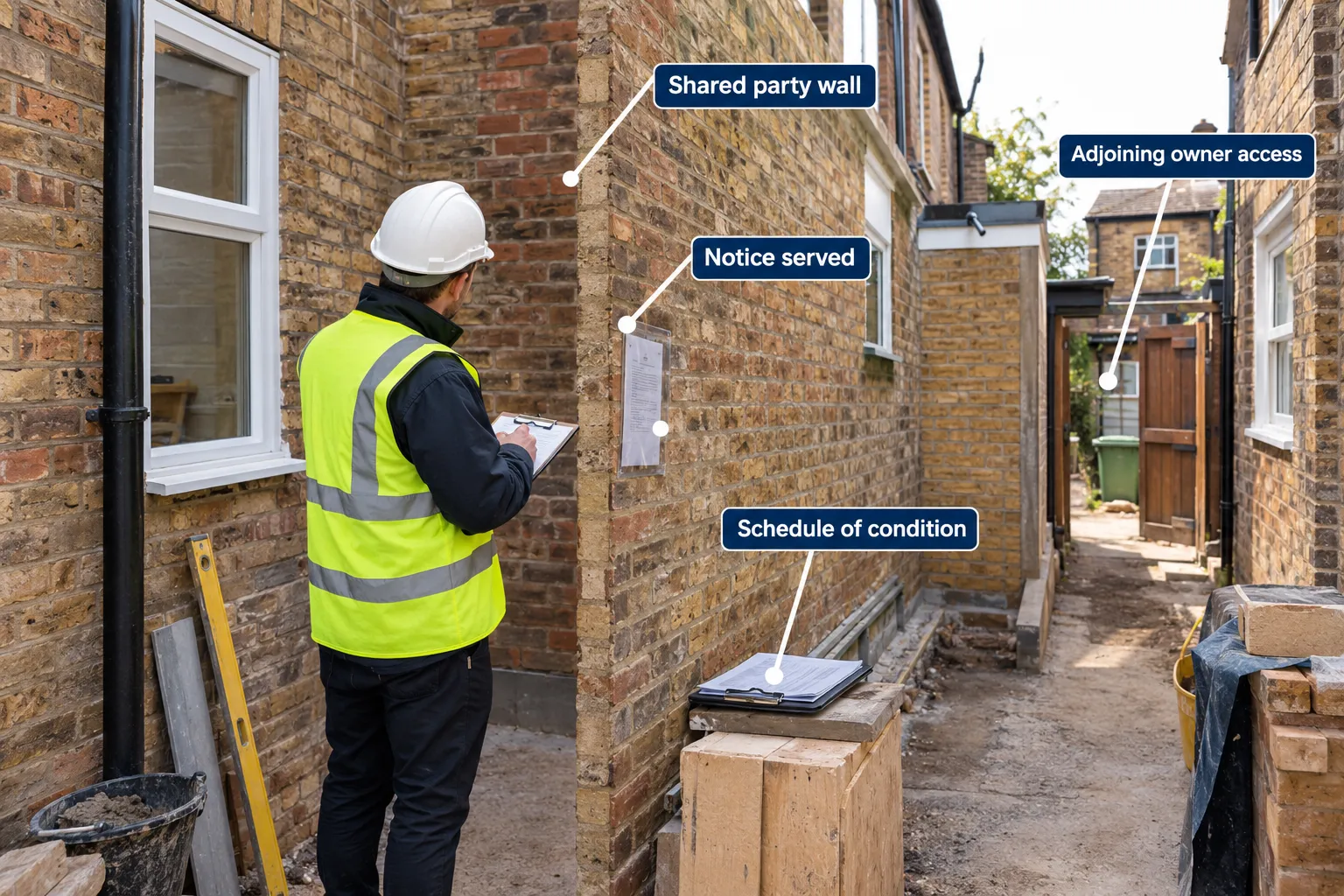
    4. Agree a schedule of condition for the adjoining property before works begin, recording existing cracks, finishes and structural condition. This protects both the building owner and adjoining owner if damage is later alleged.
    5. Obtain the party wall award (if the adjoining owner dissents or a surveyor is appointed) before starting notifiable work.

    Skipping the schedule of condition is a frequent and costly mistake, without it, disputes over pre-existing damage become far harder to resolve fairly.

    Fee Pressures Flat Owners Should Expect

    While no specific figures have been confirmed for either licence to alter charges or the proposed fee caps, London leaseholders should be aware of two separate cost pressures:

    • Landlord/managing agent fees for processing a licence to alter application, which the September 2026 announcement signals could eventually be capped, pending consultation outcomes.
    • Party wall surveyor fees, which remain a statutory cost of the works themselves, payable by the building owner, and are not part of the fee cap discussion at all.

    Flat owners should budget for both, and should not assume that future caps on landlord admin fees will reduce party wall costs.

    Frequently Asked Questions

    Does the leasehold fee cap announcement change party wall surveyor fees? No. The 29 September 2026 announcement concerns landlord and managing agent fees, such as alteration permission charges. Party wall surveyor fees arise under separate statute and are unaffected.

    If my landlord grants a licence to alter, do I still need to serve party wall notices? Yes, if the works fall within sections 1, 2 or 6 of the Party Wall etc. Act 1996. Landlord consent and statutory notice are independent requirements.

    Who counts as an “owner” under the Party Wall Act in a block of flats? Both freeholders and leaseholders with more than one year remaining on their lease can be owners, meaning notices may need to be served on several parties for a single project.

    Has the government set a cap figure for alteration permission fees yet? No. The government has only announced that it will consult on which fees to cap and at what level. No amounts have been confirmed.

    Will the Commonhold and Leasehold Reform Bill replace the Party Wall Act? No. The Bill, expected before Christmas 2026, addresses tenure, ground rent and forfeiture. It does not affect party wall notice requirements.

    Is the Leasehold and Freehold Reform Act 2024 already affecting lease extension costs? Not yet. Valuation changes under that Act are not in force, and the related consultation on valuation rates closes on 21 October 2026.

    Conclusion

    London flat owners planning extensions, loft conversions or internal alterations face a genuinely two-track approval landscape: a lease-based licence to alter governed by private contract, and a statutory party wall process governed by the 1996 Act. The government’s 29 September 2026 announcement on capping leasehold permission fees, and the Prime Minister’s 7 October 2026 confirmation of the Commonhold and Leasehold Reform Bill, both signal meaningful change ahead for landlord-side costs and leasehold structure generally. None of this, however, alters the party wall notice periods, owner definitions or procedural requirements that have applied since 1996.

    The practical next step for anyone starting works is straightforward: review the lease for alteration clauses, instruct a party wall surveyor early to identify which sections of the Act apply, and keep the licence to alter and party wall notice processes moving in parallel rather than treating one as a substitute for the other. Watch for the upcoming consultation details on fee caps, but plan current projects on today’s rules, not anticipated ones.

  • A Hedge, a Fence and a £200,000 Bill: The Torquay Boundary Dispute Every London Homeowner Should Learn From

    A few millimetres. That is the margin that separated two neighbours in a Devon courtroom after years of legal argument, a High Court appeal, and a costs bill that could leave one party worse off by more than £200,000. This Torquay case is now the clearest real-world lesson in why every London homeowner needs to understand the difference between a party wall notice and a boundary claim, because the neighbour boundary dispute £200,000 costs party wall lessons buried in this judgment apply just as much to a Victorian terrace in Hackney as they do to a hilltop house in Devon.

    Sarah Douglas, managing director of a Devon estate agency, bought her £700,000 hilltop home in 2017. In 2018, her then-neighbour removed a hedge that divided the two properties. When Ronald Channon, an 87-year-old former rally driver, bought the neighbouring house for £1.4 million in 2021, he later built a fence along the strip where the hedge once stood. Douglas said the fence sat partly on her land. What followed was years of litigation over a boundary line that, in the end, moved by only a few millimetres.

    Key Takeaways

    • The Party Wall etc. Act 1996 governs work to shared walls, structures and excavations near neighbouring buildings, it does not decide who owns the land.
    • Land Registry title plans show “general boundaries” only, not precise legal lines, which is exactly why disputes like this one happen.
    • Judge Mitchell rejected the “southernmost leaf” argument because a boundary tied to foliage can shift with growth or trimming; stems, not leaves, mark a fixed line.
    • Douglas was ordered to pay 70% of Channon’s costs, estimated above £300,000, with £108,402 due upfront, a bill that could exceed £200,000 beyond her own legal spend.
    • RICS boundary surveys, determined boundary applications and early mediation are far cheaper than litigation and should be standard practice before removing hedges or building on a boundary line.

    What Actually Happened in Torquay

    Douglas argued the boundary followed the hedge’s “southernmost leaf”, essentially, wherever the furthest edge of foliage happened to reach. Judge Paul Mitchell at Plymouth County Court rejected this. A boundary defined by leaf growth is not fixed; it moves every time the plant is trimmed or left to grow. Instead, the judge found the boundary ran through the middle of where the hedge stems had once stood, following the outer edge of those stems. The practical difference between the two competing lines was described in court as a matter of millimetres.

    Douglas’s claims, ownership of the disputed strip, an injunction, and damages over a stepped bank, all failed. Channon’s own £200,000 counterclaim for lost property value, harassment and nuisance was also dismissed. Both sides lost their main arguments, yet one side still ended up with a devastating costs order.

    On appeal, Mr Justice Linden in the High Court upheld the costs decision, noting: “The difference between the two lines was, the judge permissibly found, immaterial.” He added that “the costs of the litigation were already very substantial” and that “both sides pursued their respective positions robustly.” Judge Mitchell had earlier observed that the case had “caused a significant amount of stress and upset, let alone cost,” calling it, in its own way, “a tragedy.”

    Boundary Dispute vs Party Wall Matter: Know the Difference

    This is the single most important distinction London homeowners misunderstand, and it sits at the heart of the neighbour boundary dispute £200,000 costs party wall lessons from this case.

    Issue Party Wall etc. Act 1996 Boundary Dispute
    What it covers Work to shared walls, structures, and excavations near a neighbour’s building Ownership and location of the legal boundary line
    Who decides Party wall surveyors (one, two or three-surveyor procedure) Courts, Land Registry, or First-tier Tribunal
    Typical trigger Loft conversions, extensions, excavations within 3-6 metres of a neighbour’s foundations Fences, hedges, walls, extensions built on or near a disputed line
    Outcome A party wall award covering the works A determined boundary, injunction, or damages ruling

    The Party Wall Act does not and cannot resolve who owns a strip of land. A party wall surveyor appointed under the Act has no authority to rule on title or ownership, that is a legal and Land Registry matter entirely separate from the Act’s remit. Many homeowners wrongly assume that serving a party wall notice, or going through the party wall process, settles boundary questions. It does not. Douglas and Channon’s dispute was never a party wall matter at all; it was a pure boundary and land ownership claim, which is precisely why it ended up in court rather than being resolved through a surveyor’s award.

    Why Land Registry Plans Will Not Save You

    Many London homeowners assume their title plan shows an exact boundary line. It does not. HM Land Registry title plans are based on Ordnance Survey mapping and show what is called a general boundary, an approximate line, not a legally precise one. The Land Registry itself states that general boundaries are not guaranteed to be accurate to the exact inch, or even the exact metre, in some cases.

    This matters enormously in densely packed London streets, where terraced and semi-detached houses often share walls, fences, and tiny strips of garden land worth arguing over. A title plan that looks definitive on screen may be legally silent on exactly where a boundary sits once you get into stems, leaves, footings or historic fence lines.

    How to Avoid a £200,000 Mistake

    Get a RICS Boundary Survey First

    Before removing a hedge, replacing a fence, or building an extension near a shared line, commission a RICS boundary survey. A chartered surveyor can measure the physical features, review historic deeds, and produce a report that identifies where the likely legal boundary sits, long before any structure goes up.

    Consider a Determined Boundary Application

    HM Land Registry offers a determined boundary process. This is a formal application to fix the exact boundary line on the title register, supported by survey evidence. It is slower and costs more than doing nothing, but it is dramatically cheaper than six-figure litigation.

    Try Mediation or Expert Determination Early

    Courts and the Royal Institution of Chartered Surveyors both encourage early neutral evaluation, mediation, or expert determination for boundary disputes. An independent expert can review the evidence and give a binding or advisory opinion far faster, and far more cheaply, than a trial.

    Document Everything Before You Touch a Hedge or Fence

    • Photograph the hedge, fence or wall from multiple angles before any removal or alteration.
    • Keep copies of historic title deeds, conveyances and any boundary agreements.
    • Speak to previous owners or long-term neighbours about historic boundary features.
    • Notify your neighbour in writing before removing shared boundary features, even if you believe they sit entirely on your land.

    Separate Party Wall Works from Boundary Questions

    If planned works also involve excavation or building near a shared wall, serve a party wall notice under the 1996 Act separately from any boundary discussion. Appoint a party wall surveyor for the structural works, and seek separate legal or RICS surveying advice if ownership of the land itself is in question.

    FAQ

    Does the Party Wall Act decide who owns a boundary? No. The Act governs notifiable building work near shared walls and structures. Ownership of land is decided by title deeds, Land Registry records, or the courts.

    Why did a few millimetres matter so much in the Torquay case? It did not, in practical terms, the High Court called the difference “immaterial.” What mattered, and drove the costs, was the years of litigation over that tiny margin.

    Can a hedge mark a legal boundary? A hedge can be evidence of a historic boundary, but foliage itself is not a reliable marker because growth and trimming change its shape. Courts tend to look at fixed features like stems, roots or old fence posts.

    What is a determined boundary application? It is a formal Land Registry process to fix an exact boundary line on the register, supported by survey evidence, rather than relying on the general boundary shown on a standard title plan.

    How can London homeowners avoid costly boundary litigation? Get a RICS boundary survey before building or removing hedges and fences, keep deeds and photographic evidence, and use mediation or expert determination before issuing court proceedings.

    Conclusion

    The Torquay case is a stark warning dressed up as a minor disagreement over a hedge. Two neighbours spent years and well over £300,000 combined arguing over millimetres, and one now faces a bill that could exceed £200,000 on top of her own costs. The neighbour boundary dispute £200,000 costs party wall lessons from this judgment are simple: boundaries are not party wall matters, Land Registry plans are not precise, and litigation is a last resort that rarely produces a winner. London homeowners planning any work near a shared boundary should commission a RICS survey, consider a determined boundary application, and try mediation before a single brick is laid or a hedge is cut. As Judge Mitchell put it, these cases are, in their own way, a tragedy, and nearly all of them are avoidable.

  • Building Safety Levy London Rates 1 October 2026: What Developers and Party Wall Teams Need to Know

    One week ago, London’s development industry crossed a line it had been bracing for since the policy was first announced. On 1 October 2026, the Building Safety Levy went live, and every qualifying residential scheme submitted for building control from that date now carries a new cost line that did not exist a fortnight earlier. The Building Safety Levy London rates 1 October 2026 developers party wall question is no longer theoretical. It is sitting in live cost appraisals, cash-flow models and site meetings across the capital right now.

    This matters well beyond head office finance teams. Project managers sequencing demolition and construction, neighbours expecting Party Wall etc. Act 1996 notices, and contractors pricing mid-size schemes all need to understand how the levy interacts with existing processes. This article sets out the rates, who pays, the exemptions, and what the levy changes for development and party wall works in practice.

    Key Takeaways

    • The levy applies to building control applications and initial notices submitted on or after 1 October 2026 for major residential development of at least 10 new dwellings, or at least 30 purpose-built student bedspaces.
    • The 10-dwelling threshold is tested against the whole planning permission, so splitting a scheme into several smaller building control submissions does not avoid liability.
    • London borough rates vary widely per square metre of chargeable floorspace, with a reduced rate for sites that are at least 75 percent previously developed land.
    • The named client on the building control application is legally responsible for paying the levy, and a completion certificate cannot be issued until it is settled.
    • Party wall procedures under the 1996 Act continue unchanged alongside building control; most single-house extensions and loft conversions sit below the levy threshold entirely.

    The Building Safety Levy London Rates 1 October 2026 Developers Party Wall Regime Explained

    The levy is a national charge designed to raise around £3.4 billion over roughly ten years, funding the remediation of unsafe buildings. It sits alongside, not instead of, existing building control fees and Party Wall Act obligations.

    Liability is triggered by the building control application or initial notice, not by planning permission or start of works. Any qualifying application lodged on or after 1 October 2026 falls inside the regime. Crucially, an application submitted and then rejected before that date, then resubmitted afterwards, becomes liable at that point. There is no grandfathering for resubmissions.

    Who Pays and Which Schemes Qualify

    A scheme qualifies as a “major residential development” if it delivers at least 10 new dwellings, or at least 30 purpose-built student accommodation bedspaces. This threshold is assessed against the entire planning permission covering the site.

    That detail matters for phased schemes. A developer cannot carve a 24-home permission into three building control applications of eight homes each to sit under the threshold. Regulators look at the permission as a whole.

    The client named on the building control application or initial notice holds statutory responsibility for payment. Local authorities collect the charge. For schemes using the Building Safety Regulator’s gateway process on higher-risk buildings, the same principle applies: no settled levy, no completion certificate.

    Borough Rates for the Building Safety Levy London Rates 1 October 2026 Developers Party Wall Charge

    Rates are set per square metre of new chargeable floorspace and vary significantly by borough. A reduced rate applies only where at least 75 percent of the land within the permission’s red line boundary is previously developed land.

    Borough Standard rate (per m²) Previously developed land rate (per m²)
    Kensington and Chelsea £100.35 £50.17
    Westminster £98.01 £49.01
    Hammersmith and Fulham £91.87 £45.94
    Camden £87.12 £43.56
    City of London £87.04 £43.52

    The previously developed land rate is a 50 percent reduction on the standard rate, available only where the 75 percent threshold is met across the whole site.

    Chargeable floorspace means new residential gross internal area, including qualifying communal areas. Affordable housing and other exempt accommodation within a scheme are excluded from the calculation, even where the wider development is otherwise liable.

    Worked Example: A Westminster Scheme

    Numbers make this concrete. Take a 40-home scheme in Westminster with 3,000 square metres of chargeable floorspace.

    • At the standard rate: 3,000 m² multiplied by £98.01 gives a levy bill of approximately £294,000.
    • At the previously developed land rate: 3,000 m² multiplied by £49.01 gives approximately £147,000, provided at least 75 percent of the site meets the previously developed land test.

    That is a meaningful six-figure cost, not a rounding error in a viability appraisal, but it is a far cry from the “millions” some early commentary implied. For schemes of this size, the levy is a line item to budget accurately, not an existential threat to deliverability on its own.

    Exemptions from the Levy

    Several categories sit outside the charge entirely:

    • Developments below the 10-dwelling or 30-bedspace threshold.
    • Social and supported housing.
    • Specified accommodation including hospitals, care homes, hospices, hotels, hostels, children’s homes, refuges, prisons, almshouses and temporary homeless accommodation.
    • Non-profit registered providers and their wholly owned subsidiaries.

    Joint ventures are not automatically exempt, even where a registered provider is one partner. Structuring matters here, and legal advice on the delivery vehicle should happen before the building control application is drafted, not after.

    What This Means for Development Viability and Programme

    For mid-size London schemes, the levy adds a new fixed cost that must be modelled early, ideally at the land acquisition and planning stage rather than discovered at building control submission. Three practical pressures stand out:

    Viability. The charge is payable regardless of sales performance or build cost inflation. Appraisals for schemes around the 10-home threshold should treat the levy as a near-certain cost, not a contingency.

    Cash flow. After commencement information is submitted, the local authority can take up to eight weeks to issue a levy liability notice or a notice of no charge. That lag needs to sit inside the programme, because the levy must be settled before a completion certificate is issued. For higher-risk buildings, the Building Safety Regulator will not issue a completion certificate while any balance is outstanding.

    Submission strategy. Developers weighing whether to submit before or after a borough boundary change, or whether to phase a scheme, need to remember the whole-permission test. Attempting to engineer smaller submissions purely to dodge the charge is unlikely to succeed and could delay the project further.

    Party Wall Works Still Run Alongside Building Control

    A common misconception is that the levy changes neighbour relations or party wall procedure. It does not. The Party Wall etc. Act 1996 process, serving notices, agreeing schedules of condition, appointing surveyors and issuing awards, runs entirely separately from building control and the levy.

    For most domestic projects, this distinction is simple: a typical single-house extension or loft conversion falls well below the 10-dwelling threshold and is not charged the levy at all, even though party wall notices may still be required if the works are near a shared boundary. It is only once a scheme reaches the scale of a genuine multi-unit residential development, converting a building into ten or more flats, for example, that both regimes can apply in parallel: party wall awards governing the physical works next to a boundary, and the levy governing the building control charge for the development as a whole.

    Frequently Asked Questions

    Does the levy apply to a single house extension or loft conversion? No. These projects almost always fall well under the 10-dwelling or 30-bedspace threshold and are not liable, though party wall notices may still be needed separately.

    Can a developer avoid the levy by splitting a scheme into smaller building control applications? No. The threshold is tested against the whole planning permission, so phased or split submissions covering the same permission remain liable.

    What happens if a building control application was submitted before 1 October 2026? It stays outside the regime. However, if that application was rejected before 1 October and resubmitted afterwards, it becomes liable.

    Who is legally responsible for paying the levy? The client named on the building control application or initial notice, not the contractor or the eventual homeowner.

    How long does it take to get a levy liability notice? Local authorities can take up to eight weeks after commencement information is provided to issue a levy liability notice or a notice of no charge.

    Does paying the levy affect party wall surveyor appointments? No. Party wall matters under the 1996 Act are handled independently of building control and the levy, though both processes typically run concurrently on larger schemes.

    Conclusion

    The Building Safety Levy London rates 1 October 2026 developers party wall framework is now an operating reality, not a future compliance date. Borough rates range from roughly £87 to over £100 per square metre, previously developed land can halve that cost, and the whole-permission threshold test closes off obvious avoidance routes. For schemes of 10 homes or more, the practical next steps are clear: model the levy into viability appraisals now, build the eight-week notice window into the completion programme, confirm whether any exemption applies before finalising the delivery structure, and keep party wall notices and awards moving on their own separate track. Developers who treat this as a routine budgeting and scheduling task, rather than a crisis, will clear building control with far less friction.

  • Conservatives Pledge to Scrap Stamp Duty and Future Homes Standard: What It Means for London Party Wall Matters

    Conservatives Pledge to Scrap Stamp Duty and Future Homes Standard: What It Means for London Party Wall Matters

    Fifty thousand pounds. That is the figure shadow housing secretary Katie Lam put on the table at the Conservative Party conference on 5 October 2026 as the potential saving per new home if a future Conservative government tore up building regulations. It is a striking number, and it sits at the centre of a package that would reshape how London builds, extends and alters property. The Conservatives pledge to scrap stamp duty and Future Homes Standard has landed just three weeks before Chancellor-level decisions at the 28 October 2026 Budget, and it raises a practical question many London homeowners have not yet asked: what happens to shared walls, boundaries and party structures if a building boom actually arrives.

    This article sets out exactly what was proposed, how the property industry has reacted, and why the Party Wall etc. Act 1996 would still matter just as much, arguably more, under a deregulated building regime.

    Key Takeaways

    • At the October 2026 Conservative conference, Katie Lam proposed scrapping stamp duty, axing the Future Homes Standard, merging Section 106 and the Community Infrastructure Levy into one charge, and removing other housebuilding rules.
    • The party claims these changes could cut new-build costs by up to £50,000 per home, though this is an opposition proposal, not government policy.
    • Prime Minister Andy Burnham has confirmed stamp duty will not change at the 28 October 2026 Budget, so no immediate change is coming.
    • Propertymark’s Timothy Douglas welcomed the supply focus but warned savings must reach buyers and that cutting costs must not mean cutting quality.
    • Regardless of planning or regulatory shake-ups, the Party Wall etc. Act 1996 still governs extensions, basements and infill works on shared walls, and a looser building regime makes independent surveying more important, not less.

    What the Conservatives Pledge to Scrap Stamp Duty and Future Homes Standard Actually Proposes

    The announcement, made at party conference on 5 October 2026, was wide-ranging. Lam set out four main commitments:

    What the Conservatives Pledge to Scrap Stamp Duty and Future Homes Standard Actually Proposes
    • Scrap stamp duty entirely, removing a tax Reallymoving estimates costs the average English mover £9,500, and London movers a much steeper £21,250.
    • Scrap the Future Homes Standard, the set of energy efficiency and low-carbon heating rules due to shape new-build construction.
    • Merge Section 106 agreements and the Community Infrastructure Levy into a single unified developer charge, replacing two separate negotiated systems with one.
    • Remove other housebuilding regulations, which the party argues adds unnecessary cost to every new home built.

    Lam also commented on the Renters’ Rights Act, saying “I don’t care where it comes from. It’s got to go.” The party later clarified this referred to regulatory burdens on landlords generally, not a formal pledge to repeal the Act itself.

    It is worth being precise about what this is and is not. These are opposition proposals from a party not currently in government. They would require winning an election and passing new legislation before any of it became law. For now, nothing changes. Prime Minister Andy Burnham has already stated that stamp duty will not be altered at the 28 October 2026 Budget, closing off any suggestion of an imminent shift under the current government.

    Why a Building Boom Would Change the Party Wall Landscape in London

    London’s housing stock is dense, old, and physically interconnected in a way few other UK cities match. Terraced houses share structural walls. Basements sit metres from a neighbour’s foundations. Side-return extensions run hard against boundary lines. If the Conservatives pledge to scrap stamp duty and Future Homes Standard were ever implemented, the stated aim is simple: make it cheaper and easier to build. Lower transaction costs could encourage more people to move rather than stay put and extend, but a simplified, cheaper planning and regulatory system could also unleash more extensions, loft conversions, basement digs and infill development, particularly in a city where land is scarce and every square metre matters.

    “Scrapping stamp duty would remove a significant barrier to moving,” said Timothy Douglas of Propertymark, “but the £50,000 saving will need to be tested against whether it actually reaches consumers.”

    That caution matters for party wall purposes too. A genuine building boom, more extensions, more basements, more infill schemes squeezed between existing homes, means more projects that fall within the scope of the Party Wall etc. Act 1996. More projects means more notices served on neighbours, more negotiated awards, and more schedules of condition recording the state of adjoining properties before work begins.

    The Party Wall Act Still Applies However Planning Rules Change

    Here is the key point for London property owners to understand: the Party Wall etc. Act 1996 is separate legislation from planning permission and building regulations. Scrapping the Future Homes Standard, merging developer levies, or removing other building rules would not touch the Party Wall Act. If a project involves work on, or near, a shared wall, excavating within three to six metres of a neighbouring structure for a basement, or building up to or astride a boundary line, the Act’s notice and dispute-resolution procedures still apply in full.

    The Party Wall Act Still Applies However Planning Rules Change

    This distinction matters because deregulation at the planning and building-control level does not mean deregulation of neighbour rights. If anything, a faster, cheaper approvals process without the Future Homes Standard’s structural and energy checks could increase the importance of other safeguards, including:

    Safeguard Why it matters more under deregulation
    Schedule of condition Fewer upfront building checks mean disputes over pre-existing damage become harder to resolve without a clear baseline record
    Party wall notice Still legally required before notifiable works, regardless of planning simplification
    Appointed surveyor oversight Provides independent technical scrutiny that looser building rules may no longer guarantee
    Party wall award Sets out how works will proceed and protects both building owner and adjoining owner

    Industry Reaction: Supply Focus Welcomed, Quality Warnings Raised

    Timothy Douglas of Propertymark gave a measured response to the announcement. He welcomed the focus on housing supply and a simpler planning system, and agreed that removing stamp duty would strip away a genuine obstacle for people wanting to move home. But he raised two clear cautions. First, the headline £50,000 saving needs testing, savings on paper for developers do not automatically translate into lower prices for buyers. Second, and most relevant to party wall work, he warned that policy makers must not cut costs at the expense of quality and standards.

    That second warning is the one London homeowners and developers should sit with. Removing red tape can speed up delivery, but it can also strip away checks that currently protect neighbours from poor workmanship, inadequate foundations, or undocumented damage. A schedule of condition and a properly appointed party wall surveyor become the practical backstop when other regulatory layers are thinned out.

    What Homeowners and Developers Should Do Now

    Because these proposals are not government policy, there is no need for panic action. But London property owners planning extensions, loft conversions or basement works should keep three things in mind:

    • Nothing changes immediately. Stamp duty rules and current building regulations remain in force; the Budget on 28 October 2026 is not expected to alter stamp duty.
    • Party wall obligations do not depend on which party is in government. Anyone planning notifiable works on a shared wall or near a boundary still needs to serve proper notice.
    • A schedule of condition is cheap insurance. Whatever happens to planning rules nationally, documenting the state of a neighbouring property before work starts protects everyone involved if a dispute arises later.

    FAQ

    Is scrapping stamp duty and the Future Homes Standard already government policy? No. These are proposals from the Conservative Party, currently in opposition, announced at their October 2026 conference. They would require a change of government and new legislation to take effect.

    Will stamp duty change at the October 2026 Budget? No. Prime Minister Andy Burnham has confirmed stamp duty will not change at the 28 October 2026 Budget.

    Does the Party Wall Act still apply if building regulations are relaxed? Yes. The Party Wall etc. Act 1996 is separate from planning and building control. Any changes to the Future Homes Standard or other building rules would not remove the legal requirement to serve notice on affected neighbours for notifiable works.

    Why would scrapping the Future Homes Standard affect party wall matters? It would not change the Act itself, but if it leads to more building activity with fewer structural and energy checks, independent oversight through party wall surveys and schedules of condition becomes a more important safeguard for both building owners and neighbours.

    What is the average stamp duty saving being discussed? Reallymoving estimates average stamp duty paid by movers in England at £9,500 in 2026, rising to £21,250 for London movers, figures cited in discussion of the proposed scrapping.

    Conclusion

    The Conservatives pledge to scrap stamp duty and Future Homes Standard is a significant opposition proposal, not a change in law. For now, London homeowners should plan around the rules that exist today, not the ones being debated at conference podiums. What is certain is this: whatever happens to stamp duty, Section 106, or energy standards, the Party Wall etc. Act 1996 will keep governing shared walls, boundaries and excavation near neighbouring structures. Anyone planning an extension, basement or infill project in London should serve proper notice, commission a thorough schedule of condition, and engage a qualified party wall surveyor early, steps that protect both building owners and neighbours no matter which party sets housing policy next.

    party wall surveyor, Party Wall etc. Act 1996, stamp duty reform, Future Homes Standard, Conservative housing policy, London extensions, schedule of condition, basement excavation London, Section 106, Community Infrastructure Levy, planning deregulation, housing supply policy

  • Ealing HMO Extension Appeal Daylight October 2026 London: What the Cecilia House Decision Means for Your Rear Extension

    Ealing HMO Extension Appeal Daylight October 2026 London: What the Cecilia House Decision Means for Your Rear Extension

    Two extra bedrooms. One shared wall. And a planning inspector who decided that two existing tenants mattered more than two new ones. That is the blunt summary of a decision that every London homeowner, landlord and party wall surveyor should read before they pick up a saw.

    On 2 October 2026, a Planning Inspectorate decision on a site in Hanger Lane, Ealing, put daylight loss back in the spotlight. The Ealing HMO extension appeal daylight October 2026 London ruling dismissed plans for a single-storey rear extension at Cecilia House, a large sui generis HMO formed from two former detached houses in the Ealing Common Conservation Area. The case is a sharp reminder that good intentions, more housing, efficient land use, do not automatically beat harm to the people already living next door.

    Key Takeaways

    • An inspector dismissed a non-determination appeal for a rear extension at Cecilia House, Ealing, because it would harm daylight, sunlight and outlook to two existing ground-floor rooms.
    • The appellant’s daylight report was based on a different address and did not assess the actual scheme, which proved fatal to the appeal.
    • Housing benefits, two new en-suite bedrooms, were given substantial weight, but harm to existing occupiers was given “greater than substantial weight.”
    • Planning daylight and sunlight rules are separate from the Party Wall etc. Act 1996, which covers shared walls, new boundary walls and nearby excavations, not rights to light.
    • A site-specific daylight assessment and the right notice sequence can prevent both planning refusals and party wall disputes.

    The Cecilia House Appeal: Inside the Ealing HMO Extension Appeal Daylight October 2026 London Decision

    Cecilia House sits within the Ealing Common Conservation Area and operates as a 29-unit HMO. The owners wanted to add a single-storey rear extension with a hipped roof, creating two en-suite bedrooms and pushing the total to 31 units. Because Ealing Council failed to decide the application in time, it became a non-determination appeal, the applicant appealed the lack of a decision rather than a refusal.

    The Cecilia House Appeal: Inside the Ealing HMO Extension Appeal Daylight October 2026 London Decision

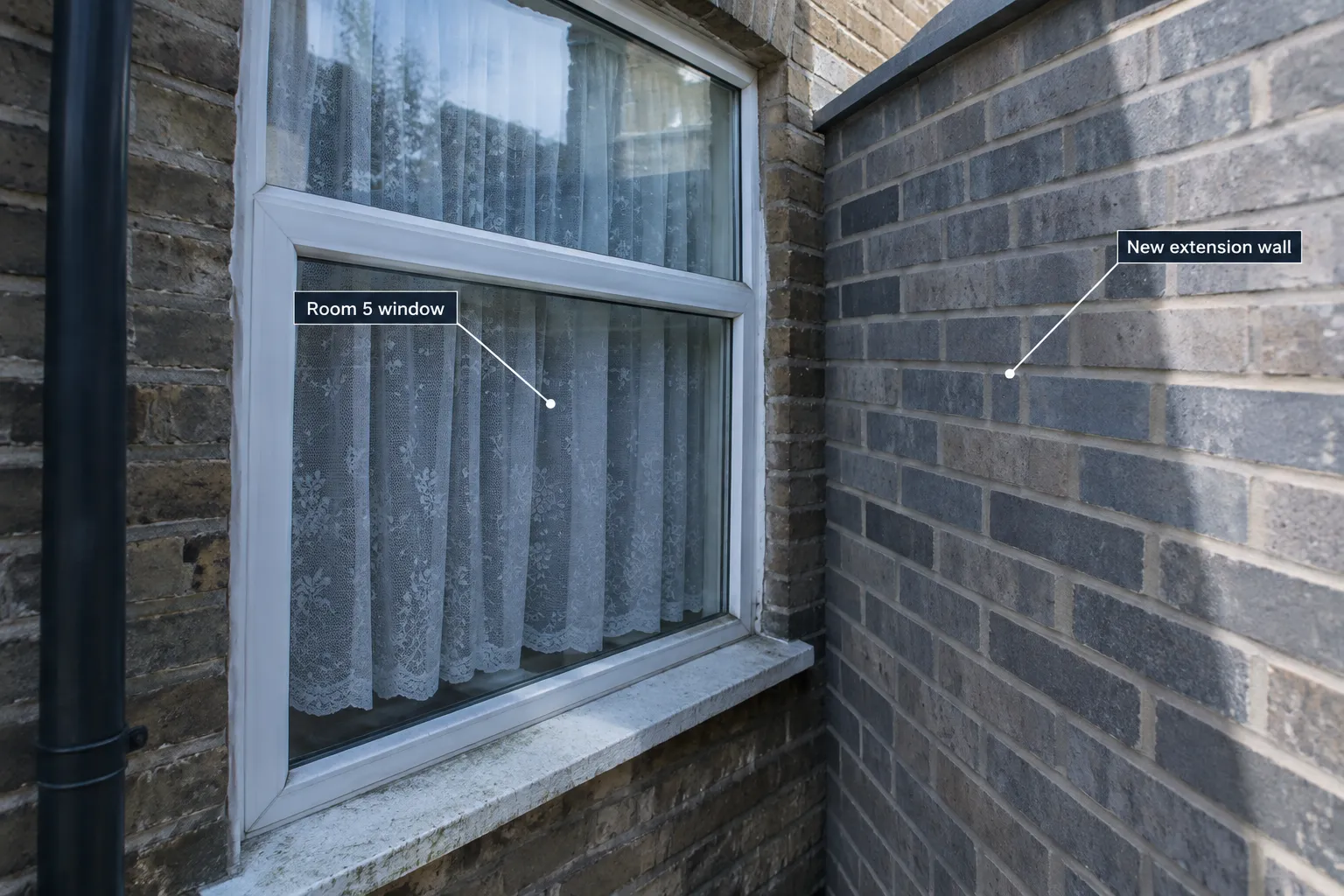
    Inspector Carla Livingstone dismissed the appeal. The core problem was not the conservation area, visual impact or scale. It was daylight. Two existing ground-floor rooms, referred to as room 5 and room 30, would lose meaningful light and outlook because the new structure would sit very close to their windows. Room 5 depended on a single large window for all its natural light. Room 30 relied on two small windows plus a kitchen and living area window. The Inspector found the proposed extension would materially harm both.

    A key detail sealed the outcome. The appellant’s daylight assessment, submitted to support the scheme, actually related to a different property, 15 Hanger Lane, not Cecilia House itself. The Inspector found the report did not “clearly and accurately assess the specific effect of the appeal scheme,” leaving the decision-maker without credible evidence that the harm was acceptable. In planning appeals, a daylight study tied to the wrong address is effectively no evidence at all.

    Why Daylight and Sunlight Rules Are Not the Same as Party Wall Rights

    This case highlights a distinction that trips up many homeowners: planning daylight assessment and party wall rights are governed by completely different frameworks, and confusing them can derail a project twice over.

    Why Daylight and Sunlight Rules Are Not the Same as Party Wall Rights

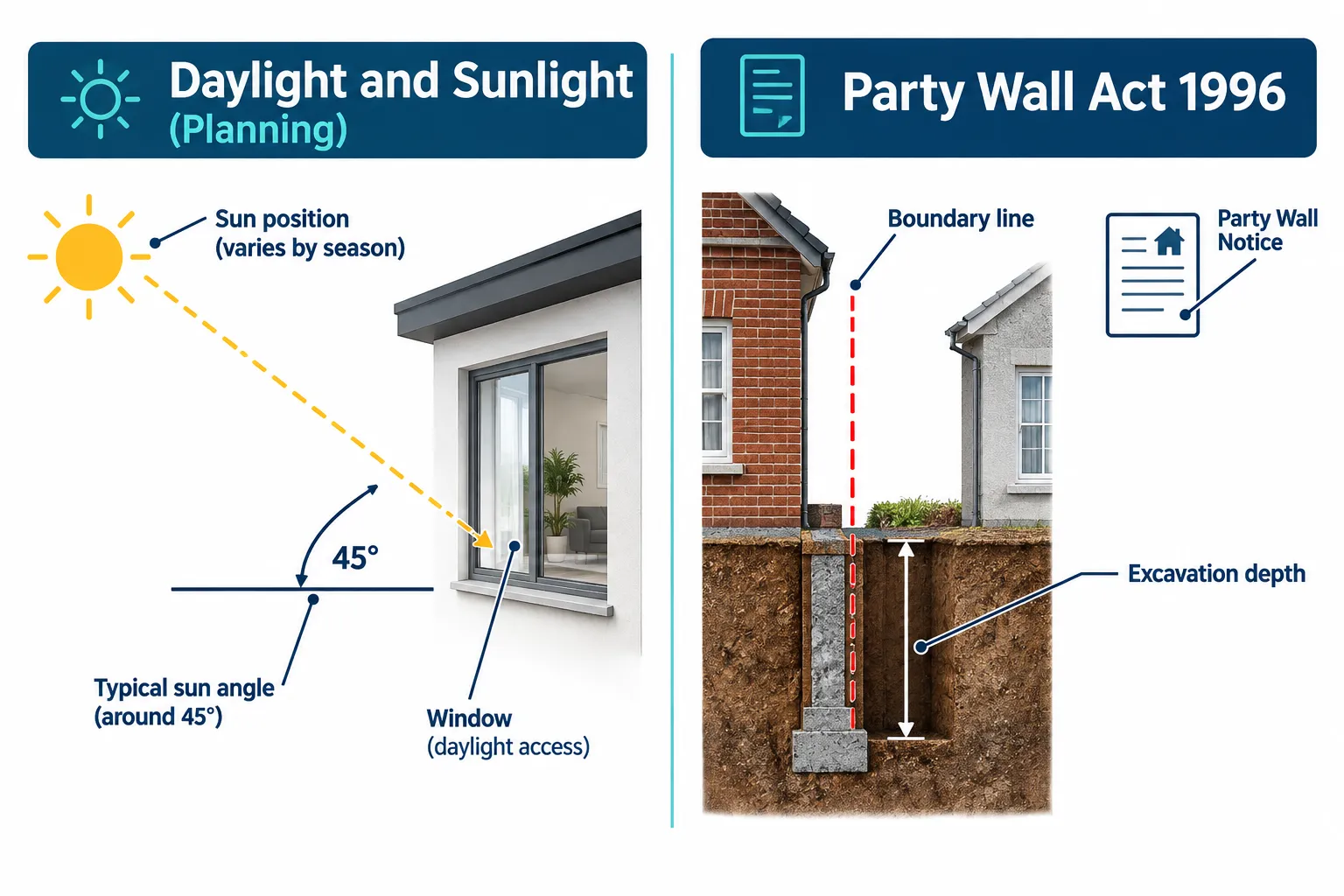
    Planning authorities assess daylight and sunlight using Building Research Establishment (BRE) guidance. Surveyors typically run tests such as the 45-degree line and the vertical sky component to judge whether a new structure will block too much natural light reaching existing windows. These tests feed into planning policy judgments, in this case, Ealing’s own daylight and amenity policy (referred to as policy 7B) and a London Plan-style framework policy on protecting existing occupiers, often labelled policy L2 d ii.

    The Party Wall etc. Act 1996 works in a different lane entirely. It governs:

    • Work directly on a shared wall between two properties.
    • Building a new wall at or astride the boundary line.
    • Excavation within 3 metres of a neighbour’s building (or 6 metres for deeper foundations), where that work goes below the neighbour’s foundation level.

    Crucially, the Party Wall Act does not deal with daylight, sunlight or rights to light. A neighbour cannot block an extension using a party wall notice simply because it will shade their window. Rights to light are a separate area of civil law, distinct from both planning and the Party Wall Act, and usually only bite where a long-established legal right to light has built up over time, typically through at least 20 years of uninterrupted enjoyment of light through a defined aperture.

    This is exactly why the Cecilia House case matters beyond Ealing. A scheme can pass every Party Wall Act test, correct notices, agreed surveyors, a sound award, and still be refused at planning stage purely because of daylight harm to existing rooms. The two processes run in parallel, not in sequence, and success in one gives no guarantee of success in the other.

    Planning Policy Balance: Housing Need Versus Harm to Existing Occupiers

    London boroughs are under real pressure to deliver more homes, and the Inspector in this case acknowledged that genuinely. Two additional en-suite bedrooms and more efficient use of an existing large site were given substantial weight in the planning balance.

    But substantial weight was outweighed. The Inspector gave “greater than substantial weight” to the harm the extension would cause to the two existing occupiers of rooms 5 and 30. Under Ealing’s settlement-balance framework, often shortened to policy S4, that tipped the scales decisively against approval. Put simply: protecting the people already living in a building can outweigh the benefit of housing two more people, if the physical harm is serious enough.

    Two other points from the decision are worth noting for context:

    Issue raised Inspector’s finding
    Harm to Ealing Common and Creffield conservation areas No harm, the rear extension would not be visible from the public realm
    Disputes over earlier building works on site Treated as an enforcement matter, not decisive to this appeal
    Which version of national planning policy applied The revised NPPF of 17 August 2026 was applied; no material difference found from the December 2024 version for this case

    The conservation area argument, often the headline concern in Ealing, was actually a non-issue here. The real battleground was daylight to existing internal rooms, a far more technical and easily overlooked risk for anyone extending an HMO or a converted house with closely spaced windows.

    Lessons for London Extensions: Getting Planning, Party Wall Notices and Rights of Light in the Right Order

    A well-run rear extension project in London should treat three legal processes as distinct but connected:

    1. Commission a site-specific daylight and sunlight report early. It must assess the actual building, actual windows and actual proposed structure, not a comparable or nearby property. The Cecilia House appeal failed partly because the evidence was for the wrong address.
    2. Check rights to light separately from planning. Even an approved scheme can face a civil rights-to-light claim from a long-standing neighbour, which sits outside both planning and the Party Wall Act.
    3. Serve Party Wall Act notices at the right time. Line of junction and party structure notices generally require one to two months’ notice before work starts, while notices for adjacent excavation also require advance notice. Serve too late and work may have to pause; serve without proper detail and neighbours can reasonably dispute the notice.

    Sequencing matters. Planning permission should normally be secured, or at least be well advanced, before party wall notices are served, since the design in the notice should match what has been approved. Running both processes with professional advice from the outset, a planning consultant for daylight and policy compliance, a party wall surveyor for notices and boundary work, reduces the risk of a dismissed appeal or a stalled build.

    FAQ: Ealing HMO Extension Appeal Daylight October 2026 London

    Did the Cecilia House extension get refused because of the conservation area? No. The Inspector found no harm to the Ealing Common or Creffield conservation areas, since the rear extension would not be visible from public viewpoints. The refusal was based on daylight, sunlight and outlook harm to existing rooms.

    Why did the daylight report fail to help the appellant’s case? The submitted assessment related to a different property, 15 Hanger Lane, rather than Cecilia House itself. The Inspector found it did not accurately assess the specific scheme under appeal.

    Does the Party Wall Act protect a neighbour’s daylight? No. The Party Wall etc. Act 1996 covers shared walls, new boundary walls and nearby excavation. It does not regulate daylight, sunlight or rights to light, which are separate planning and civil law matters.

    How much notice is needed under the Party Wall Act for a rear extension? Typically one to two months’ notice is required before starting work, depending on whether the works involve a party structure, a new wall at the boundary, or excavation near a neighbour’s building.

    Can a planning-approved extension still face a rights-to-light claim? Yes. Rights to light are a separate legal area from planning permission and the Party Wall Act, and can apply even after planning consent is granted, particularly where a neighbour has enjoyed light through a window for many years.

    Conclusion

    The Cecilia House decision is a clear warning: daylight to existing rooms is not a minor box to tick, and the Ealing HMO extension appeal daylight October 2026 London ruling shows how quickly a weak or misapplied daylight report can sink an otherwise reasonable housing proposal. Anyone planning a rear extension in London should commission a site-specific daylight and sunlight assessment, understand that the Party Wall Act deals with structural and boundary issues rather than light, and sequence planning, rights-to-light checks and party wall notices carefully. Speak to a qualified party wall surveyor and a planning consultant before drawings are finalised, it is far cheaper than a dismissed appeal.

    References

    • Planning Geek, “Ealing HMO extension appeal dismissed over daylight harm,” reporting Planning Inspectorate appeal decision APP/6005995, decision dated 2 October 2026, reported 4 October 2026.
    • Party Wall etc. Act 1996 (UK Parliament).
    • Building Research Establishment, “Site Layout Planning for Daylight and Sunlight: A Guide to Good Practice.”
    • National Planning Policy Framework, revised 17 August 2026, Ministry of Housing, Communities and Local Government.
  • Cleverly London New Build £100,000 Bureaucracy Claim: Party Wall Developers October 2026 Reaction

    Cleverly London New Build £100,000 Bureaucracy Claim: Party Wall Developers October 2026 Reaction

    A flat that costs £375,000 today could, according to one mayoral hopeful, cost £275,000 if London simply stripped out its red tape. That is the striking number now circulating among developers, homeowners and the people who build next door to them. The Cleverly London new build £100,000 bureaucracy claim party wall developers October 2026 story broke on 5 October 2026, when Sir James Cleverly set out his pitch to become the Conservative candidate for London Mayor, and it has reignited a long-running argument about what actually drives up the price of a London home.

    For anyone planning to build, extend or live next door to a development, the headline figure matters less than the detail underneath it. This article sets out what Cleverly actually said, what makes up the real cost of a London new build, and why one piece of “bureaucracy”, the Party Wall etc. Act 1996, is not going anywhere, whatever happens in the mayoral race of May 2028.

    Key Takeaways

    • Sir James Cleverly claimed on 5 October 2026 that bureaucracy, taxes and charges add roughly £100,000 to the cost of a new London property, but offered no breakdown of which levies he would cut.
    • The real London new-build cost stack includes land value, construction, finance, the Community Infrastructure Levy (CIL), Mayoral CIL, Section 106 affordable housing contributions, biodiversity net gain (BNG) obligations and the new Building Safety Levy, which took effect on 1 October 2026.
    • ONS data shows more people are leaving London for towns like Braintree, Maidstone, Milton Keynes and Hemel Hempstead than are arriving from the rest of the UK, adding political weight to the affordability debate.
    • The Party Wall etc. Act 1996 is primary legislation, not a mayoral levy, it cannot be abolished by City Hall and will continue to apply to new-build and infill schemes regardless of planning or tax reform.
    • Developers and neighbours should budget time and cost for party wall notices and awards early in any project planning next to shared walls, boundaries or deep excavations.

    What Cleverly Actually Claimed About London New Build Costs

    Speaking as he launched his bid for the Conservative nomination, Cleverly, who announced his candidacy in August 2026 and will not seek re-election as MP for Braintree, argued that “the accumulated cost of bureaucracy, taxes, and various other things adds about £100,000 per property onto new build properties in London.” He suggested that removing this burden could bring a flat priced between £350,000 and £400,000 down to somewhere between £250,000 and £300,000, reported Property Industry Eye’s Marc da Silva.

    What Cleverly Actually Claimed About London New Build Costs

    Crucially, Cleverly did not specify which taxes, levies or regulatory requirements he would scrap, or set out any mechanism to guarantee that savings would be passed on to buyers rather than absorbed by developers or landowners. He also said he would review council tax, transport costs and driving charges as part of a wider affordability platform ahead of the May 2028 election. The election itself is some way off, and Cleverly’s claim is, at this stage, a political statement rather than a costed policy.

    He linked the affordability argument to migration figures from the Office for National Statistics. In the year to mid-2025, 420,500 people moved from London to other parts of the UK and a further 183,000 moved abroad, while 288,500 arrived in London from elsewhere in the UK and 235,000 came from overseas. Among the most popular destinations for those leaving London were Braintree, Maidstone, Milton Keynes and Hemel Hempstead, all commuter towns offering cheaper housing than the capital.

    The Real Cost Stack Behind London New Build Prices

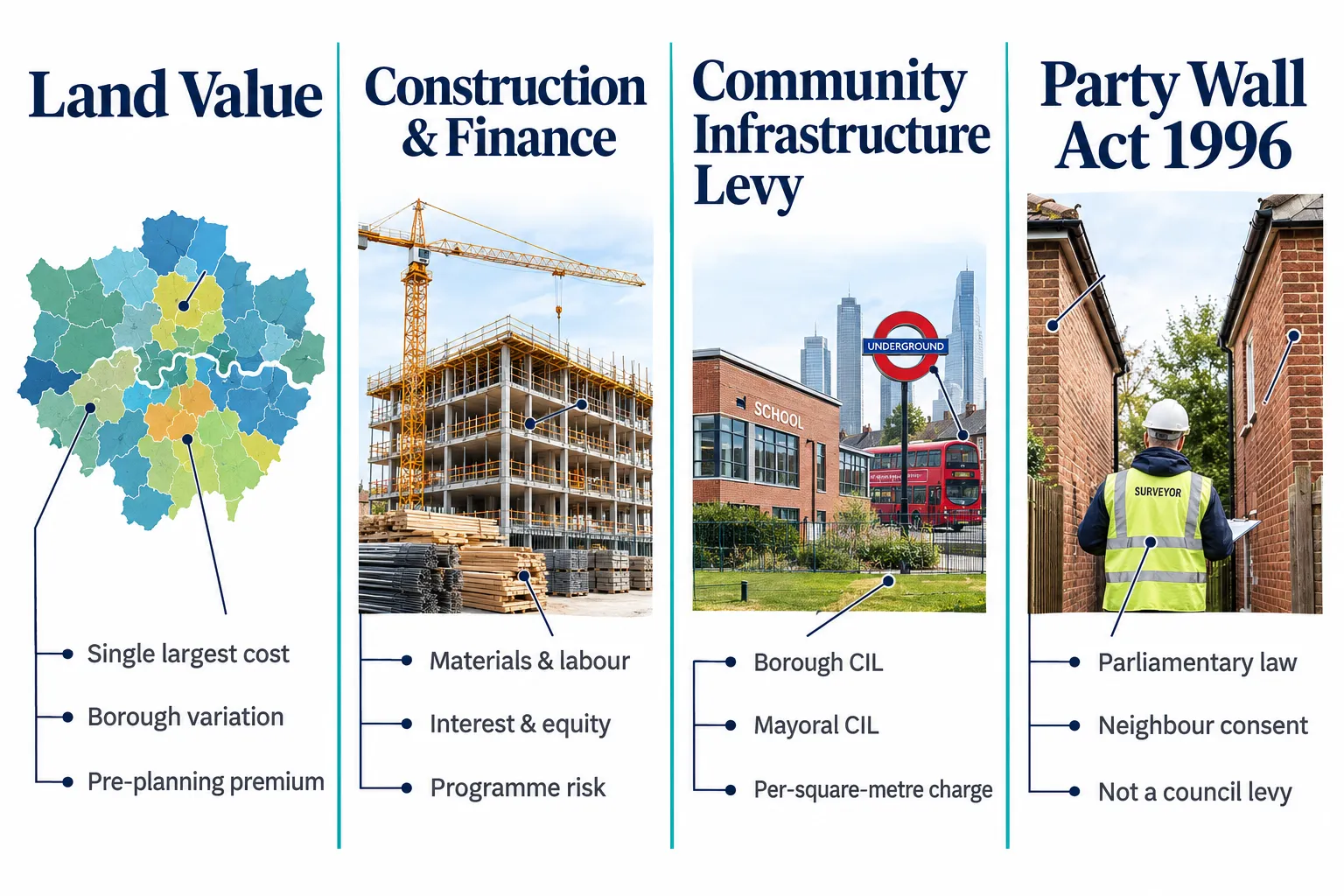
    Unpicking the £100,000 figure requires understanding what genuinely sits inside the price of a new London home. Housebuilders and planning consultants typically point to a stack of costs that goes well beyond a single tax line.

    Land value. In many London boroughs, land remains the single largest cost component, often dwarfing construction costs on a per-unit basis in high-demand areas.

    Construction costs. Materials, labour, plant hire and site logistics in a dense city are all more expensive than in regional England, partly due to access constraints on tight urban plots.

    Finance costs. Development finance, interest payments during the build period and contingency reserves add up, particularly on longer schemes delayed by planning or supply issues.

    Planning and infrastructure levies. This is where most of the political argument actually sits:

    Charge What it funds Applies to
    Community Infrastructure Levy (CIL) Local infrastructure, roads, schools, open space Most new development over a threshold
    Mayoral CIL Crossrail and strategic transport infrastructure London-wide new development
    Section 106 contributions Affordable housing, local amenities Site-specific, negotiated with the borough
    Biodiversity Net Gain (BNG) Habitat creation or offsetting Most new development since BNG rules took effect
    Building Safety Levy Remediation of unsafe buildings New residential development from 1 October 2026

    The Building Safety Levy only began applying to new residential development in England on 1 October 2026, almost exactly when Cleverly made his claim, adding fresh weight to the cost-stack debate. Separately, the Conservative Party conference pledged to merge various building levies into a single, simplified levy, suggesting that reform of some kind is already on the table regardless of who wins the mayoralty.

    Professional and compliance fees. Architects, planning consultants, building control, structural engineers, fire safety consultants and party wall surveyors all charge for their work, and all are necessary to get a scheme built safely and lawfully.

    Supporters of deregulation argue that trimming overlapping levies and streamlining planning would lower build costs and, over time, prices. Those defending the current system point out that CIL, Mayoral CIL and Section 106 money directly fund new infrastructure, schools and affordable housing, remove the charge and you remove the funding stream, not just the cost. The national picture adds urgency either way: net additional dwellings in England fell 4.4% to 199,500 in 2025-26, meaning fewer homes are being delivered even before any policy change is weighed.

    Why Party Wall Law Sits Outside the Cleverly London New Build £100,000 Bureaucracy Claim

    Whatever happens to CIL, Mayoral CIL or the Building Safety Levy, one legal obligation on London developers will not change because of mayoral policy: the Party Wall etc. Act 1996. This is primary legislation passed by Parliament, not a council or Greater London Authority charge, and no Mayor of London has the power to repeal it, suspend it or reduce its notice periods.

    Why Party Wall Law Sits Outside the Cleverly London New Build £100,000 Bureaucracy Claim

    That distinction matters for anyone following the Cleverly London new build £100,000 bureaucracy claim party wall developers October 2026 debate and wondering whether party wall compliance might be swept up in future deregulation. It will not be, because the Act exists to protect a legal right that has nothing to do with planning fees or infrastructure levies: an adjoining owner’s right not to have their property damaged or devalued by a neighbour’s building works without proper notice, process and, where necessary, compensation.

    When the Party Wall Act Applies to London Developments

    Dense London building almost always means construction near, on, or under a boundary shared with a neighbour. The Act covers three main scenarios:

    • Section 1, building a new wall at or astride the boundary line between two properties, including many infill and backland new-build schemes.
    • Section 2, work to an existing party wall or party structure, such as cutting in beams, raising a wall, or underpinning a shared wall.
    • Section 6, excavating within 3 metres of a neighbouring building where the new foundations will go deeper than the neighbour’s, or within 6 metres where a line drawn at 45 degrees from the base of the neighbour’s foundations would be crossed.

    For a closer look at where these boundaries lie in practice, see this guide on boundary rules and how close a neighbour can build to a fence, and the broader explanation of the Party Wall etc. Act 1996 itself.

    Notice Periods and the Award Process

    Developers must serve the correct notice before starting relevant work:

    • Two months’ notice for Section 1 and Section 2 works.
    • One month’s notice for Section 6 excavation work.

    Once served, an adjoining owner can consent, dissent and appoint their own surveyor, or stay silent, silence after 14 days is treated as dissent, triggering the formal surveyor process. Where owners do not agree, one or two party wall surveyors (or a third surveyor if needed) prepare a party wall award setting out the work permitted, how it will be carried out, and provisions for a schedule of condition and access. More detail on the mechanics is available in this overview of party wall awards and what a party structure notice is and how to serve it in London.

    What This Means for Developers Budgeting in 2026

    Party wall costs are a genuine, if modest, line in the overall cost stack, typically covering surveyor fees for both sides, schedules of condition, and any monitoring during works. Developers who build this into their programme and budget early, rather than treating it as an afterthought, avoid the delays that come from late notice service or disputed awards. Practical cost-control guidance is set out in this piece on how to keep party wall costs down, while the different categories of notifiable work are summarised in types of party wall works.

    What This Means for Neighbours of New Build Schemes

    For homeowners receiving a notice about works next door, whether a loft conversion, basement dig, or full infill new build, the Act is a protection, not a formality to ignore. Responding promptly, appointing a surveyor if needed, and securing a schedule of condition before work starts are the best ways to protect a property’s structure and value. Guidance on notices and responses is available in Party Wall Act notices: what they are and how to respond, and on the risks of proceeding without a surveyor.

    Homeowners and developers across the capital can find local support through regional pages covering North London, Central London, West London, East London and South London.

    Balancing the Deregulation Argument With Infrastructure Funding

    The debate sparked by Cleverly’s comments is genuinely two-sided. Those backing deregulation argue that London’s layered system of CIL, Mayoral CIL, Section 106 and the new Building Safety Levy stacks too many separate charges onto each unit, discouraging the smaller schemes that could add supply quickly. The Conservative conference pledge to merge levies into one reflects this view.

    Those defending the current charges argue that CIL funds roads and schools, Mayoral CIL has helped pay for Crossrail-scale transport infrastructure, Section 106 delivers affordable homes that would not otherwise exist, and the Building Safety Levy funds remediation of genuinely unsafe buildings following well-documented safety failures. Cutting these charges without an alternative funding source, they argue, simply shifts the cost elsewhere, onto taxpayers, onto future building safety risk, or onto reduced affordable housing delivery.

    Both positions can be true at once: London new-build costs are high, and the charges that contribute to that figure also fund things Londoners rely on. What the £100,000 claim lacks, for now, is the itemised detail that would let either side test it properly.

    Frequently Asked Questions

    Did Sir James Cleverly say which £100,000 of costs he would cut? No. He referred broadly to “bureaucracy, taxes, and various other things” without naming specific levies, taxes or regulations he would remove.

    Is the Party Wall etc. Act 1996 one of the charges Cleverly is talking about? No. The Act is not a tax or levy, it is primary legislation protecting adjoining owners’ property rights during building works, and it cannot be abolished through mayoral or planning policy.

    Will the Building Safety Levy affect new London flats? Yes. It took effect on new residential development in England from 1 October 2026 and sits alongside CIL, Mayoral CIL and Section 106 as part of the overall development cost stack.

    What should a developer do first when planning works near a boundary? Identify whether Section 1, 2 or 6 of the Act applies, then serve the correct notice (one or two months depending on the works) well before the planned start date, and budget for surveyor fees and a schedule of condition.

    What happens if a neighbour ignores a party wall notice? Silence for 14 days is treated as dissent, which triggers the formal surveyor appointment and award process rather than allowing work to proceed unchecked.

    Could future reform of London levies affect party wall timelines? Potentially, if administrative processes change, but the core notice periods and award process under the 1996 Act are set by statute and are not subject to London mayoral policy.

    Conclusion

    The Cleverly London new build £100,000 bureaucracy claim party wall developers October 2026 story highlights a real tension in London housing: costs are high, delivery is falling, and people are leaving for cheaper towns. But the £100,000 figure remains an unverified political claim rather than a costed, itemised plan, and genuine reform will need to grapple with the fact that CIL, Mayoral CIL, Section 106 and the Building Safety Levy each fund something specific.

    For developers and neighbours alike, the practical lesson is simpler and more immediate. Party wall obligations are not part of this political argument and will not be removed by any future Mayor. Anyone planning works near a boundary, or receiving a notice about works next door, should seek early, qualified advice. Contact Party Wall Surveyor London to discuss notice requirements, awards, and how to protect a project or a property as London’s new-build debate continues through 2026 and beyond.

  • Building Safety Levy 1 October 2026 London Developers Party Wall: What Changed and Why It Matters

    Building Safety Levy 1 October 2026 London Developers Party Wall: What Changed and Why It Matters

    A new line item just appeared on the cost sheet of every London scheme with ten or more flats, and nobody is talking about how it collides with the one law that already governs almost every boundary wall in the capital. From 1 October 2026, the Building Safety Levy sits on top of CIL, Section 106 and, for most infill sites, a Party Wall etc. Act 1996 process that was already tightening timelines. For developers and homeowners alike, the Building Safety Levy 1 October 2026 London developers party wall question is no longer theoretical. It is live, it is being charged per square metre, and it is already shaping how schemes are designed on the ground.

    This analysis, published 4 October 2026 by Party Wall Surveyor London, sets out exactly what the levy does, who is exempt, the confirmed borough rates, and why party wall sequencing now needs to move even earlier in the programme.

    Key Takeaways

    • The Building Safety Levy took effect on 1 October 2026 for building-control applications submitted on or after that date, charged per square metre of new residential floorspace.
    • Developments of fewer than 10 dwellings (or fewer than 30 student bedspaces) are exempt, a threshold that is already influencing unit counts on tight sites.
    • Confirmed London rates range from £48.00/m² in Bexley to £100.35/m² in Kensington & Chelsea, with a 50% discount on previously developed land.
    • Most homeowner extensions, loft conversions and basements escape the levy but still require Party Wall Act notices and, often, a formal award.
    • Because the levy is triggered by the building-control application date and party wall notice periods run one to two months, sequencing the two processes correctly protects both budget and programme.

    What the Building Safety Levy Means for London Developers From 1 October 2026

    The levy applies to initial notices or full plans applications for new residential floorspace submitted from 1 October 2026 onward. Rates are set per local authority, reflecting local house prices, and are charged per square metre of qualifying floorspace. The local authority acts as the collecting authority, but liability sits with the “client” named on the building-control application. Payment falls due by the first completion notice or first occupation, whichever happens first, and a completion certificate will be withheld if the levy is unpaid.

    What the Building Safety Levy Means for London Developers From 1 October 2026

    The policy intent is straightforward. MHCLG’s August 2026 remediation data recorded 4,724 buildings of 11 metres or more identified with unsafe cladding, with 46% of remediation work not yet started. The levy is forecast to raise roughly £3.5 billion over ten years to help fund that remediation programme. Propertymark lobbied specifically for the per-square-metre model and for the small-site exemption, arguing that a flat charge would have hit smaller housebuilders disproportionately hard.

    For London specifically, the rates are high relative to most of England, reflecting local house prices. That makes the interaction with existing contributions, CIL and Section 106, a genuine cash-flow issue for small and medium developers running tight infill schemes.

    Confirmed Building Safety Levy Rates for London Boroughs

    The following published rates apply to standard sites and to previously developed land, where at least 75% of the planning red-line site meets the definition of previously developed land (in which case the rate is 50% of the standard figure).

    Borough Standard rate (£/m²) Previously developed land rate (£/m²)
    Kensington & Chelsea 100.35 50.17
    Westminster 98.01 49.01
    Hammersmith & Fulham 91.87 45.94
    Camden 87.12 43.56
    Tower Hamlets 61.20 30.60
    Greenwich 54.33 27.16
    Bexley 48.00 24.00

    These figures only cover the boroughs officially published and referenced here; developers working outside these areas should check their own local authority’s confirmed rate rather than assume a figure.

    Exemptions, and Why Most Homeowner Projects Are Unaffected

    The levy carves out a long list of exempt categories: developments of fewer than 10 dwellings (or fewer than 30 purpose-built student bedspaces), social housing, supported housing, care homes, hospitals, hotels, hostels and hospices, school accommodation, prisons, temporary homeless accommodation, and armed-forces or Crown accommodation.

    In practice, this means the vast majority of London homeowner projects, a rear extension, a loft conversion, a basement dig, a two-flat conversion, fall outside the levy entirely. But exemption from the Building Safety Levy does not mean exemption from the Party Wall etc. Act 1996. Any excavation within 3 or 6 metres of a neighbour’s foundations, any work directly on a shared wall, or any new wall built astride or against the boundary still triggers a statutory notice requirement, regardless of levy status. Homeowners should review Party Wall Notices and the underlying Party Wall etc. Act 1996 framework before assuming a small project needs no formal process.

    Building Safety Levy 1 October 2026 London Developers Party Wall: The 9-Unit vs 10-Unit Question

    For small and medium developers, the 10-dwelling exemption threshold is already shaping scheme design decisions. A scheme of nine flats pays no Building Safety Levy. A scheme of ten flats on an identical footprint pays full levy on every square metre of qualifying floorspace, at whatever rate the borough sets.

    Building Safety Levy 1 October 2026 London Developers Party Wall: The 9-Unit vs 10-Unit Question

    It is easy to see why some architects and developers will now test whether dropping a unit, or redesigning floorspace to shrink below the threshold, makes commercial sense versus building the tenth flat and absorbing the levy. This is a design and viability decision for developers and their advisers to work through on a scheme-by-scheme basis, this article does not offer tax or legal advice on how to structure a project around the exemption.

    What is clear is that any scheme at or near the ten-unit line, on a tight urban infill plot, is also highly likely to share boundaries with neighbouring buildings on more than one side. That raises the stakes on party wall planning from day one.

    The Brownfield Discount and What Counts as Previously Developed Land

    The 50% discount for previously developed land only applies where at least 75% of the planning red-line site meets the statutory definition. For many London infill sites, former garages, yards, or demolished light-industrial units, this discount can materially change the levy bill. But the 75% threshold is strict: a site with significant garden land, undeveloped amenity space, or agricultural land mixed into the red line may fail the test even if the building footprint itself sits on brownfield ground. Developers should confirm this classification with their building-control body before relying on the discounted rate in a viability appraisal.

    Sequencing: Building Control Applications and Party Wall Notices

    The levy is triggered by the date a building-control application, an initial notice or full plans, is submitted. Party Wall Act notices, by contrast, require one month’s notice for new walls on the line of junction or adjacent excavation works, and two months’ notice for works to an existing party structure. Getting the order wrong creates two different risks.

    Submit building control too early, before party wall notices have been served and responded to, and a developer may find adjoining owners dissenting, appointing surveyors, or even seeking an injunction after the levy clock and construction programme have already started. Submit party wall notices too late, and a scheme can find a signed-off building control application sitting idle while notice periods run, pushing back the start of works and the point at which the levy becomes payable relative to projected cash flow. Reviewing what a party structure notice involves and how to serve it in London early in pre-construction planning helps avoid both scenarios.

    What a Party Wall Award Should Cover on a Multi-Unit Scheme

    On a scheme of ten or more flats facing full levy liability alongside CIL and Section 106, programme risk from party wall disputes is no longer a minor nuisance, it is a direct cost. A well-drafted party wall award on a multi-unit site should address:

    • Security for expenses: protection for adjoining owners if the developer’s financial position changes mid-build.
    • Access rights: clearly defined rights of entry to adjoining land for scaffolding, underpinning or finishing works.
    • Working hours and noise controls: agreed parameters that reduce the risk of complaint-driven work stoppages.
    • Schedule of condition: a detailed photographic record of the adjoining property before works start, protecting both sides from later disputes over damage.
    • Programme and sequencing clauses: timing provisions that dovetail with the building-control and occupation dates that now also drive levy liability.

    Developers working across several boroughs should also budget surveyor fees against total scheme contingency; the costs of the party wall process vary by complexity but are far lower than the cost of a stalled site. Reviewing a party wall contract template and award guide before appointing surveyors helps developers and their teams, including building owners, understand what a robust award typically contains.

    FAQ

    Does the Building Safety Levy replace CIL or Section 106? No. It is an additional charge collected by the local authority alongside existing CIL and Section 106 obligations.

    Are homeowner loft conversions and extensions liable for the levy? Almost always no, because they fall under the 10-dwelling threshold. They may still require party wall notices under the 1996 Act.

    What happens if the levy is not paid? The collecting local authority will withhold the completion certificate until payment is made.

    Does the brownfield discount apply automatically? No. At least 75% of the planning red-line site must meet the statutory definition of previously developed land for the 50% rate to apply.

    Can party wall notices be served before a building-control application is submitted? Yes, and on multi-unit schemes near the levy exemption threshold this is often advisable, since notice periods of one to two months can otherwise delay the start of works relevant to levy timing.

    Does serving a party wall notice affect levy liability? No. The two processes are entirely separate; the notice relates to neighbour consent for works, not to the levy charge itself.

    Conclusion

    The Building Safety Levy 1 October 2026 London developers party wall landscape now has two parallel compliance tracks running on every qualifying scheme: a financial obligation tied to building-control submission, and a statutory neighbour-notification process tied to the works themselves. Developers building at or near the ten-unit threshold need both tracks mapped against the same programme, with party wall notices served early enough to avoid dissent, appointed surveyors, or delayed awards eating into a budget that already carries levy, CIL and Section 106 costs.

    For developers, architects and homeowners across London boroughs, from Kensington & Chelsea to Bexley, getting the sequencing right from the outset is far cheaper than fixing it mid-build. Party Wall Surveyor London advises developers, architects and homeowners across North, South, East, West and Central London on notice strategy, award drafting and programme sequencing for schemes affected by the new levy. Contact Party Wall Surveyor London today to discuss how your project’s building-control timeline and party wall obligations should be sequenced.

  • Householder Extension Planning Officer Decision 31 October 2026 London Party Wall Rules Explained

    Householder Extension Planning Officer Decision 31 October 2026 London Party Wall Rules Explained

    A single regulation change on 31 October 2026 will strip London councillors of the power to block most extensions, lofts and basements, even when dozens of neighbours object. That is not a slow bureaucratic shift; it is a rewrite of who decides what happens to your house, and it lands in just a few weeks.

    For anyone planning a rear extension, loft conversion or basement dig in London this autumn, the householder extension planning officer decision 31 October 2026 London party wall story matters on two fronts. Planning will become faster and more predictable, but it will also become less of a venue for neighbour disputes. That means the Party Wall etc. Act 1996, not the planning committee, becomes the real place where neighbours’ rights are protected.

    Key Takeaways

    • From 31 October 2026, the National Scheme of Delegation (SI 2026/854) hands almost all householder extension decisions to planning officers, with no committee route regardless of objection numbers.
    • Objections can still shape conditions, but they can no longer trigger a committee hearing or vote on a standard extension or loft conversion.
    • Planning permission has never authorised interference with a neighbour’s structure, the Party Wall Act 1996 remains unchanged and is now the primary safeguard for neighbours.
    • With mortgage rates at 5.93% and Bank Rate decided on 5 November 2026, build cost and finance planning matter as much as design.
    • The safe sequence is design, then planning, then party wall notices, then award, then build, rushing this order risks delay or dispute.

    What Changes for a Householder Extension Planning Officer Decision 31 October 2026 London Party Wall Applications

    The Town and Country Planning (Discharge of Local Planning Authority Functions) (England) Regulations 2026, known as the National Scheme of Delegation, comes into force on 31 October 2026. It sorts planning applications into two schedules. Schedule 1 covers householder applications, extensions, loft conversions and similar domestic works, and these must be decided by a planning officer. They cannot be sent to committee, no matter how many letters of objection a scheme attracts.

    What Changes for a Householder Extension Planning Officer Decision 31 October 2026 London Party Wall Applications

    Schedule 2 covers larger or more contentious applications, which can only reach committee if a nominated officer and a nominated committee member both agree the case passes a gateway test. Committees themselves are capped at 13 members. The old practice of automatic referral once objection numbers hit a local threshold is abolished, as is routine councillor call-in. Statutory guidance is explicit: a committee decision taken on an application that should have been delegated risks judicial review. Local councils can no longer write their own override procedures.

    For London homeowners, the practical effect is a more consistent, policy-led process. Decisions will be made against the local plan and national guidance rather than the mood of a committee room. For neighbours who previously relied on turning up to object at a meeting, that avenue effectively closes for standard extension schemes.

    Why This Makes the Party Wall Act the Real Protection for Neighbours

    This is the point many homeowners and neighbours miss. Planning permission has never given anyone the right to damage, build on, or excavate near a neighbour’s wall or foundations. It regulates land use, design and amenity, not who can touch a shared structure. That job belongs entirely to the Party Wall etc. Act 1996, and the Act is unchanged by the new planning regulations.

    Under the Act, notice is required before:

    • Section 2, work to an existing shared or party wall, requiring two months’ notice.
    • Section 1, building a new wall on the boundary line, requiring one month’s notice.
    • Section 6, excavation within 3 metres of a neighbouring structure (or 6 metres on a 45-degree line) where the new work goes deeper than the neighbour’s foundations, requiring one month’s notice.

    A neighbour who receives a notice has 14 days to consent or dissent. Silence counts as dissent. Dissent triggers the appointment of party wall surveyors and a formal party wall award, which includes a schedule of condition recording the state of the neighbouring property before work starts. Full detail on this process is set out in our guide to the Party Wall Etc Act 1996.

    With planning objections carrying less weight at the committee stage, the party wall notice has become the moment neighbours should pay closest attention, not the planning portal comments box.

    The Correct Sequence: Design, Planning, Party Wall Notices, Award, Build

    Getting the order right avoids wasted money and avoidable arguments. The recommended sequence for an autumn or winter 2026 project is:

    1. Design, finalise drawings, structural calculations and specification before anything is submitted.
    2. Planning application, submit for householder consent, now decided by an officer under the delegated scheme.
    3. Party wall notices, serve section 1, 2 or 6 notices as soon as the design is fixed, ideally once planning is granted or close to decision.
    4. Party wall award, if a neighbour dissents (or stays silent), surveyors are appointed and an award is agreed, with a schedule of condition.
    5. Build, work starts only once planning permission and any required award are in place.

    Realistic timelines matter here. A householder planning decision typically takes around eight weeks from validation, though the new delegated process should reduce delay caused by committee scheduling. Section 2 notices need two months, section 1 and 6 notices need one month, and if a dispute arises, a surveyor-led award can add several more weeks. Builders booked for a January 2027 start should be serving party wall notices well before Christmas 2026, not after. Homeowners wanting to serve notices themselves before appointing a surveyor can review Having A Party Wall Agreement Without A Surveyor for what is and is not advisable.

    Common London Scenarios Under the New Rules

    Rear extension on a terrace. The classic London single-storey rear extension usually involves work to the party wall shared with next door. A section 2 notice is almost always required. Under the new delegation rules, the planning officer will assess the application on policy grounds such as light, outlook and design, objections about noise or disruption during construction carry little planning weight but remain central to the party wall process.

    Common London Scenarios Under the New Rules

    Loft conversion with steel beams into the party wall. Loft conversions often need padstones or steel beams bearing into the shared wall. This is party wall work even where no excavation is involved, so a section 2 notice applies. Homeowners should check our Types Of Party Wall Works guide to confirm which notices their specific build triggers.

    Basement excavation. Basement projects are the highest-risk category. Excavation near a neighbour’s foundations almost always triggers a section 6 notice, and deep digs close to shared walls routinely lead to a full award with a detailed schedule of condition, given the risk of settlement or cracking next door.

    Homeowners in different parts of the capital can find locally based support through Party Wall Surveyor West London, Party Wall Surveyor North London, Party Wall Surveyor Central London, Party Wall Surveyor East London and Party Wall Surveyor South London.

    Costs, Finance and Who Pays for Party Wall Work

    Finance conditions are tightening at the same time as these planning reforms. The average two-year fixed mortgage sits at 5.93%, its highest level since July 2024, and sub-5% deals have almost disappeared. Bank Rate is 3.75%, with the next decision due 5 November 2026 and markets pricing in a rise to 4%. Nationwide’s 1 October 2026 figures show UK house prices up 0.8% annually, London up a more modest 0.4%, while terraced houses, the classic extension candidate, led growth at 1.8%.

    Against that backdrop, controlling party wall costs matters. The building owner carrying out the work generally pays the surveyor’s fees, including any surveyor appointed on the neighbour’s behalf, plus the cost of the schedule of condition. Our guide on How To Keep Party Wall Costs Down explains practical ways to manage this, and Costs Of Party Wall The Process sets out what a typical award process involves.

    What Neighbours Should Do When a Notice Arrives

    Receiving a party wall notice is not something to ignore, and it is not the same as a planning consultation letter. Neighbours should:

    • Read the notice carefully and note the type (section 1, 2 or 6) and the deadline for responding.
    • Respond within 14 days, consenting, dissenting, or requesting more information.
    • Consider appointing a surveyor if there are concerns about structural risk, even where consenting feels like the easier option.
    • Keep records and photographs of the shared wall and nearby structure before work begins.

    Further detail on responding properly is covered in Party Wall Act Notices What They Are And How To Respond and What Is A Party Structure Notice How Do I Serve It In London. Those wanting to see what a formal agreement looks like can review the Free Download Sample Party Wall Agreement Template Word or the broader Party Wall Contract Template Guide On Party Wall Awards.

    FAQ

    Does the new delegation scheme change how long planning permission takes? Not directly, but removing committee referral for householder applications should reduce delays caused by waiting for a committee date, since officers decide Schedule 1 applications themselves.

    Can neighbours still object to a planning application after 31 October 2026? Yes, objections can still be submitted and may influence conditions, but they cannot force a householder extension to committee.

    Does planning permission remove the need for party wall notices? No. Planning and party wall matters are entirely separate. Permission to build does not authorise work on a neighbour’s wall or foundations.

    What happens if a neighbour does not respond to a notice? Silence after 14 days is treated as dissent, which leads to surveyor appointment and a formal award.

    Who pays for the party wall surveyor? Normally the building owner carrying out the works pays all reasonable surveyor fees, including those of a surveyor appointed for the neighbour.

    Is a basement extension more likely to need an award? Yes, because excavation close to a neighbour’s foundations almost always triggers a section 6 notice and a detailed schedule of condition.

    Conclusion

    The 31 October 2026 reforms make London’s planning system faster and more rule-based, but they shift the real decision-making power away from public objection and towards policy and procedure. That makes the Party Wall Act 1996 more important than ever for protecting neighbours and for giving homeowners certainty before building work starts. Anyone planning an extension, loft conversion or basement this autumn should finalise designs now, submit for planning promptly, and serve party wall notices in good time, ideally with guidance from a qualified surveyor at Party Wall Etc Act 1996 and Party Wall Awards, so that planning approval and a party wall award arrive together, not in conflict.

  • Property Sale Fall Through Rate, Completion Delays and Party Wall London 2026: October 2026 Market Analysis

    Nearly a quarter of agreed property sales in England and Wales are collapsing before completion, and the ones that survive are taking longer than ever to close. That is the uncomfortable headline buried inside the October 2026 data, and for London homeowners it carries an extra sting: party wall problems are quietly contributing to the delays that push deals past the six-month mark. Understanding the property sale fall through rate, completion delays and party wall London 2026 picture is no longer optional for anyone buying, selling or extending a home in the capital.

    Property Industry Eye’s October 2026 analysis names getting sales to completion as the market’s single biggest challenge. The average gap between agreeing a sale and actually completing it has stretched to 154 days nationally, more than five months, according to Rightmove. Roughly 23% of agreed sales fall through before completion. Party wall matters, from undocumented loft conversions to unresolved neighbour disputes, sit among the enquiry-related issues now slowing London transactions to a crawl.

    Key Takeaways

    • The average UK sale now takes 154 days from agreement to completion, according to Rightmove, with roughly 23% of agreed sales falling through before completion.
    • TwentyEA reports 60.8% of exchanges now take more than six months from instruction, up sharply from 36.1% in 2019.
    • HMRC recorded 96,250 residential transactions in August 2026, down 11% on the month and 9% on the year, while Bank of England mortgage approvals fell to 54,900.
    • Nationwide data shows London house price growth of just 0.4% annually in Q3 2026, against 0.8% UK-wide in September 2026.
    • Missing party wall awards, undisclosed loft and basement works, and unresolved damage claims are a recurring cause of solicitor enquiries that stall London completions.

    The Numbers Behind the Property Sale Fall Through Rate Completion Delays Party Wall London 2026 Story

    The scale of the slowdown is now well documented across multiple sources, and together they paint a consistent picture of a market struggling with friction rather than demand.

    Metric Figure Source
    Average time from sale agreed to completion (national) 154 days Rightmove
    Agreed sales that fall through Approx. 23% Industry-wide, reported by Property Industry Eye
    Exchanges taking more than six months from instruction 60.8% (vs 36.1% in 2019) TwentyEA
    Forecast transactions for 2026 1.16 million (4.4% below 2025) TwentyEA
    Sales agreed, year on year Down 5.8% TwentyEA
    Residential transactions, August 2026 (not seasonally adjusted) 96,250 (down 11% on month, 9% on year) HMRC
    Residential transactions, August 2026 (seasonally adjusted) 95,220 HMRC
    Mortgage approvals, August 2026 54,900 (down from 56,000 in July) Bank of England
    London annual house price growth, Q3 2026 0.4% Nationwide
    UK annual house price growth, September 2026 0.8% Nationwide

    Richard Donnell of Zoopla points to mortgage affordability as a key driver, noting that “sales agreed have fallen 9% as mortgage rates climbed above 5% since the start of the year”. Jeremy Leaf, meanwhile, has described how transactions take “painfully long to complete” once agreed, which is exactly where enquiry-related delays, including party wall questions, do their damage.

    Why London Sales Are Taking Over Five Months to Complete

    Property Industry Eye is blunt about the cause: “Enquiries continue to be a major source of delay” because information often sits with third parties or historical documentation is incomplete. For London’s older housing stock, much of it extended, converted or dug out beneath ground level over the decades, that historical documentation frequently includes party wall paperwork.

    A conveyancing enquiry about party wall compliance can sit unanswered for weeks while a seller tries to locate an award signed a decade earlier, or while a surveyor is instructed retrospectively to assess works that were never notified in the first place. Multiply that across a chain of three or four properties, and the 154-day national average from Rightmove starts to look optimistic for homes with unresolved structural history.

    Party Wall Issues: The Hidden Driver of Completion Delays

    London’s terraces, semis and converted flats share walls, floors and foundations more often than almost anywhere else in the UK. That makes the Party Wall etc. Act 1996 relevant to an enormous share of the capital’s housing stock, and it means party wall gaps are a recurring, specific contributor to the broader property sale fall through rate, completion delays and party wall London 2026 trend.

    Missing or Unregistered Party Wall Awards

    Many London sellers discover during conveyancing that a past loft conversion, rear extension or basement dig-out was carried out without a retained party wall award, or that the award exists but was never shared with the buyer’s solicitor. Awards and schedules of condition are the paper trail that proves a project was handled correctly. Without them, a buyer’s solicitor has no way to confirm the work was lawful or that any damage to a neighbouring property was properly recorded and resolved.

    Works Started Without Notice Under the Party Wall etc. Act 1996

    Some projects, particularly basement conversions and loft extensions involving shared walls, begin without the statutory notice required under the Act. This leaves sellers exposed later, because a buyer’s solicitor who spots recent structural work with no corresponding award will almost always raise a formal enquiry. Resolving that enquiry after the fact, sometimes years after the building work finished, takes considerably longer than handling it at the time.

    Outstanding Neighbour Damage Claims

    Where a party wall project caused cracking, damp or other damage to an adjoining property, and the claim was never formally closed out, it can resurface during a sale. An unresolved claim, even a minor one, is exactly the kind of “information sitting with third parties” that, in our experience, is a major source of delay.

    “Enquiries continue to be a major source of delay” as information often sits with third parties or historical documentation is incomplete.

    What Buyers’ Solicitors Are Asking About Party Wall Compliance

    Conveyancers acting for London buyers are increasingly thorough on this point, and typical enquiries include:

    • Was a party wall notice served before any extension, loft conversion or basement work began?
    • Is there a signed party wall award, and can a copy be provided?
    • Was a schedule of condition completed before works started, and is there photographic evidence?
    • Were any damage claims from neighbours raised, and how were they resolved?
    • Has the seller disclosed all relevant works on the TA6 Property Information Form?

    Each unanswered question adds days, sometimes weeks, to a transaction that is already averaging 154 days nationally from agreement to completion.

    Practical Steps for Sellers Facing Completion Delays

    Sellers who get ahead of these questions can materially reduce their risk of becoming part of the 23% fall-through statistic.

    1. Locate every party wall award and schedule of condition connected to past building work before marketing the property.
    2. Obtain retrospective evidence where notice was never served, including photographs, structural reports or a surveyor’s written assessment confirming no outstanding issues.
    3. Disclose fully on the TA6 form. Omissions discovered later by a buyer’s solicitor cause far more delay than an upfront, honest answer.
    4. Instruct a party wall surveyor early if any uncertainty exists, rather than waiting for a solicitor’s enquiry to force the issue mid-transaction.

    Practical Steps for Buyers Dealing With Party Wall Uncertainty

    Buyers have a clear interest in surfacing party wall issues before exchange rather than after completion.

    • Request copies of all party wall awards and schedules of condition relating to any extension, loft conversion or basement work.
    • Instruct a qualified party wall surveyor to inspect shared walls and any recent structural changes, particularly in older London terraces and converted properties.
    • Ask specifically about any history of neighbour disputes or damage claims connected to the property.
    • Build realistic timescales into mortgage offers and removal plans, given that 60.8% of exchanges, per TwentyEA, now take more than six months from instruction.

    Owners Planning Works While a Sale Is Pending

    Some London homeowners continue building projects even after accepting an offer, assuming it will not affect the sale. This is risky. Starting works without serving notice under the Party Wall etc. Act 1996 while a sale is live can trigger fresh enquiries, delay exchange, or give a buyer grounds to withdraw. Anyone planning an extension, loft conversion or basement project while marketing or selling a property should pause and take advice, or at minimum ensure notices are served and consents documented before legal work begins, so the transaction is not derailed by avoidable structural disputes.

    How a Party Wall Surveyor Can Prevent Completion Delays in London 2026

    Against a backdrop of 1.16 million forecast transactions nationally, 4.4% below 2025 according to TwentyEA, and London price growth of just 0.4% annually per Nationwide, every week saved in the conveyancing process matters. An appointed party wall surveyor can:

    • Verify or reconstruct missing documentation quickly, reducing the time a solicitor’s enquiry sits open.
    • Mediate and resolve disputes between neighbours before they escalate into formal objections that stall a sale.
    • Produce retrospective schedules of condition and written confirmations that satisfy buyers’ solicitors without requiring a full new award process.
    • Advise sellers and buyers on realistic timescales so expectations match the reality of a market where exchanges regularly exceed six months, as TwentyEA data confirms.

    Early, decisive surveyor involvement is often the difference between a transaction that completes within the 154-day national Rightmove average and one that drifts past the six-month threshold reported by TwentyEA.

    FAQ: Property Sale Fall Through Rate, Completion Delays and Party Wall London 2026

    How long does it currently take to complete a property sale in London? Rightmove’s data puts the national average at 154 days from sale agreed to completion, over five months, though TwentyEA notes 60.8% of exchanges now take more than six months from instruction.

    What proportion of agreed sales fall through? Roughly 23% of agreed sales fall through before completion, according to industry-wide data reported by Property Industry Eye in October 2026.

    Can a missing party wall award really delay a sale? Yes. Buyers’ solicitors routinely raise enquiries when no award or schedule of condition exists for past extensions, loft conversions or basement works, and resolving these after the fact takes time.

    What should a seller do if a party wall notice was never served for past work? Instruct a party wall surveyor to assess the situation, gather retrospective evidence such as photographs or structural reports, and disclose the position honestly on the TA6 form.

    Does the current mortgage market make delays worse? Yes. Bank of England data shows mortgage approvals fell to 54,900 in August 2026, down from 56,000 in July, and Zoopla’s Richard Donnell notes sales agreed have fallen 9% as mortgage rates climbed above 5%.

    Is this just a London problem? No, it is a UK-wide issue, but London’s dense terraced and converted housing stock makes party wall compliance a more frequent factor in enquiry-related delays than in many other regions.

    Conclusion

    The property sale fall through rate, completion delays and party wall London 2026 story is ultimately one of friction: a market with fewer transactions, slower mortgage approval rates, and conveyancing enquiries that take weeks to resolve. Party wall issues, whether a missing award, unreported works, or an unresolved neighbour dispute, are an avoidable piece of that friction. Sellers should audit their party wall history before marketing a property. Buyers should ask the right questions early and instruct a qualified surveyor to inspect shared walls. Owners mid-project should pause before starting new works on a property under offer. Acting early, with professional party wall advice, is the clearest way for London transactions to avoid joining the queue of sales pushed past the six-month mark.

    LANGUAGE: en

  • Improve, Don’t Move: Why 5.29% Mortgage Rates and 27-Year-High Gilt Yields Are Pushing Londoners Towards Extensions in October 2026

    A London homeowner refinancing this month will pay roughly £180 more every single month than they would have paid in February 2026 for the same mortgage. That single figure, buried in Rightmove’s latest data, explains why phones at party wall surveying firms across the capital have been ringing more than estate agents’ phones this autumn. When borrowing becomes this expensive and selling takes this long, staying put and building up or out starts to look like the smarter financial move. This is the story of improve not move London extensions mortgage rates economics in October 2026, and what homeowners need to know before they pick up a tape measure.

    Key Takeaways

    • Average two-year fixed mortgage rates hit 5.29% in September 2026, up from 4.25% in February, adding about £180 a month to typical repayments.
    • A 10-year gilt auction on 30 September 2026 priced at 5.38%, the highest since 1999, which pushes mortgage swap rates higher still.
    • Mortgage approvals fell to 54,900 in August 2026, the lowest since December 2023, while London homes now take 78 days on average to sell and only 42% find a buyer.
    • With moving costly and slow, extending under the Party Wall etc. Act 1996 is becoming the practical alternative for homeowners who need more space.
    • Correct notices, awards and schedules of condition protect both homeowners and neighbours and keep extension projects on schedule.

    The Cost of Moving Has Jumped in 2026

    Borrowing to buy a home in London has become noticeably more expensive over the course of 2026. Rightmove’s 21 September 2026 figures show the average two-year fixed mortgage rate reached 5.29%, up from 5.09% just a month earlier and a full percentage point above the 4.25% recorded in February 2026. For a typical borrower, that climb translates into approximately £180 extra per month compared with February levels, a meaningful hit to household budgets in a city where monthly outgoings are already stretched.

    The pressure is not confined to the mortgage market. On 30 September 2026, the UK Government paid 5.38% to borrow £4.25bn over 10 years, the highest 10-year gilt rate since 1999. This matters well beyond Westminster because gilt yields feed directly into the swap rates that lenders use to price fixed-rate mortgages. When gilts rise, mortgage pricing tends to follow, and the September auction result signalled that cheaper borrowing is unlikely to return quickly.

    The Bank of England’s Money and Credit release, published 29 September 2026, confirmed the knock-on effect. Mortgage approvals for house purchase fell to 54,900 in August 2026, the lowest level since December 2023. The effective interest rate on newly drawn mortgages stood at 4.6%. Fewer approvals mean fewer completed moves, and that slowdown is now visible across London’s property market.

    A Slow London Sales Market

    Zoopla’s House Price Index, released on 1 October 2026, paints a picture of a market losing momentum. London property prices are down 1% year on year, while sales agreed across the UK have fallen by 9%. Across the UK, flats fell in value in 9 of the 11 regions tracked, a sign that the affordability squeeze is being felt well beyond the capital, even if London’s own price movement is more modest. The stock of unsold homes has reached its highest level in 12 years, meaning sellers face more competition and less urgency from buyers.

    Rightmove’s figures sharpen the picture for London specifically. The average London home now takes 78 days to find a buyer, and only 42% of London listings succeed in finding one at all. That means well over half of properties listed in London this year have not sold.

    Lucian Cook of Savills said upsizers are putting off plans to move until they have more confidence in their personal finances. That single observation captures the mood driving this shift: households who might have traded up to a bigger home are choosing to wait, and many are choosing to build instead.

    Why Extending Is Winning: Lofts, Side Returns, Rear Extensions and Basements

    Against this backdrop, extending has become an increasingly attractive route to extra space. Rather than selling in a market where fewer than half of listings find buyers, and rather than taking on a mortgage at 5.29% to fund a move, many London homeowners are choosing to improve the property they already own.

    The most common projects in London remain familiar: loft conversions, side return infill extensions, rear extensions, and basement digs. Each of these works differently affects neighbouring properties, which is exactly where the Party Wall etc. Act 1996 becomes relevant. A loft conversion may only need internal structural work, but a rear extension that touches a shared wall, or a basement dig that excavates near a neighbour’s foundations, triggers specific legal notice requirements that cannot be skipped.

    This is the heart of the improve not move London extensions mortgage rates trend: homeowners are recognising that the money saved by not moving, in stamp duty, agents’ fees, and higher mortgage interest, can fund a well-planned extension instead.

    What the Party Wall etc. Act 1996 Requires Before You Build

    Before any spade goes into the ground, homeowners planning qualifying works need to understand their legal obligations under the Party Wall etc. Act 1996.

    Three main types of notice apply:

    • Section 1 covers new walls built at the line of junction between two properties and requires one month’s notice to the adjoining owner.
    • Section 2 covers works to an existing party structure, such as cutting into a party wall to insert a beam, and requires two months’ notice.
    • Section 6 covers excavation near a neighbour’s property, specifically within 3 metres (or 6 metres where the 45-degree rule applies) of their foundations, and also requires one month’s notice.

    These notice periods are not optional extras. They give neighbours a fair chance to understand what is proposed and to raise concerns before work begins.

    Notices, Awards and Schedules of Condition: A Practical Timeline

    Serving notice is only the first step. Once a notice has been served, the adjoining owner has 14 days to respond. If they do not consent within that window, the law treats a dispute as having arisen automatically, even if no argument has actually taken place.

    At that point, surveyors must be appointed. The two owners can agree to use a single agreed surveyor, or each can appoint their own surveyor, who then select a third surveyor in case of disagreement.

    The surveyor’s job centres on two documents:

    1. The award, a formal document setting out exactly what work is permitted, how and when the builder may access the neighbour’s property if needed, and what protections must be put in place to prevent or address damage.
    2. The schedule of condition, a detailed record of the neighbour’s property before work starts, covering existing cracks, finishes and any pre-existing defects, so that any later dispute about damage can be assessed against a clear baseline.

    Homeowners who build in extra time for this process tend to have smoother, faster projects overall, because disputes are resolved on paper before they can delay the build on site.

    What This Means for London Homeowners and Why a Party Wall Surveyor Matters

    The numbers tell a consistent story. Mortgage rates near 5.29%, gilt yields at their highest since 1999, approvals at their lowest since 2023, and a London sales market where more than half of listings fail to find a buyer within a reasonable time. Together, these conditions make extending look like sound financial planning rather than a lifestyle indulgence.

    But building well, and lawfully, requires getting the Party Wall etc. Act 1996 process right from day one. A qualified party wall surveyor manages notices, negotiates awards, prepares schedules of condition and keeps neighbour relationships intact, all of which protects the homeowner’s investment and timeline. In a market where moving is expensive and slow, a well-managed extension project is one of the few variables a homeowner can actually control.

    Frequently Asked Questions

    Is extending cheaper than moving in London right now? No reliable extension cost data is cited here, but the broader financial pressures are clear: mortgage rates have risen sharply in 2026 and London sales are slow, which is why many homeowners are weighing up improving instead of moving.

    Do I need a party wall surveyor for every extension? Not every project triggers the Act. It applies specifically to work on a shared party structure, new walls at the boundary, or excavation near a neighbour’s foundations within the distances set out in Section 6.

    What happens if my neighbour ignores my party wall notice? If there is no response within 14 days, a dispute is deemed to have arisen automatically, and surveyors must then be appointed to resolve matters through an award.

    How long does the party wall notice process take? Notice periods are one month for Section 1 and Section 6 works, and two months for Section 2 works, before building can start, though the full surveyor and award process can take longer if a dispute arises.

    Why have mortgage rates risen so much in 2026? Rising gilt yields, including the 5.38% rate paid at the 30 September 2026 government bond auction, feed into the swap rates lenders use to price fixed mortgages, pushing rates such as the 5.29% average two-year fix higher through the year.

    Conclusion

    October 2026’s figures leave little doubt about the direction of travel. Mortgage rates have climbed to 5.29%, gilt yields sit at their highest since 1999, and London’s sales market is moving slowly, with homes taking 78 days to sell and fewer than half of listings succeeding. For many homeowners, the improve not move London extensions mortgage rates calculation now favours staying put and building. Anyone planning a loft conversion, rear extension or basement dig should start the Party Wall etc. Act 1996 process early, serve the correct notices, and engage a party wall surveyor to prepare the schedule of condition and award before work begins. Getting this right protects the project, the budget and the neighbourly relationship, all at once.

    party wall surveyor, Party Wall etc Act 1996, London extensions, improve not move, mortgage rates 2026, loft conversion London, rear extension, basement extension, schedule of condition, gilt yields, London property market, house price index

  • London Movers 2026 Savills Survey: +31% Confidence Meets a Stock Squeeze That Will Fill Autumn With Extensions

    A net balance of minus 23% one year. Plus 24% the next, and plus 31% in London. Few housing indicators reverse that sharply in twelve months, yet that is exactly what has happened, according to fresh data reported by Property Industry Eye and Estate Agent Today on 29 September 2026. The London movers 2026 Savills survey captured around 1,100 prospective buyers and sellers, and the headline number tells a story of pent-up demand finally breaking free. The catch: there are not enough homes to satisfy it, and that shortage is quietly reshaping how London homeowners plan to stay put and build instead.

    For anyone weighing a move this autumn, or a loft conversion, basement dig, or side-return extension instead, the survey results carry practical weight. They also point directly to a legal process many Londoners forget until it is too late: the Party Wall etc. Act 1996.

    Key Takeaways

    • The London movers 2026 Savills survey found a net balance of +24% of respondents nationally plan to move in the next 12 months, up sharply from -23% a year earlier.
    • London leads the country at +31%, ahead of +24% in the regions, with relocating buyers even more confident at +38%.
    • Location remains king: 58% call it the least negotiable factor, and 40% prioritise proximity to family.
    • Just 17% cite insufficient stock as a barrier to moving, a small percentage in survey terms, but a huge number of households in absolute terms across a city of London’s size.
    • With fewer homes to buy, many owners will extend, convert, or dig down instead, triggering Party Wall Act obligations that buyers and sellers both need to understand.

    What the London Movers 2026 Savills Survey Actually Found

    The scale of the swing is the headline. A net balance of -23% twelve months ago meant more people planned to stay than move. That has flipped to +24% nationally, and the London movers 2026 Savills survey shows the capital pulling ahead of every other region.

    Key figures from the survey include:

    Metric Figure
    National net balance planning to move (12 months) +24%
    London net balance +31%
    Regional average (outside London) +24%
    Relocating buyers +38%
    Would move if more location choice existed 34%
    Say location is non-negotiable 58%
    Prioritise proximity to family 40%

    Frances McDonald, research director at Savills, summed up the market dynamic behind these numbers: “quality stock is still moving quickly,” with “demand for turnkey homes in the right location remaining strong.” That single line explains why confidence is high but choice is thin, buyers want ready-to-live-in homes in specific postcodes, and those homes sell fast when they appear.

    Why Location Confidence Is Rising Faster Than Supply

    The London movers 2026 Savills survey paints a picture of buyers who are more decisive but no less picky. Location tops every other consideration. With 58% treating it as their least negotiable requirement and 40% weighting decisions around family proximity, London’s tightly defined micro-markets, specific streets, school catchments, transport links, remain fiercely competitive.

    That specificity is precisely why supply feels so constrained. It is not that London lacks homes overall; it is that London lacks the right homes in the right streets, finished to a turnkey standard. Three barriers stood out in the survey:

    • Domestic political change, 31% cited this as a reason for caution
    • Insufficient stock, 17% said a lack of suitable homes is holding them back
    • Potential tax changes, 15% flagged this as a concern

    Second-home buyers and those shopping above £2 million remain notably cautious, while needs-based movers, families relocating for schools, jobs, or space, are the ones driving the current surge in activity.

    The Knock-On Effect: More Extensions, More Party Wall Notices

    Here is the practical consequence for London homeowners this autumn. When 17% of would-be movers cannot find suitable stock, a meaningful share of them do not simply wait, they improve. Loft conversions, basement digs, rear extensions, and side-return builds become the alternative to moving, especially for families who need more space but cannot find it on the open market at the right price or in the right postcode.

    This shift matters enormously for London’s terraced and semi-detached housing stock, where nearly every significant extension project touches a shared wall, boundary line, or a neighbour’s foundations. That is where the Party Wall etc. Act 1996 comes in, and it is not optional.

    When the Party Wall Act 1996 Applies

    The Act applies in three main situations, and London’s dense terraced streets mean most extension projects hit at least one of them:

    1. Work directly to an existing party wall, cutting into it, inserting damp proofing, raising its height, or underpinning it.
    2. Building a new wall at the boundary line, even a garden wall or the flank wall of a new extension.
    3. Excavating near a neighbour’s structure, digging foundations within 3 metres of a neighbour’s building if the new work goes deeper than their existing foundations, or within 6 metres if it cuts a line drawn at 45 degrees from the underside of their foundations.

    Basement projects, increasingly common as Londoners try to add space without extending their footprint, almost always fall into that third category.

    Notice Periods Homeowners Must Respect

    The Act sets clear minimum notice periods:

    • Section 1 (line of junction notices), one month’s notice before building a new wall on or near the boundary.
    • Section 6 (excavation notices), one month’s notice for digging foundations within the 3-metre or 6-metre zones described above.
    • Section 2 (party structure notices), two months’ notice before carrying out work directly to a shared party wall.

    Serving notice properly starts the clock. Neighbours have 14 days to respond, and if they do not consent, a party wall surveyor becomes essential.

    The Role of the Party Wall Surveyor and the Award

    Once a neighbour dissents, or simply does not reply, the dispute resolution machinery in the Act kicks in. Either one agreed surveyor acts for both parties, or each owner appoints their own surveyor, who then work together to produce a party wall award.

    The award is a formal legal document covering:

    • What work is allowed and how it must be carried out
    • Working hours and access arrangements
    • A schedule of condition for the neighbouring property
    • Who pays the surveyor’s fees (usually the building owner)

    A properly drafted award protects both the person building and the neighbour, reducing the risk of costly disputes over cracks, subsidence claims, or access disagreements later.

    What This Means for London Buyers and Sellers in 2026

    Anyone buying into the current wave of confidence identified by the London movers 2026 Savills survey should treat party wall paperwork as a standard due diligence item, not an afterthought. If a London property has an obvious rear or loft extension, ask two questions before exchanging contracts:

    1. Was a party wall award obtained for the work?
    2. Was a schedule of condition recorded on neighbouring properties before construction began?

    Missing documentation does not necessarily mean the work is unsafe, but it does raise the risk of unresolved disputes surfacing after completion, disputes that become the new owner’s problem, not the seller’s.

    Sellers, meanwhile, should keep award paperwork on file. Solicitors and buyers increasingly ask for it during conveyancing, and gaps can slow down a sale in a market where, per the survey, quality stock is already moving fast and buyers expect a smooth, turnkey transaction.

    Conclusion

    The London movers 2026 Savills survey confirms what agents across the capital have sensed all year: confidence is back, and London is leading the national rebound in moving intentions. But confidence without stock creates its own pressure valve. With only 17% citing shortage as a barrier yet demand concentrated on specific, non-negotiable locations, a wave of Londoners will choose to extend rather than relocate this autumn.

    That means more Section 1, Section 2, and Section 6 notices landing on doormats across the city in the coming months. Homeowners planning works should serve notice early, respect the one- and two-month periods built into the Act, and engage a qualified party wall surveyor the moment a neighbour raises an objection. Buyers should make party wall awards a standard checklist item before exchange. Getting this right protects timelines, budgets, and neighbourly relationships, exactly the things a heated, stock-starved market has no patience to fix later. Party Wall Surveyor London can serve notices, act as agreed surveyor and prepare awards and schedules of condition across Greater London.

    Frequently Asked Questions

    Does the Party Wall Act apply to every extension in London? Not every extension, but most that touch a shared wall, sit on the boundary, or involve excavation within 3 or 6 metres of a neighbour’s foundations will trigger the Act.

    How much notice must be given before starting party wall work? One month for Section 1 line-of-junction and Section 6 excavation notices; two months for Section 2 party structure notices.

    What happens if a neighbour does not respond to a party wall notice? No response within 14 days is treated as a dissent, which means a surveyor (or surveyors) must be appointed to produce a party wall award.

    Who pays for the party wall surveyor? Typically the building owner carrying out the work covers reasonable surveyor fees, including the adjoining owner’s surveyor if one is appointed.

    Should buyers check for a party wall award before purchasing a London home? Yes. If a property shows signs of a loft conversion, extension, or basement dig, buyers should confirm an award and schedule of condition exist before exchange.

    Why are more Londoners extending instead of moving in 2026? The Savills survey shows strong moving intentions but limited suitable stock in preferred locations, pushing many households toward extending their current home instead.

  • Improve, Don’t Move: London Home Extensions, Mansion Tax Valuation and Party Wall Rules for September 2026

    Five point nine two per cent. That is the average two-year fixed mortgage rate Moneyfacts recorded on 28 September 2026, up from 5.59% just a month earlier. For a homeowner weighing up a bigger house against a bigger loft, that jump alone can decide the argument. Add prime London sale prices down 8% annually, with sellers accepting an average 10.4% discount to their original asking price according to LonRes, and the maths on moving looks increasingly unattractive. This is why the conversation around London home extensions mansion tax valuation party wall September 2026 has become so pressing for homeowners across the capital: building up, back or down is now often cheaper and less risky than selling and buying again, but it brings its own valuation questions and legal obligations, particularly under the Party Wall etc. Act 1996.

    This article sets out where mortgage rates and prices stand today, how a new High Value Council Tax Surcharge due in 2028 could interact with extension plans, what you can build without planning permission, and exactly which building works trigger party wall notices, with timelines, costs and a pre-works checklist for autumn 2026.

    Key Takeaways

    • Two-year fixed mortgage rates hit 5.92% on 28 September 2026, up sharply in a month, while Bank Rate held at 3.75% on 17 September, making home improvement more attractive than a house move for many Londoners.
    • A new High Value Council Tax Surcharge starts April 2028 on homes worth £2m or more, with bands of £2,500 to £7,500 a year; a national valuation exercise is under way and owners will be notified in autumn 2027.
    • Most single-storey rear extensions and loft conversions still fall within permitted development limits, but side returns, shared foundations and basement digs almost always require formal party wall notices.
    • Section 1, 2 and 6 notices carry one- or two-month notice periods; ignoring them risks injunctions, delays and additional cost.
    • Specialist party wall surveyors can prepare notices, negotiate awards, act as agreed surveyor, and produce a schedule of condition to protect both neighbours.

    Rates, Prices and the “Improve, Don’t Move” Calculation

    The Bank of England held Bank Rate at 3.75% on 17 September, a split 6-3 decision, with markets widely expecting a rise at the next meeting on 5 November. That backdrop has not stopped mortgage pricing from climbing: the average five-year fix now stands at 5.94%, barely below the two-year rate. For anyone comparing a remortgage-funded extension against selling up, the sums increasingly favour staying put.

    Meanwhile, LonRes data shows prime London sale prices down 8% year-on-year, with sellers typically settling for a 10.4% discount against their original asking price. Selling a family home in this market, only to compete for a bigger one at inflated borrowing costs, is a hard sell. Extending, a side return, a loft conversion, a basement, lets families gain space without re-entering a stalling sales market or resetting a mortgage at today’s higher rates.

    The Value Question: Could Your Extension Trigger the £2m Surcharge?

    Any serious discussion of London home extensions mansion tax valuation party wall September 2026 has to address the elephant in the room: the incoming High Value Council Tax Surcharge. From April 2028, homes valued at £2m or more will attract an additional charge on top of standard council tax, set across four bands from £2,500 to £7,500 a year. Around 165,000 households are expected to be affected nationally. Roughly half of England’s £2m-plus homes sit in London, and 85% are in London and the South East, meaning this is overwhelmingly a London and commuter-belt story.

    The valuation exercise behind the surcharge is the first of its kind since 1991. It is under way now, with owners due to be notified of their band in autumn 2027 and given six months to challenge the figure. Expected revenue from the surcharge is £0.4bn in 2029-30.

    There are unconfirmed reports suggesting the £2m threshold could be lowered to £1.5m. This remains speculation only, unconfirmed by government, and should not drive extension decisions today, but it is worth watching as the valuation exercise progresses.

    Will an Extension Push You Into the Band?

    A well-executed loft conversion, side-return kitchen or basement can add meaningful value to a London property, sometimes enough to cross the £2m line where a home previously sat just below it. In most cases, though, the added value from a sensible extension will outweigh a £2,500 to £7,500 annual surcharge many times over. For most owners, the surcharge is a modest ongoing cost relative to the capital gain and improved living space an extension delivers.

    Where the valuation looks wrong, for example, if the automated exercise overstates a property’s worth based on a neighbouring sale rather than its own condition, an independent RICS valuation, commissioned ahead of or during the autumn 2027 notification window, is the sensible way to support a formal challenge. Keeping renovation records, photographs and receipts from any extension work will also help demonstrate the property’s true condition and value if a challenge becomes necessary.

    What You Can Build Under Permitted Development vs Planning Permission

    No permitted development changes have taken effect in 2026, so the long-standing limits still apply. Understanding them matters before any party wall question even arises.

    Rear extensions (single storey):

    • Up to 3m for terraced and semi-detached houses, or 4m for detached houses, without planning permission.
    • Up to 6m (terraced/semi-detached) or 8m (detached) under the prior approval neighbour consultation scheme, which involves a 21-day neighbour comment period and a 42-day council decision.

    Loft conversions:

    • Up to 40 cubic metres of additional roof space for terraced houses.
    • Up to 50 cubic metres for detached and semi-detached houses.

    Outbuildings and overall coverage:

    • Extensions and outbuildings combined must not cover more than 50% of the property’s curtilage (garden and grounds).

    Staying within these limits avoids a planning application, but it does not exempt anyone from the Party Wall etc. Act 1996. Permitted development and party wall law are entirely separate legal frameworks, and many homeowners are caught out assuming that “no planning permission needed” means “no notice needed” too.

    Which Works Trigger the Party Wall Act

    The Party Wall etc. Act 1996 applies regardless of whether your project needs planning permission. The works most commonly triggering formal notice in London extension projects include:

    • Side return extensions that build against or connect to a shared party wall.
    • Rear extension foundations that go below the level of a neighbour’s foundations, particularly in Victorian and Edwardian terraces with shallow original footings.
    • Loft conversions where steel beams are inserted into or bear on a party wall to support new floor loads.
    • Basement excavation and underpinning, which almost always falls within the Act’s excavation provisions given typical London plot widths.

    The Act sets out three key notice types, explained in detail in our guide to party wall notices:

    • Section 1, building a new wall at or astride the boundary. Requires one month’s notice.
    • Section 2, carrying out works to an existing party wall or structure, such as cutting in beams or raising a shared wall. Requires two months’ notice.
    • Section 6, excavating within 3m of a neighbouring structure where the new work goes deeper than the neighbour’s foundations, or within 6m on a deeper trajectory. Requires one month’s notice.

    Neighbours have 14 days to respond to a notice. If they dissent, or fail to respond, surveyors are appointed and a party wall award is prepared before work can lawfully proceed.

    Notice Type Triggering Work Notice Period Neighbour Response
    Section 1 New wall at/astride boundary 1 month 14 days
    Section 2 Works to existing party wall/structure 2 months 14 days
    Section 6 Excavation within 3m/6m below neighbour’s foundations 1 month 14 days

    Once dissent is registered, surveyors typically prepare a party wall award covering the scope of works, working hours, access arrangements and protective measures. A schedule of condition, a detailed photographic and written record of the neighbouring property before work starts, is standard practice and protects both sides against later disputes over pre-existing damage.

    The Cost of Skipping Notices

    Serving notice properly is far cheaper than the alternative. Where a homeowner proceeds without serving the required notice, or ignores a neighbour’s dissent, the neighbour can seek an injunction to halt work, generally a slow, stressful and costly outcome for everyone involved, on top of legal fees and potential remedial costs if damage occurs. Our guide to party wall costs explains typical surveyor fees and how to keep them proportionate, while our article on keeping party wall costs down covers practical steps to avoid unnecessary expense.

    It is possible, in principle, to reach a party wall agreement without appointing a surveyor where neighbours are cooperative, but once there is any dissent, appointing a qualified surveyor (either an agreed surveyor for both parties, or one each) becomes the only route to a lawful award.

    Advice for Neighbours Receiving a Notice

    If you receive a Section 1, 2 or 6 notice from a neighbour planning works this autumn:

    • Read it carefully and note the response deadline, you have 14 days.
    • You are entitled to a schedule of condition of your own property before work begins.
    • Consent, dissent, or appoint a surveyor, doing nothing is not a safe option, as it can be treated as dissent and slow the process.
    • Our explainer on how to respond to a party wall notice walks through each option in plain language.

    Checklist Before Starting Works This Autumn

    • Confirm whether your extension or loft conversion sits within permitted development limits or needs a planning application.
    • Identify every wall, boundary and excavation point that could fall under Sections 1, 2 or 6.
    • Serve notices with the correct notice period, one month for Sections 1 and 6, two months for Section 2.
    • Commission a schedule of condition on neighbouring properties before work starts.
    • Keep a file of extension costs and improvements in case a future council tax valuation challenge is needed.
    • Budget for surveyor fees as part of the project, not an afterthought.

    Homeowners in outer boroughs should also check local variations, see our location guides for East London, North London, West London, Central London and South London.

    FAQ

    Does every rear extension need a party wall notice? Not necessarily. A detached extension away from any shared wall may not trigger the Act, but most terraced and semi-detached rear extensions involve foundations near a neighbour’s, triggering Section 6.

    Will the £2m surcharge apply immediately if my extension pushes value over the line? No. The surcharge starts in April 2028, following the current valuation exercise. Owners will be notified in autumn 2027 and have six months to challenge.

    Can I challenge a valuation I think is wrong? Yes. A RICS valuation report, supported by evidence about the property’s actual condition and any works carried out, is the standard basis for a challenge during the six-month window.

    What happens if my neighbour ignores my party wall notice? No response within 14 days is generally treated as dissent, which leads to the appointment of surveyors and a formal award before work can proceed.

    Is the £1.5m threshold change confirmed? No. It is reported speculation only and has not been confirmed by government. Plans should be based on the confirmed £2m threshold.

    Do I need a surveyor if my neighbour agrees straight away? It is possible to proceed without one where both parties are in full agreement, but any dissent, or works involving excavation and shared structures, generally requires an appointed surveyor to issue a valid award.

    Conclusion

    With mortgage rates climbing and prime London prices under pressure, extending has become the rational choice for many homeowners rather than moving. But bigger projects bring bigger obligations, both towards the coming council tax valuation regime and towards neighbours under the Party Wall etc. Act 1996. Getting notices, schedules of condition and awards right from the outset avoids injunctions, delays and disputes later. Party Wall Surveyor London prepares Section 1, 2 and 6 notices, acts as agreed surveyor or appointed surveyor, negotiates awards, and produces detailed schedules of condition for homeowners and neighbours across the capital. Before works begin this autumn, get the paperwork right, it is far cheaper than fixing problems after the diggers arrive.