
}
Only 34% of construction professionals surveyed in early 2026 felt fully confident using AI-assisted documentation tools in their daily practice, yet those tools are already reshaping how party wall work gets done. For party wall surveyors, that confidence gap is not just a professional inconvenience; it carries real legal and statutory risk. Training Tomorrow’s Party Wall Surveyors: Upskilling for AI and Reality Capture in 2026 Workflows is no longer a forward-looking aspiration. It is an immediate operational priority.
The party wall surveyor’s role is anchored in statute. The Party Wall etc. Act 1996 demands impartial, legally sound decisions from appointed surveyors [8]. No AI tool changes that obligation. What technology does change is the speed, accuracy, and volume of work that surveyors are expected to manage. Understanding how to supervise AI outputs, interpret reality capture data, and maintain RICS compliance within automated workflows is the defining skill challenge of 2026.
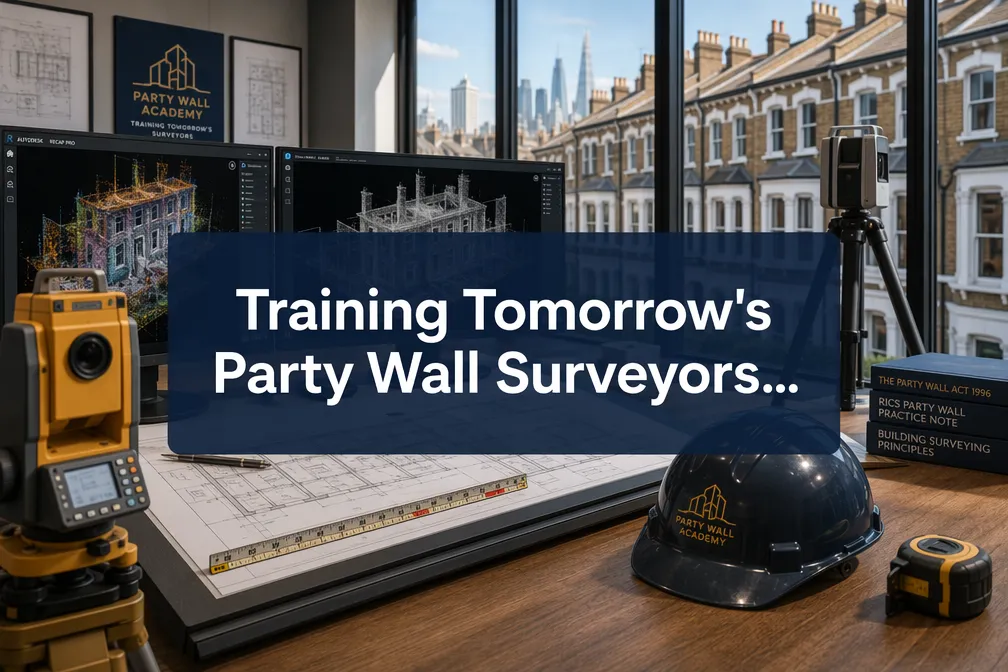
Key Takeaways
- The statutory and ethical duties of party wall surveyors remain unchanged; technology training must reinforce, not replace, legal and procedural knowledge.
- AI tools now automate notice generation and document drafting, creating an urgent need for surveyors trained in quality control and prompt design.
- Reality capture technologies, including SLAM LiDAR and 3D laser scanning, are entering mainstream party wall practice, requiring new spatial literacy skills.
- RICS CPD frameworks and specialist short courses provide structured pathways for upskilling in 2026.
- Firms that invest in blended training programmes, combining legal procedure, AI workflow design, and reality capture literacy, will hold a measurable competitive advantage.
The Skill Gap Facing Party Wall Surveyors in 2026
The gap between what party wall surveyors currently know and what 2026 workflows demand is widening at pace. Two forces are driving this divergence: the rapid deployment of AI-assisted documentation platforms, and the mainstreaming of reality capture hardware in residential and commercial surveying.
What the Traditional Training Model Covered
Historically, party wall surveyor training focused on three pillars:
- Statutory procedure under the Party Wall etc. Act 1996, including the correct service of party wall notices and the preparation of party wall awards
- Legal impartiality, with surveyors trained to act independently of the appointing owner and resolve disputes without bias [8]
- Condition recording, including schedules of condition prepared before notifiable works begin
These remain foundational. RICS guidance is explicit that a surveyor appointed under section 10 of the Act must be a disinterested person whose primary obligation is to the award, not the appointing party [8][12]. No amount of technological change modifies that statutory position.
Where the New Gaps Sit
The gaps emerging in 2026 are not replacements for traditional knowledge, they are additions to it. Surveyors now encounter:
- AI platforms that auto-generate party wall proposals, notices, and award templates based on user inputs and regulatory databases [1]
- 3D laser scanners and SLAM LiDAR devices capable of producing millimetre-accurate point clouds of party wall structures [4][5]
- Cloud-based project management systems that centralise documentation, client communications, and condition records
- Drone-mounted LiDAR tools that capture full-site spatial data in a single pass [7]
Without training in these systems, surveyors risk either avoiding them, losing efficiency, or using them uncritically, which creates compliance and liability exposure.
Understanding the Technology: AI and Reality Capture in Party Wall Practice
Before surveyors can be trained effectively, the technologies themselves need to be understood in the context of party wall work specifically.
AI-Assisted Documentation: Opportunity and Risk
AI-driven services now offer automated generation of party wall proposals based on user input, referencing regulatory databases to produce tailored documentation for construction projects, including notices and agreement proposals [1]. A dedicated pipeline of user input, AI processing, and customised document output is already in commercial use, reflecting a shift toward semi-automated front-end advice and document drafting [1].
Pull quote: “AI can draft a party wall notice in seconds. A trained surveyor still needs to verify every line against the Act.”
This creates a specific training need: surveyors must learn to act as quality controllers of AI output rather than passive recipients of it. That means understanding:
- Prompt design, how to instruct AI tools to produce outputs aligned with RICS guidance and the Act
- Template governance, maintaining firm-level templates that constrain AI-generated content within legally compliant parameters
- Verification procedures, systematic checks that AI-generated notices, awards, and schedules meet statutory requirements before service or publication
One independent analysis found that while AI tools can recite party wall legislation accurately, they struggle with nuanced, site-specific judgements, particularly around disputed boundaries and structural risk assessments [3]. This reinforces that AI is a productivity tool, not a decision-maker.
For surveyors working across London, whether as a building owner’s surveyor or an adjoining owner’s surveyor, the ability to supervise AI-generated documentation while maintaining independent professional judgement is a critical 2026 competency.
Reality Capture: LiDAR, SLAM, and Point Clouds
Reality capture refers to technologies that create precise digital representations of physical environments. In party wall practice, the most relevant tools are:
| Technology | Application in Party Wall Work | Key Benefit |
|---|---|---|
| SLAM LiDAR | Scanning party walls, basements, and loft spaces | Fast, accurate capture without fixed targets |
| Terrestrial 3D laser scanning | Detailed structural condition records | Millimetre accuracy for pre- and post-works comparison |
| Drone LiDAR | Full-site capture for large or complex projects | Covers inaccessible areas efficiently |
| 360-degree imagery | Photographic condition records integrated with spatial data | Visual evidence for schedules of condition |
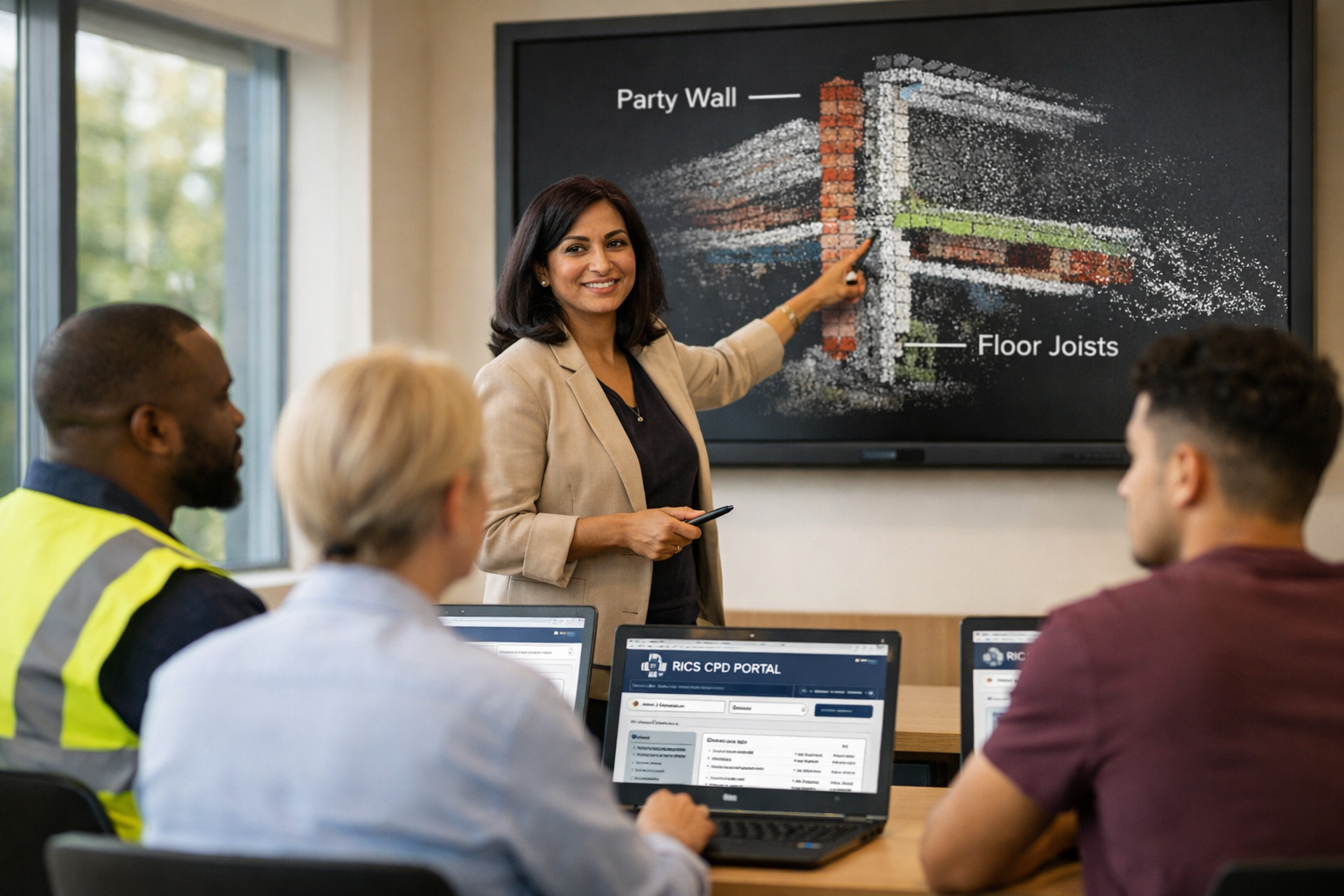
The 2026 landscape for 3D laser scanning has shifted significantly, with cloud-based processing, AI-assisted point cloud interpretation, and real-time data sharing becoming standard features of leading platforms [5]. Emesent’s all-in-one SLAM LiDAR, RTK, and 360-degree imagery scanner is a recent example of hardware convergence that packages multiple capture modalities into a single device [4].
For party wall surveyors, the practical application is the schedule of condition, the pre-works record that protects both building owners and adjoining owners from disputed damage claims. A LiDAR-generated point cloud, combined with 360-degree imagery, produces a defensible, objective condition record that is far more robust than photographs alone.
Certification Paths and Training Frameworks for Upskilling in 2026
Training Tomorrow’s Party Wall Surveyors: Upskilling for AI and Reality Capture in 2026 Workflows requires a structured approach to professional development. The good news is that multiple pathways exist, from RICS-endorsed CPD to specialist technology training.
RICS CPD Requirements and Resources
RICS members are required to complete a minimum of 20 hours of CPD per year, with at least 10 hours in formal learning. In 2026, RICS has expanded its guidance on technology integration in surveying practice, and the 7th edition of Party Wall Legislation and Procedure remains the authoritative reference for statutory procedure training [8].
Key RICS-aligned CPD topics relevant to party wall surveyors in 2026 include:
- Party wall law and procedure, covering the Act, dispute resolution, and the surveyor’s statutory duties [8]
- Digital surveying tools, including reality capture, BIM integration, and data management
- Professional ethics and AI, addressing the use of AI tools within RICS Rules of Conduct
- Risk management, particularly around AI-generated documentation and data security
RICS also provides consumer-facing guidance that surveyors should be familiar with, as it shapes client expectations around how and when works are carried out and the surveyor’s role in determining those conditions [10].
Specialist Short Courses and Micro-Credentials
Beyond RICS CPD, a growing ecosystem of specialist training providers offers focused upskilling in the specific tools entering party wall practice:
AI and documentation tools:
- Workflow automation courses covering AI prompt engineering for legal documents
- Quality assurance training for AI-generated party wall notices and awards
- Data governance and GDPR compliance for cloud-based surveying platforms
Reality capture and spatial data:
- LiDAR operation and data processing courses (often offered by hardware manufacturers and specialist training firms)
- Point cloud interpretation and BIM integration training
- Drone operations certification (CAA-regulated in the UK for commercial use)
Blended party wall practice:
- Specialist party wall surveying courses that integrate technology modules alongside statutory procedure
- Mentored practice programmes pairing junior surveyors with experienced practitioners on live projects [9]
Building a Firm-Level Training Programme
Individual upskilling matters, but the most effective training for AI and reality capture in 2026 workflows happens at the firm level. A structured internal programme might include:
- Skills audit, assessing current competency levels across statutory procedure, AI tool use, and reality capture
- Prioritised learning pathways, directing surveyors toward the CPD most relevant to their current skill gaps
- Tool governance protocols, establishing firm-wide standards for AI output verification and data management
- Supervised practice, requiring junior surveyors to have AI-generated documents reviewed by a senior before service
- Regular review cycles, updating training content as tools and RICS guidance evolve
Firms operating across different parts of London, from South London to North London and Central London, face varied project types and client expectations. A firm-level training programme can be tailored to reflect the specific structural and legal challenges common in each area, from Victorian terrace party walls in inner London to newer-build developments on the urban fringe.
Keeping Statutory Duties at the Centre of Technology Training
The most important principle in Training Tomorrow’s Party Wall Surveyors: Upskilling for AI and Reality Capture in 2026 Workflows is that technology training must never displace statutory and ethical training. It must sit alongside it.
The Statutory Foundation Cannot Be Automated
The party wall surveyor is a statutory appointment. Under section 10 of the Party Wall etc. Act 1996, the surveyor must act as an independent, disinterested decision-maker [8]. No AI platform can hold that appointment. No point cloud can exercise professional judgement on a disputed boundary. The legal and procedural knowledge that underpins party wall awards, the correct service of party wall notices, and the impartial resolution of disputes remains entirely human territory.
This means training programmes must maintain a strong core of:
- Statutory procedure, the Act’s requirements for notice, consent, and dispute resolution
- Award drafting, understanding what makes a legally sound and enforceable party wall award
- Professional ethics, RICS Rules of Conduct, independence, and conflict of interest management
- Client communication, explaining complex statutory processes clearly to building owners and adjoining owners
Understanding the costs of the party wall process and how to advise clients on proportionate expenditure also remains a core professional skill, one that AI tools can inform but not replace.
Technology as an Amplifier, Not a Substitute
The correct framing for 2026 upskilling is that AI and reality capture tools amplify the surveyor’s capabilities. A surveyor who understands the Act and can also operate a SLAM LiDAR scanner produces better, faster, more defensible work than one who can do only one of those things.
Firms that have integrated drone and LiDAR technology into their surveying workflows report significant improvements in site data quality, reduced revisit rates, and stronger condition records that hold up under scrutiny [7]. Digital surveying investment is accelerating across the profession, with firms doubling down on technology adoption to meet client expectations and competitive pressures [2].
The surveyors best positioned for 2026 and beyond are those who treat technology literacy as a professional obligation, not an optional extra, while keeping their statutory duties firmly in view.
Conclusion
The profession of party wall surveying is not being replaced by AI or reality capture technology. It is being reshaped by it. Surveyors who invest in structured upskilling, covering AI workflow design, point cloud literacy, and quality control alongside their statutory and ethical foundations, will deliver faster, more accurate, and more defensible work in 2026 and beyond.
Actionable next steps for party wall surveyors and firms:
- Conduct a skills audit across your team, mapping current competencies against the AI and reality capture tools now entering party wall practice
- Enrol in RICS-endorsed CPD covering both statutory procedure and digital surveying tools, targeting the 20-hour annual minimum as a floor, not a ceiling
- Establish AI governance protocols at firm level, including mandatory verification of AI-generated notices and awards before service
- Invest in reality capture training relevant to schedule of condition work, prioritising LiDAR and 360-degree imagery skills
- Stay current with RICS guidance, the 7th edition of Party Wall Legislation and Procedure remains the authoritative reference [8], and updates should be tracked as standard professional practice
- Pair junior surveyors with experienced practitioners on live projects to build supervised competency in both statutory procedure and new technology workflows
The surveyors who will define the profession in the years ahead are those training today, not just in the law, but in the tools that will carry that law into practice.
References
[1] Party Wall Survey Service – logicballs.com
[2] Doubling Down On Digital – amerisurv.com
[3] Does Chatgpt Know More Than Your Party Wall Surveyor – peterbarry.co.uk
[4] Emesent Launches An All In One Slam Lidar Rtk And 360 Imagery Scanner – geoweeknews.com
[5] 3d Laser Scanning In 2026 Major Technology And Workflow Shifts – enginyring.com
[7] Seeing The Whole Site How Thomas Hutton Uses Drone And Lidar Technology To Elevate Surveying – thomasandhutton.com
[8] Jan 22 Party Wall Legislation And Procedure 7th Edition – rics.org
[9] Party Wall Surveying – coaleypeak.co.uk
[10] Rics Consumer Guide Party Walls – houricanassociates.com
Speak to a RICS chartered party wall surveyor
Free initial consultation. Notices, awards and schedules of condition across London and nationwide.