


Council Property Surveyor: Your Complete Guide to Public Sector Property Professionals
When a council-owned property shows signs of structural damage, who ensures the building remains safe for tenants? The answer lies with a specialized professional who bridges the gap between public housing needs and technical building expertise. A council property surveyor serves as the guardian of public housing stock, conducting critical assessments that protect both local authorities and residents from structural failures, safety hazards, and costly repairs.
Key Takeaways
- Council property surveyors are specialized professionals who assess, maintain, and manage local authority-owned buildings and housing stock
- These surveyors require specific qualifications including RICS accreditation and extensive knowledge of public sector regulations and building standards
- Their responsibilities extend beyond simple inspections to include budget management, compliance monitoring, and strategic property planning
- Career opportunities in council property surveying offer job security, competitive salaries, and the satisfaction of serving the public interest
- Understanding the role of a council property surveyor is essential for anyone involved in public housing, property disputes, or local authority construction projects
What Is a Council Property Surveyor?
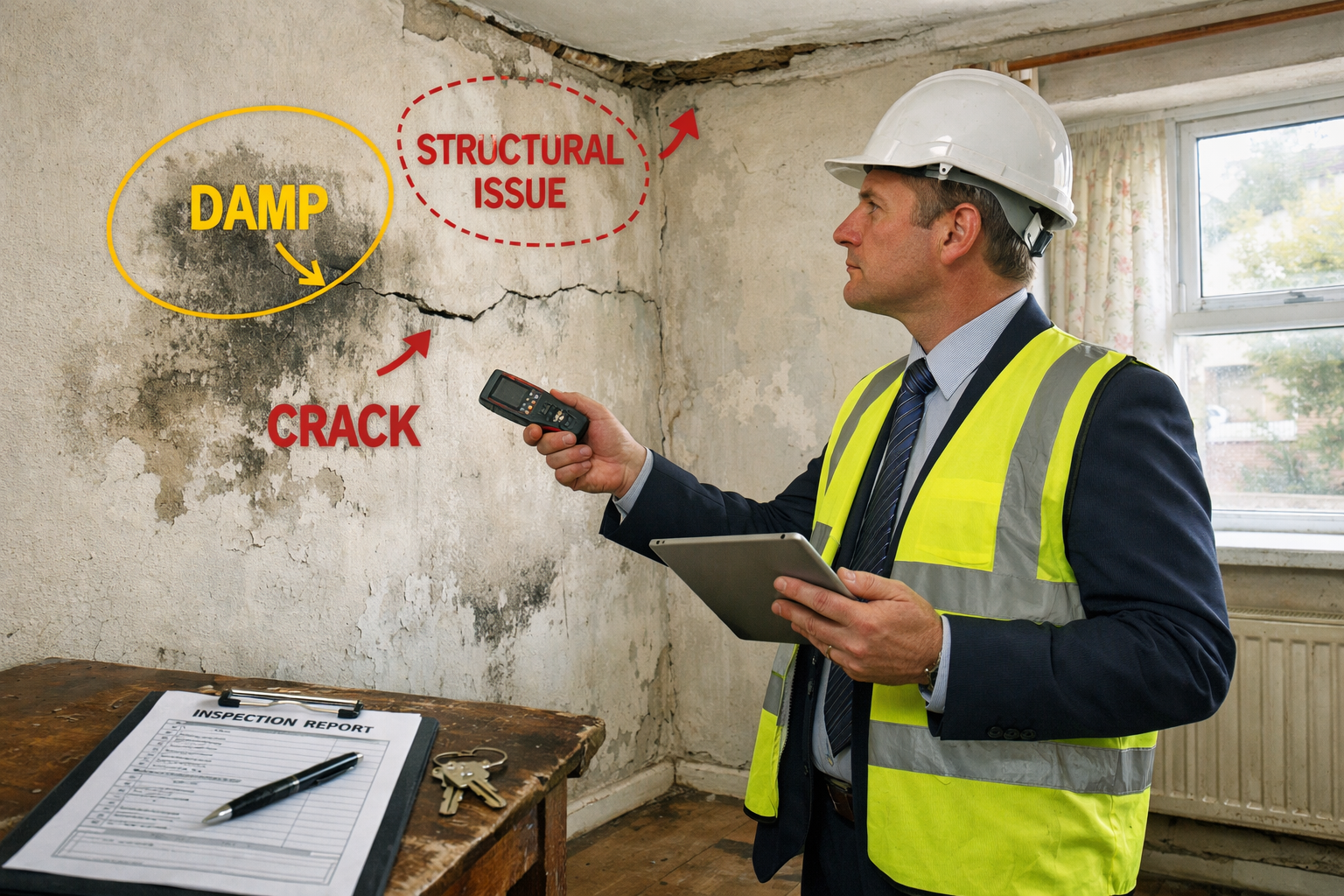
A council property surveyor is a qualified building professional employed by local government authorities to manage, inspect, and maintain publicly-owned property portfolios. Unlike private sector surveyors who work primarily for commercial clients or individual homeowners, council surveyors focus exclusively on properties owned or managed by local authorities, including social housing, community centers, administrative buildings, and public facilities.
These professionals serve a dual purpose: protecting public investment in property assets while ensuring safe, habitable conditions for residents who depend on council housing. Their work directly impacts thousands of families who live in social housing across the United Kingdom.
Core Responsibilities
Council property surveyors handle a diverse range of duties that require both technical expertise and administrative capabilities:
Property Inspections & Assessments 🏘️
- Conducting structural surveys of council-owned buildings
- Identifying defects, dampness, subsidence, and safety hazards
- Preparing detailed condition reports with photographic evidence
- Recommending repair priorities based on urgency and risk
Maintenance Planning & Budget Management 💰
- Developing long-term maintenance schedules for property portfolios
- Estimating repair costs and preparing budget proposals
- Securing quotes from contractors and managing tender processes
- Monitoring expenditure against allocated budgets
Compliance & Regulatory Oversight ⚖️
- Ensuring properties meet current building regulations
- Verifying compliance with health and safety legislation
- Managing asbestos surveys and fire safety assessments
- Coordinating gas safety certificates and electrical inspections
Tenant Relations & Dispute Resolution 🤝
- Responding to tenant repair requests and complaints
- Investigating property-related disputes between neighbors
- Providing expert advice on boundary wall rules and property disputes
- Liaising with adjoining owners regarding shared structures
The Difference Between Council Property Surveyors and Private Surveyors
Understanding the distinction between council and private sector surveyors helps clarify the unique role these public servants play in property management.
| Aspect | Council Property Surveyor | Private Property Surveyor |
|---|---|---|
| Employer | Local authority/council | Private firm or self-employed |
| Client Base | Public sector only | Private individuals and businesses |
| Property Types | Social housing, public buildings | Residential and commercial properties |
| Funding | Public taxation | Client fees |
| Priorities | Public safety, value for money | Client satisfaction, profit |
| Accountability | Public scrutiny, council oversight | Professional standards, client contracts |
| Workload | Large portfolios, systematic approach | Individual projects, varied clients |
While both types of surveyors require similar technical qualifications, council property surveyors must navigate additional layers of bureaucracy, public accountability, and political considerations that don’t typically affect private practitioners.
Qualifications and Skills Required for Council Property Surveyors
Becoming a council property surveyor requires a combination of formal education, professional accreditation, and practical experience. The pathway is rigorous but leads to a rewarding career in public service.
Educational Requirements
Academic Qualifications 📚
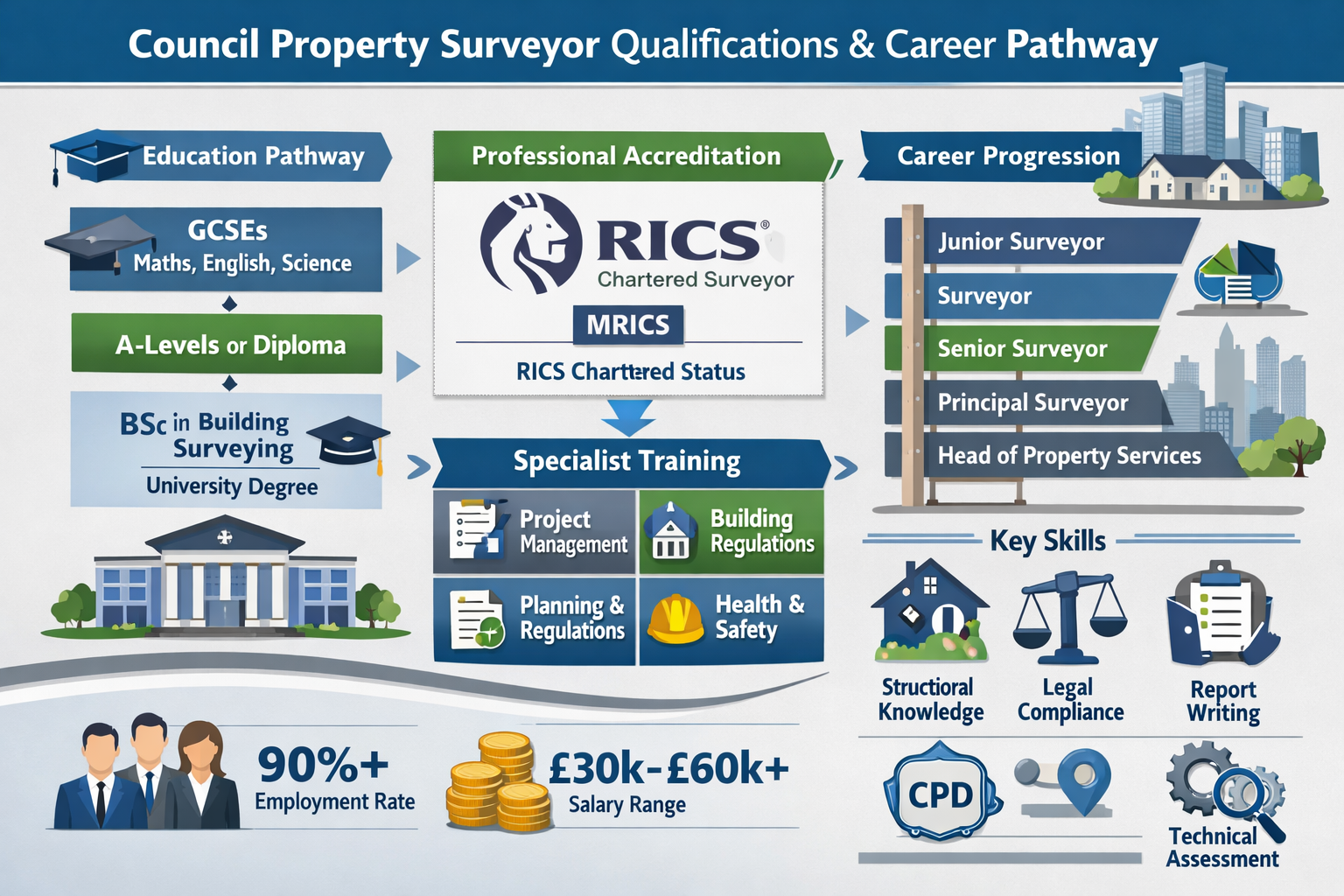
- GCSE Level: Minimum five GCSEs (grades A-C/9-4) including Mathematics and English
- A-Level or Equivalent: Three A-levels or BTEC National Diploma, preferably in relevant subjects
- Degree: BSc or BEng in Building Surveying, Construction Management, or related discipline (accredited by RICS)
- Postgraduate: Optional MSc for career advancement and specialization
Professional Accreditation
The Royal Institution of Chartered Surveyors (RICS) sets the professional standard for surveyors in the UK. Achieving chartered status demonstrates competence and commitment to ethical practice.
RICS Chartership Pathway:
- Complete an accredited degree program
- Gain minimum two years of structured professional experience
- Maintain a detailed training record (Assessment of Professional Competence)
- Pass the RICS Assessment of Professional Competence (APC) final assessment
- Commit to ongoing Continuing Professional Development (CPD)
Essential Skills and Competencies
Beyond formal qualifications, successful council property surveyors develop a broad skill set:
Technical Abilities 🔧
- Structural analysis and building pathology
- Understanding of construction methods and materials
- Knowledge of building regulations and planning law
- Proficiency with surveying equipment and software
- Ability to read and interpret architectural drawings
Professional Skills 💼
- Report writing and documentation
- Budget management and cost estimation
- Project management and coordination
- Contract administration and procurement
- Risk assessment and mitigation
Interpersonal Qualities 👥
- Clear communication with non-technical audiences
- Diplomacy when handling tenant complaints
- Negotiation skills for contractor management
- Teamwork within multidisciplinary departments
- Empathy for vulnerable residents in social housing
How Council Property Surveyors Support Public Housing
The work of a council property surveyor extends far beyond simple building inspections. These professionals play a vital role in maintaining the quality and safety of social housing that serves as home to millions of UK residents.
Preventative Maintenance Programs
Rather than waiting for problems to emerge, effective council surveyors implement proactive maintenance strategies that extend building lifespans and reduce long-term costs.
Cyclical Inspection Schedules 🔄
Council surveyors typically establish systematic inspection programs:
- Annual inspections: High-risk properties and vulnerable tenant accommodations
- Biennial surveys: Standard housing stock condition assessments
- Five-year reviews: Comprehensive structural surveys of all properties
- Responsive inspections: Emergency callouts for urgent issues
These scheduled assessments allow councils to identify deterioration early, preventing minor issues from escalating into expensive emergencies.
Managing Major Works Projects
When significant repairs or improvements are needed, council property surveyors coordinate complex projects that may affect dozens or hundreds of properties simultaneously.
Typical Major Works Projects:
- External wall insulation and cladding replacement
- Roof renewals across entire estates
- Window and door replacement programs
- Heating system upgrades and boiler installations
- Bathroom and kitchen modernization schemes
During such projects, surveyors must balance competing priorities: minimizing disruption to residents, maintaining quality standards, controlling costs, and meeting regulatory deadlines. This requires exceptional project management skills and the ability to coordinate multiple contractors simultaneously.
Handling Party Wall Matters
Council property surveyors frequently encounter situations involving party wall matters when council properties share structural elements with neighboring buildings. Understanding the Party Wall etc. Act 1996 is essential for these professionals.
Common Party Wall Scenarios:
- Terraced council houses sharing walls with private properties
- Boundary disputes between council tenants and private homeowners
- Structural alterations affecting adjoining properties
- Excavation work near neighboring foundations
When disputes arise, council surveyors may serve as building owners’ surveyors representing the local authority’s interests, or they may recommend appointing independent professionals to ensure fair resolution. Familiarity with party wall notices and procedures helps prevent costly legal disputes.
The Council Property Surveyor’s Role in Compliance and Safety
Public accountability demands that council property surveyors maintain the highest standards of building safety and regulatory compliance. Recent tragic events, including the Grenfell Tower fire, have intensified scrutiny on social housing safety standards.
Fire Safety Assessments
Following the Regulatory Reform (Fire Safety) Order 2005 and subsequent amendments, council surveyors must ensure all multi-occupancy buildings have:
✅ Current fire risk assessments
✅ Adequate fire detection and alarm systems
✅ Clear escape routes and emergency lighting
✅ Appropriate fire doors and compartmentation
✅ Regular testing and maintenance records
Council property surveyors coordinate with fire safety specialists to implement recommendations and demonstrate due diligence in protecting residents.
Building Safety Act 2022 Compliance
The Building Safety Act 2022 introduced significant new responsibilities for those managing higher-risk residential buildings. Council surveyors working with buildings over 18 meters or seven stories must:
- Register buildings with the Building Safety Regulator
- Appoint an Accountable Person with clear safety responsibilities
- Conduct regular safety assessments and maintain safety case reports
- Establish resident engagement strategies
- Implement mandatory occurrence reporting systems
These requirements demand that council property surveyors stay current with evolving legislation and best practices.
Asbestos Management
Many older council properties contain asbestos materials that pose health risks if disturbed. Council surveyors must:
- Maintain comprehensive asbestos registers for all properties
- Commission Type 2 (standard) or Type 3 (full access) asbestos surveys
- Develop management plans for asbestos-containing materials
- Ensure contractors receive asbestos information before starting work
- Monitor asbestos condition through regular inspections
This responsibility requires detailed record-keeping and coordination with specialist asbestos surveyors.
Career Progression and Opportunities for Council Property Surveyors
A career as a council property surveyor offers stability, professional development, and the satisfaction of public service. Understanding the typical career trajectory helps aspiring surveyors plan their professional journey.
Entry-Level Positions
Graduate Surveyor / Assistant Surveyor (£25,000-£32,000)
Recent graduates typically begin in junior roles, working under supervision while completing their RICS APC. Responsibilities include:
- Assisting with property inspections
- Preparing basic condition reports
- Learning council procedures and systems
- Supporting senior surveyors on projects
Mid-Career Roles
Surveyor / Senior Surveyor (£35,000-£48,000)
After achieving chartership, surveyors take on greater autonomy:
- Managing property portfolios independently
- Leading specific projects or programs
- Supervising junior staff and graduates
- Representing the council in meetings and disputes
Principal Surveyor / Team Leader (£45,000-£58,000)
Experienced professionals move into leadership positions:
- Overseeing teams of surveyors
- Setting departmental priorities and strategies
- Managing larger budgets and complex projects
- Liaising with senior council management
Senior Management
Head of Property Services / Asset Manager (£55,000-£75,000+)
Senior positions involve strategic oversight:
- Directing entire property services departments
- Developing long-term asset management strategies
- Presenting to council committees and elected members
- Representing the authority in external partnerships
Alternative Career Paths
Council property surveyors can leverage their experience to move into:
- Private sector surveying: Higher salaries but less job security
- Consultancy: Advising multiple councils on specialized issues
- Housing associations: Similar public service ethos with different structures
- Central government: Policy development and regulatory roles
- Education: Teaching future surveyors in universities and colleges
For those interested in understanding more about different surveyor roles, exploring resources about adjoining owners’ surveyors can provide valuable insights into specialized surveying positions.
Challenges Facing Council Property Surveyors in 2026
The role of a council property surveyor continues to evolve in response to changing social, economic, and regulatory pressures. Understanding current challenges helps both practitioners and stakeholders navigate this complex environment.
Budget Constraints and Austerity
Local authorities across the UK face significant financial pressures that directly impact property services:
Resource Limitations 📉
- Reduced maintenance budgets forcing difficult prioritization decisions
- Staff shortages due to recruitment freezes and competitive private sector salaries
- Aging housing stock requiring increasingly expensive interventions
- Pressure to do “more with less” while maintaining safety standards
Council surveyors must develop creative solutions, such as:
- Implementing predictive maintenance technologies
- Negotiating framework agreements for better contractor rates
- Prioritizing interventions based on risk assessment matrices
- Seeking external funding through grants and partnerships
Increasing Regulatory Burden
The regulatory landscape has become significantly more complex following high-profile building failures:
Compliance Challenges ⚠️
- Keeping pace with frequently updated building regulations
- Managing new Building Safety Act requirements
- Responding to emerging issues (e.g., RAAC concrete, cladding concerns)
- Demonstrating compliance through extensive documentation
Successful council property surveyors invest in continuous professional development and establish robust systems for tracking regulatory changes.
Climate Change and Sustainability
Environmental concerns are reshaping property management priorities:
Green Agenda Pressures 🌱
- Meeting government targets for carbon-neutral social housing by 2050
- Retrofitting older properties with energy-efficient measures
- Balancing sustainability goals with heritage conservation
- Managing increased weather-related damage (flooding, extreme heat)
Council surveyors increasingly need expertise in sustainable construction methods, renewable energy systems, and climate adaptation strategies.
Tenant Expectations and Social Media
Modern tenants have higher expectations and more powerful voices:
Accountability Pressures 📱
- Social media amplifying complaints and creating reputational risks
- Increased scrutiny following high-profile housing scandals
- Rising tenant activism and organized campaigns
- Greater emphasis on customer service alongside technical competence
Council property surveyors must develop strong communication skills and empathy to navigate these interpersonal challenges effectively.
Working With Council Property Surveyors: A Guide for Residents and Contractors
Understanding how to effectively engage with a council property surveyor can make the difference between smooth resolution and prolonged frustration.
For Council Tenants
Reporting Property Issues 🏠
When problems arise in council housing, follow these steps:
- Document the issue: Take photographs and note dates when problems began
- Report through official channels: Use the council’s designated reporting system (online portal, phone line, or housing office)
- Provide clear descriptions: Explain the problem in simple terms with specific locations
- Request inspection: Ask for a surveyor visit if the issue is structural or complex
- Follow up: Keep records of reference numbers and correspondence
Understanding Survey Reports
If a surveyor inspects your property, their report may include:
- Category 1 hazards: Serious risks requiring immediate action
- Category 2 hazards: Less urgent issues that still need attention
- Repair timescales: Emergency (24 hours), urgent (7 days), routine (28 days)
- Cost estimates: Budget implications that may affect prioritization
Don’t hesitate to ask the surveyor to explain findings in plain language. Their role includes helping residents understand technical assessments.
For Contractors and Developers
Working With Council Surveyors 🔨
Private contractors engaged by councils should:
Before Starting Work:
- Attend pre-start meetings with the appointed surveyor
- Review specifications and drawings thoroughly
- Clarify any ambiguities before mobilizing
- Understand inspection and sign-off procedures
During Projects:
- Maintain open communication with the supervising surveyor
- Report variations or unexpected conditions promptly
- Accommodate inspection visits and provide requested information
- Keep accurate records of work completed
Quality Standards:
Council surveyors typically enforce stricter quality requirements than private clients because of public accountability. Expect:
- Regular inspections at key stages
- Detailed snagging lists before final acceptance
- Requirement for guarantees and warranties
- Retention of payment pending defects resolution
For guidance on managing costs effectively when working with surveyors, review strategies for keeping party wall costs down, as many principles apply to council projects.
For Neighboring Property Owners
Boundary and Party Wall Issues 🏡
If you own property adjacent to council housing, you may need to interact with a council property surveyor regarding:
- Boundary disputes and fence heights
- Party wall notices for council building work
- Shared maintenance responsibilities
- Tree root damage or encroachment issues
When your neighbor is carrying out works on council property that may affect your building, you have rights under the Party Wall etc. Act 1996. The council’s surveyor should serve proper notices and may need to coordinate with your appointed surveyor to produce a party wall award.
Technology and Innovation in Council Property Surveying
Modern council property surveyors increasingly leverage technology to improve efficiency, accuracy, and service delivery.
Digital Survey Tools
Mobile Technology 📱
- Tablet-based inspection apps replacing paper forms
- Real-time data upload to central management systems
- Photographic evidence with GPS tagging and timestamps
- Digital signatures for immediate report approval
Measurement Technology 📏
- Laser distance measurers for accurate dimensions
- Thermal imaging cameras for detecting heat loss and dampness
- Drones for roof and high-level inspections
- 3D scanning for complex structural assessments
Asset Management Software
Sophisticated property management systems allow council surveyors to:
Data-Driven Decision Making 💻
- Track entire property portfolios with detailed asset registers
- Analyze maintenance patterns and predict future failures
- Generate automated inspection schedules based on risk profiles
- Produce performance reports for management and elected members
- Model budget scenarios and investment options
Integration Benefits:
Modern systems integrate with:
- Geographic Information Systems (GIS) for spatial analysis
- Financial systems for seamless budget management
- Contractor portals for work order management
- Tenant self-service platforms for repair requests
Building Information Modeling (BIM)
Progressive councils are adopting BIM for major projects:
BIM Advantages 🏗️
- Digital representations of buildings with complete asset information
- Collaborative design processes reducing errors and rework
- Lifecycle cost analysis for better investment decisions
- Simplified maintenance through accessible building data
As BIM becomes standard in construction, council property surveyors need to develop competencies in digital modeling and data management.
The Future of Council Property Surveying
The profession continues to evolve in response to technological, social, and environmental changes. Understanding emerging trends helps current and aspiring council property surveyors prepare for future demands.
Predictive Maintenance and AI
Artificial intelligence and machine learning are beginning to transform property management:
Emerging Applications 🤖
- Algorithms predicting component failures before they occur
- Automated analysis of inspection photographs identifying defects
- Optimization of maintenance schedules based on weather patterns
- Chatbots handling routine tenant inquiries
While technology will enhance capabilities, human judgment and empathy will remain essential, particularly when dealing with vulnerable residents.
Modular and Modern Methods of Construction
As councils seek faster, more cost-effective housing delivery:
New Construction Approaches 🏭
- Off-site manufactured housing components
- Rapid assembly reducing construction times
- Improved quality control in factory conditions
- Sustainability benefits from reduced waste
Council property surveyors will need to understand these new construction methods and adapt inspection and maintenance approaches accordingly.
Integrated Health and Housing
Growing recognition of links between housing quality and health outcomes is driving:
Holistic Approaches 🏥
- Collaboration between housing and health departments
- Targeting interventions at properties housing vulnerable residents
- Measuring health outcomes alongside traditional property metrics
- Preventative investments reducing long-term healthcare costs
Council surveyors increasingly work within multidisciplinary teams addressing social determinants of health.
Climate Adaptation
Beyond reducing carbon emissions, councils must prepare for climate change impacts:
Resilience Planning 🌍
- Flood risk assessments and mitigation measures
- Overheating prevention in increasingly hot summers
- Storm-resistant building improvements
- Water conservation and drought resilience
Council property surveyors will play crucial roles in implementing adaptation strategies that protect residents and property assets.
Conclusion: The Essential Role of Council Property Surveyors
The council property surveyor occupies a unique and vital position at the intersection of technical expertise, public service, and social responsibility. These professionals safeguard the homes of millions while managing substantial public investments in property infrastructure. Their work directly impacts the safety, comfort, and wellbeing of some of society’s most vulnerable members.
As housing challenges intensify—from aging stock and budget pressures to climate change and evolving regulations—the importance of skilled, dedicated council property surveyors will only grow. The profession offers rewarding careers for those who combine technical aptitude with a commitment to public service.
Next Steps
For Aspiring Council Property Surveyors 🎓
- Research accredited surveying degree programs
- Seek work experience with local authorities or housing associations
- Join professional organizations like RICS as a student member
- Network with practicing surveyors to understand the reality of the role
For Council Tenants 🏠
- Familiarize yourself with your council’s property services department
- Understand how to report issues and request surveys
- Learn about your rights regarding property standards
- Engage constructively with surveyors when they visit
For Local Authorities 🏛️
- Invest in recruitment and retention of qualified surveyors
- Provide ongoing training and professional development opportunities
- Implement modern technology and data systems
- Foster collaboration between housing, planning, and building control teams
For Property Professionals 💼
- Consider the public sector as a career option offering stability and purpose
- Develop expertise in social housing and public sector regulations
- Build relationships with local authority property teams
- Stay informed about evolving compliance requirements
The council property surveyor remains an indispensable guardian of public housing standards. Whether you’re considering this career path, working with these professionals, or simply seeking to understand their role, recognizing their contribution to safe, decent housing for all is essential.
For more information about property surveying, boundary issues, and related topics, explore our comprehensive resources and guides or contact our team for professional advice.